Question 13 Marks
State Raoult’s law for a solution containing a nonvolatile solute.
AnswerStatement of Raoult’s law : The law states that the vapour pressure of a solvent over the solution of a nonvolatile solute is equal to the vapour pressure of the pure solvent multiplied by mole fraction of the solvent at constant temperature.
View full question & answer→Question 23 Marks
What is the effect on the boiling point of water if 1 mole of methyl alcohol is added to $1 dm ^3$ of water? Why?
Answer
- The boiling point of water (or any liquid) depends on its vapour pressure.
- Higher the vapour pressure, lower is the boiling point.
- When 1 mole of volatile methyl alcohol is added to $1 dm ^3$ of water, its vapour pressure is increased decreasing the boiling point of water.
View full question & answer→Question 33 Marks
Anhydrous sodium sulphate dissolves in water with the evolution of heat. What is the effect of temperature on its solubility ?
AnswerSince the dissolution of anhydrous sodium sulphate in water is an exothermic process due to evolution of heat, according to Le Chatelier’s principle its solubility decreases with the increase in temperature.
View full question & answer→Question 43 Marks
Why naphthalene dissolves in benzene but not in water ?
AnswerSince naphthalene is a covalent nonpolar substance, it is soluble in a nonpolar solvent like benzene but insoluble in polar solvent like water.
View full question & answer→Question 53 Marks
While considering boiling point elevation and freezing point depression a solution concentration is expressed in molality and not in molarity. Why?
Answer
- Boiling point elevation and freezing point depression involve temperature changes, ( $\Delta T _{ b }$ and $\Delta T _{ f }$ ).
- Since molarity depends on temperature but molality is independent of temperature we use molality and not molarity in considering boiling point elevation and freezing point depression.
View full question & answer→Question 63 Marks
A solution of cane sugar containing $18 g L ^{-1}$ has an osmotic pressure $1.25 atm$. Calculate the temperature of the solution. (Molar mass of cane sugar $=342, R=0.082 lit ltm mol ^{-1} K ^{-1}$ )
AnswerGiven : Amount of cane sugar $= W =18 g L ^{-1}$
Osmotic pressure $=\pi=1.25 atm$
Molar mass of cane sugar $= M =342 g mol ^{-1}$
Temperature $=T=?$
Number of moles of cane sugar
$\begin{aligned}
& =\frac{W}{M} \\
& =\frac{18}{342} \\
& =0.05263 \text { mol } \\
& \therefore \text { Concentration of solution }=C \\
& =\frac{n}{V} \\
& =\frac{0.05263}{1} \\
& =0.05263 mol lit ^{-1} \\
& \pi=C R T \\
& \therefore T=\frac{\pi}{C R} \\
& =\frac{1.25}{0.05263 \times 0.08206} \\
& =289.4 K
\end{aligned}$
Temperature of solution $=289.4 K$
View full question & answer→Question 73 Marks
Obtain a relation between degree of dissociation and molar mass for an electrolyte.
Question 83 Marks
Write modification of expressions of colligative properties with the help of van’t Hoff factor.
AnswerThe modified expressions of colligative properties with the help of van't Hoff factor i are as follows
(1) By Raoult's law :
$\frac{P_0-P}{P_0}=i x_2 \quad \text { OR } \quad \frac{P_0-P}{P_0}=i \times \frac{W_2 \times M_1}{W_1 \times M_2}$
(2) For elevation in boiling point :
$\begin{aligned}
& \Delta T_{ b }=i \times K_{ b } \times m \\
& \Delta T_{ b }=i \times K_{ b } \times \frac{W_2 \times 1000}{W_1 \times M_2} \\
& \Delta T_{ b }=i \times K_{ b } \times \frac{W_2}{W_1 \times M_2} \text { }
\end{aligned}$
(3) For depression in freezing point :
$\begin{aligned}
& \Delta T_{ f }=i \times K_{ f } \times m \\
& \Delta T_{ f }=i \times K_{ f } \times \frac{W_2 \times 1000}{W_1 \times M_2} \\
& \Delta T_{ f }=i \times K_{ f } \times \frac{W_2}{W_1 \times M_2}
\end{aligned}$
(4) Osmotic pressure :
$\begin{aligned}
& \pi=i C R T \\
& \pi=i \times \frac{n R T}{V} \\
& \pi=i \times \frac{W R T}{M \times V} \quad \text { }
\end{aligned}$
View full question & answer→Question 93 Marks
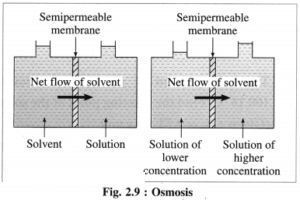
Define and explain osmosis.
Question 103 Marks
The boiling point of an aqueous solution is $100.18^{\circ} C$. Find the freezing point of the solution.
(Given : $K _{ b }=0.52 K kg mol ^{-1}, K _{ f }=1.86 K kg mol ^{-1}$ )
AnswerGiven : $T_b=100.18{ }^{\circ} C +273=373.18 K$
$K _{ b }=0.52 K kg mol ^{-1} ; K _{ f }=1.86 K kg mol ^{-1}$
Boiling point of water $=T_0=373 K$
$T _{ f }=?$
$\Delta T_b=T_b-T_0=373.18-373=0.18 K$
If $m$ is the molality of the solution, then
$\begin{aligned}
& \Delta T_b=K_b \times m \text { and } \Delta T_f=K_f \times m \\
& \therefore \frac{\Delta T_{ f }}{\Delta T_{ b }}=\frac{K_{ f } \times m}{K_{ b } \times m}=\frac{K_{ f }}{K_{ b }} \\
& \therefore \Delta T_{ f }=\Delta T_{ b } \times \frac{K_{ f }}{K_{ b }} \\
& =0.18 \times \frac{1.86}{0.52} \\
& =0.6438 K \\&\end{aligned}$
Freezing point of water $=T_0=273 K$
$\Delta T_f=T_0-T_f$
Hence the freezing point of the solution is,
$T_f=T_0-\Delta T_f=273-0.6438=272.3562 K$
OR Freezing point of solution is $-0.6438^{\circ} C$.
Freezing point of the solution
$\begin{aligned}
& =272.3562 K \\
& =-0.6438^{\circ} C
\end{aligned}$
View full question & answer→Question 113 Marks
The freezing point of pure benzene is $278.4 K$. Calculate the freezing point of the solution when $2 g$ of a solute having molecular weight 100 is added to $100 g$ of benzene. ( $K _{ f }$ for benzene $=5.12 K$ $\left.kg mol ^{-1}\right)$
Answer$\begin{aligned}
& \text {Given : } K_f \text { for benzene }=5.12 K kg mol ^{-1} \\
& T _0=\text { Freezing point of the solvent }=278.4 K \\
& W _1=\text { Mass of the solvent }=100 g =0.1 kg \\
& W _2=\text { Mass of the solute }=2 g =2 \times 10^{-3} kg \\
& M _2=\text { Molecular mass of the solute }=100 g mol ^{-1} \\
& =100 \times 10^{-3} kg mol ^{-1} \\
& T =\text { Freezing point of the solution }=\text { ? } \\
& \Delta T_{ f }=\frac{K_{ f } W_2}{M_2 W_1} \\
& \Delta T_{ f }=\frac{5.12 \times 2 \times 10^{-3}}{100 \times 10^{-3} \times 0.1} \\
& =\frac{10.24}{10}=1.024 K \\
& \Delta T_{ f }=T_0-T \\
& \therefore T=T_0-\Delta T_{ f } \quad \\
& =278.4-1.024=277.376 K \\&\end{aligned}$
Freezing point of the solution $=277.376 K$
View full question & answer→Question 123 Marks
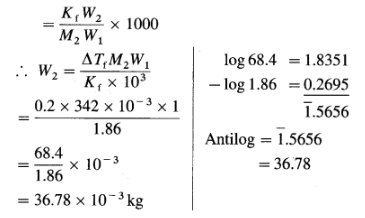
When certain amount of sucrose is dissolved in $1 kg$ of water, the freezing point of the solution is found to be $272.8 K$. If the molecular mass of sucrose is $342 g mol ^{-1}$ and $K _{ f }$ for water is $1.86 K kg$ $mol ^{-1}$, calculate the amount of sucrose present in the solution.
View full question & answer→Question 133 Marks
What is a relationship between freezing point depression and concentration of solute (or solution)?
AnswerIt is observed experimentally that as the concentration of a solution increases, the freezing point of the solution decreases and hence the depression in the freezing point $\left(\Delta T_f\right)$ increases.
The depression in the freezing point of a solution is directly proportional to the molal concentration (expressed in $mol _{ kg ^{-1}}$ ) of the solution.
Thus,
$\Delta T _f \propto m$
where $m$ is the molality of the solution.
$\therefore \Delta T _{ f }= Kfm$, where $Kf$ is a constant of proportionality. If $m =1 molal$,
$\Delta T_f=K_f$. Hence $K_f$ is called the cryoscopic constant or molal depression constant. $K _{ f }$ is characteristic of the solvent.
View full question & answer→Question 143 Marks
$35 \%$ (W/W) solution of ethylene glycol in water, an anti-freezer used in automobiles in radiators as a coolant. It lowers freezing point of water to $-17.6^{\circ} C$. Calculate the mole fraction of the components.
Answer$35 \%$ (W/W) means $100 g$ solution contains $35 g$ ethylene glycol $\left( CH _2 OH - CH _2 OH \right)$ and $65 g H _2 O$
Molar mass of water $=18 g mol ^{-1}$
Molar mass of ethylene glycol $\left( CH _2 OH - CH _2 OH \right)=62 g mol ^{-1}$
Number of moles of water $=n_1=\frac{65}{18}=3.611 mol$
Number of moles of ethylene glycol $=n_2=\frac{35}{62}$
$=0.5645 mol$
Total moles $=n=n_1+n_2=3.611+0.5645$
$=4.1755 mol$
Mole fraction of ethylene glycol $=x_2$
$=\frac{n_2}{n_1}=\frac{0.5645}{4.1755}=0.1352$
$\therefore$ Mole fraction of water $=1- x _2=1-0.1352$
$=0.8648$
Mole fraction of water $=0.8648$
Mole fraction of ethylene glycol $=0.1352$
View full question & answer→Question 153 Marks
Boiling point of water at $750 mm$ of $Hg$ is $99.63^{\circ} C$. How much sucrose must be added to 500 $g$ of water so that it boils at $100^{\circ} C ?\left( K _{ b }=0.52 K kg mol ^{-1}\right)$
Answer$\begin{aligned}
& \text {Given : Pressure }=P=750 mm Hg \\
& T_0=273+99.63=372.63 K \\
& T_b=273+100=373 K \\
& K_b=0.52 K kg mol ^{-1}
\end{aligned}$
Molar mass of sucrose $\left( C _{12} H _{22} O _{11}\right)=342 \times 10^{-3} kg mol ^{-1}$
$W_1=500 g =0.5 kg$
Mass of sucrose to be added $= W _2=$ ?
$\begin{aligned}
& \Delta T _{ b }= T _{ b }- T _0=373-372.63=0.37 K \\
& \Delta T_{ b }=K_{ b } \times \frac{W_2}{W_1 \times M_2} \\
& \therefore W_2=\frac{\Delta T_{ b } \times W_1 \times M_2}{K_{ b }}
\end{aligned}$
$\begin{aligned}
& =121.7 \times 10^{-3} kg \\
& =121.7 g \quad \\
&
\end{aligned}$
Mass of sucrose to be added $=121.7 \times 10^{-3} kg$ $=121.7 g$
View full question & answer→Question 163 Marks
A solution of phosphorus prepared by dissolving $0.0175 \ kg$ of phosphorus in $0.08 \ kg$ of $CS _2$ has a boiling point $319.87 K$. If $K _{ b }$ for $CS _2$ is $2.4 K \ kg \ mol -1$ and atomic mass of phosphorus is $31 \times 10^{-3} \ kg \ mol ^{-1}$, find the formula of phos-phorus. $($Boiling point of $CS _2=319.45 K )$
AnswerGiven : Mass of solvent $\left( CS _2\right)= W _1=0.08 \ kg$
Mass of phosphorus $=W_2=0.0175 \ kg$
Boiling point of $CS _2= T _0=319.45 K$
Boiling point of solution $=T_b=319.87 K$
Molal elevation constant $= K _{ b }=2.4 K \ kg\ mol ^{-1}$
Atomic mass of phosphorus $=31 \times 10^{-3} \ kg\ mol ^{-1}$
Molecular formula of phosphorus $=?$
$\Delta T _{ b }= T _{ b }- T _0=319.87-319.45=0.42 K$
$ \Delta T_{ b }=\frac{K_{ b } \times W_2}{W_1 \times M_2}$
$ \therefore M_2=\frac{K_{ b } \times W_2}{\Delta T_{ b } \times W_1}$
$ =\frac{2.4 \times 0.0175}{0.42 \times 0.08}$
$ =125 g \ mol ^{-1}$
$\therefore \text { Number of atoms in a molecule of phosphorus}= \frac{\text { molar mass of phosphorus }}{\text { atomic mass of phosphorus }}$
$=\frac{125}{31}$
$=4.032$
$\cong 4$
Hence the molecular formula of phosphorus is $P _4$ in $CS _2$.
Molecular formula of phosphorus $=P_4$
View full question & answer→Question 173 Marks
Boiling point of water at $750 mm$ of $Hg$ is $99.63^{\circ} C$. How much sucrose must be added to 500 $g$ of water so that it boils at $100{ }^{\circ} C ?\left( K _{ b }=5.02 K kg mol ^{-1}\right)$
Answer$\begin{aligned}
& \text { Given : Boiling point of water }= T _0=273+99.63 \\
& =372.63 K \\
& \text { Boiling point of a solution }= T _{ b }=273+100=373 K \\
& \text { Mass of a solvent (water) }= W _1=500 g \\
& \text { Molar mass of sucrose }\left( C _{12} H _{22} O _{11}\right)= M 2 \\
& =342 g mol ^{-1} \\
& K _{ b }=5.02 K kg mol ^{-1} \\
& \text { Mass of solute (sucrose) }= W _2=\text { ? } \\
& \Delta T _{ b }= T _{ b }- T _0 \\
& =373-372.63 \\
& =0.37 K \\
& \Delta T_{ b }=K_{ b } \times \frac{W_2 \times 1000}{W_1 \times M_2} \\
& \therefore W_2=\frac{\Delta T_{ b } \times W_1 \times M_2}{K_{ b } \times 1000} \\
& \quad=\frac{0.37 \times 500 \times 342}{5.02 \times 1000} \\
& \quad W _2=12.60 g \text { sucrose }
\end{aligned}$
Mass of sucrose required to be added $=12.60 g$
View full question & answer→Question 183 Marks
A solution containing $0.73 g$ of camphor (molar mass $152 g mol ^{-1}$ ) in $36.8 g$ of acetone (boiling point $56.3^{\circ} C$ ) boils at $56.55^{\circ} C$. A solution of $0.564 g$ of unknown compound in the same weight of acetone boils at $56.46^{\circ} C$. Calculate the molar mass of the unknown compound.
AnswerGiven : Mass of solute $= W _2=0.73 g$ camphor
Mass of solvent $=W_1=36.8 g$
Molar Mass of solute $= M _2=152 g mol ^{-1}$
Boiling point of acetone $=T_0=(273+56.3) K$
Mass of unknown solute $=W_2^{\prime}=0.564 g$
Mass of solvent $= W ^{\prime}{ }_1=36.8 g$
Boiling point of solution of camphor $=T_b=(273+56.55) K$
Boiling point solution of unknown compound $=T_b^{\prime}=(273+56.46) K$
Molar mass of unknown compound $= M _2^{\prime}=$ ?
For camphor solution,
$\begin{aligned}
& \therefore \Delta T_b=T_b-T_0 \\
& =(273+56.55)-(273+56.3) \\
& =0.25 K
\end{aligned}$
$\begin{aligned}
& \therefore \Delta T_{ b }=K_{ b } \times \frac{W_2 \times 1000}{W_1 \times M_2} \\
& \therefore K_{ b }=\frac{\Delta T_{ b } \times W_1 \times M_2}{W_2 \times 1000}=\frac{0.25 \times 36.8 \times 152}{0.73 \times 1000} \\
& =1.916 K kg mol ^{-1} \text { }
\end{aligned}$
For a solution of unknown compound
$\begin{aligned}
& \Delta T _{ b }^{\prime}=\Delta T _{ b }^{\prime}- T _0 \\
& =(273+56.46)-(273+56.3) \\
& =0.16 K \\
& \Delta T_{ b }^{\prime}=K_{ b } \times \frac{W_2^{\prime} \times 1000}{W_1^{\prime} \times M_2^{\prime}} \\
& \begin{aligned}
\therefore M_2^{\prime} & =\frac{K_{ b } \times W_2^{\prime} \times 1000}{\Delta T_{ b }^{\prime} \times W_1^{\prime}} \\
\quad & \frac{1.916 \times 0.564 \times 1000}{0.16 \times 36.8} \\
\quad & 183.5 g mol { }^{-1} \text { }
\end{aligned}
\end{aligned}$
Molar mass of the compound $=183.5 g mol ^{-1}$
View full question & answer→Question 193 Marks
A solution containing $0.5126 g$ of naphthalene (molar mass $=128.17 g mol ^{-1}$ ) in 50.0 g of $CCl _4$ gives a boiling point elevation of $0.402{ }^{\circ} C$. While a solution of $0.6216 g$ of unknown solute in the same mass of the solvent gives a boiling point elevation of $0.647^{\circ} C$. Find the molar mass of the unknown solute. $\left( K _{ b }\right.$ for $CCl _4=5.03 K kg mol ^{-1}$ of solvent $)$
AnswerGiven : For naphthalene solution :
$\begin{aligned}
& W _2=0.5126 g \\
& W _1=50 g \\
& M _2=128.17 g mol ^{-1} \\
& K _{ b }=5.03 K kg mol ^{-1} \\
& \Delta T _{ b }=0.402^{\circ} C
\end{aligned}$
For unknown solute :
$\begin{aligned}
& W _1^{\prime}=50 g \\
& W _2^{\prime}=0.6216 g \\
& \Delta T _{ b }^{\prime}=0.647^{\circ} C \\
& M _2^{\prime}=?
\end{aligned}$
For the solution of unknown substance,
$\begin{aligned}
\Delta T_{ b }^{\prime}= & K_{ b } \times \frac{W_2^{\prime} \times 1000}{W_1^{\prime} \times M_2^{\prime}} \\
\therefore M_2^{\prime} & =\frac{K_{ b } \times W_2^{\prime} \times 1000}{W_1^{\prime} \times \Delta T_{ b }^{\prime}} \\
& =\frac{5.03 \times 0.6216 \times 1000}{50 \times 0.647} \\
& =96.65 g mol ^{-1}
\end{aligned}$
Molecular weight of unknown substance $=96.65 g mol ^{-1}$
View full question & answer→Question 203 Marks
Boiling point of a solvent is $80.2^{\circ} C$. When $0.419 g$ of the solute of molar mass $252.4 g mol ^{-1}$ is dissolved in $75 g$ of the above solvent, the boiling point of the solution is found to be $80.256^{\circ} C$. Find the molal elevation constant.
Answer$\begin{aligned}
& \text { Given : } T _0=(273+80.2) K \\
& T _b=273+80.256( K ) \\
& W _1=75 g \\
& W _2=0.419 g \\
& M _2=252.4 g mol ^{-1} \\
& K _{ b }=? \\
& \Delta T_b=T_b-T_0 \\
& =(273+80.256)-(273+80.2) \\
& =0.056 K \\
& \Delta T_{ b }=K_{ b } \times \frac{W_2 \times 1000}{W_1 \times M_2} \\
& \therefore K_{ b }=\Delta T_{ b } \times \frac{W_1 \times M_2}{W_2 \times 1000} \\
& =0.056 \times \frac{75 \times 252.4}{0.41 g \times 1000} \\
& =2.53 K kg mol ^{-1} \text { } \\
&
\end{aligned}$
$K _{ b }=2.53 K kg mol ^{-1}$
View full question & answer→Question 213 Marks
Calculate the (i) elevation in the boiling point and (ii) the boiling point of $0.05 m$ aqueous solution of glucose. $\left(K_b=0.52 Km ^{-1}\right)$
AnswerGiven : Concentration of the solution $= m =0.05 m$
Molal elevation constant $= K _{ b }=1.86 K kg mol ^{-1}$
Boiling point of pure water $=T_0=373 K$
Elevation in the boiling point $=\Delta T _{ b }=$ ?
Boiling point of solution $=T_b=?$
$\text {
} \begin{aligned}
(i) & \Delta T _{ b }= K _{ b } \times m \\
= & 0.52 \times 0.05 \\
= & 0.026 K
\end{aligned}$
(ii) The elevation in the boiling point is given by,
$\Delta T_b=T_b-T_0$
$\therefore$ Boiling point of a solution,
$\begin{aligned}
& T_b=T_0+\Delta T_b \\
& =373+0.026 \\
& =373.026 K
\end{aligned}$
$\Delta T _{ b }=0.026 K , T _{ b }=373.026 K$
View full question & answer→Question 223 Marks
Define molal elevation constant (Ebullioscopic constant)? Does it depend on the nature of a solute ? What are its units ?
Question 233 Marks
Derive the relation between molar mass of the solute and boiling point elevation.
AnswerThe boiling point elevation, $\Delta T_b$ of a solution is directly proportional to molality (m) of the solution.
$\begin{aligned}
& \therefore \Delta T_b \propto m \\
& \Delta T_b=K_b m
\end{aligned}$
where $K _b$ is a proportionality constant
If $m=1$ molal, then
$\Delta T_b=K_b$
where $K_b$ is called molal elevation constant.
The molality of the solution is given by,
Number of moles of the solute, $m=\frac{\text { Number of moles of the solute }}{\text { Weight of the solvent in } kg }$
Let $W _1=$ Weight (in gram) of a solvent,
$W _2=$ Weight (in gram) of a solute
$M _2=$ Molecular weight of the solute
Then the molality ( $m$ ) of the solution is given by
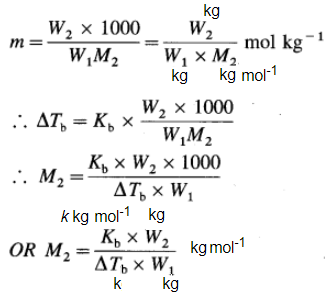
If the weights and molecular weight are expressed in $kg$, then,
$\Delta T_{ b }=K_{ b } \times \frac{W_2}{W_1 M_2}\ View full question & answer→Question 243 Marks
In an experiment, $18.04 g$ of mannitol were dissolved in $100 g$ of water. The vapour pressure of water was lowered by $0.309 mm Hg$ from $17.535 mm Hg$. Calculate the molar mass of mannitol.
View full question & answer→Question 253 Marks
The vapour pressure of a pure liquid at $298 K$ is $4 \times 10^4 Nm ^{-2}$. When a nonvolatile solute is dissolved the vapour pressure becomes $3.65 \times 10^4 Nm ^{-2}$. Calculate $(A)$ relative vapour pressure, $(B)$ lowering of vapour pressure and $(C)$ relative lowering of vapour pressure.
AnswerGiven : $P_0=4 \times 10^4 Nm ^{-2}$
$P=3.65 \times 10^4 Nm ^{-2}$
$(A)$ Relative vapour pressure $=\frac{P}{P_0}$
$=\frac{3.65 \times 10^4}{4 \times 10^4}$
$=0.9125$
$(B)$ Lowering of vapour pressure $=\Delta P=P_0-P$
$=4 \times 10^4-3.65 \times 10^4$
$ =(4-3.65) \times 10^4$
$ =0.35 \times 10^4 Nm ^{-2}=3.5 \times 10^3 Nm ^{-2}$
$(C) $ Relative lowering of vapour pressure is given by,
$\frac{P_0-P}{P_0} =\frac{4 \times 10^4-3.65 \times 10^4}{4 \times 10^4}$
$ =\frac{0.35 \times 10^4}{4 \times 10^4}$
$ =0.0875$
$(A) 0.9125 \ (B) 3.5 \times 10^3 Nm ^{-2} \ (C) 0.0875$
View full question & answer→Question 263 Marks
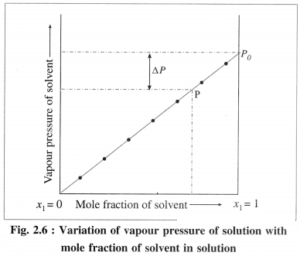
Explain the variation of vapour pressure with mole fraction of a solvent in solution.
####
Explain the variation of vapour pressure with the concentration of a solution.
Question 273 Marks
State and explain Raoult’s law for solutions of nonvolatile solutes.
Answer(a) Statement of Raoult’s law : The law states that the vapour pressure of a solvent over the solution of a nonvolatile solute is equal to the vapour pressure of the pure solvent multiplied by mole fraction of the solvent at constant temperature.
(b) Explanation : Let P0 and P be the vapour pressures of a pure solvent and a solution respectively. If $x_1$ is the mole fraction of the solvent then Raoult's law can be represented as,
$P=x_1 P_0$
For a binary solution containing one solute, if $x_1$ and $x_2$ are mole fractions of a solvent and a solute respectively then,
$\begin{aligned}
& x _1+ x _2=1 \\
& \therefore x _1=1- x _2 \\
& \therefore P = x _1 P_0 \\
& =\left(1- x _2\right) P _0 \\
& = P _0- x _2 P _0 \\
& = P _0- P = x _2 P _0 \\
& \therefore P _0- P = x _2 P _0 \\
& \therefore x _2=\frac{P_0-P}{P_0}
\end{aligned}$
$P _0- P =\Delta P$ is the lowering of vapour pressure
$\therefore x _2=\frac{\Delta P}{P_0}$
In the equation, $P_0-P / P_0$ is called relative lowering of vapour pressure.
Hence Raoult's law can also be stated as the relative lowering of vapour pressure is equal to mole fraction of the solute.
View full question & answer→Question 283 Marks
A mixture of two liquids $A$ and $B$ have vapour pressures $3.4 \times 10^4 \ Nm^{-2}$ and $5.2 \times 10 \ Nm^{-2}.$ If the mole fractions of $A$ is $0.85,$ find the vapour pressure of the solution.
AnswerGiven : Vapour pressure of pure liquid $A$
$=P_{ A }^0=3.4 \times 10^4 \ Nm ^{-2}$
Vapour pressure of pure liquid $B$
$=P_{ B }^0=5.2 \times 10^4 \ Nm ^{-2}$
Mole fraction of $A=x_A=0.85$
Mole fraction of $B=x_B=1-x_A$
$=1-0.85$
$ =0.15$
The vapour solution is given by
$P_{\text {soln }}=X_A P_A^0+X_B P_B^0$
$ =0.85 \times 3.4 \times 10+0.15 \times 5.2 \times 10^4$
$ =2.89 \times 10^4+0.78 \times 10^4$
$ =(2.89+0.78) \times 10^4$
$ P_{\text {soln }}=3.67 \times 10^4 \ Nm ^{-2}$
Vapour pressure of a solution $=3.67 \times 10^4 \ Nm ^{-2}$
View full question & answer→Question 293 Marks
The vapour pressures of pure liquids $A$ and $B$ are $400 mm Hg$ and $650 mm Hg$ respectively at $330 K$. Find the composition of liquid and vapour if total vapour pressure of solution is $600 mm$ $Hg$.
AnswerGiven : $P_{ A }^0=400 mm Hg ; P_{ B }^0=650 mm Hg$,
$P_T=600 mm Hg , T =330 K ; x _{ A }=? x _{ B }=?, y _1=? y _2=?$
( $x$ is mole fraction in liquid phase while $y$ is mole fraction in vapour phase.)
$\begin{aligned}
& P _{ T }=\left(P_{ A }^0-P_{ B }^0\right) x _{ B }+P_{ A }^0 \\
& 600=(650-400) x _B+400 \\
& =250 x _{ B }+400 \\
& \therefore x _B=\frac{600-400}{250}=0.8 \\
& \because x _{ A }+ x _{ B }=1 \\
& \therefore x _{ A }=1- x _{ B }=1-0.8=0.2
\end{aligned}$
The composition of $A$ and $B$ in liquid mixture is, $x_A=0.2$ and $x_B=0.8$.
If $P_1$ and $P_2$ are vapour pressures (or partial pressures) of $A$ and $B$ in vapour phase then by Raoult's law.
$\begin{aligned}
& P_1=x_A \times P_A^0=0.2 \times 400=80 mm Hg \\
& P_2=x_B \times P_B^0=0.8 \times 650=520 mm Hg
\end{aligned}$
If $y_1$ and $y_2$ are mole fractions of $A$ and $B$ respectively in vapour phase then, by Dalton's law,
$\begin{aligned}
& P _1= y _1 P _{ T } \\
& \therefore \quad y_1=\frac{P_1}{P_{ T }}=\frac{80}{600}=0.1333 \\
& \quad P_2=y_2 P_{ T }
\end{aligned}$
$\therefore y_2=\frac{P_2}{P_{ T }}=\frac{520}{600}=0.8667$
$\text { (or } y _2=1- y _1=1-0.1333=0.8667 \text { ) }$
Composition of liquid: $x_A=0.2$ and $x_B=0.8$ Composition of vapour: $y_A=0.1333$ and $y_B=0.8667$
View full question & answer→Question 303 Marks
The vapour pressures of two liquids $A$ and $B$ are $400 mm Hg$ and $600 mm Hg$ respectively at 47 ${ }^{\circ} C$. A solution is prepared by dissolving $10 g$ of $A$ of molar mass $60 g mol ^{-1}$ in $80 g$ of $B$ of molar mass $40 g mol ^{-1}$. Find the vapour pressure of the solution.
View full question & answer→Question 313 Marks
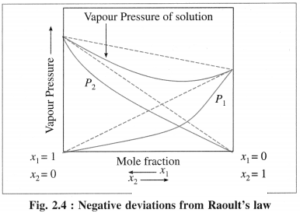
Explain solutions with negative deviations from Raoult’s law.
Question 323 Marks
Explain solutions with positive deviations from Raoult’s law.
Answer(i) A solution or a liquid mixture which has higher vapour pressure than theoretically calculated by Raoult’s law or higher than those of pure components is called a nonideal solution with positive deviation.
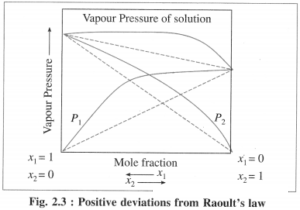
(ii) In these solutions, solute-solvent intermolecular attractions are weaker than those between solvent-solvent and solute-solute interactions.
(iii) For example, solutions of acetone and ethanol, carbon disulphide and acetone, etc
View full question & answer→Question 333 Marks
What are the characteristics of ideal solutions ?
AnswerThe ideal solutions obey Raoult’s law over entire range of concentrations at constant temperature.
In the formation of an ideal solution, heat is neither evolved nor absorbed and enthalpy change for mixing is zero, i.e. $\triangle _{mix} H = 0.$
In the formation of an ideal solution, there is no volume change on mixing two liquid components and the volume of solution is equal to the sum of volumes of two liquid components. $\triangle _{mix} V = 0$
In the ideal solution, solvent$-$solvent, solute$-$solute and solvent$-$solute interactions are comparable.
The vapour pressure of an ideal solution lies between vapour pressures of two pure components.
View full question & answer→Question 343 Marks
Explain the composition of vapour phase above a liquid mixture.
AnswerConsider a liquid mixture of two liquids $A$ and $B$ having vapour pressures $P_{ A }^0$ and $P_{ B }^0$ and mole fractions $x_1$ and $x_2$ respectively in the liquid phase.
By Raoult's law, the vapour pressures of two liquids will be,
$P _{ A }= x _1 P_{ A }^0 \text { and } P _{ B }= x _2 P_{ B }^0$
The total vapour pressure of this liquid mixture is,
$\begin{aligned}
& P _{ T }= P _{ A }+ P _{ B } \\
& P _{ T }= x _1 P_{ A }^0+ x _2 P_{ B }^0
\end{aligned}$
The vapour above liquid surface contains $A$ and $B$. If $y_1$ and $y_2$ are the mole fractions of $A$ and $B$ components respectively in the vapour phase, then by Dalton's law of partial pressures,
$P _A= y _1 P _{ T } \text { and } P _{ B }= y _2 P _{ T }$
and total vapour pressure is,
$P _{ T }= y _1 P _{ T }+ y _2 P _{ T } .$
View full question & answer→Question 353 Marks
Explain the variation of vapour pressure with mole fraction of a solute in a liquid mixture.
AnswerConsider a liquid mixture of two liquid components $A$ and $B$ having vapour pressures $P_1^0$ and $P_2^0$ and mole fractions $x_1$ and $x_2$ respectively.
By Raoult's law, the vapour pressures $P_1$ and $P_2$ are,
$P _1= x _1 P_1^0 \text { and } P _2= x _2 P_2^0$
The vapour pressure of the solution is,
$P _{ T }= P _1+ P _2= x _1 P_1^0+ x _2 P_2^0$
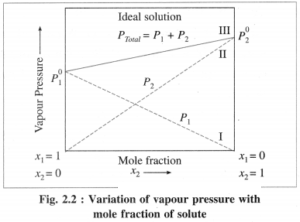
$\therefore P _{ T }=\left(P_2^0-P_1^0\right) x _2+P_1^0$
The plot of $P_T$ versus $x_2$ is a straight line. The plots of $P_1$ versus $x_1$, and $P_2$ versus $x_2$ are straight lines passing through the origin.
When $x _1=1, x _2=0, P _{ T }=P_1^0$ and when $x _1=0, x _2=1, P _{ T }=P_2^0$ as shown by lines $I$ and $II$ in Fig. 2.2
View full question & answer→Question 363 Marks
Marine life like fish prefers to stay at lower level in water. Explain.
###
Explain, why do aquatic animals prefer to stay at lower level of water during summer?
Answer- The solubility of oxygen gas decreases with the increase in temperature.
- In sea or lake water, the temperature of upper level is higher than the lower level.
- Therefore the dissolved oxygen content in water is more at lower level than at higher level required for the marine life.
Hence marine life like fish prefers to stay at lower level than upper level of water.
View full question & answer→Question 373 Marks
The solubility of nitrogen at $30^{\circ} C$ is $2.5 \times 10^{-3} g dm ^{-3}$ at $760 mm$ pressure. What will be its solubility in $mol dm ^{-3}$ at $20,000 mm$ and same temperature?
AnswerGiven : Initial solubility of $N _2= S _1=2.5 \times 10^{-3} g dm ^{-3}$
Initial pressure $= P _1=760 mm$
Final pressure $=P_2=20,000 mm$
Final solubility $= S _2$ in $mol dm ^{-3}=$ ?
Molar mass of $N _2$ gas $=28 g mol ^{-1}$
$\begin{aligned}
& S _1=2.33 \times 10^{-5} mol dm ^{-3} \\
& =\frac{2.5 \times 10^{-3}}{28} mol dm ^{-3} \\
& =8.93 \times 10^{-5} mol dm ^{-3} \\
& P _1=\frac{760}{760}=1 atm \\
& P _2=\frac{20,000}{760}=26.32 atm
\end{aligned}$
By Henry's law,
$\begin{aligned}
& S _1= K _{ H } \times P _1 \\
& \therefore K _{ H }=\frac{S_1}{P_1}=\frac{8.93 \times 10^{-5}}{1} \\
& =8.93 \times 10^{-5} mol dm ^{-3} atm ^{-1} \\
& S _2= K _{ H } \times P _2=8.93 \times 10^{-5} \times 26.32 \\
& =2.35 \times 10^{-3} mol dm ^{-3}
\end{aligned}$
Ans. Solubility of $N _2$ gas
$=2.35 \times 10^{-3} mol dm ^{-3} \text {. }$
[Alternative method:
$\begin{aligned}
& S _1= K _{ H } P _1 \text { and } S _2= K _{ H } P _2 \\
& \therefore \frac{S_2}{S_1}=\frac{K_{ H } P_2}{K_{ H } P_1}=\frac{P_2}{P_1} \\
& \therefore S _2= S _1 \times \frac{P_2}{P_1}=8.93 \times 10^{-5} \times \frac{20,000}{760} \\
& \left.=2.35 \times 10^{-3} mol dm ^{-3}\right]
\end{aligned}$
View full question & answer→Question 383 Marks
What are the exceptions to Henry’s law? Why ?
Answer(1) The gases like $NH _3$ and $CO _2$ do not obey Henry's law.
(2) This is because, these gases react with water,
$\begin{aligned}
& NH _{3( g )}+ H _2 O _{( l )} \longrightarrow NH _{4( aq )}^{+}+ OH _{( aq )}^{-} \\
& CO _{2( g )}+ H _2 O ( l ) \rightarrow H _2 CO _{3( aq )}
\end{aligned}$
(3) Due to reactions of the gases like $NH _3, CO _{2( g )}$, they have higher solubilities than expected by Henry's law.
View full question & answer→Question 393 Marks
Explain with the help of Le Chatelier’s principle the effect of temperature on solubility.
Answer1. The effect of temperature on solubility depends on enthalpy of solution.
2. For example, dissolution of $KCl$ in water is an endothermic process since heat is absorbed during dissolution. In according to Le Chatelier's principle by increasing temperature the solubility of $KCl$ increases.
3. Dissolution of $CaCl _2, Li _2 SO _4, H _2 O$ in water is an exothermic process since heat is evolved during dissolution. In this, according to Le Chatelier's principle by increasing the temperature the solubility decreases.
View full question & answer→