MCQ 11 Mark
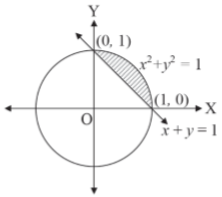
The area of the region included between the line $x+y=1$ and the circle $x^2+y^2=1$ is
- A
$\frac{\pi}{2}-1$ sq units
- B
- ✓
$\frac{\pi}{4}-\frac{1}{2}$ sq units
- D
$\pi-\frac{1}{2}$ sq units
AnswerCorrect option: C. $\frac{\pi}{4}-\frac{1}{2}$ sq units
$\frac{\pi}{4}-\frac{1}{2}$ sq units
View full question & answer→MCQ 21 Mark
The area of the region included between the parabolas $y^2=4 a x$ and $x^2=4 a y,(a>0)$ isgiven by
- ✓
$\frac{16 a^2}{3}$ sq units
- B
$\frac{8 a^2}{3}$ sq units
- C
$\frac{4 a^2}{3}$ sq units
- D
$\frac{32 a^2}{3}$ sq units
AnswerCorrect option: A. $\frac{16 a^2}{3}$ sq units
$\frac{16 a^2}{3}$ sq units
View full question & answer→MCQ 31 Mark
The area of the region bounded by $x^2=16 y, y=1, y=4$ and $x=0$ in the first quadrant, is
- A
$\frac{7}{3}$ sq units
- B
$\frac{8}{3}$ sq units
- C
$\frac{64}{3}$ sq units
- ✓
$\frac{56}{3}$ sq units
AnswerCorrect option: D. $\frac{56}{3}$ sq units
$\frac{56}{3} sq$ units
View full question & answer→MCQ 41 Mark
The area bounded by the curve $y=\tan x$, X-axis and the line $x=\frac{\pi}{4}$ is
AnswerCorrect option: A. $\frac{1}{3} \log 2 sq$ units
$\frac{1}{3} \log 2$ sq units
View full question & answer→MCQ 51 Mark
The area enclosed between the two parabolas $y^2=4 x$ and $y=x$ is
- A
$\frac{8}{3}$ sq units
- B
$\frac{32}{3}$ sq units
- ✓
$\frac{16}{3} sq$ units
- D
$\frac{4}{3}$ sq units
AnswerCorrect option: C. $\frac{16}{3} sq$ units
$\frac{16}{3} sq$ units
View full question & answer→MCQ 61 Mark
The area bounded by the parabola $y=x^2$ and the line $y=x$ is
- A
$\frac{1}{2}$ sq unit
- B
$\frac{1}{3}$ sq unit
- ✓
$\frac{1}{6}$ sq unit
- D
$\frac{1}{12} sq$ unit
AnswerCorrect option: C. $\frac{1}{6}$ sq unit
$\frac{1}{6} sq$ unit
View full question & answer→MCQ 71 Mark
The area bounded by the ellipse $\frac{x^2}{a^2}+\frac{y^2}{b^2}=1$ and the line $\frac{x}{a}+\frac{y}{b}=1$ is
AnswerCorrect option: B. $\frac{\pi a b}{4}-\frac{a b}{2}$ sq units
$\frac{\pi a b}{4}-\frac{a b}{2}$ sq units
View full question & answer→MCQ 81 Mark
The area bounded by y = √x and line x = 2y + 3, X-axis in first quadrant is
- A
- ✓
- C
$\frac{34}{3}$ sq units
- D
View full question & answer→MCQ 91 Mark
The area enclosed between the curve $y=\cos 3 x, 0 \leq x \leq \frac{\pi}{6}$ and the X-axis is
- A
$\frac{1}{2}$ sq unit
- B
- C
$\frac{2}{3}$ sq unit
- ✓
$\frac{1}{3}$ sq unit
AnswerCorrect option: D. $\frac{1}{3}$ sq unit
$\frac{1}{3}$ sq unit
View full question & answer→MCQ 101 Mark
The area bounded by the parabola $y^2=x$ and the line $2 y=x$ is
- ✓
$\frac{4}{3}$ sq units
- B
- C
$\frac{2}{3}$ sq unit
- D
$\frac{1}{3} sq$ unit
AnswerCorrect option: A. $\frac{4}{3}$ sq units
$\frac{4}{3}$ sq units
View full question & answer→MCQ 111 Mark
The area of the region bounded by the ellipse $\frac{x^2}{a^2}+\frac{y^2}{b^2}=1$ is
View full question & answer→MCQ 121 Mark
The area of the circle $x^2+y^2=25$ in first quadrant is
AnswerCorrect option: A. $\frac{25 \pi}{3}$ sq units
$\frac{25 \pi}{3}$ sq units
View full question & answer→MCQ 131 Mark
The area under the curve y = 2√x, enclosed between the lines x = 0 and x = 1 is
- A
- B
$\frac{3}{4}$ sq units
- C
$\frac{2}{3}$ sq units
- ✓
$\frac{4}{3}$ sq units
AnswerCorrect option: D. $\frac{4}{3}$ sq units
$\frac{4}{3}$ sq units
View full question & answer→MCQ 141 Mark
The area bounded by the parabola $y^2=8 x$, the $X$-axis and the latus rectum is
AnswerCorrect option: B. $\frac{32}{3} sq$ units
$\frac{32}{3}$ sq units
View full question & answer→MCQ 151 Mark
The area of the region bounded by y = cos x, Y-axis and the lines x = 0, x = 2π is
MCQ 161 Mark
The area of the region bounded between the line $x=4$ and the parabola $y^2=16 x$ is
- ✓
$\frac{128}{3}$ sq units
- B
$\frac{108}{3}$ sq units
- C
$\frac{118}{3} sq$ units
- D
$\frac{218}{3}$ sq units
AnswerCorrect option: A. $\frac{128}{3}$ sq units
$\frac{128}{3}$ sq units
View full question & answer→MCQ 171 Mark
The area enclosed between the parabola $y^2=4 x$ and line $y=2 x$ is
- A
$\frac{2}{3}$ sq units
- ✓
$\frac{1}{3}$ sq units
- C
$\frac{1}{4}$ sq units
- D
$\frac{3}{4}$ sq units
AnswerCorrect option: B. $\frac{1}{3}$ sq units
$\frac{1}{3}$ sq units
View full question & answer→MCQ 181 Mark
The area bounded by the curve $y=x^3$, the $X$-axis and the lines $x=-2$ and $x=1$ is
- A
- B
$-\frac{15}{4}$ sq units
- ✓
$\frac{15}{4}$ sq units
- D
$\frac{17}{4}$ sq units
AnswerCorrect option: C. $\frac{15}{4}$ sq units
$\frac{15}{4} sq$ units
View full question & answer→MCQ 191 Mark
The area of the region enclosed by the curve $y=\frac{1}{x}$, and the lines $x=e, x=e^2$ is given by
- ✓
- B
$\frac{1}{2}$ sq units
- C
$\frac{3}{2} sq$ units
- D
$\frac{5}{2}$ sq units
View full question & answer→MCQ 201 Mark
The area bounded by the region 1 ≤ x ≤ 5 and 2 ≤ y ≤ 5 is given by
MCQ 212 Marks
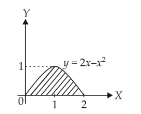
The area of the region bounded by the curve $y=2 x-x^2$ and $x-$ axis is
- A
$\frac{2}{3} \text { sq.units }$
- ✓
$\frac{4}{3} \text { sq.units }$
- C
$\frac{5}{3} \text { sq.units }$
- D
$\frac{8}{3} \text { sq.units }$
AnswerCorrect option: B. $\frac{4}{3} \text { sq.units }$
Required area
$=\int_0^2\left(2 x-x^2\right) d x$
$=\left[\frac{2 x^2}{2}-\frac{x^3}{3}\right]_0^2$
$=\left[4-\frac{8}{3}\right]=\frac{4}{3} \text { sq.units }$
View full question & answer→MCQ 222 Marks
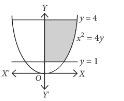
The area of the region bounded by $x^2=4 y, y=1$, $y=4$ and the $y$-axis lying in the first quadrant is square units.
- A
$\frac{22}{3}$
- ✓
$\frac{28}{3}$
- C
- D
$\frac{21}{4}$
AnswerCorrect option: B. $\frac{28}{3}$
(b) : Area bounded by curve $x^2=4 y$ or $x=2 \sqrt{y}$ between $y=1 \& y=4$ is $\int_1^4 2 \sqrt{y} d y=2\left[\frac{y^{3 / 2}}{3 / 2}\right]_1^4$ $=\frac{2 \times 2}{3}\left[(4)^{3 / 2}-(1)^{3 / 2}\right]=\frac{4}{3}(8-1)=\frac{28}{3}$ square unit
View full question & answer→MCQ 232 Marks
The area bounded by the curve $y=|x-2|, x=1 . x=3$ and $X-$asis is
- A
$3$ sq. units
- B
$2$ sq. units
- ✓
$1$ sq. units
- D
$4$ sq. units
AnswerCorrect option: C. $1$ sq. units
We have $y=|x-2|=\left\{\begin{array}{cc}x-2, & x>2 \\ 0 & \text { if } x=2 \\ 2-x & x<2\end{array}\right.$
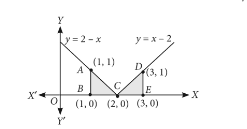
$ \therefore $ Required area $=$ Area of $\triangle A B C + $ Area of $ \triangle C D E$
$=\left(\frac{1}{2} \times A B \times C B\right)+\left(\frac{1}{2} \times D E \times C E\right)$
$=\left(\frac{1}{2} \times 1 \times 1\right)+\left(\frac{1}{2} \times 1 \times 1\right)$
$=1 \text { sq. unit }$ View full question & answer→MCQ 242 Marks
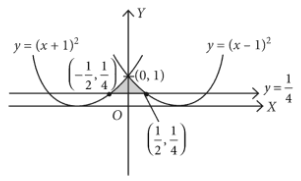
The area bounded by the curves $y=(x-1)^2$, $y=(x+1)^2$ and $y=\frac{1}{4}$ is
View full question & answer→MCQ 252 Marks
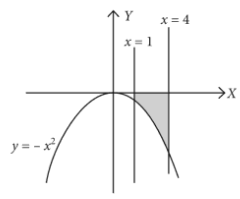
The area bounded by the curve, $y=-x^2, x$-axis; $x=1$ and $x=4$, is
- A
- B
$\frac{21}{2}$ sq. usits
- C
- D
View full question & answer→MCQ 262 Marks
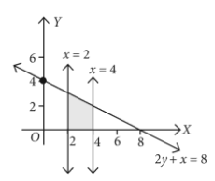
The area of the region bounded by the line $2 y+x=8, X$-axis and the lines $x=2$ and $x=4$ is
View full question & answer→MCQ 272 Marks
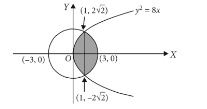
The area bounded by the curves $x^2+y^2=9$ and $y^2=8 x$ is
View full question & answer→MCQ 282 Marks
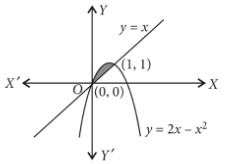
The area of the region bounded by the curve $y=2 x-x^2$ and the line $y=x$ is square units.
- A
$1 / 6$
- B
$1 / 2$
- C
$1 / 3$
- D
$7 / 6$
View full question & answer→MCQ 292 Marks
The area of the region enclosed between pair of the lines $x y=0$ and the lines $x y+5 x-4 y-20=0$, is
- ✓
$20$ square units
- B
$4 / 5$ square unit
- C
$10$ square units
- D
$6$ square units
AnswerCorrect option: A. $20$ square units
Lines that represent $x y=0$ are $x=0$ and $y=0$.
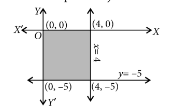
Now, $x y+5 x-4 y-20=0$
$\Rightarrow x(y+5)-4(y+5)=0$
$\Rightarrow(y+5)(x-4)=0$
$\Rightarrow y+5=0$ or $x-4=0$
$\therefore y=-5$ and $x=4$ are the other two lines.
After plotting the lines, we get the following enclosed region.
$\therefore$ Required area is shaded as in the figure, which is a rectangle with length $5$ units, and breadth $4$ units.
$\therefore $ Area $=$ length $\times$ breadth
$=5 \times 4$
$=20$ square units. View full question & answer→MCQ 302 Marks
The area of the region bounded by the lires $y=2 x+1 , y=3 x+1$ and $x=4$ is
AnswerCorrect option: D. $8 \text { sq. units }$
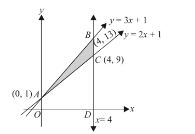
The bounded area is shown in figure.
Curves are $y=2 x+1, y=3 x+1$ and $x=4$
Solving them, we get
$A=(0,1), B=(4,13),$
$C \equiv(4,9), D \equiv(4,0),$
Required area $\text{ABC}$ is
Area $\text{OAD} -$ Area $\text{OACD}$
$=\int_0^4(3 x+1) d x-\int_0^4(2 x+1) d x$
$=\int_0^4 x d x=\left[\frac{x^2}{2}\right]_0^4=8 \text { sq. units }$
View full question & answer→MCQ 312 Marks
The area bounded by the curves $y=\sin x, y=\cos x$ and $x=0$ is
- ✓
$(\sqrt{2}-1) \text { sq. units }$
- B
$1 \text { sq. units }$
- C
$\sqrt{2} \text { sq. units }$
- D
$(1+\sqrt{2})\text { sq. units }$
AnswerCorrect option: A. $(\sqrt{2}-1) \text { sq. units }$
The given equation of curves are
$y=\sin x ...(i)$
and $y=\cos x...(ii)$
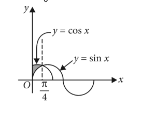
From equation $(i)$ and $(ii),$ we get
$\sin x=\cos x $
$\Rightarrow x=\frac{\pi}{4}$
$\therefore$ Required area $=\int_0^{\pi / 4}(\cos x-\sin x) d x$
$=[\sin x+\cos x]_0^{\pi / 4}$
$=\left(\sin \frac{\pi}{4}+\cos \frac{\pi}{4}-\sin 0-\cos 0\right)$
$=\left[\frac{1}{\sqrt{2}}+\frac{1}{\sqrt{2}}-1\right]$
$=\frac{2}{\sqrt{2}}-1$
$=(\sqrt{2}-1) \text { sq. units }$ View full question & answer→MCQ 322 Marks
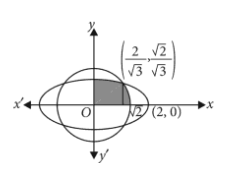
The area common to the curves $x^2+y^2=2$ and $x^2+4 y^2=4$ is
View full question & answer→MCQ 332 Marks
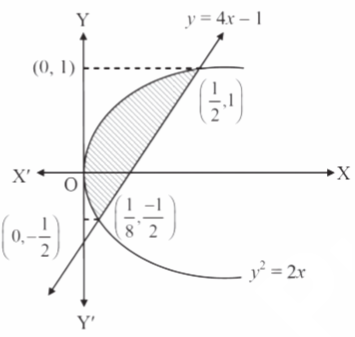
The area (in sq. units) of the region described by $\left\{(x, y): y^2 \leq 2 x\right.$ and $\left.y \geq 4 x-1\right\}$ is
- A
$\frac{7}{32}$
- B
$\frac{5}{64}$
- C
$\frac{15}{64}$
- D
$\frac{9}{32}$
View full question & answer→MCQ 342 Marks
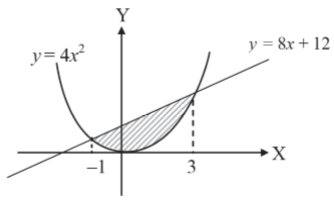
The area (in sq. units) of the region $\left\{(x, y) \in R ^2 / 4 x^2 \leq y \leq 8 x+12\right\}$ is
- A
$\frac{128}{3}$
- B
$\frac{127}{3}$
- C
$\frac{124}{3}$
- D
$\frac{125}{3}$
View full question & answer→MCQ 352 Marks
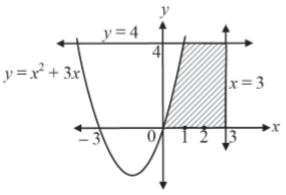
The area (in sq.units) of the region $A =\{(x, y) \in R \times R / 0 \leq x \leq 3,0 \leq y \leq 4$, $\left.y \leq x^2+3 x\right\}$ is
- A
$\frac{53}{6}$
- B
$8$
- C
$\frac{59}{6}$
- D
$\frac{26}{3}$
View full question & answer→MCQ 362 Marks
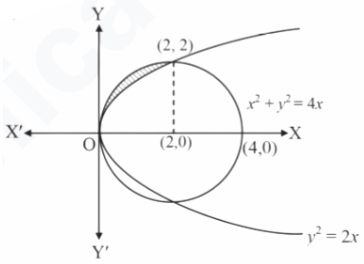
The area (in sq. units) of the region $\left\{(x, y): y^2 \geq 2 x\right.$ and $\left.x^2+y^2 \leq 4 x, x \geq 0, y \geq 0\right\}$ is
View full question & answer→MCQ 372 Marks
The area of region $\left\{(x, y): x^2+y^2 \leq 1 \leq x+y\right\}$ is
View full question & answer→MCQ 382 Marks
Area of the region bounded by $\frac{x^2}{9}+\frac{y^2}{4}=1$ and the line $\frac{x}{3}+\frac{y}{2}=1$ is
- A
$\frac{1}{2}(\pi-2)$ sq. units
- ✓
$\frac{3}{2}(\pi-2)$ sq. units
- C
$\frac{5}{4}(\pi-2)$ sq. units
- D
$\frac{2}{3}(\pi-2)$ sq. units
AnswerCorrect option: B. $\frac{3}{2}(\pi-2)$ sq. units
(B)
Here, $a =3, b=2$
The area between $\frac{x^2}{ a ^2}+\frac{y^2}{b^2}=1$ and the straight line $\frac{x}{a}+\frac{y}{b}=1$ is $\frac{1}{4} \pi a b-\frac{1}{2} a b$ sq. units.
$\therefore $ Required area $=\frac{1}{4} \pi(3)(2)-\frac{1}{2}(3)(2)$
$=\frac{3}{2}(\pi-2)$ sq.units
View full question & answer→MCQ 392 Marks
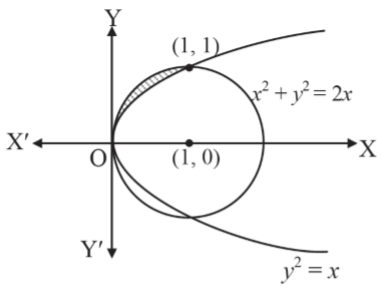
The area of the region above X -axis included between the parabola $y^2=x$ and the circle $x^2+y^2=2 x$ in square units is
- A
$\frac{3}{2}-\frac{\pi}{4}$
- B
$\frac{\pi}{4}-\frac{2}{3}$
- C
$\frac{\pi}{4}-\frac{3}{2}$
- D
$\frac{2}{3}-\frac{\pi}{4}$
View full question & answer→MCQ 402 Marks
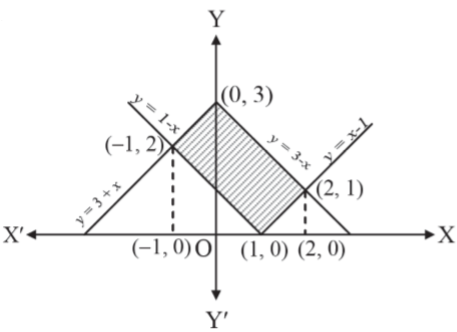
The area of the region bounded by the curves $y=|x-1|$ and $y=3-|x|$ is
View full question & answer→MCQ 412 Marks
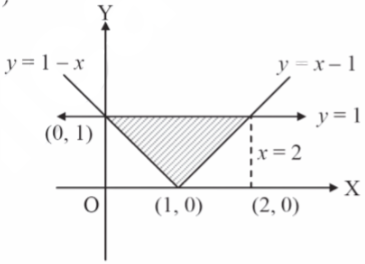
The area of the region bounded by $y=|x-1|$ and $y=1$ is
- A
$2$
- B
$1$
- C
$\frac{1}{2}$
- D
$3$
View full question & answer→MCQ 422 Marks
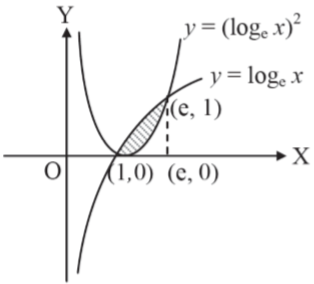
The area bounded by the curves $y=\log _e x$ and $y=\left(\log _e x\right)^2$ is
- A
$3- e$
- B
$e-3$
- C
$\frac{1}{2}(3- e )$
- D
$\frac{1}{2}(e-3)$
View full question & answer→MCQ 432 Marks
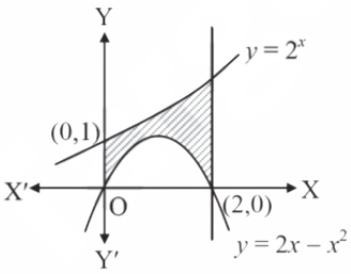
The area bounded by the straight lines $x=0$, $x=2$ and the curves $y=2^x, y=2 x-x^2$ is
- A
$\frac{4}{3}-\frac{1}{\log 2}$
- B
$\frac{3}{\log 2}+\frac{4}{3}$
- C
$\frac{4}{\log 2}-1$
- D
$\frac{3}{\log 2}-\frac{4}{3}$
View full question & answer→MCQ 442 Marks
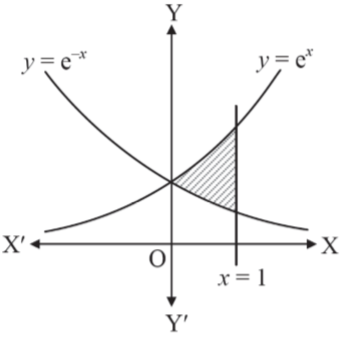
The area bounded by $y= e ^x, \quad y= e ^{-x}$ and the straight line $x=1$ is
- A
$e+\frac{1}{e}$
- B
$e-\frac{1}{e}$
- C
$e+\frac{1}{e}-2$
- D
$e+\frac{1}{e}+2$
View full question & answer→MCQ 452 Marks
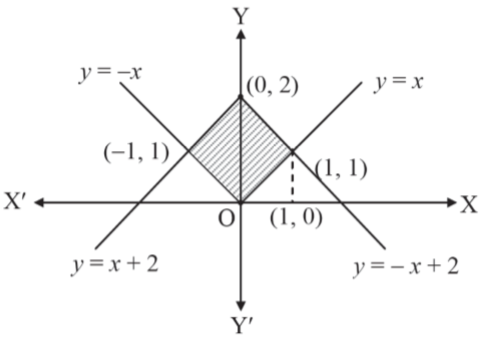
Area of the region bounded by $y=|x|$ and $y=-|x|+2$ is
View full question & answer→MCQ 462 Marks
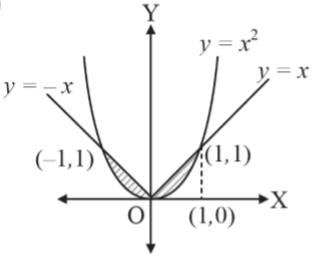
The area (in sq. units) enclosed between the curves $y=x^2$ and $y=|x|$ is
- A
$\frac{2}{3}$
- B
$1$
- C
$\frac{1}{6}$
- D
$\frac{1}{3}$
View full question & answer→MCQ 472 Marks
If area bounded by the curves $y^2=4 a x$ and $y=m x$ is $\frac{a^2}{3}$, then the value of $m$ is
Answer(A)
The two curves $y^2=4 a x$ and $y= m x$ intersect
at $(0,0)$ and $\left(\frac{4 a }{ m ^2}, \frac{4 a }{ m }\right)$.
According to the given condition,
$\int_0^{\frac{4 a }{ m ^2}}(\sqrt{4 a x}- m x) d x=\frac{ a ^2}{3}$
$\Rightarrow \frac{8}{3} \cdot \frac{ a ^2}{m^3}=\frac{ a ^2}{3} \Rightarrow m^3=8 \Rightarrow m=2$
View full question & answer→MCQ 482 Marks
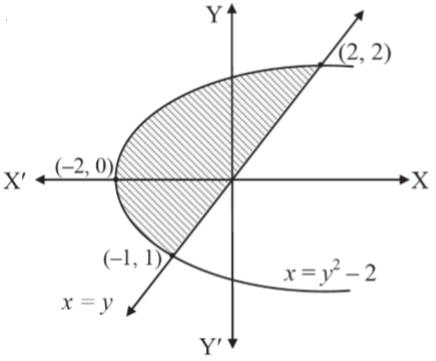
The area of the region bounded by the curves $x=y^2-2$ and $x=y$ is
- A
$\frac{9}{4}$
- B
- C
$\frac{9}{2}$
- D
$\frac{9}{7}$
View full question & answer→MCQ 492 Marks
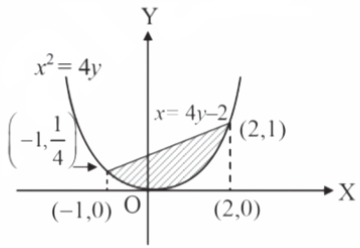
Area bounded by the curve $x^2=4 y$ and the straight line $x=4 y-2$ is
- A
$\frac{8}{9}$ sq. units
- B
$\frac{9}{8}$ sq. units
- C
$\frac{4}{3}$ sq. units
- D
$\frac{3}{4}$ sq. units
View full question & answer→MCQ 502 Marks
The area enclosed between the curves $y=x$ and $y=2 x-x^2$ is (in square units)
- A
$\frac{1}{2}$
- ✓
$\frac{1}{6}$
- C
$\frac{1}{3}$
- D
$\frac{1}{4}$
AnswerCorrect option: B. $\frac{1}{6}$
(B)
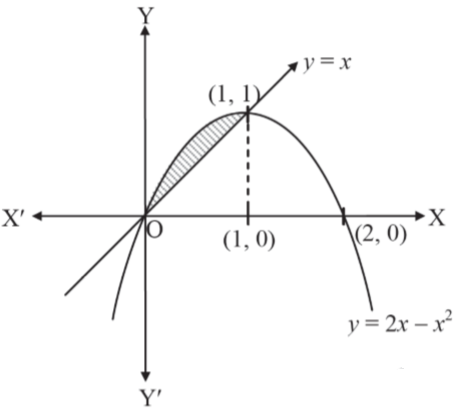
$\begin{aligned} \text { Required area } & =\int_0^1\left[\left(2 x-x^2\right)-x\right] d x=\int_0^1\left(x-x^2\right) d x \\ & =\left[\frac{x^2}{2}-\frac{x^3}{3}\right]_0^1=\frac{1}{6}\end{aligned}$ View full question & answer→