MCQ 11 Mark
If the surrounding air is kept at 20°C and the body cools from 80°C to 70°C in 5 minutes, the temperature of the body after 15 minutes will be…..
MCQ 21 Mark
The decay rate of certain substances is directly proportional to the amount present at that instant. Initially, there are 27 grams of substance and 3 hours later it is found that 8 grams left. The amount left after one more hour is……
- A
$5 \frac{2}{3}$ grams
- ✓
$5 \frac{1}{3}$ grams
- C
- D
AnswerCorrect option: B. $5 \frac{1}{3}$ grams
$5 \frac{1}{3} grams$
View full question & answer→MCQ 31 Mark
$\frac{x^2}{a^2}-\frac{y^2}{b^2}=1$ is a solution of
- A
$\frac{d^2 y}{d x^2}+y x+\left(\frac{d y}{d x}\right)^2=0$
- ✓
$x y \frac{d^2 y}{d x^2}+2\left(\frac{d y}{d x}\right)^2-y \frac{d y}{d x}=0$
- C
$y \frac{d^2 y}{d x^2}+2\left(\frac{d y}{d x}\right)^2+y=0$
- D
$x y \frac{d y}{d x}+y \frac{d^2 y}{d x^2}=0$
AnswerCorrect option: B. $x y \frac{d^2 y}{d x^2}+2\left(\frac{d y}{d x}\right)^2-y \frac{d y}{d x}=0$
$x y \frac{d^2 y}{d x^2}+2\left(\frac{d y}{d x}\right)^2-y \frac{d y}{d x}=0$Hint: $\frac{x^2}{a^2}-\frac{y^2}{b^2}=1$
... (1)
$\therefore \frac{1}{a^2} \times 2 x-\frac{1}{b^2} \times 2 y \frac{d y}{d x}=0$
$\therefore \frac{x}{a^2}-\frac{y}{b^2} \frac{d y}{d x}=0$
$\ldots$ (2)
and $\frac{1}{a^2} \times 1-\frac{1}{b^2}\left[y \frac{d^2 y}{d x^2}+\left(\frac{d y}{d x}\right)^2\right]=0$
Equations (1), (2) and (3) are consistent
$\therefore\left|\begin{array}{ccc}x^2 & -y^2 & 1 \\ x & -y \frac{d y}{d x} & 0 \\ 1 & -\left[y \frac{d^2 y}{d x^2}+\left(\frac{d y}{d x}\right)^2\right] & 0\end{array}\right|=0$
$\left.\therefore x y \frac{d^2 y}{d x^2}+x\left(\frac{d y}{d x}\right)^2-y \frac{d y}{d x}=0\right]$
View full question & answer→MCQ 41 Mark
The particular solution of $\frac{d y}{d x}=x e^{y-x}$, when $x = y =0$ is......
- ✓
$e^{x-y}=x+1$
- B
$e^{x+y}=x+1$
- C
$e^x+e^y=x+1$
- D
$e^{y-x}=x-1$
AnswerCorrect option: A. $e^{x-y}=x+1$
$e^{x-y}=x+1$
Hint :
$\frac{d y}{d x}=x e^{y-x}=\frac{x e^y}{e^x}$
$\therefore \int e^{-y} d y=\int x e^{-x} d x$
$\therefore e^{-y}=x \cdot \frac{e^{-x}}{-1}-\int 1 \cdot \frac{e^{-x}}{-1} d x+c$
$\therefore-e^{-y}=-x e^{-x}+\frac{e^{-x}}{-1}+c$
$\therefore e^{-y}=\frac{x}{e^x}+\frac{1}{e^x}-c $
$ \therefore e^{x-y}=x+1-c e^x$
When $x=y=0$, we get
$1=1-c \quad \therefore c=0$
$\therefore$ particular solution is
$\left.e^{x-y}=x+1\right]$
View full question & answer→MCQ 51 Mark
The solution of the differential equation $\frac{d y}{d x}=\sec x-y \tan x$ is.......
Answer y sec x = tan x + c Hint:
$\frac{d y}{d x}=\sec x - y \tan x$
$\therefore \frac{d y}{d x}+ y \tan x =\sec x$
I.F. $=e^{\int \tan x d x}=e^{\log \sec x}=\sec x$
∴ the solution is
y . sec x = ∫sec x . sec x dx + c
∴ y sec x = tan x + c
View full question & answer→MCQ 61 Mark
The integrating factor of linear differential equation $x \frac{d y}{d x}+2 y=x^2 \log x$ is........
- A
$\frac{1}{x}$
- B
- C
$\frac{1}{n^2}$
- ✓
$x^2$
Answer$x^2$Hint:
I.F. $=e^{\int \frac{2}{x} d x}$
$=e^{2 \log x}$
$=x^2$
View full question & answer→MCQ 71 Mark
The solution of $\frac{d y}{d x}+ y =\cos x -\sin x$ is......
- A
$y e^x=\cos x+c$
- B
$y e^x+e^x \cos x=c$
- ✓
$y e^x=e^x \cos x+c$
- D
$y^2 e^x=e^x \cos x+c$
AnswerCorrect option: C. $y e^x=e^x \cos x+c$
$y e^x=e^x \cos x+c$Hint:
$\frac{d y}{d x}+ y =\cos x -\sin x$
I.F. $=e^{\int 1 d x}=e^x$
$\therefore$ the solution is $y \cdot e ^{ x }=\int(\cos x -\sin x ) e ^{ x }+ c$
$\therefore y \cdot e ^{ x }= e ^{ x } \cos x + c$
View full question & answer→MCQ 81 Mark
The Solution of $\frac{d y}{d x}=\frac{y+\sqrt{x^2-y^2}}{2}$ is......
- A
$\sin ^{-1}\left(\frac{y}{x}\right)=2 \log |x|+c$
- ✓
$\sin ^{-1}\left(\frac{y}{x}\right)=\log |x|+c$
- C
$\sin \left(\frac{x}{y}\right)=\log |x|+c$
- D
$\sin \left(\frac{y}{x}\right)=\log |y|+c$
AnswerCorrect option: B. $\sin ^{-1}\left(\frac{y}{x}\right)=\log |x|+c$
$\sin ^{-1}\left(\frac{y}{x}\right)=\log |x|+c$
Hint :
$\frac{d y}{d x}=\frac{y+\sqrt{x^2-y^2}}{x}$
Put $y=v x \quad \therefore \frac{d y}{d x}=v+x \frac{d v}{d x}$
$\therefore v+x \frac{d v}{d x}=\frac{v x+\sqrt{x^2-v^2 x^2}}{x}=v+\sqrt{1-v^2}$
$\therefore x \frac{d v}{d x}=\sqrt{1-v^2}$
$\therefore \int \frac{1}{\sqrt{1-v^2}} d v=\int \frac{1}{x} d x$
$\therefore \sin ^{-1} v=\log |x|+c$
$\therefore \sin ^{-1}\left(\frac{y}{x}\right)=\log |x|+c$
View full question & answer→MCQ 91 Mark
The solution of $( x + y )^2 \frac{d y}{d x}=1$ is.......
AnswerCorrect option: C. $y=\tan ^{-1}(x+y)+c$
$y=\tan ^{-1}(x+y)+c$
Hint:
$(x+y)^2 \frac{d y}{d x}=1$
Put $x+y=u \quad \therefore 1+\frac{d y}{d x}=\frac{d u}{d x}$
$\therefore u^2\left(\frac{d u}{d x}-1\right)=1$
$\therefore u^2 \frac{d u}{d x}=u^2+1$
$\therefore \int \frac{u^2}{u^2+1} d u=\int d x$
$\therefore \int\left(1-\frac{1}{u^2+1}\right) d u=\int d x$
$\therefore u-\tan ^{-1} u=x+c $
$\therefore x+y-\tan ^{-1}(x+y)=x+c $
$\therefore y=\tan ^{-1}(x+y)+c$
View full question & answer→MCQ 101 Mark
The solution of $\frac{1}{x} \cdot \frac{d y}{d x}=\tan ^{-1} x$ is......
AnswerCorrect option: D. $y=\frac{x^2 \tan ^{-1} x}{2}-\frac{1}{2}\left(x-\tan ^{-1} x\right)+c$
$y=\frac{x^2 \tan ^{-1} x}{2}-\frac{1}{2}\left(x-\tan ^{-1} x\right)+c$$\operatorname{Hint}: \frac{1}{x} \frac{d y}{d x}=\tan ^{-1} x \quad \therefore d y=x \tan ^{-1} x d x$
$\therefore \int d y=\int\left(\tan ^{-1} x\right) \cdot x d x$
$\therefore y=\left(\tan ^{-1} x\right) \cdot \frac{x^2}{2}-\int \frac{d}{d x}\left(\tan ^{-1} x\right) \cdot \frac{x^2}{2} d x+c$
$=\frac{x^2 \tan ^{-1} x}{2}-\int \frac{1}{1+x^2} \times \frac{1}{2} x^2 d x+c$
$=\frac{x^2 \tan ^{-1} x}{2}-\frac{1}{2} \int \frac{\left(1+x^2\right)-1}{1+x^2} d x+c$
$=\frac{x^2 \tan ^{-1} x}{2}-\frac{1}{2} \int\left(1-\frac{1}{1+x^2}\right) d x+c$
$\left.=\frac{x^2 \tan ^{-1} x}{2}-\frac{1}{2}\left(x-\tan ^{-1} x\right)+c.\right]$
View full question & answer→MCQ 111 Mark
The differential equation $y \frac{d y}{d x}+ x =0$ represents family of
Answercircles Hint: circles y $\frac{d y}{d x}+x=0$
$\therefore \int y d y+\int x d x=c$
$\therefore \frac{y^2}{2}+\frac{x^2}{2}=c$
$\therefore x ^2+ y ^2=2 c$ which is a circle.
View full question & answer→MCQ 121 Mark
The differential equation of all circles having their centres on the line y = 5 and touching the X-axis is
- A
$y^2\left(1+\frac{d y}{d x}\right)=25$
- B
$(y-5)^2\left[1+\left(\frac{d y}{d x}\right)^2\right]=25$
- C
$(y-5)^2+\left[1+\left(\frac{d y}{d x}\right)^2\right]=25$
- ✓
$(y-5)^2\left[1-\left(\frac{d y}{d x}\right)^2\right]=25$
AnswerCorrect option: D. $(y-5)^2\left[1-\left(\frac{d y}{d x}\right)^2\right]=25$
$(y-5)^2\left[1+\left(\frac{d y}{d x}\right)^2\right]=25$Hint : Equation of the circle is
$(x-h)^2+(y-5)^2=5^2$.......(1)
$\therefore 2(x-h)+2(y-5) \frac{d y}{d x}=0$
$\therefore(x-h)^2=(y-5)^2\left(\frac{d y}{d x}\right)^2$
$\therefore 25-(y-5)^2=(y-5)^2\left(\frac{d y}{d x}\right)^2$
$[B y(1)]$
$\therefore(y-5)^2\left[1+\left(\frac{d y}{d x}\right)^2\right]=25$
View full question & answer→MCQ 131 Mark
$x^2+y^2=a^2$ is a solution of
- A
$\frac{d^2 y}{d x^2}+\frac{d y}{d x}-y=0$
- B
$y=x \sqrt{1+\left(\frac{d y}{d x}\right)^2}+a^2 y$
- ✓
$y=x \frac{d y}{d x}+a \sqrt{1+\left(\frac{d y}{d x}\right)^2}$
- D
$\frac{d^2 y}{d x^2}=(x+1) \frac{d y}{d x}$
AnswerCorrect option: C. $y=x \frac{d y}{d x}+a \sqrt{1+\left(\frac{d y}{d x}\right)^2}$
$y=x \frac{d y}{d x}+a \sqrt{1+\left(\frac{d y}{d x}\right)^2}$Hint : $x^2+y^2=a^2 \quad \therefore 2 x+2 y \frac{d y}{d x}=0$
$\therefore \frac{d y}{d x}=-\frac{x}{y}$
$=x\left(-\frac{x}{y}\right)+a \sqrt{1+\frac{x^2}{y^2}}=-\frac{x^2}{y}+a \times \frac{a}{y}$
$=\frac{a^2-x^2}{y}=\frac{y^2}{y}=y$.
View full question & answer→MCQ 141 Mark
The differential equation of $y = c ^2+\frac{c}{x}$ is.
- ✓
$x^4\left(\frac{d y}{d x}\right)^2-x \frac{d y}{d x}=y$
- B
$\frac{d y}{d x^2}+x \frac{d y}{d x}+y=0$
- C
$x^3\left(\frac{d y}{d x}\right)^2+x \frac{d y}{d x}=y$
- D
$\frac{d^2 y}{d x^2}+\frac{d y}{d x}-y=0$
AnswerCorrect option: A. $x^4\left(\frac{d y}{d x}\right)^2-x \frac{d y}{d x}=y$
$x^4\left(\frac{d y}{d x}\right)^2-x \frac{d y}{d x}=y$
View full question & answer→MCQ 151 Mark
The order and degree of the differential equation $\sqrt{1+\left(\frac{d y}{d x}\right)^2}=\left(\frac{d^2 y}{d x^2}\right)^{\frac{3}{2}}$ arerespectively……..
View full question & answer→MCQ 162 Marks
The differential equation of the family of cintes touching $y$ - axis at the origin is
- A
$\left(x^2+y^2\right) \frac{d y}{d x}-2 x y=0$
- B
$\left\{x^2-y^2\right\}+2 x y \frac{d y}{d x}=0$
- C
$\left(x^2-y^2\right) \frac{d y}{d x}-2 x y=0$
- D
$\left(x^2+y^2\right) \frac{d y}{d x}+2 x y=0$
Answer(b) : Equation of family of circles touching $y$-axis at origin is :
$
\begin{aligned}
& (x-a)^2+y^2=a^2 \\
& \Rightarrow x^2+a^2-2 a x+y^2=a^2 \\
& \Rightarrow x^2+y^2-2 a x=0...(i)
\end{aligned}
$
Differentiate w.r.t. $x$, we get $2 x+2 y y^{\prime}-2 a=0 \Rightarrow x+y y^{\prime}=a$
Putting value of ' $a$ ' in (i), we get $x^2+y^2=2\left(x+y y^{\prime}\right) x$
$
\begin{aligned}
& \Rightarrow x^2+y^2=2 x^2+2 x y y^{\prime} \Rightarrow x^2+2 x y y^{\prime}-y^2=0 \\
& \Rightarrow\left(x^2-y^2\right)+2 x y \frac{d y}{d x}=0
\end{aligned}
$
View full question & answer→MCQ 172 Marks
General solution of the differential equation $\cos x(1+\cos y) d x-\sin y(1+\sin x) d y=0$ is
- A
- B
- C
- D
$1+\sin x \cos y=c$, where $c$ is a constant of integration.
Answer(c) : We have, $\cos x(1+\cos y) d x-\sin y(1+\sin x) d y$ $=0$
$
\Rightarrow \frac{\cos x}{1+\sin x} d x=\frac{\sin y}{1+\cos y} d y
$
On integrating both sides, we get
$
\int \frac{\cos x}{1+\sin x} d x=\int \frac{\sin y}{1+\cos y} d y ...(i)
$
Let $1+\sin x=p$ and $1+\cos y=q$
$\Rightarrow \cos x d x=d p$ and $\sin y d y=-d q$
So, equation (i) becomes
$
\begin{aligned}
& \int \frac{1}{p} d p=\int \frac{-1}{q} d q \\
\Rightarrow & \log p=-\log q+C \\
\Rightarrow & \log (1+\sin x)+\log (1+\cos y)=C \\
\Rightarrow & \log [(1+\sin x)(1+\cos y)]=C
\end{aligned}
$
$\Rightarrow(1+\sin x)(1+\cos y)=e^C=c$, where $c$ is constant of integration.
View full question & answer→MCQ 182 Marks
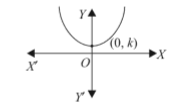
The differential equation of all parabolas, whose axes are parallel to $Y$-axis, is
Answer(c) : We have given equation of parabola whose axes are parallel to $y$-axis.
$\therefore \quad$ Vertex is $(h, k)$
So, $(x-h)^2=4 a(y-k)$
On differentiating both sides, we get
$
2(x-h)=4 a \frac{d y}{d x}
$
Again on differentiating both sides, we get
$
2=4 a \frac{d^2 y}{d x^2}
$
Again, on differentiating both sides, we get $0=4 a \cdot \frac{d^3 y}{d x^3}$
$
\begin{aligned}
& \Rightarrow \frac{d^3 y}{d x^3}=0 \\
& \Rightarrow y_3=0
\end{aligned}
$
View full question & answer→MCQ 192 Marks
The particular solution of the differential equation $\left(1+y^2\right) d x-x y d y=0$ at $x=1, y=0$, represents
Answer(c) : $\left(1+y^2\right) d x-x y d y=0$
$
\Rightarrow \frac{d y}{d x}=\frac{1+y^2}{x y} \Rightarrow \frac{1}{x} d x=\frac{y}{1+y^2} d y
$
On integrating both sides, we get
$
\int \frac{1}{x} d x=\int \frac{y}{1+y^2} d y
$
$
\Rightarrow \ln x+\ln c=\int \frac{y}{1+y^2} d y
$
Let $1+y^2=t \Rightarrow y d y=\frac{d t}{2} \Rightarrow \ln (x c)=\int \frac{1}{2 t} d t$
$
\begin{aligned}
& \Rightarrow \ln (x c)=\frac{1}{2} \ln \left(y^2+1\right) \\
& \Rightarrow \ln (x c)=\ln \left(y^2+1\right)^{1 / 2} \\
& \Rightarrow x c=\left(y^2+1\right)^{1 / 2} \Rightarrow x^2 c^2=\left(y^2+1\right)
\end{aligned}
$
Now, at $x=1, y=0$
$
\Rightarrow c^2=1 \Rightarrow y^2+1=x^2 \Rightarrow x^2-y^2=1
$
This represent a hyperbola.
View full question & answer→MCQ 202 Marks
If a body cools from $80^{\circ} C$ to $50^{\circ} C$ in the room temperature of $25^{\circ} C$ in 30 minutes, then the temperature of the body after 1 hour is
- A
$31.36^{\circ} C$
- B
$32.25^{\circ} C$
- ✓
$36.36^{\circ} C$
- D
$33.25^{\circ} C$
AnswerCorrect option: C. $36.36^{\circ} C$
(c) : Let $\theta^{\circ} C$ be the temperature of the body at time $t$ minutes. Room temperature is given $25^{\circ} C$.
$
\begin{aligned}
& \therefore \frac{d \theta}{d t} \propto(\theta-25) [Newton's law of cooling] \\
& \therefore \frac{d \theta}{d t}=-k(\theta-25), \text { where } k>0 \\
& \Rightarrow \frac{d \theta}{\theta-25}=-k d t
\end{aligned}
$
$\therefore \frac{d \theta}{d t}=-k(\theta-25)$, where $k>0$
On integrating, we get $\log (\theta-25)=-k t+c$ ...(i)
Initially at $t=0, \theta=80^{\circ} C$
$\therefore \log (80-25)=c$
$\Rightarrow c=\log 55$ ...(ii)
$\Rightarrow \log \left(\frac{\theta-25}{55}\right)=-k t$ ...(iii) [Using (i) and (ii)]
Now, at $t=30, \theta=50$
$
\begin{aligned}
& \Rightarrow \log \left(\frac{50-25}{55}\right)=-30 k \Rightarrow k=\frac{-1}{30} \log \left(\frac{5}{11}\right) \\
& \therefore \log \left(\frac{\theta-25}{55}\right)=\frac{t}{30} \log \left(\frac{5}{11}\right)
\end{aligned}
$
After 1 hour, i.e., at $t=60$ minutes
$
\begin{gathered}
\log \left(\frac{\theta-25}{55}\right)=2 \log \left(\frac{5}{11}\right) \Rightarrow \frac{\theta-25}{55}=\left(\frac{5}{11}\right)^2 \\
\Rightarrow \theta-25=\frac{25}{121} \times 55 \Rightarrow \theta=25+\frac{125}{11}=\frac{400}{11}=36.36
\end{gathered}
$
$\therefore \quad$ After 1 hour temperature of body is $36.36^{\circ} C$.
View full question & answer→MCQ 212 Marks
If the slope of the tangent of the curve at any point is equal to $-y+e^{-x}$, then the equation of the curve passing through origin is
Answer(c) : Given, $\frac{d y}{d x}=-y+e^{-x}$
$\Rightarrow \frac{d y}{d x}+y=e^{-x}$, which is linear D.E.
$
\therefore \quad \text { I.F. }=e^{\int d x}=e^x
$
$\therefore$ Solution of the given equation is $y e^x=\int e^x e^{-x} d x+c$
$
\Rightarrow y e^x=x+c \Rightarrow y e^x-x=c
$
Since, curve passing through origin $(0,0)$.
$
\Rightarrow 0-0=c \Rightarrow c=0
$
$\therefore y e^x-x=0$ is the required equation of curve.
View full question & answer→MCQ 222 Marks
The differential equation representing the family of curves $y^2=2 c(x+\sqrt{c})$, where $c$ is a positive parameter, is of
Answer(d) : Given family of curves is $y^2=2 c(x+\sqrt{c})$ ...(i)
On differentiating (i) w.r.t. to $x$, both sides, we get
$
2 y \frac{d y}{d x}=2 c \Rightarrow c=y \frac{d y}{d x}
$
From (i), we have
$
\begin{aligned}
& y^2=2 y \frac{d y}{d x}\left\{x+\left(y \frac{d y}{d x}\right)^{1 / 2}\right\} \\
\Rightarrow & y^2-2 x y \frac{d y}{d x}=2\left(y \frac{d y}{d x}\right)^{3 / 2}
\end{aligned}
$
On squaring both sides, we get
$
\left(y^2-2 x y \frac{d y}{d x}\right)^2=4\left(y \frac{d y}{d x}\right)^3
$
$\therefore$ Order of differentiatial eqation $=1$
Degree of differentiatial eqation $=3$
View full question & answer→MCQ 232 Marks
The differential equation of $y=e^x(a \cos x+b \sin x)$ is
- A
$\frac{d^2 y}{d x^2}-2 \frac{d y}{d x}-y=0$
- B
$\frac{d^2 y}{d x^2}+2 \frac{d y}{d x}+2 y=0$
- C
$\frac{d^2 y}{d x^2}-2 \frac{d y}{d x}+y=0$
- D
$\frac{d^2 y}{d x^2}-2 \frac{d y}{d x}+2 y=0$
Answer(d) : $y=e^x(a \cos x+b \sin x)$
Differentiating both sides w.r.t. ' $x$ ', we get
$
\begin{aligned}
& \frac{d y}{d x}=e^x(a \cos x+b \sin x)+e^x(b \cos x-a \sin x) \\
\Rightarrow & \frac{d y}{d x}=y+e^x(b \cos x-a \sin x) ...(i)
\end{aligned}
$
Again differentiating both sides w.r.t. ' $x$ ', we get
$
\begin{aligned}
& \frac{d^2 y}{d x^2}=\frac{d y}{d x}+e^x(b \cos x-a \sin x)+e^x(-b \sin x-a \cos x) \\
& =\frac{d y}{d x}+\frac{d y}{d x}-y-e^x(a \cos x+b \sin x) \quad \text { [Using (i)] } \\
& =\frac{2 d y}{d x}-2 y \Rightarrow \frac{d^2 y}{d x^2}-2 \frac{d y}{d x}+2 y=0
\end{aligned}
$
View full question & answer→MCQ 242 Marks
The general solution of differential equation $\frac{d y}{d x}=e^{x+y}+x^2 e^{x^3+y}$ is (where C is a constant of integration)
Answer$\begin{aligned} & \text {(b) : } \frac{d y}{d x}=e^{x+y}+x^2 e^{x^3+y} \\ & \Rightarrow \frac{d y}{d x}=e^x \cdot e^y+x^2 e^{x^3} \cdot e^y\end{aligned}$
$
\Rightarrow e^{-y} d y=\left(e^x+x^2 e^{x^3}\right) d x
$
By integrating on both sides, we get
$
\begin{aligned}
& \int e^{-y} d y=\int e^x d x+\int x^2 e^{x^3} d x \\
& \Rightarrow-e^{-y}=e^x+\int x^2 e^{x^3} d x ...(i)
\end{aligned}
$
Let $I=\int x^2 e^{x^3} d x$
Let $x^3=t \Rightarrow x^2 d x=\frac{d t}{3}$
$
\therefore \quad I=\frac{1}{3} \int e^t d t=\frac{1}{3} e^t+C=\frac{1}{3} e^{x^3}+C
$
Substituting the value of $I$ in equation (i), we get
$
\begin{aligned}
& -e^{-y}=e^x+\frac{1}{3} e^{x^3}+C \\
& \Rightarrow e^x+e^{-y}+\frac{1}{3} e^{x^3}=C_1 \quad\left[C_1=-C\right]
\end{aligned}
$
View full question & answer→MCQ 252 Marks
Solution of the differential equation $2 y \sin x \frac{d y}{d x}=2 \sin x \cos x-y^2 \cos x$ satisfying $y(\pi / 2)=1$ is given by
- A
$y^2=\sin x$
- B
$y=\sin ^2 x$
- C
$y^2=\cos x+1$
- D
$y^2 \sin x=4 \cos ^3 x$
Answer(a) : The given equation can be written as
$
\begin{aligned}
& 2 y \sin x \frac{d y}{d x}+y^2 \cos x=\sin 2 x \Rightarrow \frac{d}{d x}\left(y^2 \sin x\right)=\sin 2 x \\
& \Rightarrow y^2 \sin x=(-1 / 2) \cos 2 x+C ...(i) \\
& \text { So }(y(\pi / 2))^2 \sin (\pi / 2)=(-1 / 2) \cos (2 \pi / 2)+C \\
& \Rightarrow C=1 / 2...(ii)
\end{aligned}
$
From (i) and (ii), we have
$
y^2 \sin x=(1 / 2)(1-\cos 2 x)=\sin ^2 x \Rightarrow y^2=\sin x
$
View full question & answer→MCQ 262 Marks
If $y_1(x)$ is a solution of the differential equation $d y / d x-f(x) y=0$, then a solution of the differential equation $\frac{d y}{d x}+f(x) y=r(x)$ is
Answer(a): We have, $\frac{d y}{d x}-f(x) \cdot y=0$
$
\Rightarrow \frac{d y}{y}=f(x) d x \Rightarrow \ln y=\int f(x) d x \Rightarrow y_1(x)=e^{\int f(x) d x}
$
For required equation, I.F. $=e^{\int f(x) d x}$
Hence solution is $y \cdot y_1(x)=\int r(x) \cdot y_1(x) d x$
i.e., $y=\frac{1}{y_1(x)} \int r(x) \cdot y_1(x) d x$
View full question & answer→MCQ 272 Marks
The solution of the differential equation $y_1 y_3=3 y_2{ }^2$ is
Answer(a): We have, $y_1 y_3=3 y_2{ }^2$
$
\begin{aligned}
& \Rightarrow \frac{y_3}{y_2}=3 \frac{y_2}{y_1} \Rightarrow \ln y_2=3 \ln y_1+\ln c \\
& \Rightarrow y_2=c y_1{ }^3 \Rightarrow \frac{y_2}{y_1^2}=c y_1 \quad \therefore-\frac{1}{y_1}=c y+c_2 \\
& \Rightarrow \frac{d x}{d y}=-c y-c_2 \Rightarrow x=-\frac{c y^2}{2}-c_2 y+c_3 \\
& \therefore x=A_1 y^2+A_2 y+A_3
\end{aligned}
$
View full question & answer→MCQ 282 Marks
The general solution of the differential equation of all circles having centre at $A(-1,2)$ is
- A
$x^2+y^2+x-2 y+c=0$
- B
- C
$x^2+y^2-x+2 y+c=0$
- ✓
Answer(d) : General equation of all circles having centre at $A(-1,2)$ is
$(x+1)^2+(y-2)^2=r^2$; where $r=$ radius of circles
$\Rightarrow x^2+1+2 x+y^2+4-4 y=r^2$
On differentialing w.r.t ' $x$, we get
$2 x+2+2 y \frac{d y}{d x}-4 \frac{d y}{d x}=0 \Rightarrow \frac{d y}{d x}(2 y-4)=-2 x-2$
$\Rightarrow(2 y-4) d y=(-2 x-2) d x$
$\Rightarrow \int 2 y d y=\int 4 d y=\int-2 x d x-\int 2 d x$
$\Rightarrow y^2-4 y=-x^2-2 x-c \Rightarrow z^2+y^2+2 x-4 y+c=0$
View full question & answer→MCQ 292 Marks
The order of the differential equation of all circles whose radius is 4 , is
Answer(b) : Equation of a circle having radius $=4$ is
$
(x-a)^2+(y-b)^2=4^2 ...(i)
$
where $(a, b)$ is the centre of the circle.
$
\Rightarrow \quad(x-a)^2+(y-b)^2=16
$
On differentiating w.r.t. ' $x$ ', we get
$
2(x-a)+2(y-b) y^{\prime}=0 \Rightarrow(x-a)+(y-b) y^{\prime}=0 ...(ii)
$
On differentiating again w.r.t. ' $x$ ', we get
$
\begin{array}{r}
1+\left(y^{\prime}\right)^2+(y-b) y^{\prime \prime}=0 \\
\Rightarrow y-b=\frac{-\left(1+\left(y^{\prime}\right)^2\right)}{y^{\prime \prime}}
\end{array}
$
Substituting value of $(y-b)$ in (ii), we get
$
(x-a)-\frac{\left(1+\left(y^{\prime}\right)^2\right)}{y^{\prime \prime}} y^{\prime}=0 \Rightarrow(x-a)=\frac{\left(1+\left(y^{\prime}\right)^2\right) y^{\prime}}{y^{\prime \prime}}
$
Now, substituting value of $(x-a)$ and $(y-b)$ in (i), we get
$
\begin{aligned}
& {\left[\frac{\left(1+\left(y^{\prime}\right)^2\right) y^{\prime}}{y^{\prime \prime}}\right]^2+\left[\frac{-\left(1+\left(y^{\prime}\right)^2\right)}{y^{\prime \prime}}\right]^2=4^2} \\
& \Rightarrow\left(\left(1+\left(y^{\prime}\right)^2\right) y^{\prime}\right)^2+\left(1+\left(y^{\prime}\right)^2\right)^2=16\left(y^{\prime \prime}\right)^2 \\
& \therefore \text { Order is 2 }
\end{aligned}
$
View full question & answer→MCQ 302 Marks
The solution of the differential equation $\frac{d \theta}{d t}=-k\left(\theta-\theta_0\right)$ where $k$ is constant, is
Answer(a) : We have, $\frac{d \theta}{d t}=-k\left(\theta-\theta_0\right)$
$
\begin{aligned}
& \Rightarrow \int \frac{d \theta}{\theta-\theta_0}=-k \int d t \\
& \Rightarrow \log \left(\theta-\theta_0\right)=-k t+c \Rightarrow \theta-\theta_0=e^{-k t+c}=e^{-k t} \cdot e^c \\
& \Rightarrow \theta=\theta_0+a e^{-k t} ; \text { where } a=e^c
\end{aligned}
$
View full question & answer→MCQ 312 Marks
The solution of the differential equation $y d x-x d y$ $=x y d x$ is
- A
- B
- C
$x y=c e^2$
- D
$x^2 y^2=c \log x$
Answer(b): We have, $y d x-x d y=x y d x$
$
\begin{aligned}
& \Rightarrow y d x-x y d x=x d y \Rightarrow y(1-x) d x=x d y \\
& \Rightarrow\left(\frac{1-x}{x}\right) d x=\frac{d y}{y} \Rightarrow \int\left(\frac{1-x}{x}\right) d x=\int \frac{d y}{y} \\
& \Rightarrow \int \frac{1}{x} d x-\int 1 d x=\log y+c_1 \Rightarrow \log x-x=\log y+c_1 \\
& \Rightarrow \log x-\log y=x+c_1 \Rightarrow \log \left(\frac{x}{y}\right)=x+c_1 \\
& \Rightarrow \frac{x}{y}=e^{x+c_1}=e^x \cdot e^{c_1} \Rightarrow x=c y e^x\left[\text { where } c=e^{c_1}\right]
\end{aligned}
$
View full question & answer→MCQ 322 Marks
The particular solution of the differential equation $\log \left(\frac{d y}{d x}\right)=x$, when $x=0, y=1$ is
Answer(d) : We have, $\log \left(\frac{d y}{d x}\right)=x$
$
\begin{aligned}
& \Rightarrow \frac{d y}{d x}=e^x \Rightarrow d y=e^x d x \\
& \Rightarrow \int d y=\int e^x d x \Rightarrow y=e^x+c
\end{aligned}
$
Now, at $x=0, y=1$
$
\therefore \quad 1=1+c \Rightarrow c=0
$
$\therefore \quad$ Particular solution is $y=e^x$.
View full question & answer→MCQ 332 Marks
The general solution of $x \frac{d y}{d x}=y-x \tan \left(\frac{y}{x}\right)$ is
Answer(c) : We are given that $x \frac{d y}{d x}=y-x \tan \left(\frac{y}{x}\right)$
$
\Rightarrow \frac{d y}{d x}=\frac{y}{x}-\tan \left(\frac{y}{x}\right)
$
Clearly, the given differential equation is homogeneous.
$
\begin{aligned}
& \text { Put } y=v x \Rightarrow \frac{d y}{d x}=v+x \frac{d v}{d x} \\
& \therefore v+x \frac{d v}{d x}=v-\tan v \Rightarrow x \frac{d v}{d x}=-\tan v \\
& \Rightarrow \int \cot v d v=-\int \frac{d x}{x} \Rightarrow \log \sin v=-\log x+\log c \\
& \Rightarrow \sin v=\frac{c}{x} \Rightarrow \sin \left(\frac{y}{x}\right)=\frac{c}{x} \Rightarrow x \sin \left(\frac{y}{x}\right)=c
\end{aligned}
$
View full question & answer→MCQ 342 Marks
The order of the differential equation of all parabolas, whee latus rectum is $4 a$ and axis paralle! no the $x$-axis, is
Answer(d) : Equation of the family of such parabolas is
$
(y-k)^2=4 a(x-h) ...(i)
$
where $h$ and $k$ are arbitrary constants.
On differentiating (i) w.r.t. $x$, we get
$
(y-k) \frac{d y}{d x}=2 a ...(ii)
$
On differentiating (ii) w.r.t. $x$, we get
$
(y-k) \frac{d^2 y}{d x^2}+\left(\frac{d y}{d x}\right)^2=0 ...(ii)
$
On putting value of $(y-k)$ from (ii) in (iii), we get
$
2 a \frac{d^2 y}{d x^2}+\left(\frac{d y}{d x}\right)^3=0
$
Hence the order of required differential equation is 2.
View full question & answer→MCQ 352 Marks
The general solution of differential equation $\frac{d x}{d y}=\cos (x+y)$ is
- A
$\tan \left(\frac{x+y}{2}\right)=y+c$
- B
$\tan \left(\frac{x+y}{2}\right)=x+c$
- C
$\cot \left(\frac{x+y}{2}\right)=y+c$
- D
$\cot \left(\frac{x+y}{2}\right)=x+c$
Answer(a) : We have $d x / d y=\cos (x+y)$...(i)
Let $x+y=v$
On differentiating both sides w.r.t. $y$, we get
$
\frac{d x}{d y}+1=\frac{d v}{d y} \Rightarrow \frac{d x}{d y}=\frac{d v}{d y}-1
$
Put in (i), we get
$
\therefore \quad \frac{d v}{d y}-1=\cos v \Rightarrow \frac{d v}{d y}=1+\cos v \Rightarrow \frac{d v}{d y}=2 \cos ^2 \frac{v}{2}
$
On integrating both sides, we get
$
\begin{aligned}
& \int \frac{d v}{\cos ^2 \frac{v}{2}}=2 \int d y \Rightarrow \int \sec ^2 \frac{v}{2} d v=2 y+K \\
& \Rightarrow \quad 2 \tan \left(\frac{v}{2}\right)=2 y+K \Rightarrow 2 \tan \left(\frac{x+y}{2}\right)=2 y+K \\
& \Rightarrow \quad \tan \left(\frac{x+y}{2}\right)=y+c \quad \quad(\text { where } c=K / 2)
\end{aligned}
$
(where $c=K / 2$ )
View full question & answer→MCQ 362 Marks
The particular solution of the differential equation $x d y+2 y d x=0$, when $x=2, y=1$ is
- A
$x y=4$
- B
$x^2 y=4$
- C
$x y^2=4$
- D
$x^2 y^2=4$
Answer(b) : We have, $x d y+2 y d x=0$
$
\Rightarrow \frac{d y}{y}+2 \frac{d x}{x}=0
$
Integrating both sides, we get
$\log y+2 \log x=\log C \Rightarrow x^2 y=C$...(i)
Put $x=2 ; y=1$ in (i), we get $C=4$
$\therefore \quad$ Particular solution is $x^2 y=4$
View full question & answer→MCQ 372 Marks
The solution of the differential equation $\frac{d y}{d x}=\tan \left(\frac{y}{x}\right)+\frac{y}{x}$ is
Answer(b) : We have, $\frac{d y}{d x}=\tan \left(\frac{y}{x}\right)+\left(\frac{y}{x}\right)$ Put $\frac{y}{x}=v \Rightarrow y=v x \Rightarrow \frac{d y}{d x}=v+x \frac{d v}{d x}$
$\therefore \quad$ The given equation becomes
$
v+x \frac{d v}{d x}=\tan v+v \Rightarrow \frac{1}{\tan v} d v=\frac{1}{x} d x
$
Integrating both sides, we get, $\int \cot v d v=\int \frac{1}{x} d x$
$
\begin{aligned}
& \Rightarrow \log |\sin v|=\log x+\log c=\log (x c) \\
& \Rightarrow \sin v=x c \Rightarrow \sin \left(\frac{y}{x}\right)=x c
\end{aligned}
$
View full question & answer→MCQ 382 Marks
The differential equation of all parabolas whose axis is $y$-axis is
- A
$x \frac{d^2 y}{d x^2}-\frac{d y}{d x}=0$
- B
$x \frac{d^2 y}{d x^2}+\frac{d y}{d x}=0$
- C
- D
$\frac{d^2 y}{d x^2}-\frac{d y}{d x}=0$
View full question & answer→MCQ 392 Marks
If $\sin x$ is the integrating factor (I.F.) of the linear differential equation $\frac{d y}{d x}+P y=Q$, then $P$ is
- A
$\log \sin x$
- B
$\cos x$
- C
- D
$\cot x$
Answer(d) : $\frac{d y}{d x}+P y=Q$
Since, I.F. $=\sin x$
$
\Rightarrow e^{\int P d x}=\sin x=e^{\log \sin x} \Rightarrow \int P d x=\log \sin x
$
Differentiate both sides w.r.t. $x$, we get
$P=\frac{1}{\sin x} \cdot \cos x=\cot x
$
View full question & answer→MCQ 402 Marks
The particular solution of the differential equation $y(1+\log x) \frac{d x}{d y}-x \log x=0$ when $x=e, y=e^2$ is
- A
$y=e x \log x$
- B
- C
$x y=e \log x$
- D
Answer$\begin{aligned} & \text { (a) : } y(1+\log x) \frac{d x}{d y}-x \log x=0 \\
& \Rightarrow \quad y \frac{d x}{d y}=\frac{x \log x}{1+\log x} \Rightarrow \int \frac{d y}{y}=\int\left(\frac{1+\log x}{x \log x}\right) d x \\
& \Rightarrow \log y=\log (x \log x)+\log c \Rightarrow y=c x \log x \\
& \text { When } y=e^2, x=e \Rightarrow e^2=c e \log e \Rightarrow c e=e^2 \Rightarrow c=e \\
& \therefore \quad y=e x \log x\end{aligned}$
View full question & answer→MCQ 412 Marks
The degree and order of the differential equation $\left[1+\left(\frac{d y}{d x}\right)^3\right]^{7 / 3}=7\left(\frac{d^2 y}{d x^2}\right)$ respectively are
Answer(b) 1 Given $:\left[1+\left(\frac{d y}{d x}\right)^5\right]^{2 / 3}=7\left(\frac{d^2 y}{d x^2}\right)$
$=\left[1+\left(\frac{d y}{d x}\right)^3\right]^2=(7)^3\left(\frac{d^2 y}{d x^2}\right)^3$
$\Rightarrow$ Order =2 and Degree $=3$
View full question & answer→MCQ 422 Marks
If $\frac{d y}{d x}=\tan ^2(x+y)$, then $\sin 2(x+y)=$
- A
$x-y+c$
- B
$2(x-y)+c$
- C
$x+y+c$
- D
Answer(b) : Substitute $x+y=z \Rightarrow \frac{d y}{d x}=\frac{d z}{d x}-1$
So, the given equation becomes
$
\begin{aligned}
& \frac{d z}{d x}=\sec ^2 z \Rightarrow d x=\cos ^2 z d z \\
\Rightarrow & d x=\left(\frac{1+\cos 2 z}{2}\right) d z \\
\Rightarrow & x=\frac{1}{2}\left(z+\frac{\sin 2 z}{2}\right)+c_1 (Integrating) \\
\Rightarrow & 2 x=x+y+\frac{\sin 2(x+y)}{2}+c_2 \\
\Rightarrow & 2(x-y)=\sin 2(x+y)-c \\
\Rightarrow & \sin 2(x+y)=2(x-y)+c
\end{aligned}
$
View full question & answer→MCQ 432 Marks
The solution of $\frac{x d y}{d x}=y(\ln y-\ln x+1)$ is
- A
$x \ln \frac{y}{x}=c y$
- B
- C
$\ln \frac{x}{y}=c y$
- D
$\ln \frac{y}{x}=c x$
Answer(d) : $\frac{d y}{d x}=\frac{y}{x}\left(1+\ln \frac{y}{x}\right)$
Substitute $y=v x \Rightarrow \frac{d y}{d x}=\frac{x d v}{d x}+v$
So, given equation becomes $\frac{x d v}{d x}+v=v(1+\ln v)$
$
\begin{aligned}
& \Rightarrow \int \frac{d v}{v \ln v}=\int \frac{d x}{x} \Rightarrow \ln \left(\ln \frac{y}{x}\right)=\ln x+\ln c \\
& \Rightarrow \ln \frac{y}{x}=c x .
\end{aligned}
$
View full question & answer→