Questions

Solve the Following Question.(3 Marks)

Take a timed test

11 questions · self-marked practice — reveal the answer and mark yourself.

Question 13 Marks
Evaluate : $\int \frac{1}{5-4 \cos x} d x$
Answer
$I=\int \frac{1}{5-4 \cos x} d x$
Put $\tan \frac{x}{2}= t , $
$\therefore \frac{x}{2}=\tan ^{-1} t \text {, }$
$\therefore x=2 \tan ^{-1} t$
$\therefore d x=\frac{2}{1+t^2} d t$
and $\cos x=\frac{1-t^2}{1+t^2}$
$\therefore I=\int \frac{\frac{2 d t}{1+t^2}}{5-4\left(\frac{1-t^2}{1+t^2}\right)}$
$=\int \frac{2 d t}{5+5 t^2-4+4 t^2}$
$=2 \int \frac{d t}{9 t^2+1}$
$=2 \int \frac{d t}{(3 t)^2+1}$
$=\frac{2}{3} \tan ^{-1}(3 t)+c$
$=\frac{2}{3} \tan ^{-1}\left(3 \tan \frac{x}{2}\right)+c$
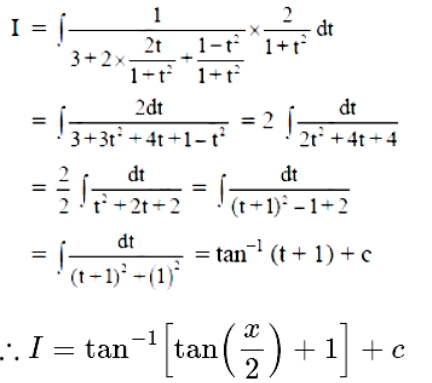
View full question & answer
Question 23 Marks
If $x=\phi(t)$ is a differentiable function of ' $t$ ', then prove that $\int f(x) d x=\int f[\phi(t)] \phi^{\prime}(t) d t$
View full question & answer
Question 33 Marks
Evaluate : $\int \frac{d x}{2+\cos x-\sin x}$
Answer
$I =\int \frac{d x}{2+\cos x-\sin x}$
Put $\tan \left(\frac{x}{2}\right)=t, \therefore \frac{x}{2}=\tan ^{-1} t$
$\therefore x=2 \tan ^{-1} t, d x=\frac{2}{1+t^2} d t$
Also $\cos x=\frac{1-t^2}{1+t^2}, \sin x=\frac{2 t}{1+t^2}$
$\therefore I =\int \frac{\frac{2 d t}{1+t^2}}{2+\frac{1-t^2}{1+t^2}-\frac{2 t}{1+t^2}}$
$ =\int \frac{2 d t}{2+2 t^2+1-t^2-2 t}$
$ =\int \frac{2 d t}{t^2-2 t+3}$
$ =2 \int \frac{d t}{t^2-2 t+1+2}$
$ =2 \int \frac{d t}{(t-1)^2+(\sqrt{2})^2}$
$=\frac{2}{\sqrt{2}} \tan ^{-1}\left(\frac{t-1}{\sqrt{2}}\right)+c$
$=\sqrt{2} \tan ^{-1}\left(\frac{\tan \frac{x}{2}-1}{\sqrt{2}}\right)+c$
View full question & answer
Question 53 Marks
Evaluate: $\int \frac{1+\log x}{x(2+\log x)(3+\log x)} d x$
Answer

Let $I=\int \frac{1+\log x}{x(2+\log x)(3+\log x)} d x$
Put
$\log x=t$
$\frac{1}{x} d x=d t$
$I=\int \frac{1+t}{(2+t)(3+t)} d t$
consider
$\frac{1+t}{(2+t)(3+t)}=\frac{A}{2+t}+\frac{B}{3+t}$
$(1+t)=A(3+t)+B(2+t)$
A=-1,B=2
$\begin{aligned} & \frac{1+t}{(2+t)(3+t)}=-\frac{1}{2+t}+\frac{2}{3+t} \\ & I=\int-\frac{1}{2+t} d t+\int \frac{2}{3+t} d t \\ & =-\log |(2+t)|+2 \log |(3+t)|+c \\ & =\log \left[\left|\frac{(3+t)^2}{2+t}\right|\right]+c \\ & =\log \left[\left|\frac{(3+\log x)^2}{2+\log x}\right|\right]+C\end{aligned}$

View full question & answer
Question 63 Marks
Integrate $\sec ^3 x$ w.r.t. $x$
Answer

$\begin{aligned} & I=\int \sec ^3 x d x \\ & I=\int \sec x \cdot \sec ^2 x d x \\ & I=\sec x \cdot \int \sec ^2 x d x-\int\left[\frac{d}{d x}(\sec x) \cdot \int \sec ^2 x d x\right] d x \\ & I=\sec x \cdot \tan x-\int \sec x \cdot \tan x \cdot \tan x d x \\ & I=\sec x \cdot \tan x-\int \sec x\left(\sec ^2 x-1\right) d x \\ & I=\sec x \cdot \tan x-\int\left[\sec ^3 x-\sec x\right] d x \\ & I=\sec x \cdot \tan x-\int \sec ^3 x+\int \sec x d x \\ & I=\sec x \cdot \tan x-I+\log |\sec x+\tan x|+c \\ & 2 I=\sec x \cdot \tan x+\log |\sec x+\tan x|+c \\ & \therefore I=\frac{1}{2}(\sec x \cdot \tan x+\log |\sec x+\tan x|)+c\end{aligned}$

View full question & answer
Question 83 Marks
Evaluate: $\int \frac{1}{3+5 \cos x} d x$
Answer

Let $I=\int \frac{1}{3+5 \cos x} d x$ put $\tan \left(\frac{x}{2}\right)=t$
then $d x=\frac{2}{1+t^2} d t$ and $\cos x=\frac{1-t^2}{1+t^2}$
$I=\int \frac{2 \frac{d t}{1+t^2}}{3+5\left(\frac{1-t^2}{1+t^2}\right)}$
$=2 \int \frac{\frac{d t}{1+t^2}}{\frac{3\left(1+t^2\right)+5\left(1-t^2\right)}{1+t^2}}$
$=2 \int \frac{d t}{3+3 t^2+5-5 t^2}$
$=2 \int \frac{d t}{8-2 t^2}$
$=\int \frac{d t}{2^2-t^2}$
$\begin{aligned} & =\frac{1}{2(2)} \log \left|\frac{2+t}{2-t}\right|+c \\ & =\frac{1}{4} \log \left|\frac{2+\tan \left(\frac{x}{2}\right)}{2-\tan \left(\frac{x}{2}\right)}\right|+c\end{aligned}$

View full question & answer
Question 113 Marks

If u and v are two functions of x then prove that
$\int u v d x=u \int v d x-\int\left[d \frac{u}{d x} \int v d x\right] d x$
Hence evaluate, $\int x e^x d x$


Answer

Let $\int v d x=w \ldots . .(1)$
then $\frac{d w}{d x}=v \ldots . .(2)$
$N o w \frac{d}{d x}(u, w)=u \cdot \frac{d}{d x}(w)+w \frac{d}{d x}(u)$
$=u . v+w \frac{d u}{d x} \ldots \ldots .$. from $(2)$
By definition of integration.
$u \cdot w=\int\left[u \cdot v+w \frac{d u}{d x}\right] d x$
$=\int u \cdot v d x+\int w \cdot \frac{d u}{d x} d x$
$\int u \cdot v d x=u \cdot w-\int w \frac{d u}{d x} d x$
$=u \int v d x-\int\left[\frac{d u}{d x} \int v \cdot d x\right] d x$
[next section only required for question 2]
Hence, $\int x e^x d x=x \cdot \int e^x d x-\int\left[\frac{d}{d x} x \cdot \int e^x d x\right] d x$
$=x e^x-\int 1 \times e^x d x$
$=x e^x-e^x+c$

View full question & answer
Solve the Following Question.(3 Marks) - Maths STD 12 Science Questions - Vidyadip