Question 14 Marks
Solve the following L.P.P. using graphical method:
Minimize, $z=8 x+10 y$
Subject to $2 x+y \geq 7,2 x+3 y \geq 15, y \geq 2, x \geq 0$
Answer| To draw line | | $x$ | $y$ | The line passes through $(x, y)$ |
| sign | Origin lies on |
| $L_1:$ $2 x+y=7$ | | 0 | 7 | $A (0,7)$ | | 3.5 | 0 | $B (3.5 .0)$ |
| $\geq$ | Non origin side of $L _1$ |
| $L _2:$ $2 x+3 y=15$ | | 0 | 5 | $C (0,5)$ | | 7.5 | 0 | $B (7.5,0)$ |
| $\geq$ | Non origin side of $L_2$ |
| $L _3: $ $y=2$ | $L _3$ is parallel to x-axis | $z$ | Non origin side of $L_3$ |
Solving equations of $L_1$ and $L_2$
$2 x+y=7$
$2 x+3 y=15$
____________
$y=4, \quad x=1.5$
$\therefore P (1.5,4)$
Solving equations of $L _2, L _3$
$Q=(4.5 ; 2)$
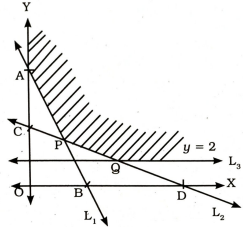
The shaded feasible region is unbounded feasible region in the graph with vertices at $A (0,7), P (1.5,4)$ and $Q (4.5,2)$
| $(x, y)$ Vertices | Value of $Z =8 x+10 y$ |
| $A (0,7)$ | 70 |
| $P (1.5,4)$ | $12+40=52$ |
| $Q (4.5,2)$ | $36+20=56$ |
From the above table, minimum value of $Z$ is 52 at $x=1.5, y=4$.
View full question & answer→Question 24 Marks
Minimize $Z =6 x+4 y$
Subject to the conditions, $3 x+2 y \geq 12, x+y \geq 5,0 \leq x \leq 4,0 \leq y \leq 4$
View full question & answer→Question 34 Marks
Solve the following LPP by using graphical method.
Maximize : $Z =6 x+4 y$
Subject to $x \leq 2, x+y \leq 3,-2 x+y \leq 1, x \geq 0, y \geq 0$.
Also find maximum value of $Z$.
Answer| Inequalities | $x \leq 2$ | $x+y \leq 3$ | $-2 x+y \leq 1$ |
| Equalities | $x=2$ | $x+y=3$ | $-2 x+y=1$ |
| Intercept form | $\frac{x}{2}=1$ | $\frac{x}{3}+\frac{y}{3}=1$ | $\frac{x}{-\frac{1}{2}}+\frac{y}{1}=1$ |
| Origin Test | $0 \leq 2$ | $0+0 \leq 3$ | $-2(0)+0 \leq 1$ |
| | True Origin Side | True Origin Side | True Origin Side |
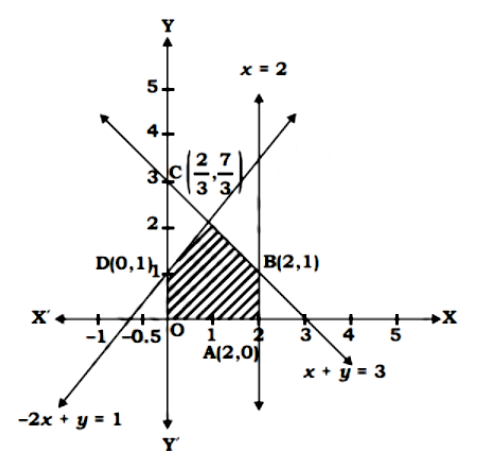
Shaded portion OABC is the feasible region, Where O(0,0) A(2, 0) D(0, 1), B(2, 1)
For C :
x + y = 3
– 2x + y = 1
– – –
-----------------
3x = 2
∴ x = 2/3
2/3+y=3 i.e y=7/3
$\therefore c\left(\frac{2}{3}, \frac{7}{3}\right)$
Z = 6x + 4y
Z at O(0, 0) = 6(0) + 4(0) = 0
Z at A(2, 0) = 6(2) + 4(0) = 12
Z at B(2, 1) = 6(2) + 4(1) = 16
$Z$ at $c\left(\frac{2}{3}, \frac{7}{3}\right)=6\left(\frac{2}{3}\right)+\left(\frac{7}{3}\right) 4=\frac{40}{3}$
Z at D(0,1) = 6(0) + 4(1) = 4 Thus, Z is maximized at B(2, 1) and its maximum value is 16.
View full question & answer→Question 44 Marks
Solve the following L.P.P. graphically.
Minimize $Z =6 x+2 y$
Subject to $5 x+9 y \leq 90, x+y \geq 4, y \leq 8, x \geq 0, y \geq 0$
AnswerTo draw the feasible region, construct table as follows:
| Inequality | $5 x+9 y \leq$90 | $x+y \geq 4$ | $y \leq 8$ |
| Corresponding equation (of line) | $5 x+9 y=$90 | $x+y=4$ | $y=8$ |
| Intersection of line with X-axis | $(18,0)$ | $(4,0)$ | - |
| Intersection of line with Y-axis | $(0,10)$ | $(0,4)$ | $(0,8)$ |
| Region | Origin side | Non-origin side | Origin side |
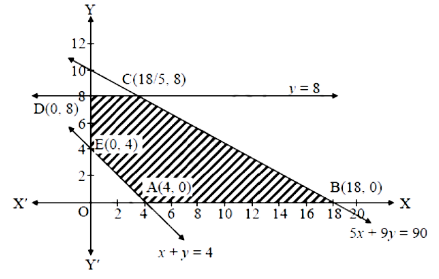
Shaded portion ABCDE is the feasible region, whose vertices are A(4, 0), B(18, 0), C,D(0, 8) and E(0, 4).
C is the point of intersection of the lines y = 8 and 5x + 9y = 90.
Putting y = 8 in 5x + 9y = 90, we get
5x + 72 = 90
∴ x = 18/5
$\therefore C=\left(\frac{18}{5}, 8\right)$
Here, the objective function is Z = 6x + 2y,
Z at A(4, 0) = 6(4) + 2(0) = 24
Z at B(18, 0) = 6(18) + 2(0) = 108
$Z$ at $C\left(\frac{18}{5}, 8\right)=6\left(\frac{18}{5}\right)+2(8)$
= 188/5 = 37.6
Z at D(0, 8) = 6(0) + 2(8) = 16
Z at E(0, 4) = 6(0) + 2(4) = 8
∴ Z has minimum value 8 at E(0, 4).
∴ Z is minimum, when x = 0 and y = 4.
View full question & answer→Question 54 Marks
Solve the $\text{L. P. P.}$ by graphical method:
Minimize, $z = 8x + 10y$
Subject to $2x + y ≥ 7,$
$2x + 3y ≥ 15,$
$y≥ 2, x ≥ 0$
Answer
| Inequalities |
Equation of line |
Points |
Origin side |
| $2 x+y \geq 7$ |
$2 x+y=7$
$\frac{x}{\frac{7}{2}}+\frac{y}{7}=1$ |
$P \left(\frac{7}{2}, 0\right)$
$A (0,7)$ |
$X$ |
| $2 x+3y \geq 15$ |
$2 x+3 y=15$
$\frac{x}{15}+\frac{y}{5}=1$ |
$R \left(\frac{15}{2}, 0\right)$
$S (0,5)$ |
$X$ |
| $y \geq 2$ |
$y=2$ |
$Q (0,2)$ |
$X$ |
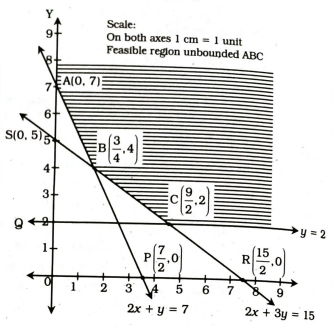
$A (0,7), B \left(\frac{7}{2}, 4\right), C \left(\frac{9}{2}, 2\right)$
By convex polygon theorem, optimum value lies at any of the vertices.
$Z=8 x+10 y$
$Z \mid A (0,7)=8(0)+10(7)=70$
$Z \left\lvert\, B \left(\frac{2}{3}, 4\right)=8\left(\frac{3}{2}\right)+10(4)=52\right.$
$Z \left\lvert\, C \left(\frac{9}{2}, 2\right)=8\left(\frac{9}{2}\right)+10(2)=56\right.$
Minimum value of $Z$ is
$Z =52$ at $B \left(\frac{3}{2}, 4\right)$
i.e. at $x=\frac{3}{2}, y=4$ View full question & answer→Question 64 Marks
Solve the following linear programming problem:
Maximize: $Z =150 x+250 y$
Subject to ; $4 x+y \leq 40$,
$3 x+2 y \leq 60$
$x \geq 0$
$y \geq 0$
View full question & answer→Question 74 Marks
Maximize $Z =3 x+5 y$ Subject to $x+4 y \leq 24,3 x+y \leq 21, x+y \leq 9, x \geq 0, y \geq 0$ also find the maximum value of z.
View full question & answer→Question 84 Marks
Minimize $Z =7 x + y$
Subject to $5 x+y \geq 5, x+y \geq 3, x \geq 0, y \geq 0$
AnswerTo draw the feasible region, construct table as follows:
| Inequality |
$5x + y \geq 5$ |
$x + y \geq 3$ |
| Corresponding equation $($of line$)$ |
$5x + y = 5$ |
$x + y = 3$ |
| Intersection of line with $X-$axis |
$(1, 0)$ |
$(3, 0)$ |
| Intersection of line with $Y-$axis |
$(0, 5)$ |
$(0, 3)$ |
| Region |
Non$-$origin side |
Non$-$origin side |
$x \geq 0, y \geq 0$ represent $1^{st}$ quadrant.
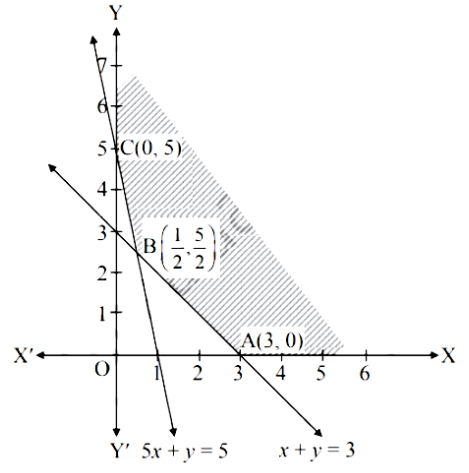
Shaded portion $ \text{XABCY}$ is the feasible region, whose vertices are $A(3, 0), B$ and $C (0, 5).$
$B$ is the point of intersection of the lines $x + y = 3$ and $5x + y = 5.$
Solving the above equations, we get $x=\frac{1}{2}, y=\frac{5}{2}$
$\therefore B \equiv\left(\frac{1}{2}, \frac{5}{2}\right)$
Here, the objective function is $Z = 7x + y$
$\therefore Z$ at $A(3, 0) = 7(3) + 0 = 21$
$Z$ at $B \left(\frac{1}{2}, \frac{5}{2}\right)=7\left(\frac{1}{2}\right)+\frac{5}{2}=\frac{7}{2}+\frac{5}{2}=6$
$Z$ at $C(0,5)=7(0)+5=5$
$\therefore Z$ has minimum value $5$ at $C(0, 5).$
$\therefore Z$ has minimum value $5$ when $x = 0$ and $y = 5.$
View full question & answer→Question 94 Marks
Solve the following LPP by using graphical method.
Maximize : $Z =6 x+4 y$
Subject to $x \leq 2, x+y \leq 3,-2 x+y \leq 1, x \geq 0, y \geq 0$.
View full question & answer→Question 104 Marks
Minimize $Z =4 x+5 y$
Subject to $2 x+y \geq 7,2 x+3 y \leq 15, x \leq 3, x \geq 0, y \geq 0$. Solve using graphical method.
AnswerConsider equations obtained by converting all inequations representing the constraints.
$2 x+y=7$ i.e $\frac{x}{3.5}+\frac{y}{7}=1$
$2 x+3 y=15$ i.e $\frac{x}{7.5}+\frac{y}{5}=1$
$x=3, x=0, y=0$
Plotting these lines on graph we get the feasible region.
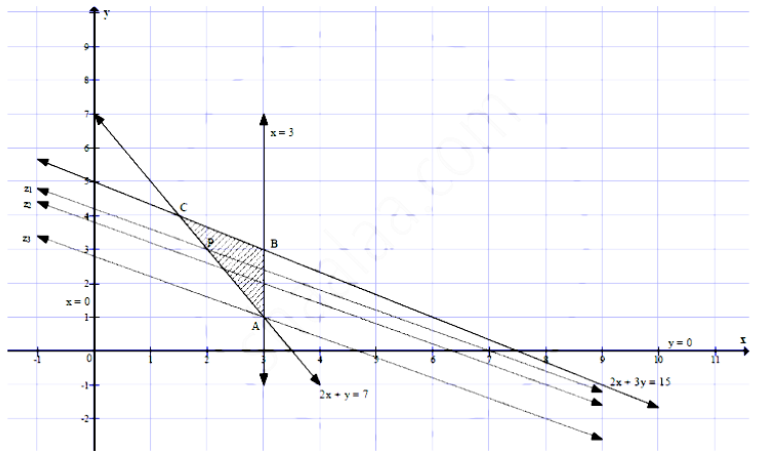
From the graph we can see that $\text{ABC}$ is the feasible region.
Take any one point on the feasible region say $P (2, 3)$ .
Draw initial isocost line z passing through the point $(2, 3)$ .
$\therefore z_1=4(2)+5(3)=8+15=23$
$\therefore$ intial isocost line is $4 x+5 y=23$.
Since the objective function is of minimization type, from the graph we can see that the line $z_3$ contains only one point $A(3, 1)$ of the feasible region $\text{ABC}$.
Minimum value of $z = 4(3)+ 5(1)= 12 + 5 =17$
$z$ is minimum when $x = 3$ and $y = 1.$ View full question & answer→Question 114 Marks
A diet of a sick person must contain at least 48 units of vitamin $A$ and 64 units of vitamin $B$. Two foods $F_1$ and $F_2$ are avallable. Food $F_1$ costs Rs. 6 per unit and food $F_2$ costs Rs. 10 per unit. One unit of food $F_1$ contain 6 units of vitamin $A$ and 7 units of vitamin B. One unit of food $F_2$ contains 8 units of vitamin. $A$ and 12 units of vitamin B. Find the minimum costs for the diet that consists of mixture of these two foods and also meeting the minimal nutritional requirements.
AnswerLet x and y be two different types of food.
Thus, our objective function is minimise the cost
Z = 6x + 10y, subject to the constraints,
6x + 8y ≥48
7x + 12y ≥ 64
Plotting the above lines in a graph, we have,
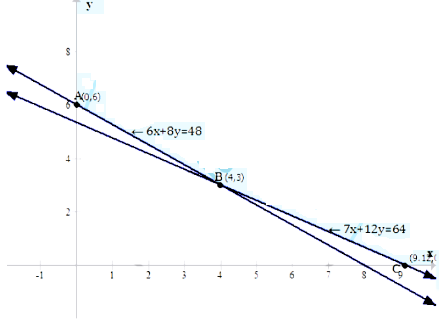
Thus, the region above ABC is unbounded.
Let us check the value of the function at the corner points A, B and C
| Corner point | Value of Z = 6x + 10y |
| (0,6) | Z = 0 + 10 x 6 = 60 |
| (4,3) | Z = 6 x 4 + 10 x 3 = 54 |
| (64/7,0) | Z = 6 x 64/7+ 10 x 0 = 54.85 |
Minimum of the function is at 4, 3
Minimum cost of the optimum diet is Rs. 54
View full question & answer→Question 124 Marks
Minimize $Z=6 x+4 y$
Subject to $3 x+2 y \geq 12, x+y \geq 5,0 \leq x \leq 4,0 \leq y \leq 4$
Answer3x+2y ≥12
Points : (4, 0) and (0, 6), Non origin side
x+y ≥5
Points : (5, 9) and (0, 5), Non origin side
0 ≤x ≤4
Parallel to y-axis, point (4, 0), origin side
0 ≤ y ≤ 4
Parallel to x-axis, point (0, 4), origin side
x ≥ 0, y ≥ 0
x-axis and y-axis, first quadrant only.
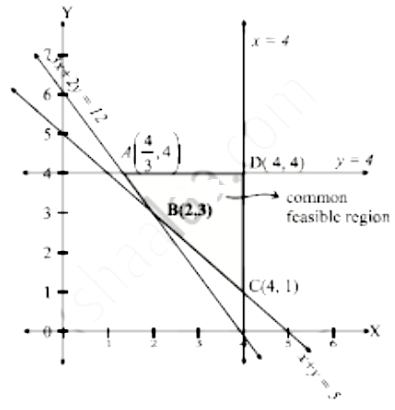
A is the intersection of 3x+2y =12 and y= 4
x=4/3 and y=4
A(4/3, 4)
B is intersection of 3x + 2 y = 12 and x + y= 5
x=2, y=3
B(2,3)
C is the intersection of x = 4 and x + y = 5
x=4, y=1
C(4,1)
D is the intersection of x = 4 and y = 4
D ( 4, 4)
| End Points | value of z=6x+4y |
| A(4/3, 4) | 8+16=24 |
| B(2, 3) | 12+12=24 |
| C(4, 1) | 24+4=28 |
| D(4, 4) | 24+16=40 |
Z is minimum 24 on the segment AB joining A( 4/3 ,4) and (2,3)
View full question & answer→Question 134 Marks
Solve the following L.P.P. graphically.
Minimize $Z=10 x+25 y$
Subject to $x \leq 3, y \leq 3, x+y \leq 5, x \geq 0, y \geq 0$
AnswerFirst we draw the lines AB, CD and EF whose equations are x = 3, y = 3 and x + y = 5 respectively.
| Line | Equation | Point on the
X-axis | Point on the
Y-axis | Sign | Region |
| AB | x = 3 | A(3,0) | - | ≤ | origin side of line AB |
| CD | y = 3 | - | D(0,3) | ≤ | origin side of line CD |
| EF | x + y = 5 | E(5,0) | F(0,5) | ≤ | origin side of line EF |
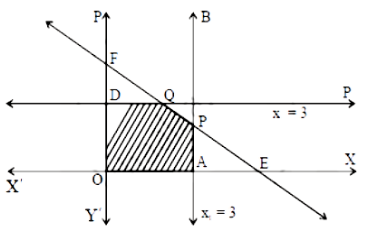
The feasible region is OAPQDO which is shaded in the figure.
The vertices of the feasible region are O (0,0), A (3, 0), P, Q and D (0, 3)
P is the point of intersection of the lines x + y = 5 and x = 3
Substituting x = 3 in x + y = 5, we get,
3+ y=5
y = 2
P≡ (3, 2)
Q is the point of intersection of the lines x + y = 5 and y = 3
Substituting y = 3 in x + y = 5, we get,
x + 3 = 5
x = 2
Q ≡ (2,3)
The values of the objective function z = 10x + 25y at these vertices are
Z(O) =10(0)+ 25(0)= 0
Z(A) =10(3) + 25(0) = 30
Z(P) =10(3) + 25(2) = 30 + 50 = 80
Z(Q) =10(2) + 25(3) = 20 + 75 = 95
Z(D) =10(0) + 25(3) =75
Z has max imumvalue 95, when x = 2 and y = 3.
View full question & answer→Question 144 Marks
Maximize: $Z=6 x+4 y$
Subject to $x \leq 2, x+y \leq 3,-2 x+y \leq 1, x \geq 0, y \geq 0$. Also find maxdmum value of $Z$.
View full question & answer→Question 154 Marks
A company manufactures bicycles and tricycles each of which must be processed through machines A and B. Machine A has maximum of 120 hours avallable and machine B has maximum of 180 hours avallable.
Manufacturing a bicycle requires 6 hours on machine A and 3 hours on machine B. Manufacturing a tricycle requires 4 hours on machine A and 10 hours on machine B.
If profits are 180 for a bicycle end 220 for a tricycle, formulate and solve the L.P.P. to determine the number of bicycles and tricycles that should be manufactured in order to maximize the profit.
AnswerLet x number of bicycles and y number of tricycles be manufactured by the company.
Total profit Z = 180x + 220y
This is the objective function to be maximized.
The given information can be tabulated as shown below:
| | Bicycles (x) | Tricycles (y) | Maximum availability of time (hrs) |
| Machine A | 6 | 4 | 120 |
| Machine B | 3 | 10 | 180 |
The constraints are 6x + 4y ≤ 120, 3x + 10y ≤ 180, x ≥ 0, y ≥ 0
Given problem can be formulated as
Maximize Z = 180x + 220y
Subject to, 6x + 4y ≤ 120, 3x + 10y ≤ 180 , x ≥ 0, y ≥ 0.
To draw the feasible region, construct the table as follows:
| Inequality | 6x + 4y ≤ 120 | 3x + 10y ≤ 180 |
| Corresponding equation (of line) | 6x + 4y = 120 | 3x + 10y = 180 |
| Intersection of line with X-axis | (20, 0) | (60, 0) |
| Intersection of line with Y-axis | (0, 30) | (0, 18) |
| Region | Origin side | Origin side |
Shaded portion OABC is the feasible region, whose vertices are O=(0, 0), A =(20, 0), B and C = (0, 18)
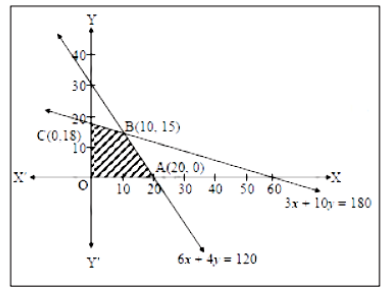
B is the point of intersection of the lines 3x + 10y = 180 and 6x + 4y = 120.
Solving the above equations, we get
B = (10, 15) Here the objective function is,
Z = 180x + 220y
Z at O(0, 0) = 180(0) + 220(0) = 0
Z at A(20, 0) = 180(20) + 220(0) = 3600
Z at B(10, 15) = 180(10) + 220(15) = 5100
Z at C(0, 18) = 180(0) + 220(18) = 3960
Z has maximum value 5100 at B(10, 15)
Z is maximum when x = 10, y = 15
Thus, the company should manufacture 10 bicycles and 15 tricycles to gain maximum profit of Rs.5100.
View full question & answer→Question 164 Marks
The cost of 4 dozen pencils, 3 dozen pens and 2 dozen erasers is $₹ 60$. The cost of 2 dozen pencils, 4 dozen pens and 6 dozen erases is ₹ 90 whereas the cost of 6 dozen pencils, 2 dozen pens and 3 dozen erasers is ₹ 70 . Find the cost of each item per dozen by using matrices.
View full question & answer→Question 174 Marks
Maximize $Z =3 x+5 y$ Subject to $x+4 y \leq 24,3 x+y \leq 21, x+y \leq 9, x \geq 0, y \geq 0$ also find the maximum value of $z.$
AnswerTo draw the feasible region, construct table as follows:
| Inequality |
$x+4 y \leq 24$ |
$3 x+y \leq 21$ |
$x+y \leq 9$ |
| Corresponding equation $($of line$)$ |
$x+4 y=24$ |
$3 x+y=21$ |
$x+y=9$ |
| Intersection of line with $X-$axis |
$(24, 0)$ |
$(7, 0)$ |
$(9, 0)$ |
| Intersection of line with $Y-$axis |
$(0, 6)$ |
$(0, 21)$ |
$(0, 9)$ |
| Region |
Origin side |
Origin side |
Origin side |
$x \geq 0, y \geq 0$ represent $1^{st}$ quadrant.
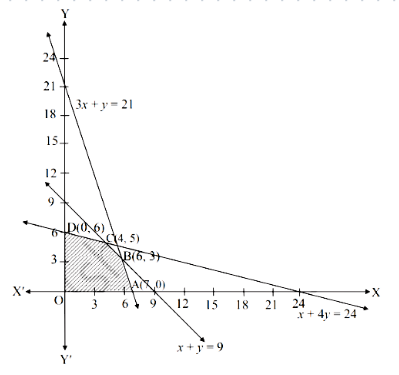
Shaded portion $ \text{OABCD}$ is the feasible region, whose vertices are $O(0, 0), A(7, 0), B, C$ and $D(0, 6).$
$B$ is the point of intersection of the lines $3x + y = 21$ and $x + y = 9.$
Solving the above equations, we get
$x = 6, y = 3$
$\therefore B ≡ (6, 3)$
$C$ is the point of intersection of the lines $x + 4y = 24$ and $x + y = 9.$
Solving the above equations, we get
$x = 4, y = 5$
$\therefore C ≡ (4, 5)$
Here, the objective function is $Z = 3x + 5y$
$\therefore Z$ at $O(0, 0) = 3(0) + 5(0) = 0$
$Z$ at $A(7, 0) = 3(7) + 5(0) = 21$
$Z$ at $B(6, 3) = 3(6) + 5(3) = 18 + 15 = 33$
$Z$ at $C(4, 5) = 3(4) + 5(5) = 12 + 25 = 37$
$Z$ at $D(0, 6) = 3(0) + 5(6) = 30$
$\therefore Z$ has maximum value $37$ at $C(4, 5).$
$\therefore Z$ has maximum value $37$ when $x = 4, y = 5.$
View full question & answer→