Questions

Solve the Following Question.(4 Marks)

🎯

Test yourself on this topic

4 questions · timed · auto-graded

Question 14 Marks
Examine whether the statement pattern $(\sim p \rightarrow q) \wedge(p \wedge r)$ is a tautology or a contradiction or a contingency.
Answer

Truth Table

1234567
pqr$\sim p$$\sim p \rightarrow q$$p \wedge r$$(\sim p \rightarrow q) \wedge(p \wedge r)$
TTTFTTT
TTFFTFF
TFTFTTT
TFFFTFF
FTTTTFF
FTFTTFF
FFTTFFF
FFFTFFF


From the last column, as the truth values are not same given statement pattern is a contingency.
 
View full question & answer
Question 24 Marks
Without using truth table prove that $(p \wedge q) \vee(\sim p \wedge q) \vee(p \wedge \sim q) \equiv p \vee q$
Answer
$
\begin{aligned}
\text { L.H.S. } & =(p \wedge q) \vee(\sim p \wedge q) \vee(p \wedge \sim q) \\
& =[(p \vee \sim p) \wedge q] \vee(p \wedge \sim q) \quad \ldots \text { (Distribution law) } \\
& =[ T \wedge q] \vee(p \wedge \sim q)(\text { Complement law) } \\
& =q \vee(p \wedge \sim q) \quad \ldots \text { (Identity law) } \\
& =(q \vee p) \wedge(q \vee \sim q) \quad \ldots \text { (Distributive law) } \\
& =(q \vee p) \wedge T \quad \ldots \text { (Complement law) } \\
& =q \vee p \quad \ldots \text { (Identity law) } \\
& =p \vee q \quad \ldots \text { (Commutative law) } \\
& =\text { R.H.S. }
\end{aligned}
$
View full question & answer
Question 34 Marks
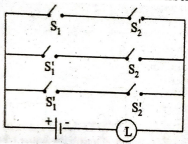
Find the symbolic form of the glven switching circuit. Construct its switching table and interpret your result.
Image
Answer
coming soon
View full question & answer
Question 44 Marks
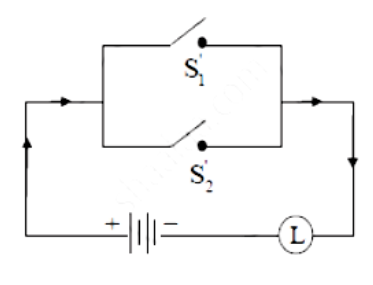
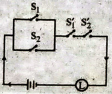
Simplify the following circuit so that new circuit has minimum number of switches. Also draw simplified circuit.
Image
Answer
Let $p:$ the switch $S_{1 }$ is closed
$q:$ the switch $S_2$ is closed
$\sim p:$ the switch $S_1′$ is closed or the switch $S_1$ is open
$\sim q:$ the switch $S_2′$ is closed or the switch $S_2$ is open.
Then the given circuit in symbolic form is:
$(p ∧ \sim q) ∨ (\sim p ∧ q) ∨ (\sim p ∧ \sim q)$
Using the laws of logic, we have
$(p ∧ \sim q) ∨ (\sim p ∧ q) ∨ (\sim p ∧ \sim q)$
$≡ (p ∧ \sim q) ∨ [(\sim p ∧ q) ∨ (\sim p ∧ \sim q)] ....($By Associative Law$)$
$≡ (p ∧ \sim q) ∨ [\sim p ∧ (q ∨ \sim q)] ....($By Distributive Law$)$
$≡ (p ∧ \sim q) ∨ (\sim p ∧ T) ....($By Complement Law$)$
$≡ (p ∧ \sim q) ∨ \sim p ....($By Identity Law$)$
$≡ (p ∨ \sim p) ∧ (\sim q ∨ \sim p) ....($By Distributive Law$)$
$≡ T ∧ (\sim q ∨ \sim p) ....($By Complement Law$)$
$≡ \sim q ∨ \sim p ....($By Identity Law$)$
$≡ \sim p ∨ \sim q ....($By Commutative Law$)$
Hence, the simplified circuit for the given circuit is:
Image
View full question & answer
Solve the Following Question.(4 Marks) - Maths STD 12 Science Questions - Vidyadip