Questions

Solve the Following Question.(2 Marks)

🎯

Test yourself on this topic

7 questions · timed · auto-graded

Question 12 Marks
Find the probability distribution of number of heads in two tosses of a coin.
Answer
Here the r.v. $X$ takes values $0,1,2$.
Also $S=\{ HH , HT , TH , TT \}$
$
\begin{aligned}
\therefore P(X=0) & =\frac{1}{4}, \\
P(X=1) & =\frac{2}{4}=\frac{1}{2} \\
P(X=2) & =\frac{1}{4},
\end{aligned}
$
$\therefore$ Probability distribution of $X$ is :
$X$012
$P ( X =x)$$\frac{1}{4}$$\frac{1}{2}$$\frac{1}{4}$
View full question & answer
Question 22 Marks
Find $k$, such that the function
$
P (x)=\left\{\begin{array}{ll}
k\left(\frac{4}{x}\right) & ; \quad x=0,1,2,3,4, k>0 \\
0 ; & \text { otherwise, }
\end{array}\right.
$
is a probability mass function (p.m.f.)
Answer
coming soon
View full question & answer
Question 32 Marks
A random variable $X \sim N(0,1)$. Find $P(X>0)$ and $P(X<0)$
Answer

Given X ∼ N(0, 1)
∴ μ = 0
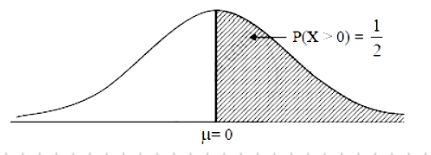
$\therefore P(X>\mu)=P(X>0)=\frac{1}{2}$ as the distribution is symmetric about $\mu=0$.
Image
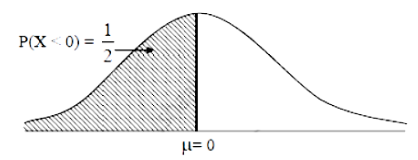
$P(X<\mu)=P(X<0)=\frac{1}{2}$ as the distribution is symmetric about $\mu=0$.
Image

View full question & answer
Question 42 Marks
Find expected value of the random variable $X$ whose probability mass function is :
$X =x$123
$P ( X =x)$$\frac{1}{5}$$\frac{2}{5}$$\frac{2}{5}$
Answer
coming soon
View full question & answer
Question 52 Marks
The probability distribution of a discrete random variable $X$ is :
$X =x$12345
$P ( X =x)$$k$$2k$$3k$$4k$$5k$

Find $( X \leq 4$ )
Answer

Given X is discreate r . v.
∴ P(x) is p.m.f.
p.m.f = ∑ pi = 1
i.e. k + 2k + 3k + 4k + 5k = 1
i.e. 15 k = 1
i.e. $k=\frac{1}{15}$
P(X≤ 4) = P(X =1) + P(X = 2) + P(X = 3) + P(X = 4)
= k + 2k + 3k + 4k
= 10k
$\begin{aligned} & =10 \times \frac{1}{15} \\ & =\frac{2}{3}\end{aligned}$

View full question & answer
Question 62 Marks
The probability mass function $(p.m.f.)$ of $X$ is given below :
$X =x$ $1$ $2$ $3$
$P ( X =x)$ $\frac{1}{5}$ $\frac{2}{5}$ $\frac{2}{5}$
Find $E \left( X ^2\right)$.
Answer
$x$ $P(x)$ $xP(x)$ $x^2P(x)$
$1$ $1/5$ $1/5$ $1/5$
$2$ $2/5$ $4/5$ $8/5$
$3$ $2/5$ $6/5$ $18/5$
      $\sum x^2 P(x)=\frac{27}{5}$
$E\left(x^2\right)=\sum x^2 P(x)=\frac{27}{5}$
View full question & answer
Question 72 Marks
Obtain the probability distribution of the number of sixes in two tosses of a fair die.
Answer
coming soon
View full question & answer
Solve the Following Question.(2 Marks) - Maths STD 12 Science Questions - Vidyadip