Questions

Answer the following questions in short.

Take a timed test

29 questions · self-marked practice — reveal the answer and mark yourself.

Question 11 Mark
Find the c.d.f. $F(x)$ associated with p.d.f. $f(x)$ of r.v. $X$ where $f(x)=3\left(1-2 x^2\right) \quad$ for $0<x<1$ and $=0$, otherwise.
Answer
Since $f(x)$ is p.d.f. of r.v. therefore c.d.f. is
$
F(x)=\int_0^x 3\left(1-2 x^2\right) d x=\left[3\left(x-\frac{2 x^3}{3}\right)\right]_0^x=\left[3 x-2 x^3\right]=3 x-2 x^3
$
View full question & answer
Question 21 Mark
Find $k$ if the following function is the p.d.f. of r.v. $X$.
$
f(x)=k x^2(1-x), \quad \text { for } 0<x<1 \text { and }=0 \text {, otherwise. }
$
Answer
Since $f(x)$ is the p.d.f. of r.v. $X$
$
\begin{array}{ll}
& \int_0^1 k x^2(1-x) d x=1 \\
\therefore & \int_0^1 k\left(x^2-x^3\right) d x=1 \\
\therefore \quad & k\left[\frac{x^3}{3}-\frac{x^4}{4}\right]_0^1=1 \\
\therefore \quad & k\left\{\left[\frac{1}{3}-\frac{1}{4}\right]-(0)\right\}=1 \\
\therefore \quad & k \times \frac{1}{12}=1 \quad \therefore \quad k=12
\end{array}
$
View full question & answer
Question 31 Mark
Verify if the following functions are p.d.f. of a continuous r.v. $X$. : $f(x)=\frac{x}{2}$, for $-2<x<2$ and $=0$, otherwise.
Answer
$f(x)<0$ i.e. negative for $-2<x<0$ therefore $\mathrm{f}(\mathrm{x})$ is not p.d.f.
View full question & answer
Question 41 Mark
Verify if the following functions are p.d.f. of a continuous r.v. $X$. : $f(x)=e^{-x}$, for $0<x<\infty$ and $=0$, otherwise.
Answer
$e^{-x}$ is $\geq 0$ for any value of $x$ since $e>0$,
$
\begin{aligned}
& \therefore \quad e^{-x}>0, \text { for } 0<x<\infty \\
& \int_0^{\infty} f(x) d x=\int_0^{\infty} e^{-x} d x=\left[-e^{-x}\right]_0^{\infty}=\left[\frac{1}{e^{\infty}}-e^0\right]=-(0-1)=1
\end{aligned}
$
Both the conditions of p.d.f. are satisfied $f(x)$ is p.d.f. of r.v.
View full question & answer
Question 51 Mark
Let's return to the example in which $X$ has the following probability density function :
$f(x)=\frac{x^3}{4}$ for $0<x<4$. What is the cumulative distribution function $X$ ?
Answer
$F(x)=\int_0^x f(x) d x=\int_0^x \frac{x^3}{4} d x=\frac{1}{4}\left[\frac{x^4}{4}\right]_0^x=\frac{1}{16}=\left[x^4-0\right]=\frac{x^4}{16}$
View full question & answer
Question 61 Mark
Let's return to the example in which $X$ has the following probability density function :
$f(x)=3 x^2$
for $0<x<1$. What is the cumulative distribution function $F(x)$ ?
Answer
$F(x)=\int_{-0}^x f(x) d x=\int_0^x 3 x^2 d x=\left[x^3\right]_0^x=x^3$
View full question & answer
Question 71 Mark
Let $X$ be a continuous random variable whose probability density function is $f(x)=\frac{x^3}{4}$ for an interval $0<x<c$. What is the value of the constant $\mathrm{c}$ that makes $f(x)$ a valid probability density function?
Answer
Note that the integral of the p. d. f. over the support of the random variable must be That is, $\int_0^c f(x) d x=1$.
That is, $\int_0^c\left(\frac{x^3}{4}\right) d x=1$. But, $\int_0^c\left(\frac{x^3}{4}\right) d x=\left[\frac{x^4}{16}\right]_0^c=\frac{c^4}{16}$. Since this integral must be equal to 1 , we have $\frac{c^4}{16}=1$, or equivalently $c^4=16$, so that $c=2$ since $\mathrm{c}$ must be positive.
View full question & answer
Question 81 Mark
Let $X$ be a continuous random variable whose probability density function is $f(x)=3 x^2$, for $0<x<1$. note that $f(x)$ is not $P[X=x]$.
For example, $f(0.9)=3(0.9)^2=2 \cdot 43>1$, which is clearly not a probability. In the continuous case, $f(x)$ is the height of the curve at $X=x$, so that the total area under the curve is 1 . Here it is areas under the curve that define the probabilities.
Answer
Now, let's start by verifying that $f(x)$ is a valid probability density function.
For this, note the following results.
1. $f(x)=3 x^2 \geq 0$ for all $x \in[0,1]$.
2. $\int_0^1 f(x)=\int_0^1 3 x^2 d x=1$
Therefore, the function $f(x)=3 x^2$, for $0<x<1$ is a proper probability density function.
View full question & answer
Question 91 Mark
The following is the p.d.f. of continuous r.v. X $f(x)=\frac{x}{8}$, for $0<x<4$ and $=0$ otherwise.
Find $F(x)$ at $x=0.5,1.7$ and 5 .
View full question & answer
Question 101 Mark
The following is the p.d.f. of continuous r.v. X $f(x)=\frac{x}{8}$, for $0<x<4$ and $=0$ otherwise.
Find expression for c.d.f. of $X$.
View full question & answer
Question 111 Mark
Suppose that $X$ is waiting time in minutes for a bus and its p.d.f. is given by $f(x)=\frac{1}{5}$, for 0 $\leq x \leq 5$ and $=0$ otherwise. Find the probability that
waiting time is more than 4 minutes.
View full question & answer
Question 121 Mark
Suppose that $X$ is waiting time in minutes for a bus and its p.d.f. is given by $f(x)=\frac{1}{5}$, for 0 $\leq x \leq 5$ and $=0$ otherwise. Find the probability that
waiting time is between 1 and 3
View full question & answer
Question 131 Mark
It is known that error in measurement of reaction temperature (in $0^{\circ} \mathrm{C}$ ) in a certain experiment is continuous r.v. given by
$f(x)=\frac{x^2}{3}$ for $-1<x<2$
$=0$. otherwise.
Find the probability that $X$ is negative.
View full question & answer
Question 141 Mark
It is known that error in measurement of reaction temperature (in $0^{\circ} \mathrm{C}$ ) in a certain experiment is continuous r.v. given by
$f(x)=\frac{x^2}{3}$ for $-1<x<2$
$=0$. otherwise.
Find $P(0<x \leq 1)$
View full question & answer
Question 151 Mark
It is known that error in measurement of reaction temperature (in $0^{\circ} \mathrm{C}$ ) in a certain experiment is continuous r.v. given by
$f(x)=\frac{x^2}{3}$ for $-1<x<2$
$=0$. otherwise.
Verify whether $f(x)$ is p.d.f. of r.v. $X$


View full question & answer
Question 191 Mark
Verify which of the following is p.d.f. of r.v. X: f(x) $=2$, for $0 \leq x \leq 1$.
Answer
(a) $f(x)=2 \geq 0$ for $0 \leq x \leq 1$
(b) $\int_{-\infty}^{\infty} f(x) d x=\int_{-\infty}^0 f(x) d x+\int_0^1 f(x) d x+\int_1^{\infty} f(x) d x$ $=0+\int_0^1 2 d x+0=[2 x]_0=2-0=2 \neq 1$
Hence, $f(x)$ is not p.d.f. of X.
View full question & answer
Question 201 Mark
Verify which of the following is p.d.f. of r.v. X: $f(x)=x$, for $0 \leq x \leq 1$ and $-2-x$ for $1
Answer
$f(x)=x \geq 0$ if $0 \leq x \leq 1$
For $1<x<2,-2<-x<-1$
$-2-2<-2-x<-2-1$
i.e. $-4<f(x)<-3$ if $1<x<2$
Hence, $f(x)$ is not p.d.f. of X.
View full question & answer
Question 211 Mark
Verify which of the following is p.d.f. of r.v. X: $f(x)=\sin x$, for $0 \leq x \leq \frac{\pi}{2}$
Answer
$f(x)$ is the p.d.f. of r.v. $X$ if
(a) $f(x) \geq 0$ for all $x \in R$ and
(b) $\int_{-\infty}^{\infty} f(x) d x=1$.
(a) $f(x)=\sin x \geqslant 0$ if $0 \leqslant x \leqslant \frac{\pi}{2}$
Hence, $f(x)$ is the p.d.f. of $X$.
View full question & answer
Question 221 Mark
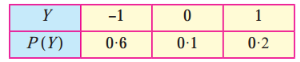
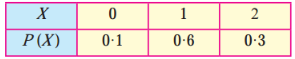
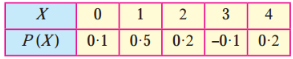
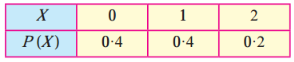
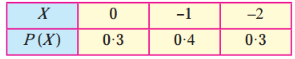
State which of the following are not the probability mass function of a random variable. Give reasons for your answer : Image
View full question & answer
Question 231 Mark
State which of the following are not the probability mass function of a random variable. Give reasons for your answer : Image
View full question & answer
Question 241 Mark
State which of the following are not the probability mass function of a random variable. Give reasons for your answer : Image
View full question & answer
Question 251 Mark
State which of the following are not the probability mass function of a random variable. Give reasons for your answer : Image
View full question & answer
Question 261 Mark
State which of the following are not the probability mass function of a random variable. Give reasons for your answer : Image
View full question & answer
Question 271 Mark
State which of the following are not the probability mass function of a random variable. Give reasons for your answer : Image
View full question & answer
Question 281 Mark
An urn contains 5 red and 2 black balls. Two balls are drawn at random. X denotes the number of black balls drawn. What are the possible values of X?
Answer
The urn contains 5 red and 2 black balls.
If two balls are drawn from the urn, it contains either 0 or 1 or 2 black balls.
X can take values 0, 1, 2.
∴ X = {0, 1, 2}.
View full question & answer
Question 291 Mark
Let X represent the difference between a number of heads and the number of tails when a coin is tossed 6 times. What are the possible values of X?
Answer
When a coin is tossed 6 times, the number of heads can be 0, 1, 2, 3, 4, 5, 6.
The corresponding number of tails will be 6, 5, 4, 3, 2, 1, 0.
∴ X can take values 0 – 6, 1 – 5, 2 – 4, 3 – 3, 4 – 2, 5 – 1, 6 – 0
i.e. -6, -4, -2, 0, 2, 4, 6.
∴ X = {-6, -4, -2, 0, 2, 4, 6}.
View full question & answer