Questions

Solve the Following Question.(2 Marks)

Take a timed test

12 questions · self-marked practice — reveal the answer and mark yourself.

Question 12 Marks
The p.m.f. of a r.v. $X$ is given by $P(X=x)=\frac{{ }^5 C_x}{2^5}$, for $x=0,1,2,3,4,5$ and $=0$, otherwise. Then show that $P(X \leq 2)=P(X \geq 3)$.
Answer
$
\begin{aligned}
& \mathrm{P}(\mathrm{X} \leq 2)=\mathrm{P}(\mathrm{X}=0)+\mathrm{P}(\mathrm{X}=1)+\mathrm{P}(\mathrm{X}=2) \\
& =\frac{{ }^5 C_0}{2^5}+\frac{{ }^5 C_1}{2^5}+\frac{{ }^5 C_2}{2^5} \\
& =\frac{{ }^5 C_5}{2^5}+\frac{{ }^5 C_4}{2^5}+\frac{{ }^5 C_3}{2^5} \ldots \ldots . .\left[{ }^n C_r={ }^n C_n-r\right] \\
& =P(X=5)+P(X=4)+P(X=3) \\
& =P(X \geq 3) \\
& \therefore P(X \leq 2)=P(X \geq 3) .
\end{aligned}
$
View full question & answer
Question 22 Marks
For each of the following p.d.f. of r.v. $X$, find (a) $P(X<1)$ and (b) $P(|X|<1)$ : $f(x)=\frac{x+2}{18}$, for $-2<x<4$ and $=0$, otherwise.
Answer
(a)$
\begin{aligned}
P(X<1) & =\int_{-2}^1 \frac{x+2}{18} d x=\frac{1}{18}\left[\frac{x^2}{2}+2 x\right]_{-2}^1 \\
& =\frac{1}{18}\left\{\left(\frac{1}{2}+2\right)-\left(\frac{(-2)^2}{2}+2(-2)\right)\right\}=\frac{1}{18}\left\{\frac{5}{2}+2\right\}=\frac{1}{18} \times \frac{9}{2}=\frac{1}{4}
\end{aligned}
$
(b)$
\begin{aligned}
P(|X|<1) & =P(-1<x<1)=\int_{-1}^1 \frac{x+2}{18} d x=\frac{1}{18}\left[\frac{x^2}{2}+2 x\right]_{-1}^1 \\
& =\frac{1}{18}\left\{\left(\frac{1}{2}+2\right)-\left(\frac{1}{2}-2\right)\right\}=\frac{1}{18}\left\{\frac{5}{2}+\frac{3}{2}\right\}=\frac{1}{18} \times 4=\frac{2}{9}
\end{aligned}
$
View full question & answer
Question 32 Marks
For each of the following p.d.f. of r.v. $X$, find (a) $P(X<1)$ and (b) $P(|X|<1)$ : $f(x)=\frac{x^2}{18}, \quad$ for $-3<x<3$ and $=0$, otherwise.
Answer
(a)$
P(X<1) \quad=\int_{-3}^1 \frac{x^2}{18} d x=\left[\frac{\frac{1}{18}\left(x^3\right)}{3}\right]_{-3}^1=\frac{1}{54}\left[1-(-3)^3\right]=\frac{1}{54}(1+27)=\frac{28}{54}=\frac{14}{27}
$

(b)$
\begin{aligned}
P(|X|<1) & =P(-1<x<1)=\int_{-1}^1 \frac{x^2}{18} d x=\left[\frac{\frac{1}{18}\left(x^3\right)}{3}\right]_{-1}^1 \\
& =\frac{1}{54}\left[1-(-1)^3\right]=\frac{1}{54}(1+1)=\frac{2}{54}=\frac{1}{27}
\end{aligned}
$

View full question & answer
Question 42 Marks
Let X be the amount of time for which a book is taken out of the library by a randomly selected students and suppose X has p.d.f.
f(x) = 0.5x, for 0 ≤ x ≤ 2 and = 0 otherwise.
Calculate:
P(x ≥ 1.5).
View full question & answer
Question 52 Marks
Let X be the amount of time for which a book is taken out of the library by a randomly selected students and suppose X has p.d.f.
f(x) = 0.5x, for 0 ≤ x ≤ 2 and = 0 otherwise.
Calculate:
P(0.5 ≤ x ≤ 1.5)
View full question & answer
Question 62 Marks
Let X be the amount of time for which a book is taken out of the library by a randomly selected students and suppose X has p.d.f.
f(x) = 0.5x, for 0 ≤ x ≤ 2 and = 0 otherwise.
Calculate:
P(x ≤ 1)
View full question & answer
Question 72 Marks
Find $k$ if the following function represents p.d.f. of r.v. $\mathrm{X}$
$f(x)=k x$. for $0<x<2$ and $=0$ otherwise.
Also find $P\left(\frac{1}{4}<x<\frac{3}{2}\right)$.
View full question & answer
Question 82 Marks
Find the mean number of heads in three tosses of a fair coin.
Answer
When three coins are tossed the sample space is $\{ HHH , HHT, THH, HTH, HTT, THT, TTH, TTT\}$
$\therefore n ( S )=8$
Let $X$ denote the number of heads when three coins are tossed.
Then $X$ can take values $0,1,2,3$
$ P(X=0)=P(0)=\frac{1}{8}$
$P(X=1)=P(1)=\frac{3}{8}$
$P(X=2)=P(2)=\frac{3}{8}$
$P(X=3)=P(3)=\frac{1}{8}$
$\therefore \text { mean }=E(X)=\Sigma x_i P\left(x_i\right)$
$=0 \times \frac{1}{8}+1 \times \frac{3}{8}+2 \times \frac{3}{8}+3 \times \frac{1}{8}$
$=0+\frac{3}{8}+\frac{6}{8}+\frac{3}{8}$
$=\frac{12}{8}$
$=1.5 $
View full question & answer
Question 92 Marks
Find expected value and variance of X, where X is the number obtained on the uppermost face when a fair die is thrown.
Answer
If a die is tossed, then the sample space for the random variable $X$ is
$ S=\{1,2,3,4,5,6\}$
$\therefore P(X)=\frac{1}{6} ; X=1,2,3,4,5,6 .$
$\therefore E(X)=\sum_{x \in S} X \cdot P(X)$
$\quad=1\left(\frac{1}{6}\right)+2\left(\frac{1}{6}\right)+3\left(\frac{1}{6}\right)+4\left(\frac{1}{6}\right)+5\left(\frac{1}{6}\right)+6\left(\frac{1}{6}\right)$
$\quad=\frac{1}{6}(1+2+3+4+5+6) $
$ =\frac{21}{6}=\frac{7}{2}=3.5$
$V(X)=E\left(X^2\right)-[E(X)]^2$
$=\sum_{X \in S} X^2 \cdot P(X)-\left(\frac{7}{2}\right)^2$
$=\left[(1)^2\left(\frac{1}{6}\right)+(2)^2\left(\frac{1}{6}\right)+(3)^2\left(\frac{1}{6}\right)+\right.$
$=\frac{1}{6}(1+4+9+16+25+36)-\frac{49}{4}$
$=\frac{91}{6}-\frac{49}{4}=\frac{182-147}{12}=\frac{35}{12}=2.9167 $
Hence, $E(X)=3.5$ and $V(X)=2.9167$
View full question & answer
Question 102 Marks
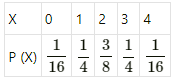
Find the probability distribution of : number of heads in four tosses of a coin.
Answer
When a coin is tossed four times, the sample space is
$S=\{\mathrm{HHHH}, \mathrm{HHHT}, \mathrm{HHTH}, \mathrm{HTHH, THHH, HHTT, HTHT, HTTH, THHT, THTH, TTHH, HTTT, THTT,
TTHT, TTTH, TTTT\}}$
$\therefore n(S)=16$
Let $X$ be the random variable, which represents the number of heads.
It can be seen that $X$ can take the value of $0,1,2,3$, or $4.$
When $X=0$, then $X=\{$ TTTT $\}$
$\therefore n(X)=1$
$\therefore \mathrm{P}(\mathrm{X}=0)=\frac{n(X)}{n(S)}=\frac{1}{16}$
When $X=1$, then
$X=\{\mathrm{HTTT}$, THTT, TTHT, TTTH $\}$
$\therefore n(X)=4$
$\therefore \mathrm{P}(\mathrm{X}=1)=\frac{n(X)}{n(S)}=\frac{4}{16}=\frac{1}{4}$
When $x=2$, then
$X=\{\mathrm{HHTT}, \mathrm{HTHT}, \mathrm{HTTH}$, THHT, THTH, TTHH $\}$
$\therefore n(x)=6$
$\therefore \mathrm{P}(\mathrm{X}=2)=\frac{n(X)}{n(S)}=\frac{6}{16}=\frac{3}{8}$
When $X=3$, then
$X=\{\mathrm{HHHT}, \mathrm{HHTH}, \mathrm{HTHH}, \mathrm{THHH}\}$
$\therefore n(X)=4$
$\therefore \mathrm{P}(\mathrm{X}=3)=\frac{n(X)}{n(S)}=\frac{4}{16}=\frac{1}{4}$
When $x=4$, then
$ \mathrm{X}=\{\mathrm{HHHH}\}$
$\therefore \mathrm{n}(\mathrm{X})=1$
$\therefore \mathrm{P}(\mathrm{X}=4)=\frac{n(X)}{n(S)}=\frac{1}{16} $
$\therefore$ the probability distribution of $\mathrm{X}$ is as follows :
Image
View full question & answer
Question 112 Marks
Find the probability distribution of : number of tails in the simultaneous tosses of three coins.
Answer
When three coins are tossed simultaneously, the sample space is $\{\mathrm{HHH}, \mathrm{HHT}, \mathrm{HTH}, \mathrm{HTT}, \mathrm{THH}, \mathrm{THT}, \mathrm{TTH, TTT }\}$
Let $X$ represent the number of tails.
It can be seen that $X$ can take the value of $0,1,2$, or 3 .
$ P(X=0)=P(H H H)=\frac{1}{8}$
$P(X=1)=P(H H T)+P(H T H)+P(T H H)=\frac{1}{8}+\frac{1}{8}+\frac{1}{8}=\frac{3}{8}$
$P(X=2)=P(H T T)+P(T H T)+P(T T H)=\frac{1}{8}+\frac{1}{8}+\frac{1}{8}=\frac{3}{8}$
$P(X)=P(T T T)=\frac{1}{8} $
Thus, the probability distribution is as follows.Image
View full question & answer
Question 122 Marks
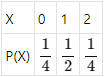
Find the probability distribution of : number of heads in two tosses of a coin.
Answer
When one coin is tossed twice, the sample space is $\{\mathrm{HH}, \mathrm{HT}, \mathrm{TH}, \mathrm{TT}\}$
Let $X$ represent the number of heads $s$ in two tosses of a coin.
$\therefore X(\mathrm{HH})=2, X(\mathrm{HT})=1, X(\mathrm{TH})=1, X(\mathrm{TT})=0$
Therefore, $X$ can take the value of $0,1 ,$ or $2 .$
It is known that,
$ P(H H)=P(H T)=P(T H)=P(T T)=\frac{1}{4}$
$P(X=0)=P(T T)=\frac{1}{4}$
$P(X=1)=P(H T)+P(T H)=\frac{1}{4}+\frac{1}{4}=\frac{1}{2}$
$P(X=2)=P(H H)=\frac{1}{4} $
Thus, the required probability distribution is as follows.
Image
View full question & answer