Questions

MCQ

Take a timed test

8 questions · 7 auto-graded MCQ + 1 self-marked written.

MCQ 12 Marks
The approximate value of $\tan \left(44^{\circ} 30^{\prime}\right)$, given that $1^{\circ}=0.0175^c$, is  __________.
  • A
    0.8952
  • B
    0.9528
  • C
    0.9285
  • 0.9825
Answer
Correct option: D.
0.9825
(D) 0.9825
Explanation :
Let $f(x)=\tan x\ldots\ldots (\text{i})$
Differentiate w.r.t. $x$, we get
$f^{\prime}(x)=\sec ^2 x\ldots\ldots (\text{ii})$
Now, $44^{\circ} 30^{\prime}=45^{\circ}-30^{\prime}=45^{\circ}-\left(\frac{1}{2}\right)^{\circ}=\frac{\pi}{4}-\frac{0.0175}{2}=\frac{\pi}{4}-0.00875$
Let $a=\frac{\pi}{4}, h=0.00875$
For $x=a=\frac{\pi}{4}$, from (i), we get
$f(a)=f\left(\frac{\pi}{4}\right)=\tan \left(\frac{\pi}{4}\right)=1\ldots\ldots (\text{iii})$
For $x=a=\frac{\pi}{4}$, from (ii), we get
$f^{\prime}(a)=f^{\prime}\left(\frac{\pi}{4}\right)=\sec ^2\left(\frac{\pi}{4}\right)=2\ldots\ldots (\text{iv})$
We have, $f(a+h) \doteqdot f(a)+h f^{\prime}(a)$
$\begin{array}{ll}\therefore f\left(\frac{\pi}{4}-0.00875\right) \doteqdot f\left(\frac{\pi}{4}\right)-0.00875 f^{\prime}\left(\frac{\pi}{4}\right) \\
\therefore f\left(\frac{\pi}{4}-0.00875\right) \doteqdot 1-0.00875 \times 2 \ldots\ldots[\text{From (iii) and (iv)}]\\
\therefore f\left(44^{\circ} 30^{\prime}\right) \doteqdot 0.9825\end{array}$

View full question & answer
MCQ 22 Marks
Given that $X \sim B(n, p)$. If $n=10$ and $p=0.4$ then $E(X)$ and $\operatorname{Var}(X)$ respectively are  __________.
  • A
    $4,0.24$
  • B
    $0.4,0.24$
  • $4,2.4$
  • D
    $3, 0.24$
Answer
Correct option: C.
$4,2.4$
(C) $4,2.4$
Explanation :
$p=0.4, \quad n=10, \quad E(X)=?, \quad \operatorname{Var}(X)=?$
We know that, $E(X)=n p$
$\therefore \quad E(X)=10 \times 0.4=4$
We know that, $q=1-p=1-0.4=0.6$
We know that, $\operatorname{Var}(X)=E(X) \times q$
$\therefore \quad \operatorname{Var}(X)=4 \times 0.6=2.4$
View full question & answer
MCQ 32 Marks
$y=c^2+\frac{c}{x}$ is solution of  __________ .
  • $x^4\left(\frac{d y}{d x}\right)^2-x \frac{d y}{d x}-y=0$
  • B
    $x^2\left(\frac{d y}{d x}\right)^2+y=0$
  • C
    $x^3\left(\frac{d^2 y}{d x^2}\right)-x \frac{d y}{d x}+y=0$
  • D
    $x \frac{d^2 y}{d x^2}=4 y$
Answer
Correct option: A.
$x^4\left(\frac{d y}{d x}\right)^2-x \frac{d y}{d x}-y=0$
(A) $x^4\left(\frac{d y}{d x}\right)^2-x \frac{d y}{d x}-y=0$
Explanation :
$y=c^2+\frac{c}{x}\ldots\ldots (1)$
$\begin{array}{ll}\therefore & \frac{d y}{d x}=-\frac{c}{x^2} \\
\therefore & c=-x^2 \cdot \frac{d y}{d x}\end{array}$
Substituting the value of $c$ in equation (1), we get
$\begin{array}{ll} y=\left(-x^2 \cdot \frac{d y}{d x}\right)^2+\frac{\left(-x^2 \cdot \frac{d y}{d x}\right)}{x} \\
\therefore \quad y=x^4\left(\frac{d y}{d x}\right)^2-x \cdot \frac{d y}{d x} \\
\therefore \quad x^4\left(\frac{d y}{d x}\right)^2-x \cdot \frac{d y}{d x}-y=0\end{array}$
View full question & answer
MCQ 42 Marks
If $x=e^{\frac{x}{y}}$ then $\frac{d y}{d x}=........$
  • A
    $1-\frac{y}{x}$
  • B
    $1+\frac{y}{x}$
  • $\frac{x-y}{x \log x}$
  • D
    $\frac{x+y}{x \log x}$
Answer
Correct option: C.
$\frac{x-y}{x \log x}$
$x=e^{\frac{x}{y}}$
Taking $\log$ on both sides, we get
$ \log x=\frac{x}{y}\ldots\ldots(1)$
$ \therefore y=\frac{x}{\log x}$
$\therefore \frac{d y}{d x}=\frac{\log x \times 1-x \times \frac{1}{x}}{(\log x)^2} \text {..... }[$ If $y=\frac{u}{v}$ then  $\frac{d y}{d x}=\frac{v \frac{d u}{d x}-u \frac{d v}{d x}}{v^2}]$
$\therefore \frac{d y}{d x}=\frac{\frac{x}{y}-1}{\left(\frac{x}{y}\right)^2} \ldots\ldots[$ From $(1)] $
$\therefore \frac{d y}{d x}=\frac{\frac{x-y}{y}}{\frac{x \cdot x}{y} \cdot \frac{x}{y}}=\frac{x-y}{x \cdot \frac{x}{y}}$
$\therefore \frac{d y}{d x}=\frac{x-y}{x \cdot \log x} \ldots\ldots[$ From $(1)]$
View full question & answer
MCQ 52 Marks
The perpendicular distance of the plane $\hat{r} .(2 \hat{i}+3 \hat{j}-\hat{k})=5$, from the origin is ..........
  • $\frac{5}{\sqrt{14}}$ units
  • B
    $\frac{5}{14}$ units
  • C
    5 units
  • D
    $\frac{\sqrt{14}}{5}$ units
Answer
Correct option: A.
$\frac{5}{\sqrt{14}}$ units
(A) $\frac{5}{\sqrt{14}}$ units
Explanation : Comparing $\bar{r} \cdot(2 \hat{\imath}+3 \hat{\jmath}-\hat{k})=5$ with $\bar{r} \cdot \bar{n}=p$, we get
$\bar{n}=2 \hat{\imath}+3 \hat{\jmath}-\hat{k}$ and $p=5$
Length of the perpendicular from the origin to the plane $=\frac{p}{|n|}=\frac{5}{\sqrt{2^2+3^2+(-1)^2}}=\frac{5}{\sqrt{14}}$ units
View full question & answer
MCQ 62 Marks
The angle between the lines,
$\tilde{r}=(\hat{\imath}+2 \hat{\jmath}-3 \hat{k})+\lambda(3 \hat{\imath}+2 \hat{\jmath}+6 \hat{k})$ and $\bar{r}=(5 \hat{\imath}-2 \hat{\jmath}+7 \hat{k})+\lambda^{\prime}(\hat{\imath}+2 \hat{\jmath}+2 \hat{k})$ is ..............
  • A
    $\cos ^{-1}\left(\frac{17}{21}\right)$
  • B
    $\cos ^{-1}\left(\frac{20}{21}\right)$
  • C
    $\cos ^{-1}\left(\frac{18}{21}\right)$
  • D
    $\cos ^{-1}\left(\frac{19}{21}\right)$
View full question & answer
MCQ 72 Marks
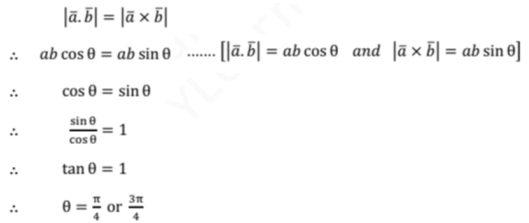
If $\theta$ is the angle between two vectors $\bar{a}$ and $\bar{b}$ and $|\bar{a} . \bar{b}|=|\bar{a} \times \bar{b}|$ then $\theta$ is equal to ________
  • A
    $0$
  • $\frac{\pi}{4}$ or $\frac{3 \pi}{4}$
  • C
    $\frac{\pi}{2}$
  • D
    $\pi$ or $\frac{\pi}{6}$
Answer
Correct option: B.
$\frac{\pi}{4}$ or $\frac{3 \pi}{4}$
(b) $\frac{\pi}{4}$ or $\frac{3 \pi}{4}$
Explantion:
Image
View full question & answer
MCQ 82 Marks
$\cos \left[\tan ^{-1}\left(\frac{1}{3}\right)+\tan ^{-1}\left(\frac{1}{2}\right)\right]= ........ $ 
  • A
    $\frac{\sqrt{3}}{2}$
  • B
    $\frac{1}{2}$
  • $\frac{1}{\sqrt{2}}$
  • D
    $\frac{\pi}{4}$
Answer
Correct option: C.
$\frac{1}{\sqrt{2}}$
$\cos \left[\tan ^{-1}\left(\frac{1}{2}\right)+\tan ^{-1}\left(\frac{1}{3}\right)\right]$
$=\cos \left[\tan ^{-1}\left(\frac{\frac{1}{3}+\frac{1}{2}}{1-\frac{1}{3} \times \frac{1}{2}}\right)\right]$
$[\because \tan ^{-1} x+\tan ^{-1} y=\tan ^{-1}\left(\frac{x+y}{1-x y}\right)],$
if  $[x>0, y>0, x y<1]$
$\therefore=\cos \left[\tan ^{-1}\left(\frac{\frac{5}{6}}{\frac{5}{6}}\right)\right]$
$=\cos \left[\tan ^{-1}(1)\right]=\cos \left(\frac{\pi}{4}\right)=\frac{1}{\sqrt{2}}$
View full question & answer
MCQ - Maths STD 12 Science Questions - Vidyadip