Questions

Solve the Following Question.(4 Marks)

Take a timed test

16 questions · self-marked practice — reveal the answer and mark yourself.

Question 14 Marks
Solve the triangle in which $a=(\sqrt{3}+1), b=(\sqrt{3}-1)$ and $\angle C=60^{\circ}$.
Answer
Given : $a=\sqrt{3}+1, b=\sqrt{3}-1$ and $\angle C=60^{\circ}$.
By cosine rule,$c^2=a^2+b^2-2 a b \cos C$
$\begin{aligned} & =(\sqrt{3}+1)^2+(\sqrt{3}-1)^2-2(\sqrt{3}+1)(\sqrt{3}-1) \cos 60^{\circ} \\ & =3+1+2 \sqrt{3}+3+1-2 \sqrt{3}-2(3-1)\left(\frac{1}{2}\right)\end{aligned}$
$\begin{aligned} & =8-2=6 \\ & \therefore c=\sqrt{6} \ldots[\because c>0)\end{aligned}$
By sine rule,
$\begin{aligned} & \frac{a}{\sin A}=\frac{b}{\sin B}=\frac{c}{\sin C} \\ \therefore & \frac{\sqrt{3}+1}{\sin A}=\frac{\sqrt{3}-1}{\sin B}=\frac{\sqrt{6}}{\sin 60^{\circ}}\end{aligned}$
$\begin{aligned} & \therefore \frac{\sqrt{3}+1}{\sin A}=\frac{\sqrt{3}-1}{\sin B}=\frac{\sqrt{6}}{(\sqrt{3} / 2)}=2 \sqrt{2} \\ & \therefore \sin A=\frac{\sqrt{3}+1}{2 \sqrt{2}} \text { and } \sin B=\frac{\sqrt{3}-1}{2 \sqrt{2}}\end{aligned}$
$\begin{aligned} & \therefore \sin A=\frac{\sqrt{3}}{2 \sqrt{2}}+\frac{1}{2 \sqrt{2}} \text { and } \sin B=\frac{\sqrt{3}}{2 \sqrt{2}}-\frac{1}{2 \sqrt{2}} \\ & \therefore \sin A=\frac{\sqrt{3}}{2} \times \frac{1}{\sqrt{2}}+\frac{1}{2} \times \frac{1}{\sqrt{2}} \\ & \text { and } \sin B=\frac{\sqrt{3}}{2} \times \frac{1}{\sqrt{2}}-\frac{1}{2} \times \frac{1}{\sqrt{2}}\end{aligned}$
∴ sin A = sin 60° cos 45° + cos 60° sin 45° and sin B = sin 60° cos 45° – cos 60° sin 45° ∴ sin A = sin (60° + 45°) – sin 105° and sin B = sin (60° – 45°) = sin 15° ∴ A = 105° and B = 15°
Hence, $\mathrm{A}=105^{\circ}, \mathrm{B} 15^{\circ}$ and $\mathrm{C}=\sqrt{6}$ units.
View full question & answer
Question 24 Marks
With usual notations prove that $\frac{\sin (A-B)}{\sin (A+B)}=\frac{a^2-b^2}{c^2}$.
Answer
By the sine rule,
$\begin{aligned} & \frac{a}{\sin A}=\frac{b}{\sin B}=\frac{c}{\sin C}=k \\ & \therefore a=k \sin A, b=k \sin B, c=k \sin C\end{aligned}$
$\mathrm{RHS}=\frac{a^2-b^2}{c^2}=\frac{k^2 \sin ^2 \mathrm{~A}-k^2 \sin ^2 \mathrm{~B}}{k^2 \sin ^2 \mathrm{C}}$
$=\frac{\sin ^2 A-\sin ^2 B}{\sin ^2 C}$
$=\frac{(\sin A+\sin B)(\sin A-\sin B)}{[\sin \{\pi-(A+B)\}]^2}$
$\ldots[\because \mathrm{A}+\mathrm{B}+\mathrm{C}=\pi]$
$=\frac{2 \sin \left(\frac{A+B}{2}\right) \cdot \cos \left(\frac{A-B}{2}\right) \times 2 \cos \left(\frac{A+B}{2}\right) \cdot \sin \left(\frac{A-B}{2}\right)}{\sin ^2(A+B)}$
$=\frac{2 \sin \left(\frac{A+B}{2}\right) \cdot \cos \left(\frac{A+B}{2}\right) \times 2 \sin \left(\frac{A-B}{2}\right) \cdot \cos \left(\frac{A-B}{2}\right)}{\sin ^2(A+B)}$
$=\frac{\sin (A+B) \cdot \sin (A-B)}{\sin ^2(A+B)}$
$=\frac{\sin (A-B)}{\sin (A+B)}=$ LHS.
View full question & answer
Question 34 Marks
Show that $2 \cot ^{-1} \frac{3}{2}+\sec ^{-1} \frac{13}{12}=\frac{\pi}{2}$
Answer
$2 \cot ^{-1} \frac{3}{2}=2 \tan ^{-1} \frac{2}{3} \quad \ldots\left[\because \cot ^{-1} x=\tan ^{-1}\left(\frac{1}{x}\right)\right]$
$=\tan ^{-1}\left[\frac{2 \times \frac{2}{3}}{1-\left(\frac{2}{3}\right)^2}\right]$
$\cdots\left[\because 2 \tan ^{-1} x=\tan ^{-1}\left(\frac{2 x}{1-x^2}\right)\right]$
$=\tan ^{-1}\left[\frac{\left(\frac{4}{3}\right)}{1-\frac{4}{9}}\right]$
$=\tan ^{-1}\left(\frac{4}{3} \times \frac{9}{5}\right)=\tan ^{-1} \frac{12}{5}$
$\ldots$ (1)
Let $\sec ^{-1} \frac{13}{12}=\alpha$
Then, $\sec \alpha=\frac{13}{12}$, where $0<\alpha<\frac{\pi}{2}$
$\therefore \tan \alpha>0$
Now, $\tan \alpha=\sqrt{\sec ^2 \alpha-1}$
$=\sqrt{\frac{169}{144}-1}=\sqrt{\frac{25}{144}}=\frac{5}{12}$
$\therefore \alpha=\tan ^{-1} \frac{5}{12}=\cot ^{-1} \frac{12}{5} \ldots\left[\because \tan ^{-1} x=\cot ^{-1}\left(\frac{1}{x}\right)\right]$
$\therefore \sec ^{-1} \frac{13}{12}=\cot ^{-1} \frac{12}{5}$
$\ldots(2)$
Now, LHS $=2 \cot ^{-1} \frac{3}{2}+\sec ^{-1} \frac{13}{12}$
$=\tan ^{-1} \frac{12}{5}+\cot ^{-1} \frac{12}{5} \quad \ldots[$ By (1) and (2)]
$\begin{array}{ll}=\frac{\pi}{2} \quad \cdots\left[\because \tan ^{-1} x+\cot ^{-1} x=\frac{\pi}{2}\right] \\ =\text { RHS. }\end{array}$
View full question & answer
Question 44 Marks
If $\sin ^{-1}(1-x)-2 \sin ^{-1} x=\frac{\pi}{2}$, then find the value of $x$.
Answer
$\begin{aligned} & \sin ^{-1}(1-x)-2 \sin ^{-1} x=\frac{\pi}{2} \\ & \therefore \sin ^{-1}(1-x)=\frac{\pi}{2}+2 \sin ^{-1} x\end{aligned}$
$\therefore 1-x=\sin \left(\frac{\pi}{2}+2 \sin ^{-1} x\right)$
$\therefore 1-x=\cos \left(2 \sin ^{-1} x\right) \quad \ldots\left[\because \sin \left(\frac{\pi}{2}+\theta\right)=\cos \theta\right]$
$\therefore 1-x=1-2\left[\sin \left(\sin ^{-1} x\right)\right]^2 \ldots\left[\because \cos 2 \theta=1-2 \sin ^2 \theta\right]$
$\begin{aligned} & \therefore 1-x=1-2 x^2 \\ & \therefore 2 x^2-x=0 \quad \therefore x(2 x-1)=0\end{aligned}$
$\therefore x=0$ or $x=\frac{1}{2}$
When $x=\frac{1}{2}$
$\begin{aligned} \mathrm{LHS} & =\sin ^{-1}\left(1-\frac{1}{2}\right)-2 \sin ^{-1}\left(\frac{1}{2}\right) \\ & =\sin ^{-1}\left(\frac{1}{2}\right)-2 \sin ^{-1}\left(\frac{1}{2}\right)\end{aligned}$
$=-\sin ^{-1}\left(\frac{1}{2}\right)=-\sin ^{-1}\left(\sin \frac{\pi}{6}\right)=-\frac{\pi}{6} \neq \frac{\pi}{2}$
$\therefore x \neq \frac{1}{2}$
Hence, $x=0$.
View full question & answer
Question 54 Marks
Solve: $\tan ^{-1}\left(\frac{1-x}{1+x}\right)=\frac{1}{2}\left(\tan ^{-1} x\right)$, for $x>0$.
Answer
$\tan ^{-1}\left(\frac{1-x}{1+x}\right)=\frac{1}{2}\left(\tan ^{-1} x\right)$
$\therefore 2 \tan ^{-1}\left(\frac{1-x}{1+x}\right)=\tan ^{-1} x$
$\therefore \tan ^{-1}\left[\frac{2\left(\frac{1-x}{1+x}\right)}{1-\left(\frac{1-x}{1+x}\right)^2}\right]=\tan ^{-1} x$
$\cdots\left[\because 2 \tan ^{-1} x=\tan ^{-1}\left(\frac{2 x}{1-x^2}\right)\right]$
$\therefore \frac{2\left(\frac{1-x}{1+x}\right)(1+x)^2}{(1+x)^2-(1-x)^2}=x$
$\begin{aligned} & \therefore \frac{2(1-x)(1+x)}{\left(1+2 x+x^2\right)-\left(1-2 x+x^2\right)}=x \\ & \therefore \frac{2\left(1-x^2\right)}{1+2 x+x^2-1+2 x-x^2}=x\end{aligned}$
$\begin{aligned} & \therefore \frac{2-2 x^2}{4 x}=x \\ & \therefore 2-2 x^2=4 x^2 \\ & \therefore 6 x^2=2 \quad \therefore x^2=\frac{1}{3} \\ & \therefore x=\frac{1}{\sqrt{3}}\end{aligned}$
$\ldots[\because x>0]$
View full question & answer
Question 64 Marks
Show that
$\tan ^{-1}\left(\frac{\sqrt{1+x}-\sqrt{1-x}}{\sqrt{1+x}+\sqrt{1-x}}\right)=\frac{\pi}{4}-\frac{1}{2} \cos ^{-1} x$
for $-\frac{1}{\sqrt{2}} \leqslant x \leqslant 1$
Answer

$\mathrm{LHS}=\tan ^{-1}\left(\frac{\sqrt{1+x}-\sqrt{1-x}}{\sqrt{1+x}+\sqrt{1-x}}\right)$
Put $x=\cos \theta$
$\therefore \theta=\cos ^{-1} x$
$\therefore$ LHS $=\tan ^{-1}\left(\frac{\sqrt{1+\cos \theta}-\sqrt{1-\cos \theta}}{\sqrt{1+\cos \theta}+\sqrt{1-\cos \theta}}\right)$
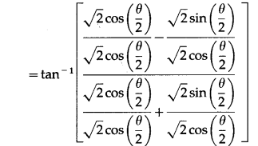
$=\tan ^{-1}\left[\frac{\sqrt{2 \cos ^2\left(\frac{\theta}{2}\right)}-\sqrt{2 \sin ^2\left(\frac{\theta}{2}\right)}}{\sqrt{2 \cos ^2\left(\frac{\theta}{2}\right)}+\sqrt{2 \sin ^2\left(\frac{\theta}{2}\right)}}\right]$
$=\tan ^{-1}\left[\frac{\sqrt{2} \cos \left(\frac{\theta}{2}\right)-\sqrt{2} \sin \left(\frac{\theta}{2}\right)}{\sqrt{2} \cos \left(\frac{\theta}{2}\right)+\sqrt{2} \sin \left(\frac{\theta}{2}\right)}\right]\Image
$=\tan ^{-1}\left[\frac{1-\tan \left(\frac{\theta}{2}\right)}{1+\tan \left(\frac{\theta}{2}\right)}\right]$
$=\tan ^{-1}\left[\frac{\tan \frac{\pi}{4}-\tan \left(\frac{\theta}{2}\right)}{1+\tan \frac{\pi}{4} \cdot \tan \left(\frac{\theta}{2}\right)}\right] \ldots\left[\because \tan \frac{\pi}{4}=1\right]$
$=\tan ^{-1}\left[\tan \left(\frac{\pi}{4}-\frac{\theta}{2}\right)\right]=\frac{\pi}{4}-\frac{\theta}{2}$
$\begin{aligned} & =\frac{\pi}{4}-\frac{1}{2} \cos ^{-1} x . \quad \ldots\left[\because \theta=\cos ^{-1} x\right] \\ & =\text { RHS. }\end{aligned}$
View full question & answer
Question 74 Marks
Show that $\tan ^{-1}\left(\frac{1}{5}\right)+\tan ^{-1}\left(\frac{1}{7}\right)+\tan ^{-1}\left(\frac{1}{3}\right)+\tan ^{-1}\left(\frac{1}{8}\right)=\frac{\pi}{4}$.
Answer
LHS $=\tan ^{-1}\left(\frac{1}{5}\right)+\tan ^{-1}\left(\frac{1}{7}\right)+\tan ^{-1}\left(\frac{1}{3}\right)+\tan ^{-1}\left(\frac{1}{8}\right)$
$=\tan ^{-1}\left[\frac{\frac{1}{5}+\frac{1}{7}}{1-\frac{1}{5} \times \frac{1}{7}}\right]+\tan ^{-1}\left[\frac{\frac{1}{3}+\frac{1}{8}}{1-\frac{1}{3} \times \frac{1}{8}}\right]$
$=\tan ^{-1}\left(\frac{7+5}{35-1}\right)+\tan ^{-1}\left(\frac{8+3}{24-1}\right)$
$\begin{aligned} & =\tan ^{-1}\left(\frac{12}{34}\right)+\tan ^{-1}\left(\frac{11}{23}\right) \\ & =\tan ^{-1}\left(\frac{6}{17}\right)+\tan ^{-1}\left(\frac{11}{23}\right)\end{aligned}$
$=\tan ^{-1}\left[\frac{\frac{6}{17}+\frac{11}{23}}{1-\frac{6}{17} \times \frac{11}{23}}\right]$
$=\tan ^{-1}\left(\frac{138+187}{391-66}\right)=\tan ^{-1}\left(\frac{325}{325}\right)$
$\begin{aligned} & =\tan ^{-1}(1)=\tan ^{-1}\left(\tan \frac{\pi}{4}\right) \\ & =\frac{\pi}{4}=\text { RHS. }\end{aligned}$
View full question & answer
Question 84 Marks
Show that $2 \sin ^{-1}\left(\frac{3}{5}\right)=\tan ^{-1}\left(\frac{24}{7}\right)$.
Answer
Let $\sin ^2\left(\frac{3}{5}\right)=x$.
Then $\sin x=\frac{3}{5}$, where $0<x<\frac{\pi}{2}$
$\therefore \cos x>0$
Now, $\cos x=\sqrt{1-\sin ^2 x}=\sqrt{1-\frac{9}{25}}=\sqrt{\frac{16}{25}}=\frac{4}{5}$
$\therefore \tan x=\frac{\sin x}{\cos x}=\frac{(3 / 5)}{(4 / 5)}=\frac{3}{4}$
$\therefore x=\tan ^{-1}\left(\frac{3}{4}\right)$
$\therefore \sin ^{-1}\left(\frac{3}{5}\right)=\tan ^{-1}\left(\frac{3}{4}\right)$
Now, LHS $=2 \sin ^{-1}\left(\frac{3}{5}\right)=2 \tan ^{-1}\left(\frac{3}{4}\right)$
$=\tan ^{-1}\left(\frac{3}{4}\right)+\tan ^{-1}\left(\frac{3}{4}\right)$
$=\tan ^{-1}\left[\frac{\frac{3}{4}+\frac{3}{4}}{1-\frac{3}{4} \times \frac{3}{4}}\right]=\tan ^{-1}\left[\frac{12+12}{16-9}\right]$
$=\tan ^{-1}\left(\frac{24}{7}\right)=$ RHS.
Alternative Method:
$\mathrm{LHS}=2 \sin ^{-1}\left(\frac{3}{5}\right)=2 \tan ^{-1}\left(\frac{3}{4}\right)$
$=\tan ^{-1}\left[\frac{2\left(\frac{3}{4}\right)}{1-\left(\frac{3}{4}\right)^2}\right]$
$\cdots\left[\because 2 \tan ^{-1} x=\tan ^{-1}\left(\frac{2 x}{1-x^2}\right)\right]$
$=\tan ^{-1}\left[\frac{\left(\frac{3}{2}\right)}{1-\left(\frac{9}{16}\right)}\right]$
$=\tan ^{-1}\left(\frac{3}{2} \times \frac{16}{7}\right)$
$\therefore \tan ^{-1}\left(\frac{24}{7}\right)=$ RHS
View full question & answer
Question 94 Marks
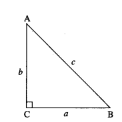
In $\triangle A B C$ if $\angle C=90^{\circ}$ then prove that $\sin (A-B)=\frac{a^2-b^2}{a^2+b^2}$
Answer
In ∆ABC, if ∠C = 90º

$\therefore c^2=a^2+b^2 \ldots(1)$

By sine rule,

$\frac{a}{\sin A}=\frac{b}{\sin B}=\frac{c}{\sin C}$

$\therefore \frac{a}{\sin A}=\frac{b}{\sin B}=\frac{c}{\sin 90^{\circ}}$

$\therefore \frac{a}{\sin A}=\frac{b}{\sin B}=c$

$\cdots\left[\because \sin 90^{\circ}=1\right]$

Image

$\therefore \sin \mathrm{A}=\frac{a}{c}$ and $\sin \mathrm{B}=\frac{b}{c}$

$\ldots(2)$

$\begin{aligned} \text { LHS } & =\sin (A-B) \\ & =\sin A \cos B-\cos A \sin B\end{aligned}$

$=\frac{a}{c} \cos B-\frac{b}{c} \cos A$

$\ldots$ [By (2)]

$=\frac{a}{c}\left(\frac{c^2+a^2-b^2}{2 c a}\right)-\frac{b}{c}\left(\frac{b^2+c^2-a^2}{2 b c}\right)$

$\begin{aligned} & =\frac{c^2+a^2-b^2}{2 c^2}-\frac{b^2+c^2-a^2}{2 c^2} \\ & =\frac{c^2+a^2-b^2-b^2-c^2+a^2}{2 c^2}\end{aligned}$

$\begin{aligned} & =\frac{2 a^2-2 b^2}{2 c^2}=\frac{a^2-b^2}{c^2} \\ & =\frac{a^2-b^2}{a^2+b^2} \\ & =\text { RHS. }\end{aligned}$

$\ldots[$ By (1)]

View full question & answer
Question 104 Marks
In ∆ABC, if a cos A = b cos B then prove that the triangle is right angled or an isosceles traingle.
Answer
By the sine rule,

$\begin{aligned} & \frac{a}{\sin A}=\frac{b}{\sin B}=k \\ & a=k \sin A \text { and } b=k \sin B\end{aligned}$

$\begin{aligned} & \therefore a \cos A=b \cos B \text { gives } \\ & k \sin A \cos A=k \sin B \cos B \\ & \therefore 2 \sin A \cos A=2 \sin B \cos B\end{aligned}$

$\begin{aligned} & \therefore \sin 2 A=\sin 2 B \therefore \sin 2 A-\sin 2 B=0 \\ & \therefore 2 \cos (A+B) \cdot \sin (A-B)=0\end{aligned}$

$\begin{aligned} & \therefore 2 \cos (\pi-C) \cdot \sin (A-B)=0 \ldots[\because A+B+C=\pi] \\ & \therefore-2 \cos C \cdot \sin (A-B)=0\end{aligned}$

$\begin{aligned} & \therefore C \cos C=0 O R \sin (A-B)=0 \\ & \therefore C=90^{\circ} O R A-B=0 \\ & \therefore C=90^{\circ} O R A=B\end{aligned}$

∴ the triangle is either rightangled or an isosceles triangle.

View full question & answer
Question 114 Marks
In $\triangle A B C$, if $\cot A, \cot B, \cot C$ are in A.P. then show that $a^2, b^2, c^2$ are also in A.P
Answer
By the sine rule,

$\begin{aligned} & \frac{\sin \mathrm{A}}{a}=\frac{\sin \mathrm{B}}{b}=\frac{\sin \mathrm{C}}{c}=k \\ & \therefore \sin \mathrm{A}=k a, \sin B=k b, \sin C=k c \ldots(1)\end{aligned}$

Now, $\cot A, \cot B, \cot C$ are in A.P.

$\therefore \cot C-\cot B=\cot B-\cot A$

$\therefore \cot A+\cot C=2 \cot B$

$\therefore \frac{\cos A}{\sin A}+\frac{\cos C}{\sin C}=2 \cot B$

$\therefore \frac{\sin (A+C)}{\sin A \cdot \sin C}=2 \cot B$

$\therefore \frac{\sin (\pi-B)}{\sin A \cdot \sin C}=2 \cot B \quad \quad \ldots[\because A+B+C=\pi]$

$\therefore \frac{\sin B}{\sin A \cdot \sin C}=\frac{2 \cos B}{\sin B}$

$\therefore \frac{\sin ^2 B}{\sin A \cdot \sin C}=2 \cos B$

$\therefore \frac{k^2 b^2}{(k a)(k c)}=2\left(\frac{a^2+c^2-b^2}{2 a c}\right)$

$\therefore \frac{b^2}{a c}=\frac{a^2+c^2-b^2}{a c}$

Hence, $a^2, b^2, c^2$ are in A.P.

$\therefore b^2=a^2+c^2-b^2 \quad \therefore 2 b^2=a^2+c^2$

View full question & answer
Question 134 Marks
Which of the following equations have solutions ?

1.cos 2θ = -1

2.$\cos ^2 \theta=-1$

3.2 sinθ = 3

4. 3 tanθ = 5

Answer
cos 2θ = -1 Since -1 ≤ cos θ ≤ 1 for any θ, cos 2θ = -1 has solution.

2.$\cos ^2 \theta=-1$

This is not possible because $\cos ^2 \theta \geq 0$ for any $\theta$.

$\therefore \cos ^2 \theta=-1$ does not have any solution.

3.$2 \sin \theta=3 \therefore \sin \theta=\frac{3}{2}$

This is not possible because -1 ≤ sin θ ≤ 1 for any θ.
∴ 2 sin θ = 3 does not have any solution.

4.$3 \tan \theta=5 \therefore \tan \theta=\frac{5}{3}$

This is possible because tan θ is any real number.

$\therefore 3 \tan \theta=5$ has solution.

View full question & answer
Question 144 Marks
Find the general solutions of the following : cosθ + sinθ = 1.
Answer
cosθ + sinθ = 1
Dividing both sides by $\sqrt{(1)^2+(1)^2}=\sqrt{2}$, we get
$\frac{1}{\sqrt{2}} \cos \theta+\frac{1}{\sqrt{2}} \sin \theta=\frac{1}{\sqrt{2}}$
$\therefore \cos \frac{\pi}{4} \cos \theta+\sin \frac{\pi}{4} \sin \theta=\cos \frac{\pi}{4}$
$\therefore \cos \left(\theta-\frac{\pi}{4}\right)=\cos \frac{\pi}{4}$
The general solution of
$\cos \theta=\cos \alpha$ is $\theta=2 n \pi \pm \alpha, n \in Z$
$\therefore$ the general solution of $(1)$ is given by
$\theta-\frac{\pi}{4}=2 n \pi \pm \frac{\pi}{4}, n \in Z$
Taking positive sign, we get
$\theta-\frac{\pi}{4}=2 n \pi+\frac{\pi}{4}, n \in Z$
Taking negative sign, we get
$\theta-\frac{\pi}{4}=2 n \pi-\frac{\pi}{4}, n \in Z$
$\therefore \theta=2 n \pi, n \in Z$
$\therefore$ the required general solution is
$\theta=2 n \pi+\frac{\pi}{2}, n \in Z$ or $\theta=2 n \pi, n \in Z$
Alternative Method:
$\begin{aligned} & \cos \theta+\sin \theta=1 \\ & \therefore \sin \theta=1-\cos \theta\end{aligned}$
$\begin{aligned} & \therefore 2 \sin \frac{\theta}{2} \cos \frac{\theta}{2}=2 \sin ^2 \frac{\theta}{2} \\ & \therefore 2 \sin \frac{\theta}{2} \cos \frac{\theta}{2}-2 \sin ^2 \frac{\theta}{2}=0\end{aligned}$
$\begin{aligned} & \therefore 2 \sin \frac{\theta}{2}\left(\cos \frac{\theta}{2}-\sin \frac{\theta}{2}\right)=0 \\ & \therefore 2 \sin \frac{\theta}{2}=0 \text { or } \cos \frac{\theta}{2}-\sin \frac{\theta}{2}=0\end{aligned}$
$\therefore \sin \frac{\theta}{2}=0$ or $\sin \frac{\theta}{2}=\cos \frac{\theta}{2}$
$\therefore \sin \frac{\theta}{2}=0$ or $\tan \frac{\theta}{2}=1 \quad \therefore\left[\because \cos \frac{\theta}{2} \neq 0\right]$
$\therefore \sin \frac{\theta}{2}=0$ or $\tan \frac{\theta}{2}=\tan \frac{\pi}{4} \quad \cdots\left[\because \tan \frac{\pi}{4}=1\right]$
The general solution of $\sin \theta=0$ is $\theta=n \pi, n \in Z$ and
$\tan \theta=\tan \alpha$ is $\theta=n \pi+\alpha, n \in Z$
$\therefore$ the required general solution is
$\frac{\theta}{2}=n \pi, n \in Z$ or $\frac{\theta}{2}=n \pi+\frac{\pi}{4}, n \in Z$
i.e. $\theta=2 n \pi, n \in Z$ or $\theta=2 n \pi+\frac{\pi}{2}, n \in Z$.
View full question & answer
Question 154 Marks
Find the general solutions of the following :

$\tan ^3 \theta=3 \tan \theta$

Answer
$\begin{aligned} & \tan ^3 \theta=3 \tan \theta \\ & \therefore \tan ^3 \theta-3 \tan \theta=0\end{aligned}$

$\therefore \tan \theta\left(\tan ^2 \theta-3\right)=0$

$\therefore$ either $\tan \theta=0$ or $\tan ^2 \theta-3=0$

$\therefore$ either $\tan \theta=0$ or $\tan ^2 \theta=3$

$\therefore$ either $\tan \theta=0$ or $\tan ^2 \theta=(\sqrt{3})^3$

$\therefore$ either $\tan \theta=0$ or $\tan ^2 \theta=\left(\tan \frac{\pi}{3}\right)^3 \ldots\left[\tan \frac{\pi}{3}=\sqrt{3}\right]$

$\therefore$ either $\tan \theta=0$ or $\tan ^2 \theta=\tan ^2 \frac{\pi}{3}$

The general solution of

$\tan \theta=0$ is $\theta=n \pi, n \in Z$ and

$\tan ^2 \theta=\tan ^2 \alpha$ is $\theta=n \pi \pm \alpha, n \in Z$.

∴ the required general solution is given by

$\theta=n \pi, n \in Z$ or $\theta=n \pi \pm \frac{\pi}{3}, n \in Z$

View full question & answer
Question 164 Marks
Find the general solutions of the following : sinθ = tanθ
Answer
sin θ = tan θ

$\therefore \sin \theta=\frac{\sin \theta}{\cos \theta}$

$\therefore \sin \theta \cos \theta=\sin \theta$

$\therefore \sin \theta \cos \theta-\sin \theta=0$

$\therefore \sin \theta(\cos \theta-1)=\theta$

$\therefore$ either $\sin \theta=0$ or $\cos \theta-1=0$

$\therefore$ either $\sin \theta=0$ or $\cos \theta=1$

$\therefore$ either $\sin \theta=0$ or $\cos \theta=\cos \theta \ldots[\because \cos 0=1]$

The general solution of sinθ = 0 is θ = nπ, n ∈ Z and cos θ = cos ∝ is θ = 2nπ ± ∝, where n ∈ Z.

∴ the required general solution is given by

$\theta=n \pi, n \in Z$ or $\theta=2 n \pi \pm 0, n \in Z$

$\therefore \theta=n \pi, n \in Z$ or $\theta=2 n \pi, n \in Z$

View full question & answer