Question 12 Marks
Show that the points $A (3,2,-4), B (9,8,-10)$ and $C (-2,-3,1)$ are collinear.
AnswerLet $\bar{a}, \bar{b}, \bar{c}$ be the position vectors of the points
$
\begin{aligned}
A & =(3,2,-4), B =(9,8,-10), C =(-2,-3,1) \\
\therefore \bar{a} & =3 \hat{i}+2 \hat{\jmath}-4 \hat{k} \\
\bar{b} & =9 \hat{i}+8 \hat{\jmath}-10 \hat{k} \\
\bar{c} & =-2 \hat{i}-3 \hat{\jmath}+\hat{k} \\
\overline{ AB } & =\bar{b}-\bar{a}=6 \hat{i}+6 \hat{\jmath}-6\hat{k}
\end{aligned}
$
$
\overline{ AC }=\bar{c}-\bar{a}=-5 \hat{i}-5 \hat{j}+5 \hat{k}
$
The direction ratios of the lines along $\overline{ AB }$ and $\overline{ AC }$ are proportional.
$\therefore$ Lines $A B$ and $A C$ are parallel and point $A$ is common. Therefore points A, B, C are collinear.
View full question & answer→MCQ 22 Marks
If two non-zero vectors, $\bar{a}$ and $\bar{b}$ are perpendicular to each other, then $(\bar{a}-\bar{b})^2=\ldots \ldots$
- A
$a^2-b^2$
- B
$(\bar{a}+\bar{b})^2$
- C
$\bar{a} \cdot \bar{b}$
- D
$\bar{a} \times \bar{b}$
Answer$(\bar{a}+\bar{b})^2$\begin{aligned}
(\bar{a}-\bar{b})^2 & =(\bar{a}-\bar{b}) \cdot(\bar{a}-\bar{b}) \\
& =a^2-\bar{a} \cdot \bar{b}-\bar{b} \cdot \bar{a}+b^2 \\
& =a^2+b^2-2 \bar{a} \cdot \bar{b} \\
& =a^2+b^2-0(\because \bar{a} \perp \bar{b}) \\
& =a^2+b^2 \\
\therefore(\bar{a}+\bar{b})^2 & =a^2+2 \bar{a} \cdot \bar{b}+b^2=a^2+b^2 \\
\therefore(\bar{a}-\bar{b})^2 & =(\bar{a}+\bar{b})^2
\end{aligned}
View full question & answer→Question 32 Marks
If two non-zero vectors $\bar{a}$ and $\bar{b}$ are collinear then prove that there exist scalars $m$ and $n$ such that $m \bar{a}+n \bar{b}=\overline{0}$ and $(m, n) \neq(0,0)$.
View full question & answer→Question 42 Marks
Prove that the volume of a parallelepiped whose coterminous edges as $\bar{a}, \bar{b}, \bar{c}$ is $[\bar{a} \bar{b} \bar{c}]$. Hence find the volume of a parallelepiped whose coterminous edges $\bar{i}+\bar{j} \cdot \bar{j}+\bar{k}$ and $\bar{k}+\bar{i}$
View full question & answer→Question 52 Marks
If $A, B, C, D$ are four non-collinear points in the plane such that $\overline{A D}+\overline{B D}+\overline{C D}=\overline{0}$, then prove that point $D$ is the centroid of the $\triangle ABC$.
AnswerLet $\bar{a}, \bar{b}, \bar{c}, \bar{d}$ be the position vectors of points $A , B , C , D$ respectively
$\overline{A D}+\overline{B D}+\overline{C D}=\bar{O}$
$(\bar{d}-\bar{a})+(\bar{d}-\bar{b})+(\bar{d}-\bar{c})=\bar{O}$
$3 \bar{d}-(\bar{a}+\bar{b}+\bar{c})=\bar{O}$
$3 \bar{d}=\bar{a}+\bar{b}+\bar{c}$
$\bar{d}=\frac{\bar{a}+\bar{b}+\bar{c}}{3}$
$\bar{d}$ represents centroid of the triangle.
Point D is the centroid of the ΔABC.
View full question & answer→Question 62 Marks
If $\bar{c}=3 \bar{a}-2 \bar{b}$, then prove that $[\bar{a} \bar{b} \bar{c}]=0$
View full question & answer→MCQ 72 Marks
If $[\bar{a} \bar{b} \bar{c}] \neq 0$ and $\bar{p}=\frac{\bar{b} \times \bar{c}}{[\bar{a} \bar{b} \bar{c}]}, \bar{q}=\frac{\bar{c} \times \bar{a}}{[\bar{a} \bar{b} \bar{c}]}, \bar{r}=\frac{\bar{a} \times \bar{b}}{[\bar{a} \bar{b} \bar{c}]}$ then $\bar{a}, \bar{p}+\bar{b}, \bar{q}+\bar{c}, \bar{r}$ is equal to.....
View full question & answer→Question 82 Marks
Find the direction ratios of a vector perpendicular to the two lines whose direction ratios are $-2,1,-1$ and $-3,-4,1$
View full question & answer→MCQ 92 Marks
Direction cosines of the line passing through the points $A=(-4,2,3)$ and $B \equiv(1,3,-2)$ are _____
- A
$\pm \frac{1}{\sqrt{51}}, \pm \frac{5}{\sqrt{51}}, \pm \frac{1}{\sqrt{51}}$
- B
$\pm \frac{1}{\sqrt{51}}, \pm \frac{1}{\sqrt{51}}, \pm \frac{-5}{\sqrt{51}}$
- C
$\pm 5, \pm 1, \pm 5$
- D
$\pm \sqrt{51}, \pm \sqrt{51}, \pm \sqrt{51}$
AnswerThe direction ratios of the line are 1 + 4, 3 − 2, −2 − 3 i.e., 5, 1, −5
∴ the direction cosines of the line are
$\begin{aligned} & \pm \frac{5}{\sqrt{5^2+1^2+(-5)^2}}, \pm \frac{1}{\sqrt{5^2+1^2+(-5)^2}}, \pm-\frac{5}{\sqrt{5^2+1^2+(-5)^2}} \\ & \text { i.e } \pm \frac{5}{\sqrt{51}}, \pm \frac{1}{\sqrt{51}}, \pm-\frac{5}{\sqrt{51}}\end{aligned}$
View full question & answer→Question 102 Marks
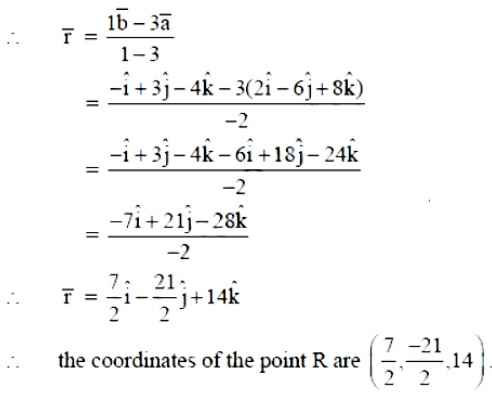
Find the co-ordinates of the point, which divides the line segment joining the points $A (2,-6,8)$ and $B (-1,3,-4)$ externally in the ratio $1: 3$.
AnswerLet $\bar{a}$ and $\bar{b}$ be the position vectors of the points $A$ and $B$ respectively.
Then, $\bar{a}=2 \hat{i}-6 \hat{j}+8 \widehat{k}$ and $\bar{b}=-\hat{i}+3 \hat{j}-4 \widehat{k}$
Let R ($\bar{r}$) be the point which divides the line segment joining the points A and B externally in the ratio 1 : 3.
View full question & answer→MCQ 112 Marks
The value of $\hat{i} \cdot(\hat{j} \times \hat{k})+\hat{j} \cdot(\hat{k} \times \hat{i})+\hat{k} \cdot(\hat{i} \times \hat{j})$ is .....
Answer3
$\hat{i} \cdot(\hat{j} \times \hat{k})+\hat{j} \cdot(\hat{k} \times \hat{i})+\hat{k} \cdot(\hat{i} \times \hat{j})$
$=\hat{\imath} \cdot \hat{\imath}+\hat{j} \cdot \hat{\jmath}+\hat{k} \cdot \hat{k}$
= 1 + 1 + 1
= 3

Hence option (d)
View full question & answer→Question 122 Marks
$\bar{a}$ and $\bar{b}$ are non - collinear vectors. If $\bar{c}=(x-2) \bar{a}+\bar{b}$ and $\bar{d}=(2 x+1) \bar{a}-\bar{b}$ are collinear, then find the value of $x$.
View full question & answer→MCQ 132 Marks
If $\bar{a}=3 \hat{i}-\hat{j}+4 \hat{k}, \bar{b}=2 \hat{i}+3 \hat{j}-\hat{k}$ and $\bar{c}=-5 \hat{i}+2 \hat{j}+3 \hat{k}$, then $\bar{a} \cdot(\bar{b} \times \bar{c})$ is $\qquad$
View full question & answer→Question 142 Marks
Show that the points $A (-7,4,-2), B (-2,1,0)$ and $C (3,-2,2)$ are collinear.
AnswerLet $\bar{a}, \bar{b}, \& \bar{c}$ be position vectors of $A, B \& C$
$\overline{ AB }=\overline{ b }-\overline{ a }$
$=(-2 \hat{i}+\hat{j})-(-7 \hat{i}+4 \hat{j}-2 \hat{k})$
$=5 \hat{ i }-3 \hat{ j }+2 \hat{ k }$
$\overline{ AC }=\overline{ c }-\overline{ a }$
$=(3 \hat{ i }-2 \hat{ j }+2 \hat{ k })-(-7 \hat{ i }+4 \hat{ j }-2 \hat{ k })$
$=10 \hat{ i }-6 \hat{ j }+4 \hat{ k }$
$=2[5 \hat{ i }-3 \hat{ j }+2 \hat{ k }]$
$\Rightarrow \overline{ AC }=2 \overline{( AB )}$
$\Rightarrow \overline{ AC }$ is a scalar multiple of $\overline{ AB }$
$\Rightarrow \overline{ AC } \& \overline{ AB }$
∵ A is common
$\Rightarrow A B \& C$ are collinear.
View full question & answer→Question 152 Marks
Find the value of $p$, if the vectors $\hat{i}-2 \hat{j}+\hat{k}, 2 \hat{i}-5 \hat{j}+p \hat{k}$ and $5 \hat{i}-9 \hat{j}+4 \hat{k}$ are coplanar.
View full question & answer→Question 162 Marks
Find the volume of the parallelepiped, if the coterminous edges are given by the vectors $2 \hat{i}+5 \hat{j}-4 \hat{k}, 5 \hat{i}+7 \hat{j}+5 \hat{k}, 4 \hat{i}+5 \hat{j}-2 \hat{k}$.
AnswerIf $\vec{a} \vec{b}$ and $\vec{c}$ are conterminus edges of parallelopiped then the volume of the parallelopiped $=[\vec{a} \vec{b} \vec{c}]$
where $\vec{a}=2 \hat{i}+5 \hat{j}-4 \widehat{k}$
$\vec{b}=5 \hat{i}+7 \hat{j}+5 \widehat{k}$
$\vec{c}=4 \hat{i}+5 \hat{j}-2 \widehat{k}$
$\therefore V=[\vec{a} \vec{b} \vec{c}]=\left[\begin{array}{ccc}2 & 5 & -4 \\ 5 & 7 & 5 \\ 4 & 5 & -2\end{array}\right]$
$=2(-14-25)-5(-10-20)-4(25-28)$
$=2(-39)-5(-30)-4(-3)$
$=-78+150+12$
$=84$ cube Unit
View full question & answer→Question 172 Marks
If $\bar{a}=3 \hat{i}-2 \hat{j}+7 \hat{k}, \bar{b}=5 \hat{i}+\hat{j}-2 \hat{k}$ and $\bar{c}=\hat{i}+\hat{j}-\hat{k}$ then find $\bar{a} \cdot(\bar{b} \times \bar{c})$
Answer$\bar{a}(\bar{b} \times \bar{c})=[\bar{a} \bar{b} \bar{c}]=\left[\begin{array}{lll}a_1 & a_2 & a_3 \\ b_1 & b_2 & b_3 \\ c_1 & c_2 & c_3\end{array}\right]$
$\therefore \bar{a}(\bar{b} \times \bar{c})=\left|\begin{array}{ccc}3 & -2 & 7 \\ 5 & 1 & -2 \\ 1 & 1 & -1\end{array}\right|$
$=3(-1+2)+2(-5+2)+7(5-1)$
$=3-6+28$
$=25$
View full question & answer→Question 182 Marks
If the points $A (2,1,1), B (0,-1,4)$ and $C (k, 3,-2)$ are collinear, then $k=\ldots \ldots$.
Answer(c) 4
solution:
Direction Ratio of bar(AB )=(-2, -2, 3)
Direction Ratio of bar(BC)=(k, 4, -6)
If point $A , B$ and $C$ are collinear then $\frac{ DR \text { of } \overline{A B}}{ DR \text { of } \overline{B C}}=$ constatnt
$-\frac{2}{k}=-\frac{2}{4}$
$k=4$
View full question & answer→Question 192 Marks
If $\bar{p}=\hat{i}-2 \hat{j}+\hat{k}$ and $\bar{q}=\hat{i}+4 \hat{j}-2 \hat{k}$ are position vector (PV) of points $P$ and $g$. find the position vector of the point $R$ which divides segment $PQ$ internally in the ratio 2:1.
AnswerR is the point which divides the line segment joining the points PQ internally in the ratio 2:1.
$\bar{r}=\frac{2(\bar{q})+1(\bar{p})}{2+1}$
$=\frac{2(\hat{i}+4 \hat{j}-2 \widehat{k})+1(\hat{i}-2 \hat{j}+\widehat{k})}{3}$
$=\frac{3 \hat{i}+6 \hat{j}-3 \widehat{k}}{3}$
$\bar{r}=\hat{i}+2 \hat{j}-\widehat{k}$
The position vector of point $R$ is $\hat{i}+2 \hat{j}-\widehat{k}$
View full question & answer→Question 202 Marks
If $\bar{a}=\bar{i}+2 \bar{j}, \bar{b}=-2 \bar{i}+\bar{j}, \bar{c}=4 \bar{i}+3 \bar{j}$, find $x$ and $y$ such that $\bar{c}=x \bar{a}+y \bar{b}$
AnswerGiven that $\vec{a}=\hat{i}+2 \hat{j}, \vec{b}=-2 \hat{i}+\hat{j}, \vec{c}=4 \hat{i}+3 \hat{j}$
We need to find $x$ and $y$ such that $\vec{c}=x \vec{a}+y \vec{b}$
Substituting the values of $a$, $b$ and $c$, in $\vec{c}=x \vec{a}+y \vec{b}$, we have,
$4 \hat{i}+3 \hat{j}=x(\hat{i}+2 \hat{j})+y(-2 \hat{i}+\hat{j})$
$4 \hat{i}+3 \hat{j}=(x-2 y) \hat{i}+(2 x+y) \hat{j}$
Comparing the coefficients of i and j on both the sides, we have,
x-2y= 4
and
2x + y = 3
Solving the above simultaneous equations, we have,
x = 2 and y = -1
View full question & answer→MCQ 212 Marks
Which of the following represents direction cosines of a lines
- A
$0, \frac{1}{\sqrt{2}}, \frac{1}{2}$
- B
$0,-\frac{\sqrt{3}}{2}, \frac{1}{2}$
- C
$0,-\frac{\sqrt{3}}{2}, \frac{1}{2}$
- D
$\frac{1}{2}, \frac{1}{2}, \frac{1}{2}$
AnswerAns. (C)
`l^2+m^2+n^2`
`=(0)^2+(sqrt3/2)^2+(1/2)^2`
`=3/4+1/4=1`
View full question & answer→Question 222 Marks
If $\bar{a}, \bar{b}, \bar{c}$ are the position vectors of the points $A , B , C$ respectively and $2 \bar{a}+3 \bar{b}-5 \bar{c}=\overline{0}$, then find the ratio in which the point $C$ divides line segment $A B$.
Answer$2 \bar{a}+3 \bar{b}-5 \bar{c}=0$
$5 \bar{c}=3 \bar{b}+2 \bar{a}$
$\bar{c}=\frac{3 \bar{b}+2 \bar{a}}{5}$
$\bar{c}=\frac{3 \bar{b}+2 \bar{a}}{3+2}$
∴C divides seg AB internally in the ratio 3 : 2
View full question & answer→MCQ 232 Marks
If the vectors $-3 \hat{i}+4 \hat{j}-2 \hat{k}, \hat{i}-p \hat{j}$ are coplanar then the value of $p$ is
AnswerLet $\overline{ a }=-3 \hat{ i }+4 \hat{ j }-2 \hat{ k }, \overline{ b }=\hat{ i }+2 \hat{ k }, \overline{ c }=\hat{ i }-p \hat{ j }$
Then $\bar{a}, \bar{b}, \bar{c}$ are coplanar.
$\therefore[\overline{ a } \overline{ b } \overline{ c }]=0$
$\therefore\left|\begin{array}{ccc}-3 & 4 & -2 \\ 1 & 0 & 2 \\ 1 & - p & 0\end{array}\right|=0$
∴ −3(0 + 2p) − 4(0 − 2) − 2(− p − 0) = 0
∴ − 6p + 8 + 2p = 0
∴ − 4p = − 8
∴ p = 2
View full question & answer→Question 242 Marks
If points $A(5,5, \lambda), B(-1,3,2)$ and $C(-4,2,-2)$ are collinear, then find the value of $\lambda$.
View full question & answer→Question 252 Marks
If $\vec{a}, \vec{b}, \vec{c}$ are the position vectors of the points $A, B, C$ respectively such that $3 \vec{a}+5 \vec{b}=8 \vec{c}$, then find the ratio in which $C$ divides $AB$.
View full question & answer→MCQ 262 Marks
If the vectors $\hat{i}-2 \hat{j}+\hat{k}, a \hat{i}-5 \hat{j}+3 \hat{k}$ and $5 \hat{i}-9 \hat{j}+4 \hat{k}$ are coplanar, then the value of $a$ is
View full question & answer→Question 272 Marks
If a line makes angles $\alpha, \beta, \gamma$ with co-ordinate axes prove that $\cos 2 \alpha+\cos 2 \beta+\cos 2 \gamma+1=0$
Answer$\begin{aligned} & =\left(2 \cos ^2 \alpha-1\right)+\left(2 \cos ^2 \beta-1\right)+\left(2 \cos ^2 \gamma-1\right) \\ & =2\left(\cos ^2 \alpha+\cos ^2 \beta+\cos ^2 \gamma\right)-3 \\ & =2(1)-3 \quad\left[\because \cos ^2 \alpha+\cos ^2 \beta+\cos ^2 \gamma=1\right] \\ & =-1 \\ & \therefore \cos 2 \alpha+\cos 2 \beta+\cos 2 \gamma=-1 \\ & \therefore \cos 2 \alpha+\cos 2 \beta+\cos 2 \gamma+1=0\end{aligned}$
View full question & answer→Question 282 Marks
If $\bar{a}, \bar{b}, \bar{c}$ are the position vectors of the points $A , B , C$ respectively such that $3 \bar{a}+5 \bar{b}-8 \bar{c}=\overline{0}$, find the ratio in which $A$ divides $BC$.
AnswerGiven : $3 \bar{a}+5 \bar{b}-8 \bar{c}=0$
$
\begin{aligned}
& 3 \bar{a}=8 \bar{c}-5 \bar{b} \\
& \bar{a}=\frac{8 \bar{c}-5 \bar{b}}{3} \\
& \bar{a}=\frac{8 \bar{c}-5 \bar{b}}{8-5} \quad[\because 3=8-5]
\end{aligned}
$
$A(\bar{a})$ divides $BC$ externally in the ratio $8: 5$.
View full question & answer→Question 292 Marks
If $\bar{a}=3 \hat{i}-\hat{\jmath}+4 \hat{k}, \bar{b}=2 \hat{i}+3 \hat{j}-\hat{k}, \bar{c}=5 \hat{i}+2 \hat{j}+3 \hat{k}$, then $\bar{a} \cdot(\bar{b} \times \bar{c})=\ldots \ldots$.
Answer$\begin{aligned} & \bar{a} \cdot(\bar{b} \times \bar{c})=\left|\begin{array}{ccc}3 & -1 & 4 \\ 2 & 3 & -1 \\ -5 & 2 & 3\end{array}\right| \\ & =3(9+2)+1(6-5)+4(4+15) \\ & =33+1+76 \\ & =110\end{aligned}$
View full question & answer→MCQ 302 Marks
If a line makes angles $90^{\circ}, 135^{\circ}, 45^{\circ}$ with $X , Y$ and $Z$ axes respectively, then its its direction cosines are
- A
$0, \frac{1}{\sqrt{2}},-\frac{1}{\sqrt{2}}$
- B
$0,-\frac{1}{\sqrt{2}},-\frac{1}{\sqrt{2}}$
- C
$1, \frac{1}{\sqrt{2}}, \frac{1}{\sqrt{2}}$
- D
$0,-\frac{1}{\sqrt{2}}, \frac{1}{\sqrt{2}}$
Answer(D) `0,-1/sqrt2,1/sqrt2`
Let α, β, γ be the angles made by the line with positive directions of X, Y, Z axes respectively.
α = 90°, β = 135°, γ = 45°
l = cos 90°, m = cos 135°, n = cos 45°
Now, m = cos 135° = cos(180° – 45°)
=`-cos45^@=-1/sqrt2`
`l=0, m=-1/sqrt2, n=1/sqrt2`
Direction cosines of the line are `0,-1/sqrt2,1/sqrt2`
View full question & answer→Question 312 Marks
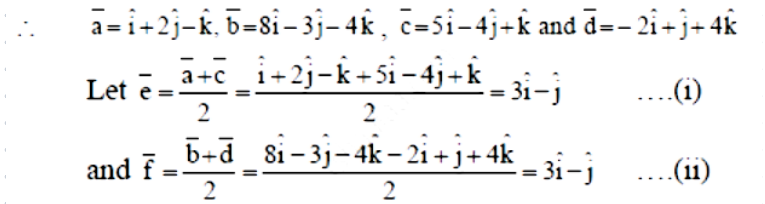
By vector method show that the quadrilateral with vertices $A (1,2,-1), B (8,-3,-4), C (5,-4,1), D (-2,1,4)$ is a parallelogram.
AnswerLet $\bar{a}, \bar{b}, \bar{c}$ and $\bar{d}$ be the position vectors of vertices $A , B , C , D$ respectively
∴From (i) and (ii), we get
$\bar{e}=\bar{f}$
The mid point of the diagonals AC and BD is same
∴ The diagonals AC and BD bisect each other.
$\therefore$ The $\square ABCD$ is a Parallelogram.
View full question & answer→MCQ 322 Marks
If the vectors $2 \bar{i}-q \bar{j}+3 \bar{k}$ and $4 \bar{i}-5 \bar{j}+6 \bar{k}$ are collinear, then value of $q$ is
- A
- B
- C
$\frac{5}{2}$
- D
$\frac{5}{4}$
Answer(C) 5/2
Let $\bar{a}=2 \hat{i}-q \hat{j}+3 \widehat{k}$ and $\bar{b}=4 \hat{i}-5 \hat{j}+6 \widehat{k}$
Since, $\bar{a}$ and $\bar{b}$ are collinear.
$\therefore$ there exists a scalar $t$ such that $\bar{b}=t \bar{a}$.
$\therefore 4 \hat{i}-5 \hat{j}+6 \widehat{k}=t(2 \hat{i}-q \hat{j}+3 \widehat{k})=2 t \hat{i}-q t \hat{j}+3 t \widehat{k}$
∴ By equality of vectors, we get
4 = 2t, - 5 = - qt, 6 = 3t
∵ 4 = 2t and 6 = 3t ∴t = 2
- 5 =- q(2)
–5 = – 2q
∴ 5 = 2q
q = 5/2
View full question & answer→