Question 13 Marks
Find the area of the parallelogram whose adjacent sides are the vectors $2 \hat{i}-2 \hat{j}+\hat{k}$ and $\hat{i}-3 \hat{j}-3 \hat{k}$.
AnswerLet $\bar{a}=2 \hat{i}-2 \hat{j}+\hat{k}, \bar{b}=\hat{i}-3 \hat{j}-3 \hat{k}$
Area of parallelogram whose adjacent sides are $\bar{a}$ and $\bar{b}$ is given by $|\bar{a} \times \bar{b}|$.
Now,
$
\begin{aligned}
\bar{a} \times \bar{b} & =\left|\begin{array}{ccc}
\hat{i} & \hat{j} & \hat{k} \\
2 & -2 & 1 \\
1 & -3 & -3
\end{array}\right| \\
& =\hat{i}(6+3)-\hat{j}(-6-1)+\hat{k}(-6+2) \\
& =9 \hat{i}+7 \hat{j}-4 \hat{k} \\
\therefore|\bar{a} \times \bar{b}| & =\sqrt{(9)^2+(7)^2+(-4)^2} \\
& =\sqrt{81+49+16}=\sqrt{146}
\end{aligned}
$
From (1)
Area of parallelogram $=\sqrt{146}$ sq. units
View full question & answer→Question 23 Marks
If the vectors $3 \hat{i}+5 \hat{k}, 4 \hat{i}+2 \hat{j}-3 \hat{k}$ and $3 \hat{i}+\hat{j}+4 \hat{k}$ are coterminus edges of a parallelopiped, then find the volume of the parallelopiped.
AnswerLet $\bar{a}=3 \hat{i}+5 \hat{k}, \bar{b}=4 \hat{i}+2 \hat{j}-3 \hat{k}$,
$\bar{c}=3 \hat{i}+\hat{j}+4 \hat{k}$
Volume of parallelopiped $=\left[\begin{array}{lll}\bar{a} & \bar{b} & \bar{c}\end{array}\right]$
$=\bar{a} \cdot(\bar{b} \times \bar{c})$
Now, $\bar{a} \cdot(\vec{b} \times \bar{c})=\left|\begin{array}{ccc}3 & 0 & 5 \\ 4 & 2 & -3 \\ 3 & 1 & 4\end{array}\right|$
=3(8+3)+5(4-6)
=3(11)+5(-2)
=33-10=23
Volume of parallelopiped $=23$ cu.units.
View full question & answer→Question 33 Marks
Express $-\bar{i}-3 \bar{j}+4 \bar{k}$ as a linear combination of vectors $2 \bar{i}+\bar{j}-4 \bar{k}, 2 \bar{i}+3 \bar{k}$ and $3 \bar{i}+\bar{j}-2 \bar{k}$
View full question & answer→Question 43 Marks
Using vector method, prove that the median of a triangle are concurrent.
Answer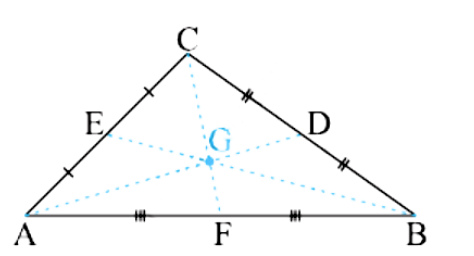
Let A, B and C be vertices of a triangle.
Let D, E and F be the mid-points of the sides BC, AC and AB respectively.
Let $\bar{a}, \bar{b}, \bar{c}, \bar{d}, \bar{e}$ and $\bar{f}$ be position vectors of points $A , B , C , D , E$ and $F$ respectively.
Therefore, by mid-point formula,
$\therefore \bar{d}=\frac{\bar{b}+\bar{c}}{2}, \bar{e}=\frac{\bar{a}+\bar{c}}{2}$ and $\bar{f}=\frac{\bar{a}+\bar{b}}{2}$
$\therefore 2 \bar{d}=\bar{b}+\bar{c}, 2 \bar{e}=\bar{a}+\bar{c}$ and $2 \bar{f}=\bar{a}+\bar{b}$
$\therefore 2 \bar{d}+\bar{a}=\bar{a}+\bar{b}+\bar{c}$, similarly $2 \bar{e}+\bar{b}=2 \bar{f}+\bar{c}=\bar{a}+\bar{b}+\bar{c}$
$\therefore \frac{2 \bar{d}+\bar{a}}{3}=\frac{2 \bar{e}+\bar{b}}{3}=\frac{2 \bar{f}+\bar{c}}{3}=\frac{\bar{a}+\bar{b}+\bar{c}}{3}=\bar{g} \ldots$ (Say)
Then we have
$\bar{g}=\frac{\bar{a}+\bar{b}+\bar{c}}{3}=\frac{(2) \bar{d}+(1) \bar{a}}{2+1}=\frac{(2) \bar{e}+(1) \bar{b}}{2+1}=\frac{(2) \bar{f}+(1) \bar{c}}{2+1}$
If G is the point whose position vector is $\bar{g}$, then from the above equation it is clear that the point G lies on the medians AD, BE, CF and it divides each of the medians AD, BE, CF internally in the ratio 2 : 1.
Therefore, three medians are concurrent.
View full question & answer→Question 53 Marks
If $A (\bar{a})$ and $B (\bar{b})$ be any two points in the space and $R (\bar{r})$ be a point on the line segment $AB$ dividing it internally in the ratio $m: n$ then prove that $\bar{r}=\frac{m \bar{b}+n \bar{a}}{m+n}$
Answer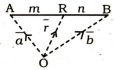
Let R is a point on segment AB (A - R - B)and $\overline{ AR }$ and $\overline{ RB }$ are in same directions.
$\frac{ AR }{ RB }=\frac{m}{n}$
$\therefore$n(AR) = m(RB)
As AR and RB have same directions,
$m(\overline{ RB })=n(\overline{ AR })$
$\therefore m(\overline{ OB }-\overline{ OR })=n(\overline{ OR }-\overline{ OA })$
$\therefore m(\bar{b}-\bar{r})=n(\bar{r}-a)$
$\therefore m \bar{r}+n \bar{r}=m \bar{b}+n \bar{a}$
$\therefore(m+n) \bar{r}=m \bar{b}+n \bar{a}$
$\therefore \bar{r}=\frac{m \bar{b}+n \bar{a}}{m+n}$
View full question & answer→Question 63 Marks
If $A (5,1, p), B (1, q, p)$ and $C (1,-2,3)$ are vertices of a triangle and $G \left(r, \frac{-4}{3}, \frac{1}{3}\right)$ is its centroid, then find the values of $p, q, r$ by vector method.
Answer$ A =(5,1, p), B =(1, q, p), C =(1,-2,3)$
$G =\left(r, \frac{-4}{3}, \frac{1}{3}\right)$
$\bar{a}=5 \hat{i}+\hat{j}+p \hat{k}, \bar{b}=\hat{i}+q \hat{j}+p \hat{k}$
$\bar{c}=\hat{i}-2 \hat{j}+3 \hat{k}, \bar{g}=r \hat{i}-\frac{4}{3} \hat{j}+\frac{1}{3} \hat{k}$
Centroid $=\bar{g}=\frac{\bar{a}+\bar{b}+\bar{c}}{3}$
$(5 \hat{i}+\hat{j}+p \hat{k})+(\hat{i}+q \hat{j}+p \hat{k})$
$\therefore r \hat{i}-\frac{4}{3} \hat{j}+\frac{1}{3} \hat{k}=\frac{+(\hat{i}-2 \hat{j}+3 \hat{k})}{3}$
$=\frac{7 \hat{i}+(q-1) \hat{j}+(2 p+3) \hat{k}}{3}$
Comparing the coefficient of $\hat{i}, \hat{j}$ and $\hat{k}$
$r =\frac{7}{3}, \frac{-4}{3}=\frac{q-1}{3}, \frac{1}{3}=\frac{2 p+3}{3}$
$\therefore r =\frac{7}{3}, q=-3, p=-1$
$\therefore p =-1, q=-3, r=\frac{7}{3}$
View full question & answer→Question 73 Marks
If $\triangle A B C$ is right angled at $B$, where $A(5,6,4), B(4,4,1)$ and $C(8,2, x)$, then find the value of $x$.
View full question & answer→Question 83 Marks
If $A (\bar{a})$ and $B (\bar{b})$ be any two points in the space $R (\bar{r})$ be a point on the line segment $AB$ dividing it internally in the ratio $m: n$, then prove that $\bar{r}=\frac{m \bar{b}+n \bar{a}}{m+n}$.
Answer$R$ is a point on the line segment $A B(A-R-B)$ and $\overline{A R}$ and $\overline{R B}$ are in the same direction.
Point $R$ divides $A B$ internally in the ratio $m: n$

$\therefore \frac{ AR }{ RB }=\frac{m}{n}$
$\therefore n ( AR )= m ( RB )$
As $n(\overline{ AR })$ and $m(\overline{ RB })$ have same direction and magnitude,
$n(\overline{ AR })=m(\overline{ RB })$
$\therefore n(\overline{ OR }-\overline{ OA })=m(\overline{ OB }-\overline{ OR })$
$\therefore n(\vec{r}-\vec{a})=m(\vec{b}-\vec{r})$
$\therefore n \vec{r}-n \vec{a}=m \vec{b}-m \vec{r}$
$\therefore m \vec{r}+n \vec{r}=m \vec{b}+n \vec{a}$
$\therefore(m+n) \vec{r}=m \vec{b}+n \vec{a}$
$\therefore \vec{r}=\frac{m \vec{b}+n \vec{a}}{m+n}$
View full question & answer→Question 93 Marks
If the origin is the centroid of the triangle whose vertices are $A (2, p,-3), B (q,-2,5)$ and $R (-5,1, r)$, then find the values of $p, q, r$.
AnswerLet $\bar{a}, \bar{b}, \bar{c}$ be the position vectors of $\triangle A B C$ whose vertices are $A (2, p ,-$ 3), $B(q,-2,5)$ and $C(-5,1, r)$
$\therefore \bar{a}=2 \hat{i}+p \bar{j}-3 \bar{k}, \bar{b}=q \bar{i}-2 \bar{j}+5 \bar{k}, \bar{c}=-5 \bar{i}+\bar{j}+r \bar{k}$
Given that origin $O$ is the centroid of $\triangle A B C$
$\therefore \bar{O}=\frac{\bar{a}+\bar{b}+\bar{c}}{3}$
$\therefore \bar{a}+\bar{b}+\bar{c}=\bar{O}$
$2 \hat{i}+p \hat{j}-3 \widehat{k}+\hat{j}-2 \hat{j}+5 \widehat{k}-5 \hat{i}+\hat{j}+r \widehat{k}=\bar{O}$
$\Rightarrow(2+q-5) \hat{i}+(p-2+1) \hat{j}+(-3+5+r) \widehat{k}=0 \hat{i}+0 \hat{j}+0 \widehat{k}$
by equality of vectors
2 + q - 5 = 0 ⇒ q = 3
p - 2 + 1 = 0 ⇒ p = 1
-3 + 5 + r = 0 ⇒ r = -2
∴ p = 1, q = 3 and r = -2
View full question & answer→Question 103 Marks
Find the volume of tetrahedron whose coterminus edges are $7 \hat{i}+\hat{k}, 2 \hat{i}+5 \hat{j}-3 \hat{k}$ and $4 \hat{i}+3 \hat{j}+\hat{k}$.
AnswerVolume of tetrahedron whose conterminus edges are
$\bar{a}, \bar{b}$ and $\bar{c}$ is $\frac{1}{6}[\bar{a} \bar{b} \bar{c}]$.
Here $\bar{a}=7 \hat{i}+\widehat{k} ; \bar{b}=2 \hat{i}+5 \hat{j}-3 \widehat{k} ; \bar{c}=4 \hat{i}+3 \hat{j}+\widehat{k}$.
Volume of tetrahedron $=\frac{1}{6}[\bar{a}, \bar{b}, \bar{c}]$
$=\frac{1}{6}\left|\begin{array}{ccc}7 & 0 & 1 \\ 2 & 5 & -3 \\ 4 & 3 & 1\end{array}\right|$
$=\frac{1}{6}[7(5+9)-0(2+12)+1(6-20)]$
$=\frac{1}{6}[98-0-14]$
$=\frac{1}{6}[84]$
= 14
Hence volume of tetrahedron is 14 cubic units.
View full question & answer→Question 113 Marks
If point $C (\bar{c})$ divides the segment joining the points $A (\bar{a})$ and $B (\bar{b})$ internally in the ratio $m: n$, then prove that
$\bar{c}=\frac{m \bar{b}+n \bar{a}}{m+n}$
AnswerGiven that $C (\vec{c})$ divides the segment joining the points $A (\vec{a})$ and $B (\vec{b})$ internally in the ratio $m: n$
We need to prove that $\vec{c}=\frac{m \vec{b}+n \vec{a}}{m+n}$
Consider the following figure
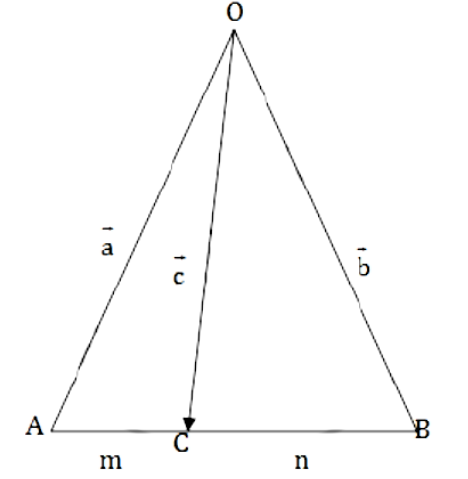
since
n x length (AC)=m X length (BC)
$n \overrightarrow{A C}=m \overrightarrow{C B}$
$n(\overrightarrow{O C}-\overrightarrow{O A})=m(\overrightarrow{O B}-\overrightarrow{O C})$
$n(\vec{c}-\vec{a})=m(\vec{b}-\vec{c})$
$n \vec{c}-n \vec{a}=m \vec{b}-m \vec{c}$
$(n+m) \vec{c}=m \vec{b}+n \vec{a}$
$\vec{c}=\frac{m \vec{b}+n \vec{a}}{m+n}$
Hence proved.
View full question & answer→Question 123 Marks
If A, B, C and D are $(1,1,1),(2,1,3),(3,2,2),(3,3,4)$ respectively, then find the volume of parallelopiped with $AB , AC$ and $AD$ as the concurrent edges.
AnswerLet $\bar{a}, \bar{b}, \bar{c}, \bar{d}$ be the position vectors of points $A (1,1,1), B (2,1,3), C (3,2$, 2) and $D(3,3,4)$
$\bar{a}=\hat{i}+\hat{j}+\widehat{k}$
$\bar{b}=2 \hat{i}+\hat{j}+3 \widehat{k}$
$\bar{c}=3 \hat{i}+2 \hat{j}+2 \widehat{k}$
$\bar{d}=3 \hat{i}+3 \hat{j}+4 \widehat{k}$
Given that vectors $\overline{A B}, \overline{A C}$ and $\overline{A D}$ represent the concurrent edges of a palallelopiped ABCD.
$\overline{A B}=\bar{b}-\bar{a}=2 \hat{i}+\hat{j}+3 \widehat{k}-\hat{i}-\hat{j}-\widehat{k}=\hat{i}+2 \widehat{k}$
$\overline{A C}=\bar{c}-\bar{a}=3 \hat{i}+2 \hat{j}+2 \widehat{k}-\hat{i}-\hat{j}-\widehat{k}=2 \hat{i}+\hat{j}+\widehat{k}$
$\overline{A D}=\bar{d}-\bar{a}=3 \hat{i}+3 \hat{j}+4 \widehat{k}-\hat{i}-\hat{j}-\widehat{k}=2 \hat{i}+2 \hat{j}+3 \widehat{k}$
Consider, $\overline{A B} \cdot(\overline{A C} \times \overline{A D})=\left|\begin{array}{lll}1 & 0 & 2 \\ 2 & 1 & 1 \\ 2 & 2 & 3\end{array}\right|$
= 1(3 – 2) + 2(4 – 2)
= 1 + 4
= 5
Therefore, Volume of parallelopiped with AB, AC and AD as concurrent edges is
$V =[\overline{A B} \cdot(\overline{A C} \times \overline{A D})]=5$ cubic units.
View full question & answer→Question 133 Marks
If A, B, C D are (1, 1, 1), (2, 1,3), (3, 2, 2) and (3, 3, 4) respectively, then find the volume of the parallelopiped with $AB , AC$ and $AD$ as concurrent edges.
View full question & answer→Question 143 Marks
Prove that three vectors $\bar{a}, \bar{b}$ and $\bar{c}$ are coplanar, if and only if, there exists a non-zero linear combination $x \bar{a}+y \bar{b}+z \bar{c}=\overline{0}$.
AnswerLet $\bar{a}, \bar{b}, \bar{c}$ be coplanar vectors.
Case I: Suppose that any two of $\bar{a}, \bar{b}$ and $\bar{c}$ are collinear vectors, say $\bar{a}$ and $\bar{b}$.
∴ There exist scalars x and y at least one of which is non-zero such that $x \bar{a}+y \bar{b}=\overline{0}$.
$\therefore x \bar{a}+y \bar{b}+z \bar{c}=\overline{0}$ is required non-zero linear combination where $z=$ 0.
Case II: None of the two vectors $\bar{a}, \bar{b}$ and $\bar{c}$ are collinear.
Then any one of them, say $\bar{a}$, will be the linear combination of $\bar{b}$ and $\bar{c}$.
$\therefore$ There exist scalars $\alpha$ and $\beta$ such that $\bar{a}=\alpha \bar{b}+\beta \bar{c}$
$\therefore(-1) \bar{a}+\alpha \bar{b}+\beta \bar{c}=\overline{0}$, i.e $x \bar{a}+y \bar{b}+z \bar{c}=\overline{0}$
where x = –1, y = α, z = β which are not all zero simultaneously.
Conversely: Let there exist scalars x, y, z not all zero such that
$x \bar{a}+y \bar{b}+z \bar{c}$...(1)
Let x ≠ 0, then divide (1) by x, we get
i.e $\bar{a}+\left(\frac{y}{x}\right) \bar{b}+\left(\frac{z}{x}\right) \bar{c}=\overline{0}$
$\therefore \bar{a}=\left(-\frac{y}{x}\right) \bar{b}+\left(-\frac{z}{x}\right) \bar{c}$
i.e. $\bar{a}=\alpha \bar{b}+\beta \bar{c}$, where $\alpha=-\frac{y}{x}$ and $\beta=-\frac{z}{x}$ are scalars.
$\therefore \bar{a}$ is the linear combination of $\bar{b}$ and $\bar{c}$.
Hence, $\bar{a}, \bar{b}, \bar{c}$ are coplanar.
View full question & answer→