MCQ 2012 Marks
If three points $A , B , C$ are collinear, whose position vectors are $\hat{i}-2 \hat{j}-8 \hat{k}, 5 \hat{i}-2 \hat{k}$ and $11 \hat{ i }+3 \hat{ j }+7 \hat{ k }$ respectively, then the ratio in which B divides AC is
- A
$1: 2$
- ✓
$2: 3$
- C
$2: 1$
- D
$1: 1$
AnswerCorrect option: B. $2: 3$
(B) Let the point B divide AC in the ratio $\lambda: 1$
$\therefore \quad 5 \hat{ i }-2 \hat{ k }=\frac{\lambda(11 \hat{ i }+3 \hat{ j }+7 \hat{ k })+\hat{ i }-2 \hat{ j }-8 \hat{ k }}{\lambda+1}$
$\Rightarrow \lambda(5 \hat{ i }-2 \hat{ k })+(5 \hat{ i }-2 \hat{ k })$
$=\lambda(11 \hat{i}+3 \hat{j}+7 \hat{k})+(\hat{i}-2 \hat{j}-8 \hat{k})$
$\Rightarrow-6 \lambda \hat{ i }-3 \lambda \hat{ j }-9 \lambda \hat{ k }=-4 \hat{ i }-2 \hat{ j }-6 \hat{ k }$
$\Rightarrow-6 \lambda=-4$
$\Rightarrow \lambda=\frac{2}{3}$ i.e. ratio $=2: 3$
View full question & answer→MCQ 2022 Marks
If $3 \bar{P}+2 \bar{R}-5 \bar{Q}=\overline{0}$, then
AnswerCorrect option: A. $P, Q, R$ are collinear
(A) $3 \overline{ P }+2 \overline{ R }-5 \overline{ Q }=\overline{0}$
$\Rightarrow 3 \overline{ P }+2 \overline{ R }=5 \overline{ Q }$
$\Rightarrow \overline{ Q }=\frac{3 \overline{ P }+2 \overline{ R }}{5}$
$\overline{ Q }$ is the position vector of the point dividing $P$ and $R$ in the ratio $3: 2$ internally. Thus, $P , Q$ and R are collinear.
View full question & answer→MCQ 2032 Marks
A and B are two points. The position vector of A is $6 \overline{b}-2 \overline{ a }$. A point P divides the line AB in the ratio $1: 2$. If $\bar{a}-\bar{b}$ is the position vector of $P$, then the position vector of $B$ is given by
- ✓
$7 \overline{ a }-15 \overline{b}$
- B
$7 \overline{ a }+15 \overline{b}$
- C
$15 \overline{ a }-7 \overline{b}$
- D
$15 \overline{ a }+7 \overline{b}$
AnswerCorrect option: A. $7 \overline{ a }-15 \overline{b}$
(A) The position vector of $A$ is $6 \bar{b}-2 \bar{a}$ and the position vector of P is $\overline{ a }-\overline{ b }$
Let the position vector of $B$ be $\bar{r}$
Since P divides AB in the ratio $1: 2$
$\therefore \quad \bar{a}-\bar{b}=\frac{1(\bar{r})+2(6 \bar{b}-2 \bar{a})}{3}$
$\begin{array}{l}\Rightarrow 3 \overline{ a }-3 \overline{b}-12 \overline{b}+4 \overline{ a }=\overline{ r } \\ \Rightarrow \overline{ r }=7 \overline{ a }-15 \overline{b}\end{array}$
View full question & answer→MCQ 2042 Marks
If $\bar{a}+\bar{b}+\bar{c}=\lambda \bar{d}$ and $\bar{b}+\bar{c}+\bar{d}=\mu \bar{a}$ and $\bar{a}, \bar{b}, \bar{c}$ are non-coplanar, then $\bar{a}+\bar{b}+\bar{c}+\bar{d}$ is equal to
AnswerCorrect option: C. $\overline{0}$
(C) $\overline{ a }+\overline{ b }+\overline{ c }+\overline{ d }=(1+\lambda) \overline{ d }$
Also, $\bar{a}+\bar{b}+\bar{c}+\bar{d}=(1+\mu) \bar{a}$
$\Rightarrow(1+\lambda) \overline{ d }=(1+\mu) \overline{ a }$
if $\lambda \neq-1$, then
$\overline{ d }=\left(\frac{1+\mu}{1+\lambda}\right) \overline{ a }$
Now, $\overline{ a }+\overline{ b }+\overline{ c }+\overline{ d }=(1+\mu) \overline{ a }$
$\therefore \bar{a}+\bar{b}+\bar{c}+\left(\frac{1+\mu}{1+\lambda}\right) \bar{a}=(1+\mu) \bar{a}$
$\Rightarrow\left[1+\left(\frac{1+\mu}{1+\lambda}\right)-(1+\mu)\right] \bar{a}+\bar{b}+\bar{c}=0$
This contradicts the fact that $\bar{a}, \bar{b}, \bar{c}$ are non-coplanar
$\Rightarrow \lambda=-1$
$\therefore \overline{ a }+\overline{ b }+\overline{ c }+\overline{ d }=\overline{0}$
View full question & answer→MCQ 2052 Marks
If $\overline{ a }=2 \overline{ p }+3 \overline{ q }-\overline{ r }, \overline{ b }=\overline{ p }-2 \overline{ q }+2 \overline{ r }$ and $\bar{c}=-2 \bar{p}+\bar{q}-2 \bar{r}$ and $\bar{R}=3 \bar{p}-\bar{q}+2 \bar{i}$, where $\bar{p}, \bar{q}, \bar{r}$ are non-coplanar vectors, then $\overline{ R }$ in terms of $\overline{ a }, \overline{ b }, \overline{ c }$ is
- A
$5 \overline{ a }+2 \overline{b}+3 \overline{ c }$
- B
$3 \overline{ a }+5 \overline{b}+2 \overline{ c }$
- ✓
$2 \overline{ a }+5 \overline{b}+3 \overline{ c }$
- D
$5 \overline{ a }+3 \overline{b}+2 \overline{ c }$
AnswerCorrect option: C. $2 \overline{ a }+5 \overline{b}+3 \overline{ c }$
(C) Let $\overline{ R }= x\overline{ a }+y\overline{ b }+ z \overline{ c }$
$\overline{ R }=x(2 \overline{ p }+3 \overline{ q } - \overline{ r })+y(\overline{ p } - 2 \overline{ q }+2 \overline{ r })$ $+z(-2 \bar{p}+\bar{q} - 2 \bar{r})$
$\Rightarrow$ $3 \bar{p} -\bar{q}+2 \bar{r}=(2x + y +2 z) \bar{p}$ $+(3 x-2 y+z) \bar{q}+(-x+2 y-2 z) \bar{r}$
On comparing, we get
$2x+y-2 z=3$ ...(i)
$3x-2y+z=1$, ...(ii)
$-x+2y-2z=2$ ...(iii)
Solving above equations, we get
$x=2, y=5, z=3$
$\overline{ R }=2 \overline{ a }+5 \overline{b}+3 \overline{ c }$
View full question & answer→MCQ 2062 Marks
If the points $A , B , C$ and D have position vectors $\bar{a}, 2 \bar{a}+\bar{b}, 4 \bar{a}+2 \bar{b}$ and $5 \bar{a}+4 \bar{b}$ respectively, then three collinear points are
- ✓
$A , B , D$
- B
- C
$B , C , D$
- D
AnswerCorrect option: A. $A , B , D$
(A) $\overline{ AB }=\overline{ a }+\overline{ b }$
$\overline{ BD }=3 \overline{ a }+3 \overline{b}=3 \overline{ AB }$
$\therefore$ Points $A , B , D$ are collinear.
View full question & answer→MCQ 2072 Marks
If $\bar{a}, \bar{b}, \bar{c}$ are three non-zero vectors which are pairwise non-collinear. If $\bar{a}+3 \bar{b}$ is collinear with $\bar{c}$ and $\bar{b}+2 \bar{c}$ is collinear with $\bar{a}$, then $\overline{ a }+3 \overline{b}+6 \overline{ c }$ is
- A
$\bar{c}$
- ✓
$\overline{0}$
- C
$\bar{a}+\bar{c}$
- D
$\overline{ a }$
AnswerCorrect option: B. $\overline{0}$
(B) Since $\overline{ a }+3 \overline{b}$ is collinear with $\overline{ c }$, and $\overline{ b }+2 \overline{ c }$ is collinear with $\overline{ a }$,
$\therefore \overline{ a }+3 \overline{b}=x\overline{ c }$ and $\overline{ b }+2 \overline{ c }=y\overline{ a } \ \forall x, y \in R$.
$\therefore \bar{a}+3 \bar{b}+6 \bar{c}=(+6) \bar{c}$
Also, $\overline{ a }+3 \overline{b}+6 \overline{ c }=\overline{ a }+3(\overline{b}+2 \overline{ c })=(1+3y) \overline{ a }$
$\therefore (x+6) \bar{c}=(1+3y) \bar{a}$
$\Rightarrow(x+6) \overline{ c }-(1+3 y) \overline{ a }=0$
$\therefore x+6=0$ and $1+3 y=0$
$\Rightarrow x=-6$ and $y=-\frac{1}{3}$
Now, $\overline{ a }+3 \overline{b}=x \overline{ c } \Rightarrow \overline{ a }+3 \overline{b}+6 \overline{ c }=\overline{0}$
View full question & answer→MCQ 2082 Marks
Three points whose position vectors are $\bar{a}+\bar{b}$, $\overline{ a }-\overline{ b }$ and $\overline{ a }+ k \overline{ b }$ are collinear, then the value of $k$ is
- A
- B
Only negative real number
- C
Only positive real number
- ✓
Answer(D) Let $A , B , C$ be the three collinear point.
$\therefore \quad \overline{ AB }=\lambda \overline{ BC }$
Here, $\overline{A B}=-2 b, \overline{B C}=(k+1) \bar{b}$
$\therefore \forall k \in R \Rightarrow \overline{ AB }=\lambda \overline{ BC }$
View full question & answer→MCQ 2092 Marks
If the position vectors of the points $A , B , C$ be $\hat{i}+\hat{j}$, $\hat{i}-\hat{j}$ and $a \hat{i}+b \hat{j}+c \hat{k}$ respectively, then the points $A , B , C$ are collinear if
- A
$a=b=c=1$
- B
$a=1, b$ and $c$ are arbitrary scalars
- C
$a=b=c=0$
- ✓
$c=0, a=1$ and $b$ is arbitrary scalar
AnswerCorrect option: D. $c=0, a=1$ and $b$ is arbitrary scalar
(D) Here $\bar{a}=\hat{i}+\hat{j}, \bar{b}=\hat{i}-\hat{j}, \bar{c}=a \hat{i}+b \hat{j}+c \hat{k}$
The points are collinear
$\therefore \quad \overline{ AB }=\lambda \overline{ BC }$
$\Rightarrow-2 \hat{ j }=\lambda[( a -1) \hat{ i }+( b +1) \hat{ j }+ c \hat{ k }]$
On comparing, we get
$\lambda( a -1)=0, \lambda(b+1)=-2, \lambda c =0$
Hence $a =1, c =0$ and b is arbitrary scalar.
View full question & answer→MCQ 2102 Marks
If three points $A , B$ and C have co-ordinates (1, x, 3), (3,4,7) and (y,-2,-5) respectively. They are collinear, then $x, y=$
AnswerCorrect option: A. $2,-3$
(A) Here $\bar{a}=\hat{i}+\hat{j}+3 \hat{k}, \bar{b}=3 \hat{i}+4 \hat{j}+7 \hat{k}$, and $\bar{c}=y\hat{i}-2 \hat{j}-5 \hat{k}$
$\therefore \quad \overline{ AB }=\lambda \overline{ BC }$
$\Rightarrow 2 \hat{ i }+(4-x) \hat{ j }+4 \hat{ k }=\lambda[(y-3) \hat{ i }-6 \hat{ j }-12 \hat{ k }]$
On comparing, we get
$4=-12 \lambda \Rightarrow \lambda=\frac{-1}{3}$,
$4-x=-6 \lambda \Rightarrow x=2$, and
$2=\lambda(y-3) \Rightarrow -6 = y-3 \Rightarrow y = -3$
View full question & answer→MCQ 2112 Marks
If the position vectors of the points $A , B , C$ are $\overline{ a }, \overline{ b }$ and $3 \overline{ a }-2 \overline{b}$ respectively, then the points A, B, C are
- ✓
- B
- C
Forming a right angled triangle
- D
Answer(A) Here $\overline{ AB }=\overline{ b }-\overline{ a }$ and $\overline{ AC }=2 \overline{ a }-2 \overline{b}=-2(\overline{b}-\overline{ a })$
$\therefore \quad \overline{ AC }= m \overline{ AB }$
Hence A, B, C are collinear.
View full question & answer→MCQ 2122 Marks
If the points $P (\overline{ a }+2 \overline{b}+\overline{ c }), Q (2 \overline{ a }+3 \overline{b})$ and $R (\overline{ b }+ t \overline{ c })$ are collinear, where $\overline{ a }, \overline{ b }, \overline{ c }$ are three non-coplanar vectors, then the value of $t$ is
- A
$-2$
- B
$-\frac{1}{2}$
- C
$\frac{1}{2}$
- ✓
$2$
Answer(D) $\overline{ PQ }= k \overline{ QR }$
$\bar{a}+\bar{b}-\bar{c}=k(-2 \bar{a}-2 \bar{b}+t \bar{c})$
On comparing, we get
$1=-2 k \Rightarrow k =\frac{-1}{2}$ and $-1= kt \Rightarrow t =2$
View full question & answer→MCQ 2132 Marks
If the vectors $-\hat{i}+3 \hat{j}+2 \hat{k},-4 \hat{i}+2 \hat{j}-2 \hat{k}$ and $5 \hat{i}+\lambda \hat{j}+\mu \hat{k}$ are collinear then
- ✓
$\lambda=5, \mu=10$
- B
$\lambda=10, \mu=5$
- C
$\lambda=-5, \mu=10$
- D
$\lambda=5, \mu=-10$
AnswerCorrect option: A. $\lambda=5, \mu=10$
(A) Let $\bar{a}=-\hat{i}+3 \hat{j}+2 \hat{k}, \bar{b}=-4 \hat{i}+2 \hat{j}-2 \hat{k}$ and $\overline{ c }=5 \hat{ i }+\lambda \hat{ j }+\mu \hat{ k }$
$\therefore \quad \overline{ AB }= m \cdot \overline{ BC }$
$\Rightarrow-3 \hat{ i }-\hat{ j }-4 \hat{ k }= m [9 \hat{ i }+(\lambda-2) \hat{ j }+(\mu+2) \hat{ k }]$
On comparing, we get
$9 m=-3 \Rightarrow m=\frac{-1}{3}$
$-1= m (\lambda-2) \Rightarrow \lambda=5$ and $-4=m(\mu+2) \Rightarrow \mu=10$
View full question & answer→MCQ 2142 Marks
If the vectors $\hat{i}+2 \hat{k}, \hat{j}+\hat{k}$ and $\lambda \hat{i}+\mu \hat{j}$ are collinear, then
- A
$\lambda=2, \mu=1$
- B
$\lambda=2, \mu=-1$
- ✓
$\lambda=-1, \mu=2$
- D
$\lambda=-1, \mu=-2$
AnswerCorrect option: C. $\lambda=-1, \mu=2$
(C) Let $\bar{a}=\hat{i}+2 \hat{k}, \bar{b}=\hat{j}+\hat{k}$ and $\bar{c}=\lambda \hat{i}+\mu \hat{j}$
$\therefore \quad \overline{ AB }= m \cdot \overline{ BC }$
$\Rightarrow-\hat{ i }+\hat{ j }-\hat{ k }= m [(\lambda \hat{ i }+(\mu-1) \hat{ j }-\hat{ k })]$
On comparing, we get
$\begin{array}{l}-1=-m \Rightarrow m=1 \\ -1=\lambda \cdot m \Rightarrow \lambda=-1\end{array}$
and $1=m(\mu-1) \Rightarrow \mu=2$
View full question & answer→MCQ 2152 Marks
If the position vectors of the points $A , B , C , D$ be $2 \hat{i}+3 \hat{j}+5 \hat{k}, \hat{i}+2 \hat{j}+3 \hat{k},-5 \hat{i}+4 \hat{j}-2 \hat{k}$ and $\hat{ i }+10 \hat{ j }+10 \hat{ k }$ respectively, then
- A
$\overline{ AB }=\overline{ CD }$
- ✓
$\overline{ AB } \| \overline{ CD }$
- C
$\overline{ AB } \perp \overline{ CD }$
- D
AnswerCorrect option: B. $\overline{ AB } \| \overline{ CD }$
(B) $\overline{ AB }=-\hat{i}-\hat{j}-2 \hat{k}$ and $\overline{ CD }=6 \hat{i}+6 \hat{j}+12 \hat{k}$
$\Rightarrow \overline{ CD }=-6 \overline{ AB }$
Hence, $\overline{ AB } \| \overline{ CD }$.
View full question & answer→MCQ 2162 Marks
If $\bar{c}=2 \bar{a}-3 \bar{b}$ and $2 \bar{c}=3 \bar{a}+4 \bar{b}$, then $\bar{c}$ and $\bar{a}$ are
Answer(A) Given $\overline{ c }=2 \overline{ a }-3 \overline{b}$ ...(i)
and $2 \overline{ c }=3 \overline{ a }+4 \overline{b}$ ...(ii)
Multiplying (i) by 4 and (ii) by 3 and adding,
we get
$10 \overline{ c }=17 \overline{ a }$
$\Rightarrow \overline{ c }=\frac{17}{10} \overline{ a }$
Since $\bar{c}$ and $\bar{a}$ are in the same direction.
$\therefore \quad \overline{ c }$ and $\overline{ a }$ are like parallel vectors.
View full question & answer→MCQ 2172 Marks
The non-zero vectors $\bar{b}$ and $\bar{c}$ are related by $\overline{ a }=8 \overline{b}$ and $\overline{ c }=-7 \overline{b}$. Then, the angle between $\overline{ a }$ and $\overline{ c }$ is
- A
$0$
- B
$\frac{\pi}{4}$
- C
$\frac{\pi}{2}$
- ✓
$\pi$
Answer(D) $\overline{ a }=8 \overline{b}$ and $\overline{ c }=-7 \overline{b}$
$\Rightarrow \bar{a}=\frac{-8}{7} \bar{c}$
$\Rightarrow \overline{ a }$ and $\overline{ c }$ are unlike parallel vectors.
⇒ Angle between $\overline{ a }$ and $\overline{ c }$ is $\pi$.
View full question & answer→MCQ 2182 Marks
If the three points with position vectors $\bar{a}-2 \bar{b}+3 \bar{c}, 2 \bar{a}+\lambda \bar{b}-4 \bar{c}, -7 \bar{b}+10 \bar{c} $ are collinear, then $\lambda=$
Answer(C) Let $\overline{ p }=\overline{ a }-2 \overline{b}+3 \overline{ c }, \overline{ q }=2 \overline{ a }+\lambda \overline{ b }-4 \overline{ c } $ and $\overline{ r }=-7 \overline{b}+10 \overline{ c }$
Since points are collinear
$\therefore \quad \overline{ PQ }= k \overline{ PR }$
$\Rightarrow 2 \overline{ a }+\lambda \overline{ b }-4 \overline{ c }-(\overline{ a }-2 \overline{b}+3 \overline{ c })$
$= k [-7 \overline{b}+10 \overline{ c }-(\overline{ a }-2 \overline{b}+3 \overline{ c })]$
$\Rightarrow \overline{ a }+(\lambda+2) \overline{ b }-7 \overline{ c }=- k \overline{ a }-5 k \overline{ b }+7 k \overline{ c }$
$\Rightarrow k =-1, \lambda=-5 k -2$
Hence, $\lambda=5-2=3$
View full question & answer→MCQ 2192 Marks
If the position vectors of $A , B , C , D$ are $2 \hat{i}+\hat{j}, \hat{i}-3 \hat{j}, 3 \hat{i}+2 \hat{j}$ and $\hat{i}+\lambda \hat{j}$ respectively and $\overline{ AB } \| \overline{ CD }$, then $\lambda$ will be
Answer(B) $\overline{A B}=-\hat{i}-4 \hat{j}, \overline{C D}=-2 \hat{i}+(\lambda-2) \hat{j}$
Since $\overline{ AB } \| \overline{ CD }$
$\therefore \quad \frac{-1}{-2}=\frac{-4}{\lambda-2}$
$\Rightarrow \lambda-2=-8$ or $\lambda=-6$
View full question & answer→MCQ 2202 Marks
If the vector $8 \hat{ i }+a \hat{ j }$ of magnitude 10 is in the direction of the vector $4 \hat{ i }-3 \hat{ j }$, then the value of a is equal to
Answer(D) $8 \hat{ i }+a \hat{ j }$ is in the direction of $4 \hat{ i }-3 \hat{ j }$.
$\therefore \quad 8 \hat{ i }+a \hat{ j }$ is a scalar multiple of $4 \hat{ i }-3 \hat{ j }$
i.e., $8 \hat{i}+a \hat{j}=k(4 \hat{i}-3 \hat{j}) \Rightarrow 8 \hat{i}+a \hat{j}=4 k \hat{i}-3 k \hat{j}$
$\therefore 4 k =8 \Rightarrow k =2$
and $a=-3 k \Rightarrow a=-6$
View full question & answer→MCQ 2212 Marks
The figure formed by the four points $\hat{i}+\hat{j}-\hat{k}$, $2 \hat{i}+3 \hat{j}, 3 \hat{i}+5 \hat{j}-2 \hat{k}$ and $\hat{k}-\hat{j}$ is a
Answer(C) Let $A \equiv(1,1,-1), B \equiv(2,3,0), C \equiv(3,5,-2)$, $D =(0,-1,1)$
So, $\overline{ AB }=(1,2,1), \overline{ BC }=(1,2,-2)$, $\overline{ CD }=(-3,-6,3), \overline{ DA }=(1,2,-2)$
Clearly, $\overline{ BC } \| \overline{ DA }$, but $AB \neq CD$ So, it is a trapezium.
View full question & answer→MCQ 2222 Marks
If the vectors $6 \hat{i}-2 \hat{j}+3 \hat{k}, 2 \hat{i}+3 \hat{j}-6 \hat{k}$ and $3 \hat{i}+6 \hat{j}-2 \hat{k}$ form a triangle, then it is
Answer(B) $\overline{A B}=(2 \hat{i}+3 \hat{j}-6 \hat{k})-(6 \hat{i}-2 \hat{j}+3 \hat{k})$
$=-4 \hat{ i }+5 \hat{ j }-9 \hat{ k }$
$\Rightarrow|\overline{ AB }|=\sqrt{16+25+81}=\sqrt{122}$
$\overline{ BC }=\hat{ i }+3 \hat{ j }+4 \hat{ k }$
$\Rightarrow|\overline{ BC }|=\sqrt{1+9+16}=\sqrt{26}$ and $\overline{ AC }=-3 \hat{ i }+8 \hat{ j }-5 \hat{ k }$
$\Rightarrow|\overline{ AC }|=\sqrt{98}$
$\therefore \quad AB ^2=122, BC ^2=26$ and $AC ^2=98$
$\Rightarrow AB ^2+ BC ^2=26+122=148$
Since $AC ^2< AB ^2+ BC ^2$
Therefore, $\triangle ABC$ is an obtuse-angled triangle.
View full question & answer→MCQ 2232 Marks
Let $\alpha, \beta, \gamma$ be distinct real numbers. The points with position vectors $\alpha \hat{i}+\beta \hat{j}+\gamma \dot{k}$, $\beta \hat{i}+\gamma \hat{j}+\alpha \hat{k}, \gamma \hat{i}+\alpha \hat{j}+\beta \hat{k}$
- A
- ✓
Form an equilateral triangle
- C
- D
Form a right angled triangle
AnswerCorrect option: B. Form an equilateral triangle
(B) Let $P , Q$ and R be points having position vectors $\alpha \hat{ i }+\beta \hat{ j }+\gamma \hat{ k }, \beta \hat{ i }+\gamma \hat{ j }+\alpha \hat{ k }$ and $\gamma \hat{ i }+\alpha \hat{ j }+\beta \hat{ k }$
Then, $|\overline{ PQ }|=|\overline{ QR }|=|\overline{ RP }|$
$=\sqrt{(\alpha-\beta)^2+(\beta-\gamma)^2+(\gamma-\alpha)^2}$
Hence, $\triangle PQR$ is an equilateral triangle.
View full question & answer→MCQ 2242 Marks
The perimeter of the triangle whose vertices have the position vectors $(\hat{ i }+\hat{ j }+\hat{ k })$, $(5 \hat{i}+3 \hat{j}-3 \hat{k})$ and $(2 \hat{i}+5 \hat{j}+9 \hat{k})$ is given by
- ✓
$15+\sqrt{157}$
- B
$15-\sqrt{157}$
- C
$\sqrt{15}-\sqrt{157}$
- D
$\sqrt{15}+\sqrt{157}$
AnswerCorrect option: A. $15+\sqrt{157}$
(A) Let $\bar{a}=\hat{i}+\hat{j}+\hat{k}, \bar{b}=5 \hat{i}+3 \hat{j}-3 \hat{k}$ and $\overline{ c }=2 \hat{ i }+5 \hat{ j }+9 \hat{ k }$
$\therefore \quad \overline{ AB }=\overline{ b }-\overline{ a }=4 \hat{ i }+2 \hat{ j }-4 \hat{ k }$
$\Rightarrow|\overline{ AB }|=\sqrt{16+4+16}=6$
$\overline{ BC }=-3 \hat{ i }+2 \hat{ j }+12 \hat{ k }$
$\Rightarrow \overline{| BC |}=\sqrt{9+4+144}=\sqrt{157}$ and $\overline{C A}=-\hat{i}-4 \hat{j}-8 \hat{k}$
$\Rightarrow|\overline{ CA }|=\sqrt{1+16+64}=9$
$\therefore \quad$ Perimeter $=|\overline{ AB }|+|\overline{ BC }|+|\overline{ CA }|=15+\sqrt{157}$
View full question & answer→MCQ 2252 Marks
If the position vector of one end of the line segment AB be $2 \hat{i}+3 \hat{j}-\hat{k}$ and the position vector of its middle point be $3(\hat{i}+\hat{j}+\hat{k})$, then the position vector of the other end is
- A
$4 \hat{ i }+3 \hat{ j }+5 \hat{ k }$
- B
$4 \hat{ i }-3 \hat{ j }+7 \hat{ k }$
- ✓
$4 \hat{ i }+3 \hat{ j }+7 \hat{ k }$
- D
$4 \hat{i}+3 \hat{j}-7 \hat{k}$
AnswerCorrect option: C. $4 \hat{ i }+3 \hat{ j }+7 \hat{ k }$
(C)
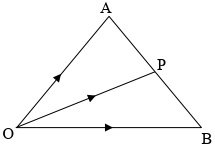
Let $\overline{O A}=2 \hat{i}+3 \hat{j}-\hat{k}, \quad \overline{O P}=3(\hat{i}+\hat{j}+\hat{k})$
we have, $\overline{ OP }=\frac{\overline{ OA }+\overline{ OB }}{2}$
$\Rightarrow \overline{ OB }=2 \overline{ OP }-\overline{ OA }$
$=6 \hat{ i }+6 \hat{ j }+6 \hat{ k }-2 \hat{ i }-3 \hat{ j }+\hat{ k }$
$=4 \hat{ i }+3 \hat{ j }+7 \hat{ k }$ View full question & answer→MCQ 2262 Marks
For three vectors $\overline{ p }, \overline{ q }$ and $\overline{ r }$, if $\overline{ r }=3 \overline{ p }+4 \overline{ q }$ and $2 \overline{ r }=\overline{ p }-3 \overline{ q }$, then
- A
$|\bar{r}|<2|\bar{q}|$ and $\bar{r}, \bar{q}$ have the same direction
- ✓
$|\bar{r}|>2|\bar{q}|$ and $\bar{r}, \bar{q}$ have opposite directions
- C
$|\overline{ r }|<2|\overline{ q }|$ and $\overline{ r }, \overline{ q }$ have opposite directions
- D
$|\bar{r}|>2|\bar{q}|$ and $\bar{r}, \bar{q}$ have the same direction
AnswerCorrect option: B. $|\bar{r}|>2|\bar{q}|$ and $\bar{r}, \bar{q}$ have opposite directions
(B) $\overline{ r }=3 \overline{ p }+4 \overline{ q }$ ...(i)
$2 \overline{ r }=\overline{ p }-3 \overline{ q }$
$\Rightarrow 6 \overline{ r }=3 \overline{ p }-9 \overline{ q }$ ...(ii)
From (i) and (ii), we get
$\overline{ r }-4 \overline{ q }=6 \overline{ r }+9 \overline{ q }$
$\begin{array}{l}\Rightarrow-5 \overline{ r }=13 \overline{ q } \\ \Rightarrow \overline{ r }=\frac{-13}{5} \overline{ q }\end{array}$
$\Rightarrow|\overline{ r }|>2|\overline{ q }|$ and $\overline{ r }, \overline{ q }$ have opposite directions
View full question & answer→MCQ 2272 Marks
If $\bar{x}$ is a vector in the direction of $(2,-2,1)$ of magnitude 6 and $\bar{y}$ is a vector in the direction of $(1,1,-1)$ of magnitude $\sqrt{3}$, then $|\bar{x}+2 \bar{y}|=$
- A
$40$
- B
$\sqrt{35}$
- C
$\sqrt{17}$
- ✓
$2 \sqrt{10}$
AnswerCorrect option: D. $2 \sqrt{10}$
(D) $\bar{x}=\frac{6(2 \hat{ i }-2 \hat{ j }+\hat{ k })}{\sqrt{4+4+1}}$
$=\frac{6(2 \hat{i}-2 \hat{j}+\hat{k})}{3}=4 \hat{i}-4 \hat{j}+2 \hat{k}$
$\bar{y}=\frac{\sqrt{3}(\hat{ i }+\hat{ j }-\hat{ k })}{\sqrt{1+1+1}}=\frac{\sqrt{3}(\hat{ i }+\hat{ j }-\hat{ k })}{\sqrt{3}}=\hat{ i }+\hat{ j }-\hat{ k }$
$|\bar{x}+2 \bar{y}|=|6 \hat{i}-2 \hat{j}|=\sqrt{40}=2 \sqrt{10}$
View full question & answer→MCQ 2282 Marks
If $\bar{a}=(2,1,-1), \bar{b}=(1,-1,0), \bar{c}=(5,-1,1)$, then unit vector parallel to $\bar{a}+\bar{b}-\bar{c}$ but in opposite direction is
- A
$\frac{1}{2}(2 \hat{ i }-\hat{ j }+2 \hat{ k })$
- ✓
$\frac{1}{3}(2 \hat{ i }-\hat{ j }+2 \hat{ k })$
- C
$\frac{1}{3}(2 \hat{ i }+\hat{ j }-2 \hat{ k })$
- D
$\frac{1}{2}(-2 \hat{ i }-\hat{ j }+\hat{ k })$
AnswerCorrect option: B. $\frac{1}{3}(2 \hat{ i }-\hat{ j }+2 \hat{ k })$
(B) $\bar{a}=2 \hat{i}+\hat{j}-\hat{k}, \bar{b}=\hat{i}-\hat{j}, \bar{c}=5 \hat{i}-\hat{j}+\hat{k}$
Vector in the direction of $\bar{a}+\bar{b}-\bar{c}=-2 \hat{i}+\hat{j}-2 \hat{k}$
$\therefore \quad-(\bar{a}+\bar{b}-\bar{c})=2 \hat{i}-\hat{j}+2 \hat{k}$
∴ Unit vector $=\frac{2 \hat{i}-\hat{j}+2 \hat{k}}{3}$
View full question & answer→MCQ 2292 Marks
The unit vector in the direction of sum of the vectors $\hat{i}+\hat{j}+\hat{k}, 2 \hat{i}-\hat{j}-\hat{k}$ and $2 \hat{j}+6 \hat{k}$ is
- ✓
$\frac{1}{7}(3 \hat{i}+2 \hat{j}+6 \hat{k})$
- B
$-\frac{1}{7}(3 \hat{i}+2 \hat{j}+6 \hat{k})$
- C
$\frac{1}{49}(3 \hat{i}+2 \hat{j}+6 \hat{k})$
- D
AnswerCorrect option: A. $\frac{1}{7}(3 \hat{i}+2 \hat{j}+6 \hat{k})$
(A) Sum of the given vectors
$=(\hat{i}+\hat{j}+\hat{k})+(2 \hat{i}-\hat{j}-\hat{k})+(2 \hat{j}+6 \hat{k})$
$=3 \hat{i}+2 \hat{j}+6 \hat{k}$
$\therefore$ The unit vector in the direction of the sum of the given vectors
$=\frac{3 \hat{i}+2 \hat{j}+6 \hat{k}}{|3 \hat{i}+2 \hat{j}+6 \hat{k}|}$
$=\frac{3 \hat{i}+2 \hat{j}+6 \hat{k}}{\sqrt{3^2+2^2+6^2}}$
$=\frac{1}{7}(3 \hat{ i }+2 \hat{ j }+6 \hat{ k })$
View full question & answer→MCQ 2302 Marks
For any two vectors $\bar{a}$ and $\bar{b}$ which of the following is true?
- A
$|\bar{a}+\bar{b}| \geq|\bar{a}|+|\bar{b}|$
- B
$|\overline{ a }+\overline{ b }|=|\overline{ a }|+|\overline{ b }|$
- C
$|\overline{ a }+\overline{ b }|<|\overline{ a }|+|\overline{ b }|$
- ✓
$|\overline{ a }+\overline{ b }| \leq|\overline{ a }|+|\overline{ b }|$
AnswerCorrect option: D. $|\overline{ a }+\overline{ b }| \leq|\overline{ a }|+|\overline{ b }|$
View full question & answer→MCQ 2312 Marks
If the position vectors of the points $A , B , C$ be $\hat{ i }, \hat{ j }, \hat{ k }$ respectively and P be a point such that $\overline{ AB }=\overline{ CP }$, then the position vector of P is
- ✓
$-\hat{ i }+\hat{ j }+\hat{ k }$
- B
$-\hat{ i }-\hat{ j }+\hat{ k }$
- C
$\hat{i}+\hat{j}-\hat{k}$
- D
AnswerCorrect option: A. $-\hat{ i }+\hat{ j }+\hat{ k }$
(A) Let the position vector of P be $x \hat{ i } + y \hat{ j } + z \hat{ k }$,
Given, $\overline{ AB }=\overline{ CP }$
$\hat{j}$ - $\hat{ i }$ = $x \hat{i}$ + $y \hat{j}$ + $(z - 1)\ \hat{ k }$
By comparing the coefficients of $\hat{i}, \hat{j}$ and $\hat{ k }$, we get $x=-1, y=1$ and $z -1=0$
$\Rightarrow z=1$
Hence, required position vector is $-\hat{i}+\hat{j}+\hat{k}$
View full question & answer→MCQ 2322 Marks
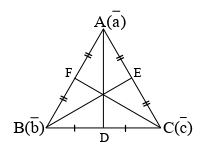
If $D , E , F$ be the middle points of the sides BC , CA and AB of the triangle ABC , then $\overline{ AD }+\overline{ BE }+\overline{ CF }$ is
View full question & answer→MCQ 2332 Marks
If ABCDEF is a regular hexagon and $\overline{ AB }+\overline{ AC }+\overline{ AD }+\overline{ AE }+\overline{ AF }=\lambda \overline{ AD }$, then $\lambda=$
Answer(B) By triangle law,
$\overline{ AB }=\overline{ AD }-\overline{ BD }, \overline{ AC }=\overline{ AD }-\overline{ CD }$
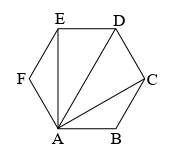
$\therefore \quad \overline{ AB }+\overline{ AC }+\overline{ AD }+\overline{ AE }+\overline{ AF }$
$\begin{array}{l}=\overline{ AD }-\overline{ BD }+\overline{ AD }-\overline{ CD }+\overline{ AD }+\overline{ AE }+\overline{ AF } \\ =3 \overline{ AD }+(\overline{ AE }-\overline{ BD })+(\overline{ AE }-\overline{ CD })\end{array}$
$=3 \overline{ AD }$ $\ldots[\overline{ AE }=\overline{ BD }, \overline{ AF }=\overline{ CD }]$
Hence, $\lambda=3$ View full question & answer→MCQ 2342 Marks
If ABCDEF is a regular hexagon and $\overline{ AB }=\overline{ a }$, $\overline{ BC }=\overline{ b }$, then $\overline{ CD }$ is equal to
AnswerCorrect option: B. $\overline{ b }-\overline{ a }$
(B) $\overline{ AB }+\overline{ BC }=\overline{ AC }$
$\Rightarrow \overline{ AC }=\overline{ a }+\overline{ b }$
Now, $\overline{ AC }+\overline{ CD }=\overline{ AD }$
$\Rightarrow(\overline{ a }+\overline{ b })+\overline{ CD }=2 \overline{b}$ $\ldots[\because \overline{ AD }=2 \overline{ BC }]$
$\Rightarrow \overline{ CD }=\overline{ b }-\overline{ a }$
View full question & answer→MCQ 2352 Marks
ABCDEF is a regular hexagon and $\overline{ AB }=\overline{ a }$, $\overline{ BC }=\overline{ b }$ and $\overline{ CD }=\overline{ c }$, then $\overline{ AE }$ is
- A
$\bar{a}+\bar{b}+\bar{c}$
- B
$\bar{a}+\bar{b}$
- ✓
$\overline{ b }+\overline{ c }$
- D
$\overline{ c }+\overline{ a }$
AnswerCorrect option: C. $\overline{ b }+\overline{ c }$
(C) 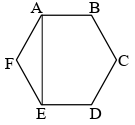
$\overline{ AE }=\overline{ AB }+\overline{ BC }+\overline{ CD }+\overline{ DE }$
$\begin{array}{l}=\overline{ AB }+\overline{ BC }+\overline{ CD }-\overline{ ED } \\ =\overline{ a }+\overline{ b }+\overline{ c }-\overline{ AB } \\ =\overline{ a }+\overline{ b }+\overline{ c }-\overline{ a } \\ =\overline{ b }+\overline{ c }\end{array}$ View full question & answer→MCQ 2362 Marks
If $M$ and $N$ are the midpoints of the sides $B C$ and $C D$ respectively of a parallelogram $A B C D$, then $\overline{ AM }+\overline{ AN }=$
- A
$\frac{4}{3} \overline{ AC }$
- B
$\frac{5}{3} \overline{ AC }$
- ✓
$\frac{3}{2} \overline{ AC }$
- D
$\frac{6}{5} \overline{ AC }$
AnswerCorrect option: C. $\frac{3}{2} \overline{ AC }$
(C) Let A be the origin.
$\therefore \quad \overline{ AB }=\overline{ b }, \overline{ AC }=\overline{ c }, \overline{ AD }=\overline{ d }$
$\overline{ AM }=\frac{\overline{ b }+\overline{ c }}{2}$ and $\overline{ AN }=\frac{\overline{ c }+\overline{ d }}{2}$ $\ldots . .[\because M$ and $N$ are mid points of $B C$ and $C D]$
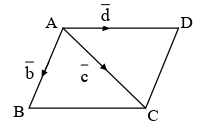
$\overline{ AM }+\overline{ AN }=\frac{\overline{ b }+\overline{ c }}{2}+\frac{\overline{ c }+\overline{ d }}{2}$
$=\frac{2 \overline{ c }+\overline{ b }+\overline{ d }}{2}$
$=\frac{2 \bar{c}+\bar{c}}{2}$ $\ldots \ldots[\because \overline{ b }+\overline{ d }=\overline{ c }]$
$=\frac{3 \overline{ c }}{2}=\frac{3}{2} \overline{ AC }$ View full question & answer→MCQ 2372 Marks
$P$ is the point of intersection of the diagonals of the parallelogram $A B C D$. If $O$ is any point, then $\overline{ OA }+\overline{ OB }+\overline{ OC }+\overline{ OD }=$
- A
$\overline{ OP }$
- B
$2 \overline{ OP }$
- C
$3 \overline{ OP }$
- ✓
$4 \overline{ OP }$
AnswerCorrect option: D. $4 \overline{ OP }$
(D) $P$ will be the mid point of $A C$ and $B D$.
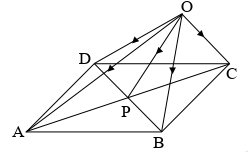
$\therefore \quad \overline{ OA }+\overline{ OC }=2 \overline{ OP }$ ...(i)
and $\overline{ OB }+\overline{ OD }=2 \overline{ OP }$ ...(ii)
Adding (i) and (ii), we get
$\overline{ OA }+\overline{ OB }+\overline{ OC }+\overline{ OD }=4 \overline{ OP }$ View full question & answer→MCQ 2382 Marks
If ABCD is a parallelogram with AC and BD as diagonals, then $\overline{ AC }-\overline{ BD }=$
- A
$4 \overline{ AB }$
- B
$3 \overline{ AB }$
- ✓
$2 \overline{ AB }$
- D
$\overline{ AB }$
AnswerCorrect option: C. $2 \overline{ AB }$
(C) $\overline{ AC }-\overline{ BD }=(\overline{ AB }+\overline{ BC })-(\overline{ BC }+\overline{ CD })$
$\begin{array}{l}=\overline{ AB }-\overline{ CD } \\ =\overline{ AB }+\overline{ DC } \\ =\overline{ AB }+\overline{ AB } \\ =2 \overline{ AB }\end{array}$
View full question & answer→MCQ 2392 Marks
A, B, C, D, E are five coplanar points, then $\overline{ DA }+\overline{ DB }+\overline{ DC }+\overline{ AE }+\overline{ BE }+\overline{ CE }$ is equal to
- A
$\overline{ DE }$
- ✓
$3 \overline{ DE }$
- C
$2 \overline{ DE }$
- D
$4 \overline{ ED }$
AnswerCorrect option: B. $3 \overline{ DE }$
(B) Given $A , B , C , D , E$ are five co-planar points.
Now, $\overline{ DA }+\overline{ DB }+\overline{ DC }+\overline{ AE }+\overline{ BE }+\overline{ CE }$
$\begin{array}{l}=(\overline{ DA }+\overline{ AE })+(\overline{ DB }+\overline{ BE })+(\overline{ DC }+\overline{ CE }) \\ =\overline{ DE }+\overline{ DE }+\overline{ DE }=3 \overline{ DE }\end{array}$
View full question & answer→MCQ 2402 Marks
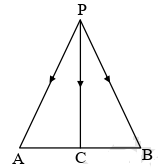
If C is the midpoint of AB and P is any point outside AB , then
- A
$\overline{ PA }+\overline{ PB }+\overline{ PC }=\overline{0}$
- B
$\overline{ PA }+\overline{ PB }+2 \overline{ PC }=\overline{0}$
- C
$\overline{ PA }+\overline{ PB }=\overline{ PC }$
- D
$\overline{ PA }+\overline{ PB }=2 \overline{ PC }$
View full question & answer→MCQ 2412 Marks
In a triangle ABC , if $2 \overline{ AC }=3 \overline{ CB }$, then $2 \overline{ OA }+3 \overline{ OB }$ equals
- ✓
$5 \overline{ OC }$
- B
$-\overline{ OC }$
- C
$\overline{ OC }$
- D
AnswerCorrect option: A. $5 \overline{ OC }$
(A) $2 \overline{ OA }+3 \overline{ OB }=2(\overline{ OC }+\overline{ CA })+3(\overline{ OC }+\overline{ CB })$
$\begin{array}{l}=5 \overline{ OC }+2 \overline{ CA }+3 \overline{ CB } \\ =5 \overline{ OC } \quad\ldots[\because 2 \overline{ CA }=-3 \overline{ CB }]\end{array}$
View full question & answer→MCQ 2422 Marks
If P is any point within a $\triangle ABC$, then $\overline{ PA }+\overline{ CP }=$
- A
$\overline{ AC }+\overline{ CB }$
- B
$\overline{ BC }+\overline{ BA }$
- C
$\overline{ CB }+\overline{ AB }$
- ✓
$\overline{ CB }+\overline{ BA }$
AnswerCorrect option: D. $\overline{ CB }+\overline{ BA }$
(D)
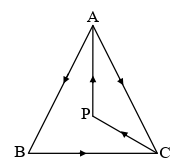
In $\triangle APC , \overline{ PA }+\overline{ AC }+\overline{ CP }=\overline{0}$ ...(i) …[Using triangle law of addition]
In $\triangle ABC , \overline{ AB }+\overline{ BC }=\overline{ AC }$ ...(ii)
From (i) and (ii), we get
$\begin{array}{l}\overline{ PA }+\overline{ CP }+\overline{ AB }+\overline{ BC }=\overline{0} \\ \Rightarrow \overline{ PA }+\overline{ CP }=\overline{ BA }+\overline{ CB }\end{array}$ View full question & answer→MCQ 2432 Marks
If direction ratios of two lines are $5,-12,13$ and $-3,4,5$, then the angle between them is
- ✓
$\cos ^{-1}\left(\frac{1}{65}\right)$
- B
$\cos ^{-1}\left(\frac{2}{65}\right)$
- C
$\cos ^{-1}\left(\frac{3}{65}\right)$
- D
$\frac{\pi}{2}$
AnswerCorrect option: A. $\cos ^{-1}\left(\frac{1}{65}\right)$
(A) Let, $a _1, b_1, c _1=5,-12,13$ and $a _2, b_2, c _2=-3,4,5$
$\therefore \quad \cos \theta=\left|\frac{a_1 a_2+b_1 b_2+c_1 c_2}{\sqrt{a_1^2+b_1^2+c_1^2} \cdot \sqrt{a_2^2+b_2^2+c_2^2}}\right|$
$=\left|\frac{5(-3)+(-12) 4+13(5)}{\sqrt{5^2+(-12)^2+13^2} \cdot \sqrt{(-3)^2+4^2+5^2}}\right|$
$=\left|\frac{-15-48+65}{13 \sqrt{2} \cdot 5 \sqrt{2}}\right|$
$=\frac{1}{65}$
$\therefore \quad \theta=\cos ^{-1}\left(\frac{1}{65}\right)$
View full question & answer→MCQ 2442 Marks
The direction cosines of AB if $A \equiv(2,-3,1)$ and $B \equiv(14,5,-3)$ are
- A
$\frac{3}{\sqrt{14}}, \frac{2}{\sqrt{14}}, \frac{1}{\sqrt{14}}$
- B
$\frac{3}{\sqrt{14}},-\frac{1}{\sqrt{14}},-\frac{2}{\sqrt{14}}$
- C
$-\frac{3}{\sqrt{14}},-\frac{1}{\sqrt{14}}, \frac{2}{\sqrt{14}}$
- ✓
$\frac{3}{\sqrt{14}}, \frac{2}{\sqrt{14}},-\frac{1}{\sqrt{14}}$
AnswerCorrect option: D. $\frac{3}{\sqrt{14}}, \frac{2}{\sqrt{14}},-\frac{1}{\sqrt{14}}$
(D) The d.r.s of AB are $2-14,-3-5,1+3$
i.e. $-12,-8,4$ i.e., $3,2,-1$
∴ The d.c.s are $\frac{3}{\sqrt{14}}, \frac{2}{\sqrt{14}}, \frac{-1}{\sqrt{14}}$
View full question & answer→MCQ 2452 Marks
The direction cosines of the line joining the points $(4,3,-5)$ and $(-2,1,-8)$ are
- ✓
$\left(\frac{6}{7}, \frac{2}{7}, \frac{3}{7}\right)$
- B
$\left(\frac{2}{7}, \frac{3}{7}, \frac{6}{7}\right)$
- C
$\left(\frac{6}{7}, \frac{3}{7}, \frac{2}{7}\right)$
- D
AnswerCorrect option: A. $\left(\frac{6}{7}, \frac{2}{7}, \frac{3}{7}\right)$
(A) d.r.s. of line are $-2-4,1-3,-8+5$
i.e., $-6,-2,-3$ i.e., $6,2,3$
∴ The d.c.s. are $\frac{6}{7}, \frac{2}{7}, \frac{3}{7}$
View full question & answer→MCQ 2462 Marks
If the direction ratios of a line are $1,-3,2$, then the direction cosines of the line are
- ✓
$\frac{1}{\sqrt{14}}, \frac{-3}{\sqrt{14}}, \frac{2}{\sqrt{14}}$
- B
$\frac{1}{\sqrt{14}}, \frac{2}{\sqrt{14}}, \frac{3}{\sqrt{14}}$
- C
$\frac{-1}{\sqrt{14}}, \frac{3}{\sqrt{14}}, \frac{-2}{\sqrt{14}}$
- D
$\frac{-1}{\sqrt{14}}, \frac{-2}{\sqrt{14}}, \frac{-3}{\sqrt{14}}$
AnswerCorrect option: A. $\frac{1}{\sqrt{14}}, \frac{-3}{\sqrt{14}}, \frac{2}{\sqrt{14}}$
(A) The d.c.s. are
$\begin{array}{l}\frac{1}{\sqrt{1+9+4}}, \frac{-3}{\sqrt{1+9+4}}, \frac{2}{\sqrt{1+9+4}} \\ \text { i.e., } \frac{1}{\sqrt{14}}, \frac{-3}{\sqrt{14}}, \frac{2}{\sqrt{14}} \text {. }\end{array}$
View full question & answer→MCQ 2472 Marks
If $l, m, n$ are direction cosines of the line, then $-l,- m ,- n$ can be
- A
only direction ratios of the line
- B
only direction cosines of the line
- ✓
direction cosines and direction ratios of the line
- D
neither direction cosines nor direction ratios of the line
AnswerCorrect option: C. direction cosines and direction ratios of the line
(C) Since $(-l)^2+(-m)^2+(-n)^2=1$, we can say that $-l,- m ,- n$ are the direction cosines of the line.
Also that $\frac{-l}{l}=\frac{- m }{ m }=\frac{- n }{ n }=-1$
Hence, we can say that $-l,- m ,- n$ are the d.r.s. of the line.
View full question & answer→MCQ 2482 Marks
The points $A (1,0,1), B (-1,2,3)$ and $C(0,1,2)$ are
Answer(B) d.r.s. of AB and BC are $(-2,2,2)$ and $(1,-1,-1)$ respectively.
$\therefore \quad \frac{-2}{1}=\frac{2}{-1}=\frac{2}{-1}$
∴ the given points are collinear.
View full question & answer→MCQ 2492 Marks
The direction ratios of a line passing through the points $A (1,2,6)$ and $B (-4,5,0)$ are
- A
$-1,3,-4$
- B
$-6,2,-4$
- ✓
$-5,3,-6$
- D
$-2,-3,-5$
AnswerCorrect option: C. $-5,3,-6$
(C) $A \equiv(1,2,6)$ and $B \equiv(-4,5,0)$
∴ D.r.s of AB are $-4-1,5-2,0-6$
i.e., $-5,3,-6$
View full question & answer→MCQ 2502 Marks
If the length of a vector be 7 and direction ratios be $2,-3,6$, then its direction cosines are
- A
$\frac{2}{21}, \frac{-1}{7}, \frac{2}{7}$
- ✓
$\frac{2}{7}, \frac{-3}{7}, \frac{6}{7}$
- C
$\frac{2}{7}, \frac{3}{7}, \frac{6}{7}$
- D
$\frac{2}{3}, \frac{-7}{3}, \frac{6}{3}$
AnswerCorrect option: B. $\frac{2}{7}, \frac{-3}{7}, \frac{6}{7}$
(B) D.c.s are $\frac{ a }{|\overline{ r }|}, \frac{ b }{|\overline{ r }|}, \frac{ c }{|\overline{ r }|}$
i.e., $\frac{2}{7}, \frac{-3}{7}, \frac{6}{7}$
View full question & answer→