MCQ 3012 Marks
If $\bar{a}=2 \hat{i}+2 \hat{j}-\hat{k}$ and $\bar{b}=6 \hat{i}-3 \hat{j}+2 \hat{k}$, then the value of $\bar{a} \times \bar{b}$ is
- A
$12 \hat{i}+12 \hat{j}-\hat{k}$
- B
$16 \hat{ i }-8 \hat{ j }+2 \hat{ k }$
- C
$\hat{ i }-10 \hat{ j }-18 \hat{ k }$
- D
$\hat{ i }+\hat{ j }+\hat{ k }$
View full question & answer→MCQ 3022 Marks
$\overline{ a } \times \overline{ b }$ is a vector
- A
parallel to $\overline{a}$
- B
perpendicular to both $\overline{ a }$ and $\overline{ b }$
- C
parallel to $\overline{ b }$
- D
perpendicular to $\overline{a}$
View full question & answer→MCQ 3032 Marks
The projection of the vector $\hat{i}-2 \hat{j}+\hat{k}$ on the vector $4 \hat{i}-4 \hat{j}+7 \hat{k}$ is
- A
$\frac{5 \sqrt{6}}{10}$
- B
$\frac{19}{9}$
- C
$\frac{9}{19}$
- D
$\frac{\sqrt{6}}{19}$
View full question & answer→MCQ 3042 Marks
If $2 \overline{ a } \cdot \overline{ b }=|\overline{ a }||\overline{ b }|$, then the angle between $\overline{ a }$ and $\overline{ b }$ is
- A
$0^{\circ}$
- B
$60^{\circ}$
- C
$30^{\circ}$
- D
$90^{\circ}$
View full question & answer→MCQ 3052 Marks
If $\theta$ is the angle between the vectors $\bar{a}=2 \hat{i}+2 \hat{j}-\hat{k}$ and $\bar{b}=6 \hat{i}-3 \hat{j}+2 \hat{k}$, then
- A
$\cos \theta=\frac{4}{21}$
- B
$\cos \theta=\frac{3}{19}$
- C
$\cos \theta=\frac{2}{10}$
- D
$\cos \theta=\frac{5}{21}$
View full question & answer→MCQ 3062 Marks
If $\bar{a}$ and $\bar{b}$ are any two vectors, then
- A
$|\overline{ a } \cdot \overline{ b }|>|\overline{ a }||\overline{ b }|$
- B
$|\overline{ a } \cdot \overline{ b }|<|\overline{ a }||\overline{ b }|$
- C
$|\overline{ a } \cdot \overline{ b }| \geq|\overline{ a }||\overline{ b }|$
- D
$|\overline{ a } \cdot \overline{ b }| \leq|\overline{ a }||\overline{ b }|$
View full question & answer→MCQ 3072 Marks
If $\bar{a} \cdot \bar{b}=-|\bar{a}||\bar{b}|$, then $\bar{a}$ and $\bar{b}$ are
View full question & answer→MCQ 3082 Marks
If $\bar{a} \cdot \bar{b}=|\bar{a}||\bar{b}|$, then $\bar{a}$ and $\bar{b}$ are
View full question & answer→MCQ 3092 Marks
The three vectors $7 \hat{i}-11 \hat{j}+\hat{k}, 5 \hat{i}+3 \hat{j}-2 \hat{k}$ and $12 \hat{i}-8 \hat{j}-\hat{k}$ form
View full question & answer→MCQ 3102 Marks
If $\bar{a}=2 \hat{i}+\hat{j}-\hat{k}$ is perpendicular to $\overline{ b }=\hat{ i }-4 \hat{ j }-\lambda \hat{ k }$, then $\lambda$ is equal to
View full question & answer→MCQ 3112 Marks
If $\bar{a}=\hat{i}+2 \hat{j}-3 \hat{k}$ and $\bar{b}=3 \hat{i}-\hat{j}+2 \hat{k}$, then the angle between the vectors $\bar{a}+\bar{b}$ and $\bar{a}-\bar{b}$ is
- A
$30^{\circ}$
- B
$60^{\circ}$
- C
$90^{\circ}$
- D
$0^{\circ}$
View full question & answer→MCQ 3122 Marks
The vector $\bar{a}=\frac{1}{8} \hat{i}-\frac{3}{8} \hat{j}+\frac{1}{4} \hat{k}$ is
- A
- B
parallel to vector $6 \hat{ i }-12 \hat{ j }+8 \hat{ k }$
- C
collinear with vector $\hat{i}-3 \hat{j}+\hat{k}$
- D
perpendicular to the vector $2 \hat{i}+4 \hat{j}+5 \hat{k}$
View full question & answer→MCQ 3132 Marks
If $|\bar{a}|=3,|\bar{b}|=5,|\bar{c}|=4$ and $\bar{a}+\bar{b}+\bar{c}=\overline{0}$, then the value of $(\bar{a} \cdot \bar{b}+\bar{b} \cdot \bar{c})$ is equal to
View full question & answer→MCQ 3142 Marks
If $\bar{a} \cdot \hat{i}=\bar{a} \cdot(\hat{i}+\hat{j})=\bar{a} \cdot(\hat{i}+\hat{j}+\hat{k})$, then $\bar{a}$ is equal to
View full question & answer→MCQ 3152 Marks
$(\overline{ a } \cdot \hat{ i }) \hat{ i }+(\overline{ a } \cdot \hat{ j }) \hat{ j }+(\overline{ a } \cdot \hat{ k }) \hat{ k }=$
- A
$\overline{ a }$
- B
$2 \bar{a}$
- C
$0$
- D
$4 \bar{a}$
View full question & answer→MCQ 3162 Marks
For any vector $\overline{ r },(\overline{ r } \cdot \hat{ i })^2+(\overline{ r } \cdot \hat{ j })^2+(\overline{ r } \cdot \hat{ k })^2$ is equal to
- A
- B
$|\overline{r}|$
- C
$\overline{ r }$
- D
$|\overline{r}|^2$
View full question & answer→MCQ 3172 Marks
If $A, B, C$ are the vertices of a triangle whose position vectors are $\bar{a}, \bar{b}, \bar{c}$ and $G$ is the centroid of the $\triangle ABC$, then $\overline{ GA }+\overline{ GB }+\overline{ GC }$ is
- A
$\overline{0}$
- B
$\bar{a}+\bar{b}+\bar{c}$
- C
$\frac{\bar{a}+\bar{b}+\bar{c}}{3}$
- D
$\frac{\bar{a}+\bar{b}-\bar{c}}{3}$
View full question & answer→MCQ 3182 Marks
If $A(a,2,2), B(a, b, 1)$ and $C(1,2,-2)$ are the vertices of triangle $A B C$ and $G(2,1, c)$ is its centroid. then values of ' $a$ ', ' $b$ ' and ' $c$ ' are
- A
$a=\frac{1}{2}, b=1, c=1$
- B
$a=\frac{5}{2}, b=-1, c=\frac{1}{3}$
- C
$a=-1, b=1, c=\frac{3}{2}$
- D
$a =\frac{1}{2}, b=\frac{1}{2}, c =-1$
View full question & answer→MCQ 3192 Marks
If $A(2,3,-4), B(m, 1,-1), C(3,2,2)$ and $G (3,2, n )$ is the centroid of $\triangle ABC$, then the values of $m$ and $n$ respectively are
View full question & answer→MCQ 3202 Marks
The co-ordinates of the point which divides the line seement joining the points A$(2,1,-1)$ and $B(1,-1,2)$ externally in the ratio $5: 2$ are
- A
$\left(\frac{1}{3}, \frac{-7}{3}, 4\right)$
- B
$\left(\frac{1}{3}, \frac{7}{3},-4\right)$
- C
$(1,-7,12)$
- D
$(1,7,-12)$
View full question & answer→MCQ 3212 Marks
The position vector of a point $R$ which divides the line joining two points P and Q whose position vectors are $\hat{i}+2\hat{j}- \hat{k}$ and -$\hat{i}+\hat{j}- \hat{k}$ respectively, in the ratio $2: 1$ externally is
View full question & answer→MCQ 3222 Marks
If the position vectors of the points A and B are $\hat{i}+3 \hat{j}-\hat{k}$ and $3 \hat{i}-\hat{j}-3 \hat{k}$, then what will be the position vector of the midpoint of AB ?
- A
$\hat{i}+2 \hat{j}-\hat{k}$
- B
$2 \hat{i}+\hat{j}-2 \hat{k}$
- C
$2 \hat{ i }+\hat{ j }-\hat{ k }$
- D
$\hat{i}+\hat{j}-2 \hat{k}$
View full question & answer→MCQ 3232 Marks
If the position vector of a point $A$ is $\bar{a}+2 \bar{b}$ and $\bar{a}$ divides AB in the ratio $2: 3$, then the position vector of $B$ is
- A
$\bar{a}+\bar{b}$
- B
$\overline{a}$
- C
$\bar{a}-3 \bar{b}$
- D
$\overline{ b }$
View full question & answer→MCQ 3242 Marks
The position vector of the point which divides internally in the ratio $2: 3$, the join of the points $2 \bar{a}-3 \bar{b}$ and $3 \bar{a}-2 \bar{b}$, is
- A
$\frac{12}{5} \bar{a}+\frac{13}{5} \bar{b}$
- B
$\frac{12}{5} \bar{a}-\frac{13}{5} \bar{b}$
- C
$\frac{3}{5} \overline{ a }-\frac{2}{5} \overline{b}$
- D
$\frac{2}{5} \bar{a}-\frac{3}{5} \bar{b}$
View full question & answer→MCQ 3252 Marks
Let $A (1,-1,2)$ and $B (2,3,-1)$ be two points. If a point P divides AB internally in the ratio $2: 3$. then the position vector of P is
- A
$\frac{1}{\sqrt{5}}(\hat{ i }+\hat{ j }+\hat{ k })$
- B
$\frac{1}{\sqrt{3}}(\hat{i}+6 \hat{j}+\hat{k})$
- C
$\frac{1}{\sqrt{3}}(\hat{i}+\hat{j}+\hat{k})$
- D
$\frac{1}{5}(7 \hat{i}+3 \hat{j}+4 \hat{k})$
View full question & answer→MCQ 3262 Marks
The vectors $\bar{a}, \bar{b}$ and $\bar{a}+\bar{b}$ are
View full question & answer→MCQ 3272 Marks
Let $\overline{ A }=(x+4 y) \overline{ a }+(2 x+y+1) \overline{ b }$ and $\overline{ B }=(y-2 x+2) \overline{ a }+(2 x-3 y-1) \overline{ b }$, where $\bar{a}$ and $\bar{b}$ are non-collinear vectors, if $3 \overline{A}=2 \overline{B} ;$ then
- A
$x=1, y=2$
- B
$x=2, y=1$
- C
$x=2, y=-1$
- D
$x=-1, y=2$
View full question & answer→MCQ 3282 Marks
If $\bar{a}=\hat{i}+\hat{j}, \quad \bar{b}=2 \hat{i}-\hat{j}$ and $\bar{r}=2 \hat{i}-4 \hat{j}$, then express $\bar{r}$ as linear combination of $\bar{a}$ and $\bar{b}$
- A
$\overline{ r }=2 \overline{ a }+2 \overline{b}$
- B
$\overline{ r }=-2 \overline{ a }+2 \overline{b}$
- C
$\overline{ r }=2 \overline{ a }-2 \overline{b}$
- D
$\overline{ r }=-2 \overline{ a }-2 \overline{b}$
View full question & answer→MCQ 3292 Marks
$\bar{a}$ and $\bar{b}$ are two non-collinear vectors, then $x \overline{ a }+y \overline{b}$ (where $x$ and $y$ are scalars) represents a vector which is
- A
Parallel to $\overline{ b }$
- B
Parallel to $\overline{ a }$
- C
Coplanar with $\bar{a}$ and $\bar{b}$
- D
View full question & answer→MCQ 3302 Marks
If $\bar{a}, \bar{b}, \bar{c}$ are non-collinear vectors such that for some scalars $x, y, z , x \overline{ a }+y \overline{b}+ z \overline{ c }=0$, then
- A
$x=0, y=0, z =0$
- B
$x \neq 0, y \neq 0, z =0$
- C
$x=0, y \neq 0, z \neq 0$
- D
$x \neq 0, y \neq 0, z \neq 0$
View full question & answer→MCQ 3312 Marks
If $\bar{a}$ and $\bar{b}$ are two non-collinear vectors and $x \overline{ a }+y \overline{b}=0$, then
- A
$x=0$, but $y$ is not necessarily zero
- B
$y=0$, but $x$ is not necessarily zero
- C
$x=0, y=0$
- D
View full question & answer→MCQ 3322 Marks
If $3 \hat{i}-2 \hat{j}+5 \hat{k}$ and $-2 \hat{i}+p \hat{j}-q \hat{k}$ are collinear vectors, then
- A
$p =\frac{4}{3}, q =\frac{-10}{3}$
- B
$p=\frac{10}{3}, q=\frac{4}{3}$
- C
$p =\frac{-4}{3}, q =\frac{10}{3}$
- D
$p=\frac{4}{3}, q=\frac{10}{3}$
View full question & answer→MCQ 3332 Marks
Vectors $(p, q)$ and $(5,1)$ are parallel, if
- A
$p+q=5$
- B
$p q=5$
- C
$p=5 q$
- D
$q=5 p$
View full question & answer→MCQ 3342 Marks
The points with position vectors $20 \hat{ i }+ p \hat{ j }$, $5 \hat{i}-\hat{j}$ and $10 \hat{i}-13 \hat{j}$ are collinear. The value of $p$ is
View full question & answer→MCQ 3352 Marks
The points with position vectors $60 \hat{i}+3 \hat{j}$, $40 \hat{ i }-8 \hat{ j }, a \hat{ i }-52 \hat{ j }$ are collinear, if $a=$
View full question & answer→MCQ 3362 Marks
The vectors $\overline{ a }$ and $\overline{ b }$ are non-collinear. The value of $x$ for which the vectors $\overline{ c }$$=(x-2) \overline{ a }+\overline{ b }$ and $\overline{ d }=$ $(2 x+1) \bar{a}-\bar{b}$ are collinear, is
- A
$1$
- B
$\frac{1}{2}$
- C
$\frac{1}{3}$
- D
View full question & answer→MCQ 3372 Marks
If A B C D is a parallelogram, $\overline{A B}$ $=2 \hat{i}+4 \hat{j}-5 \hat{k}$ and $\overline{A D}=\hat{i}+2 \hat{j}+3 \hat{k}$, then the unit vector in the direction of BD is
- A
$\frac{1}{\sqrt{69}}(\hat{ i }+2 \hat{ j }-8 \hat{ k })$
- B
$\frac{1}{69}(\hat{i}+2 \hat{j}-8 \hat{k})$
- C
$\frac{1}{\sqrt{69}}(-\hat{ i }-2 \hat{ j }+8 \hat{ k })$
- D
$\frac{1}{69}(-\hat{i}-2 \hat{j}+8 \hat{k})$
View full question & answer→MCQ 3382 Marks
If ABCD is a parallelogram and the position vectors of $A, B, C$ are $\hat{i}+3 \hat{j}+5 \hat{k}, \hat{i}+\hat{j}+\hat{k}$ and $7\hat{i}+7 \hat{j}+7 \hat{k}$, then the position vector of D will be
- A
$7 \hat{ i }+5 \hat{ j }+3 \hat{ k }$
- B
$7 \hat{i}+9 \hat{j}+11 \hat{k}$
- C
$9 \hat{i}+11 \hat{j}+13 \hat{k}$
- D
$8 \hat{i}+8 \hat{j}+8 \hat{k}$
View full question & answer→MCQ 3392 Marks
If the position vectors of the vertices of a triangle be $6 \hat{i}+4 \hat{j}+5 \hat{k}, 4 \hat{i}+5 \hat{j}+6 \hat{k}$ and $5 \hat{ i }+6 \hat{ j }+4 \hat{ k }$, then the triangle is
View full question & answer→MCQ 3402 Marks
The position vectors of P and Q are $5 \hat{i}+4 \hat{j}+a \hat{k}$ and $-\hat{i}+2 \hat{j}-2 \hat{k}$ respectively. If the distance between them is 7 , then the value of a will be
AnswerCorrect option: A. $-5,1$
(A) Given, $P Q=7$
$\Rightarrow \sqrt{(5+1)^2+(4-2)^2+(a+2)^2}=7$
Squaring both sides, we get
$36+4+(a+2)^2=49$
$\begin{array}{l}\Rightarrow( a +2)^2=9 \\ \Rightarrow a +2= \pm 3 \\ \Rightarrow a =-5,1\end{array}$
View full question & answer→MCQ 3412 Marks
If $\bar{a}=2 \hat{i}+5 \hat{j}$ and $\bar{b}=2 \hat{i}-\hat{j}$, then the unit vector along $\bar{a}+\bar{b}$ will be
- A
$\frac{\hat{ i }-\hat{ j }}{\sqrt{2}}$
- B
$\hat{ i }+\hat{ j }$
- C
$\sqrt{2}(\hat{ i }+\hat{ j })$
- ✓
$\frac{\hat{ i }+\hat{ j }}{\sqrt{2}}$
AnswerCorrect option: D. $\frac{\hat{ i }+\hat{ j }}{\sqrt{2}}$
(D) $\overline{ a }+\overline{ b }=4 \hat{ i }+4 \hat{ j }$
∴ Unit vector $=\frac{4(\hat{ i }+\hat{ j })}{\sqrt{32}}=\frac{\hat{ i }+\hat{ j }}{\sqrt{2}}$
View full question & answer→MCQ 3422 Marks
The value of $x$, if $x(\hat{ i }+\hat{ j }+\hat{ k })$ is a unit vector, is
- A
$\pm \sqrt{3}$
- B
$\pm \frac{1}{3}$
- ✓
$\pm \frac{1}{\sqrt{3}}$
- D
$\pm 3$
AnswerCorrect option: C. $\pm \frac{1}{\sqrt{3}}$
(C) $x(\hat{ i }+\hat{ j }+\hat{ k })$ is a unit vector.
$\therefore|x(\hat{ i }+\hat{ j }+\hat{ k })|=1$
$\Rightarrow|x| \sqrt{3}=1$
$\Rightarrow|x|=\frac{1}{\sqrt{3}}$
$\Rightarrow x= \pm \frac{1}{\sqrt{3}}$
View full question & answer→MCQ 3432 Marks
If $\bar{a}=2 \hat{i}+\hat{j}+\hat{k}$ and $\bar{b}=\hat{i}+2 \hat{j}+3 \hat{k}$, then the magnitude of the vector $(\bar{a}+\bar{b})$ is
- A
$\sqrt{6}$
- ✓
$\sqrt{34}$
- C
$\sqrt{14}$
- D
$\sqrt{26}$
AnswerCorrect option: B. $\sqrt{34}$
(B) $\bar{a}+\bar{b}=(2 \hat{i}+\hat{j}+\hat{k})+(\hat{i}+2 \hat{j}+3 \hat{k})$
$=3 \hat{ i }+3 \hat{ j }+4 \hat{ k }$
$\therefore|\overline{ a }+\overline{ b }|=\sqrt{3^2+3^2+4^2}=\sqrt{9+9+16}=\sqrt{34}$
View full question & answer→MCQ 3442 Marks
What should be added in vector $\overline{a}=3 \hat{i}+4 \hat{j}-2 \hat{k}$ to get its resultant a unit vector $\hat{i}$ ?
- ✓
$-2 \hat{i}-4 \hat{j}+2 \hat{k}$
- B
$-2 \hat{i}+4 \hat{j}-2 \hat{k}$
- C
$2 \hat{i}+4 \hat{j}-2 \hat{k}$
- D
AnswerCorrect option: A. $-2 \hat{i}-4 \hat{j}+2 \hat{k}$
(A) Suppose $\overline{ b }$ is added to the vector $\overline{ a }$, then $\overline{ a }+\overline{ b }=\hat{ i }$
$\Rightarrow \overline{ b }=\hat{ i }-\overline{ a }=\hat{ i }-(3 \hat{ i }+4 \hat{ j }-2 \hat{ k })$
$=-2 \hat{i}-4 \hat{j}+2 \hat{k}$
View full question & answer→MCQ 3452 Marks
If $\bar{a}$ and $\bar{b}$ represents the sides AB and BC of a regular hexagon ABCDEF , then the vector $\overline{ FA }$ equals
AnswerCorrect option: B. $\bar{a}-\bar{b}$
(B)
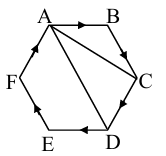
$\overline{ FA }=\overline{ DC }$
$\begin{array}{l}=\overline{ DA }+\overline{ AC } \\ =\overline{ AC }-\overline{ AD }\end{array}$
$=(\overline{ AB }+\overline{ BC })-2 \overline{ BC }$
$=\overline{ AB }-\overline{ BC }=\overline{ a }-\overline{ b }$ View full question & answer→MCQ 3462 Marks
If OACB is a parallelogram with $\overline{ OC }=\overline{ a }$ and $\overline{ AC }=\overline{ b }$, then $\overline{ OA }=$
AnswerCorrect option: B. $\bar{a}-\bar{b}$
(B)
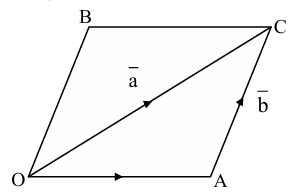
By Parallelogram Law,
$\overline{ OA }+\overline{ b }=\overline{ a } \Rightarrow \overline{ OA }=\overline{ a }-\overline{ b }$ View full question & answer→MCQ 3472 Marks
In the triangle $ABC , \overline{ AB }= a , \overline{ AC }= c , \overline{ BC }= b$, then
- A
$a+b+c=0$
- ✓
$a+b-c=0$
- C
$a-b+c=0$
- D
$-a+b+c=0$
AnswerCorrect option: B. $a+b-c=0$
(B) $\overline{ AB }+\overline{ BC }+\overline{ CA }=0$
$\Rightarrow a + b - c =0$
View full question & answer→MCQ 3482 Marks
If $\overline{ a }$ is a non-zero vector and $| k \overline{ a }|=1$, then $k =$
AnswerCorrect option: D. $\pm \frac{1}{|\bar{a}|}$
(D) $| k \overline{ a }|=1 \Rightarrow| k ||\overline{ a }|=1$
$\Rightarrow| k |=\frac{1}{|\overline{ a }|}$
$\Rightarrow k = \pm \frac{1}{|\overline{ a }|}$
View full question & answer→MCQ 3492 Marks
If $|\bar{a}|=8$, then $|(-5) \bar{a}|$ is
Answer(B) $|(-5) \overline{ a }|=|-5||\overline{ a }|=5 \times 8=40$
View full question & answer→MCQ 3502 Marks
View full question & answer→