Questions

Answer the following in Brief

Take a timed test

13 questions · self-marked practice — reveal the answer and mark yourself.

Question 13 Marks
Obtain an expression for equivalent capacity for combination of three capacitors connected in series.
Answer
coming soon…
View full question & answer
Question 23 Marks
Two charges of magnitude \(5 nC\) and \(-2 nC\) are placed at points \((2 cm , 0,0)\) and \((20 cm 0,0)\) in a region of a region of a space where there is a no external field. Find electrostatic potential energy of the system.
Answer
1. Two charges of magnitude 5nC and - 2nC are placed at 2cm and 20cm from the origin respectively.
We know that,\(U =\frac{1}{4 \pi \epsilon_{ o }} \times \frac{ q _1 q _2}{\Delta r }\)
Substituting the values,
\(\longrightarrow U=9 \times 10^9 \times \frac{5 \times 10^{-9} \times-2 \times 10^{-9}}{20 \times 10^{-2}-2 \times 10^{-2}}\)
\(\longrightarrow U=-\frac{9 \times 10 \times 10^{-9}}{18 \times 10^{-2}}\)
\(\rightarrow U =-0.5 \times 10^{-6} J\)
View full question & answer
Question 33 Marks
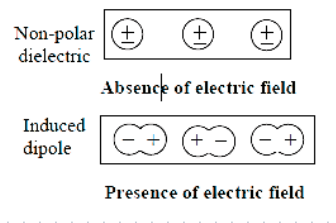
With the help of neat diagrams, explain how the non-polar dielectric material is polarised in external filed of increasing intensity. Define polarisation in dielectrics.
Answer
Image
If a dielectric (non-polar) molecule is placed in an external electric field, a small induced dipole moment is created because the positive charge in each atom is pushed in the direction of the field and negative charge is pushed in the opposite direction as shown in the figure.
Polarization is the amount of induced surface charge per unit area or the surface density of polarization charges appearing at right angles to applied external electric field.
View full question & answer
Question 43 Marks
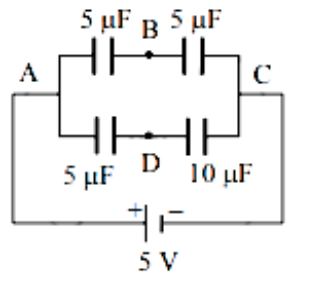
Six capacitors of capacities 5, 5, 5, 5, 10 and \(X \mu F\) are connected as shown in the network given diagram. Find: (a) The value of X if the network is balanced, and (b) The resultant capacitance between A and C.
Image
Answer
Given balanced network of capacitors with
$C_{AB} = C_{BC} = C_{AD} = C_{BD} = 5 µF, C_{DC} = (10 + X) µF$
The value of X = ?
Resultant capacitance between A and C $(C_{eq}) = ?$
a.Using formula, \(C_s=\frac{C_1 C_2}{C_1+C_2}\) for branch DC of the given network we get
\(C_s=\frac{10 \times X}{10+X}\)...(i)
Now using formula
\(\frac{C_{A B}}{C_{B C}}=\frac{C_{A D}}{C_{D C}}\) (For balance condition)
\(\therefore \frac{5}{5}=\frac{5}{\frac{10 \times X}{10+X}}\)
\(\therefore 1=\frac{10+X}{2 X}\)
\(\therefore 2 X=10+X\)
\(\therefore x=10 \mu F\)
The value of X is 10 µF.
b. As the bridge is balanced, no current flows through branch BD. Hence the network can be reduced as follows:
Image
Here, 5 µF and 5 µF are in series in the branch ABC.
Using formula (i),
\(C_s=\frac{5 \times 5}{5+5}=2.5 \mu F\)
Also, 5 µF and 10 µF are in series in the branch ADC.
\(C_s^{\prime \prime}=\frac{5 \times 10}{10+10}=\frac{50}{20}=2.5 \mu F\)
Now, \(C_s^{\prime}\) and \(C_s^{\prime \prime}\) are in parallel
$\therefore CAC = CP = C_S′ + C_S′′ = 2.5 µF + 2.5 µF$
$= 5 µF$
$\therefore$ The resultant capacitance between A and C is $5 µF.$
View full question & answer
Question 53 Marks
The energy density at a point in a medium of dielectric constant 6 is \(26.55 \times 10^6 J / m ^3\). Calculate electric field intensity at that point. \(\left(\varepsilon_0=8.85 \times 10^{-12}\right.\) SI units) \(\left[\right.\)
Answer
$k = 6, u = 26.55 \times 10^6 J/m^3$
\(u =\frac{1}{2} \varepsilon_0 kE ^2\)
\(E=\left(\frac{2 u}{\varepsilon_0 k}\right)^{1 / 2}\)
\(=\frac{2 \times 26.55 \times 10^6}{8.85 \times 10^{-12} \times 6}=\left(10^{18}\right)^{1 / 2}\)
\(E =10^9 N / C\)
Electric field intensity at the point in the medium is 109 N/C.
View full question & answer
Question 63 Marks
A parallel plate capacitor filled with air has an area of \(6 cm ^2\) and plate separation of \(3 mm\). Calculate its capacitance.
Answer
Given,
$A = 6 cm^2 = 6 \times 10^{-4} m^2$
$d = 3 mm = 3 \times 10^{-3} m$
$k = 1$
$ε_0 = 8.85 \times 10^{-12} c^2/Nm^2$
$C = ?$
Capacitance of parallel plate capacitor
\(C=\frac{A \varepsilon_0 k}{d}\)
\(=\frac{6 \times 10^{-4} \times 8.85 \times 10^{-12} \times 1}{3 \times 10^{-3}}\)
\(=17.7 \times 10^{-13}\)
\(=1.77 \times 10^{-12} F\)
∴ Capacitance of a parallel plate capacitor is \(=1.77 \times 10^{-12} F\)
View full question & answer
Question 73 Marks
Explain the concept of a parallel plate capacitor. State its any 'two' applications.
Answer
parallel plate capacitor is a type of capacitor that consists of two parallel conductive plates separated by a small gap or distance. This gap is typically filled with a dielectric material, which helps to increase the capacitor's ability to store electrical charge. The amount of electrical charge that a parallel plate capacitor can store is determined by the surface area of the plates, the distance between the plates, and the type of dielectric material used.
One application of a parallel plate capacitor is in power supplies, where it is used to store electrical energy and then release it as needed to power electrical devices. Another application is in filtering circuits, where the capacitor is used to remove unwanted AC components from an electrical signal.
View full question & answer
Question 83 Marks
A cube of marble having each side $1$ cm is kept in an electric field of intensity $300 V / m$. Determine the energy contained in the cube of dielectric constant $8$ . (Given: $\varepsilon_o=8.85 \times 10^{-12} C ^2 / Nm ^2$ )
Answer
Given: \(l=1 cm =10^{-2} m , E=300 Vm ^{-11}, k=8\)
To find: Energy contained in the cube (U)
formula: \(u=\frac{U}{V}\)
volume of marble
\(V=\left(i^3\right)=\left(10^{-2}\right) 3=10^{-6} m ^3\)
Energy Density, \(u=\frac{1}{2} \in_0 k E^2\)
\(=\frac{1}{2} \times 8.85 \times 10^{-12} \times 8 \times(300)^2\)
\(=3.185 \times 10^{-6} \frac{ J }{ m ^3}\)
From formula \(U=u \times V=3.185 \times 10^{-6} \times 10^{-6}\)
\(U=3.185 \times 10^{-12} J\)
View full question & answer
Question 93 Marks
A small particle carrying a negative charge of \(1.6 \times 10^{-19} C\) is suspended in equilibrium between two horizontal metal plates \(10 cm\) apart, having a potential difference of 4000 volts across them. Find the mass of the particle
Answer
\(6.53 \times 10^{-16} kg\)
View full question & answer
Question 103 Marks
Obtain an expression for energy of a charged capacitor and express it in different forms.
Answer
coming soon…
View full question & answer
Question 113 Marks
An electric dipole consists of two opposite charges each of magnitude \(1 \mu C\), separated by \(2 cm\).
The dipole is placed in an external field of \(10^5 N / C\). Calculate:
(a) maximum torque experienced by the dipole and
(b) work done by the external field to turn the dipole through \(180^{\circ}\).
Answer
Given:
$q = 1 \mu C = 10^{-6} C, E = 10^5 N/C, 2l = 2 cm = 2 \times 10^{-2}m$
To Find:
$τ_{max} = ?, W = ?$
We know that, $p = q \times 2l = 10^{-6} \times 2 \times 10^{-2} = 2 \times 10^{-8} m$
$τ_{max} = pE = 2 \times 10^{-8} \times 10^5= 2 \times 10^{-3} Nm$
Work done by the external field to turn the dipole through $180^\circ$ is given by,
$W = pE(cos\theta _1 - cos\theta _2)$
$\therefore W = 2 \times 10^{-8} \times 10^5\times (1 + 1)$
$\therefore W = 4 \times 10^{-3} J$
View full question & answer
Question 123 Marks
A conductor of any shape, having area \(40 cm ^2\) placed in air is uniformly charged with a charge \(0.2 \mu C\). Determine the electric intensity at a point just outside its surface. Also, find the mechanical force per unit area of the charged conductor. $[/ \varepsilon_0=8.85 \times 10^{-12}\ S.I. Units]$
Answer
Given: $Q=0.2 \mu C=0.2*10^{-6}C$
$A=40cm^2=40*10^{-4}m^2$
$ε_0=8.85*10^{-12}SI units$
The electric field intensity just outside the surface of a charged conductor of any shape is
\(E=\frac{\sigma}{\varepsilon_0}=\frac{Q}{A \varepsilon_0}\)
\(\therefore E=\frac{0.2 \cdot 10^{-6}}{40 \cdot 10^{-4} \cdot 8.85 \cdot 10^{-12}}\)
\(\therefore E=5.65 \cdot 10^6 N / C\)
Now, the mechanical force per unit area of a conductor is
\(f=\frac{1}{2} \varepsilon_0 E^2=\frac{1}{2} \cdot 8.85 \cdot 10^{-12} \cdot\left(5.65 \cdot 10^6\right)^2\)
$\therefore f=141.25N/m^2$
View full question & answer
Question 133 Marks
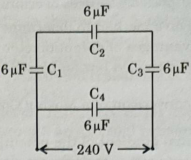
A network of four capacitors of \(6 \mu F\) each is connected to a \(240 V\) supply. Determine the charge on each capacitor.
Image
Answer
$C_1,C_2$ and $C_3$ are in series
\(\therefore \frac{1}{C_s}=\frac{1}{C_1}+\frac{1}{C_2}+\frac{1}{C_3}\)
\(=\frac{1}{6 \times 10^{-6}}+\frac{1}{6 \times 10^{-6}}+\frac{1}{6 \times 10^{-6}}\)
\(\frac{1}{C_s}=\frac{3}{6 \times 10^{-6}}\)
$\therefore Cs = 2x10^{-6} F$
$C_s and C_4$ are parallel
$\therefore$ equivalent resistance
$C = C_p = C_s + C_4$
$= 2x10^{-6} + 6x10^{-6}$
$C = 8x10^{-6}$
$\therefore v = v1+ v2+ v3$
$240 = 3v_1  {v_1=v_2=v_3}$
$\therefore v_1  80 volt$
Also charge on $C_1,C_2 ,C_3$ are same.
$Q_1 = Q_2 = Q_3 = Q$
$Q = C_1v_1$
$= 6x10^{-6} x 80$
$Q = 480x10^{-6}C and Q_4 = 6x10^{-6}x 240= 144 \times 10^{-5}$
$Q_4 = 1.44 \times 10^{-3} C$
View full question & answer