Questions

Answer the following in Brief

Take a timed test

12 questions · self-marked practice — reveal the answer and mark yourself.

Question 13 Marks
An alternating voltage is given by $e = 8sin628.4t.$ Find
$1.$ peak value of e.m.f.
$2.$ frequency or e.m.f.
$3.$ instantaneous value of e.m.f. at time $t = 10.$ ms
Answer
Given an alternating voltage $e = 8sin⁡(628.4t),$ we can analyze it as follows:
$1.$ Peak value of e.m.f. $(E_0​):$ The coefficient in front of the sine function gives us the peak value of the e.m.f., which is $8$ volts in this case.
$2.$ Frequency of e.m.f.: The angular frequency $ω$ is given as $628.4 rad/s.$ The frequency $f$ can be found using the
relationship $\omega=2 \pi f$, so $f=\frac{\omega}{2 \pi}$.
Let's calculate $f:$
$f=\frac{628.4}{2 \pi}$
$3.$ Instantaneous value of e.m.f. at time $t = 10 ms:$ To find the instantaneous value of e.m.f. at $t = 10 ms (0.01 s),$ we substitute t into the given equation for e.
$e(t) = 8sin(628.4 \times 0.01)$
Let's calculate the frequency and the instantaneous value of e.m.f.:
$1.$The peak value of e.m.f. is approximately $8$ volts.
$2.$The frequency of the e.m.f. is approximately $100 Hz.$
$3.$The instantaneous value of e.m.f. at time $t = 10 \ ms$ is approximately $0.0065$ volts.
View full question & answer
Question 23 Marks
Prove the Mayer's relation $C_p-C_v=\frac{R}{J}$
Answer
The first law of thermodynamics states that a system's heat absorption equals its internal energy increase and work done.(i.e) $dQ = dU + dW.$
Relation between $C_p$ and $C_v:$ Consider one mole of an ideal gas. Let the gas be heated at a constant value so that its temperature increases by $dT$
if $Q_1 =$ heat supplied to $1$ mole of gas at constant volume, then $Q_1 = C_vdT ...(i)$
Now, let the gas be heated at constant pressure until its temperature rises by $dT.$
If $Q_2 =$ heat supplied to $1$ mole of gas at constant pressure, then $Q_2 = C_pdT ...(ii)$
When gas is heated at constant volume, it will not perform external work. According to the first law of thermodynamics, the heat supplied will just increase the internal energy of the gas.
Therefore, equation $(i)$ becomes, $dU = C_vdT ...(iii)$
When heat is given under continuous pressure, it increases internal energy and allows the gas to perform work $(dW).$ As the volume of the gas increases $(dV),$ the work done by the gas $(dW)$ is equal to the $\text{PDV}...(iv).$ According to the basic law of thermodynamics.
$Q_2=Q_1+d W$
$Q_2=d U+d W$
$C_p d T=C_v d T+p d V$
$\left(C_p-C_v\right) d T=P d V$
or $C_p-C_v=\frac{p d V}{d T} ...(vi)$
if $C_p$ and $C_V$ are measured in heat units and $R$ in units of work, then
$C_p-C_v=\frac{R}{J}$
View full question & answer
Question 33 Marks
The radius of a circular track is $200 m$. Find the angle of banking of the track, if the maximum speed at which a car can be driven safely along it is $25 m/ \sec$.
Answer
Given  $v=25 m / s, r=200 m, g=9.8 m / s^2$
$\theta=\tan ^{-1}\left(\frac{v^2}{r g}\right)$
$\theta=\tan ^{-1}\left(\frac{(25)^2}{200 \times 9.8}\right)$
$\theta=\tan ^{-1}\left(\frac{625}{1960}\right)$
$\theta=\tan ^{-1}(0.318877551)$
$\theta=\tan ^{-1}(0.318877551) \approx 17.7^{\circ}$
Therefore, the angle of banking of the track should be approximately $17.7^{\circ}$ to allow a car to be driven safely along it at a maximum speed of $25 m / s$.
View full question & answer
Question 43 Marks
A current carrying toroid winding is internally filled with lithium having susceptibility $x = 2.1 \times 10^{−5}.$ What is the percentage increase in the magnetic field in the presence of lithium over that without it?
Answer
To determine the percentage increase in the magnetic field inside a toroid when it is filled with lithium $($which is a diamagnetic material given its positive susceptibility$),$ we first need to understand how the magnetic susceptibility $(x)$ affects the magnetic field inside materials.
The magnetic susceptibility, $x,$ is a dimensionless proportionality constant that indicates the degree to which a material can be magnetized in response to an external magnetic field. The total magnetic field $(B)$ inside a material in the presence of an external magnetic field $(B_0​)$ can be expressed as:
$B=\mu B_0$
where $\mu$ is the permeability of the material, and it is related to the magnetic susceptibility $x$ by the relation:
$\mu=\mu_0(1+x)$
Here, $\mu_0$ is the permeability of free space, and its value is $4 \mu \times$$10^{-7} H / m \text {. }$
Given the magnetic susceptibility of lithium, $x=2.1 \times 10^{-5}$, the percentage increase in the magnetic field due to the presence of lithium over that without it $($i.e., in free space or air, where $x=0$, hence $\mu=\mu_0 )$ can be calculated as follows:
Calculate the permeability of lithium, $\mu_{ Li }$ :
$\mu_{Li}=\mu_0(1+x)$
$\mu_{Li}=\left(4 \pi \times 10^{-7}\right)\left(1+2.1 \times 10^{-5}\right)$
Calculate the magnetic field inside lithium, $B _{ Li }$ using an arbitrary $B _0$, since we are interested in the percentage increase:
Percentage Increase $=\left(\frac{B_{L i}-B_0}{B_0}\right) \times 100 \%$
Percentage Increase $=\left(\frac{\mu_{L i}-\mu_0}{\mu_0}\right) \times 100 \%$
Percentage Increase $=$
$\left(\frac{\left(4 \pi \times 10^{-7}\right)\left(1+2.1 \times 10^{-5}\right)-\left(4 \pi \times 10^{-7}\right)}{4 \pi \times 10^{-7}}\right) \times 100 \%$
Percentage Increase $=\left(1+2.1 \times 10^{-5}-1\right) \times 100 \%$
Percentage Increase $=2.1 \times 10^{-5} \times 100 \%$
Percentage Increase $=2.1 \times 10^{-3} \%$
Thus, the percentage increase in the magnetic field inside a toroid when filled with lithium over that without it is approximately $0.0021\%.$
View full question & answer
Question 53 Marks
Calculate the wavelength of the first two lines in the Balmer series of hydrogen atoms.
Answer
The Balmer series of hydrogen atom emission lines arises when an electron transitions from a higher energy level $\left(n_2>2\right)$ down to the $n_1=n_1=2$ energy level. The wavelength $(\lambda)$ of the emitted photon during such a transition can be calculated using the Balmer formula, which is a specific case of the Rydberg formula for hydrogen emissions:
$\frac{1}{\lambda}=R\left(\frac{1}{2^2}-\frac{1}{n_2^2}\right)$
where
$- \lambda$ is the wavelength of the emitted light,
$- R$ is the Rydberg constant $(1.097 \times 10^7m−1),$
$- n_1=2$ for the Balmer series,
$-n_2$​ is the principal quantum number of the higher energy level $(n_2​> 2).$
For the first line in the Balmer series $\left( H _\alpha\right)$ :
This transition occurs from $n_2=3$ to $n_1=2$.
$\frac{1}{\lambda_{H \alpha}}=1.097 \times 10^7\left(\frac{1}{2^2}-\frac{1}{3^2}\right) m^{-1}$
For the second line in the Balmer series $\left( H _\beta\right)$ :
This transition occurs from $n_2=4$ to $n_1=2$.
$\frac{1}{\lambda_{H_{P}}}=1.097 \times 10^7\left(\frac{1}{2^2}-\frac{1}{4^2}\right) m^{-1}$
Let's calculate the wavelengths for both $H _\alpha$ and $H _\beta$ transitions. The wavelength of the first line in the Balmer series $\left(H_\alpha\right)$ is approximately $656.3 \ nm ,$ and the wavelength of the second line $\left(H_\beta\right.$ ) is approximately $486.2 \ nm .$
View full question & answer
Question 63 Marks
Derive an expression for the impedance of an $\text{LCR}$ circuit connected to an $\text{AC}$ power supply. Draw phasor diagram.
Answer
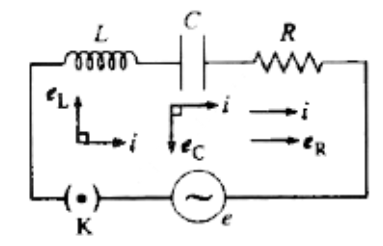
The following figure shows an inductor of inductance $L,$ capacitor of capacitance $C,$ a resistor of resistance $R,$ key $K$ and source $($power supply$)$ of alternating emf $(e)$ connected to form a dosed series circuit.
Image
LCR Series circuit
The inductor, capacitor, and resistor are assumed to be perfect. Because they are connected in series, they all carry the same current $i = i_0 \sin ωt$ at any given time.
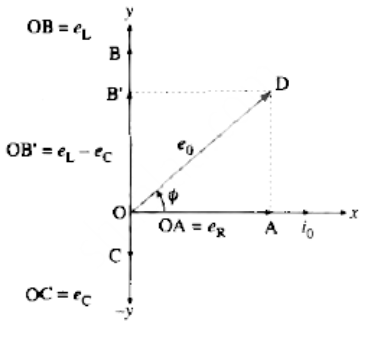
The current is in phase with the voltage across the resistor, $e_R = Ri.$ The voltage across the inductor, $e_L = X_Li,$ is $\pi /2 \ rad$ ahead of the current, while the voltage across the capacitor, $e_C=X_C i$, is $\pi / 2$ rad behind the current.
This is depicted in the phasor diagram below.

Image
From this figure, $e_0^2=e_R^2+\left(e_L-e_C\right)^2$
$=R^2 i_0^2+\left(X_I i_0-X_C i_0\right)^2=i_0^2\left[R^2+\left(X_L-X_C\right)^2\right]$
$\therefore e_0= i _0 \sqrt{ R ^2+\left( X _{ L }- X _{ C }\right)^2}= i _0 Z$, where $Z=\frac{e_0}{i_0}=\sqrt{R^2+\left(X_L-X_C\right)^2}$ is the effective resistance of the circuit. It is called the impedance.
View full question & answer
Question 73 Marks
Derive an expression for equation of stationary wave on a stretched string. Show that the distance between two successive nodes or antinodes is $\lambda / 2$.
Answer
When two progressive waves having the same amplitude, wavelength and speed propagate in opposite directions through the same region of a medium, their superposition under certain conditions creates a stationary interference pattern called a stationary wave.
Consider two simple harmonic progressive waves of equal amplitudes
$(a)$ and wavelength $(\lambda)$ propagating on a long uniform string in opposite directions $($remember $2 \pi / \lambda=k$ and $2 \pi n=\omega ).$
The equation of wave travelling along the $x-$axis in the positive direction is
$y _1=a \sin \left\{2 \pi\left(n t-\frac{x}{2}\right)\right\} ....(1)$
The equation of wave travelling along the $x-$axis in the negative direction is
$y _2=a \sin \left\{2 \pi\left(n t+\frac{x}{\lambda}\right)\right\} ....(2)$
When these waves interfere, the resultant displacement of particles of string is given by the principle of superposition of waves as
$y=y_1+y_2$
$y=a \sin \left\{2 \pi\left(n t-\frac{x}{\lambda}\right)\right\}+a \sin \left\{2 \pi\left(n t+\frac{x}{\lambda}\right)\right\}$
Using the trigonometrical identity,
​​​​​​​$\sin C+\sin D=2 \sin \left(\frac{C+D}{2}\right) \cos \left(\frac{C-D}{2}\right)$,
we get $y =2 a \sin (2 \pi n t) \cos \frac{2 \pi x}{\lambda}$
$y =2 a \cos \frac{2 \pi x}{\lambda} \sin (2 \pi n t)$ or,$ ....(3)$
Using $2 a \cos \frac{2 \pi x}{\lambda}= A$ in equation $3,$
we get $y=A \sin (2 \pi n t)$
As $\omega=2 \pi n$,
we get, $y=A \sin \omega t$.
View full question & answer
Question 83 Marks
What is an isothermal process? Obtain an expression for work done by a gas in an isothermal process.
Answer
A process in which change in pressure and volume takes place at a constant temperature is called an isothermal process or isothermal change. For such a system $\Delta T =0$. Isothermal process is a constant temperature process.
View full question & answer
Question 93 Marks
Define surface energy of the liquid. Obtain the relation between the surface energy and surface tension.
Answer
The surface molecules possess extra potential energy as compared to the molecules inside the liquid. The extra energy of the molecules in the surface layer is called the surface energy of the liquid.
View full question & answer
Question 103 Marks
Define the current gain $\alpha_{D C}$ and $\beta_{D C}$ for a transistor. Obtain the relation between them
Answer
The dc common-base current ratio or current gain $\left(\alpha_{d c}\right)$ is defined as the ratio of the collector current to emitter current.
$\alpha_{dc}=\frac{I_{C}}{I_{E}}$
View full question & answer
Question 113 Marks
Define photoelectric effect and Explain the experimental set-up of photoelectric effect.
Answer
The phenomenon of emission of electrons from a metal surface, when radiation of appropriate frequency is incident on it, is known as the photoelectric effect.
  1. Light Source: To emit photons of varying frequencies towards a metal surface.
  2. Metal Surface (Photocell): The target material from which electrons are ejected when hit by photons with sufficient energy.
  3. Vacuum Chamber: Houses the metal surface to prevent electrons from interacting with air molecules.
  4. Electrodes: A cathode (the metal surface) and an anode to collect emitted electrons.
  5. Variable Voltage Source: Adjusts the potential difference between the electrodes to measure the stopping potential, which is the voltage needed to stop electron flow.
  6. Ammeter: Measures the current generated by the photoelectrons, indicating the number of electrons emitted.
The light source illuminates the metal surface, causing electrons to be emitted if the photon energy exceeds the metal's work function. By varying the light frequency and applying voltage, the experiment explores the relationship between light frequency and electron kinetic energy, demonstrating the quantum nature of light.
View full question & answer
Question 123 Marks
A circular coil of wire is made up of $200$ turns, each of radius $10 \ cm$. If a current of $0.5A$ passes through it, what will be the Magnetic field at the centre of the coil?
Answer
Data: $N =200$ turns $R=10 \ cm=0.1 mI =0.5 A$
$\mu_0=4 \pi \times 10^{-7} T \ m / A$
$B=\frac{\mu_0 NI}{2 R}=\frac{\left(4 \pi \times 10^{-7}\right)(0.5)(200)}{2(0.1)}$
$B=2 \pi \times 10^{-5} T \approx 6.28 \times 10^{-5} T$
The magnetic field at the center of the coil is $6.28 \times 10^{-5} T$
View full question & answer