Question 15 Marks
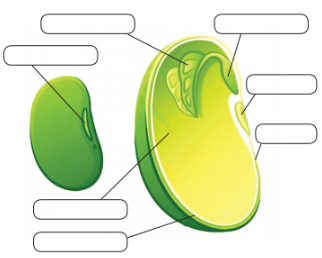
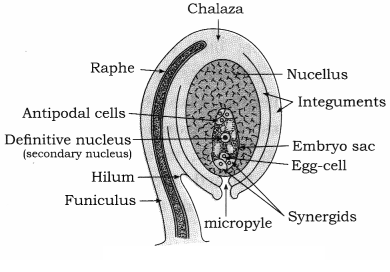
Label the parts of seed
42 questions · self-marked practice — reveal the answer and mark yourself.
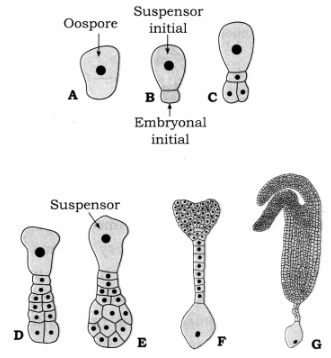
The oospore undergoes a transverse division to form a large basal cell towards the micropyle and a small apical or terminal cell towards the chalaza of the embryo sac. This two celled structure is called proembryo. The basal cell or suspensor initial undergoes repeated transverse divisions to form a multicellular structure called suspensor. The suspensor pushes the embryo towards the endosperm to draw its nutrition.
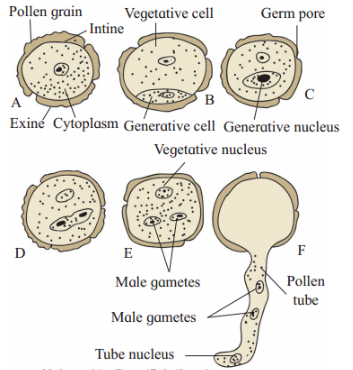
(2) During double fertilization, the pollen tube on reaching the ovule enters the embryo sac through micropyle and bursts in one of the synergids. Owing to this, the two male gametes contained in the pollen tube, are set free.
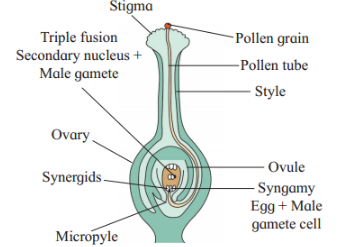
(3) Out of the two male gametes, one unites with the egg or female gamete and the other unites with the secondary nucleus of the embryo sac, forming a triploid or triple fusion nucleus, called the primary endosperm nucleus. The process involving the fusion of one of the male gametes with the egg nucleus, resulting in the formation of a diploid zygote is called syngamy.
(4) The reproductive process in which non-motile male nuclei are carried to the egg cell through a pollen tube is called siphonogamy.
(5) After fertilization, zygote develops into an embryo. Certain changes take place in the ovule leading to the development of a seed.
(i) Apomixis : The phenomenon of formation of embryo(s) by asexual methods without formation of gametes and fertilization is termed as apomixis.
(ii) There are three main categories of apomixis.
1. Recurrent apomixis : In this diploid sporophytic cell, archesporial cell or nucellus form embryos, When diploid megaspore mother cell forms embryo sac it is known as diplospory. It is also called apospory.
2. Non-recurrent apomixis : Haploid embryo sac is formed but the embryos arise either from egg cell or any other haploid cell. It is also known as apogamy.
3. Adventive Embryony : In this in addition to normal zygotic embryo, additional embryos develop from nucellus or integuments. It results in polyembryony.
There are three types of endosperm, viz., nuclear, cellular and helobial.
(i) Nuclear endosperm: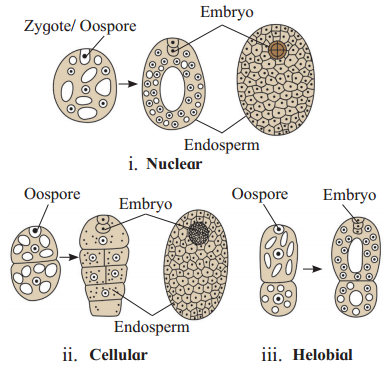
1.Nuclear endosperm is the most common type of endosperm.
2.During the formation of nuclear endosperm, the primary endosperm nucleus (PEN) undergoes free nuclear division forming a large number of triploid nuclei which remain freely suspended in the common cytoplasm of central cell.
3.A central vacuole pushes the nuclei towards periphery.
4.Later on wall formation takes place around these nuclei to form a cellular mass.
5.It is seen in plants like maize, sunflower, wheat, coconut, etc.
(ii) Cellular endosperm:
1.In this type of endosperm, the triploid primary endosperm nucleus undergoes nuclear divisions followed by cytokinesis.
2.Owing to this, the development of endosperm occurs in cellular form.
3.It is less common and seen in dicot plants like Datura, Petunia, Balsam, Adoxa.
(iii) Helobial endosperm:
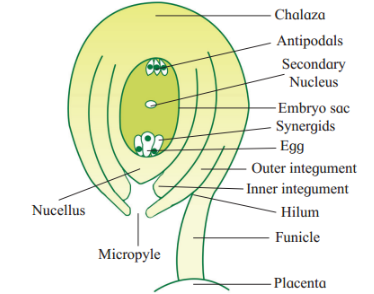
Describe the development of female gametophyte in angiosperms. ### What is megasporogenesis ? Give an account of development of the female gametophyte. ### With a neat diagram explain the 7-celled, 8-nucleate nature of the female gametophyte.
1. Megasporogenesis : The process by which . the diploid megaspore mother cell of nucellus undergoes meiosis to form a tetrad of haploid megaspores is known as megasporogenesis.
2. Development of female gametophyte:
(i) The diploid megaspore mother cell undergoes meiosis to form a linear tetrad consisting of four-haploid megaspores. Generally, the chalazal megaspore becomes the functional megaspore. The other three megaspores degenerate.
(ii) The chalazal megaspore (fertile megaspore) is the first cell of the female gametophyte. It undergoes enlargement and develops into the female gametophyte. The haploid nucellus of chalazal megaspore undergoes three successive free nuclear mitotic divisions to produce eight nuclei. Of these, the first mitotic division results in the formation of two nuclei.
(iii) Both these nuclei undergo two successive mitotic divisions resulting in the formation of four nuclei at both the poles. In the meantime, one nucleus from each pole called polar nucleus moves towards the centre of the embryo sac and fuse to form a diploid nucleus called secondary nucleus.
(iv) The three nuclei at the micropylar end are organised to form a three-celled structure called egg apparatus, while the other three nuclei at the chalazal end reorganise to form three antipodal cells. The egg apparatus consists of a central cell called egg cell or female gamete which is flanked by two lateral cells called synergids.
(v) The female gametophyte consists of an egg apparatus, a secondary nucleus and three antipodal cells, A7 celled 8 nucleated structure.
1.A typical angiospermic pollen grain (mature) is a unicellular, uninucleate, spherical or oval haploid structure.
2.The pollen grain is also called microspore.
3.It is covered and protected by a double layered wall called sporoderm.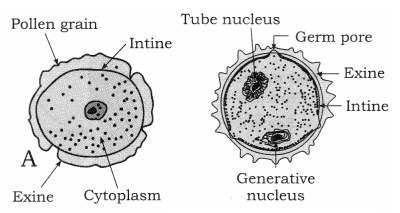 "
"
1.The outer layer of the wall is thick. It is known as exine. The inner layer of the wall is thin. It is known as intine.
2.The exine is made up of a complex substance called sporopollenin. The sporopollenin protects the pollen grain from physical and biological decomposition.
3.The exine is spiny in insect pollinated plants, with sculptured pattern or smooth in wind pollinated plants.
4.The exine is not continuous throughout. It is interrupted, very thin at one or more places by small pores called germ pores.
5.The intine which is composed of cellulose and pectin encloses the protoplasm with a single haploid nucleus.
| Hypohydrophily | Epihydrophily |
| 1. Porogamy | ______________________________ |
| 2. __________ | Entry of pollen tube in Ovule piercing integuments |
| 3. __________ | Entry of pollen tube in Ovule through Chalaza |
| Hypohydrophily | Epihydrophily |
| 1. Porogamy | Entry of pollen tube into Ovule through micropyle |
| 2. Mesogamy | Entry of pollen tube in Ovule piercing integuments |
| 3. Chalazogamy | Entry of pollen tube in Ovule through Chalaza |
| Type | Description | Example |
| 1. ____________________ | Unisexual flowers/Monoecious or dioecious plants | Papaya, Maize |
| 2.____________________ | Mechanical device to prevent Self-Pollination - Natural physical barrier | ________ |
| 3. Prepotency | _____________________________ | Apple |
| 4. Heteromorphy | _____________________________ | Primula |
| 5. Protandry | Androecium matures earlier than gynoecium | ________ |
| Type | Description | Example |
| 1. Unisexuality | Unisexual flowers/Monoecious or dioecious plants | Papaya, Maize |
| 2. Herkogamy | Mechanical device to prevent Self-Pollination Natural physical barrier | Calotropis |
| 3. Prepotency | Pollens of other flower germinate rapidly rather than from same | Apple |
| 4.Heteromorphy | Presence of different forms of flowers with respect to Stigma and anthers | Primula |
| 5. Protandry | Androecium matures earlier than gynoecium | Sunflower disc florets |
Type of Pollination | Agent | Kind of flowers | Example |
1. Anemophily | ______ | Small, colourless, without nectar | Maize |
2.__________ | Bats | __________________________ | Adansonia |
3. Entomophily | ______ | Large, showy, sweet smell with nectar | _______ |
4.__________ | Birds | Brightly coloured, large, showy, with dilute nectar | _______ |
| Type of Pollination | Agent | Kind of flowers | Example |
| 1. Anemophily | wind | Small, colourless, without nectar | Maize |
| 2. Chiropterophily | Bats | Dull coloured, with strong Fragrance, abundant Nectar | Adansonia |
| 3. Entomophily | Insect | Large, showy, sweet smell with nectar | Rose/Jasmine |
| 4. Ornithophily | Birds | Brightly coloured, large, showy, with dilute nectar | Bombax/Butea |
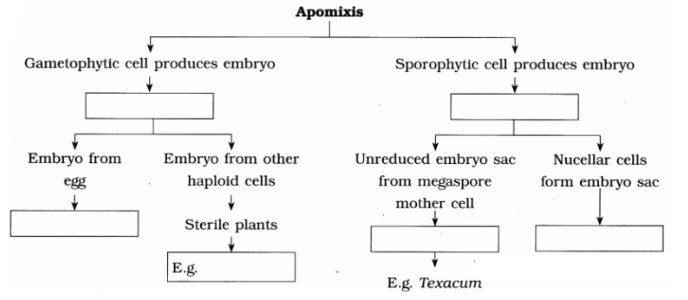

(i) Apomixis : The phenomenon of formation of embryo(s) by asexual methods without formation of gametes and fertilization is termed as apomixis.
(ii) There are three main categories of apomixis.
1. Recurrent apomixis : In this diploid sporophytic cell, archesporial cell or nucellus form embryos, When diploid megaspore mother cell forms embryo sac it is known as diplospory. It is also called apospory.
2. Non-recurrent apomixis : Haploid embryo sac is formed but the embryos arise either from egg cell or any other haploid cell. It is also known as apogamy.
3. Adventive Embryony : In this in addition to normal zygotic embryo, additional embryos develop from nucellus or integuments. It results in polyembryony.
Describe the development of female gametophyte in angiosperms.
OR
What is megasporogenesis ? Give an account of development of the female gametophyte.
OR
With a neat diagram explain the 7-celled, 8-nucleate nature of the female gametophyte.
1. Megasporogenesis : The process by which . the diploid megaspore mother cell of nucellus undergoes meiosis to form a tetrad of haploid megaspores is known as megasporogenesis.
2. Development of female gametophyte:
(i) The diploid megaspore mother cell undergoes meiosis to form a linear tetrad consisting of four-haploid megaspores. Generally, the chalazal megaspore becomes the functional megaspore. The other three megaspores degenerate.
(ii) The chalazal megaspore (fertile megaspore) is the first cell of the female gametophyte. It undergoes enlargement and develops into the female gametophyte. The haploid nucellus of chalazal megaspore undergoes three successive free nuclear mitotic divisions to produce eight nuclei. Of these, the first mitotic division results in the formation of two nuclei.
(iii) Both these nuclei undergo two successive mitotic divisions resulting in the formation of four nuclei at both the poles. In the meantime, one nucleus from each pole called polar nucleus moves towards the centre of the embryo sac and fuse to form a diploid nucleus called secondary nucleus.
(iv) The three nuclei at the micropylar end are organised to form a three-celled structure called egg apparatus, while the other three nuclei at the chalazal end reorganise to form three antipodal cells. The egg apparatus consists of a central cell called egg cell or female gamete which is flanked by two lateral cells called synergids.
(v) The female gametophyte consists of an egg apparatus, a secondary nucleus and three antipodal cells, A7 celled 8 nucleated structure.
Describe the structure of a mature pollen grain.
OR
Sketch and label pollen grain.
| Asexual Reproduction | Sexual Reproduction |
| 1. Fusion of sex cells or two compatible gametes is not involved. | 1. Fusion of sex cells or two compatible gametes is involved. |
| 2. It results in production of genetically identical progeny. | 2. It results in production of genetically dissimilar offspring. |
| 3. Offspring inherit genes of the parent. | 3. Offspring have combination genes from both the parents through their gametes. |
| 4. Variations are not observed in progeny. | 4. Variations due to recombination are observed which are useful for survival and evolution of species. |
Autogamy (Self-pollination) | Xenogamy (Cross pollination) |
1. In self-pollination, bisexual flower is pollinated by its own pollen grains. | 1. In cross pollination the pollen grains from the anther are carried to the stigma of another flower of same species. |
2. Self-pollination does not depend upon external agents for pollination. | 2. Cross pollination does depend upon external agents for pollination. |
3. Self-pollination is economical as there is no wastage of pollen grains. | 3. Cross pollination is not economical as there is wastage of pollen grains during transfer. |
4. Offspring are genetically similar to their parents; E.g. Pea | 4. Offspring are genetically varied due to recombination. E.g. Food and fibre crops – Maize, Rice. |
Hypohydrophily | Epihydrophily |
1. Pollination takes place below the surface of water. | 1. Pollination takes place on the surface of water. |
2. Pollen grains are heavier and they sink in water. | 2. Pollen grains float on the water surface. |
3. Pollens are long, ribbon like without exine. | 3. Pollens have specific gravity equal to water. |
4. E.g. Zostera (sea grass) | 4. E.g. Vallisneria |