Question 13 Marks
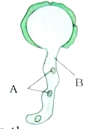
Name the figure given below. Identify label A and B. Explain its developemt.
Answer
View full question & answer→coming soon…
8 questions · self-marked practice — reveal the answer and mark yourself.
| Sr. No. | Anemophily | Entomophily |
| 1. | Wind pollinated flowers. | Insect-pollinated flowers. |
| 2. | The size of the flowers is small. | The size of the flowers is large or present in groups to show a conspicuous appearance. |
| 3. | Not brightly coloured. | Brightly coloured. |
| 4. | Odourless. | Usually, odour/fragrance is present. |
| 5. | Nectar is not produced. | Nectar or edible pollen is usually present. |
| 6. | The number of pollen grains produced in large quantities. | The number of pollen grains is less. |
| 7. | Stigma is branched or hairy. | Stigma is usually unbranched and sticky. |
| 8. | Pollination is non-directional. | Pollination is directional and highly specific. |
| 9. | Pollen grains are light and smooth. | Pollen grains are heavier and sticky. |
| 10. | e.g. grass, maize, etc. | e.g. jasmine, rose, etc. |