MCQ 11 Mark
Which element from following forms a chlorophyll complex?
MCQ 21 Mark
Identify the type of hybridization involved in hexaamminecobalt (III) complex ion?
- A
$sp ^3$
- ✓
$d^2 s p^3$
- C
$s p^3 d^2$
- D
$d s p^2$
AnswerCorrect option: B. $d^2 s p^3$
View full question & answer→MCQ 31 Mark
What is the number of unpaired electrons in $\left[ Co \left( NH _3\right)_6\right]^{3+}$ complex?
View full question & answer→MCQ 41 Mark
What is the oxidation state of cobalt in a complex $\left[ Co \left( NH _3\right)_6\right]^{3+}$ ?
- A
$6^{+}$
- B
$2^{+}$
- ✓
$3^{+}$
- D
$4^{+}$
AnswerCorrect option: C. $3^{+}$
View full question & answer→MCQ 51 Mark
Which following pair of structure and magnetic properties is correct for tetracyanonickalate (II) ion?
- A
Square planar, paramagnetic
- ✓
Square planar, diamagnetic
- C
Tetrahedral, paramagnetic
- D
AnswerCorrect option: B. Square planar, diamagnetic
View full question & answer→MCQ 61 Mark
What type of geometry and magnetic nature is present in a complex $\left[ NiCl _4\right]^{2-}$ ?
- ✓
Tetrahedral, Paramagnetic
- B
Square planar, diamagnetic
- C
- D
Square planar, Paramagnetic
AnswerCorrect option: A. Tetrahedral, Paramagnetic
View full question & answer→MCQ 71 Mark
How many unpaired electrons are present in cobalt ion in +3 oxidation state prior to hybridization in $\left[ CoF _6\right]^{3+}$ complex ion ?
View full question & answer→MCQ 81 Mark
Identify a formula of coordinate complex Bis(ethylenediamine ) dithiocyanatoplatinum ( IV).
- ✓
$\left[ Pt ( en )_2( SCN )_2\right]^{2+}$
- B
$\left[ Pt _4\left( NH _3\right)_2( NCS )_2\right]$
- C
$\left[ Pt \left( NH _3\right)_4\left( S _2 CN \right)\right]^{2+}$
- D
$\left[ Pt ( en )_2( NCS )_2\right]^{4+}$
AnswerCorrect option: A. $\left[ Pt ( en )_2( SCN )_2\right]^{2+}$
View full question & answer→MCQ 91 Mark
Ideatify the number of unpaired electrons present and the geometry respectively of a complex $\left[ COF _6\right]^{3-}$ ( given atomic number $CO _0=27$ )
View full question & answer→MCQ 101 Mark
Identify the type of isomerism exhibited by complex compounds. $\left[ Cr \left( H _2 O \right)_6\right] Cl _3$ and $\left[ Cr \left( H _2 O \right)_5 Cl _2 Cl _2 H _2 O \right.$
View full question & answer→MCQ 111 Mark
Identify the formula of Bis (ethylenediamine) dithiocynatoplatinum (iv).
- ✓
$\left[ Pt ( en )_2( SCN )_2\right]^{2+}$
- B
$Pt \left[( en )_2 S _2 CN \right]^{4-}$
- C
$Pt \left[( en )_2 S _2 CN \right]^{4+}$
- D
$\left[ Pt ( en )( SCN )_2\right]^{4-}$
AnswerCorrect option: A. $\left[ Pt ( en )_2( SCN )_2\right]^{2+}$
View full question & answer→MCQ 121 Mark
Which among the following complexes does NOT exhibit different geometrical isomers? ( $M=$ metal ion and $A, B, C=$ ligands)
- A
$\left[ MA _4 B _2\right]$
- ✓
$\left[ MA _6\right]$
- C
$\left[ M ( AA )_2 B _2\right]$
- D
$\left[ MA _4 BC \right]$
AnswerCorrect option: B. $\left[ MA _6\right]$
View full question & answer→MCQ 131 Mark
Identify cationic complex from following.
- A
Triamminetrinitrocobalt (III)
- ✓
Pentaamminechlorocobalt (II) sulphate
- C
Tetracyanonickelate (II) ion
- D
Trioxalatocobaltate (III) ion
AnswerCorrect option: B. Pentaamminechlorocobalt (II) sulphate
View full question & answer→MCQ 141 Mark
What is the number of unpaired electrons of nickel observed in $\left[ Ni ( CN )_4\right]^{2-}$ ?
View full question & answer→MCQ 151 Mark
Which among the following cations forms a least stable complex if the ligand is same?
- A
$Co ^{2+}$
- ✓
$Cd ^{2+}$
- C
$Ni ^{2+}$
- D
$Fe ^{2+}$
AnswerCorrect option: B. $Cd ^{2+}$
View full question & answer→MCQ 161 Mark
What type of isomerism is exhibited by $\left[ Co \left( NH _3\right)_6\right]\left[ Cr ( CN )_6\right] \text { and }\left[ Cr \left( NH _3\right)_6\right]\left[ Co ( CN )_6\right] \text { ? }$
View full question & answer→MCQ 171 Mark
Which among the following cations forms a most stable complex with the same ligand?
- ✓
$Co ^{2+}$
- B
$Fe ^{2+}$
- C
$Mn ^{2+}$
- D
$Cd ^{2+}$
AnswerCorrect option: A. $Co ^{2+}$
View full question & answer→MCQ 181 Mark
Identify the geometry of complex formed when cobalt chloride is dissolved water.
MCQ 191 Mark
What is the number of unpaired electrons present in d orbitals of $\operatorname{Cr}(Z=24)$ to have extra stability?
View full question & answer→MCQ 201 Mark
Identify a ligand with single donor atom from following.
AnswerCorrect option: A. $OH ^{-}$
View full question & answer→MCQ 211 Mark
How many hybrid orbitals of cobalt ion are involved in formation of hexaammine cobalt (III) chloride complex?
MCQ 221 Mark
The sum of coordination number and oxidation number of M in $\left[ M ( en )_2 C _2 O _4\right] Cl$ is
View full question & answer→MCQ 231 Mark
When an excess of AgNO3 is added to the complex one mole of AgCl is precipitated. The formula of the complex is ……………..
- ✓
${\left[ CoCl 2\left( NH _3\right)_4\right] Cl }$
- B
${\left[ CoCl \left( NH _3\right)_4\right] Cl _2}$
- C
${\left[ CoCl _3\left( NH _3\right)_3\right]}$
- D
${\left[ Co \left( NH _3\right)_4\right] Cl _3}$
AnswerCorrect option: A. ${\left[ CoCl 2\left( NH _3\right)_4\right] Cl }$
${\left[ CoCl 2\left( NH _3\right)_4\right] Cl }$
View full question & answer→MCQ 241 Mark
On the basis of CFT predict the number of unpaired electrons in $\left[ CrF _6\right]^{3 \oplus}$.
View full question & answer→MCQ 251 Mark
Which of the following complexes are chiral?
1. $\left[ Co ( en )_2 Cl _2\right]^{\oplus}$
2. $\left[ Pt ( en ) Cl _2\right]$
3. $\left[ Cr \left( C _2 O _4\right)_3\right]^{3 \oplus}$
4. $\left[ Co \left( NH _3\right) 4 Cl _2\right]^{\oplus}$
View full question & answer→MCQ 261 Mark
Which of the following complexes exist as cis and trans isomers?
1. $\left[ Cr \left( NH _2\right)_2 Cl _4\right]^{\oplus}$
2. $\left[ Co \left( NH _3\right)_5 Br \right]^{2 \oplus}$
3. $\left[ PtCl _2 Br _2\right]^{2 \oplus}$ (square planar)
4. $\left[ FeCl _2\left( NCS _2\right]^{2 \oplus}\right.$ (tetrahedral)
View full question & answer→MCQ 271 Mark
Formula for the compound sodium hexacynoferrate (III) is
- A
$\left[ NaFe ( CN )_6\right]$
- B
$Na _2\left[ Fe ( CN )_6\right]$
- C
$Na \left[ Fe ( CN )_6\right]$
- ✓
$Na _3\left[ Fe ( CN )_6\right]$
AnswerCorrect option: D. $Na _3\left[ Fe ( CN )_6\right]$
$Na _3\left[ Fe ( CN )_6\right]$
View full question & answer→MCQ 281 Mark
IUPAC name of the complex $\left[ Pt ( en )_2( SCN )_2\right]^{2+}$ is ..........
- ✓
bis (ethylenediamine dithiocyanatoplatinum (IV) ion
- B
bis (ethylenediamine) dithiocyantoplatinate (IV) ion
- C
dicyanatobis (ethylenediamine) platinate IV ion
- D
bis (ethylenediammine)dithiocynato platinate (IV) ion
AnswerCorrect option: A. bis (ethylenediamine dithiocyanatoplatinum (IV) ion
bis(ethylenediamine dithiocyanatoplatinum (IV) ion
View full question & answer→MCQ 291 Mark
The oxidation state of cobalt ion in the complex $\left[ Co \left( NH _3\right)_5 Br \right] SO _4$ is.............
View full question & answer→MCQ 301 Mark
Identify monodentate ligand from following.
- ✓
- B
- C
- D
Ethylenediaminetetraacetate
Answer(a) : $CN ^{-}$(cyanide ion) is monodentate ligand.
View full question & answer→MCQ 311 Mark
Identify number of moles of donor atoms in $2 n$ mole of $SCN^-$ ?
Answer(c) : $SCN ^{-}$is an ambidentate ligand with two donor atoms $N$ and $S .2 n$ moles of $SCN ^{-}$will have $4 n$ moles of donor atoms.
View full question & answer→MCQ 321 Mark
Identify neutral ligand from following.
Answer(a) : Ammine $\left( NH _3\right)$ is a neutral ligand.
Cyano, nitrato and chloro are negatively charged ligands.
View full question & answer→MCQ 331 Mark
Identify anionic sphere complex from following.
- A
Hexaamminecobalt(III) chloride
- ✓
Potassium hexacyanoferrate(II)
- C
Tetraamminedichlorocobalt(III) ion
- D
Pentaamminechlorocobalt(III) sulphate
AnswerCorrect option: B. Potassium hexacyanoferrate(II)
(b): The complex ion in anionic sphere complex carries a negative charge.
$
K _4\left[ Fe ( CN )_6\right] \rightleftharpoons 4 K ^{+}+\left[ Fe ( CN )_6\right]^{4-}
$
View full question & answer→MCQ 341 Mark
Which coordination complex from following contains neutral ligand?
- ✓
- B
Trioxalatocobaltate(III) ion
- C
Sodium hexanitrocobaltate(III)
- D
Tetracyanonickelate(II) ion
Answer(a) : Carbonyl is a neutral ligand.
View full question & answer→MCQ 351 Mark
What is coordination number of central metal ion in $\left[ Fe \left( C _2 O _4\right)_3\right]^{3-}$ ?
Answer(d) : In $\left[ Fe \left( C _2 O _4\right)_3\right]^{3-}, Fe$ is coordinated to three oxalate ligands which are didentate in nature.
View full question & answer→MCQ 361 Mark
Which from following formulae is of sodium hexanitrocobaltate(III)?
- A
$Na _3\left[ Co \left( NO _2\right)_6\right]$
- B
$Na _2\left[ Co \left( NO _2\right)_6\right]$
- C
$\left[ Co \left( NaNO _2\right)_6\right]$
- D
Answer(a): $\mathrm{Na}_x\left[\mathrm{Co}\left(\mathrm{NO}_2\right)_6\right]$
No. of $\mathrm{Na}: x(+1)+3+6(-1)=0$
$x+3-6=0$ or $x=3$
$\therefore \quad \mathrm{Na}_3\left[\mathrm{Co}\left(\mathrm{NO}_2\right)_6\right]$ is the correct formula.
View full question & answer→MCQ 371 Mark
Identify a formula of coordinate complex Bis(ethylenediamine)dithiocyanatoplatinum(IV).
Answer(c) : The formula of the complex
bis(ethylenediamine)dithiocyanatoplatinum(IV) is
$
\left[ Pt ( en )_2( SCN )_2\right]^{2+} \text {. }
$
View full question & answer→MCQ 381 Mark
Identify the use of EDTA from following.
- ✓
treatment of lead poisoning
- B
electroplating of noble metals
- C
- D
transmission of nerve signals.
AnswerCorrect option: A. treatment of lead poisoning
(a): The complex of calcium with EDTA is used for the treatment of lead poisoning.
View full question & answer→MCQ 391 Mark
What is the number of unpaired electrons of nickel observed in $\left[ Ni ( CN )_4\right]^{2-}$ ?
Answer(a) :
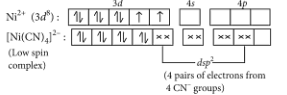
Hence the number of unpaired electrons in $Ni$ in $\left[ Ni ( CN )_4\right]^{2-}$ is zero. View full question & answer→MCQ 401 Mark
Which among the following cations forms a least stable complex if the ligand is same?
- A
$Fe ^{2+}$
- B
$Ni ^{2+}$
- ✓
$Cd ^{2+}$
- D
$Co ^{2+}$
AnswerCorrect option: C. $Cd ^{2+}$
(c) : For a given ligand, the stability of complexes of metallic ions having the same charge on them decreases with the increase of the size of the central metal ions.
View full question & answer→MCQ 411 Mark
Identify the type of isomerism exhibited by complex compounds $\left[\mathrm{Cr}\left(\mathrm{H}_2 \mathrm{O}\right)_6\right] \mathrm{Cl}_3$ and $\left[\mathrm{Cr}\left(\mathrm{H}_2 \mathrm{O}\right)_5 \mathrm{Cl}^2 \mathrm{Cl}_2 \mathrm{H}_2 \mathrm{O}\right.$.
Answer(b): This is an example of solvate isomerism. Solvate isomers differ by whether or not a solvent molecule is directly bonded to the metal ion or mainly present as free solvent molecules in the crystal lattice.
View full question & answer→MCQ 421 Mark
Identify the formula of bis (ethylenediamine) dithiocyanatoplatinum(IV).
- A
$Pt \left[( cm )_2 S _2 CN \right]^{4-}$
- B
$Pt \left[(e n)_2 S _2 CN \right]^{4+}$
- C
$\left[ Pt (e n)( SCN )_2\right]^{4-}$
- ✓
$\left[ Pt ( en )_2( SCN )_2\right]^{2+}$
AnswerCorrect option: D. $\left[ Pt ( en )_2( SCN )_2\right]^{2+}$
(d) : $\left[ Pt ( en )_2( SCN )_2\right]^{2+}$
bis(ethylenediamine)dithiocyanatoplatinum(IV)
View full question & answer→MCQ 431 Mark
The IUPAC name for $\left[( CO )_5 Mn - Mn ( CO )_5\right]$ is
- A
- B
bis(pentacarbonyl dimanganese)
- ✓
- D
Answer(c) : $\left[( CO )_5 Mn - Mn ( CO )_5\right]$ : $B i s($ pentacarbonyl manganese)
View full question & answer→MCQ 441 Mark
Match the column $1$ with column $II$ and select the correct option.
| Column $I ($Pair of isomers$)$ |
Column $II($Type of isomerism$)$ |
| $(p)$ |
$\left.\begin{array}{l}\text { (I) }\left[\mathrm{Co}\left(\mathrm{NH}_3\right)_6\right]\left[\mathrm{Cr}(\mathrm{CN})_6\right] \\ \text {(II) }\left[\mathrm{Cr}\left(\mathrm{NH}_3\right)_6\right]\left[\mathrm{Co}(\mathrm{CN})_6\right]\end{array}\right\}$ |
$1.$ |
Ionisation |
| $(q)$ |
$\left.\begin{array}{l}\text { (III) }\left[\mathrm{PtCl}_2\left(\mathrm{NH}_3\right)_4\right] \mathrm{Br}_2 \\ \text { (IV) }\left[\mathrm{PtBr}_2\left(\mathrm{NH}_3\right)_4\right] \mathrm{Cl}_2\end{array}\right\}$ |
$2.$ |
Hydrate |
| $(r)$ |
$\left.\begin{array}{l}\text { (V) }\left[\mathrm{Co}(\mathrm{SCN})\left(\mathrm{NH}_3\right)_5\right] \mathrm{Cl}_2 \\ \text {(VI) }\left[\mathrm{Co}(\mathrm{NCS})\left(\mathrm{NH}_3\right)_5\right] \mathrm{Cl}_2\end{array}\right\}$ |
$3.$ |
Coordination |
| $(s)$ |
$\left.\begin{array}{l}(\mathrm{VII})\left[\mathrm{Cr}\left(\mathrm{H}_2 \mathrm{O}\right)_6\right] \mathrm{Cl}_3 \\ (\mathrm{VIII})\left[\mathrm{CrCl}_2\left(\mathrm{H}_2 \mathrm{O}\right)_4\right] \mathrm{Cl} \cdot 2 \mathrm{H}_2 \mathrm{O}\end{array}\right\}$ |
$4.$ |
Geometrical |
| |
|
$5.$ |
Linkage |
- A
$p -4, q -1, r -5, s -2$
- B
$p-1, q-3, r-2,s-5$
- ✓
$p-3, q-1,r-5, s-2$
- D
$p-1, q-3, r-5, s-2$
AnswerCorrect option: C. $p-3, q-1,r-5, s-2$
Compounds $\ce{(I)}$ and $\ce{(II)}$ both contain complex cation and anion, so they show coordination isomerism.
Compounds $\ce{(III)}$ and $\ce{(IV)}$ are obtained by the interchange of groups outside the coordination sphere and the ligands within the coordination sphere.
Therefore, they give different ions in the solution.
Hence, they show ionisation isomerism.
Compounds $\ce{(V)}$ and $\ce{(VI)}$ are linkage isomers, because the ambidentate ligand, $\mathrm{SCN}^{-}$has two donor atoms,
i.e., it has two possibilities of attachment $(-\ce{SCN}$ and $-\mathrm{NCS} )$ with the central metal.
Hence, they show linkage isomerism.
Compounds $\ce{(VII)}$ and $\ce{(VIII)}$ are obtained by the replacement of a coordinated group such as $\mathrm{Cl}^{-}$ by water of hydration.
Hence, they show hydrate isomerism.
View full question & answer→MCQ 451 Mark
Which among the following is used in the treatment of cancer?
- A
$\operatorname{cis}-\left[ Pt (e n)_2 Cl _2\right]$
- ✓
cis- $\left[ PtCl _2\left( NH _3\right)_2\right]$
- C
trans- $\left[ Pt ( em )_2 Cl _2\right]$
- D
trans- $\left[ P \left( NH _3\right)_2 Cl _2\right]$
AnswerCorrect option: B. cis- $\left[ PtCl _2\left( NH _3\right)_2\right]$
(b) : The platinum complex cis- $\left[ Pt \left( NH _3\right)_2 Cl _2\right]$, known as cis-platin, is useful in the treatment of cancer.
View full question & answer→MCQ 461 Mark
Which complex among the following gives a white precipitate on treatment with an aqueous solution of barium chloride?
- A
$\left[ Pt \left( NH _3\right)_4 Br _2\right] Cl _2$
- B
$\left[ Co \left( NH _3\right)_5 SO _4\right] NO _2$
- C
$\left[ Co \left( NH _3\right)_5 NO _2\right] SO _4$
- D
$\left.Pt \left( NH _3\right)_4 Cl _2\right] Br _2$
Answer(c):
$
\begin{aligned}
& {\left[\mathrm{Co}\left(\mathrm{NH}_3\right)_5 \mathrm{NO}_2\right] \mathrm{SO}_4+\mathrm{BaCl}_2 \rightarrow} \\
& {\left[\mathrm{Co}\left(\mathrm{NH}_3\right)_5 \mathrm{NO}_2\right] \mathrm{Cl}_2+\mathrm{BaSO}_4}
\end{aligned}
$
White ppt.
View full question & answer→MCQ 471 Mark
Which among the following is a neutral complex?
- A
$\left[ Fe \left( H _2 O \right)_6\right] Cl _3$
- B
$\left[ Ni \left( NH _3\right)_6\right] Cl _2$
- ✓
$\left[ Pt \left( NH _3\right)_2 Cl _2\right]$
- D
$K \left[ Ag ( CN )_2\right]$
AnswerCorrect option: C. $\left[ Pt \left( NH _3\right)_2 Cl _2\right]$
(c) $\left[ Pt \left( NH _3\right)_2 Cl _2\right]$
View full question & answer→MCQ 481 Mark
According to Werner's theory, the geometry of the comples is determined by
- A
only from the primary valence in space
- B
number and position of the primary valencies in space
- ✓
number and position of the secondary valencies in space
- D
only from the position of secondary valence in space.
AnswerCorrect option: C. number and position of the secondary valencies in space
(c): The ligands satisfying secondary valencies are always directed towards fixed positions in space thereby giving a definite geometry to the complex but the primary valencies are non-directional.
View full question & answer→MCQ 491 Mark
What is the number of donor atoms in dimethylglyoximato ligand?
Answer(b) :
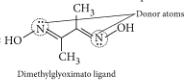
View full question & answer→MCQ 501 Mark
The correct charge on and co$-$ordination number of $'Fe\ '$ in $\mathrm{K}_3\left[\mathrm{Fe}(\mathrm{CN})_6\right]$ is
- A
$+2,4$
- ✓
$+3,6$
- C
$+2,6$
- D
$+3,3$
AnswerCorrect option: B. $+3,6$
$(b) :$ Let oxidation state of $Fe$ in $\ce{K_3\left[Fe(CN)_6\right]}$ be $x$.
$x+6 \times(-1)=-3$
$x=-3+6=+3$
Co$-$ordination number of $Fe$ in this complex is $6.$
View full question & answer→MCQ 511 Mark
Which of following coordinate complexes is an exception to EAN rule?(Given At. $\mathrm{No} . \mathrm{Pt}=78, \mathrm{Fe}=26, \mathrm{Zn}=30, \mathrm{Cu}=29$ )
Answer(d) : EAN = Atomic number of central atom $+ No$ of electrons donated by ligands - Oxidation state of central atom
(a) $\left[ Pt \left( NH _3\right)_6\right]^{4+} ; EAN =78+2 \times 6-4=86$
(b) $\left[ Fe ( CN )_6\right]^{4-} ; EAN =26+1 \times 6+4=36$
(c) $\left[ Zn \left( NH _3\right)_4\right]^{2+} ; EAN =30+2 \times 4-2=36$
(d) $\left[ Cu \left( NH _3\right)_4\right]^{2+} ; EAN =29+2 \times 4-2=35$
View full question & answer→MCQ 521 Mark
Which of the following is a neutral complex?
Answer(a) : A complex carrying no net charge is called a neutral complex. $\left[ Pt \left( NH _3\right)_2 Cl _2\right]$ is a neutral complex. $\left[ Co \left( NH _3\right)_6\right] Cl _3$ and $\left[ Ni \left( NH _3\right)_6\right] Cl _2$ are cationic complexes while $K _4\left[ Fe ( CN )_6\right]$ is an anionic complex.
View full question & answer→MCQ 531 Mark
The molecular formula of Wilkinson catalyst, used in hydrogenation of alkenes is
Answer(b) : Rhodium complex, $\left[\left( Ph _3 P \right)_3 RhCl \right]$, Wilkinson catalyst, is used for the hydrogenation of alkenes.
View full question & answer→MCQ 541 Mark
$\left[\mathrm{Cr}\left(\mathrm{NH}_3\right)_6\right]\left[\mathrm{Cr}(\mathrm{SCN})_6\right] \quad$ and $\quad\left[\mathrm{Cr}\left(\mathrm{NH}_3\right)_2(\mathrm{SCN})_4\right]$ $\left[\mathrm{Cr}\left(\mathrm{NH}_3\right)_4(\mathrm{SCN})_2\right]$ are the examples of what type of isomerism?
Answer(c) : Coordination isomerism is shown by compounds in which both cations as well as anions are complexes and ligands interchange their positions between two complex ions.
View full question & answer→MCQ 551 Mark
The correct IUPAC name of $\left[\mathrm{Co}\left(\mathrm{NH}_3\right)_3\left(\mathrm{NO}_2\right)_3\right]$ is
- ✓
- B
triamminetrinitrito-N-cobalt(II)
- C
triamminecobalt(III) nitrite
- D
triamminetrinitrito-N-cobaltate(III).
View full question & answer→MCQ 561 Mark
Select the diamagetic complex ion amongst the followig complexes. (Atomic no. $Fe =26, Co =27$ )
- A
$\mathrm{K}_3\left[\mathrm{Fe}(\mathrm{CN})_6\right]$
- ✓
$\left[\mathrm{Co}\left(\mathrm{NH}_3\right)_6\right] \mathrm{Cl}_3$
- C
$\mathrm{K}_3\left[\mathrm{FeF}_6\right]$
- D
$\mathrm{K}_3\left[\mathrm{CoF}_6\right]$
AnswerCorrect option: B. $\left[\mathrm{Co}\left(\mathrm{NH}_3\right)_6\right] \mathrm{Cl}_3$
View full question & answer→MCQ 571 Mark
Which of the following complexes has lowest molar conductance?
Answer(a) :
| Mol. formula | Moles of $Agcl$ percipitated | Total no. of ions | Structural formula |
| $\mathrm{CoCl}_3 \cdot 3 \mathrm{NH}_3$ | 0 | - | $\left[\mathrm{Co}\left(\mathrm{NH}_3\right)_3 \mathrm{Cl}_3\right]$ |
| $\mathrm{CoCl}_3 \cdot 4 \mathrm{NH}_3$ | 1 | 2 | $\left[\mathrm{Co}\left(\mathrm{NH}_3\right)_4 \mathrm{Cl}_2\right] \mathrm{Cl}$ |
| $\mathrm{CoCl}_3 \cdot 5 \mathrm{NH}_3$ | 2 | 3 | $\left[\mathrm{Co}\left(\mathrm{NH}_3\right)_5 \mathrm{Cl}\right] \mathrm{Cl}_2$ |
| $\mathrm{CoCl}_3 \cdot 6 \mathrm{NH}_3$ | 3 | 4 | $\left[\mathrm{Co}\left(\mathrm{NH}_3\right)_6\right] \mathrm{Cl}_3$ |
View full question & answer→MCQ 581 Mark
Cisplatin compound is used in the treatment of
MCQ 591 Mark
What is effective atomic number of $Fe ( z =26)$ in $\left[ Fe ( CN )_6\right]^{4-}$ ?
View full question & answer→MCQ 601 Mark
Which of the following complexes will give a white precipitate on treatment with a solution of barium nitrate?
- A
$\left[ Cr \left( NH _3\right)_4 SO _4\right] Cl$
- B
$\left[ CO \left( NH _3\right)_4 Cl _2\right] NO _2$
- ✓
$\left[ Cr \left( NH _3\right)_4 Cl _2\right] SO _4$
- D
$\left[ CrCl _3\left( H _2 O \right)_4\right] Cl$
AnswerCorrect option: C. $\left[ Cr \left( NH _3\right)_4 Cl _2\right] SO _4$
$\left[ Cr \left( NH _3\right)_4 Cl _2\right] SO _4$
View full question & answer→MCQ 611 Mark
Ligand used in the estimation of hardness of water is
MCQ 621 Mark
The number of unpaired electrons in a high spin octahedral complex ion of $d ^7$ is
View full question & answer→MCQ 631 Mark
The number of unpaired electrons in a low spin octahedral complex ion of d1 is
MCQ 641 Mark
Among the following complexes, the highest magnitude of crystal field stabilisation energy will be for $\left[ Co \left( H _2 O \right)_6\right]^{3+},\left[ CO ( CN )_6\right]^{3-},\left[ Co \left( NH _3\right)_6\right]^{3+},\left[ CoF _6\right]^{3-}$
- A
$\left[ Co \left( H _2 O \right)_6\right]^{3+}$
- ✓
$\left[ CO ( CN )_6\right]^{3-}$
- C
$\left[ Co \left( NH _3\right)_6\right]^{3+}$
- D
$\left[ CoF _6\right]^{3-}$
AnswerCorrect option: B. $\left[ CO ( CN )_6\right]^{3-}$
$\left[ CO ( CN )_6\right]^{3-}$
View full question & answer→MCQ 651 Mark
The number of unpaired electrons in $[ NiClJ 2-$ and $[ Ni ( CN ) 4] 2$ _ are respectively,
View full question & answer→MCQ 661 Mark
The number of unpaired electrons in [CO(NH3)6]3+ is
MCQ 671 Mark
Inner complex has hybridisation,
- ✓
$d^2 s p^3$
- B
$s p^3 d^2$
- C
$s p^3 d$
- D
$sp ^3 d ^3$
AnswerCorrect option: A. $d^2 s p^3$
$d^2 s p^3$
View full question & answer→MCQ 681 Mark
Octahedral complex has hybridisation,
- A
$dsp { }^2$
- B
$d^3 s p^3$
- C
$dsp ^3$
- ✓
$d^2 s p^3$
AnswerCorrect option: D. $d^2 s p^3$
$d^2 s p^3$
View full question & answer→MCQ 691 Mark
If Z is the atomic number of a metal, X is number of electrons lost forming metal ion and Y is the number of electrons from the ligands then EAN is
- A
$Z+X+Y$
- B
$X-Z+Y$
- ✓
$Z-X+Y$
- D
$X+Z-Y$
AnswerCorrect option: C. $Z-X+Y$
$Z-X+Y$
View full question & answer→MCQ 701 Mark
The cationic complex among the following is
AnswerCorrect option: D. $\left[ CO \left( NH _3\right)_6\right] Cl _2$
$\left[ CO \left( NH _3\right)_6\right] Cl _2$
View full question & answer→MCQ 711 Mark
EDTA is a ligand of the type
MCQ 721 Mark
The complex which violates EAN rule is
AnswerCorrect option: B. $\left[ Fe ( CN )_6\right]^{3-}$
$\left[ Fe ( CN )_6\right]^{3-}$
View full question & answer→MCQ 731 Mark
Magnetic moment of (NH4)2 (MnBr4) is BM
- ✓
$5.91$
- B
$4.91$
- C
$3.91$
- D
$2.91$
AnswerCorrect option: A. $5.91$
$5.91$
View full question & answer→MCQ 741 Mark
The strongest ligand in the following is
- ✓
$CN ^{-}$
- B
$Br ^{-}$
- C
$HO ^{-}$
- D
$F ^{-}$
AnswerCorrect option: A. $CN ^{-}$
$CN ^{-}$
View full question & answer→MCQ 751 Mark
Among $[ Ni ( Co ) J ,[ Ni ( CN ) 4] 2 A [ NiClJ 2-$ Species, the hybridisation states at the Nickel atom are respectively
AnswerCorrect option: A. $s p^3, d s p^2, s p^3$
$s p^3, d s p^2, s p^3$
View full question & answer→MCQ 761 Mark
Which one of the following is an inner orbital complex as well as diamagnetic in behaviour (Atomic no. $Zn =30, Cr =24, Co =27, Ni =28$ )
- A
$\left[ Zn \left( NH _3\right)_6\right]^{2+}$
- B
$\left[ Cr \left( NH _3\right)_6\right]^{3+}$
- ✓
$\left[ CO \left( NH _3\right)_6\right]^{3+}$
- D
$\left[ Ni \left( NH _3\right)_6\right]^{2+}$
AnswerCorrect option: C. $\left[ CO \left( NH _3\right)_6\right]^{3+}$
$\left[ CO \left( NH _3\right)_6\right]^{3+}$
View full question & answer→MCQ 771 Mark
The dimagnetic species is
- ✓
$\left[ Ni ( CN )_4\right]^{2-}$
- B
$\left[ NiCl _4\right]^{2-}$
- C
$\left[ CoCl _4\right]^{2-}$
- D
$\left[ CoF _6\right]^{2-}$
AnswerCorrect option: A. $\left[ Ni ( CN )_4\right]^{2-}$
$\left[ Ni ( CN )_4\right]^{2-}$
View full question & answer→MCQ 781 Mark
The number of ions produced by the complex $\left[ CO \left( NH _3\right)_4 Cl _2\right] Cl$ is
View full question & answer→MCQ 791 Mark
The IUPAC name of $\left[ Ni ( Co )_4\right]$ is
- ✓
tetra carbonyl nickel (O)
- B
tetra carbonyl nickel (II)
- C
tetra carbonyl nickelate (O)
- D
tetra carbonyl nickelate (II)
AnswerCorrect option: A. tetra carbonyl nickel (O)
tetra carbonyl nickel (O)
View full question & answer→MCQ 801 Mark
$\left[ CO \left( NH _3\right)_6\right]^{3+}$ is an orbital complex and is in nature.
View full question & answer→MCQ 811 Mark
The complex cis- $\left[ Pt \left( NH _3\right)_2 Cl _2\right]$ is used in treatment of cancer under the name.
View full question & answer→MCQ 821 Mark
The geometry of $\left[ Ni ( CN )_4\right]^{3-}$ and $\left[ NiCl _4\right]^{-2}$ are
- A
- B
- C
tetrahedral and square planar respectively
- ✓
square planar and tetrahedral respectively
AnswerCorrect option: D. square planar and tetrahedral respectively
square planar and tetrahedral respectively
View full question & answer→MCQ 831 Mark
Amongst the following ions which one has the highest paramagnetism?
- A
$\left[ Cr \left( H _2 O \right)_6\right]^{3+}$
- ✓
$\left[ Fe \left( H _2 O \right)_6\right]^{2+}$
- C
$\left[ CU \left( H _2 O \right)_6\right]^{2+}$
- D
$\left[ Zn \left( H _2 O \right)_6\right]^{2+}$
AnswerCorrect option: B. $\left[ Fe \left( H _2 O \right)_6\right]^{2+}$
$\left[ Fe \left( H _2 O \right)_6\right]^{2+}$
View full question & answer→MCQ 841 Mark
The correct structure of $\left[ Cr \left( H _2 O \right)_6\right]^{3+}$ is ………………………………..
View full question & answer→MCQ 851 Mark
Oxidation number of cobalt in $K \left[ COCl _4\right]$ is
View full question & answer→MCQ 861 Mark
Which of the following compounds can exhibit linkage isomerism?
- A
$\left[ Co ( en )_3\right] Cl _3$
- B
$\left[ Co ( en )_2 Cl _2\right] Cl$
- ✓
$\left[ Co ( en )_2 NO _2 Br \right] Cl$
- D
$\left[ Co \left( NH _3\right)_5 Cl \right] Br _2$
AnswerCorrect option: C. $\left[ Co ( en )_2 NO _2 Br \right] Cl$
$\left[ Co ( en )_2 NO _2 Br \right] Cl$
View full question & answer→MCQ 871 Mark
Which one of the following compounds can exhibit coordination isomerism?
- A
$\left[ Co ( en )_2 Cl _2\right] Br$
- ✓
$\left[ CO \left( NH _3\right)_6\right]\left[ Cr ( CN )_6\right]$
- C
$\left[ Co ( en )_3\right] Cl _3$
- D
$\left[ CO \left( NH _3\right)_5 NO _2\right] Cl _2$
AnswerCorrect option: B. $\left[ CO \left( NH _3\right)_6\right]\left[ Cr ( CN )_6\right]$
$\left[ CO \left( NH _3\right)_6\right]\left[ Cr ( CN )_6\right]$
View full question & answer→MCQ 881 Mark
EDTA combines with cations to form
- ✓
- B
- C
- D
non-stoichiometric compounds
View full question & answer→MCQ 891 Mark
The coordination number of cobalt in the complex $\left[ Co ( en )_2 Br _2\right] Cl _2$ is
View full question & answer→


