Questions

Answer the following in one or two sentence.

Take a timed test

45 questions · self-marked practice — reveal the answer and mark yourself.
Question 22 Marks
Will the resulting material contain the same number of total number of electrons as the original pure silicon ?
Answer
Total number of electrons in doped silicon will be more than in original silicon.
View full question & answer
Question 32 Marks
What are ferromagnetic substances?
Answer
The substances which possess unpaired electrons and high paramagnetic character and when placed in a magnetic field are strongly attracted and show permanent magnetic moment even when the external magnetic field is removed are said to be ferromagnetic. They can be permanently magnetised. In the solid state, the metal ions of ferromagnetic substance are grouped together into small regions called domains, where each domain acts as a tiny magnet.

Image

For example : Fe, Co, Gd, Ni, CrO2, etc.
View full question & answer
Question 52 Marks
Mention two properties that are common to both hep and ccp lattices.
Answer
In hcp and ccp crystal lattices coordination number is 12 and packing efficiency is 74%.
View full question & answer
Question 62 Marks
A solid is hard, brittle and electrically non-conductor. Its melt conducts electricity. What type of solid is it?
Answer
A solid crystalline electrolyte like NaCl is hard, brittle and electrically nonconductor. But its melt conducts electricity.
View full question & answer
Question 82 Marks
How does electrical conductivity of a semiconductor change with temperature ? Why?
Answer
Since the energy difference between valence band and conduction band in semiconductor is not large, the electrons from valence band can be promoted to conduction by heating. Hence electrical conductivity of a semiconductor increases with temperature.
View full question & answer
Question 92 Marks
What is a unit cell?
Answer
Unit cell : It is the smallest repeating structural unit of a crystalline solid (or crystal lattice) which when repeated in different directions produces the crystalline solid (lattice). The crystal is considered to consist of an infinite number of unit cells. The unit cell possesses all the characteristics of the crystalline solid.
View full question & answer
Question 102 Marks
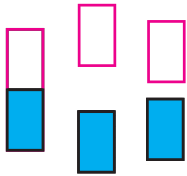
The following pictures show population of bands for materials having different electrical properties. Classify them as insulator, semiconductor or a metal.

Image

Answer
Picture A represents metal conductor, Picture B represents insulator, Picture C represents semiconductor.
View full question & answer
Question 112 Marks
Which of the three types of packing used by metals makes the most efficient use of space and which makes the least efficient use ?
Answer
fcc has the most efficient packing of particles while scc has the least efficient packing.
View full question & answer
Question 122 Marks
What are the types of particles in each of the four main classes of crystalline solids?
Answer
The smallest constituents or particles of various solids are atoms, ions or molecules.
View full question & answer
Question 132 Marks
What are the uses of semiconductors ?
Answer
The uses of semiconductors are as follows :
  1. They are used in transistors, digital computers and cameras.
  2. They are used in solar cells and television sets.
  3. By combining n-type and p-type semiconductors, n-p junctions are formed which are effectively used in rectifiers or to convert light energy into electrical energy.
View full question & answer
Question 142 Marks
Why does metallic conductivity decrease by increasing temperature?
Answer
  1. In metals a large number of outermost electrons of atoms occupy conduction bands.
  2. Band formation in metals results in delocalisation of outermost electrons forming metal ions or cations.
  3. The metallic cations occupying crystal lattice sites vibrate about mean positions.
  4. As temperature increases the vibrational motion increases which interrupts flow of electrons decreasing electrical conductivity.
View full question & answer
Question 152 Marks
What are the consequences of Frenkel defect ?
Answer
Consequences of Frenkel defect :
Since there is no loss of ions from the crystal lattice, the density of the solid remains unchanged.
The crystal remains electrically neutral.
This defect is observed in $ZnS, AgCl, AgBr, AgI, CaF_2,$ etc.
View full question & answer
Question 162 Marks
What are major classes of point defects ?
Answer
There are three major classes of point defects : stoichiometric point defects, impurity defects and nonstoichiometric point defects.

There are four types of stoichiometric point defects as vacancy defect, self interstitial defect, Schottky defect and Frenkel defect.
View full question & answer
Question 172 Marks
What is meant by crystal defects or imperfections?
Answer
  1. Defect in crystalline structure : Any deviation from orderly and stoichiometrically perfect arrangement of atoms, ions or molecules in the crystal lattice is called a defect in the crystalline structure.
  2. Defects are created during the crystallisation process. If the process occurs at faster rate, the defects are more.
  3. The properties of solids are affected due to imperfactions.
View full question & answer
Question 182 Marks
In a crystalline compound, atoms A occupy ccp lattices while atoms B occupy 2/3 rd tetrahedral voids. What is the formula of the compound ?
Answer
In ccp unit, lattice points are 8 comers and 6 face centres where atoms $A$ are present.
$\therefore$ Number of $A$ atoms
$\frac{1}{8} \times 8+\frac{1}{2} \times 6=1+3=4$
(corners) (face centres)
In cubic unit cell, there are 8 tetrahedral voids.
Hence,
Number of $B$ atoms $=\frac{2}{3} \times 8=\frac{16}{3}$.
Hence the formula should be $A_4 B_{16 / 3}$ or $A_{12} B_{16}$ or $A_3 B_4$.
The formula of the compound is $A_3 B_4$.
View full question & answer
Question 192 Marks
0.1 mole of Buckminster fullerene of molar mass $720 gmol ^{-1}$ contains how many $Kg$ of carbon ?
Answer
$\begin{aligned}
& \text { Molar mass of fullerene, } C 60=720 gmol ^{-1} \\
& \because \text { Mass of } 1 \text { mole of fullerene }=720 g =0.72 kg \\
& \therefore \text { Mass of } 0.1 \text { mole of fullerene }=0.72 \times 0.1 \\
& =0.072 kg
\end{aligned}$ $0.072 kg$.
View full question & answer
Question 202 Marks
A cubic unit cell contains atoms A at the corners, atoms B at face centres and atom C at the body centre. What is the formula of the crystalline compound?
Answer
Given : Atoms A are at 8 comers, atoms B at the 6 face centres and one atom C at body centre.
Total number of atoms of $A=\frac{1}{8} \times 8=1$.
Total number of atoms of $B=\frac{1}{2} \times 6=3$.
One atom of $C$ at the body centre.
Therefore the unit cell contains one atom of $A$, three atoms of $B$ and one atom of $C$.
Hence the formula of the compound is $AB _3 C$.
The formula of the crystalline compound is $AB _3 C$.
View full question & answer
Question 212 Marks
Atoms C and D form fee crystalline structure. Atom C is present at the corners of the cube and D is at the face centres of the cube. What is the formula of the compound ?
Answer
Given : Crystal has fee structure.
Atoms $C$ are at 8 comers while atoms $D$ are at 6 face centres of the cubic unit cell.
At the comer, $\frac{1}{8}$ th of each $C$ atom is present while at each face centre, half of each $D$ atom is present.
Number of $C$ atoms $=\frac{1}{8} \times 8=1$.
Number of $D$ atoms $=\frac{1}{8} \times 6=3$.
Thus unit cell contains one $C$ atom and three $D$ atoms.
Hence the formula of the compound is $CD _3$.
Formula of the compound $= CD _3$.
View full question & answer
Question 222 Marks
A cubic unit cell of a crystal consists of atoms of A and B elements. Atoms of A occupy corners of the unit cell while one B atom is present at the body centre. Determine the formula of the crystalline compound.
Answer
Given : Atoms of A are at the comers while atom B is at the body centre of the cubic unit cell.
Since $\frac{1}{8}$ th atom is contributed at each comer and there are 8 comers in unit cell, number of atoms of A due to comers is $\frac{1}{8} \times 8=1$.

In addition there is one atom of $B$ at body centre. Hence this unit cell contains one atom of each, $A$ and $B$, therefore the formula of the compound is $A B$.
The formula of the compound $=A B$.
View full question & answer
Question 232 Marks
What is packing efficiency?
Answer
(1) Packing efficiency : It is the fraction of a percentage of the total space (of the unit cell) occupied by the particles (spheres).
$\therefore$ Packing efficiency
$=\frac{\text { Volume occupied by particles in unit cell }}{\text { Total volume of unit cell }}$
(2) The magnitude of packing efficiency gives a measure of how tightly particles are packed together.
View full question & answer
Question 242 Marks
What are number of voids per atom in hep and ccp ?
Answer
The tetrahedral and octahedral voids occur in hep and ccp/fcc structures. There are two tetrahedral voids associated with each atom. The number of octahedral voids is half that of tetrahedral voids. Thus, there is one octahedral void per atom.
View full question & answer
Question 252 Marks
What is coordination number? What is its significance?
Answer
(1) Coordination number : The number of the closest neighbouring constituent particles like atoms, ions or molecules which are in contact with a particular particle or an atom in the crystal lattice is called coordination number of that particle.
(In the crystal lattice, all atoms may have same or different coordination numbers.)
(2) The magnitude of the coordination number is a measure of compactness of spheres in close-packed structures.
(3) The higher the coordination number, the closer are the spheres to each other.
View full question & answer
Question 262 Marks
Explain briefly crystal systems.
Answer
(1) The constituent particles like atoms, ions or molecules of the crystal can be arranged in seven different ways changing edges (a, b, c) and angles (α, β, γ) and accordingly they form seven systems or types of the crystal.

(2) These seven crystal system are named as :
(a) Cubic system, (b) Tetragonal system (c) Orthorhombic system (d) Rhombohedral system (e) Monoclinic system (f) Triclinic system (g) Hexagonal system.
View full question & answer
Question 282 Marks
What is a lattice point?
Answer
Lattice point : A position occupied by a crystal constituent particle like an atom, ion or a molecule in the crystal lattice is called lattice point or lattice site.
OR
Any point at the intersection of the lines in the unit cell occupied by a constituent particle like an atom, an ion or a molecule in the crystalline solid is called a lattice point.
View full question & answer
Question 292 Marks
What is crystal lattice (space lattice) ?
Answer
Crystal lattice (space lattice) : A regular arrangement of the constituent particles (atoms, ions or molecules) of a crystalline solid having similar environment in three dimensional space is called crystal lattice or space lattice.
View full question & answer
Question 302 Marks
What are the characteristics of metallic crystals ?
Answer
  1. Metallic crystals are solids formed by atoms of the same metallic element held together by metallic bonds.
  2. Metallic crystals have high melting point and boiling point.
  3. Metals are malleable and can be hammered into thin sheets.
  4. Metals are ductile and can be drawn into thin wires.
  5. Metals are good conductors of heat and electricity.
  6. Examples are Cu, Ag, Au, Ni, etc.
View full question & answer
Question 312 Marks
What are the characteristics of molecular crystals ?
Answer
The characteristics of molecular crystals are as follows :
  1. The constituent particles of these solids are molecules (or unbonded single atoms) of the same substance.
  2. The atoms within the molecules are bonded by covalent bonds.
  3. The molecules are held together by intermolecular forces of attraction.
View full question & answer
Question 322 Marks
What are molecular crystals ?
Answer
The crystals in which the constituent particles are molecules (or unbonded single atoms) of the same substance held together by intermolecular forces of attraction. For example solidified $Cl _2$, $CO _2$, etc.
View full question & answer
Question 332 Marks
What are allotropes ?
Answer
Allotropes : When a substance exists in two or more forms then they are called allotropes. They are polymorphous. For example, carbon has allotropes diamond and graphite.
View full question & answer
Question 342 Marks
Explain why ionic solids are hard and brittle.
Answer
  1. In ionic crystalline solids, constituent particles are positively charged cations and negatively charged anions placed at alternate lattice points.
  2. The ions are held by strong coulombic electrostatic forces of attraction compensating opposite forces. Hence they are hard.
  3. Since there are no free electrons, they are not malleable and on applying a shearing force, ionic crystals break into small units. Hence they are brittle.
View full question & answer
Question 352 Marks
What are crystalline solids?
Answer
The solids in which the constituent particles are charged ions namely cations and anions held together by electrostatic force of attraction are called crystalline solids.
View full question & answer
Question 362 Marks
How are crystalline solids classified ?
Answer
Crystalline solids are classified as follows :
  1. Ionic crystals
  2. Covalent network crystals
  3. Molecular crystals
  4. Metallic crystals
View full question & answer
Question 372 Marks
Why does a crystalline solid has a sharp melting point ?
Answer
  1. Crystalline solid is a homogeneous solid and it has long range order of regular pattern of arrangement which repeats periodically over entire crystal.
  2. The interatomic or intermolecular forces are identical, hence the thermal energy required to break the regular structure by overcoming the intermolecular forces is uniform throughout.
  3. Hence the heat and temperature needed to melt the solid are same, and therefore solids have sharp melting points.
View full question & answer
Question 382 Marks
Identify isomorphous and polymorphous substances in the following:
$K _2 SO _4$, graphite, $\beta$-quartz, $Na _2 SeO _4, CaCO _3$, diamond, cristobalite, $C _5 NO _3$.
Answer
IsomorphousPolymorphous
$K _2 SO _4, Na _2 SeO _4$Graphite, diamond
$CaCO 3, C _5 NO 3$Β-quartz, cristobalite
View full question & answer
Question 392 Marks
What is polymorphous ?
Answer
Polymorphous: A single substance which crystallises in two or more forms under different conditions of solidification is called polymorphous. Polymorphic forms of an element are called allotropic forms or allotropes. For example, carbon exists as diamond and graphite, or sulphur exists in rhombic and monoclinic allotropic forms.
View full question & answer
Question 402 Marks
What is polymorphism ?
Answer
Polymorphism : A phenomenon in which when a single substance crystallises in two or more forms under different conditions of solidification is called polymorphism and the substance is called polymorphous. For example, calcite and oragonite are two forms of $CaCO _3$.
View full question & answer
Question 412 Marks
What is isomorphous?
Answer
Isomorphous: When two or more crystalline substances have the same crystalline structure, they are said to be isomorphous. For example, $NaF$ and $MgO , NaNO _3$ and $CaCO _3$.
View full question & answer
Question 422 Marks
What is isomorphism ?
Answer
Isomorphism : A phenomenon in which two or more crystalline substances show same crystalline structure is called isomorphism and the crystals are said to be isomorphous. For example, $NaNO _3$ and $CaCO _3$. They have atomic ratios $1: 1: 3$.
View full question & answer
Question 432 Marks
Why does crystalline solid show different refractive indices in different directions ?
Answer
  1. Crystalline solid has long range order of regular pattern of arrangement which repeats periodically over entire crystal.
  2. Within the given pattern, the arrangements of different atoms or ions or molecules is different in different directions. Hence the properties like refractive indices in the different directions are different.

This shows that the crystalline solids are anisotropic in nature.
View full question & answer
Question 442 Marks
Define and explain isotropy.
Answer
Isotropy : The ability of amorphous solids to exhibit identical physical properties even though measured in different directions is called isotropy.
Explanation : This property arises because there is no long range order of regular pattern of arrangement in them and hence the arrangement is irregular along all the directions. Therefore the magnitude of any physical property would be identical along all directions.
View full question & answer
Question 452 Marks
Define :
$(1)$ Crystalline solid.
$(2)$ Amorphous solid.
Answer
$(1)$ Crystalline solid : A homogeneous solid in which the constituent particles like atoms, ions or molecules are arranged in a definite repeating pattern throughout the solid is called crystalline solid. For example, $NaCl, KNO_3$, etc.
$(2)$ Amorphous solid : A substance which appears like solid but does not have perfectly ordered crystalline structure and no regular arrangement of constituent particles in structure is called amorphous solid. For example, glass, rubber, plastics, etc.
View full question & answer
Answer the following in one or two sentence. - Chemistry STD 12 Questions - Vidyadip