MCQ 11 Mark
The approximate value of tan (44° 30′), given that 1° = 0.0175, is
MCQ 21 Mark
If the tangent at $(1,1)$ on $y^2=x(2-x)^2$ meets the curve again at $P$, then $P$ is
AnswerCorrect option: D. $\left(\frac{9}{4}, \frac{3}{8}\right)$
$\left(\frac{9}{4}, \frac{3}{8}\right)$
Hint: $y^2=x(2-x)^2$
$=x\left(4-4 x+x^2\right)$
$=x^3-4 x^2+4 x $
$ \therefore 2 y \frac{d y}{d x}=3 x^2-8 x+4$
$\therefore \frac{d y}{d x}=\frac{3 x^2-8 x+4}{2 y}$
$\therefore\left(\frac{d y}{d x}\right)_{\text {at }(1,1)}=\frac{3(1)^2-8(1)+4}{2(1)}=-\frac{1}{2}$
= slope of the tangent at $(1, 1)$ ∴ equation of the tangent at $(1, 1)$ is
$y-1=-\frac{1}{2}(x-1) $
$ \therefore 2 y-2=-x+1 $
$ \therefore x+2 y=3$
Only the coordinates $\left(\frac{9}{4}, \frac{3}{8}\right)$ satisfy both the equations $y^2=x(2-x)^2$ and $x+2 y=3$
$\therefore P$ is $\left(\frac{9}{4}, \frac{3}{8}\right)$
View full question & answer→MCQ 31 Mark
The equation of the tangent to the curve $y =1-e^{\frac{x}{2}}$ at the point of intersection with $Y$-axisis
Answerx + 2y = 0 Hint: The point of intersection of the curve with the Y-axis is the origin (0, 0).
View full question & answer→MCQ 41 Mark
The normal to the curve $x^2+2 x y-3 y^2=0$ at $(1,1)$
- A
meets the curve again in the second quadrant
- B
does not meet the curve again
- C
meets the curve again in the third quadrant
- ✓
meets the curve again in the fourth quadrant
AnswerCorrect option: D. meets the curve again in the fourth quadrant
meets the curve again in the fourth quadrant
Hint:
$x^2+2 x y-3 y^2=0$
$\therefore 2 x+2\left(x \frac{d y}{d x}+y \times 1\right)-3 \times 2 y \frac{d y}{d x}=0 $
$ \therefore(2 x-6 y) \frac{d y}{d x}=-2 x-2 y$
$\therefore \frac{d y}{d x}=\frac{-(x+y)}{x-3 y}$
$ \therefore\left(\frac{d y}{d x}\right)_{\text {at }(1,1)}=\frac{-(1+1)}{1-3}=1$
$=$ slope of the tangent at $(1, 1)$
$∴$ equation of the tangent at $(1, 1)$ is $-1$
$∴$ equation of the normal is $y – 1= -1 (x – 1) = -x + 1$
$∴ x + y = 2$
$∴ y = 2 – x$
Substituting $y=2-x$ in $x^2+2 x y-3 y^2=0$, we get
$x^2+2 x(2-x)-3(2-x)^2=0$
$\Rightarrow x^2+4 x-2 x^2-3\left(4-4 x+x^2\right)=0 $
$\Rightarrow x^2-4 x+3=0$
$⇒ (x – 1)(x – 3) = 0$
$⇒ x = 1, x = 3$
When $x = 1, y = 2 – 1 = 1$
When $x = 3, y = 2 – 3 = -1$
$∴$ the normal at $(1, 1)$ meets the curve at $(3, -1)$ which is in the fourth quadrant.
View full question & answer→MCQ 51 Mark
If $x=-1$ and $x=2$ are the extreme points of $y=\alpha \log x+\beta x^2+x$, then
- A
$\alpha=-6, \beta=\frac{1}{2}$
- B
$\alpha=-6, \beta=\frac{-1}{2}$
- ✓
$\alpha=2, \beta=\frac{-1}{2}$
- D
$\alpha=2, \beta=\frac{1}{2}$
AnswerCorrect option: C. $\alpha=2, \beta=\frac{-1}{2}$
$\alpha=2, \beta=\frac{-1}{2}$ Hint: $y=\alpha \log x+\beta x^2+x$
$\therefore \frac{d y}{d x}=\frac{\alpha}{x}+\beta \times 2 x+1=\frac{\alpha}{x}+2 \beta x+1$
f(x) has extreme values at x = -1 and x = 2 ∴ f'(-1) = 0 and f(2) = 0 α + 2β = 1
and $\frac{\alpha}{2}+4 \beta=-1$
By solving these two equations, we get
$\alpha=2, \beta=\frac{-1}{2}$
View full question & answer→MCQ 61 Mark
Let $f(x)=x^3-6 x^2+9 x+18$, then $f(x)$ is strictly decreasing in
View full question & answer→MCQ 71 Mark
Let $f(x)$ and $g(x)$ be differentiable for $0 < x < 1$ such that $f(0) = 0, g(0) = 0, f(1) = 6.$ Let there exist a real number $c$ in $(0, 1)$ such that $f'(c) = 2g'(c),$ then the value of g$(1)$ must be
Answer$3$
Hint:f
(x) and g(x) both satisfies the conditions of LMVT in $(0, 1).$
$\therefore f^{\prime}(c)=\frac{f(1)-f(0)}{1-0}=\frac{6-0}{1}=6$
$\text { and } g^{\prime}(c)=\frac{g(1)-g(0)}{1-0}=\frac{g(1)-0}{1}=g(1) $
$ \text { But } f^{\prime}(c)=2 g^{\prime}(c) $
$ 6=2 g(1)$
$ \therefore g(1)=3$
View full question & answer→MCQ 81 Mark
A ladder 5 m in length is resting against a vertical wall. The bottom of the ladder is pulled along the ground away from the wall at the rate of 1.5 m/sec. The length of the higher point of the ladder when the foot of the ladder is 4.0 m away from the wall decreases at the rate of
MCQ 91 Mark
If $f(x)=\frac{x^2-1}{x^2+1}$, for every real $x$, then the minimum value of $f$ is
View full question & answer→MCQ 101 Mark
If the function $f(x)=a x^3+b x^2+11 x-6$ satisfies conditions of Rolle's theorem in $[1,3]$ and$f^{\prime}\left(2+\frac{1}{\sqrt{3}}\right)=0$, then values of $a$ and $b$ are respectively.
- ✓
$1, -6$
- B
$.-2, 1.$
- C
$-1, -6$
- D
$.-1, 6$
AnswerCorrect option: A. $1, -6$
$1, -6$
Hint:
$f(x)=a x^3+b x^2+11 x-6$ satisfies the conditions of Rolle's theorem in $[1,3]$
$\therefore f(1)=f(3) $
$ a(1)^3+b(1)^2+11(1)-6=a(3)^3+b(3)^2+11(3)-6 $
$ a+b+11=27 a+9 b+33 $
$ 26 a+8 b=-22 $
$ 13 a+4 b=-11$
$ \text { Only } a=1, b=-6 \text { satisfy this equation. }$
View full question & answer→MCQ 112 Marks
The point on the curve $6 y=x^3+2$ at which $y-$ co $-$ ordinate is changing $8$ times as fast as $x-$ co $-$ ordinate is
- ✓
$(4,11)$
- B
$(4,-11)$
- C
$(-4,11)$
- D
$(-4,-11)$
AnswerCorrect option: A. $(4,11)$
Given curve is $6 y=x^3+2...(i)$
and $\frac{d y}{d t}=8\left(\frac{d x}{d t}\right)...(ii)$
Differentiate $(i) \text{w.r.t.} \ 't\ ',$ we get
$6 \frac{d y}{d t}=3 x^2\left(\frac{d x}{d t}\right)$
$\Rightarrow 6\left(8 \frac{d x}{d t}\right)$
$=3 x^2\left(\frac{d x}{d t}\right) [$from $(ii)]$
$\Rightarrow 48 \frac{d x}{d t}=3 x^2 \frac{d x}{d t}$
$\Rightarrow 3 x^2=48 $
$\Rightarrow x^2=16 $
$\Rightarrow x= \pm 4$
Put value of $x$ in $(i),$ we obtain
When $x=4,6 y=(4)^3+2=66 $
$\Rightarrow y=11$
When $x=-4,6 y=(-4)^3+2$
$=-64+2=-62$
$\Rightarrow y=-\frac{31}{3}$
$\therefore$ Required point on the curve is $(4,11)$.
View full question & answer→MCQ 122 Marks
If Rolle's theorem for $f(x)=e^x(\sin x-\cos x)$ is verified on $[\pi / 4,5 \pi / 4]$, then the value of $c$ is
- A
$\pi / 3$
- B
$\pi / 2$
- C
- D
$\pi$
View full question & answer→MCQ 132 Marks
A spherical balloon is filled with $4500 \pi$ cubic metres of helium gas. If a leak in the balloon causes the gas to escape at the rate of $72 \pi$ cubic metres per minute, then the rate (in metres per minute) at which the radius of the balloon decreases 49 minutes after the leakage began is
- A
$2 / 9$
- B
$9 / 2$
- C
- D
$7 / 9$
Answer$
\begin{aligned}
& \text {(a) : } \frac{d v}{d t}=-72 \pi m ^3 / min , v_0=4500 \pi \\
& v=\frac{4}{3} \pi r^3 \therefore \frac{d v}{d t}=\frac{4}{3} \pi \times 3 r^2 \times \frac{d r}{d t}
\end{aligned}
$
After $49 \min , v=v_0+49 \cdot \frac{d v}{d t}=4500 \pi-49 \times 72 \pi$ $=4500 \pi-3528 \pi=972 \pi$
$\Rightarrow \quad 972 \pi=\frac{4}{3} \pi r^3 \Rightarrow r^3=243 \times 3=3^6 \Rightarrow r=9$
$\therefore-72 \pi=4 \pi \times 81 \times \frac{d r}{d t} \Rightarrow \frac{d r}{d t}=-\frac{18}{81}=-\frac{2}{9}$
Thus, radius decreases at a rate of $\frac{2}{9} m / min$
View full question & answer→MCQ 142 Marks
Let the curve be represented by $x=2(\cos t+t \sin t)$, $y=2(\sin t-t \cos t)$. Then normal at any point ' $t$ ' of the curve is at a distance of units from the origin.
Answer(c) : We have, $x=2 \cos t+2 t \sin t$
$\Rightarrow \frac{d x}{d t}=-2 \sin t+2 \sin t+2 t \cos t=2 t \cos t$
and $y=2 \sin t-2 t \cos t$
$\Rightarrow \frac{d y}{d t}=2 \cos t-2 \cos t+2 t \sin t=2 t \sin t$
Now, $\frac{d y}{d x}=\frac{d y / d t}{d x / d t}=\frac{2 t \sin t}{2 t \cos t}=\tan t$
$\Rightarrow \frac{-d x}{d y}=-\cot$
So, equation of normal is given as
$\begin{aligned}
& y-(2 \sin t-2 t \cos t)=-\cot t(x-2 \cos t-2 t \sin t) \\
\Rightarrow & y \sin t-2 \sin ^2 t+2 t \sin t \cos t \\
& =-x \cos t+2 \cos ^2 t+2 t \sin t \cos t \\
\Rightarrow & x \cos t+y \sin t=2
\end{aligned}
$
Now, distance of normal from origin is given as
$
d=\left|\frac{0-0-2}{\sqrt{\cos ^2 t+\sin ^2 t}}\right|=2 \text { units }
$
View full question & answer→MCQ 152 Marks
Let $f(x)=5-|x-2|$ and $g(x)=|x+1|, x \in R$ If $f(x)$ attains maximum value at $\alpha$ and $g(x)$ attains minimum value at $\beta$, then $\lim _{x \rightarrow-\alpha \beta} \frac{(x-1)\left(x^2-5 x+6\right)}{x^2-6 x+8}$ is equal to
- ✓
$\frac{1}{2}$
- B
$\frac{-3}{2}$
- C
$\frac{-1}{2}$
- D
$\frac{3}{2}$
AnswerCorrect option: A. $\frac{1}{2}$
(a) : $f(x)=5-|x-2|, g(x)=|x+1|, x \in R$
$f(x)$ attains maximum value, when $|x-2|=0$
i.e., at $x-2=0$ i.e., at $x=2=\alpha$
Now, $g(x)$ attains minimum value when $|x+1|=0$ i.e.,
at $x=-1=\beta$
So, $\alpha \beta=2 \times(-1)$ $=-2 \Rightarrow-\alpha \beta=2$
$\therefore \operatorname{Lim}_{x \rightarrow-\alpha \beta} \frac{(x-1)\left(x^2-5 x+6\right)}{x^2-6 x+8}=\operatorname{Lim}_{x \rightarrow 2} \frac{(x-1)(x-2)(x-3)}{(x-2)(x-4)}$
$=\frac{1(-1)}{-2}=\frac{1}{2}$
View full question & answer→MCQ 162 Marks
The approximate value of $\log _{10} 998$ is $($given that $\left.\log _{10} e=0.4343\right)$
- A
$3.0008686$
- B
$1.9991314$
- C
$2.0008686$
- ✓
$2.9991314$
AnswerCorrect option: D. $2.9991314$
Let $f(x)=\log _{10} x=\frac{\log _e x}{\log _e 10}$
$=\log _{10} e \log _e x=(0.4343) \log x$
$\Rightarrow f^{\prime}(x)=\frac{0.4343}{x}$
Now $, x=998=1000-2=a-h$
Where $ a=1000$ and $ h=2$
$f(a)=\log _{10}(1000)=\log _{10}(10)^3$
$=3 \log _{10} 10=3$
$f^{\prime}(a)=f^{\prime}(1000)$
$=\frac{0.4343}{1000}=0.0004343$
Now, $f(a-h)=f(a)-h f^{\prime}(a)$
$=3-2(0.0004343)$
$=3-0.0008686=2.9991314$
View full question & answer→MCQ 172 Marks
A spherical raindrop evaporates at a rate proportional to its surface area. If originally its radius is $3\ mm$ and $1$ hour later it reduces to $2\ mm$,then the expression for the radius $R$ of the raindrop at any time $t$ is
- A
$6 R=t+2$
- B
$R(t+2)=6$
- ✓
$ R=-t+3$
- D
$6 R=t$
AnswerCorrect option: C. $ R=-t+3$
$($None of the options is correct$)$ :
Let $R$ be the radius, $V$ be the volume and $S$ be the surface area of spherical raindrop at time $t(i).$
$\therefore V=\frac{4}{3} \pi R^3 \text { and } S =4 \pi R^2$
The rate of evaporation of raindrop $=\frac{d V}{d t}$
$\Rightarrow \frac{d V}{d t} \propto S$
$\Rightarrow \frac{d V}{d t}=-k s, k>0 ...(i)$
Also, $\frac{d V}{d t}=\frac{4 \pi}{3} \times 3 R^2 \times \frac{d R}{d t}$
$\Rightarrow \frac{d V}{d t}=4 \pi R^2 \frac{d R}{d t}...(ii)$
From $(i)$ and $(ii),$ we get $-k S=4 \pi R^2 \frac{d R}{d t}$
$\Rightarrow -k\left(4 \pi R^2\right)=\frac{d R}{d t}\left(4 \pi R^2\right)$
$\Rightarrow \frac{d R}{d t}=-k$
$\Rightarrow d R=-k d t$
On integrating, we get
$\Rightarrow \int d R=\int-k d t$
$ \Rightarrow R=-k t+C$
At $t=0, R=3 mm $
$\therefore 3=C$
So, $R=-k t+3$
Also, at $t=1, R=2 mm$
$\Rightarrow 2=-k+3 $
$\Rightarrow-k=-1 $
$\Rightarrow k=1$
$\therefore R=-t+3$
View full question & answer→MCQ 182 Marks
The value of $c$ of Lagrange's mean value theorem for $f(x)=\sqrt{25-x^2}$ on $[1,5]$ is
- A
$\sqrt{15}$
- B
- C
$\sqrt{10}$
- D
Answer(a) : According to lagrange's mean value theorem for any function $f(x), a<x<b$, there exist $c \in(a, b)$ such that
$
f^{\prime}(c)=\frac{f(b)-f(a)}{b-a}
$
Here, $a=1, b=5$ and $f(x)=\sqrt{25-x^2}$
$
\therefore f(5)=\sqrt{25-25=0}
$
And $f(1)=\sqrt{25-1}=\sqrt{24}=2 \sqrt{6}$
$
\begin{aligned}
& \therefore f^{\prime}(c)=\frac{0-2 \sqrt{6}}{5-1}, c \in(1,5)=\frac{-2 \sqrt{6}}{4} \\
& \Rightarrow f^{\prime}(c)=-\frac{\sqrt{6}}{2} ...(i)
\end{aligned}
$
Now, $f(x)=\sqrt{25-x^2}$
$
\Rightarrow f^{\prime}(x)=\frac{1}{2 \sqrt{25-x^2}}(-2 x)=\frac{-x}{\sqrt{25-x^2}}
$
$
\Rightarrow f^{\prime}(c)=\frac{-c}{\sqrt{25-c^2}} ...(ii)
$
On equating (i) and (ii), we get
$
\begin{aligned}
& \frac{-c}{\sqrt{25-c^2}}=\frac{-\sqrt{6}}{2} \\
& \Rightarrow 2 c=\sqrt{150-6 c^2} \\
& \Rightarrow 4 c^2=150-6 c^2 \Rightarrow 10 c^2=150 \\
& \Rightarrow c^2=15 \Rightarrow c= \pm \sqrt{15}
\end{aligned}
$
Since, $c \in(1,5)$, So, $c=\sqrt{15}$
View full question & answer→MCQ 192 Marks
The function $f(x)=x^3-6 x^2+9 x+2$ has maximum value when $x$ is
AnswerGiven, $f(x)=x^3-6 x^2+9 x+2$
$\Rightarrow f^{\prime}(x)=3 x^2-12 x+9$
For critical points we must have, $f^{\prime}(x)=0$
$\Rightarrow 3 x^2-12 x+9=0$
$\Rightarrow 3 x^2-3 x-9 x+9=0$
$\Rightarrow(3 x-9)(x-1)=0 $
$\Rightarrow x=3, x=1$
Now, $f^{\prime \prime}(x)=6 x-12$
and $f^{\prime \prime}(3)=18-12=6>0$ and $f^{\prime \prime}(1)=6-12=-6<0$
$\Rightarrow x=1$ is the point of maxima.
View full question & answer→MCQ 202 Marks
The diagonal of a square is changing at the rate of $0.5 \ cm / \sec$. Then the rate of change of area when the area is $400 \ cm ^2$ is equal to
- A
$20 \sqrt{2} cm ^2 / \sec$
- ✓
$10 \sqrt{2} cm ^2 / \sec$
- C
$\frac{1}{10 \sqrt{2}} cm ^2 / \sec$
- D
$\frac{10}{\sqrt{2}} \ cm ^2 / \sec$
AnswerCorrect option: B. $10 \sqrt{2} cm ^2 / \sec$
Let the side of the square be $'x\ '$ and its diagonal be $y$.
Rate of change of diagonal is given $0.5 \ cm / \sec$.
$\therefore \frac{d y}{d t}=0.5$
By applying pythagoras theorem, we get
$y^2=x^2+x^2$
$\Rightarrow y=\sqrt{2 x^2}$
$\Rightarrow y=\sqrt{2} x \text { or } x=\frac{y}{\sqrt{2}}$
Now, area of square $=x^2=\left(\frac{y}{\sqrt{2}}\right)^2=\frac{y^2}{2}$
Since, area of square is given $400 \ cm ^2$
$\Rightarrow \frac{y^2}{2}=400$
$ \Rightarrow y^2=800 $
$\Rightarrow y=20 \sqrt{2} \ cm$
Now, rate of change of area is given by
$\frac{d A}{d t}=\frac{d}{d t}\left(\frac{y^2}{2}\right)$
$=\frac{1}{2} \times 2 y \times \frac{d y}{d t}$
$=20 \sqrt{2} \times 0.5$
$=10 \sqrt{2} \ cm ^2 / \sec$

View full question & answer→MCQ 212 Marks
If $y-4 x-5$ is a tangent to the curve $y^2=p x^3+q$ at $(2,3)$, then $p-q$ is
Answer(c) : Given curve is $y^2=p x^3+q$
On differentiating w.r.t. $x$, we get $2 y \frac{d y}{d x}=3 p x^2$
$
\Rightarrow \frac{d y}{d x}=\frac{3 p x^2}{2 y} \Rightarrow\left(\frac{d y}{d x}\right)_{(2,3)}=\frac{12 p}{6}=2 p
$
Since, line $y=4 x-5$ is a tangent to the curve at $(2,3)$
$
\therefore\left(\frac{d y}{d x}\right)_{(2,3)}=\text { slope of line }
$
$
\Rightarrow 2 p=4 \quad \Rightarrow p=2$
Equation of curve at $(2,3), 9=2 \times 8+q$
$\Rightarrow q=9-16 \Rightarrow q=-7 \therefore p-q=2-(-7)=9 $
View full question & answer→MCQ 222 Marks
Let $x_0$ be the point of local minima of $f(x)=\vec{a} \cdot(\vec{b} \times \vec{c})$ where $\vec{a}=x \hat{i}-2 \hat{j}+3 \hat{k}$, $\vec{b}=-2 \hat{i}+x \hat{j}-\hat{k}, \vec{c}=7 \hat{i}-2 \hat{j}+x \hat{k}$, then the value of $\vec{a} \cdot \vec{b}$ at $x=x_0$ is
AnswerGiven, $f(x)=\vec{a} \cdot(\vec{b} \times \vec{c})=\left|\begin{array}{ccc}x & -2 & 3 \\ -2 & x & -1 \\ 7 & -2 & x\end{array}\right|$
$=x\left(x^2-2\right)+2(-2 x+7)+3(4-7 x)$
$=x^3-2 x-4 x+14+12-21 x$
$=x^3-27 x+26$
$\Rightarrow f^{\prime}(x)=3 x^2-27$
For critical point, we must have $f^{\prime}(x)=0$
$\Rightarrow 3\left(x^2-9\right)=0 $
$\Rightarrow x= \pm 3$
Now, $f^{\prime \prime}(x)=6 x f^{\prime \prime}(3)=18>0$
$\therefore x=3$ is the point of local minima.
Now, $\vec{a} \cdot \vec{b}=(x \hat{i}-2 \hat{j}+3 \hat{k}) \cdot(-2 \hat{i}+x \hat{j}-\hat{k})$
$ =-2 x-2 x-3=-4 x-3$
$\therefore (\vec{a} \cdot \vec{b})_{x=3}=-12-3=-15$
View full question & answer→MCQ 232 Marks
Let $B \equiv(0,3)$ and $C \equiv(4,0)$. The point $A$ is moving on the line $y=2 x$ at the rate of $2$ units/second. The area of $\triangle A B C$ is increasing at the rate of
- A
$\frac{11}{5}(\text{units})^2 / \sec$
- ✓
$\frac{11}{\sqrt{5}}(\text{units}){ }^2 / \sec$
- C
$\frac{13}{\sqrt{5}} (\text{units})^2 / \sec$
- D
$\frac{13}{5} (\text{units}) ^2 / \sec$
AnswerCorrect option: B. $\frac{11}{\sqrt{5}}(\text{units}){ }^2 / \sec$
Let $A \equiv(a, 2 a)$
$\therefore$ Equation of line $B C$ is given by $\frac{x}{4}+\frac{y}{3}=1$
Perpendicular distance from point $(a, 2 a) \frac{\frac{a}{4}+\frac{2 a}{3}-1}{\sqrt{\left(\frac{1}{4}\right)^2+\left(\frac{2}{3}\right)^2}}$
$=\frac{\frac{3 a+8 a-1}{12}}{\sqrt{\frac{9+16}{144}}}$
$=\frac{3 a+8 a-12}{5}=\frac{11 a-12}{5}$
Also, $B C=\sqrt{O C^2+O B^2}=\sqrt{4^2+3^2}=5$ units
Area, $A=\frac{1}{2} \times B C \times \frac{11 a-12}{5}$
$=\frac{1}{2} \times 5 \times \frac{11 a-12}{5}=\frac{11 a-12}{2}$
Distance of point $A$ from origin $=\sqrt{(a)^2+(2 a)^2}=\sqrt{5} a$
According to question, $\frac{d(\sqrt{5} a)}{d t}=2$
$\Rightarrow \sqrt{5} \frac{d a}{d t}=2 $
$\Rightarrow \frac{d a}{d t}=\frac{2}{\sqrt{5}}$
$\therefore \frac{d A}{d t}=\frac{d\left(\frac{11 a-12}{2}\right)}{d t}$
$=\frac{1}{2} \times 11 \times \frac{d a}{d t}$
$=\frac{1}{2} \times 11 \times \frac{2}{\sqrt{5}}$
$=\frac{11}{\sqrt{5}}\left(\text{units}^2 / \sec) \right. $
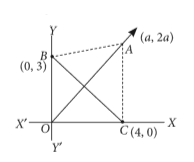
View full question & answer→MCQ 242 Marks
Let $f(x)=\int \frac{x^2-3 x+2}{x^4+1} d x$, then function decreases in the interval
Answer(c) : $f(x)=\int \frac{x^2-3 x+2}{x^4+1} d x$
$f(x)=\int \frac{(x-2)(x-1)}{x^4+1} d x$, then $f^{\prime}(x)=\frac{(x-2)(x-1)}{x^4+1}$
For critical points, $f^{\prime}(x)=0$
$
\Rightarrow(x-2)(x-1)=0 \quad\left[\because x^4+1>0 \forall x \in R \right]$
$\Rightarrow x=2,1$ are critical points.
So, $f^{\prime \prime}(x)=\frac{(2 x-3)\left(x^4+1\right)-4 x^3\left(x^2-3 x+2\right)}{\left(x^4+1\right)^2}$
$f^{\prime \prime}(1)=\frac{-2-4 \times 0}{2^2}=\frac{-1}{2}<0$
$\Rightarrow x=1$ is the point of local maxima.
$f^{\prime \prime}(2)=\frac{17-32 \times 0}{(17)^2}=\frac{1}{17}>0$
$\Rightarrow x=2$ is the point of local minima.
$\therefore f(x)$ is decreasing in $(1,2)$
View full question & answer→MCQ 252 Marks
Let $f(x)=\left\{\begin{array}{ll}x^3-x^2+10 x-7 & ,x \leq 1 \\ -2 x+\log _2\left(b^2-4\right) & , \quad x>1\end{array}\right.$ Then the set of all values of $b$, for which $f(x)$ has maximum value at $x=1$, is
AnswerCorrect option: C. $[-6,-2) \cup(2,6]$
$f(x)=\left\{\begin{array}{ll}x^3-x^2+10 x-7, & x \leq 1 \\ -2 x+\log _2\left(b^2-4\right), & x>1\end{array}\right.$
Since $f(x)$ has maximum value at $x=1$, therefore
$\text{L.H.L.} \geq \text{R.H.L.}$ at $x=1$
$\Rightarrow \lim _{x \rightarrow 1}\left(x^3-x^2+10 x-7\right) \geq \lim _{x \rightarrow 1}\left[-2 x+\log _2\left(b^2-4\right)\right]$
$\Rightarrow 3 \geq-2+\log _2\left(b^2-4\right) $
$\Rightarrow 2^5 \geq b^2-4$
$\Rightarrow b^2 \leq 36 $
$\Rightarrow(b-6)(b+6) \leq 0 $
$\Rightarrow b \in[-6,6]$
$\text { but } b^2-4 \neq 0 $
$\Rightarrow b \neq \pm 2 $
$\Rightarrow b \in[-6,-2) \cup(2,6]$
View full question & answer→MCQ 262 Marks
A stone is dropped in a quiet lake and it is observed that waves move in circles. If the radius of a circular wave increases at the rate $2 cm / sec$, then the rate of increase in its area at the instant when its radius is $10 cm$, is $cm ^2 / sec$.
- ✓
$40 \pi$
- B
- C
$10 \pi$
- D
$80 \pi$
AnswerCorrect option: A. $40 \pi$
(a) : Given $\frac{d r}{d t}=2 cm / sec$
We know that area of circle $(A)=\pi r^2$ i.e., $A=\pi r^2$
Differentiating w.r.t. ' $t$ ' we get
$
\frac{d A}{d t}=2 \pi r \frac{d r}{d t}=2 \pi r \times 2=\left.4 \pi r \Rightarrow \frac{d A}{d t}\right|_{r=10 cm }=40 \pi
$
$\Rightarrow$ Rate of increase in area of circle when radius is 10 $cm$ is $40 \pi cm ^2 / sec$.
View full question & answer→MCQ 272 Marks
The function $f(x)=x \sqrt{1-x},$ where $x \in(0,1)$ has local maximum at $x=$
- ✓
$\frac{2}{3}$
- B
$\frac{1}{4}$
- C
$\frac{3}{4}$
- D
$\frac{1}{3}$
AnswerCorrect option: A. $\frac{2}{3}$
Given $,f(x)=x \sqrt{1-x}$
$f^{\prime}(x)=x \cdot \frac{-1}{2 \cdot \sqrt{1-x}}+\sqrt{1-x}$
$=\frac{-x+2(1-x)}{2 \sqrt{1-x}}$
$=\frac{2-3 x}{2 \sqrt{1-x}}$
Put $f^{\prime}(x)=0$ so, $x=\frac{2}{3}$ is the critical point
Now, $f^{\prime \prime}(x)=\frac{2 \sqrt{1-x}(-3)-(2-3 x) \cdot 2 \cdot \frac{(-1) \cdot 2}{\sqrt{1-x}}}{4(1-x)}$
$=\frac{-6(1-x)+(2-3 x)}{4(1-x)^{3 / 2}}$
$=\frac{-4+3 x}{4(1-x)^{3 / 2}}$
Now at $x=\frac{2}{3} f^{\prime \prime}(x)=- ve$
Hence, at $x=\frac{2}{3} f(x)$ has local maximum.
View full question & answer→MCQ 282 Marks
If $x=t^2$ and $y=2 t$ are parametric equations of a curve, then equation of the normal to the curve at $t$ $=2$ is
- A
$2 x+3 y-20=0$
- B
$x+y-8=0$
- ✓
$2 x+y-12=0$
- D
$x+2 y-12=0$
AnswerCorrect option: C. $2 x+y-12=0$
(c) : Given $x=t^2, y=2 t$
So, equation of curve is $y^2=4 x$
At $t=2, x=4$ and $y=4$
Now slope of normal to the curve at $(4,4)$ is
$\left(\frac{1}{-\frac{d y}{d x}}\right)_{(4,4)}=\left(-\frac{1}{\frac{2}{y}}\right)_{(4,4)}=\frac{-4}{2}=-2$
Equation of normal at $(4,4)$ is $y-4=-2(x-4)$
$\Rightarrow y-4=-2 x+8 \Rightarrow 2 x+y-12=0$
View full question & answer→MCQ 292 Marks
If the water is being poured at the rate $36 m ^3 / sec$ in a cylindrical vessel of base radius $3 m$, then the rate at which water level is rising, is
- A
- B
$3 / \pi m / sec$
- ✓
- D
$\pi / 4 m / sec$
Answer(c) : Volume of cylinder is $V=\pi r^2 h$
Differentiate with respect to time $(t)$, we get
$\Rightarrow \frac{d V}{d t}=\pi(3)^2 \frac{d h}{d t}=9 \pi \frac{d h}{d t} \quad($ Given $r=3)$
Now, $36=9 \pi \frac{d h}{d t} \Rightarrow \frac{d h}{d t}=\frac{4}{\pi} m / sec$
View full question & answer→MCQ 302 Marks
The rate at which the population of a city increses varies as the population present. Within the period of $30$ years, the population grew from $20$ lakhs to $40$ lakhs. Then, the population after a further period of $15$ years will be $($Take $\sqrt{2}=1.41)$
- A
$56$ lakhs
- B
$57.4$ lakhs
- ✓
$56.4$ lakhs
- D
$60$ lakhs
AnswerCorrect option: C. $56.4$ lakhs
$\frac{d P}{d t}=k P $
$\Rightarrow \ln P=k t+c$
$\Rightarrow[\ln P]_{2000000}^{400000}=[k t+c]_0^{30}$
$\Rightarrow \ln 2=30 k $
$\Rightarrow k=\frac{\ln 2}{30}$
$\Rightarrow[\ln P]_{2000000}^P=[k t+c]_0^{45} $
$\Rightarrow P=2000000 e^{\frac{3}{2} \ln 2}$
$\Rightarrow P=56.4 \text { lakhs }$
View full question & answer→MCQ 312 Marks
The function $f(x)$ is defined by $f(x)=(x+2) e^{-x}$ is
Answer(d) : Given, $f(x)=(x+2) e^{-x}$
$f^{\prime}(x)=-(x+2) e^{-x}+e^{-x}=-e^{-x}(x+1)$
For increasing function, $-e^{-x}(x+1)>0$
i.e., $e^{-x}(x+1)<0$
Since, $e^{-x}>0$, therefore $(x+1)<0$
$\Rightarrow x \in(-\infty,-1)$
$\therefore$ For $x \in(-\infty,-1)$, function is increasing.
Now, for decreasing function, $-e^{-x}(x+1)<0$
i.e. $e^{-x}(x+1)>0 \Rightarrow x \in(-1, \infty)$
$\therefore$ For $x \in(-1, \infty)$, function is decreasing.
View full question & answer→MCQ 322 Marks
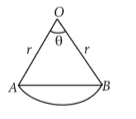
A circular sector of perimeter $60$ meter with maximum area is to be constructed. The radius of the circular arc in meter must be
- A
$10 m$
- ✓
$15 m$
- C
$5 m$
- D
$20 m$
AnswerCorrect option: B. $15 m$
Let $O A B$ be the circular sector.
Perimeter of $O A B=60 m$
$\therefore \frac{\theta}{360} \times 2 \pi r+2 r=60$
$\Rightarrow \frac{\theta}{360}=\frac{60-2 r}{2 \pi r} ...(i)$
We need maximum area, and we know that area of a sector $(A)=\frac{\theta}{360} \times \pi r^2$
i.e., $A=\frac{60-2 r}{2 \pi r} \times \pi r^2 \ ($Using $(i))$
$\Rightarrow A=30 r-r^2$
Differentiating $\text{w.r.t}\ 'r\ '$
$\frac{d A}{d r}=30-2 r$
For critical point, we have $\frac{d A}{d r}=0$
$\Rightarrow 30-2 r=0 $
$\Rightarrow r=\frac{30}{2}=15 m$
Now, $\frac{d^2 A}{d r^2}=-2<0$
$\therefore r=15 m$ gives the maximum area.
View full question & answer→MCQ 332 Marks
The side of a square sheet of metal is increasing at the rate of $3 \ cm / \min$. At what rate is the area increasing when the length of the side is $6 \ cm$ long?
- A
$12 \ cm ^2 / \min$
- B
$18 cm ^2 / \min$
- C
$9 cm ^2 / \min$
- ✓
$36 cm ^2 / \min$
AnswerCorrect option: D. $36 cm ^2 / \min$
Let side of square sheet $=s \ cm$
Given, $\frac{d s}{d t}=3 \ cm / \min$...(i)
Area of square $=s^2$
i.e., $A=s^2$
Differentiating $\text{w.r.t }\ 't\ ',$ we get
$\frac{d A}{d t}=2 s \frac{d s}{d t}$
$=2 s \times 3=6 s \ ($using $(i))$
$\left.\frac{d A}{d t}\right|_{s=6}$
$=36 \ cm ^2 / \min .$
View full question & answer→MCQ 342 Marks
The distance between the point $(1,1)$ and the tangent to the curve $y=e^{2 x}+x^2$ drawn at the point $x=0$ is
- A
$\frac{1}{\sqrt{5}}$
- B
$\frac{-1}{\sqrt{5}}$
- ✓
$\frac{2}{\sqrt{5}}$
- D
$\frac{-2}{\sqrt{5}}$
AnswerCorrect option: C. $\frac{2}{\sqrt{5}}$
(c) : Putting $x=0$ in $y=e^{2 x}+x^2$, we get $y=1$
$\therefore \quad$ The given point is $P(0,1)$
$
\begin{aligned}
& y=e^{2 x}+x^2 ...(i)\\
\Rightarrow & \frac{d y}{d x}=2 e^{2 x}+2 x \Rightarrow\left[\frac{d y}{d x}\right]_P=2
\end{aligned}
$
$\therefore \quad$ Equation of tangent at $P$ to (i) is
$
\begin{aligned}
& y-1=2(x-0) \\
\Rightarrow \quad & 2 x-y+1=0 ...(ii)
\end{aligned}
$
$\therefore$ Required distance $=$ Length of $\perp$ from $(1,1)$ to (ii)
$
=\frac{2-1+1}{\sqrt{4+1}}=\frac{2}{\sqrt{5}} \text {. }
$
View full question & answer→MCQ 352 Marks
If an error $k \%$ is made in measuring the radius of a sphere, then percentage error in its volume is
- A
$k \%$
- ✓
$3 k \%$
- C
$2 k \%$
- D
$\frac{k}{3} \%$
AnswerCorrect option: B. $3 k \%$
$\frac{\Delta r}{r} \times 100=k \text { (Given) } \because V=\frac{4}{3} \pi r^3 $
$\Rightarrow \frac{d V}{d r}=4 \pi r^2 $
$\therefore \Delta V=\frac{d V}{d r} \times \Delta r$
$\Rightarrow \frac{\Delta V}{V} \times 100$
$=\frac{4 \pi r^3}{\frac{4}{3} \pi r^3} \frac{k}{100} \times 100$
$=3 k \%$
View full question & answer→MCQ 362 Marks
$f(x)=7 x+9$ is increasing for
- ✓
$x \in R$
- B
- C
only for $x \in(-1,1)$
- D
AnswerCorrect option: A. $x \in R$
(a): Let $x_1, x_2 \in R$ be s.t. $x_2>x_1$ then $7 x_2>7 x_1$
$
\Rightarrow 7 x_2+9>7 x_1+9
$
Thus, $x_2>x_1 \Rightarrow f\left(x_2\right)>f\left(x_1\right)$ for all $x \in R$
View full question & answer→MCQ 372 Marks
A stone is dropped into a pond. Waves in the form of circles are generated and radius of outermost ripple increases at the rate of $5 cm / sec$. Then area increased after 2 seconds is
- ✓
- B
- C
$50 cm ^2 / sec$
- D
$25 cm ^2 / sec$
Answer(a) $100 \pi cm ^2 / sec$
View full question & answer→MCQ 382 Marks
If $f(x)=3 x^3-9 x^2-27 x+15,$ then the maximum value of $f(x)$ is
AnswerWe have $f(x)=3 x^3-9 x^2-27 x+15$
$f^{\prime}(x)=9 x^2-18 x-27$
For maximum or minimum value, $f^{\prime}(x)=0$
$\Rightarrow 9\left(x^2-2 x-3\right)=0$
$\Rightarrow x^2-3 x+x-3=0 $
$\Rightarrow x(x-3)+1(x-3)=0$
$\Rightarrow(x-3)(x+1)=0 $
$\Rightarrow x=3,-1$
Now, $ f^{\prime \prime}(x)=18 x-18$
For $x=-1, f^{\prime \prime}(-1)<0$
$\therefore f(x) $ attains its maximum value at $ x=-1$
$\therefore f(-1)=3(-1)^3-9(-1)^2-27(-1)+15=30$
View full question & answer→MCQ 392 Marks
The equation of normal to the curve $y=\log _e x$ at the point $P(1,0)$ is
- A
$2 x+y=2$
- B
$x-2 y=1$
- C
$x-y=1$
- D
$x+y=1$
Answer (d) : We have, $y=\log _e x$ and point $P(1,0)$.
$
\therefore \frac{d y}{d x}=\frac{1}{x} \Rightarrow\left[\frac{d y}{d x}\right]_{(1,0)}=1
$
$\therefore$ Equation of normal is $y-0=-1(x-1)$
$\Rightarrow y=1-x \Rightarrow x+y=1$
View full question & answer→MCQ 402 Marks
A particle moves so that $x=2+27 t -t^3$. The direction of motion reverses after moving a distance of units.
Answer(b) : Path of the particle is given by $2+27 t-t^3$ When direction of motion reverses, direction of the distance-time graph will change, and at that point,
$\frac{d x}{d t}=0$
$\Rightarrow 27-3 t^2=0 \Rightarrow t^2=9 \Rightarrow t= \pm 3$
$\because \quad$ Time can't be negative, therefore $t=3$
$\therefore \quad$ After 3 units of time, the direction of motion will reverse.
Now, distance covered in 3 seconds
$
=2+27 \times 3-3^3=2+81-27=56 \text { units }
$
View full question & answer→MCQ 412 Marks
Using differentiation, approximate value of $f(x)=x^2-2 x+1$ at $x=2.99$ is
Answer(a): We have, $f(x)=x^2-2 x+1$
$
\Rightarrow f^{\prime}(x)=2 x-2
$
Now, $a+h=2.99=3+(-0.01)$, where $a=3$ and $h=-0.01$
We know that, $f(a+h) \approx f(a)+h f^{\prime}(a)$
$
\begin{aligned}
\Rightarrow & f(2.99) \approx f(3)-0.01 f^{\prime}(3)=(9-6+1)-0.01(6-2) \\
& =4-0.04=3.96
\end{aligned}
$
View full question & answer→MCQ 422 Marks
The minimum value of the function $f(x)=x \log x$ is
Answer(a): We have $f(x)=x \log x \Rightarrow f^{\prime}(x)=x \times \frac{1}{x}+\log x \times 1$
$
\Rightarrow f^{\prime}(x)=1+\log x
$
Now, $f^{\prime}(x)=0 \Rightarrow 1+\log x=0 \Rightarrow \log _e x=-1$
$
\Rightarrow x=e^{-1}=\frac{1}{e}
$
Also $f^{\prime \prime}(x)=\frac{1}{x} \therefore f^{\prime \prime}\left(\frac{1}{e}\right)=\frac{1}{1 / e}=e>0$
$\therefore f(x)$ is minimum at $x=\frac{1}{e}$
and Minimum value $=f\left(\frac{1}{e}\right)=\frac{1}{e} \log \frac{1}{e}=\frac{-1}{e}$
View full question & answer→MCQ 432 Marks
If the line $y=4 x-5$ touches to the curve $y^2=a x^3+b$ at the point $(2,3)$, then $7 a+2 b=$
Answer(a): We have, $y^2=a x^3+b$
On differentiating, we get $2 y \frac{d y}{d x}=3 a x^2$
$\left.\frac{d y}{d x}\right|_{(2,3)}=\frac{a(3)(2)^2}{2(3)}=2 a=$ Slope of tangent
Given tangent $y=4 x-5=m x+c$
$
\Rightarrow m=4 \text { and } c=-5 \Rightarrow 2 a=4 \Rightarrow a=2
$
Since $(2,3)$ lie on the curve $y^2=a x^3+b$
$
\Rightarrow(3)^2=a(2)^3+b \Rightarrow 9=8 a+b \Rightarrow b=9-8 \times 2 \Rightarrow b=-7
$So, $7 a+2 b=7(2)+2(-7)=14-14=0$.
View full question & answer→MCQ 442 Marks
If $f(x)=\frac{x}{x^2+1}$ is increasing function, then the value of $x$ lies in
- A
$R$
- B
$(-\infty,-1)$
- C
- ✓
$(-1,1)$
AnswerCorrect option: D. $(-1,1)$
(d) : We have $f(x)=\frac{x}{x^2+1}$
$ f^{\prime}(x)=\frac{\left(x^2+1\right) \times 1-2 x \times x}{\left(x^2+1\right)^2}=\frac{-x^2+1}{\left(x^2+1\right)^2} $
For $f(x)$ to be increasing function, $f^{\prime}(x)>0$ $\Rightarrow\left(-x^2+1\right)>0$ as $\left(x^2+1\right)^2$ is always positive. $\Rightarrow x^2-1<0 \Rightarrow x \in(-1,1)$
View full question & answer→MCQ 452 Marks
If the volume of spherical ball is increasing at the rate of $4 \pi cc / sec$ then the rate of change of its surface area when the volume is $288 \pi cc$ is
AnswerCorrect option: A. $\frac{4}{3} \pi cm ^2 / sec$
(a) : Volume of spherical ball,
$
V=\frac{4}{3} \pi r^3 \Rightarrow \frac{d V}{d t}=4 \pi r^2 \frac{d r}{d t}
$
Given, $V=288 \pi$
$\therefore \quad 288 \pi=\frac{4}{3} \pi r^3 \Rightarrow r^3=216 \Rightarrow r=6$
Also, we have, $\frac{d V}{d t}=4 \pi \quad \therefore 4 \pi r^2 \frac{d r}{d t}=4 \pi \Rightarrow \frac{d r}{d t}=\frac{1}{r^2}$
Surface area of spherical ball, $A=4 \pi r^2$
$
\therefore \quad \frac{d A}{d t}=8 \pi r \frac{d r}{d t}=8 \pi r \times \frac{1}{r^2}=\frac{8 \pi}{r}=\frac{8 \pi}{6}=\frac{4 \pi}{3} cm ^2 / sec
$
View full question & answer→MCQ 462 Marks
The maximum value of $f(x)=\frac{\log x}{x}(x \neq 0, x \neq 1)$ is
- A
$e$
- ✓
$\frac{1}{e}$
- C
$e^2$
- D
$\frac{1}{e^2}$
AnswerCorrect option: B. $\frac{1}{e}$
We have, $f(x)=\frac{\log x}{x}$
$\Rightarrow f^{\prime}(x)=\frac{x \times \frac{1}{x}-\log x \times 1}{x^2}=\frac{1-\log x}{x^2}$
Now $, f^{\prime \prime}(x)=\frac{x^2 \times\left(-\frac{1}{x}\right)-(1-\log x) \times 2 x}{x^4}$
$\Rightarrow f^{\prime \prime}(x)$
$=\frac{-x-2 x+2 x \log x}{x^4}$
$=\frac{2 \log x-3}{x^3}$
Now, $f^{\prime}(x)=0 $
$\Rightarrow \frac{1-\log x}{x^2}=0 $
$\Rightarrow \log x=1 $
$\Rightarrow x=e$
Now, $f^{\prime \prime}(e)=\frac{2 \log e-3}{e^3}$
$=\frac{-1}{e^3}<0$
$\therefore$ Maximum value $=f(e)=\frac{\log e}{e}=\frac{1}{e}$
View full question & answer→MCQ 472 Marks
The point on the curve $y=\sqrt{x-1}$ where the tangent is perpendicular to the line $2 x+y-5=0$ is
- A
$(2,-1)$
- B
$(10,3)$
- ✓
$(2,1)$
- D
$(5,-2)$
AnswerCorrect option: C. $(2,1)$
(c) : We have, $y=\sqrt{x-1}$
$\therefore \quad \frac{d y}{d x}=\frac{1}{2 \sqrt{x-1}}=m_1=$ slope of tangent
Slope of line $2 x+y-5=0$ is $m_2=-2$
Tangent to the curve is perpendicular to the given line.
$
\therefore \quad m_1 m_2=-1 \Rightarrow\left(\frac{1}{2 \sqrt{x-1}}\right)(-2)=-1 \Rightarrow \sqrt{x-1}=1
$
Squaring both sides, we get, $x-1=1$
$
\Rightarrow x=2 \therefore y=\sqrt{x-1}=\sqrt{2-1}=1
$
$\therefore(2,1)$ is the required point.
View full question & answer→MCQ 482 Marks
The approximate value of $f(x)=x^3+5 x^2-7 x+9$ at $x=1.1$ is
Answer(a) : $f(x)=x^3+5 x^2-7 x+9$
Differentiate w.r.t. $x$, we get $f^{\prime}(x)=3 x^2+10 x-7$
$
\begin{aligned}
& a+h=1.1=1+0.1 \Rightarrow a=1, h=0.1 \\
\because \quad & f(a+h) \approx f(a)+h f^{\prime}(a) \Rightarrow f(1.1) \approx f(1)+(0.1) f^{\prime}(1) \\
= & {\left[(1)^3+5(1)^2-7(1)+9\right]+(0.1)\left[3(1)^2+10(1)-7\right] } \\
= & (1+5-7+9)+(0.1)(3+10-7)=8+0.6=8.6
\end{aligned}
$
View full question & answer→MCQ 492 Marks
At present, a firm is manufacturing $2000$ items. It is estimated that the rate of change of production $P \ \text{w.r.t}$. additional number of workers $x$ is given by $\frac{d P}{d x}=100-12 \sqrt{x}$. If the firm employs $25$ more workers, then the new level of production of items is
- A
$3000$
- ✓
$3500$
- C
$4500$
- D
$2500$
AnswerCorrect option: B. $3500$
$\frac{d P}{d x}=100-12 \sqrt{x}$
Integrating, we have, $d P=(100-12 \sqrt{x}) d x$
$P=100 x-12 \cdot \frac{2}{3} \cdot x^{3 / 2}+\lambda$
$P=100 x-8 x^{3 / 2}+\lambda$
$P(0)=2000=\lambda $
$\therefore \lambda=2000$
$P(25)=100 \times 25-8 \times 25^{3 / 2}+2000=3500 .$
View full question & answer→MCQ 502 Marks
The maximum value of the function $f(x)=3 x^3-18 x^2$ $+27 x-40$ on the set $S=\left\{x \in R / x^2+30 \leq 11 x\right\}$ is
Answer(a) : $S=\left\{x \in R / x^2+30 \leq 11 x\right\}$
i.e., $x^2-11 x+30 \leq 0 \Rightarrow(x-5)(x-6) \leq 0 \Rightarrow$
$x \in[5,6]$
Now, $f(x)=3 x^3-18 x^2+27 x-40$....(i)
Differentiating w.r.t. ' $x$ ' we get
$
f^{\prime}(x)=9 x^2-36 x+27
$
Now $f^{\prime}(x)=9(x-1)(x-3)$, which is positive at $[5,6]$.
$\Rightarrow f(x)$ is increasing in $[5,6]$ i.e., in $S$.
Maximum value of $f$ is at $x=6$ i.e., $f(6)$
$
=648-648+162-40=122 [From (i)]
$
View full question & answer→