MCQ 11 Mark
If $s = t^3- 4t^2+ 5$ describes the motion of a particle, then its velocity when the acceleration vanishes, is:
- A
$\frac{16}{2}\ \text{unit}/\text{sec}.$
- B
$\frac{\text{-32}}{3}\ \text{unit}/\text{sec}.$
- C
$\frac{4}{3}\ \text{unit}/\text{sec}.$
- ✓
$-\frac{16}{3}\ \text{unit}/\text{sec}.$
AnswerCorrect option: D. $-\frac{16}{3}\ \text{unit}/\text{sec}.$
According to the question,
$\text{s}=\text{t}^{3}-4\text{t}^{2}+5$
$\Rightarrow\frac{\text{ds}}{\text{dt}}=3\text{t}^{2}-8\text{t}$
$\Rightarrow\frac{\text{d}^{2}\text{s}}{\text{dt}^{2}}=6\text{t}-8$
$\Rightarrow6\text{t}-8=0$ $\Big[$As velocity diminish, then $\frac{\text{d}^{2}\text{s}}{\text{dt}^{2}}=0\Big]$
$\Rightarrow\text{t}=\frac{4}{3}$
Now, $\Big(\frac{\text{ds}}{\text{dt}}\Big)_{\text{t}=\frac{4}{3}}=3\Big(\frac{4}{3}\Big)^{2}-8\Big(\frac{4}{3}\Big)$
$\Rightarrow\frac{\text{ds}}{\text{dt}}=\frac{16}{3}-\frac{32}{3}$
$\Rightarrow\frac{\text{ds}}{\text{dt}}=-\frac{16}{3}\ \text{unit}/\text{sec}.$
View full question & answer→MCQ 21 Mark
A man of height $6ft$ walks at a uniform speed of $9ft/\sec.$ from a lamp fixed at $15ft$ height. The length of his shadow is increasing at the rate of:
AnswerCorrect option: C. $6\text{ft}/\text{sec}.$
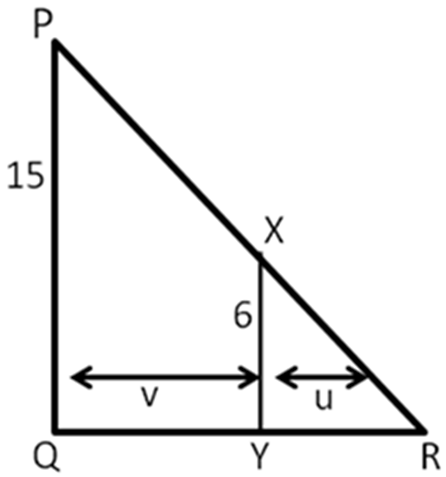
$\frac{15}{6}=\frac{\text{u+v}}{\text{u}}$
$\Rightarrow\frac{15}{6}=\frac{\text{v}}{\text{u}}+1$
$\Rightarrow\frac{\text{v}}{\text{u}}=\frac{3}{2}$
$\Rightarrow\text{u}=\frac{2\text{v}}{3}$
$\Rightarrow\frac{\text{du}}{\text{du}}=\frac{2}{3}\frac{\text{dv}}{\text{dt}}$
$\Rightarrow\frac{\text{du}}{\text{dt}}=\frac{2}{3}\times9$
$=6\text{ft}/\text{sec}.$ View full question & answer→MCQ 31 Mark
The radius of the base of a cone is increasing at the rate of $3\ \text{cm/minute}$ and the altitude is decreasing at the rate of $4\ \text{cm/minute.}$ The rate of change of lateral surface when the radius $= 7\ cm$ and altitude $24\ cm$ is:
- ✓
$54\pi \text{cm}^{2}/\text{min}$
- B
$7\pi\text{cm}^{2}/\text{min}$
- C
$27\text{cm}^{2}/\text{min}$
- D
$\text{none of these }$
AnswerCorrect option: A. $54\pi \text{cm}^{2}/\text{min}$
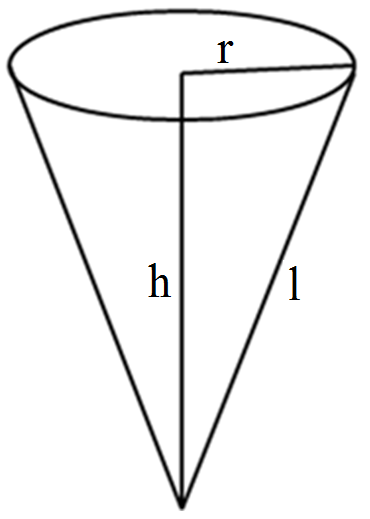
Given that $\frac{\text{dr}}{\text{dt}}=3\text{cm}/\text{min}, \frac{\text{dh}}{\text{dt}}=-4\text{cm}/\text{min}$
$\text{h}=24\text{cm}, \text{r}=7\text{cm}$
$\text{l}^{2}=\text{h}^{2}+\text{r}^{2}$
$\Rightarrow\text{l}^{2}=24^{2}+7^{2}$
$\Rightarrow\text{l}=25$
$\text{s}=\pi\text{r}\text{l}$
$\Rightarrow\text{s}^{2}=\pi\text{r}^{2}\text{l}^{2}$
$\Rightarrow\text{s}^{2}=\pi\text{r}^{2}(\text{h}^{2}+\text{r}^{2})$
$\Rightarrow\text{s}=\pi\text{r}^{2}\text{h}^{2}+\pi\text{r}^{4}$
$\Rightarrow2\text{s}\frac{\text{ds}}{\text{dt}}=2\pi^{2}\text{r}^{2}\text{h}\frac{\text{dh}}{\text{dt}}+2\pi^{2}\text{h}^{2}\text{r}\frac{\text{dr}}{\text{dt}}+4\pi^{2}\text{r}^{3}\frac{\text{dr}}{\text{dt}}$
$\Rightarrow2\pi\text{r}\text{l}\frac{\text{ds}}{\text{dt}}=2\pi^{2}\text{r}\text{h}\Bigg(\text{r}+\frac{\text{dh}}{\text{dt}}+\text{h}\frac{\text{dr}}{\text{dt}}+\frac{2\text{r}^{2}}{\text{h}}\frac{\text{dr}}{\text{dt}}\bigg)$
$\Rightarrow\pi\text{r}\text{l}\frac{\text{ds}}{\text{dt}}=\pi^{2}\text{r}\text{h}\Bigg(\text{r}+\frac{\text{dh}}{\text{dt}}+\text{h}\frac{\text{dr}}{\text{dt}}+\frac{2\text{r}^{2}}{\text{h}}\frac{\text{dr}}{\text{dt}}\Bigg)$
$\Rightarrow25\frac{\text{ds}}{\text{dt}}=\pi\text{r}\text{h}\Bigg(\text{r}+\frac{\text{dh}}{\text{dt}}+\text{h}\frac{\text{dr}}{\text{dt}}+\frac{2\text{r}^{2}}{\text{h}}\frac{\text{dr}}{\text{dt}}\Bigg)$
$\Rightarrow25\frac{\text{ds}}{\text{dt}}=\pi\text{h}\Bigg(\text{r}+\frac{\text{dh}}{\text{dt}}+\text{h}\frac{\text{dr}}{\text{dt}}+\frac{2\text{r}^{2}}{\text{h}}\frac{\text{dr}}{\text{dt}}\Bigg)$
$\Rightarrow25\frac{\text{ds}}{\text{dt}}=24\pi\Bigg(7\times(-4)+24\times3+\frac{2\times(7)^{2}}{24}\times3\bigg)$
$\Rightarrow\frac{\text{ds}}{\text{dt}}=54\pi\text{cm}^{2}/\text{sec}$ View full question & answer→MCQ 41 Mark
Side of an equilateral triangle expands at the rate of $2\text{cm}/ \text{sec}.$ The rate of increase of its area when each side is $10\ cm$ is:
AnswerCorrect option: B. $10\sqrt{3}\text{cm}^2/\sec.$
$\text{A}=\frac{\sqrt{3}}{4}\text{x}^2$
$\frac{\text{dA}}{\text{dt}}=\frac{\sqrt{3}}{2}\text{x}\frac{\text{dx}}{\text{dt}}$
$\Rightarrow\frac{\text{dA}}{\text{dt}}=\frac{\sqrt{3}}{2}\times2\times10$
$=10\sqrt{3}\text{cm}^2/\sec.$
View full question & answer→MCQ 51 Mark
The equation of motion of a particle is $\text{s} = \text{2t}^2 + \sin\text{2t,}$ where s is in metres and t is in seconds. The velocity of the particle when its acceleration is $2m/\sec^2$, is:
- A
$\pi+\sqrt{3}\text{m}/\text{sec}.$
- ✓
$\frac{\pi}{3}+\sqrt{3}\text{m}/\text{sec}.$
- C
$\frac{2\pi}{3}+\sqrt{3}\text{m}/\text{sec}.$
- D
$\frac{\pi}{3}+\frac{1}{\sqrt{3}}\text{m}/\text{sec}.$
AnswerCorrect option: B. $\frac{\pi}{3}+\sqrt{3}\text{m}/\text{sec}.$
$\text{s}=2\text{t}^{2}+\sin2\text{t}$
$\text{v}=\frac{\text{ds}}{\text{dt}}=4\text{t}+2\cos2\text{t}$
$\text{a}=\frac{\text{d}^{2}\text{s}}{\text{dt}^{2}}=4-4\sin2\text{t}$
Given that $\text{a}=2\text{m}/\text{sec}^{2}$
$\Rightarrow4-4\sin2\text{t}=2$
$\Rightarrow2-2\sin2\text{t}=1$
$\Rightarrow2\sin2\text{t}=1$
$\Rightarrow\sin2\text{t}=\frac{1}{2}$
$\Rightarrow2\text{t}=\frac{\pi}{6}$
$\Rightarrow\text{t}=\frac{\pi}{12}$
$\text{v}=4\text{t}+2\cos2\text{t}$ at $\text{t}=\frac{\pi}{12},$
$\text{v}=4\text{t}\times\frac{\pi}{12}+2\cos\frac{\pi}{6}=\frac{\pi}{3}+\sqrt{3}\text{m}/\text{sec}.$
View full question & answer→MCQ 61 Mark
The radius of a circular plate is increasing at the rate of $0.01\ \text{cm/sec.}$ The rate of increase of its area when the radius is $12\ cm$, is:
- A
$144\pi\text{cm}^{2}/\text{sec}.$
- B
$2.4\pi\text{cm}^{2}/\text{sec}.$
- ✓
$0.24\pi\text{cm}^{2}/\text{sec}.$
- D
$0.024\pi\text{cm}^{2}/\text{sec}.$
AnswerCorrect option: C. $0.24\pi\text{cm}^{2}/\text{sec}.$
$\text{A}=\pi\text{r}^{2}$
$\frac{\text{dA}}{\text{dt}}=2\pi\text{r}\frac{\text{dr}}{\text{dt}}$
$\Rightarrow\frac{\text{dA}}{\text{dt}}=2\pi\times12\times0.01$
$=0.24\pi\text{cm}^{2}/\text{sec}.$
View full question & answer→MCQ 71 Mark
If the rate of chage of volume of sphere is equal to the rate of change of its radius, then its radius is equal to:
- A
$1\ \text{unit}$
- B
$\sqrt{2\pi}\ \text{units}$
- C
$\sqrt{2\pi}\ \text{units}$
- ✓
$\frac{1}{2\sqrt{\pi}}\ \text{unit}$
AnswerCorrect option: D. $\frac{1}{2\sqrt{\pi}}\ \text{unit}$
Let $r$ be the radius and $V$ be the volume of the sphere at any time $t.$
Then,$\text{v}=\frac{4}{3}\pi\text{r}^{3}$
$\Rightarrow\frac{\text{dv}}{\text{dt}}=\frac{4}{3}(3\pi\text{r}^{2})\frac{\text{dr}}{\text{dt}}$
$\Rightarrow\frac{\text{dv}}{\text{dt}}=4\pi\text{r}^{2}\frac{\text{dr}}{\text{dt}}$
$\Rightarrow4\pi\text{r}^{2}=1\ [\therefore\frac{\text{dv}}{\text{dt}}=\frac{\text{dr}}{\text{dt}}]$
$\Rightarrow\text{r}^{2}=\frac{1}{4\pi}$
$\Rightarrow\text{r}=\sqrt{\frac{1}{4\pi}}$
$\Rightarrow\text{r}=\frac{1}{2\sqrt{\pi}}\text{unit}$
View full question & answer→MCQ 81 Mark
The distance moved by a particle travelling in straight line in $t$ seconds is given by $s = 45t + 11t^2- t^3$ The time taken by the particle to come to rest is:
AnswerCorrect option: A. $9\ \text{sec}.$
$\text{s}=45\text{t}+11\text{t}^{2}-\text{t}^{3}$
$\frac{\text{ds}}{\text{dt}}=45+22\text{t}-3\text{t}^{2}$
Given that particle moves in a straight line.
$\Rightarrow\frac{\text{ds}}{\text{dt}}=0$
$\Rightarrow3\text{t}^{2}-22\text{t}-45=0$
$\Rightarrow\text{t}=9 \ \text{or}\ \text{t}\neq\frac{-5}{3}$
$\text{t}=9\ \text{sec}.$
View full question & answer→MCQ 91 Mark
The volume of a sphere is increasing at $3\ cm^3/ \sec$. The rate at which the radius increases when radius is $2\ cm$, is:
- A
$\frac{3}{32\pi}\text{cm}/\text{sec}.$
- ✓
$\frac{3}{16\pi}\text{cm}/\text{sec}.$
- C
$\frac{3}{48\pi}\text{cm}/\text{sec}.$
- D
$\frac{1}{24\pi}\text{cm}/\text{sec}.$
AnswerCorrect option: B. $\frac{3}{16\pi}\text{cm}/\text{sec}.$
Let $r$ be the radius and $V$ be the volume of the sphere at any time $t.$
Then, $\text{v}=\frac{4}{3}\pi\text{r}^{3}$
$\Rightarrow\frac{\text{dv}}{\text{dt}}=4\pi\text{r}^{2}\frac{\text{dr}}{\text{dt}}$
$\Rightarrow\frac{\text{dr}}{\text{dt}}=\frac{1}{4\pi\text{r}^{2}}\frac{\text{dv}}{\text{dt}}$
$\Rightarrow\frac{\text{dr}}{\text{dt}}=\frac{3}{4\pi(2)^{2}}$
$\Rightarrow\frac{\text{dr}}{\text{dt}}=\frac{3}{16\pi}\text{cm}/\text{sec}.$
View full question & answer→MCQ 101 Mark
The distance moved by the particle in time $t$ is given by $x = t^3- 12t^2 + 6t + 8$. At the instant when its acceleration is zero, the velocity is:
Answer$\text{x}=\text{t}^{3}-12\text{t}^{2}+6\text{t}+8$
$\Rightarrow\frac{\text{dx}}{\text{dt}}=3\text{t}^{2}-24\text{t}+8$
$\Rightarrow\frac{\text{d}^{2}\text{x}}{\text{dt}^{2}}=6\text{t}-24$
$\Rightarrow6\text{t}-24=0 $ $[\therefore$ acceleration is zero$]$
$\Rightarrow\text{t}=4$
So, Velocity at $\text{t}=4$
$\Rightarrow\frac{\text{dx}}{\text{dt}}=3(4)^{2}-24\times4+6$
$\Rightarrow\frac{\text{dx}}{\text{dt}}=48-96+6$
$\Rightarrow\frac{\text{dx}}{\text{dt}}=-42$
View full question & answer→MCQ 111 Mark
The diameter of a circle is increasing at the rate of $1\ \text{cm/sec.}$ When its radius is $\pi$ the rate of increase of its area is:
- A
$\pi\text{cm}^{2}/\text{sec}.$
- B
$2\pi\text{cm}^{2}/\text{sec}.$
- ✓
$\pi^{2}\text{cm}^{2}/\text{sec}.$
- D
$2\pi^{2}\text{cm}^{2}/\text{sec}^{2}.$
AnswerCorrect option: C. $\pi^{2}\text{cm}^{2}/\text{sec}.$
Let $D$ be the diameter and $A$ be the area of the cricle at any time $t.$ Then,
$\text{A}=\pi\text{r}^{2} ($where $r$ is the radius of the circle$)$
$\Rightarrow\text{A}=\pi\frac{\text{D}^{2}}{4} \ \Big[\therefore\text{r}=\frac{\text{D}}{2}\Big]$
$\Rightarrow\frac{\text{dA}}{\text{dt}}=2\pi\frac{\text{D}}{4}\frac{\text{dD}}{\text{dt}}$ $\Big[\therefore\frac{\text{dD}}{\text{dt}}=1\text{cm}/\text{sec}\Big]$
$\Rightarrow\frac{\text{dA}}{\text{dt}}=\pi^{2}\text{cm}^{2}/\text{sec}.$
View full question & answer→MCQ 121 Mark
The altitude of a cone is $20\ cm$ and its semi$-$vertical angle is $30^\circ$ . If the semi$-$vertical angle is increasing at the rate of $2^\circ$ per second, then the radius of the base is increasing at the rate of:
- A
$30\text{cm}/\text{sec}.$
- ✓
$\frac{160}{3}\text{cm}/\text{sec}.$
- C
$10\text{cm}/\text{sec}.$
- D
$160\text{cm}/\text{sec}.$
AnswerCorrect option: B. $\frac{160}{3}\text{cm}/\text{sec}.$
Let $r$ be the radius, $h$ be the height and $\alpha$ be the semi$-$vertical angle of the cone.
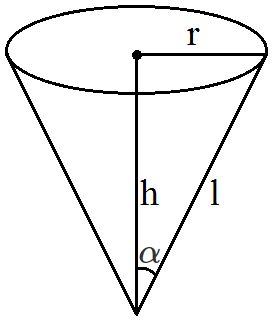
Then, $\tan\alpha = \text{rh}$
$\Rightarrow\sec2\alpha\text{d}\alpha\text{dt}=\text{dr}\text{h }\text{dt}$
$\Rightarrow\text{dr }\text{dt}=\text{h}\times\sec2\alpha\text{d}\alpha\text{dt}$
$\Rightarrow\text{dr }\text{dt}=20\times\sec230\times2 $
$\therefore\text{h}=20, \alpha=30^{\circ}$ and per second
$\Rightarrow\text{dr }\text{dt}=40\times232$
$\Rightarrow\text{dr }\text{dt}=\frac{160}{3}\text{cm}/\text{sec}.$ View full question & answer→MCQ 131 Mark
The radius of a sphere is changing at the rate of $0.1\text{cm}/\sec.$ The rate of change of its surface area when the radius is $200\ cm$ is:
AnswerCorrect option: C. $160\pi\text{cm}^2/\sec.$
Let $r$ be the radius and $S$ be the surface area of the sphere at any time $t.$
Then, $\text{S}=4\pi\text{r}^2$
$\Rightarrow\frac{\text{dS}}{\text{dt}}=8\pi\text{r}\frac{\text{dr}}{\text{dt}}$
$\Rightarrow\frac{\text{dS}}{\text{dt}}=8\pi(200)(0.1)$
$\Rightarrow\frac{\text{dS}}{\text{dt}}=160\pi\text{ cm}^2/\sec.$
View full question & answer→MCQ 141 Mark
The volume of a sphere is increasing at the rate of $4\pi\text{cm}^{3}/\text{sec}$. The rate of increase of the radius when the volume is $288\pi\text{cm}^{3}/\text{sec}$ is:
- A
$\frac{1}{4}$
- B
$\frac{1}{12}$
- ✓
$\frac{1}{36}$
- D
$\frac{1}{9}$
AnswerCorrect option: C. $\frac{1}{36}$
$\text{v}=\frac{4}{3}\pi\text{r}^{3}$
$\frac{4}{3}\pi\text{r}^{3}=288\pi$
$\text{r}^{3}=288\times\frac{3}{4}$
$\text{r}^{3}=216$
$\text{v}=\frac{4}{3}\pi\text{r}^{3}$
$\frac{\text{dv}}{\text{dt}}=4\pi \text{r}^{2}\frac{\text{dr}}{\text{dt}}$
$\frac{\text{dv}}{\text{dt}}=4\pi(6)^{2}\frac{\text{dr}}{\text{dt}}$
$4\pi=144\pi\frac{\text{dr}}{\text{dt}}$
$\frac{\text{dr}}{\text{dt}}=\frac{4}{144}$
$=\frac{1}{36}$
View full question & answer→MCQ 151 Mark
The coordinates of the point on the ellipse $16x^2+ 9y^2= 400$ where the ordinate decreases at the same rate at which the abscissa increases, are:
- ✓
$ (3, \frac{16}{3})$
- B
$ (-3, \frac{16}{3})$
- C
$ (3, -\frac{16}{3})$
- D
$ (3, -3)$
AnswerCorrect option: A. $ (3, \frac{16}{3})$
According to the question,
$\frac{\text{dy}}{\text{dt}}=\frac{-\text{dx}}{\text{dt}}$
$16\text{x}^{2}+9\text{y}^{2}=400$
$\Rightarrow32\text{x}\frac{\text{dx}}{\text{dt}}+18\text{y}\frac{\text{dy}}{\text{dt}}=0$
$\Rightarrow32\text{x}\frac{\text{dx}}{\text{dt}}=-18\text{y}\frac{\text{dy}}{dt}$
$\Rightarrow32\text{x}=18\text{y}$
$\Rightarrow\text{x}=\frac{9\text{y}}{16} ...(\text{i}) $
Now,
$16\Big(\frac{9\text{y}}{16}\Big)^{2}+9\text{y}^{2}=400$
$\Rightarrow\frac{81\text{y}^{2}}{16}+9\text{y}^{2}=400$
$\Rightarrow81\text{y}^{2}+144\text{y}^{2}=6400$
$\Rightarrow225\text{y}^{2}=6400$
$\Rightarrow\text{y}^{2}=\frac{6400}{225}$
$\Rightarrow\text{y}=\sqrt{\frac{6400}{225}}$
$\Rightarrow\text{y}=\frac{16}{3}$ and $-\frac{16}{3}$
So, $\text{x}=\frac{9}{16}\times\frac{16}{3}$ [Using (1)]
Or $\text{x}=-\frac{9}{16}\times\frac{16}{3}$
$\Rightarrow\text{x}=3 \text{ or} -3$
So, the required point is $(3, \frac{16}{3}).$
View full question & answer→MCQ 161 Mark
For what valuse of $x$ is the rate of increase of $x^3 - 5x^2 + 5x + 8$ is twice the rate of increase of $x$?
- A
$-3, -\frac{1}{3}$
- B
$-3, \frac{1}{3}$
- C
$3, -\frac{1}{3}$
- ✓
$3, \frac{1}{3}$
AnswerCorrect option: D. $3, \frac{1}{3}$
Let, $\text{y}=\text{x}^{3}-5\text{x}^{2}+5\text{x}+8$
Differentiating with respect yo $t,$
$\frac{\text{dy}}{\text{dt}}=(3\text{x}^{2}-10\text{x}+5)\frac{\text{dx}}{\text{dt}}$
Given that twice of rate of increase in x euals rate of increase in $x,$
$\Rightarrow\frac{\text{dx}}{\text{dt}}=2\frac{\text{dx}}{\text{dt}}$
$\Rightarrow(3\text{x}^{2}-10\text{x}+5)\frac{\text{dx}}{\text{dt}}=2\frac{\text{dx}}{\text{dt}}$
$\Rightarrow3\text{x}^{2}-10\text{x}+5=2$
$\Rightarrow\text{x}=3$ or $\text{x}=\frac{1}{3}$
View full question & answer→MCQ 171 Mark
In a sphere the rate of change of surface area is:
- A
$8\pi$ times the rate of change of diameter.
- B
$2\pi$ times the rate of change of diameter.
- C
$2\pi$ times the rate of change of radius.
- ✓
$8\pi$ times the rate of change of radius.
AnswerCorrect option: D. $8\pi$ times the rate of change of radius.
$\text{S}=4\pi\text{r}^{2}$
$\frac{\text{dS}}{\text{dt}}=8\pi\frac{\text{dr}}{\text{dt}}$
The rate of surface area is $8\pi$ times the rate of change of the radius.
View full question & answer→MCQ 181 Mark
A cone whose height is always equal to its diameter is increasing in volume at the rate of $40\ cm^3/ \sec$. At what rate is the radius increasing when its circular base area is $1m^2$?
- A
$1\ mm/ \sec.$
- B
$0.001\ cm/ \sec.$
- C
$2\ mm/ \sec.$
- ✓
$0.002\ cm/ \sec.$
AnswerCorrect option: D. $0.002\ cm/ \sec.$
$\text{V} = \frac{1}{3} \pi \text{r}^{2}\text{h}$
Given that height is equals diamiter.
$\Rightarrow \text{h} = 2\text{r}$
$\text{V} = \frac{1}{3} \pi\text{r}^{2}\text{2r}$
$\text{V} = \frac{2}{3} \pi\text{r}^{3}$
$\Rightarrow \frac{\text{dV}}{\text{dt}} = 2\pi\text{r}^{2} \frac{\text{dr}}{\text{dt}}$
$\Rightarrow \frac{\text{dr}}{\text{dt}} = \frac{1}{2\times10^{4}} \times40 \ \ \begin{pmatrix}\because \pi\text{r}^{2} = 1\text{m}^{2}\\\Rightarrow1\text{m}^{2} = 10^{4} \text{cm}^{2} \end{pmatrix}$
$\Rightarrow \frac{\text{dr}}{\text{dt}} = \frac{1}{2\times10^{4}} \times40 = 0.002\text{cm}/\sec.$
View full question & answer→MCQ 191 Mark
A cylindrical tank of radius $10m$ is being filled with wheat at the rate of $314$ cubic metre per hour. Then the depth of the wheat is increasing at the rate of:
- ✓
$1\text{m}/\text{hr}$
- B
$0.1\text{m}/\text{hr}$
- C
$1.1\text{m}/\text{hr}$
- D
$0.5\text{m}/\text{hr}$
AnswerCorrect option: A. $1\text{m}/\text{hr}$
$\text{V}=\pi\text{r}^{2}\text{h}$
$\Rightarrow\frac{\text{dV}}{\text{dt}}=\pi\text{r}^{2}\frac{\text{dh}}{dt}$
$\Rightarrow314=3.14\times100\times\frac{\text{dh}}{\text{dt}}$
$\Rightarrow\frac{\text{dh}}{\text{dt}}=1\text{m}/\text{hr}$
View full question & answer→MCQ 201 Mark
If the rate of change of area of a circle is equal to the rate of change of its diameter, then its radius is equal to:
- A
$\frac{2}{\pi}\ \text{unit}$
- ✓
$\frac{1}{\pi}\ \text{unit}$
- C
$\frac{\pi}{2}\ \text{unit}$
- D
$\pi \ \text{unit}$
AnswerCorrect option: B. $\frac{1}{\pi}\ \text{unit}$
$\text{A}=\pi\text{r}^{2}$
$\frac{\text{dA}}{\text{dt}}=2\pi\text{r}\frac{\text{dr}}{\text{dt}} ...(\text{i})$
$\text{D}=2\text{r} (D$ is diameter of the circle.$)$
$\frac{\text{dD}}{\text{dt}}=2\frac{\text{dr}}{\text{dt}} ...(\text{ii})$
Given that $\frac{\text{dA}}{\text{dt}}=\frac{\text{dD}}{\text{dt}}$
$2\pi\text{r}\frac{\text{dr}}{\text{dt}}=2\frac{\text{dD}}{\text{dt}}$
$2\pi\text{r}=2$
$\text{r}=\frac{1}{\pi}\ \text{unit}$
View full question & answer→MCQ 211 Mark
Each side of equilateral is increasing at the rate of $8\ cm/hr.$ The rate of increase of its area when side $2\ cm,$ is:
- ✓
$8\sqrt{3}\text{cm}^{2}/\text{hr}$
- B
$4\sqrt{3}\text{cm}^{2}/\text{hr}$
- C
$\frac{\sqrt{3}}{8}\text{cm}^{2}/\text{hr}$
- D
$\text{None of these.}$
AnswerCorrect option: A. $8\sqrt{3}\text{cm}^{2}/\text{hr}$
$\text{A}=\frac{\sqrt{3}}{4}\times2$
$\frac{\text{dA}}{\text{dt}}=\frac{\sqrt{3}}{2}\times\frac{\text{dx}}{\text{dt}}$
$\frac{\text{dA}}{\text{dt}}=\frac{\sqrt{3}}{2}\times2\times8$
$=8\sqrt{3}\text{cm}^{2}/\text{hr}$
View full question & answer→MCQ 221 Mark
A cylindrical vessel of radius $0.5m$ is filled with oil at the rate of $0.25\pi/\text{minute}$. The rate at which the surface of the oil is rising, is:
- ✓
$1\text{m/ minute}$
- B
$2\text{m/ minute}$
- C
$5\text{m/ minute}$
- D
$0.25\text{m/ minute}$
AnswerCorrect option: A. $1\text{m/ minute}$
$\text{V}=\pi\text{r}^2\text{h}$
$\Rightarrow\frac{\text{dV}}{\text{dt}}=\pi\text{r}^2\frac{\text{dh}}{\text{dt}}$
$\Rightarrow\frac{\text{dh}}{\text{dt}}=\frac{1}{\pi\text{r}^2}\frac{\text{dV}}{\text{dt}}$
$\Rightarrow\frac{\text{dh}}{\text{dt}}=\frac{1}{\pi(0.5)^2}\times(0.5)^2\pi$
$\Rightarrow\frac{\text{dh}}{\text{dt}}=1\text{m}/\sec.$
View full question & answer→MCQ 231 Mark
In a sphere the rate of change of volume is:
AnswerCorrect option: C. Surface area times the rate of change of radius.
Let $r$ be the redius $V$ be the volume of sphere at any time $t.$
Then, $\text{V}=\frac{4}{3}\pi\text{r}^{3}$
$\Rightarrow\frac{\text{dv}}{\text{dt}}=\frac{4}{3}(3\pi\text{r}^{2})\Big(\frac{\text{dr}}{\text{dt}}\Big)$
$\Rightarrow\frac{\text{dv}}{\text{dt}}=4\pi\text{r}^{2}\Big(\frac{\text{dr}}{\text{dt}}\Big)$
Thus, the rate of change of volume is surface area times the rate of change of the radius.
View full question & answer→MCQ 241 Mark
The radius of a sphere is increasing at the rate of $0.2\ \text{cm/sec.}$ The rate at which the volume of the sphere increase when radius is $15\ cm,$ is:
- A
$12\pi\ \text{cm}^{3}/\text{sec}.$
- ✓
$180\pi\ \text{cm}^{3}/\text{sec}.$
- C
$225\pi\ \text{cm}^{3}/\text{sec}.$
- D
$3\pi\ \text{cm}^{3}/\text{sec}.$
AnswerCorrect option: B. $180\pi\ \text{cm}^{3}/\text{sec}.$
$\text{v}=\frac{4}{3}\pi\text{r}^{3}$
$\Rightarrow\frac{\text{dv}}{\text{dt}}=4\pi\text{r}^{2}\frac{\text{dr}}{\text{dt}}$
$\Rightarrow\frac{\text{dv}}{\text{dt}}=4\pi(15)^{2}\times0.2$
$=180\pi \ \text{cm}^{3}/\text{sec}.$
View full question & answer→MCQ 251 Mark
A man $2$ metres tall walks away from a lamp post $5$ metres height at the rate of $4.8\ km/hr.$ The rate of increase of the length of his shadow is:
- A
$1.6\text{km}/\text{hr}$
- B
$6.3\text{km}/\text{hr}$
- C
$5\text{km}/\text{hr}$
- ✓
$3.2\text{km}/\text{hr}$
AnswerCorrect option: D. $3.2\text{km}/\text{hr}$
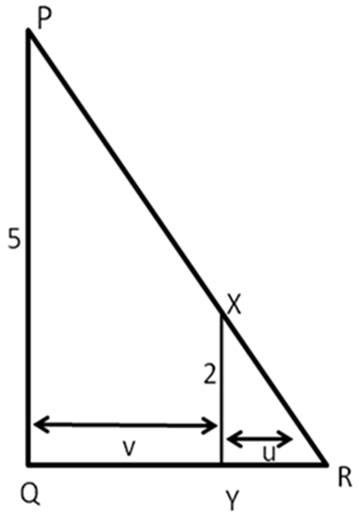
Since, $\triangle\text{P}\text{Q}\text{R}$ and $\triangle\text{X}\text{Y}\text{R}$ are similar.
$\Rightarrow\frac{\text{PQ}}{\text{XY}}=\frac{\text{QR}}{\text{YR}}$
$\Rightarrow\frac{5}{2}=\frac{\text{u+v}}{\text{u}}$
$\Rightarrow\frac{5}{2}=1-\frac{\text{v}}{\text{u}}$
$\Rightarrow\frac{\text{v}}{\text{u}}=\frac{3}{2}$
$\Rightarrow\text{u}=\frac{2}{3}\text{v}$
$\Rightarrow\frac{\text{du}}{\text{dt}}=\frac{2}{3}\frac{\text{dv}}{\text{dt}}$
$\Rightarrow\frac{\text{du}}{\text{dt}}=\frac{2}{3}\times4.8$
$=3.2\text{km}/\text{hr}$ View full question & answer→MCQ 261 Mark
If $\text{V}=\frac{4}{3}\pi\text{r}^3,$ at What rate in cubic units is $V$ increasing when $\text{r}=10\frac{\text{dr}}{\text{dt}}=0.01?$
- A
$\pi$
- ✓
$4\pi$
- C
$40\pi$
- D
$4=\frac{\pi}{3}$
AnswerCorrect option: B. $4\pi$
Given: $\text{V}=\frac{4}{3}\pi\text{r}^3,\text{and } \frac{\text{dr}}{\text{dt}}=0.01$
$\frac{\text{dV}}{\text{dt}}=4\pi\text{r}^2\frac{\text{dr}}{\text{dt}}$
$\frac{\text{dV}}{\text{dt}}=4\pi(10)^2\times0.01$
$\frac{\text{dV}}{\text{dt}}=4\pi$
View full question & answer→