MCQ 11 Mark
The range of the function $\text{f(x)}=^{7-\text{x}}\text{P}_{\text{x}-3}$ is:
- A
$\{1, 2, 3, 4, 5\}$
- B
$\{1, 2, 3, 4, 5, 6\}$
- C
$\{1, 2, 3, 4\}$
- ✓
$\{1, 2, 3\}$
AnswerCorrect option: D. $\{1, 2, 3\}$
We know that
$7-\text{x}>0;\ \text{x}-3\geq0$ and $7-\text{x}\geq\text{x}-3$
$\Rightarrow\ \text{x}<7;\ \text{x}\geq3$ and $2\text{x}\leq10$
$\Rightarrow\ \text{x}<7;\ \text{x}\geq3$ and $\text{x}\leq5$
Therefore, $x = 3, 4, 5$
Range of $\text{f}=\Big\{^{(7-3)}\text{P}_{(3-3)},\ ^{(7-4)}\text{P}_{(4-3)},\ ^{(5-3)}\text{P}_{(7-5)}\Big\}$
$= \{4P_0, 3P_1, 2P_2\}$
$= {1, 3, 2}$
$= {1, 2, 3}$
View full question & answer→MCQ 21 Mark
Let $\text{A}=\{\text{x}\in\text{R}:-1\leq\text{x}\leq1\}=\text{B}.$ Then, the mapping $f : A \rightarrow B$ given by $f(x) = x|x|$ is:
- A
Injective but not surjective.
- B
Surjective but not injective.
- ✓
- D
AnswerGiven function is $\text{A}=\{\text{x}:-1\leq\text{x}\leq1\}$ and $f : A \rightarrow A$ such that $f(x) = x|x|$
For the mod function we have to check three cases as $x < 0, x = 0, x > 0.$
For example, $x < 0$
$f(x) = x|x| < 0$
$|x| = -x$
$y = -x^2$
$\text{x}=-\sqrt{-\text{y}}$ which is not possible for $x > 0$
Hence, $f$ is onto.
$\Rightarrow f$ is bijection.
View full question & answer→MCQ 31 Mark
If $f: R \rightarrow R$ is given by $f(x)=x^3+3$, then $f^{-1}(x)$ is equal to:
AnswerCorrect option: C. $(\text{x}-3)^\frac{1}{3}$
Let $f^{-1}(x) = y$
$f(y) = x$
$\Rightarrow y^3 + 3 = x$
$\Rightarrow y^3 = x - 3$
$\Rightarrow y = (x - 3)^3$
$\Rightarrow\ \text{y}=(\text{x}-3)^\frac{1}{3}$
View full question & answer→MCQ 41 Mark
Let $\text{f(x)}=\frac{1}{1-\text{x}}.$ Then, $\{fo(fof)\}(x):$
- A
$x$ for all $\text{x}\in\text{R}$
- B
$x$ for all $\text{x}\in\text{R}-\{1\}$
- ✓
$x$ for all $\text{x}\in\text{R}-\{0,1\}$
- D
AnswerCorrect option: C. $x$ for all $\text{x}\in\text{R}-\{0,1\}$
Domain of $f: 1-\text{x}\neq0$
$\Rightarrow\ \text{x}\neq1$
Domain of $f = R - {1}$
Range of $f: \text{y}=\frac{1}{1-\text{x}}$
$\Rightarrow\ 1-\text{x}=\frac{1}{\text{y}}$
$\Rightarrow\ \text{x}=1-\frac{1}{\text{y}}$
$\Rightarrow\ \text{y}\neq0$
Range of $f = R - \{0\}$
So, $f : R - \{1\} \rightarrow R - \{0\}$ and $f : R - \{1\} \rightarrow R - \{0\}$
Range of $f$ is not a subset of the domain of $f.$
Domain $(fof) = \{x : \text{x}\in$ domain of $f$ and $\text{f(x)}\in$ domain of $f\}$
Domain $(fof) =\big\{\text{x}:\text{x}\in\text{R}-\{1\}\text{ and }\frac{1}{1-\text{x}}\in\text{R}-\{1\}\big\}$
Domain $(fof) =\big\{\text{x}:\text{x}\neq1\text{ and }\frac{1}{1-\text{x}}\neq1\big\}$
Domain $(fof) =\{\text{x}:\text{x}\neq1\text{ and }1-\text{x}\neq1\}$
Domain $(fof) =\{\text{x}:\text{x}\neq1\text{ and }\text{x}\neq0\}$
Domain $(fof) = R - \{0, 1\}$
$(fof)(x) = f(f(x))$
$=\text{f}\Big(\frac{1}{1-\text{x}}\Big)=\frac{1}{1-\frac{1}{1-\text{x}}}=\frac{1-\text{x}}{1-\text{x}-1}$
$=\frac{1-\text{x}}{-\text{x}}=\frac{\text{x}-1}{\text{x}}$
For range of fof, $\text{x}\neq0$
Now, $fof : R \rightarrow \{0, 1\} \rightarrow R - \{0\}$ and $f : R - {1} \rightarrow R - \{0\}$
Range of $fof$ is not a subset of domain of $f.$
Domain $(fo(fof)) =\{\text{x}:\text{x}\in$ domain of fof and $(fof)(x) \in$ domain of $f\}$
Domain $(fo(fof)) =\Big\{\text{x}:\text{x}\in\text{R}-\{0,1\}\text{ and }\frac{\text{x}-1}{\text{x}}\in\text{R}-\{1\}\Big\}$
Domain $(fo(fof)) =\Big\{\text{x}:\text{x}\neq0,1\text{ and }\frac{\text{x}-1}{\text{x}}\neq1\Big\}$
Domain $(fo(fof)) =\{\text{x}:\text{x}\neq0,1\text{ and }\text{x}-1\neq\text{x}\}$
Domain $(fo(fof)) =\{\text{x}:\text{x}\neq0,1\text{ and }\text{x}\in\text{R}\}$
Domain $(fo(fof)) = R - \{0, 1\}$
Domain $(fo(fof)) = f((fof)(x))$
$=\text{f}\Big(\frac{\text{x}-1}{\text{x}}\Big)$
$=\frac{1}{1-\frac{\text{x}-1}{\text{x}}}$
$=\frac{\text{x}}{\text{x}-\text{x}+1}$
$=\text{x}$
So, $(fo(fof))(x) = x,$ where $\text{x}\neq0,1$
View full question & answer→MCQ 51 Mark
If $g(x)=x^2+x-2$ and $\frac{1}{2} g \circ f(x)=2 x^2-5 x+2$, then $f(x)$ is equal to:
- ✓
$2x - 3$
- B
$2x + 3$
- C
$2x^2 + 3x + 1$
- D
$2x^2 - 3x - 1$
AnswerCorrect option: A. $2x - 3$
We will solve this problem by the trial$-$and$-$error method.
Let us check option $(a)$ first.
If $f(x) = 2x - 3$
$\frac{1}{2}(\text{gof})(x)=\text{g(f(x))}$
$=\frac{1}{2}\text{g}(2\text{x}-3)$
$=\frac{1}{2}\big[(2\text{x}-3)^2+(2\text{x}-3)-2\big]$
$=\frac{1}{2}[4\text{x}^2+9-12\text{x}+2\text{x}-3-2]$
$=\frac{1}{2}[4\text{x}^2-10\text{x}+4]$
$=2\text{x}^2-5\text{x}+2$
The given condition is satisfied by $(a).$
View full question & answer→MCQ 61 Mark
The distinct linear functions that map $[-1, 1]$ onto $[0, 2]$ are:
- A
$f(x) = x + 1, g(x) = -x + 1$
- B
$f(x) = x - 1, g(x) = x + 1$
- ✓
$f(x) = -x - 1, g(x) = x - 1$
- D
AnswerCorrect option: C. $f(x) = -x - 1, g(x) = x - 1$
Since f is invertible, range of f = co-domain of $f = x$
So, we need to find the range of f to find $X$.
For finding the range, let $f(x) = y$
$\Rightarrow 4x - x^2 = y$
$\Rightarrow x^2 - 4x = -y$
$\Rightarrow x^2 - 4x + 4 = 4 - y$
$\Rightarrow (x - 2)^2 = 4 - y$
$\Rightarrow\ \text{x}-2=\pm4-\text{y}$
$\Rightarrow\ \text{x}=2\pm4-\text{y}$
This is defined only when $4-\text{y}\geq0$
$\Rightarrow\ \text{y}\leq4,$
X = Range of f $=(-\infty,4]$
View full question & answer→MCQ 71 Mark
The function $\text{f}:[0,\infty)\rightarrow\ \text{R}$ given by $\text{f(x)}=\frac{\text{x}}{\text{x}+1}$ is:
- A
One$-$one and onto.
- ✓
One$-$one but not onto.
- C
Onto but not one$-$one.
- D
Onto but not one$-$one.
AnswerCorrect option: B. One$-$one but not onto.
Given function is $\text{f(x)}=\frac{\text{x}}{\text{x}+1}$ on $\text{f}:[0,\infty)\rightarrow\ \text{R}$
If $f(x) = f(y)$
$\Rightarrow\ \frac{\text{x}}{\text{x}+1}=\frac{\text{y}}{\text{y}+1}$
$\Rightarrow xy + x = xy + y$
$\Rightarrow x = y$
Hence, $f$ is one$-$one.
If $y = f(x)$
$\text{y}=\frac{\text{x}}{\text{x}+1}$
$\Rightarrow xy + y = x$
$\Rightarrow xy - x = -y$
$x(y - 1) = -y$
$\text{x}=\frac{-\text{y}}{\text{y}-1}\neq\text{f(x)}$
It is not onto.
View full question & answer→MCQ 81 Mark
Let $f : R \rightarrow R$ be defined as $\text{f(x)}=\begin{cases}2\text{x},&\text{if x}>3\\\text{x}^2,&\text{if }1<\text{x}\leq3\\3\text{x},&\text{if x}\leq1\end{cases}.$ Then, find $f(-1) + f(2) + f(4)$:
AnswerWe have,
$\text{f(x)}=\begin{cases}2\text{x},&\text{if x}>3\\\text{x}^2,&\text{if }1<\text{x}\leq3\\3\text{x},&\text{if x}\leq1\end{cases}$
Now,
$f(-1) + f(2) + f(4)$
$= 3(-1) + 2^2 + 2(4)$
$= -3 + 4 + 8$
$= 9$
View full question & answer→MCQ 91 Mark
Let $f : R \rightarrow R$ be given by $f(x) = [x^2] + [x + 1] - 3$ where $[x]$ denotes the greatest integer less than or equal to $x$. Then, $f(x)$ is:
- A
Many$-$one and onto.
- ✓
Many$-$one and into.
- C
One$-$one and into.
- D
One$-$one and onto.
AnswerCorrect option: B. Many$-$one and into.
$f : R \rightarrow R$
$= [x^2] + [x + 1] - 3$
It is many one function because in this case for two different values of $x$ we would get the same value of $f(x)$.
For $\text{x}=1.1,\ 1.2\in\text{R}$
$f(1.1) = (1.1)^2 + [1.1 + 1] - 3$
$= [1.21] + [2.1] - 3$
$= 1 + 2 + 3 = 0$
$f(1.1) = [1.2]^2 + [1.2 + 1] - 3$
$= [1.44] + [2.2] - 3$
$= 1 + 2 - 3$
$= 0$
It is into function because for the given domain we would only get the integral values of $f(x)$.
But $R$ is the co-domain of the given function.
That means, $\text{Co-domain}\neq\text{Range}$
Hence, the given function is into function.
Therefore, $f(x)$ is many one and into.
View full question & answer→MCQ 101 Mark
The function $f : R \rightarrow R$ defined by $f(x) = (x - 1)(x - 2)(x - 3)$ is:
AnswerCorrect option: B. Onto but not one$-$one.
Given function is $f(x) = (x - 1)(x - 2)(x - 3)$
If $f(x) = f(y)$ then
$(x - 1)(x - 2)(x - 3) = (y - 1)(y - 2)(y - 3)$
$\Rightarrow f(1) = f(2) = f(3) = 0$
It is not one$-$one.
$y = f(x)$
$\text{x}\in\text{R}$ also $\text{y}\in\text{R}$ hence $f$ is onto.
View full question & answer→MCQ 111 Mark
$f : R \rightarrow R$ is defined by $\text{f(x)}=\frac{\text{e}^{\text{x}^2}-\text{e}^{-\text{x}^2}}{\text{e}^{\text{x}^2}+\text{e}^{-\text{x}^2}}$ is:
AnswerCorrect option: D. Neither one$-$one nor onto.
We have,
$\text{f(x)}=\frac{\text{e}^{\text{x}^2}-\text{e}^{-\text{x}^2}}{\text{e}^{\text{x}^2}+\text{e}^{-\text{x}^2}}$
Here, $-2,2\in\text{R}$
Now, $2\neq-2$
But, $f(2) = f(-2)$
Therefore, function is not one-one.
And,
The minimum value of the function is $0$ and maximum value is $1.$
That is range of the function is $[0, 1]$ but the co$-$domain of the function is given $R.$
Therefore, function is not onto.
$\therefore$ function is neither one$-$one nor onto.
View full question & answer→MCQ 121 Mark
Let $\text{A}=\{\text{x}\in\text{R}:\text{x}\geq1\}.$ The inverse of the function $f : A \rightarrow A$ given by $\text{f(x)}=2^{\text{x}(\text{x}-1)},$ is:
- A
$\big(\frac{1}{2}\big)^{\text{x}(\text{x}-1)}$
- ✓
$\frac{1}{2}\big\{1+\sqrt{1+4\log_2\text{x}}\big\}$
- C
$\frac{1}{2}\big\{1-\sqrt{1+4\log_2\text{x}}\big\}$
- D
$\text{Not defined}$
AnswerCorrect option: B. $\frac{1}{2}\big\{1+\sqrt{1+4\log_2\text{x}}\big\}$
Given function is $\text{A}=\{\text{x}\in\text{R}:\text{x}\geq1\}.$
The inverse of the function $f : A \rightarrow A$ given by $\text{f(x)}=2^{\text{x}(\text{x}-1)}$
$\text{f(x)}=\text{y}$
$2^{\text{x}(\text{x}-1)}=\text{y}$
$\text{x}(\text{x}-1)=\log_2\text{y}$
$\text{x}^2+\text{x}=\log_2\text{y}$
$\text{x}^2+\text{x}+\frac{1}{4}=\log_2\text{y}+\frac{1}{4}$
$\Big(\text{x}-\frac{1}{2}\Big)^2=\frac{4\log_2\text{y}+1}{4}$
$\text{x}-\frac{1}{2}=\pm\sqrt{\frac{4\log_2\text{y}+1}{4}}$
$\text{x}=\frac{1}{2}\pm\sqrt{\frac{4\log_2\text{y}+1}{4}}$
$\text{x}=\frac{1}{2}+\sqrt{\frac{4\log_2\text{y}+1}{4}}$
$\text{f}^{-1}(\text{x})=\frac{1+\sqrt{4\log_2\text{y}+1}}{2}$
View full question & answer→MCQ 131 Mark
Which of the following functions form $Z$ to itself are bijections?
- A
$f(x) = x^3$
- ✓
$f(x) = x + 2$
- C
$f(x) = 2x + 1$
- D
$f(x) = x^2 + x$
AnswerCorrect option: B. $f(x) = x + 2$
$a.\ f$ is not because for $\text{y}=3\in\text{Co-domain (Z)},$ there is no value of $\text{x}\in\text{Domain (Z)}$
$\text{x}^3=3$
$\Rightarrow\ \text{x}=\sqrt[3]{3}\notin\text{Z}$
$\Rightarrow f$ is not onto.
So, $f$ is not a bijection.
$b.$ Injectivity: Let $x$ and $y$ be two elements of the domain $(Z)$, such that
$x + 2 = y + 2$
$\Rightarrow x = y$
So, f is one$-$one.
Surjectivity: Let $y$ be an element in the co$-$domain $(Z)$, such that
$y = f(x)$
$\Rightarrow y = x + 2$
$\Rightarrow\ \text{x}=\text{y}-2\in\text{Z} ($Domain$)$
$\Rightarrow f$ is onto.
So, $f$ is a bijection.
$c. f(x) = 2x + 1$ is not onto because if we take $4\in\text{Z} ($co domain$)$, then $4 = f(x)$
$\Rightarrow4 = 2\text{x} + 1$
$\Rightarrow 2\text{x} = 3$
$\Rightarrow\ \text{x}=\frac{3}{2}\notin\text{Z}$
So, $f$ is not a bijection.
$d. f(0) = 0^2 + 0 = 0$
$\Rightarrow $ and $f(-1) = (-1)^2 + (-1) = 1 - 1 = 0$
$\Rightarrow 0$ and $-1$ have the same image.
$\Rightarrow f$ is not one$-$one.
So, $f$ is not a bijection.
View full question & answer→MCQ 141 Mark
If the function $f : R \rightarrow R$ be such that $f(x) = x - [x]$, where $[x]$ denotes the greatest integer less than or equal to $x$, then $f^{-1}(x)$ is:
AnswerGiven function is $f(x) = x - [x]$
$[x]$ is a greatest integer function.
Hence, we will have same values of the function for the different values of $x.$
As we are considering integer only not fraction part.
Hence, it is not defined.
View full question & answer→MCQ 151 Mark
If the set $A$ contains $5$ elements and the set $B$ contains $6$ elements, then the number of one$-$one and onto mappings from $A$ to $B$ is:
AnswerAs, the number of bijection from $A$ into $B$ can only be possible when provided $\frac{7}{(\text{A})}>\frac{7}{(\text{B})}$
But here $n(A) < n(B)$
So, the number of bijection.
i.e. one$-$one and onto mapping from $A$ to $B.$
View full question & answer→MCQ 161 Mark
Let $g(x) = 1 + x - [x]$ and $\text{f(x)}=\begin{cases}-1,&\text{x}<0\\0,&\text{x}=0\\1,&\text{x}>0\end{cases}$ where $[x]$ denotes the greatest integer less than or equal to $x.$ Then for all $x, f(g(x))$ is equal to:
AnswerWhen, $-1 < x < 0$
Then, $g(x) = 1 + x - [x]$
$= 1 + x - (-1) = 2 + x$
$\therefore f(g(x)) = 1$
When, $x = 0$
Then, $g(x) = 1 + x - [x]$
$= 1 + x - 0 = 1 + x$
$\therefore f(g(x)) = 1$
When, $x > 1$
Then, $g(x) = 1 + x - [x]$
$= 1 + x - 1 = x$
$\therefore f(g(x)) = 1$
Therefore, for each interval $f(g(x)) = 1$
View full question & answer→MCQ 171 Mark
If $f : R \rightarrow (-1, 1)$ is defined by $\text{f(x)}=\frac{-\text{x}|\text{x}|}{1+\text{x}^2},$ then $f^{-1}(x)$ equals,
- A
$\sqrt{\frac{|\text{x}|}{1-|\text{x}|}}$
- ✓
$-\text{Sgn (x)}\sqrt{\frac{|\text{x}|}{1-|\text{x}|}}$
- C
$-\sqrt{\frac{\text{x}}{1-\text{x}}}$
- D
$\text{None of these}$
AnswerCorrect option: B. $-\text{Sgn (x)}\sqrt{\frac{|\text{x}|}{1-|\text{x}|}}$
Given function is $f : R \rightarrow (-1, 1)$ is defined by $\text{f(x)}=\frac{-\text{x}|\text{x}|}{1+\text{x}^2}$
Here, for mod function we will have to consider three cases as,
$x < 0, x = 0, x > 0$
$x < 0 \Rightarrow |x| = -x$
$\text{f(|x|)}=\frac{-\text{x}(-\text{x})}{1+\text{x}^2}$
$\text{y}=\frac{\text{x}^2}{1+\text{x}^2}$
$\text{y}(1+\text{x}^2)=\text{x}^2$
$\text{y}+\text{yx}^2=\text{x}^2$
$\text{y}=\text{x}^2-\text{yx}^2$
$\text{y}=(1-\text{y})\text{x}^2$
$\text{x}^2=\frac{\text{y}}{1-\text{y}}$
$\text{x}=-\sqrt{\frac{\text{y}}{1-\text{y}}}$
$\Rightarrow\ \text{x}=-\sqrt{\frac{|\text{y}|}{1-|\text{y}|}}\ \text{x} < 0$
Also you can check for the cases $x = 0$ and $x > 0$ that $\text{x}=-\sqrt{\frac{|\text{y}|}{1-|\text{y}|}}$
$-\text{Sgn (x)}\sqrt{\frac{|\text{x}|}{1-|\text{x}|}}$
View full question & answer→MCQ 181 Mark
Let $\text{f(x)}=\frac{\alpha\text{x}}{\text{x}+1},\ \text{x}\neq-1.$ Then, for what value of $\alpha$ is $f(f(x)) = x?$
- A
$\sqrt{2}$
- B
$-\sqrt{2}$
- C
$1$
- ✓
$-1$
AnswerGiven function is $\text{f(x)}=\frac{\alpha\text{x}}{\text{x}+1},\ \text{x}\neq-1$
Also $f(f(x)) = x$
$\text{f}\Big(\frac{\alpha\text{x}}{\text{x}+1}\Big)=\text{x}$
$\frac{\alpha\big(\frac{\alpha\text{x}}{\text{x}+1}\big)}{\frac{\alpha\text{x}}{\text{x}+1}+1}=\text{x}$
$\frac{\alpha^2\text{x}}{\alpha\text{x}+\text{x}+1}=\text{x}$
$\alpha^2=\alpha\text{x}+\text{x}+1$
$\alpha^2=(\alpha+1)\text{x}+1$
Comparing on both sides,
$\alpha+1=0$
$\Rightarrow\ \alpha=-1$
View full question & answer→MCQ 191 Mark
Let $A = \{1, 2, ......., n\}$ and $B = \{a, b\}$. Then the number of subjections from $A$ into $B$ is:
- A
$^{\text{n}}\text{P}_2$
- ✓
$2^\text{n}-2$
- C
$2^\text{n}-1$
- D
$^{\text{n}}\text{C}_2$
AnswerCorrect option: B. $2^\text{n}-2$
The number of functions from a set with $n$ number of elements into a set with $2$ number of elements $= 2^n$
But two functions can be many$-$one into function.
View full question & answer→MCQ 201 Mark
The function $f : R \rightarrow R$ defined by $f(x) = 6^x + 6^{|x|}$ is:
- A
One$-$one and onto.
- B
- C
One$-$one and into.
- ✓
AnswerGraph of the given function is as follows:
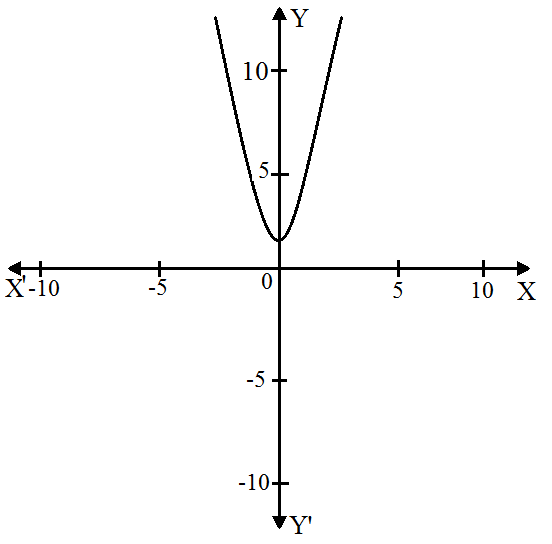
A line parallel to $X-$axis is cutting the graph at two different values.
Therefore, for two different values of $x$ we are getting the same value of $y.$
That means it is many one function.
From the given graph we can see that the range is $[2,\infty)$ and $R$ is the co$-$domain of the given function.
Hence, Co$-$dornain $=$ Range
Therefore, the given function is into. View full question & answer→MCQ 211 Mark
Let $f : R \rightarrow R$ be a function defined by $\text{f(x)}=\frac{\text{e}^{|\text{x}|}-\text{e}^{-\text{x}}}{\text{e}^{\text{x}}+\text{e}^{-\text{x}}}.$ Then,
- A
$f$ is a bijection.
- B
$f$ is an injection only.
- C
$f$ is surjection on only.
- ✓
$f$ is neither an injection nor a surjection.
AnswerCorrect option: D. $f$ is neither an injection nor a surjection.
$f : R \rightarrow R$
$\text{f(x)}=\frac{\text{e}^{|\text{x}|}-\text{e}^{-\text{x}}}{\text{e}^{\text{x}}+\text{e}^{-\text{x}}}$
For $x = -2$ and $-3 \in\text{R}$
$\text{f(-2)}=\frac{\text{e}^{|-2|}-\text{e}^2}{\text{e}^{-2}+\text{e}^2}$
$=\frac{\text{e}^2-\text{e}^2}{\text{e}^{-2}+\text{e}^2}$
$=0$
Hence, for different values of $x$ we are getting same values of $f(x)$
That means, the given function is many one.
Therefore, this function is not injective.
For $x < 0$
$f(x) = 0$
For $x > 0$
$\text{f(x)}=\frac{\text{e}^{\text{x}}-\text{e}^{-\text{x}}}{\text{e}^{\text{x}}+\text{e}^{-\text{x}}}$
$=\frac{\text{e}^{\text{x}}+\text{e}^{-\text{x}}}{\text{e}^{\text{x}}+\text{}e^{-\text{x}}}-\frac{2\text{e}^{-\text{x}}}{\text{e}^{\text{x}}+\text{e}^{-\text{x}}}$
$=1-\frac{2\text{e}^{-\text{x}}}{\text{e}^{\text{x}}+\text{e}^{-\text{x}}}$
The value of $\frac{2\text{e}^{-\text{x}}}{\text{e}^{\text{x}}+\text{e}^{-\text{x}}}$ is always positive.
Therefore, the value of $f(x)$ is always less than $1.$
Numbers more than $1$ are not included in the range but they are included in co$-$domain.
As the codomain is $R.$
$\therefore\ \text{Co-domain}\neq\text{Range}$
Hence, the given function is not onto.
Therefore, this function is not surjective.
View full question & answer→MCQ 221 Mark
The function $f : A \rightarrow B$ defined by $f(x) = -x^2 + 6x- 8$ is a bijection if,
- ✓
$\text{A}=(-\infty,3]$ and $\text{B}=(-\infty,1]$
- B
$\text{A}=[-3,\infty)$ and $\text{B}=(-\infty,1]$
- C
$\text{A}=(-\infty,3]$ and $\text{B}=[1,\infty)$
- D
$\text{A}=[3,\infty)$ and $\text{B}=[1,\infty)$
AnswerCorrect option: A. $\text{A}=(-\infty,3]$ and $\text{B}=(-\infty,1]$
$f(x) = -x^2 + 6x - 8$, is a polynomial function and the domain of polynomial function is real number.
$\therefore\ \text{x}\in\text{R}$
$f(x) = -x^2 + 6x - 8$
$= -(x^2 - 6x + 8)$
$= -(x^2 - 6x + 9 - 1)$
$= -(x - 3)^2 + 1$
Maximum value of $-(x - 3)^2$ woud be $0$
$\therefore$ Maximum value of $-(x - 3)^2 + 1$ woud be $1$
$\therefore\ \text{f(x)}\in(-\infty,1]$
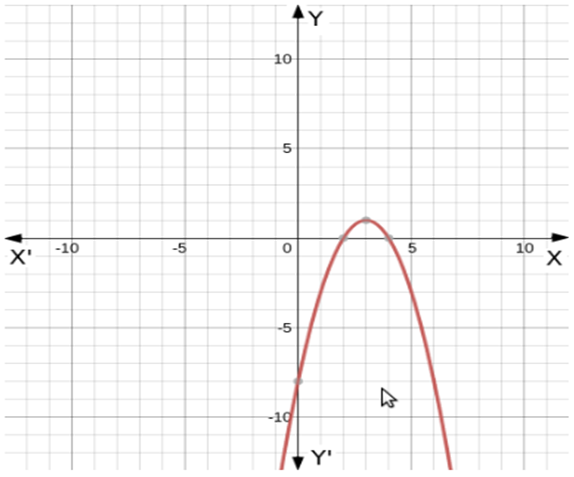
We can see from the given graph that function is symmetrical about $x = 3$ and the given function is bijective.
So, x would be either $(-\infty,3]\text{ or }[3,\infty)$
The correct option which satisfy $A$ and $B$ both is:
$\text{A}=(-\infty,3]$ and $\text{B}=(-\infty,1]$ View full question & answer→MCQ 231 Mark
Let $f(x) = x^2$ and $g(x) = 2^x$ Then, the solution set of the equation $fog(x) = gof(x)$ is:
AnswerCorrect option: C. ${0, 2}$
Since $(fog)(x) = (gof)(x),$
$f(g(x)) = g(f(x))$
$\Rightarrow\ \text{f}(2^\text{x})=\text{g}(\text{x}^2)$
$\Rightarrow\ \big(2^{\text{x}}\big)^{2}=2^{\text{x}^2}$
$\Rightarrow\ 2^{2\text{x}}=2^{\text{x}^2}$
$\Rightarrow\ \text{x}^2=2\text{x}$
$\Rightarrow\ \text{x}^2-2\text{x}=0$
$\Rightarrow\ \text{x}(\text{x}-2)=0$
$\Rightarrow\ \text{x}=0, 2$
$\Rightarrow\ \text{x}\in\{0,2\}$
View full question & answer→MCQ 241 Mark
Let $f : R \rightarrow R$ be given by $\text{f(x)}=\tan\text{x}.$ Then, $f^{-1}(1)$ is:
AnswerCorrect option: B. $\big\{\text{n}\pi+\frac{\pi}{4}:\text{n}\in\text{Z}\big\}$
We have, $f : R \rightarrow R$ is given by
$\text{f(x)}=\tan\text{x}$
$\Rightarrow\ \text{f}^{-1}(\text{x})=\tan^{-1}\text{x}$
$\therefore\ \text{f}^{-1}(1)=\tan^{-1}1$
$=\big\{\text{n}\pi+\frac{\pi}{4}:\text{n}\in\text{Z}\big\}$
View full question & answer→MCQ 251 Mark
Let $f(x) = x^3$ be a function with domain $\{0, 1, 2, 3\}$. Then domain of $f^{-1}$ is:
- A
$\{3, 2, 1, 0\}$
- B
$\{0, -1, -2, -3\}$
- ✓
$\{0, 1, 8, 27\}$
- D
$\{0, -1, -8, -27\}$
AnswerCorrect option: C. $\{0, 1, 8, 27\}$
Given function is $f(x) = x^3$ be a function with domain $\{0, 1, 2, 3\}.$
Range $= \{0, 1^3, 2^3, 3^3\} = \{0, 1, 8, 27\}$
$f$ can be written as
$\{(0, 0), (1, 1), (2, 8), (3, 27)\}$
Hence, $f^{-1}$ can be written as
$\{(0, 0), (1, 1), (8, 2), (27, 3)\}$
Domain of $f^{-1}$ is $\{0, 1, 8, 27\}$
View full question & answer→MCQ 261 Mark
Let $f : Z \rightarrow Z$ be given by $\text{f(x)}=\begin{cases}\frac{\text{x}}{2},&\text{if x is even}\\0,&\text{if x is odd}\end{cases}.$ Then, $f$ is:
AnswerCorrect option: A. Onto but not one$-$one.
Given function is
$\text{f(x)}=\frac{\text{x}}{2}$ if x is even
$= 0$ if $x$ is odd
For $f(3) = 0$ and $f(4) = 0$
$\Rightarrow f(3) = f(4)$
But, $3\neq4$
Hence, it is not one$-$one.
$\text{x}\in\text{R}\Rightarrow\ \text{y}\in\text{R}$
Here, Domain $=$ range of $f$
Hence, it is onto.
View full question & answer→MCQ 271 Mark
The function $f : R \rightarrow R, f(x) = x^2$ is:
- A
Injective but not surjective.
- B
Surjective but not injective.
- C
Injective as well as surjective.
- ✓
Neither injective nor surjective.
AnswerCorrect option: D. Neither injective nor surjective.
Given function is $f : R \rightarrow R, f(x) = x^2$
If $f(x) = f(y)$ then
$x^2 = y^2$
$\Rightarrow\ \text{x}\pm\text{y}$
Hence, it is not one$-$one or injective.
$f(x) = y$
$y = x^2$
$\text{x}=\pm\sqrt{\text{y}}$
But co$-$domain is $R.$
Hence, it is not onto or surjective.
View full question & answer→MCQ 281 Mark
Which of the following functions from $\text{A}=\{\text{x}:-1\leq\text{x}\leq1\}$ to itself are bijections?
AnswerCorrect option: B. $\text{g(x)}=\sin\big(\frac{\pi\text{x}}{2}\big)$
$i.$ Range of $\text{f}=\Big[\frac{-1}{2},\frac{1}{2}\Big]\neq\text{A}$
So, $f$ is not a bijection.
$ii.$ Range $=\Big[\sin\Big(\frac{-\pi}{2}\Big),\ \sin\Big(\frac{\pi}{2}\Big)\Big]=[-1,1]=\text{A}$
So, g is a bijection.
$iii.h(-1) = |-1| = 1$
And $h(1) = |1| = 1$
$\Rightarrow -1$ and $1$ have the same images.
So, $h$ is not a bijection.
$iv. k(-1) = (-1)^2 = 1$
And $k(1) = (1)^2 = 1$
$\Rightarrow -1$ and $1$ have the same images.
So, $k$ is not a bijection.
View full question & answer→MCQ 291 Mark
The function $f : R \rightarrow R$ defined by $f(x) = 2^x + 2^{|x|}$ is:
- A
One$-$one and onto.
- ✓
Many$-$one and onto.
- C
One$-$one and into.
- D
Many$-$one and into.
AnswerCorrect option: B. Many$-$one and onto.
Many$-$one and onto.
View full question & answer→MCQ 301 Mark
If $\text{F}:[1,\infty)\rightarrow[2,\infty)$ is given by $\text{f(x)}=\text{x}+\frac{1}{\text{x}},$ then $f^{-1}(x)$ equals:
- ✓
$\frac{\text{x}+\sqrt{\text{x}^2-4}}{2}$
- B
$\frac{\text{x}}{1+\text{x}^2}$
- C
$\frac{\text{x}-\sqrt{\text{x}^2-4}}{2}$
- D
$1+\sqrt{\text{x}^2-4}$
AnswerCorrect option: A. $\frac{\text{x}+\sqrt{\text{x}^2-4}}{2}$
Let $f^{-1}(x) = y$
$\Rightarrow\ \text{f(y)} = \text{x}$
$\Rightarrow\ \text{y}+\frac{1}{\text{y}}=\text{x}$
$\Rightarrow\ \text{y}^2 + 1 = \text{xy}$
$\Rightarrow\ \text{y}^2 - \text{xy} + 1 = 0$
$\Rightarrow\ \text{y}^2-2\times\text{y}\times\frac{\text{x}}{2}+\big(\frac{\text{x}}{2}\big)^2-\big(\frac{\text{x}}{2}\big)^2+1=0$
$\Rightarrow\ \text{y}^2-2\times\text{y}\times\frac{\text{x}}{2}+\big(\frac{\text{x}}{2}\big)^2=\frac{\text{x}^2-1}{4}$
$\Rightarrow\ \Big(\text{y}-\frac{\text{x}}{2}\Big)^2=\frac{\text{x}^2-1}{4}$
$\Rightarrow\ \text{y}-\frac{\text{x}}{2}=\frac{\sqrt{\text{x}^2-4}}{2}$
$\Rightarrow\ \text{y}=\frac{\text{x}}{2}+\frac{\sqrt{\text{x}^2-4}}{2}$
$\Rightarrow\ \text{y}=\frac{\text{x}+\sqrt{\text{x}^2-4}}{2}$
$\Rightarrow\ \text{f}^{-1}(\text{x})=\frac{\text{x}+\sqrt{\text{x}^2-4}}{2}$
View full question & answer→MCQ 311 Mark
Let $f : R \rightarrow R$ be a function defined by $\text{f(x)}=\frac{\text{x}^2-8}{\text{x}^2+2}.$ Then, $f$ is:
AnswerCorrect option: D. Neither one$-$one nor onto.
Injectivity: Let $x$ and $y$ be two elements in the domain $(R)$, such that
$f(x) = f(y)$
$\frac{\text{x}^2-8}{\text{x}^2+2}=\frac{\text{y}^2-8}{\text{y}^2+2}$
$\Rightarrow (x^2 - 8)(y^2 + 2) = (y^2 - 8)(x^2 + 2)$
$\Rightarrow x^2y^2 + 2x^2 - 8y^2 - 16 = x^2y^2 + 2y^2 - 8x^2 - 16$
$\Rightarrow 10x^2 = 10y^2$
$\Rightarrow x^2 = y^2$
$\Rightarrow\ \text{x}=\pm\text{y}$
So, $f$ is not one$-$one.
Surjectivity: $\text{f}(-1)=\frac{(-1)^2-8}{(-1)^2+2}=\frac{1-8}{1+2}=\frac{-7}{3}$
and $\text{f(1)}=\frac{(1)^2-8}{(1)^2+2}=\frac{1-8}{1+2}=\frac{-7}{3}$
$\Rightarrow\ \text{f}(-1)=\text{f}(1)=\frac{-7}{3}$
$\Rightarrow f$ is not onto.
View full question & answer→MCQ 321 Mark
Let [x] denote the greatest integer less than or equal to $x$. If $f(x) = \sin^{-1}x$, $g(x) = [x^2]$ and $\text{h(x)}=2\text{x},\frac{1}{2}\leq\text{x}\leq\frac{1}{\sqrt{2}},$ then
- A
$\text{fogoh(x)}=\frac{\pi}{2}$
- B
$\text{fogoh(x)}=\pi$
- ✓
$\text{hofog}=\text{hogof}$
- D
$\text{hofog}\neq\text{hogof}$
AnswerCorrect option: C. $\text{hofog}=\text{hogof}$
$hogof(x) = h(f(g(x)))$
$= h(f([x]))$
$= h(\sin^{-1}[x])$
$= 2sin^{-1}[x]$
$= 2 \times 0 = 0$
$f(x) = \sin^{-1}x$
$hogof(x) = hogo(x) = 0$
View full question & answer→MCQ 331 Mark
$f : R \rightarrow R$ given by $\text{f(x)}=\text{x}+\sqrt{\text{x}^2}$ is:
Answer$\text{f(x)}=\text{x}+\sqrt{\text{x}^2}=\text{x}\pm\text{x}=0\text{ or }2\text{x}$
$\Rightarrow$ Each element of the domain has $2$ images.
$f$ is not a function.
View full question & answer→MCQ 341 Mark
Let $\text{A}=\{\text{x}:-1\leq\text{x}\leq1\}$ and $f : A \rightarrow A$ such that $\text{f(x)}=\text{x}|\text{x}|,$ then f is:
- ✓
- B
Injective but not surjective.
- C
Surjective but not injective.
- D
Neither injective nor surjective.
AnswerGiven function is $\text{A}=\{\text{x}:-1\leq\text{x}\leq1\}$ and $f : A \rightarrow A$ such that $\text{f(x)}=\text{x}|\text{x}|$
For the mod function we have to check three cases as $x < 0, x = 0, x > 0.$
For example,
$x < 0$
$f(x) = x|x| < 0$
$|x| = -x$
$y = -x^2$
$\text{x}=-\sqrt{-\text{y}}$ which is not possible for $x > 0$
Hence, $f$ is onto.
$\Rightarrow f$ is bijection.
View full question & answer→MCQ 351 Mark
Let $f : R - {n} \rightarrow R$ be a function defined by $\text{f(x)}=\frac{\text{x}-\text{m}}{\text{x}-\text{n}},$ where $\text{m}\neq\text{n.}$ Then,
- A
$f$ is one$-$one onto.
- ✓
$f$ is one$-$one into.
- C
$f$ is many one onto.
- D
$f$ is many one into.
AnswerCorrect option: B. $f$ is one$-$one into.
Given function $f : R - {n} \rightarrow R$ be a function defined by $\text{f(x)}=\frac{\text{x}-\text{m}}{\text{x}-\text{n}},\ \text{m}\neq\text{n}$
If $f(x) = f(y)$ then
$\frac{\text{x}-\text{m}}{\text{x}-\text{n}}=\frac{\text{y}-\text{m}}{\text{y}-\text{n}}$
$\Rightarrow (x - m)(y - n) = (y - m)(x - n)$
After solving this we will get $x = y$
Hence, it is one$-$one.
$\text{f(x)}=\frac{\text{x}-\text{m}}{\text{x}-\text{n}},\ \text{m}\neq\text{n}$
$\text{y}=\frac{\text{x}-\text{m}}{\text{x}-\text{n}}$
$\Rightarrow y(x - n) = x - m$
$\Rightarrow yx - yn = x - m$
$\Rightarrow yx - x = ny - m$
$\Rightarrow x(y - 1) = ny - m$
$\Rightarrow\ \text{x}=\frac{\text{ny}-\text{m}}{\text{y}-1}$
Here, for $y = 1$ we can not define $x.$
Hence, it is not onto.
View full question & answer→MCQ 361 Mark
If a function $\text{f}:[2,\infty)\rightarrow\ \text{B}$ defined by $f(x) = x^2 - 4x + 5$ is a bijection, then $B =$
- A
$\text{R}$
- ✓
$[1,\infty)$
- C
$[4,\infty)$
- D
$[5,\infty)$
AnswerCorrect option: B. $[1,\infty)$
Since $f$ is a bijection, co-domain of $f =$ range of $f$
$\Rightarrow B$ = range of $f$
Given: $f(x) = x^2 - 4x + 5$
Let $f(x) = y$
$\Rightarrow y = x^2 - 4x + 5$
$\Rightarrow x^2 - 4x + (5 - y) = 0$
$\because$ Discrimant, $\text{D}=\text{b}^2-4\text{ac}\geq0,$
$(-4)^2-4\times1\times(5-\text{y})\geq0$
$\Rightarrow\ 16-20+4\text{y}\geq0$
$\Rightarrow\ 4\text{y}\geq4$
$\Rightarrow\ \text{y}\geq1$
$\Rightarrow\ \text{y}\in[1,\infty)$
$\Rightarrow $ Range of $\text{f}=[1,\infty)$
$\Rightarrow\ \text{B}=[1,\infty)$
View full question & answer→MCQ 371 Mark
Which of the following functions from $\text{A}=\{\text{x}\in\text{R}:-1\leq\text{x}\leq1\}$ to itself are bijections?
AnswerCorrect option: B. $\text{f(x)}=\sin\frac{\pi\text{x}}{2}$
It is clear that $f(x)$ is one$-$one.
Range of $\text{f}=\Big[\sin\frac{\pi(-1)}{2},\sin\frac{\pi(1)}{2}\Big]$
$=\Big[\sin\frac{-\pi}{2},\sin\frac{\pi}{2}\Big]$
$= A =$ Co$-$domain of $f$
$\Rightarrow f$ is onto.
So, $f$ is a bijection.
View full question & answer→MCQ 381 Mark
If the set $A$ contains $7$ elements and the set $B$ contains $10$ elements, then the number one$-$one functions from $A$ to $B$ is:
AnswerCorrect option: B. $^{10}\text{C}_7\times7!$
As, the number of one$-$one functions from $A$ to $B$ with $m$ and $n$ elements,
respectively $= \ ^{\text{n}}\text{P}_\text{m}=\ ^{\text{n}}\text{C}_\text{m}\times\text{m}!$
So, the number of one$-$one functions from $A$ to $B$ with $7$ and $10$ elements,
respectively $=\ ^{10}\text{P}_7=\ ^{10}\text{C}_7\times7!$
View full question & answer→MCQ 391 Mark
If $f(x) = \sin^2x$ and the composite function $\text{g(f(x))} = |\sin\text{x}|,$ then $g(x)$ is equal to:
- A
$\sqrt{\text{x}-1}$
- ✓
$\sqrt{\text{x}}$
- C
$\sqrt{\text{x}+1}$
- D
$-\sqrt{\text{x}}$
AnswerCorrect option: B. $\sqrt{\text{x}}$
Given that $\text{f(x)}=\sin^2\text{x}$ and the composite function $\text{g(f(x))}=|\sin\text{x}|$
We will do it using trial and error method.
If we take $\text{g(x)}=-\sqrt{\text{x}}$ and $\text{f(x)}=\sin^2\text{x}$
$\text{g(f(x))}=\text{g}(\sin^2\text{x})$
$=-\sin\text{x}$
Which contradicts to the $\text{g(f(x))}=|\sin\text{x}|$
Hence, we take $\text{g(x)}=\sqrt{\text{x}}$
$\text{g(f(x))}=\text{g}(\sin^2\text{x})$
$=\sqrt{\sin^2\text{x}}=|\sin\text{x}|$
View full question & answer→MCQ 401 Mark
A function $f$ from the set of natural numbers to integers defined by $\text{f(n)}=\begin{cases}\frac{\text{n}-1}{2},&\text{when n is odd}\\-\frac{\text{n}}{2},&\text{when n is even}\end{cases}$
AnswerCorrect option: D. One$-$one and onto both.
Injectivity: Let $x$ and $y$ be any two elements in the domain $(N).$
Case$-1:$ Both $x$ and $y$ are even.
Let $f(x) = f(y)$
$\Rightarrow\ \frac{-\text{x}}{2}=\frac{-\text{y}}{2}$
$\Rightarrow-\text{x}=-\text{y}$
$\Rightarrow\ \text{x}=\text{y}$
Case$-2:$ Both $x$ and $y$ are odd.
Let $f(x) = f(y)$
$\Rightarrow\ \frac{\text{x}-1}{2}=\frac{\text{y}-1}{2}$
$\Rightarrow\ \text{x}-1=\text{y}-1$
$\Rightarrow\ \text{x}=\text{y}$
Case$-3:$ Let $x$ be even and $y$ be odd.
Then, $\text{f(x)}=\frac{-\text{x}}{2}$ and $\text{f(y)}=\frac{\text{y}-1}{2}$
Then, clearly
$\text{x}\neq\text{y}$
$\Rightarrow\ \text{f(x)}\neq\text{f(y)}$
From all the cases, $f$ is one$-$one.
Surjectivity: Co$-$domain of $f = Z = \{......, -3, -2, -1, 0, 1, 2, 3, ......\}$
Range of $\text{f}=\Big\{....,\ \frac{-3-1}{2},\ \frac{-(-2)}{2},\ \frac{-1-1}{2},\ \frac{0}{2},\ \frac{1-1}{2},\ \frac{-2}{2},\ \frac{3-1}{2},\ ....\Big\}$
$\Rightarrow$ Range of $f = \{....., -2, 1, -1, 0, 0, -1, 1, .....\}$
$\Rightarrow$ Range of $f = \{....., -2, -1, 0, 1, 2, ......\}$
$\Rightarrow$ Co$-$domain of $f =$ Range of $f$
$\Rightarrow f$ is onto.
View full question & answer→MCQ 411 Mark
Let $M$ be the set of all $2 \times 2$ matrices with entries from the set $R$ of real numbers. Then, the function $f : M\rightarrow R$ defined by $f(A) = |A|$ for every $A \in M,$ is:
AnswerCorrect option: D. Onto but not one$-$one.
$\text{M}=\begin{Bmatrix}\text{A}=\begin{bmatrix}\text{a}&\text{b}\\\text{c}&\text{d}\end{bmatrix}:\text{a, b, c, d}\in\text{R}\end{Bmatrix}$
$f : M \rightarrow R$ is given by $f(A) = |A|$
Injectivity: $\text{f}\begin{pmatrix}\begin{bmatrix}0&0\\0&0\end{bmatrix}\end{pmatrix}=\begin{vmatrix}0&0\\0&0\end{vmatrix}=0$
and $\text{f}\begin{pmatrix}\begin{bmatrix}1&0\\0&0\end{bmatrix}\end{pmatrix}=\begin{vmatrix}1&0\\0&0\end{vmatrix}=0$
$\Rightarrow\ \text{f}\begin{pmatrix}\begin{bmatrix}0&0\\0&0\end{bmatrix}\end{pmatrix}=\text{f}\begin{pmatrix}\begin{bmatrix}1&0\\0&0\end{bmatrix}\end{pmatrix}=0$
So, $f$ is not one$-$one.
Surjectivity: Let $y$ be an element of the co$-$domain, such that
$\text{f(A)}=-\text{y},\ \text{A}=\begin{bmatrix}\text{a} & \text{b} \\\text{c} & \text{d} \end{bmatrix}$
$\Rightarrow\ \begin{vmatrix}\text{a}&\text{b}\\\text{c}&\text{d}\end{vmatrix}=\text{y}$
$\Rightarrow\ \text{ad}-\text{bc}=\text{y}$
$\Rightarrow\ \text{a, b, c, d}\in\text{R}$
$\Rightarrow\ \text{A}=\begin{bmatrix}\text{a} & \text{b} \\\text{c} & \text{d} \end{bmatrix}\in\text{M}$
$\Rightarrow f$ is onto.
View full question & answer→MCQ 421 Mark
A function $f$ from the set of natural numbers to the set of integers defined by $\text{f(n)}\begin{cases}\frac{\text{n}-1}{2},&\text{when n is odd}\\-\frac{\text{n}}{2},&\text{when n is even}\end{cases}$ is:
AnswerCorrect option: D. One$-$one and onto.
Given function is,
$\text{f(n)}=\frac{\text{n}-1}{2}$ for $n$ is odd
$=-\frac{\text{n}}{2}$ for $n$ is even
For $n$ is odd,
If $f(n) = f(m)$ then
$\frac{\text{n}-1}{2}=\frac{\text{m}-1}{2}$
$\Rightarrow n = m$
Also, for $n$ is even if $f(n) = f(m)$ then $n = m$
Hence, $f$ is one$-$one.
Also, each element of $y$ is associated with at least one element of $x,$
$f$ is onto.
View full question & answer→MCQ 431 Mark
The function $\text{f}:\Big[\frac{-1}{2},\frac{1}{2},\frac{1}{2}\Big]\rightarrow\ \Big[\frac{-\pi}{2},\frac{\pi}{2}\Big],$ defined by $\text{f(x)}=\sin^{-1}(3\text{x}-4\text{x}^3),$ is:
- ✓
- B
Injection but not a surjection.
- C
Surjection but not an injection.
- D
Neither an injection nor a surjection.
Answer$\text{f(x)}=\sin^{-1}(3\text{x}-4\text{x}^3)$
$\Rightarrow\ \text{f(x)}=3\sin^{-1}\text{x}$
Injectivity: Let $x$ and $y$ be two elements in the domain $\Big[\frac{-1}{2},\frac{1}{2}\Big],$ such that
$f(x) = f(y)$
$\Rightarrow\ 3\sin^{-1}\text{x}=3\sin^{-1}\text{y}$
$\Rightarrow\ \sin^{-1}\text{x}=\sin^{-1}\text{y}$
$\Rightarrow\ \text{x}=\text{y}$
So, $f$ is one$-$one.
Surjectivity: Let $y$ be any element in the co$-$domain, such that
$f(x) = y$
$\Rightarrow\ 3\sin^{-1}\text{x}=\text{y}$
$\Rightarrow\ \sin^{-1}\text{x}=\frac{\text{y}}{3}$
$\Rightarrow\ \text{x}=\sin\frac{\text{y}}{3}\in\Big[\frac{-1}{2},\frac{1}{2}\Big]$
$\Rightarrow f$ is onto.
$\Rightarrow f$ is a bijection.
View full question & answer→MCQ 441 Mark
Let $f$ be an injective map with domain $\{x, y, z\}$ and range $\{1, 2, 3\}$, such that exactly one of the following statements is correct and the remaining are false. $\text{f(x)}=1,\ \text{f(y)}\neq1,\ \text{f(z)}\neq2.$ The value of $f^{-1}(1)$ is:
AnswerGiven that $f$ be an injective map with domain $\{x, y, z\}$ and range $\{1, 2, 3\}$
$f(x) = 1 , \text{f(y)}\neq1,\ \text{f(z)}\neq2$
As $f(x) = 1 $
$\Rightarrow f^{-1}(1) = y$
View full question & answer→MCQ 451 Mark
Let $\text{A}=\{\text{x}\in\text{R}:\text{x}\leq1\}$ and $f : A \rightarrow A$ be defined as $f(x) = x(2 - x)$. Then $f^{-1}(x)$ is:
- A
$1+\sqrt{1-\text{x}}$
- ✓
$1-\sqrt{1-\text{x}}$
- C
$\sqrt{1-\text{x}}$
- D
$1\pm\sqrt{1-\text{x}}$
AnswerCorrect option: B. $1-\sqrt{1-\text{x}}$
Let $y$ be the element in the co$-$domain $R$ such that $f^{-1}(x) = y ......(1)$
$\Rightarrow f(y) = x$ and $\text{y}\leq1$
$\Rightarrow y(2 - y) = x$
$\Rightarrow 2y - y^2 = x$
$\Rightarrow y^2 - 2y + x = 0$
$\Rightarrow y^2 - 2y = -x$
$\Rightarrow y^2 - 2y + 1 = 1 - x$
$\Rightarrow (\text{y}-1)^2=\sqrt{1-\text{x}}$
$\Rightarrow \text{y}-1=\pm\sqrt{1-\text{x}}$
$\Rightarrow \text{y}=1\pm\sqrt{1-\text{x}}$
$\Rightarrow \text{y}=1-\sqrt{1-\text{x}}$
$(\because\ \text{y}\leq1)$
View full question & answer→MCQ 461 Mark
Let $f : R \rightarrow R$ be given by $f(x) = x^2 - 3$. Then, $f^{-1}$ is given by:
- A
$\sqrt{\text{x}+3}$
- B
$\sqrt{\text{x}}+3$
- C
$\text{x}+\sqrt{3}$
- ✓
AnswerGiven function is $f : R \rightarrow R$ be given by $f(x) = x^2 - 3.$
$\text{y} = \text{x}^2 - 3$
$\text{y} + 3 = \text{x}^2$
$\text{x}=\pm\sqrt{\text{y}+3}$
$\Rightarrow\ \text{y}=\pm\sqrt{\text{x}+3}$
View full question & answer→MCQ 471 Mark
Let the function $f : R - \{-b\} \rightarrow R - {1}$ be defined by $\text{f(x)}=\frac{\text{x}+\text{a}}{\text{x}+\text{b}},\ \text{a}\neq\text{b}.$ Then,
- A
$f$ is one$-$one but not onto.
- B
$f$ is onto but not one$-$one.
- ✓
$f$ is both one$-$one and onto.
- D
AnswerCorrect option: C. $f$ is both one$-$one and onto.
Injectivity: Let $x$ and $y$ be two elements in the domain $R - \{-b\},$ such that
$f(x) = f(y) \Rightarrow x + ax + b = y + ay + b$
$\Rightarrow x + ay + b = x + by + a$
$\Rightarrow xy + bx + ay + ab = xy + ax + by + ab$
$\Rightarrow bx + ay = ax + by$
$\Rightarrow a - bx = a - by$
$\Rightarrow x = y$
So, $f$ is one$-$one.
Surjectivity: Let $y$ be an element in the co$-$domain of $f,$
i.e., $R - {1},$ such that $f(x) = y$
$\Rightarrow x + ax + b = y$
$\Rightarrow x + a$
$\Rightarrow x = -a$
So, $f$ is onto.
View full question & answer→MCQ 481 Mark
The inverse of the function $\text{f}:\text{R}\rightarrow\{\text{x}\in\text{R}:\text{x}<1\}$ given by $\text{f(x)}=\frac{\text{e}^{\text{x}}-\text{e}^{-\text{x}}}{\text{e}^\text{x}+\text{e}^{-\text{x}}}$ is:
- ✓
$\frac{1}{2}\log\frac{1+\text{x}}{1-\text{x}}$
- B
$\frac{1}{2}\log\frac{2+\text{x}}{2-\text{x}}$
- C
$\frac{1}{2}\log\frac{1-\text{x}}{1+\text{x}}$
- D
$\text{None of these}$
AnswerCorrect option: A. $\frac{1}{2}\log\frac{1+\text{x}}{1-\text{x}}$
Let $f^{-1}(x) = y .....(1)$
$\Rightarrow\ \text{f(y)}=\text{x}$
$\Rightarrow\ \frac{\text{e}^{\text{y}}-\text{e}^{-\text{y}}}{\text{e}^{\text{y}}+\text{e}^{-\text{y}}}=\text{x}$
$\Rightarrow\ \frac{\text{e}^{-\text{y}}(\text{e}^{2\text{y}}-1)}{\text{e}^{-\text{y}}(\text{e}^{2\text{y}}+1)}=\text{x}$
$\Rightarrow\ (\text{e}^{2\text{y}}-1)=\text{x}(\text{e}^{2\text{y}}+1)$
$\Rightarrow\ \text{e}^{2\text{y}}-1=\text{xe}^{2\text{y}}+\text{x}$
$\Rightarrow\ \text{e}^{2\text{y}}=\frac{1+\text{x}}{1-\text{x}}$
$\Rightarrow\ 2\text{y}=\log_\text{e}\Big(\frac{1+\text{x}}{1-\text{x}}\Big)$
$\Rightarrow\ \text{y}=\frac{1}{2}\log_\text{e}\Big(\frac{1+\text{x}}{1-\text{x}}\Big)$
$\Rightarrow\ \text{f}^{-1}(\text{x})=\frac{1}{2}\log_\text{e}\Big(\frac{1+\text{x}}{1-\text{x}}\Big) [$From $(1)]$
View full question & answer→MCQ 491 Mark
If $f : R \rightarrow R$ is given by $f(x) = 3x - 5$, then $f^{-1}(x)$
- A
is given by $\frac{1}{3\text{x}-5}$
- ✓
is given by $\frac{\text{x}+5}{3}$
- C
does not exist because $f$ is not one$-$one.
- D
does not exist because $f$ is not onto.
AnswerCorrect option: B. is given by $\frac{\text{x}+5}{3}$
Given function is $f : R \rightarrow R$ is given by $f(x) = 3x - 5$
To find $f^{-1}(x)$
$y = f(x)$
$\Rightarrow y = 3x - 5$
$\Rightarrow y + 5 = 3x$
$\Rightarrow\ \text{y}=\frac{\text{y}+5}{3}$
Hence, $\text{f}^{-1}(\text{x})=\frac{\text{x}+5}{3}$
View full question & answer→MCQ 501 Mark
If the function $f : R \rightarrow A$ given by $\text{f(x)}=\frac{\text{x}^2}{\text{x}^2+1}$ is a surjection, then $A =$
- A
$R$
- B
$[0, 1]$
- C
$[0, 1)$
- ✓
$[0, 1)$
AnswerCorrect option: D. $[0, 1)$
As $f$ is surjective, range of $f =$ co$-$domain of $f$
$\Rightarrow A =$ range of $f$
$=\frac{\text{x}^2}{\text{x}^2+1},$
$\text{y}=\frac{\text{x}^2}{\text{x}^2+1}$
$\Rightarrow\ \text{y}(\text{x}^2+1)$
$\Rightarrow\ \text{x}^2=\frac{-\text{y}}{(\text{y}-1)}$
$\Rightarrow\ \text{x}=\sqrt{\frac{\text{y}}{(1-\text{y})}}$
$\Rightarrow\ \frac{\text{y}}{(1-\text{y})}\geq0$
$\Rightarrow\ \text{y}\in[0,1)$
$\Rightarrow$ Range of $f = [0, 1)$
$\Rightarrow A = [0, 1)$
View full question & answer→MCQ 511 Mark
Let $\text{A}=\{\text{x}\in\text{R}:-1\leq\text{x}\leq1\}=\text{B}$ and $\text{C}=\{\text{x}\in\text{R}:\text{x}\geq0\}$ and let $\text{S}=\{(\text{x, y})\in\text{A}\times\text{B}:\text{x}^2+\text{y}^2=1\}$ and $\text{S}_0=\{(\text{x, y})\in\text{A}\times\text{C}:\text{x}^2+\text{y}^2=1\}.$ Then,
- ✓
$S$ defines a function from $A$ to $B.$
- B
$S_0$ defines a function from $A$ to $C.$
- C
$S_0$ defines a function from $A$ to $B.$
- D
$S$ defines a function from $A$ to $C.$
AnswerCorrect option: A. $S$ defines a function from $A$ to $B.$
Given that $\text{A}=\{\text{x}\in\text{R}:-1\leq\text{x}\leq1\}=\text{B}$ and $\text{C}=\{\text{x}\in\text{R}:\text{x}\geq0\}$ and $\text{S}=\{(\text{x, y})\in\text{A}\times\text{B}:\text{x}^2+\text{y}^2=1\}$ and $\text{S}_0=\{(\text{x, y})\in\text{A}\times\text{C}:\text{x}^2+\text{y}^2=1\}$
$\text{x}^2+\text{y}^2=1$
$\Rightarrow\ \text{y}^2=1-\text{x}^2$
$\Rightarrow\ \text{y}=\sqrt{1-\text{x}^2}$
$\text{y}\in\text{B}$
Hence, S defines a function from $A$ to $B$.
View full question & answer→MCQ 521 Mark
Let $\text{f}:\text{R}-\Big\{\frac{3}{5}\Big\}\rightarrow\ \text{R}$ be defined by $\text{f(x)}=\frac{3\text{x}+2}{5\text{x}-3}.$ Then,
AnswerCorrect option: A. $f^{-1}(x) = f(x)$
Given function is $\text{f}:\text{R}-\Big\{\frac{3}{5}\Big\}\rightarrow\ \text{R}$ be defined by $\text{f(x)}=\frac{3\text{x}+2}{5\text{x}-3}$
$fof(x) = f(f(x))$
$=\text{f}\Big(\frac{3\text{x}+2}{5\text{x}-3}\Big)$
$=\frac{3\big(\frac{3\text{x}+2}{5\text{x}-3}\big)+2}{5\big(\frac{3\text{x}+2}{5\text{x}-3}\big)-3}$
After solving you will get
$f(f(x)) = x$
Also,$f^{-1}(x) = f(x)$ you can check.
View full question & answer→MCQ 531 Mark
If $f : A \rightarrow B$ given by $3^{f(x)} + 2^{-x} = 4$ is a bijection, then
- A
$\text{A}=\{\text{x}\in\text{R}:-1<\text{x}<\infty\},$ $\text{B}=\{\text{x}\in\text{R}:2<\text{x}<4\}$
- B
$\text{A}=\{\text{x}\in\text{R}:-3<\text{x}<\infty\},$ $\text{B}=\{\text{x}\in\text{R}:2<\text{x}<4\}$
- C
$\text{A}=\{\text{x}\in\text{R}:-2<\text{x}<\infty\},$ $\text{B}=\{\text{x}\in\text{R}:2<\text{x}<4\}$
- ✓
$\text{None of these.}$
AnswerCorrect option: D. $\text{None of these.}$
$\text{f}:\text{A}\rightarrow\text{B}$
$3^\text{f(x)}+2^{-\text{x}}=4$
$\Rightarrow\ 3^{\text{f(x)}}=4-2^{-\text{x}}$
Taking log on both the sides,
$\text{f(x)}\log3=\log(4-2^{-\text{x}})$
$\Rightarrow\ \text{f(x)}=\frac{\log(4-2^{-\text{x}})}{\log3}$
Logaritmic function will only be defined if $4-2^{-\text{x}}>0$
$\Rightarrow\ 4>2^{-\text{x}}$
$\Rightarrow\ 2^2>2^{-\text{x}}$
$\Rightarrow\ 2>-\text{x}$
$\Rightarrow-2<\text{x}$
$\Rightarrow\ \text{x}\in(-2,\infty)$
That means $\text{A}=\{\text{x}\in\text{R}:-2<\text{x}<\infty\}$
As we know that, $\text{f(x)}=\frac{\log(4-2^{-\text{x}})}{\log3}$
We take $\text{x}=0\in(-2,\infty)$
$\Rightarrow f(x) = 1$ which does not belong to any of the options.
View full question & answer→MCQ 541 Mark
If $\text{g(f(x))}=|\sin\text{x}|$ and $\text{f(g(x))}=(\sin\sqrt{\text{x}})^2,$ then
- ✓
$\text{f(x)}=\sin^2\text{x},\ \text{g(x)}=\sqrt{\text{x}}$
- B
$\text{f(x)}=\sin\text{x},\ \text{g(x)}=|\text{x}|$
- C
$\text{f(x)}=\text{x}^2,\ \text{g(x)}=\sin\sqrt{\text{x}}$
- D
$\text{f and g cannot be determined.}$
AnswerCorrect option: A. $\text{f(x)}=\sin^2\text{x},\ \text{g(x)}=\sqrt{\text{x}}$
If we solve it by the trial$-$and$-$error method, we can see that $(a)$ satisfies the given condition.
From $(a):$
$\text{f(x)}=\sin^2\text{x}$ and $\text{g(x)}=\sqrt{\text{x}}$
$\Rightarrow\ \text{f(g(x))}=\text{f}(\sqrt{\text{x}})=\sin^2\sqrt{\text{x}}$
$=(\sin\sqrt{\text{x}})^2$
View full question & answer→MCQ 551 Mark
Let $\text{f}:[2,\infty)\rightarrow\ \text{X}$ be defined by $f(x) = 4x - x^2$. Then, f is invertible if $X =$
- A
$[2,\infty)$
- B
$(-\infty,2]$
- ✓
$(-\infty,4]$
- D
$[4,\infty)$
AnswerCorrect option: C. $(-\infty,4]$
Since f is invertible, range of f = co-domain of $f = X$
So, we need to find the range of f to find $X$.
For finding the range, let
$f(x) = y$
$\Rightarrow 4x - x^2 = y$
$\Rightarrow x^2 - 4x = -y$
$\Rightarrow x^2 - 4x + 4 = 4 - y$
$\Rightarrow (x - 2)^2 = 4 - y$
$\Rightarrow\ \text{x}-2=\pm\sqrt{4-\text{y}}$
$\Rightarrow\ \text{x}=2\pm\sqrt{4-\text{y}}$
This is defined only when
$4-\text{y}\geq0$
$\Rightarrow\ \text{y}\leq4$
$X =$ Range of $\text{f}=(-\infty,4]$
View full question & answer→