MCQ 11 Mark
The half plane represented by 4x + 3y > 14 contains the point _______.
- A(0, 0)
- B(2, 2)
- ✓(3, 4)
- D(1, 1)
Answer
View full question & answer→Correct option: C.
(3, 4)
(3, 4)
33 questions · 22 auto-graded MCQ + 11 self-marked written.
value of z = 4x + 5y is _______.
maximum at _______.
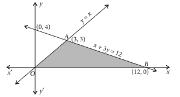
(c) : Given inequalities are
$
2 x+3 y \leq 12,2 x+y \leq 8
$
and $x \geq 0, y \geq 0$
Corresponding equations are
$
2 x+3 y=12 \text { and } 2 x+y=8
$
Now, plotting the graph of $2 x+3 y=12$ using the table
| x | 0 | 6 |
| y | 4 | 0 |
and $2 x+y=8$ using the table
| x | 0 | 4 |
| y | 8 | 0 |
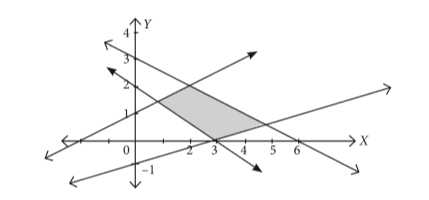
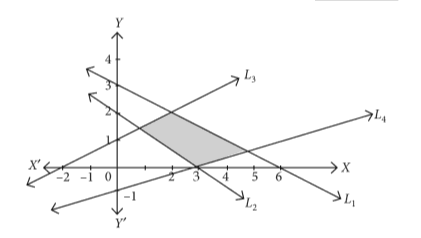
Intersection point of both lines is $(3,2)$.
For inequality $2 x+3 y \leq 12$ by substituting $(x, y)=(0,0)$ we get $0+0 \leq 12$, which is true, therefore, shaded region will be towards origin.
Now, for $2 x+y \leq 8,0+0 \leq 8$, which is true.
$\therefore \quad$ Shaded region will be towards origin.
$\therefore \quad$ Required region is $A B C O$ having points $A(0,4)$, $B(3,2), C(4,0), O(0,0)$
Max. $z=4 \times 3+5 \times 2=12+10=22$ at $B(3,2)$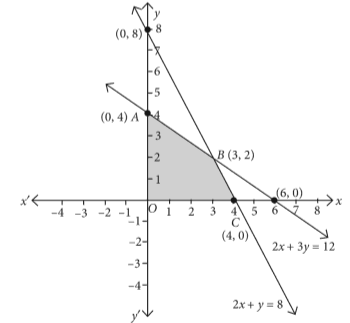
A furniture manufacturer produces tables and bookshelves made up of wood and steel. The weekly requirement of wood and steel is given as below.
| Material/Product | Wood | Steel |
| Table (x) | 8 | 2 |
| Bookshelf (y) | 11 | 3 |
The weekly availability of wood and steel is 450 and 100 units respectively. Profit on a table is ₹ 1000 and that on a bookshelf is ₹ 1200 . To determine the number of tables and bookshelves to be produced every week in order to maximize the total profit, formulate the problem as L.P.P.
(b) Given x and y units of tables and bookshelves are produced.
Profit on one table is 1000
Profit on x tables is 1000x
Profit on one bookshelf is 1200
Profit on y bookshelves is 1200y
Total profit, Z = 1000x + 1200y
| Product/ Material | Table (x) | Bookshelf (y) | Availability |
| Wood | 8 | 11 | 450 |
| Steel | 2 | 3 | 100 |
$\therefore$ Constraints are $8 x+11 y \leq 450,2 x+3 y \leq 100$, $x \geq 0, y \geq 0$
$\therefore \quad$ Given problem can be formulated as
Maximize $Z=1000 x+1200 y$
Subject to, $8 x+11 y \leq 450,2 x+3 y \leq 100, x \geq 0, y \geq 0$.
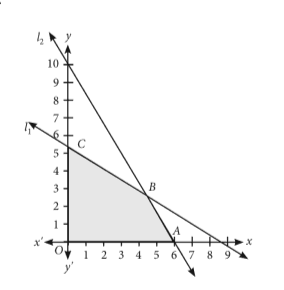
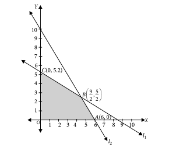
| Point | Value of objective function $z=2x+y$ |
| $O(0,0)$ | $z=2 \times 0+0=0$ |
| $A(6,0)$ | $z=2 \times 6+0=12$ |
| $B(9 / 2,5 / 2)$ | $z=2 \times \frac{9}{2}+\frac{5}{2}=\frac{23}{2}=11.5$ |
| $C\left(0, \frac{26}{5}\right)$ | $z=2 \times 0+\frac{26}{5}=\frac{26}{5}=5.2$ |
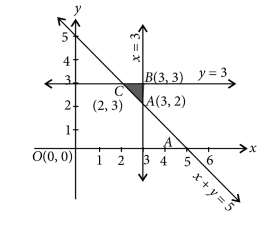
(a) : Converting the given inequations into equations, we get $2 x_1+x_2=7,2 x_1+3 x_2=15, x_2=3, x_1=$ $x_2=0$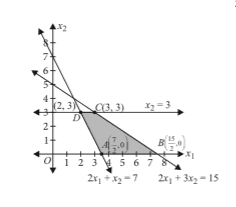
The feasible region is $A B C D$ which is shaded in the figure. The vertices of the feasible region are $A\left(\frac{7}{2}, 0\right)$, $B\left(\frac{15}{2}, 0\right), C(3,3)$ and $D(2,3)$.
The values of $z=4 x_1+5 x_2$ at these vertices are
| Points | Value of $z=4 x_1+5 x_2$ |
| $A\left(\frac{7}{2}, 0\right)$ | 14 |
| $B\left(\frac{15}{2}, 0\right)$ | 30 |
| $C(3,3)$ | 27 |
| $D(2,3)$ | 23 |
$\therefore \quad$ Minimum value $=14$ at $A\left(\frac{7}{2}, 0\right)$
Hence, minimum value occurs on $x$-axis.
(c) : We have: Objective function
$
\begin{aligned}
& z=x_1+x_2 \text { subject to } x_1+x_2 \leq 10 ; \\
& -2 x_1+3 x_2 \leq 15, x_1 \leq 6, x_1, x_2 \geq 0
\end{aligned}
$
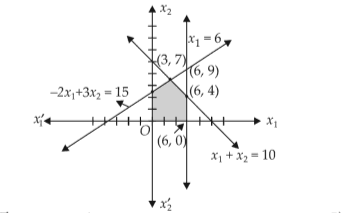
$\therefore$ The corner points of the feasible region are $(0,0),(0,5)$, $(3,7),(6,4)$ and $(6,0)$
$\therefore \quad$ Value of the objective function $z=x_1+x_2$ at corner points:
| Points | Value of objective function |
| (0,0) | 0 |
| (6,0) | 6 |
| (6,4) | 10 (Maximum) |
| (3,7) | 10 (Maximum) |
| (0,5) | 5 |