Questions

Solve the Following Question.(2 Marks)

Take a timed test

69 questions · self-marked practice — reveal the answer and mark yourself.

Question 12 Marks
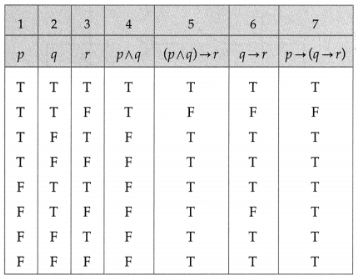
Using truth tables prove the following logical equivalences : (p ∧ q) → r ≡ p → (q → r)
Answer
Image
The entries in the columns 5 and 7 are identical.
∴ (p ∧ q) → r ≡ p → (q → r).
View full question & answer
Question 22 Marks
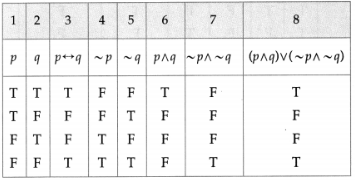
Using truth tables prove the following logical equivalences : p ↔ q ≡ (p ∧ q) ∨ (~p ∧ ~q)
Answer

Image
The entries in the columns 3 and 8 are identical.
∴ p ↔ q ≡ (p ∧ q) ∨ (~p ∧ ~q).
View full question & answer
Question 32 Marks
Using the rules in logic, write the negations of the following : (~p ∧ q) ∨ (p ∧ ~q)
Answer
The negation of (~ p ∧ q) ∨ (p ∧ ~ q) is
~ [(~p ∧ q) ∨ (p ∧ ~q)]
≡ ~(~p ∧ q) ∧ ~ (p ∧ ~q) … (Negation of disjunction)
≡ [~(~p) ∨ ~q] ∧ [~p ∨ ~(q)] … (Negation of conjunction)
≡ (p ∨ ~ q) ∧ (~ p ∨ q) … (Negation of negation)
View full question & answer
Question 42 Marks
Using the rules in logic, write the negations of the following : (p → q) ∧ r
Answer
The negation of (p → q) ∧ r is
~ [(p → q) ∧ r]
≡ ~ (p → q) ∨ (~ r) … (Negation of conjunction)
≡ (p ∧ ~q) ∨ (~ r) … (Negation of implication)
View full question & answer
Question 52 Marks
Using the rules in logic, write the negations of the following : p ∧ (q ∨ r)
Answer
The negation of p ∧ (q ∨ r) is
~ [p ∧ (q ∨ r)]
≡ ~ p ∨ ~(q ∨ r) … (Negation of conjunction)
≡ ~p ∨ (~q ∧ ~r) … (Negation of disjunction)
View full question & answer
Question 62 Marks
Using the rules in logic, write the negations of the following : (p ∨ q) ∧ (q ∨ ~r)
Answer
The negation of (p ∨ q) ∧ (q ∨ ~ r) is
~ [(p ∨ q) ∧ (q ∨ ~r)]
≡ ~ (p ∨ q) ∨ ~ (q ∨ ~r) … (Negation of conjunction)
≡ (~p ∧ ~q) ∨ [~q ∧ ~(~r)] … (Negation of disjunction)
≡ {~ p ∧ ~q) ∨ (~q ∧ r) … (Negation of negation)
≡ (~q ∧ ~p) ∨ (~q ∧ r) … (Commutative law)
≡ (~ q) ∧ (~ p ∨ r) … (Distributive Law)
View full question & answer
Question 72 Marks
Using rules in logic, prove the following : ~(p ∨ q) ∨ (~p ∧ q) ≡ ~p
Answer
~ (p ∨ q) ∨ (~p ∧ q)
≡ (~p ∧ ~q) ∨ (~p ∧ q) … (Negation of disjunction)
≡ ~p ∧ (~q ∨ q) … (Distributive Law)
≡ ~ p ∧ T … (Complement Law)
≡ ~ p … (Identity Law)
∴ ~(p ∨ q) ∨ (~p ∧ q) ≡ ~p.
View full question & answer
Question 82 Marks
Using rules in logic, prove the following : ~p ∧ q ≡ (p ∨ q) ∧ ~p
Answer
(p ∨ q) ∧ ~ p
≡ (p ∧ ~p) ∨ (q ∧ ~p) … (Distributive Law)
≡ F ∨ (q ∧ ~p) … (Complement Law)
≡ q ∧ ~ p … (Identity Law)
≡ ~p ∧ q …(Commutative Law)
∴ ~p ∧ q ≡ (p ∨ q) ∧ ~p.
View full question & answer
Question 92 Marks
Using rules in logic, prove the following : p ↔ q ≡ ~ (p ∧ ~q) ∧ ~(q ∧ ~p)
Answer
By the rules of negation of biconditional,
~(p ↔ q) ≡ (p ∧ ~q) ∨ (q ∧ ~p)
∴ ~ [(p ∧ ~ q) ∨ (q ∧ ~p)] ≡ p ↔ q
∴ ~(p ∧ ~q) ∧ ~(q ∧ ~p) ≡ p ↔ q … (Negation of disjunction)
≡ p ↔ q ≡ ~(p ∧ ~ q) ∧ ~ (q ∧ ~p).
View full question & answer
Question 102 Marks
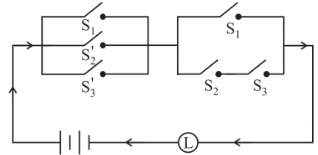
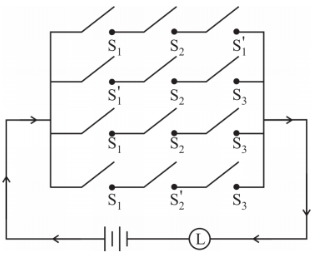
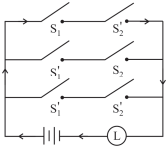
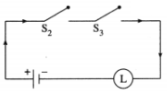
Represent the following switching circuit in symbolic form and construct its switching table. Write your conclusion from the switching table.
Image
Answer
Let $p :$ the switch $S_1$ is closed
$q :$ the switch $S_2$ is closed
$r :$ the switch $S_3$ is closed
$\sim q :$ the switch $S_2‘$ is closed or the switch $S_2$ is open
$\sim r :$ the switch $S_3‘$ is closed or the switch $S_3$ is open.
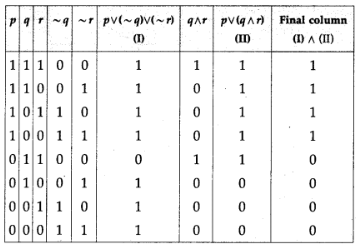
Then, the symbolic form of the given switching circuit is : $[p ∨ (\sim q) ∨ (\sim r)] ∧ [p ∨ (q ∧ r)]$
Image
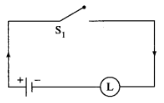
From the table, the’ final column’ and the column of $p$ are identical. Hence, the given circuit is equivalent to the simple circuit with only one switch $S_1.$
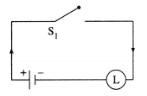
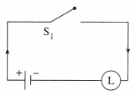
the simplified form of the given circuit is :
Image
View full question & answer
Question 112 Marks
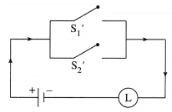
Simplify the following so that the new circuit circuit.
Image
Answer
Let p : the switch $S _1$ is closed
q : the switch $S _2$ is closed
$\sim p$ : the switch $S _1{ }^{\prime}$ is closed or the switch $S _1$ is open
$\sim q$ : the switch $S _2{ }^{\prime}$ is closed or the switch $S _2$ is open.
Then the symbolic form of the given switching circuit is :
$(\sim p \vee q) \vee(p \vee \sim q) \vee(p \vee q)$
Using the laws of logic, we have,
$(\sim p \vee q) \vee(p \vee \sim q) \vee(p \vee q)$
$\equiv(\sim p \vee q \vee p \vee \sim q) \vee(p \vee q)$
$\equiv[(\sim p \vee p) \vee(q \vee \sim q)] \vee(p \vee q) \ldots \text { (By Commutative Law) }$
$\equiv(T \vee T) \vee(p \vee q) \ldots \text { (By Complement Law) }$
$\equiv T \vee(p \vee q) \ldots \text { (By Identity Law) }$
$\equiv T \ldots \text { (By Identity Law) }$
$\therefore$ the current always flows whether the switches are open or closed. So, it is not necessary to use any switch in the circuit.
$\therefore$ the simplified form of given circuit is:
Image
View full question & answer
Question 122 Marks

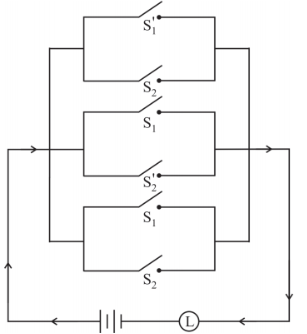
Give alternative arrangement of the switching following circuit, has minimum switches.
Image
Answer
Let $p :$ the switch $S_1$ is closed
$q :$ the switch $S_2$ is closed
$r :$ the switch $S_3$ is closed
$\sim p :$ the switch $S_1‘$ is closed, or the switch $S_1$ is open
$\sim q :$ the switch $S_2‘$ is closed or the switch $S_2$ is open.
Then the symbolic form Of the given circuit is :
$(p ∧ q ∧ \sim p) ∨ (\sim p ∧ q ∧ r) ∨ (p ∧ q ∧ r) ∨ (p ∧ \sim q ∧ r)$
Using the laws of logic, we have,
$(p ∧ q ∧ \sim p) ∨ (\sim p ∧ q ∧ r) ∨ (p ∧ q ∧ r) ∨ (p ∧ \sim q ∧ r)$
$≡ (p ∧ \sim p ∧ q) ∨ (\sim p ∧ q ∧ r) ∨ (p ∧ q ∧ r) y (p ∧ \sim q ∧ r) …($By Commutative Law$)$
$≡ (F ∧ q) ∨ (\sim p ∧ q ∧ r) ∨ (p ∧ q ∧ r) ∨ (p ∧ \sim q ∧ r) … ($By Complement Law$)$
$≡ F ∨ (\sim p ∧ q ∧ r) ∨ (p ∧ q ∧ r) ∨ (p ∧ \sim q ∧ r) … ($By Identity Law$)$
$≡ (\sim p ∧ q ∧ r) ∨ (p ∧ q ∧ r) ∨ (p ∧ \sim q ∧ r) … ($By Identity Law$)$
$≡ [(\sim p ∨ p) ∧ (q ∧ r)] ∨ (p ∧ \sim q ∧ r) … ($By Distributive Law$)$
$≡ [T ∧ (q ∧ r)] ∨ (p ∧ \sim q ∧ r) = (q ∧ r) ∨ (p ∧ \sim q ∧ r) …($By Complement Law$)$
$≡ (q ∧ r) ∨ (p ∧ \sim q ∧ r) … ($By Identity Law$)$
$≡ [q ∨ (p ∧ \sim q)] ∧ r … ($By Distributive Law$)$
$≡ [q ∨ p) ∧ ((q ∨ \sim q)] ∧ r … ($By Distributive Law$)$
$≡ [(q ∨ p) ∧ T] ∧ r …($By Complement Law$)$
$≡ (q ∨ p) ∧ r … ($By Identity Law$)$
$≡ (p ∨ q) ∧ r …($By Commutative Law$)$
$\therefore$ the alternative arrangement of the new circuit with minimum switches is :
Image
View full question & answer
Question 132 Marks
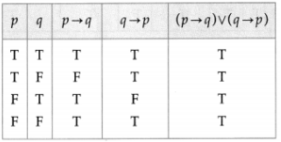
Determine whether the following statement patterns are tautologies contradictions or contingencies : (p → q) ∨ (q → p)
Answer

Image
All the entries in the last column of the above truth table are T.
∴ (p → q) ∨ (q → p) is a tautology.
View full question & answer
Question 142 Marks
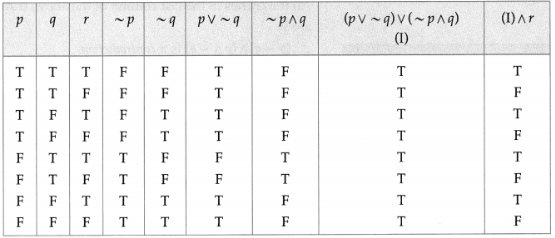
Determine whether the following statement patterns are tautologies contradictions or contingencies : [(p ∨ ~q) ∨ (~p ∧ q)] ∧ r
Answer

Image
The entries in the last column are neither T nor all F.
∴ [(p ∨ ~q) ∨ (~p ∧ q)] ∧ r is a contingency.
View full question & answer
Question 152 Marks
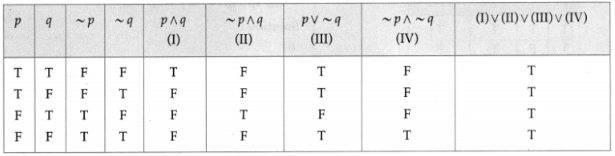
Determine whether the following statement patterns are tautologies contradictions or contingencies : (p ∧ q) ∨ (~p ∧ q) ∨ (p ∨ ~q) ∨ (~p ∧ ~q)
Answer

Image
All the entries in the last column of the above truth table are T.
∴ (p ∧ q) ∨ (~p ∧ q) ∨ (p ∨ ~q) ∨ (~p ∧ ~q) is a tautology.
View full question & answer
Question 162 Marks
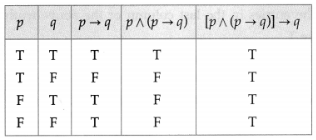
Determine whether the following statement patterns are tautologies contradictions or contingencies : [(p ∧ (p → q)] → q
Answer

Image
All the entries in the last column of the above truth table are T.
∴ [(p ∧ (p → q)] → q is a tautology.
View full question & answer
Question 172 Marks
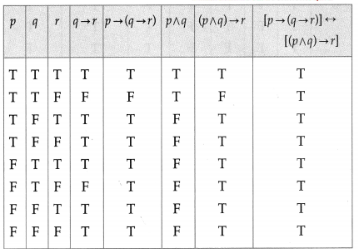
Determine whether the following statement patterns are tautologies contradictions or contingencies : [p → (q → r)] ↔ [(p ∧ q) → r]
Answer

Image
All the entries in the last column of the above truth table are T.
∴ [p → (q → r)] ↔ [(p ∧ q) → r] is a tautology.
View full question & answer
Question 182 Marks
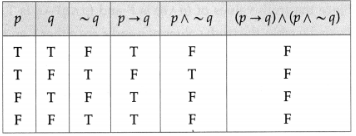
Determine whether the following statement patterns are tautologies contradictions or contingencies : (p → q) ∧ (p ∧ ~q)
Answer

Image
All the entries in the last column of the above truth table are F.
∴ (p → q) ∧ (p ∧ ~q) is a contradiction.
View full question & answer
Question 192 Marks
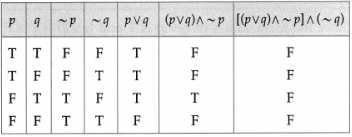
Determine whether the following statement patterns are tautologies contradictions or contingencies : [(p ∨ q) ∧ ~p] ∧ ~q
Answer

Image
All the entries in the last column of the above truth table are F.
∴ [(p ∨ q) ∧ ~p] ∧ ~q is a contradiction.
View full question & answer
Question 202 Marks
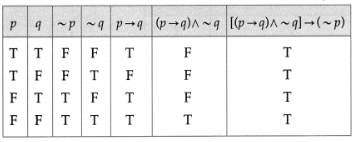
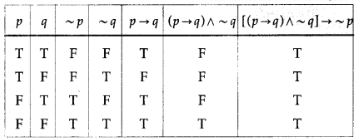
Determine whether the following statement patterns are tautologies contradictions or contingencies : [(p → q) ∧ ~q)] → ~p
Answer

Image
All the entries in the last column of the above truth table are T.
∴ [(p → q) ∧ ~q)] → ~p is a tautology.
View full question & answer
Question 262 Marks
Check whether the following switching circuits are logically equivalent – Justify.
Image
Answer
The symbolic form of the given switching circuits are
(p ∨ q) ∧ (p ∨ r) and p ∨ (q ∧ r)
By Distributive Law,
p ∨ (q ∧ r) ≡ (p ∨ q) ∧ (p ∨ r)
Hence, the given switching circuits are logically equivalent.
View full question & answer
Question 272 Marks
Check whether the following switching circuits are logically equivalent – Justify.

Image
Answer
Let $p$ : the switch $S_1$ is closed
$q$ : the switch $S_2$ is closed
$r$ : the switch $S_3$ is closed
(A) The symbolic form of the given switching circuits are
$p ∧ (q ∨ r)$ and $(p ∧ q) ∨ (p ∧ r)$ respectively.
By Distributive Law, $p ∧ (q ∨ r) ≡ (p ∧ q) ∨ (p ∧ r)$
Hence, the given switching circuits are logically equivalent.
View full question & answer
Question 282 Marks
Give an alternative arrangement for the following circuit, so that the new circuit has minimum switches.

Image

View full question & answer
Question 292 Marks
Obtain the simple logical expression of the following.
$(p ∧ q ∧ ~p) ∨ (~p ∧ q ∧ r) ∨ (p ∧ ~q ∧ r) ∨ (p ∧ q ∧ r)$
Question is Modified
$(p ∧ q ∧ ~p) ∨ (~p ∧ q ∧ r)∨ (p ∧ q ∧ r)$
Answer
Using the laws of logic, we have,
$(p \wedge q \wedge \sim p) \vee(\sim p \wedge q \wedge r) \vee(p \wedge q \wedge r)$
$=(p \wedge \sim p \wedge q) \vee(\sim p \wedge q \wedge r) \vee(p \wedge q \wedge r) \ldots \text { (By Commutative Law) }$
$=(F \wedge q) \vee(\sim p \wedge q \wedge r) \vee(p \wedge q \wedge r) \ldots \text { (By Complement Law) }$
$=F \vee(\sim p \wedge q \wedge r) \vee(p \wedge q \wedge r) \ldots \text { (By Identity Law) }$
$=(\sim p \wedge q \wedge r) \vee(p \wedge q \wedge r) \ldots(\text { By Identity Law) }$
$=(\sim p \vee p) \wedge(q \wedge r) \ldots \text { (By Distributive Law) }$
$=T \wedge(q \wedge r) \ldots \text { (By Complement Law) }$
$=q \wedge r \ldots \text { (By Identity Law) }$
Hence, the simple logical expression of the given expression is $q \wedge r$.
Let q : the switch $S _2$ is closed $r$ : the switch $S_3$ is closed.
Then the corresponding switching circuit is :

Image
View full question & answer
Question 302 Marks
Obtain the simple logical expression of the following. $[p (∨ (~q) ∨ ~r)] ∧ (p ∨ (q ∧ r)$
Answer
Using the laws of logic, we have,
${[p \vee(\sim(q) \vee(\sim r)] \wedge[p \vee(q \wedge r)]}$
$=[p \vee\{\sim(q \wedge r)\}] \wedge[p \vee(q \wedge r)] \ldots \text { (By De Morgan's Law) }$
$=p \vee[\sim(q \wedge r) \wedge(q \wedge r)] \ldots \text { (By Distributive Law) }$
$=p \vee F \ldots \text { (By Complement Law) }$
$=p \ldots \text { (By Identity Law) }$
Hence, the simple logical expression of the given expression is $p$.
Let p : the switch $S _1$ is closed
Then the corresponding switching circuit is:
​​​​​​​
Image
View full question & answer
Question 312 Marks
Obtain the simple logical expression of the following. $(~p ∧ q) ∨ (~p ∧ ~q) ∨ (p ∧ ~q)]$
Answer
Using the laws of logic, we have,
$(\sim p \wedge q) \vee(\sim p \vee \sim q) \vee(p \wedge \sim q)$
$\equiv[\sim p \wedge(q \vee \sim q)] \vee(p \wedge \sim q) \ldots \text { (By Distributive Law) }$
$\equiv(\sim p \wedge T) \vee(p \wedge \sim q) \ldots \text { (By Complement Law) }$
$\equiv \sim p \vee(p \wedge \sim q) \ldots \text { (By Identity Law) }$
$\equiv(\sim p \vee p) \wedge(\sim p \wedge \sim q) \ldots \text { (By Distributive Law) }$
$\equiv T \wedge(\sim p \wedge \sim q) \ldots \text { (By Complement Law) }$
$\equiv \sim p \vee \sim q \ldots \text { (By Identity Law) }$
Hence, the simple logical expression of the given expression is $\sim p \vee \sim q$.
Let p : the switch $S _1$ is closed
$q$ : the switch $S_2$ is closed
$\sim p$ : the switch $S _1{ }^{\prime}$ is closed or the switch $S _1$ is open
$\sim q$ : the switch $S _2{ }^{\prime}$ is closed or the switch $S _2$ is open,
Then the corresponding switching circuit is:
Image
View full question & answer
Question 322 Marks
Obtain the simple logical expression of the following. Draw the corresponding switching circuit. $p ∨ (q ∧ ~ q)$
Answer
Using the laws of logic, we have, $p \vee(q \wedge \sim q)$
$\equiv p \vee F \ldots \text { (By Complement Law) }$
$\equiv p \ldots \text { (By Identity Law) }$
Hence, the simple logical expression of the given expression is p .
Let p : the switch $S _1$ is closed
Then the corresponding switching circuit is :
Image
View full question & answer
Question 332 Marks
Without using truth table prove that : ~[(p ∨ ~q) → (p ∧ ~q)] ≡ (p ∨ ~q) ∧ (~p ∨ q)
Answer
LHS = ~[(p ∨ ~q) → (p ∧ ~q)]
≡ (p ∨ ~q) ∧ ~(p ∧ ~q) … (Negation of implication)
≡ (p ∨ ~q) ∧ [~p ∨ ~(~q)] … (Negation of conjunction)
≡ (p ∨ ~ q) ∧ (~p ∨ q)… (Negation of negation)
≡ RHS.
View full question & answer
Question 342 Marks
Without using truth table prove that : (p ∧ q) ∨ (~ p ∧ q) ∨ (p ∧ ~q) ≡ p ∨ q
Answer
LHS = (p ∧ q) v (~p ∧ q) ∨ (p ∧ ~q)
≡ [(p ∨ ~p) ∧ q] ∨ (p ∧ ~q) … (Distributive Law)
≡ (T ∧ q) ∨ (p ∧ ~q) … (Complement Law)
≡ q ∨ (p ∧ ~q) … (Identity Law)
≡ (q ∨ p) ∧ (q ∨ ~q) … (Distributive Law)
≡ (q ∨ p) ∧ T .. (Complement Law)
≡ q ∨ p … (Identity Law)
≡ p ∨ q … (Commutative Law)
≡ RHS.
View full question & answer
Question 352 Marks
Without using truth table prove that : (p ∨ q) ∧ (p ∨ ~q) ≡ p
Answer
LHS = (p ∨ q) ∧ (p ∨ ~q)
≡ p ∨ (q ∧ ~q) … (Distributive Law)
≡ p ∨ F … (Complement Law)
≡ p … (Identity Law)
≡ RHS.
View full question & answer
Question 362 Marks
Without using truth table prove that : p ↔ q ≡ (p∧ q) ∨ (~ p ∧ ~q)
Answer
LHS = p ↔ q
≡ (p ↔ q) ∧ (q ↔ p) … (Biconditional Law)
≡ (~p ∨ q) ∧ (~q ∨ p) … (Conditional Law)
≡ [~p ∧ (~q ∨ p)] ∨ [q ∧ (~q ∨ p)] … (Distributive Law)
≡ [(~p ∧ ~q) ∨ (~p ∧ p)] ∨ [(q ∧ ~q) ∨ (q ∧ p)] … (Distributive Law)
≡ [(~p ∧ ~q) ∨ F] ∨ [F ∨ (q ∧ p)] … (ComplementLaw)
≡ (~ p ∧ ~ q) ∨ (q ∧ p) … (Identity Law)
≡ (~ p ∧ ~ q) ∨ (p ∧ q) … (Commutative Law)
≡ (p ∧ q) ∨ (~p ∧ ~q) … (Commutative Law)
≡ RHS.
View full question & answer
Question 372 Marks
Write converse, inverse and contrapositive of the following statements. If voltage increases then current decreases.
Answer
Let p : Voltage increases.
q : Current decreases.
Then the symbolic form of the given statement is p → q.
Converse : q →p is the converse of p → q.
i.e. If current decreases, then voltage increases.
Inverse : ~p → ~q is the inverse of p → q.
i.e. If voltage does not increase, then current does not decrease.
Contrapositive : ~q → ~p, is the contrapositive of p → q.
i.e. If current does not decrease, then voltage doesnot increase.
View full question & answer
Question 382 Marks
Write converse, inverse and contrapositive of the following statements. If surface area decreases then pressure increases.
Answer
Let p : The surface area decreases.
q : The pressure increases.
Then the symbolic form of the given statement is p → q.
Converse : q → p is the converse of p→ q.
i.e. If the pressure increases, then the surface area decreases.
Inverse : ~p → ~q is the inverse of p → q.
i.e. If the surface area does not decrease, then the pressure does not increase.
Contrapositive : ~q → ~p is the contrapositive of p → q.
i.e. If the pressure does not increase, then the surface area does not decrease.
View full question & answer
Question 392 Marks
Write converse, inverse and contrapositive of the following statements. A family becomes literate if the woman in it is literate.
Answer
Let p : The woman in the family is literate.
q : A family become literate.
Then the symbolic form of the given statement is p → q
Converse : q → p is the converse of p → q.
i.e. If a family become literate, then the woman in it is literate.
Inverse : ~p → ~q is the inverse of p → q.
i.e. If the woman in the family is not literate, then the family does not become literate.
Contrapositive : ~q → ~p is the contrapositive of p → q. i e. If a family does not become literate, then the woman in it is not literate.
View full question & answer
Question 402 Marks
Write converse, inverse and contrapositive of the following statements. If $x < y$ then $x^2 < y^2 (x, y \in R)$
Answer
Let $p : x < y , q : x ^2< y ^2$.
Then the symbolic form of the given statement is $p \rightarrow q$.
Converse : $q \rightarrow p$ is the converse of $p \rightarrow q$.
i.e. If $x^2<y^2$, then $x<y$.
Inverse : $\sim p \rightarrow \sim q$ is the inverse of $p \rightarrow q$.
i.e. If $x>/ y$, then $x^2>/ y^2$. OR
If $x<y$, then $x^2</ y^2$.
Contrapositive : $\sim q \rightarrow p$ is the contrapositive of $p \rightarrow q$ i.e.
If $x^2>/ y^2$, then $x>/ y$. $O R$
If $x^2</ y^2$, then $x<y$.
View full question & answer
Question 412 Marks
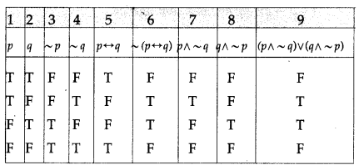
Using truth tables prove the following logical equivalences. ~(p ↔ q) ≡ (p ∧ ~q) ∨ (q ∧ ~p)
Answer

Image
The entries in the columns 6 and 9 are identical.
∴ ~(p ↔ q) ≡ (p ∧ ~q) ∨ (q ∧ ~p).
View full question & answer
Question 422 Marks
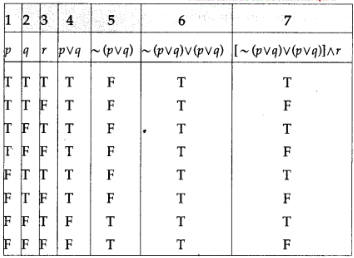
Using truth tables prove the following logical equivalences. [~(p ∨ q) ∨ (p ∨ q)] ∧ r ≡ r
Answer

Image
The entries in the columns 3 and 7 are identical.
∴ [~(p ∨ q) ∨ (p ∨ q)] ∧ r ≡ r.
View full question & answer
Question 432 Marks
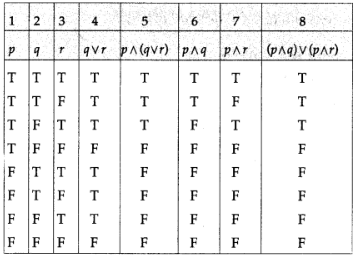
Using truth tables prove the following logical equivalences. p ∧ (q ∨ r) ≡ (p ∧ q) ∨ (p ∧ r)
Answer

Image
The entries in the columns 5 and 8 are identical.
∴ p ∧ (q ∨ r) ≡ (p ∧ q) ∨ (p ∧ r).
View full question & answer
Question 442 Marks
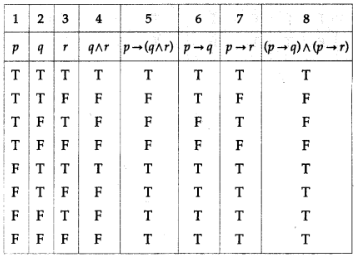
Using truth tables prove the following logical equivalences. p → (q ∧ r) ≡ (p → q) ∧ (p → r)
Answer

Image
The entries in the columns 5 and 8 are identical.
∴ p → (q ∧ r) ≡ (p → q) ∧ (p → r).
View full question & answer
Question 452 Marks
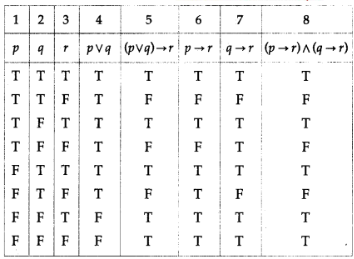
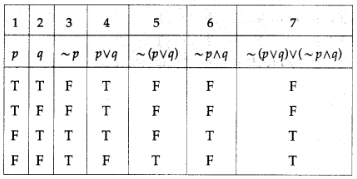
Using truth tables prove the following logical equivalences. (p ∨ q ) → r ≡ (p → r) ∧ (q → r)
Answer

Image
The entries in the columns 5 and 8 are identical.
∴ (p ∨ q ) → r ≡ (p → r) ∧ (q → r).
View full question & answer
Question 462 Marks
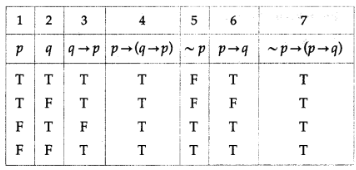
Using truth tables prove the following logical equivalences. p → (q → p) ≡ ~p → (p → q)
Answer

Image
The entries in the columns 4 and 7 are identical.
∴ p → (q → p) ≡ ~p → (p → q).
View full question & answer
Question 472 Marks
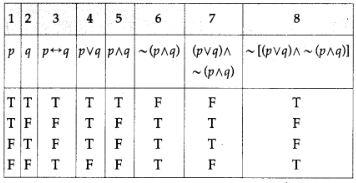
Using truth tables prove the following logical equivalences. p ↔ q ≡ ~[(p ∨ q) ∧ ~(p ∧ q)]
Answer

Image
The entries in the columns 3 and 8 are identical.
∴ p ↔ q ≡ ~[(p ∨ q) ∧ ~(p ∧ q)].
View full question & answer
Question 482 Marks
Using truth tables prove the following logical equivalences. ~(p ∨ q) ∨ (~p ∧ q) ≡ ~p
Answer

Image
The entries in the columns 3 and 7 are identical.
∴ ~(p ∨ q) ∧ (~p ∧ q) = ~p.
View full question & answer
Question 492 Marks
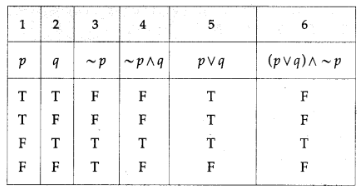
Using truth tables prove the following logical equivalences. ~p ∧ q ≡ (p ∨ q) ∧ ~p
Answer

Image
The entries in the columns 4 and 6 are identical.
∴ ~p ∧ q ≡ (p ∨ q) ∧ ~p.
View full question & answer
Question 502 Marks
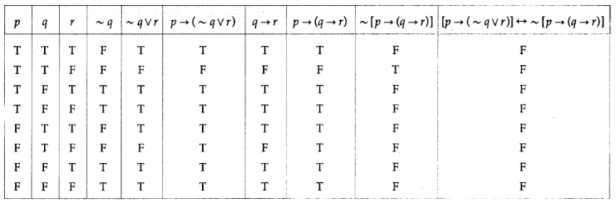
Examine whether each of the following statement patterns is a tautology or a contradiction or a contingency. [p → (~q ∨ r)] ↔ ~[p → (q → r)]
Answer

Image
All the entries in the last column of the above truth table are F.
∴ [p → (~q ∨ r)] ↔ ~[p → (q → r)] is a contradiction
View full question & answer
Question 512 Marks
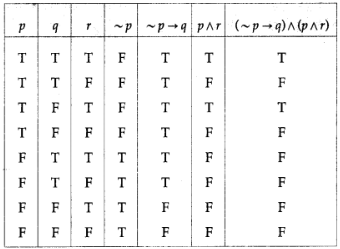
Examine whether each of the following statement patterns is a tautology or a contradiction or a contingency. (~p → q) ∧ (p ∧ r)
Answer

Image
The entries in the last column of the above truth table are neither all T nor all F.
∴ (~p → q) ∧ (p ∧ r) is a contingency.
View full question & answer
Question 522 Marks
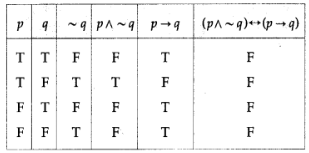
Examine whether each of the following statement patterns is a tautology or a contradiction or a contingency. (p ∧ ~q) ↔ (p → q)
Answer

Image
All the entries in the last column of the above truth table are F.
∴ (p ∧ ~q) ↔ (p → q) is a contradiction.
View full question & answer
Question 532 Marks
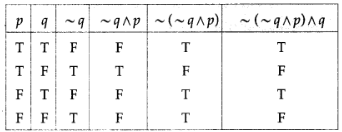
Examine whether each of the following statement patterns is a tautology or a contradiction or a contingency. ~(~q ∧ p) ∧ q
Answer

Image
The entries in the last column of the above truth table are neither all T nor all F.
∴ ~(~q ∧ p) ∧ q is a contingency.
View full question & answer
Question 542 Marks
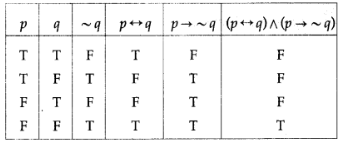
Examine whether each of the following statement patterns is a tautology or a contradiction or a contingency. (p ↔ q) ∧ (p → ~q)
Answer

Image
The entries in the last column of the above truth table are neither all T nor all F.
∴ (p ↔ q) ∧ (p → ~q) is a contingency.
View full question & answer
Question 552 Marks
Examine whether each of the following statement patterns is a tautology or a contradiction or a contingency. [(p → q) ∧ ~q] → ~p
Answer

Image
All the entries in the last column of the above truth table are T.
∴ [(p → q) ∧ ~q] → ~p is a tautology.
View full question & answer
Question 562 Marks
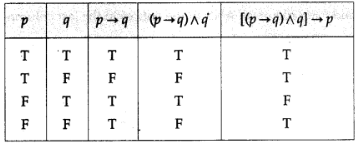
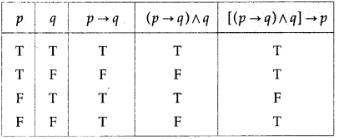
Examine whether each of the following statement patterns is a tautology or a contradiction or a contingency. [(p → q) ∧ q)] → p
Answer

Image
The entries in the last column of the above truth table are neither all T nor all F.
∴ [(p → q) ∧ q)] → p is a contingency
View full question & answer
Question 572 Marks
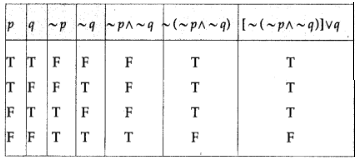
Examine whether each of the following statement patterns is a tautology or a contradiction or a contingency. [~(~p ∧ ~q)] ∨ q
Answer

Image
The entries in the last column of the above truth table are neither all T nor all F.
∴ [~(~p ∧ ~q)] ∨ q is a contingency.
View full question & answer
Question 582 Marks
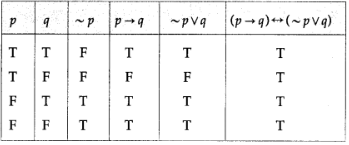
Examine whether each of the following statement patterns is a tautology or a contradiction or a contingency. (p → q) ↔ (~p ∨ q)
Answer

Image
All the entries in the last column of the above truth table are T.
∴ (p → q) ↔ (~p ∨ q) p is a tautology.
View full question & answer
Question 592 Marks
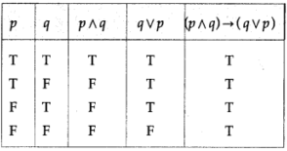
Examine whether each of the following statement patterns is a tautology or a contradiction or a contingency. (p ∧ q) → (q ∨ p)
Answer
Here are two statements and three connectives.
∴ there are 2 × 2 = 4 rows and 2 + 3 = 5 columns in the truth table.

Image

View full question & answer
Question 622 Marks
Construct the truth table for each of the following statement patterns: [p → (q → r)] ↔ [(p ∧ q) → r]
View full question & answer
Question 692 Marks
Construct the truth table for each of the following statement patterns: [(p → q) ∧ q] → p
Answer
Here are two statements and three connectives.
∴ there are 2 × 2 = 4 rows and 2 + 3 = 5 columns in the truth table.

Image

View full question & answer