Questions

Solve the Following Question.(4 Marks)

Take a timed test

5 questions · self-marked practice — reveal the answer and mark yourself.

Question 14 Marks
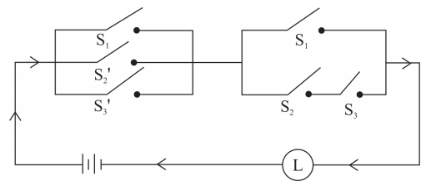
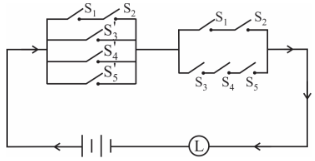
Simplify the following so that the new circuit has minimum number of switches. Also, draw the simplified circuit.
Image
Answer
(ii) Let $p :$ the switch $S_1$ is closed
$q :$ the switch $S_2$ is closed
$r :$ the switch $S_3$ is closed
$s :$ the switch $S_4$ is closed
$t :$ the switch $S_5$ is closed
$\sim p :$ the switch $S_1‘$ is closed or the switch $S_1$ is open
$\sim q :$ the switch $S_2‘$ is closed or the switch $S_2$ is open
$\sim r :$ the switch $S_3‘$ is closed or the switch $S_3$ is open
$\sim s :$ the switch $S_4‘$ is closed or the switch $S_4$ is open
$\sim t :$ the switch $S_5‘$ is closed or the switch $S_5$ is open.
Then the given circuit in symbolic form is
$[(p ∧ q) ∨ \sim r ∨ \sim s ∨ \sim t] ∧ [(p ∧ q) ∨ (r ∧ s ∧ t)]$
Using the laws of logic, we have,
$[(p ∧ q) ∨ \sim r ∨ \sim s ∨ \sim t] ∧ [(p A q) ∨ (r ∧ s ∧ t)]$
$= [(p∧ q) ∨ \sim (r ∧ s ∧ t)] ∧ [(p ∧ q) ∨ (r ∧ s ∧ t)] … ($By De Morgan’s Law$)$
$= (p ∧ q) ∨ [ \sim (r ∧ s ∧ t) ∧ (r ∧ s ∧ t)] … ($By Distributive Law$)$
$= (p ∧ q) ∨ F … ($By Complement Law$)$
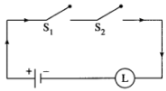
$= p ∧ q … ($By Identity Law$)$
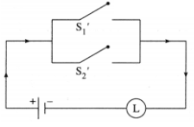
Hence, the alternative simplified circuit is :
Image
View full question & answer
Question 24 Marks
Simplify the following so that the new circuit has minimum number of switches. Also, draw the simplified circuit.
Image
Answer
Let $p :$ the switch $S_1$ is closed
$q :$ the switch $S_2$ is closed
$\sim p:$ the switch $S_1‘$ is closed or the switch $S_1$ is open
$\sim q:$ the switch $S_2‘$ is closed or the switch $S_2$ is open.
Then the given circuit in symbolic form is :
$(p ∧ \sim q) ∨ (\sim p ∧ q) ∨ (\sim p ∧ \sim q)$
Using the laws of logic, we have,
$(p ∧ \sim q) ∨ (\sim p ∧ q) ∨ (\sim p ∧ \sim q)$
$= (p ∧ \sim q) ∨ [(\sim p ∧ q) ∨ (\sim p ∧ \sim q) …($By Complement Law$)$
$= (p ∧ \sim q) ∨ [\sim p ∧ (q ∨ \sim q) ($By Distributive Law$)$
$= (p ∧ \sim q) ∨ (\sim p ∧ T) …($By Complement Law$)$
$= (p ∧ \sim q) ∨ \sim p …($By Identity Law$)$
$= (p ∨ \sim p) ∧ (\sim q ∨ \sim p) …($By Distributive Law$)$
$= \sim q ∨ \sim p …($By Identity Law$)$
$= \sim p ∨ \sim p …($By Commutative Law$)$
Hence, the simplified circuit for the given circuit is :
Image
View full question & answer
Question 34 Marks
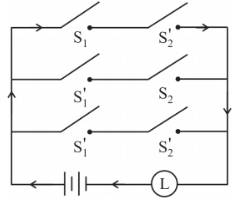
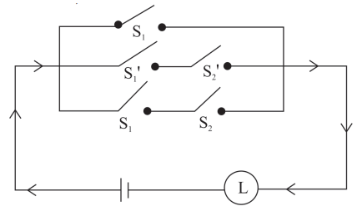
Write the symbolic form of the following switching circuits construct its switching table and interpret it.Image
Answer
Let $p$ : the switch $S_1$ is closed
$q$ : the switch $S_2​​​​​​​$​​​​​​​ is closed
$r$ : the switch $S_3$​​​​​​​ is closed
$~q$ : the switch $S_2​​​​​​​$​​​​​​​‘ is closed or the switch $S_2​​​​​​​$​​​​​​​ is open
$~r$: the switch $S_3​​​​​​​$​​​​​​​‘ is closed or the switch $S_3$​​​​​​​ is open.
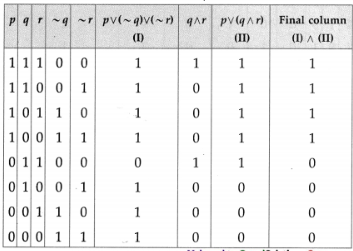
Then the symbolic form of the given circuit is :$[p ∨ (~q) ∨ r)] ∧ [p ∨ (q ∧ r)]$
Image
From the switching table, the ‘final column’ and the column of p are identical. Hence, the lamp will glow which $S_1​​​​​​​$​​​​​​​ is $‘ON’$.
View full question & answer
Question 44 Marks
Write the symbolic form of the following switching circuits construct its switching table and interpret it.Image
Answer
Let $p :$ the switch $S_1$ is closed
$q :$ the switch $S_2$ is closed
$\sim p :$ the switch $S_1$ is closed or the switch $S_1$ is open.
$\sim q :$ the switch $S_2‘$ is closed or the switch $S_2$ is open.
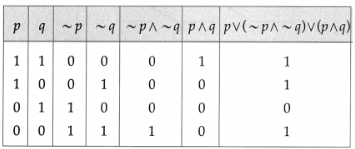
Then the symbolic form of the given circuit is $: p ∨ (\sim p ∧ \sim q) ∨ (p ∧ q)$Image
Since the final column contains $‘0’$ when $p$ is $0$ and $q$ is $‘1’$, otherwise it contains $‘1′.$
Hence, the lamp will not glow when $S_1$ is OFF and $S_2$ is ON, otherwise the lamp will glow.
View full question & answer
Question 54 Marks
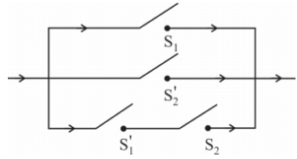
Write the symbolic form of the following switching circuits construct its switching table and interpret it.Image
Answer
Let $p :$ the switch $S_1$ is closed
$q :$ the switch $S_2$ is closed
$\sim p :$ the switch $S_1‘$ is closed or the switch $S_1$ is open
$\sim q :$ the switch $S_2‘$ is closed or the switch $S_2$ is open.
Then the symbolic form of the given circuit is :
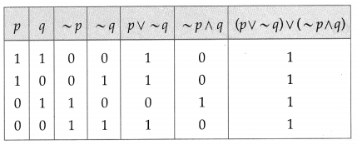
$(p ∨ \sim q) ∨ (\sim p ∧ q)$
​​​​​​​Image
Since the final column contains all’ $1′,$ the lamp will always glow irrespective of the status of switches.
View full question & answer
Solve the Following Question.(4 Marks) - Maths STD 12 Questions - Vidyadip