Questions

Solve the Following Question.(3 Marks)

Take a timed test

29 questions · self-marked practice — reveal the answer and mark yourself.

Question 13 Marks
A random variable X has the following probability distribution:
Values of X: 0 1 2 3 4 5 6 7 8
P(X) a 3a 5a 7a 9a 11a 13a 15a 17a
Determine:
$\text{P}(\text{X}<3),\text{P}(\text{X}\geq3),\text{P}(0<\text{X}<5).$
Answer
$\text{P}(\text{X}<3)=\text{P}(0)+\text{P}(1)+\text{P}(2)$
$=\text{a}+3\text{a}+5\text{a}$
$=9\text{a}$
$=9\Big(\frac{1}{81}\Big)$
$\therefore\ \text{P}(\text{X}<3)=\frac{1}{9}$
$\text{P}(\text{X}\geq3)=1-\text{P}(\text{X}<3)=1-\frac{1}{9}=\frac{8}{9}$
$\text{P}(0<\text{X}<5)=\text{P}(1)+\text{P}(2)+\text{P}(3)+\text{P}(4)$
$=3\text{a}+5\text{a}+7\text{a}+9\text{a} $
$=24\text{a}$
$=24\Big(\frac{1}{81}\Big)$
$\therefore\ \text{P}(0<\text{X}<5)=\frac{8}{27}$
View full question & answer
Question 23 Marks
If the probability distribution of a random variable of $X$ is given by
$X = x_i:$ 1 2 3 4
$P(X = x_i):$ 2k 4k 3k k
Write tyhe value of k.
Answer
Here,
$X = x_i:$ 1 2 3 4
$P(X = x_i):$ 2k 4k 3k k
Since, $\sum\text{P}(\text{X})=1$
$\Rightarrow\text{P}(1)+\text{P}(2)+\text{P}(3)+\text{P}(4)=1$
$\Rightarrow2\text{k}+4\text{k}+3\text{k}+\text{k}=1$
$\Rightarrow10\text{k}=1$
$\Rightarrow\text{k}=\frac{1}{10}$
$\Rightarrow\text{k}=0.1$
View full question & answer
Question 33 Marks
Find the mean and standard deviation of the following probability distributions:
$\text{x}_\text{i}$
$0$
$1$
$2$
$3$
$4$
$5$
$\text{p}_\text{i}$
$\frac{1}{6}$
$\frac{5}{18}$
$\frac{2}{9}$
$\frac{1}{6}$
$\frac{1}{9}$
$\frac{1}{18}$
Answer
$\text{x}_\text{i}$ $\text{p}_\text{i}$ $\text{p}_\text{i}\text{x}_\text{i}$ $\text{p}_\text{i}\text{x}_\text{i}^2$
$0$ $\frac{1}{6}$ $0$ $0$
$1$ $\frac{5}{18}$ $\frac{5}{18}$ $\frac{5}{18}$
$2$ $\frac{2}{9}$ $\frac{4}{9}$ $\frac{8}{9}$
$3$ $\frac{1}{6}$ $\frac{1}{2}$ $\frac{3}{2}$
$4$ $\frac{1}{9}$ $\frac{4}{9}$ $\frac{16}{9}$
$5$ $\frac{1}{18}$ $\frac{5}{18}$ $\frac{25}{18}$
    $\sum\text{p}_\text{i}\text{x}_\text{i}=\frac{35}{18}$ $\sum\text{p}_\text{i}\text{x}_\text{i}^2=\frac{35}{6}$
Mean $=\sum\text{p}_\text{i}\text{x}_\text{i}=\frac{35}{18}$
Variance $\sum\text{p}_\text{i}\text{x}_\text{i}^2-\big(\sum\text{p}_\text{i}\text{x}_\text{i}\big)^2=\frac{35}{6}-\Big(\frac{35}{18}\Big)^2=\frac{665}{324}$
Standard Deviation $=\sqrt{\text{Variation}}=\frac{\sqrt{665}}{18}$
View full question & answer
Question 43 Marks
Two cards are drawn successively without replacement from well shuffled pack of 52 cards. Find the probability distribution of the number of aces.
Answer
Two cards are drawn successively without replacement from a pack of 52 cards. Let X denote the number of aces drawn from pack out of 2 cards. Then, X can take the values 0, 1 and 2.
Now,
P(X = 0)
$=\frac{48}{52}\times\frac{47}{51}$
$=\frac{2256}{2652}$
$=\frac{188}{221}$
P(X = 1)
$=\frac{4}{52}\times\frac{48}{51}+\frac{48}{52}\times\frac{4}{51}$
$=\frac{384}{2652}$
$=\frac{32}{221}$
P(X = 2)
$=\frac{4}{52}\times\frac{3}{51}$
$=\frac{12}{2652}$
$=\frac{1}{221}$
So, required probability distribution is
$\text{X}:$
$0$
$1$
$2$
$\text{P}(\text{X}):$
$\frac{188}{221}$
$\frac{32}{221}$
$\frac{1}{221}$
View full question & answer
Question 53 Marks
An urn contain 5 red and 2 black balls. Two balls rendomly selected. Let X represent the number of black ball. What are the possible values of X. Is X a random variable?
Answer
Urn has 5 red and 2 black balls. 2 balls are rendomly selected. Here, X denote the numbers of black balls. So, possible values of X = 0, 1, 2 $\text{P}(\text{x}=0)=\text{P}\big(\overline{\text{B}}_1\big)\times\text{P}\big(\overline{\text{B}}_2\big)$ $=\frac{5}{7}\times\frac{5}{7}$ $=\frac{25}{49}$ $\text{P}(\text{X}=1)=\text{P}(\text{B}_1)\text{P}\big(\overline{\text{B}}_2\big)+\text{P}\big(\overline{\text{B}}_1\big)\text{P}(\text{B}_2)$ $=\frac{2}{7}\times\frac{5}{7}+\frac{5}{7}\times\frac{2}{7}$ $=\frac{20}{49}$ $\text{P}(\text{X}=2)=\text{P}(\text{B}_1)\text{P}(\text{B}_2)$ $=\frac{2}{7}\times\frac{2}{7}$ $=\frac{4}{49}$Now,
$\text{P}(\text{X}=0)+\text{P}(\text{X}=1)+\text{P}(\text{X}=2)$ $=\frac{25}{49}+\frac{20}{49}+\frac{4}{49}$ $=\frac{49}{49}$ $=1$ So, $\sum\text{P}(\text{X})=1$ Therefore, X is a random variable.
View full question & answer
Question 63 Marks
A fair die is tossed twice. If the number appearing on the top is less than 3, it is success. Find the probability distribution of number of successes.
Answer
Let X denote the event of getting number less than 3 (1 or 2) on throwing the die. Then, X can take the values 0, 1 and 2.
Now,
$\text{P}(\text{X}=0)=\frac{16}{36}=\frac{4}{9}$
$\text{P}(\text{X}=1)=\frac{16}{36}=\frac{4}{9}$
$\text{P}(\text{X}=2)=\frac{4}{36}=\frac{1}{9}$
Thus, the probability distribution of X is given by
$\text{X}$
$0$
$1$
$2$
$\text{P}(\text{X})$
$\frac{4}{9}$
$\frac{4}{9}$
$\frac{1}{9}$
View full question & answer
Question 73 Marks
Find the mean and standard deviation of the following probability distributions:
$x_i$ -2 -1 0 1 2
$p_i$ 0.1 0.2 0.4 0.2 0.1
Answer
$x_i$ $p_i$ $x_ip_i$ $x_i^2p_i$
-2 0.1 -0.2 0.4
-1 0.2 -0.2 0.2
0 0.4 0 0
1 0.2 0.2 0.2
2 0.1 0.2 0.4
    $\sum\text{xp}=0$ $\sum\text{x}^2\text{p=1.2}$
Mean $=\sum\text{xp}$
Mean $=0$
Standard Deviation $=\sqrt{\sum\text{x}^2\text{p}-(\text{mean})^2}$
$=\sqrt{(1.2)^2-(0)^2}$
$=1.095$
View full question & answer
Question 83 Marks
Find the mean and standard deviation of the following probability distributions:
$\text{x}_\text{i}$
$-5$
$-4$
$1$
$2$
$\text{p}_\text{i}$
$\frac{1}{4}$
$\frac{1}{8}$
$\frac{1}{2}$
$\frac{1}{8}$
Answer
$\text{x}_\text{i}$ $\text{p}_\text{i}$ $\text{p}_\text{i}\text{x}_\text{i}$ $\text{p}_\text{i}\text{x}_\text{i}^2$
$-5$ $\frac{1}{4}$ $-\frac{5}{4}$ $\frac{25}{4}$
$-4$ $\frac{1}{8}$ $-\frac{4}{8}$ $\frac{16}{8}$
$1$ $\frac{1}{2}$ $\frac{1}{2}$ $\frac{1}{2}$
$2$ $\frac{1}{8}$ $\frac{2}{8}$ $\frac{4}{8}$
    $\sum\text{p}_\text{i}\text{x}_\text{i}=-1$ $\sum\text{p}_\text{i}\text{x}_\text{i}^2=\frac{74}{8}$
$\sum\text{p}_\text{i}\text{x}_\text{i}=-1$
Variance $=\sum\text{p}_\text{i}\text{x}_\text{i}^2-(\text{Mean})^2$
$=\frac{74}{8}-(-1)^2$
$=9.25-1$
$=8.25$
Step Deviation $=\sqrt{\text{Variance}}$
$=\sqrt{8.25}$
$=2.872$
View full question & answer
Question 93 Marks
Two cards are drawn from a well shuffled pack of 52 cards. Find the probability distribution of the number of aces.
Answer
Let X denote number of aces in a sample of 2 cards drawn.
There are four aces in a pack of 52 cards.
So, X can have values 0, 1, 2
Now,
P(X = 0)
$=\frac{\text{ }^{48}\text{C}_2}{\text{}^{52}\text{C}_2}$
$=\frac{2256}{2652}$
$=\frac{188}{221}$
P(X = 1)
$=\frac{\text{}^4\text{C}_1\times\text{}^{48}\text{C}_1}{\text{}^{52}\text{C}_2}$
$=\frac{192}{1326}$
$=\frac{32}{221}$
P(X = 2)
$=\frac{\text{ }^{4}\text{C}_2}{\text{}^{52}\text{C}_2}$
$=\frac{6}{1326}$
$=\frac{1 }{221}$
So,
$\text{X}:$
$0$
$1$
$2$
$\text{P}(\text{X}):$
$\frac{188}{221}$
$\frac{32}{221}$
$\frac{1}{221}$
View full question & answer
Question 103 Marks
Find the mean and standard deviation of the following probability distributions:
$x_i$ -3 -1 0 1 3
$p_i$ 0.05 0.45 0.20 0.25 0.05
Answer
$x_i$ $p_i$ $x_ip_i$ $x_i^2p_i$
-3 0.05 -0.15 0.45
-1 0.45 -0.45 0.45
0 0.20 0 0
1 0.25 0.25 0.25
3 0.05 0.15 0.45
    $\sum\text{xp}=-0.2$ $\sum\text{x}^2\text{p=1.6}$
Mean $=\sum\text{xp}$
Mean $=0.2$
Standard Deviation $=\sqrt{\sum\text{x}^2\text{p}-(\text{mean})^2}$
$=\sqrt{(1.6)-(-0.2)^2}$
$=\sqrt{1.6-0.04}$
$=\sqrt{1.56}$
Standard Deviation $=1.249$
View full question & answer
Question 113 Marks
A bag contains 4 red and 6 black balls. Three balls are drawn at random. Find the probability distribution of the number of red balls.
Answer
A bag contains 4 red and 6 black balls. Three balls are drawn.
Let X denote number of red balls out of three drawn.
Then X = 0, 1, 2, 3.
So,
P(no red balls) = P(X = 0)
$=\frac{\text{}^6\text{C}_3}{\text{}^{10}\text{C}_3}$
$=\frac{20}{120}$
$=\frac{1}{6}$
P(one red balls) = P(X = 1)
$=\frac{\text{}^4\text{C}_1\times\text{}^6\text{C}_2}{\text{}^{10}\text{C}_3}$
$=\frac{60}{120}$
$=\frac{1}{2}$
P(two red balls) = P(X = 2)
$=\frac{\text{}^4\text{C}_2\times\text{}^6\text{C}_1}{\text{}^{10}\text{C}_3}$
$=\frac{36}{120}$
$=\frac{3}{10}$
Pall three red) = P(X = 3)
$=\frac{\text{}^4\text{C}_3}{\text{}^{10}\text{C}_3}$
$=\frac{4}{120}$
$=\frac{1}{30}$
The required probability distribution is
$\text{X}:$
$0$
$1$
$2$
$3$
$\text{P}(\text{X}):$
$\frac{1}{6}$
$\frac{1}{2}$
$\frac{3}{10}$
$\frac{1}{30}$
View full question & answer
Question 123 Marks
Find the probability distribution of white balls drawn in a random draw of 3 balls without replacement, from a bag containing 4 white and 6 red balls.
View full question & answer
Question 133 Marks
Find the mean and standard deviation of the following probability distributions:
$x_i$ 2 3 4
$p_i$ 0.2 0.5 0.3
Answer
$x_i$
$p_i$
$p_ix_i$
$p_ix_i^2$​​​​​​​
2
0.2
0.4
0.8
3
0.5
1.5
4.5
4
0.3
1.2
4.8
    $\sum\text{p}_\text{i}\text{x}_\text{i}=3.1$ $\sum\text{p}_\text{i}\text{x}_\text{i}^2=10.1$
Mean $=\sum\text{p}_\text{i}\text{x}_\text{i}=3.1$
Variation $=\sum\text{p}_\text{i}\text{x}_\text{i}^2=\big(\sum\text{p}_\text{i}\text{x}_\text{i}\big)^2=10.1-(3.1)^2=0.49$
Standard deviation $=\sqrt{\text{Variance}}=0.7$
View full question & answer
Question 143 Marks
Find the probability distribution of the number of heads, when three coins are tossed.
Answer
Let X denote number of heads in three tosses of a coin. Then, X can take the values 0, 1, 2 and 3.
Now,
$\text{P}(\text{X=0})=\text{P}(\text{TTT})=\frac{1}{8},\text{P}(\text{X}=1)$ $=\text{P}(\text{HTT or TTH or THT})=\frac{3}{8}$
$\text{P}(\text{X=2})\text{P}(\text{HTH or THH or HHT})$ $\\=\frac{3}{8},\text{P}(\text{X}=3)=\text{P}(\text{HHH})=\frac{1}{8}$
Thus, the probability distribution of X is given by
$\text{X}$
$0$
$1$
$2$
$3$
$\text{P}(\text{X})$
$\frac{1}{8}$
$\frac{3}{8}$
$\frac{3}{8}$
$\frac{1}{8}$
View full question & answer
Question 153 Marks
Two cards are drawn successively with replacement from well shuffled pack of 52 cards. Find the probability distribution of the number of aces.
Answer
Let X denote the number of aces in a sample of 2 cards drawn from a well-shuffled pack of 52 playing cards. Then, X can take the values 0, 1 and 2.
Now,
P(X = 0)
= P(no ace)
$=\frac{48}{52}\times\frac{48}{52}$
$=\frac{12\times12}{13\times13}$
$=\frac{144}{169}$
P(X = 1)
= P(1 ace)
$=\frac{4}{52}\times\frac{48}{52}$
$=\frac{2\times12}{13\times13}$
$=\frac{24}{169}$
P(X = 2)
= P(2 aces)
$=\frac{4}{52}\times\frac{4}{52}$
$=\frac{1\times1}{13\times13}$
$=\frac{1}{169}$
Thus, the probability distribution of X is given by
$\text{X}$
$0$
$1$
$2$
$\text{P}(\text{X})$
$\frac{144}{169}$
$\frac{24}{169}$
$\frac{1}{169}$
View full question & answer
Question 163 Marks
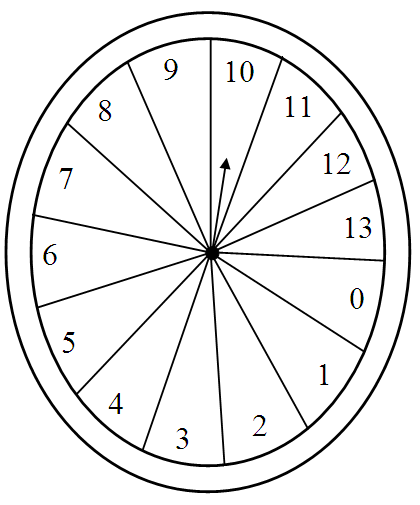
In roulette, Figure, the wheel has 13 numbers 0, 1, 2,...., 12 maked on equally spaced slots. A player sets Rs 10 on a given number. He recieves Rs 100 from the organiser of the game if the ball comes to rest in this slot; otherwise he gets nothing. If X denotes the players net gain/loss, Find E(X).
Answer
$\text{P}(\text{win})=\frac{1}{13}\Rightarrow\text{P}(\text{lose})=\frac{12}{13}$
He gains Rs 90 if he wins and loses Rs 10 if his number does not appear.
Let X denote tptal loss or gain, so,
$\text{X}:$ $90$ $-10$
$\text{P}(\text{X}):$ $\frac{1}{13}$ $\frac{12}{13}$
$\text{XP}:$ $\frac{90}{13}$ $\frac{-120}{13}$
$\text{E}(\text{X})=\sum\text{XP}$
$=\frac{90}{13}-\frac{120}{13}$
$\text{E}(\text{X})=-\frac{30}{13}$
View full question & answer
Question 173 Marks
Find the probability distribution of Y in two throws of two dice, where Y represents the number of times a total of 9 appears.
Answer
It is given that Y denotes the number of times a total of 9 appears on throwing the pair of dice.
When the dice is thrown 2 times, the possibility of getting a total of 9 is possible only for the given combination:
(3, 6) (4, 5) (5, 4) (6, 3)
So, the total number of outcomes is 36 and the total number of favourable outcomes is 4.
Probability of getting a total of $9=\frac{4}{36}=\frac{1}{9}$
Probability of not getting a total of $9=1-\frac{1}{9}=\frac{8}{9}$
If Y takes the values 0, 1 and 2. Then,
$\text{P}(\text{Y}=0)=\frac{8}{9}\times\frac{8}{9}=\frac{64}{81}$
$\text{P}(\text{Y}=1)=\frac{1}{9}\times\frac{8}{9}+\frac{8}{9}\times\frac{1}{9}=\frac{16}{81}$
$\text{P}(\text{Y}=2)=\frac{1}{9}\times\frac{1}{9}=\frac{1}{81}$
Thus, the probability distribution of X is given by
$\text{Y}$
$0$
$1$
$2$
$\text{P}(\text{Y})$
$\frac{64}{81}$
$\frac{16}{81}$
$\frac{1}{81}$
View full question & answer
Question 183 Marks
Let X represents the difference between the number of heads and the number of tails when a coin is tossed 6 times. What are possible values of X?
Answer
Given: X = Number of heads - Number of tails
Number of heads
Number of heads
Number of heads - Number of tails
0
6
-6
1
5
-4
2
4
-2
3
3
0
4
2
2
5
1
4
6
0
6
Therefore, the possible values of X are:
-6, -4, -2, 0, 2, 4, 6.
View full question & answer
Question 193 Marks
Find the mean and standard deviation of the following probability distributions:
$x_i$ -1 0 1 2 3
$p_i$ 0.3 0.1 0.1 0.3 0.2
Answer
$x_i$ $p_i$ $p_ix_i$ $p_ix_i^2$
-1 0.3 -0.3 0.3
0 0.1 0 0
1 0.1 0.1 0.1
2 0.3 0.6 0.2
3 0.2 0.6 1.8
    $\sum\text{p}_\text{i}\text{x}_\text{i}=1$ $\sum\text{p}_\text{i}\text{x}_\text{i}^2=3.4$
Mean $=\sum\text{p}_\text{i}\text{x}_\text{i}=1$
Variance $=\sum\text{p}_\text{i}\text{x}_\text{i}^2-(\text{Mean})^2$
$3.4-1$
$=2.4$
Step Deviation $=\sqrt{\text{Variance}}$
$=\sqrt{2.4}$
$=1.549$
View full question & answer
Question 203 Marks
For what value of k the following distribution is a probability distributioin?
$X = x_i$ $0$ $1$ $2$ $3$
$P(X = x_i)$ $2k^4$ $3k^2 - 5k^3$ $2k - 3k^2$ $3k - 1$
Answer
We know that the sum of the probabilities in a probability distribution is always $1$.
Therefore,
$P(X = 0) + P(X = 1) + P(X = 2) + P(X = 3) = 1$
$\Rightarrow 2k^4 + 3k^2 - 5k^3 + 2k - 3k^2 + 3k - 1 = 1$
$\Rightarrow 2k^4 -5k^3 + 5k = 2$
$\Rightarrow 2k^4 -5k^3 + 5k - 2 = 0$
$\Rightarrow (k - 1)(k - 2)(2k2 + k - 1) = 0$
$\Rightarrow (k - 1)(k - 2)(2k - 1)(k + 1) = 0$
$\Rightarrow\text{k}=-1,\frac{1}{2},1,2$
(Negleting $-1, 1$ and $2$ as they give the value of probability negative or greater than $1$)
$\therefore\ \text{k}=\frac{1}{2}.$
View full question & answer
Question 213 Marks
Four cards are drawn simultaneously from a well shuffled pack of 52 playing cards. Find the probability distribution of the number of aces.
Answer
Let X denote number of aces in a sample of 4 cards drawn from a well shuffled pack of 52 playing cards. Then, X can take values 0, 1, 2, 3 and 4.
Now,
$\text{P}(\text{X}=0)=\text{P}(\text{no ace})=\frac{\text{}^{48}\text{C}_4}{\text{}^{52}\text{C}_4}$
$\text{P}(\text{X}=1)=\text{P}(\text{1 ace})=\frac{\text{}^{4}\text{C}_1\times\text{}^{48}\text{C}_3}{\text{}^{52}\text{C}_4}$
$\text{P}(\text{X}=2)=\text{P}(\text{2 aces})=\frac{\text{}^{4}\text{C}_2\times\text{}^{48}\text{C}_2}{\text{}^{52}\text{C}_4}$
$\text{P}(\text{X}=3)=\text{P}(\text{3 aces})=\frac{\text{}^{4}\text{C}_3\times\text{}^{48}\text{C}_1}{\text{}^{52}\text{C}_4}$
$\text{P}(\text{X}=4)=\text{P}(\text{4 aces})=\frac{\text{}^{4}\text{C}_4}{\text{}^{52}\text{C}_4}$
Thus, the probability distribution of X is given by
$\text{X}$ $\text{P}(\text{X})$
$0$ $\frac{\text{}^{48}\text{C}_4}{\text{}^{52}\text{C}_4}$
$1$ $\frac{\text{}^{4}\text{C}_1\times\text{}^{48}\text{C}_3}{\text{}^{52}\text{C}_4}$
$2$ $\frac{\text{}^{4}\text{C}_2\times\text{}^{48}\text{C}_2}{\text{}^{52}\text{C}_4}$
$3$ $\frac{\text{}^{4}\text{C}_3\times\text{}^{48}\text{C}_1}{\text{}^{52}\text{C}_4}$
$4$ $\frac{\text{}^{4}\text{C}_4}{\text{}^{52}\text{C}_4}$
View full question & answer
Question 223 Marks
A box contains 13 bulbs, out of which 5 are defective. 3 bulbs are randomly drawn, one by one without replacement, from the box. Find the probability distribution of the number of defective bulbs.
Answer
Let X denote the number of defective bulbs in a sample of 3 bulbs drawn from a bag containing 13 bulbs. 5 bulbs in the bag turn out to be defective. Then, X can take the values 0, 1, 2 and 3.
Now,
P(X = 0) = P(no defective bulb) $=\frac{\text{}^{8}\text{C}_3}{\text{}^{13}\text{C}_3}=\frac{56}{286}=\frac{28}{143}$
P(X = 1) = P(1 defective bulb) $=\frac{\text{}^{5}\text{C}_1\times\text{}^{8}\text{C}_2}{\text{}^{13}\text{C}_3}=\frac{140}{286}=\frac{70}{143}$
P(X = 2) = P(2 defecive bulbs) $=\frac{\text{}^{5}\text{C}_1\times\text{}^{8}\text{C}_1}{\text{}^{13}\text{C}_3}=\frac{80}{286}=\frac{40}{143}$
P(X = 2) = P(2 defecive bulbs) $=\frac{\text{}^5\text{C}_3}{\text{}^{13}\text{C}_3}=\frac{10}{286}=\frac{5}{143}$
Thus, the probability distribution of X is given by
$\text{X}$
$0$
$1$
$2$
$3$
$\text{P}(\text{X})$
$\frac{28}{143}$
$\frac{70}{143}$
$\frac{40}{143}$
$\frac{5}{143}$
View full question & answer
Question 233 Marks
From a lot of 10 bulbs, which includes 3 defectives, a sample of two bulbs is drawn at random. Find the probability distribution of the number of defective bulbs.
Answer
Let X denote the number of defective bulbs in a sample of 2 bulbs drawn from a lot of 10 bulbs containing 3 defectives and 7 non defectives. Then X can take values 0, 1, 2.
Now,
P(X = 0) = P(no defective bulb) $=\frac{\text{}^{7}\text{C}_2}{\text{}^{10}\text{C}_2}=\frac{7}{15}$
P(X = 1) = P(1 defective bulb) $=\frac{\text{}^{3}\text{C}_1\times\text{}^{7}\text{C}_1}{\text{}^{10}\text{C}_2}=\frac{7}{15}$
P(X = 2) = P(2 defective bulbs) $=\frac{\text{}^{3}\text{C}_2}{\text{}^{10}\text{C}_2}=\frac{1}{15}$
Thus, the probability distribution of X is given below,
$\text{X}$
$0$
$1$
$2$
$\text{P}(\text{X})$
$\frac{7}{15}$
$\frac{7}{15}$
$\frac{1}{15}$
View full question & answer
Question 243 Marks
Find the mean and standard deviation of the following probability distributions:
$x_i$ 1 2 3 4
$p_i$ 0.4 0.3 0.2 0.1
Answer
$x_i$ $p_i$ $p_ix_i$ $p_ix_i^2$
1 0.3 0.4 0.4
2 0.1 0.6 1.2
3 0.1 0.6 1.8
4 0.3 0.4 1.6
    $\sum\text{p}_\text{i}\text{x}_\text{i}=2$ $\sum\text{p}_\text{i}\text{x}_\text{i}^2=5$
Mean $=\sum\text{p}_\text{i}\text{x}_\text{i}=2$
Variance $=\sum\text{p}_\text{i}\text{x}_\text{i}^2-(\text{Mean})^2$
$=5-2^2$
$=1$
Step Deviation $=\sqrt{\text{Variance}}$
$=\sqrt{1}$
$=1$
View full question & answer
Question 253 Marks
Five defective bolts are acciedently mixed with twenty good ones. If four bolts are drawn at random from this lot, find the probability distribution of the number of defective bolts.
Answer
Here, 5 defective and 20 non-defective bolts. Let X denote the number of defective bolts drawn out of four bolts drawn. So, X can have values 1, 2, 3, 4.
P(X = 0)
$=\frac{\text{}^{20}\text{C}_4}{\text{}^{25}\text{C}_4}$
$=\frac{4845}{12650}$
$=\frac{969}{2530}$
P(X = 1)
$=\frac{\text{}^{5}\text{C}_1\times\text{}^{20}\text{C}_3}{\text{}^{25}\text{C}_4}$
$=\frac{5700}{12650}$
$=\frac{114}{253}$
P(X = 2)
$=\frac{\text{}^{5}\text{C}_2\times\text{}^{20}\text{C}_2}{\text{}^{25}\text{C}_4}$
$=\frac{1900}{12650}$
$=\frac{38}{253}$
P(X = 1)
$=\frac{\text{}^{5}\text{C}_3\times\text{}^{20}\text{C}_1}{\text{}^{25}\text{C}_4}$
$=\frac{200}{12650}$
$=\frac{4}{253}$
P(X = 4)
$=\frac{\text{}^{5}\text{C}_4}{\text{}^{25}\text{C}_4}$
$=\frac{5}{12650}$
$=\frac{1}{2530}$
View full question & answer
Question 263 Marks
Let $X$ be a random variable which assumes values $x_1, x_2, x_3, x_4$ such that $2 P\left(X=x_1\right)=3 P\left(X=x_2\right)=P\left(X=x_3\right)=5 P(X=$ $x_4$ ). Find the probability distribution of $X$.
Answer
Here,$2P(x_1) = 3P(X_2) = P(x_3) = 5P(x_4)$
Let $P(x_3) = a$
$2\text{P}(\text{x}_1)=\text{P}(\text{x}_3)\Rightarrow\text{P}(\text{x}_1)=\frac{\text{a}}{2}$
$3\text{P}(\text{x}_2)=\text{P}(\text{x}_3)\Rightarrow\text{P}(\text{x}_2)=\frac{\text{a}}{3}$
$5\text{P}(\text{x}_4)=\text{P}(\text{x}_3)\Rightarrow\text{P}(\text{x}_4)=\frac{\text{a}}{5}$
Since, $\text{P}(\text{x}_1)+\text{P}(\text{x}_2)+\text{P}(\text{x}_3)+\text{P}(\text{x}_4)=1$
$\Rightarrow\frac{\text{a}}{2}+\frac{\text{a}}{3}+\frac{\text{a}}{1}+\frac{\text{a}}{5}=1$
$\Rightarrow\frac{15\text{a}+10\text{a}+30\text{a}+6\text{a}}{30}=1$
$\Rightarrow61\text{a}=30$
$\Rightarrow\text{a}=\frac{30}{61}$
So,
$\text{X}:$
$\text{x}_1$
$\text{x}_2$
$\text{x}_3$
$\text{x}_4$
$\text{P}(\text{X}):$
$\frac{15}{61}$
$\frac{10}{61}$
$\frac{30}{61}$
$\frac{6}{61}$
View full question & answer
Question 273 Marks
Find the mean and standard deviation of the following probability distributions:
$x_i$ 0 1 3 5
$p_i$ 0.2 0.5 0.2 0.1
Answer
$x_i$ $p_i$ $p_ix_i$ $p_ix_i^2$
0 0.2 0 0
1 0.5 0.5 0.5
3 0.2 0.6 1.8
5 0.1 0.5 2.5
    $\sum\text{p}_\text{i}\text{x}_\text{i}=1.6$ $\sum\text{p}_\text{i}\text{x}_\text{i}^2=4.8$
Mean $=\sum\text{p}_\text{i}\text{x}_\text{i}=1.6$
Variance $=\sum\text{p}_\text{i}\text{x}_\text{i}^2-(\text{Mean})^2$
$=4.8-1.6^2$
$=2.24$
Step Deviation $=\sqrt{\text{Variance}}$
$=\sqrt{2.24}$
$=1.497$
View full question & answer
Question 283 Marks
A fair die is tossed. Let X denote twise the number appearing. Find the probability distribution, mean and variance of X.
Answer
$\text{x}_\text{i}$ $\text{p}_\text{i}$ $\text{p}_\text{i}\text{x}_\text{i}$ $\text{p}_\text{i}\text{x}_\text{i}^2$
$2$ $\frac{1}{6}$ $\frac{2}{6}$ $\frac{4}{6}$
$4$ $\frac{1}{6}$ $\frac{4}{6}$ $\frac{16}{6}$
$6$ $\frac{1}{6}$ $\frac{6}{6}$ $\frac{36}{6}$
$8$ $\frac{1}{6}$ $\frac{8}{6}$ $\frac{64}{6}$
$10$ $\frac{1}{6}$ $\frac{10}{6}$ $\frac{100}{6}$
$12$ $\frac{1}{6}$ $\frac{12}{6}$ $\frac{144}{6}$
    $\sum\text{x}_\text{i}\text{p}_\text{i}=7$ $\sum\text{x}_\text{i}\text{p}_\text{i}^2=\frac{364}{6}$
Mean $=\sum\text{x}_\text{i}\text{p}_\text{i}=7$
Variance $=\sum\text{x}_\text{i}\text{p}_\text{i}^2-(\text{Mean})^2$
$=60.7-49$
$=11.7$
View full question & answer
Question 293 Marks
Find the mean and standard deviation of the following probability distributions:​
$x_i$ 1 2 3 4
$p_i​​​​​​$ 0.4 0.1 0.2 0.3
Answer
$x_i$ $p_i$ $x_ip_i$ $x_i^2p_i$
1 0.4 0.4 0.4
3 0.1 0.3 0.9
4 0.2 0.8 3.2
5 0.3 1.5 7.5
    $\sum\text{xp}=3$ $\sum\text{x}^2\text{p}=12$
Mean $=\sum\text{xp}=3$
Standard deviation $=\sqrt{\sum\text{x}^2\text{p}-(\text{mean})^2}$
$=\sqrt{12-(3)^2}$
$=\sqrt3$
Standard deviation = 1.732
View full question & answer