Questions

Solve the Following Question.(3 Marks)

Take a timed test

24 questions · self-marked practice — reveal the answer and mark yourself.

Question 13 Marks
The p.d.f. of r.v. $X$ is given by $f ( x )=\frac{k}{\sqrt{x}}$, for $0< x <4$ and $=0$, otherwise. Determine $k$. Determine c.d.f. of $X$ and hence find $P(X \leq 2)$ and $P(X \leq 1)$.
Answer
Since $f$ is p.d.f. of the r.v. $X_t$
$ \int_{-\infty}^{\infty} f(x) d x=1$
$\therefore \int_{-\infty}^0 f(x) d x+\int_0^4 f(x) d x+\int_4^{\infty} f(x) d x=1$
$\therefore 0+\int_0^4 \frac{k}{\sqrt{x}} d x+0=1$
$\therefore k \int_0^4 x^{-\frac{1}{2}} d x=1$
$\therefore k\left[\frac{x^{\frac{1}{2}}}{1 / 2}\right]_0^4=1 \quad \therefore 2 k[2-0]=1$
$\therefore 4 k=1 \quad \therefore k=\frac{1}{4} . $
Let $F(X)$ be the c.d.f. of $X$.
$ \therefore F(X)=P(X \leqslant x)=\int_{-\infty}^x f(x) d x$
$=\int_{-\infty}^0 f(x) d x+\int_0^x f(x) d x$
$=0+\int_0^x \frac{k}{\sqrt{x}} d x$
$=k \int_0^x x^{-\frac{1}{2}} d x=k\left[\frac{x^{\frac{1}{2}}}{1 / 2}\right]_0^x$
$=2 k \sqrt{x}=2\left(\frac{1}{4}\right) \sqrt{x}$
$\therefore F(X)=\frac{\sqrt{x}}{2}$
$P(X \leqslant 2)=F(2)=\frac{\sqrt{2}}{2}=\frac{1}{\sqrt{2}}$
$P(X \leqslant 1)=F(1)=\frac{\sqrt{1}}{2}=\frac{1}{2} .$
$\text { Hence, } k=\frac{1}{4}, P(X \leqslant 2)=\frac{1}{\sqrt{2}}, P(X \leqslant 1)=\frac{1}{2} . $
Hence, $k=\frac{1}{4}, P(X \leqslant 2)=\frac{1}{\sqrt{2}}, P(X \leqslant 1)=\frac{1}{2}$.
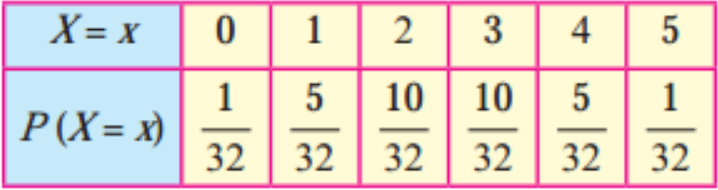
View full question & answer
Question 23 Marks
The p.d.f. of a continuous r.v. $X$ is given by $f ( x )=\frac{1}{2 a}$, for $0< x <2 a$ and $=0$, otherwise. Show that $P \left( X <\frac{a}{2}\right)= P \left( X >\frac{3 a}{2}\right)$
Answer
$
\begin{array}{c}
P\left(X<\frac{a}{2}\right)=\int_{-\infty}^{a / 2} f(x) d x \\
=\int_{-\infty}^0 f(x) d x+\int_0^{a / 2} f(x) d x \\
=0+\int_0^{a / 2} \frac{1}{2 a} d x \\
=\frac{1}{2 a} \int_0^{a / 2} 1 d x=\frac{1}{2 a}[x]_0^{a / 2} \\
=\frac{1}{2 a}\left[\frac{a}{2}-0\right]=\frac{1}{4} \\
\left.P(X) \frac{3 a}{2}\right)=\int_{3 a / 2}^{\infty} f(x) d x \\
=\int_{3 a / 2}^{2 a} f(x) d x+\int_{2 a}^{\infty} f(x) d x \\
=\int_{3 a / 2}^{2 a} \frac{1}{2 a} d x+0 \\
=\frac{1}{2 a} \int_{3 a / 2}^{2 a} 1 d x=\frac{1}{2 a}[x]_{3 a / 2}^{2 a} \\
=\frac{1}{2 a}\left[2 a-\frac{3 a}{2}\right]=\frac{1}{2 a}\left(\frac{a}{2}\right)=\frac{1}{4}
\end{array}
$
From (1) and (2), we get
$
P\left(X<\frac{a}{2}\right)=P\left(X>\frac{3 a}{2}\right) \text {. }
$
View full question & answer
Question 33 Marks
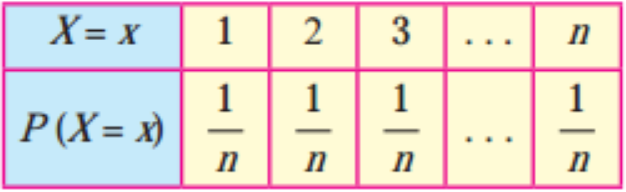
Find the expected value, variance, and standard deviation of the random variable whose p.m.f’s are given below:

Image

View full question & answer
Question 43 Marks
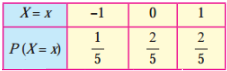
Find the expected value, variance, and standard deviation of the random variable whose p.m.f’s are given below:

Image

View full question & answer
Question 53 Marks
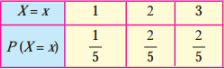
Find the expected value, variance, and standard deviation of the random variable whose p.m.f’s are given below:

Image

View full question & answer
Question 63 Marks
Find the expected value, variance, and standard deviation of the random variable whose p.m.f’s are given below:

Image

View full question & answer
Question 73 Marks
The probability distribution of discrete r.v. X is as follows:
Image
(i) Determine the value of k.
(ii) Find P(X ≤ 4), P(2 < X < 4), P(X ≥ 3).
Answer
(i) Since $P(x)$ is a probability distribution of $x$.
$
\begin{aligned}
& \Sigma_{x=0}^6 P(x)=1 \\
& \therefore P(0)+P(1)+P(2)+P(3)+P(4)+P(5)+P(6)=1 \\
& \therefore k+2 k+3 k+4 k+5 k+6 k=1 \\
& \therefore 21 k=1 \\
& \therefore k=\frac{1}{21}
\end{aligned}
$
(ii)
$
\begin{aligned}
& P(X \leq 4) \\
& =\mathrm{P}(0)+\mathrm{P}(1)+\mathrm{P}(2)+\mathrm{P}(3)+\mathrm{P}(4) \\
& =\mathrm{k}+2 \mathrm{k}+3 \mathrm{k}+4 \mathrm{k} \\
& =10 \mathrm{k} \\
& =10\left(\frac{1}{21}\right) \\
& =\frac{10}{21} \\
& \mathrm{P}(2<\mathrm{X}<4) \\
& =\mathrm{P}(3) \\
& =3 \mathrm{k} \\
& =3\left(\frac{1}{21}\right) \\
& =\frac{1}{7} \\
& \mathbf{P}(\mathrm{X} \geq 3) \\
& =P(1)+P(2)+P(3) \\
& =k+2 k+3 k \\
& =6 \mathrm{k} \\
& =6\left(\frac{1}{21}\right) \\
& =\frac{2}{7} \\
&
\end{aligned}
$
View full question & answer
Question 83 Marks
Two cards are drawn simultaneously (or successively without replacement) from a well shuffled pack of 52 cards. Find the mean, variance and standard deviation of the number of kings drawn.
Answer
Let $X$ denote the number of kings in a draw of two cards. $X$ is a random variable which can assume the values 0,1 or 2 .
Then
$
P(X=0)=P(\text { no card is king })=\frac{{ }^{48} C_2}{{ }^{52} C_2}=\frac{48 \times 47}{52 \times 51}=\frac{188}{221}
$
Then $\quad P(X=1)=P($ exactly one card is king $)=\frac{{ }^4 C_1 \times{ }^{48} C_1}{{ }^{52} C_2}=\frac{4 \times 48 \times 27}{52 \times 51}=\frac{32}{221}$
Then $\quad P(X=2)=P($ both cards are king $)=\frac{{ }^4 C_2}{{ }^{52} C_2}=\frac{4 \times 3}{52 \times 51}=\frac{1}{221}$
$
\begin{gathered}
\mu=\mathrm{E}(X)=\sum_{i=1}^n x_i p_i=0 \times \frac{188}{221}+1 \times \frac{32}{221}+2 \times \frac{1}{221}=\frac{34}{221} \\
\begin{aligned}
& \operatorname{Var}(X)=\left(\sum_{i=1}^n x_i^2 p_i\right)-\left(\sum_{i=1}^n x_i p_i\right)^2=\left(0^2 \times \frac{188}{221}+1^2 \times \frac{32}{221}+2^2 \times \frac{1}{221}\right)-\left(\frac{34}{221}\right)^2 \\
&=\frac{36}{221}-\frac{1156}{48841}=\frac{6800}{48841}=0 \cdot 1392 \\
& \sigma=\sqrt{\operatorname{Var}(X)}=\sqrt{0 \cdot 1392}
\end{aligned}
\end{gathered}
$
View full question & answer
Question 93 Marks
Find the mean and variance of the number randomly selected from 1 to 15 .
Answer
The sample space of the experiment is $S=\{1,2,3, \ldots, 15\}$.
Let $X$ denote the number selected.
Then $X$ is a random variable which can take values $1,2,3, \ldots, 15$. Each number selected is equiprobable therefore
$
\begin{aligned}
& \mathrm{P}(1)=\mathrm{P}(2)=\mathrm{P}(3)=\ldots=\mathrm{P}(15)=\frac{1}{15} \\
& \mu=\mathrm{E}(X)=\sum_{i=1}^n x_i p_i=1 \times \frac{1}{15}+2 \times \frac{1}{15}+3 \times \frac{1}{15}+\ldots+15 \times \frac{1}{15} \\
& =(1+2+3+\ldots+15) \times \frac{1}{15}=\left(\frac{15 \times 16}{2}\right) \times \frac{1}{15}=8 \\
& \operatorname{Var}(X)=\left(\sum_{i=1}^n x_i^2 p_i\right)-\left(\sum_{i=1}^n x_i p_i\right)^2=1^2 \times \frac{1}{15}+2^2 \times \frac{1}{15}+3^2 \times \frac{1}{15}+\ldots+15^2 \times \frac{1}{15}-(8)^2 \\
& =\left(1^2+2^2+3^2+\ldots+15^2\right) \times \frac{1}{15}-(8)^2 \\
& =\left(\frac{15 \times 16 \times 31}{6}\right) \times \frac{1}{15}-(8)^2 \\
& =82 \cdot 67-64=18 \cdot 67 \\
\end{aligned}
$
View full question & answer
Question 103 Marks
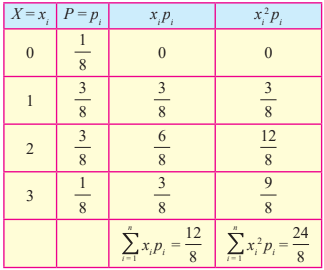
Three coins are tossed simultaneously, $X$ is the number of heads. Find expected value and variance of $X$.
Answer

Image

$S=\{$ HHH, HHT, HTH, THH, HTT, THT, TTH, TTT $\}$ and $X=\{0,1,2,3\}$
$\begin{aligned} \text { Then } \mathrm{E}(X) & =\sum_{i=1}^n x_i p_i=\frac{12}{8}=1 \cdot 5 \\ \operatorname{Var}(X) & =\left(\sum_{i=1}^n x_i^2 p_i\right)-\left(\sum_{i=1}^n x_i p_i\right)^2=\frac{24}{8}-(1 \cdot 5)^2=3-2 \cdot 25=0 \cdot 75\end{aligned}$

View full question & answer
Question 113 Marks
The Probability distribution of X is as follows :
Image

Find (i) $k$, (ii) $\mathrm{P}[X<2]$, (iii) $\mathrm{P}[X \geq 3]$, (iv) $\mathrm{P}[1 \leq X<4]$, (v) $\mathrm{F}$ (2).

Answer
The table gives a probability distribution and therefore
$
\mathrm{P}[X=0]+\mathrm{P}[X=1]+\mathrm{P}[X=2]+\mathrm{P}[X=3]+\mathrm{P}[X=4]=1 .
$
That is, $0 \cdot 1+k+2 k+2 k+k=1$.
That is, $6 k=0 \cdot 9$. Therefore $k=0 \cdot 15$.
(i) $k=0 \cdot 15$.
(ii) $\mathrm{P}[X<2]=\mathrm{P}[X=0]+\mathrm{P}[X=1]=0 \cdot 1+k=0 \cdot 1+0.15=0 \cdot 25$
(iii) $\mathrm{P}[X \geq 3]=\mathrm{P}[X=3]+\mathrm{P}[X=4]=2 k+k=3(0 \cdot 15)=0 \cdot 45$
(iv)
$
\begin{aligned}
\mathrm{P}[1 \leq X<4]=\mathrm{P}[X=1]+\mathrm{P}[X=2]+\mathrm{P}[X=3] & =k+2 k+2 k=5 k \\
& =5(0 \cdot 15)=0 \cdot 75 .
\end{aligned}
$
(v)
$
\begin{aligned}
\mathrm{F}(2)=\mathrm{P}[X \leq 2]=\mathrm{P}[X=0]+\mathrm{P}[X=1]+\mathrm{P}[X=2] & =0 \cdot 1+k+2 k=0 \cdot 1+3 k \\
& =0 \cdot 1+3(0 \cdot 15)=0 \cdot 1+0 \cdot 45=0 \cdot 55 .
\end{aligned}
$
View full question & answer
Question 123 Marks
Find the probability distribution of the number of doublets in three throws of a pair of dice.
Answer
Let $X$ denote the number of doublets. Possible doublets in a pair of dice are $(1,1),(2,2)$, $(3,3),(4,4),(5,5),,(6,6)$.
Since the dice are thrown thrice, $0,1,2$, and 3 are possible values of $X$. Probability of getting a doublet in a single throw of a pair of dice is $p=\frac{1}{6}$ and $q=1-\frac{1}{6}=\frac{5}{6}$.
$
\begin{aligned}
& P[X=0]=P[\text { no doublet }]=q q q=\frac{5}{6} \times \frac{5}{6} \times \frac{5}{6}=\frac{125}{216} . \\
& P[X=1]=P[\text { one doublet }]=p q q+q p q+q q p=3 p q^2=\frac{75}{216} . \\
& P[X=2]=P[\text { two doublets }]=p p q+p q p+q p p=3 p^2 q=\frac{15}{216} . \\
& P[X=3]=P[\text { three doublets }]=p p p=\frac{1}{216} .
\end{aligned}
$
View full question & answer
Question 133 Marks
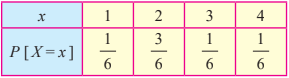
A fair die is thrown. Let $X$ denote the number of factors of the number on the upper face. Find the probability distribution of $X$.
Answer
The sample space of the experiment is $\mathrm{S}=\{1,2,3,4,5,6\}$. The values of $X$ for the possible outcomes of the experiment are as follows.
$
\begin{gathered}
X(1)=1, X(2)=2, X(3)=2, X(4)=3, X(5)=2, X(6)=4 . \text { Therefore, } \\
p_1=\mathrm{P}[X=1]=\mathrm{P}[\{1\}]=\frac{1}{6} \\
p_2=\mathrm{P}[X=2]=\mathrm{P}[\{2,3,5\}]=\frac{3}{6} \\
p_3=\mathrm{P}[X=3]=\mathrm{P}[\{4\}]=\frac{1}{6} \\
p_4=\mathrm{P}[X=4]=\mathrm{P}[\{6\}]=\frac{1}{6}
\end{gathered}
$
The probability distribution of $X$ is then as follows.

Image

View full question & answer
Question 143 Marks
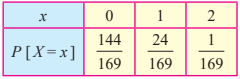
Two cards are randomly drawn, with replacement, from a well shuffled deck of 52 playing cards. Find the probability distribution of the number of aces drawn.
Answer
Let $X$ denote the number of aces among the two cards drawn with replacement.
Clearly, 0,1 , and 2 are the possible values of $X$. Since the draws are with replacement, the outcomes of the two draws are independent of each other. Also, since there are 4 aces in the deck of 52 cards,
$
\begin{aligned}
& P[\text { ace }]=\frac{4}{52}=\frac{1}{13} \text { and } P[\text { non-ace }]=\frac{12}{13} \text {. Then } \\
& \mathrm{P}[X=0]=\mathrm{P}[\text { non-ace and non-ace }]=\frac{12}{13} \times \frac{12}{13}=\frac{144}{169}, \\
& \mathrm{P}[X=1]=\mathrm{P} \text { [ace and non-ace }]+\mathrm{P} \text { [non-ace and ace }] \\
& =\frac{1}{13} \times \frac{12}{13}+\frac{12}{13} \times \frac{1}{13}=\frac{24}{169}, \\
& \text { and } \mathrm{P}[X=2]=\mathrm{P}[\text { ace and ace }]=\frac{1}{13} \times \frac{1}{13}=\frac{1}{169} \text {. } \\
&
\end{aligned}
$
The required probability distribution is then as follows.

Image

View full question & answer
Question 153 Marks
A bag contains 1 red and 2 green balls. One ball is drawn from the bag at random, its colour is noted, and then ball is put back in the bag. One more ball is drawn from the bag at random and its colour is also noted. Let $X$ denote the number of red balls drawn from the bag as described above. Derive the probability distribution of $X$.
Answer
Let the balls in the bag be denoted by $r, g_1, g_2$. The sample space of the experiment is then given by
$
S=\left\{r r, r g_1, r g_2, g_1 r, g_2 r, g_1 g_1, g_1 g_2, g_2 g_1, g_2 g_2\right\} \text {. }
$
Since $X$ is defined as the number of red balls, we have
$
\begin{aligned}
& X(\{r r\})=2, \\
& X\left(\left\{r g_1\right\}\right)=X\left(r g_2\right)=X\left(g_1 r\right)=X\left(g_2 r\right)=1, \\
& X\left(\left\{g_1 g_1\right\}\right)=X\left(g_1 g_2\right)=X\left(g_2 g_1\right)=X\left(g_2 g_2\right)=0 .
\end{aligned}
$
Thus, $X$ is a discrete random variable that can take values 0,1 , and 2 .
The probability distribution of $X$ is then obtained as follows :

Image

View full question & answer
Question 163 Marks
Two persons A and B play a game of tossing a coin thrice. If the result of a toss is head, A gets ₹ 2 from B. If the result of a toss is tail, B gets ₹ 1.5 from A. Let $X$ denote the amount gained or lost by A. Show that $X$ is a discrete random variable and show how it can be defined as a function on the sample space of the experiment.
Answer
$X$ is a number whose value depends on the outcome of a random experiment.
Therefore, $X$ is a random variable. Since the sample space of the experiment has only 8 possible outcomes, $\mathrm{X}$ is a discrete random variable. Now, the sample space of the experiment is $S=\{$ HHH, HHT, HTH, THH, HTT, THT, TTH, TTT $\}$.
The values of $X$ in rupees corresponding to these outcomes of the experiment are as follows.
$
\begin{aligned}
& X(\mathrm{HHH})=2 \times 3=₹ 6 \\
& X(\mathrm{HHT})=X(\mathrm{HTH})=X(\mathrm{THH})=2 \times 2-1.50 \times 1=₹ 2.50 \\
& X(\mathrm{HTT})=X(\mathrm{THT})=X(\mathrm{TTH})=2 \times 1-1.50 \times 2=₹-1.00 \\
& X(\mathrm{TTT})=-1.50 \times 3=₹-4.50
\end{aligned}
$
Here, a negative amount shows a loss to player A. This example shows that $X$ takes a unique value for every element of the sample space and therefore $X$ is a function on the sample space. Further, possible values of $X$ are $4.50,1,2.50,6$.
View full question & answer
Question 173 Marks
In a meeting, 70% of the member’s favour and 30% oppose a certain proposal. A member is selected at random and we take X = 0 if he opposed and X = 1 if he is in favour. Find E(X) and Var(X)
Answer
$X$ takes values 0 and 1 .
It is given that
$
\begin{aligned}
& P(X=0)=P(0)=30 \%=\frac{30}{100}=0.3 \\
& P(X=1)=P(1)=70 \%=\frac{70}{100}=0.7 \\
& \therefore E(X)=\Sigma x_i \cdot P\left(x_i\right)=0 \times 0.3+1 \times 0.7=0.7
\end{aligned}
$
Also, $\Sigma x_i^2 \cdot P\left(x_i\right)=0 \times 0.3+1 \times 0.7=0.7$
$
\begin{aligned}
& \therefore \text { Variance }=\mathrm{V}(\mathrm{X})=\Sigma x_i^2 \cdot P\left(x_i\right)-[E(X)]^2 \\
& =0.7-(0.7)^2 \\
& =0.7-0.49 \\
& =0.21
\end{aligned}
$
Hence, $E(X)=0.7$ and $\operatorname{Var}(X)=0.21$.
View full question & answer
Question 183 Marks
Two numbers are selected at random (without replacement) from the first six positive integers. Let X denote the larger of the two numbers. Find E(X).
Answer
Two numbers are chosen from the first 6 positive integers.
$\therefore n ( S )={ }^6 C_2=\frac{6 \times 5}{1 \times 2}=15$
Let $X$ denote the larger of the two numbers.
Then $X$ can take values $2,3,4,5,6$.
When $X=2$, the other positive number which is less than $2$ is $1.$
$ \therefore n ( X )=1$
$\therefore P ( X =2)= P (2)=\frac{n(X)}{n(S)}=\frac{1}{15} $
When $X=3$, the other positive number less than 3 can be 1 or 2 and hence can be chosen in 2 ways.
$ \therefore n ( X )=2$
$P ( X =3)= P (3)=\frac{n(X)}{n(S)}=\frac{2}{15} $
Similarly, $P(X=4)=P(4)=\frac{3}{15}$
$ P(X=5)=P(5)=\frac{4}{15}$
$P(X=6)=P(6)=\frac{5}{15}$
$\therefore E(X)=\sum x_i P\left(x_i\right)$
$=2 \times \frac{1}{15}+3 \times \frac{2}{15}+4 \times \frac{3}{15}+5 \times \frac{4}{15}+6 \times \frac{5}{15}$
$=\frac{2+6+12+20+30}{15}$
$=\frac{70}{15}$
$=\frac{14}{3} $
View full question & answer
Question 193 Marks
Two dice are thrown simultaneously. If $X$ denotes the number of sixes, find the expectation of $X.$
Answer
When two dice are thrown, the sample space S has $6 \times 6=36$ sample points.
$\therefore n ( S )=36$
Let $X$ denote the number of sixes when two dice are thrown.
Then $X$ can take values $0,1,2$
When $X=0$, then
$ X=\{(1,1),(1,2),(1,3),(1,4),(1,5),(2,1),(2,2),(2,3),(2,4),(2,5),(3,1),(3,2),$
$(3,3),(3,4),(3,5),(4,1),(4,2),(4,3),(4,4),(4,5),(5,1),(5,2),(5,3),(5,4),(5, 5) \}$
$ \therefore n ( X )=25$
$\therefore P ( X =0)=\frac{n(X)}{n(S)}=\frac{25}{36} $
When $X=1$, then
$ X=\{(1,6),(2,6),(3,6),(4,6),(5,6),(6,1),(6,2),(6,3),(6,4),(6,5)\}$
$\therefore n(X)=10$
$\therefore P(X=1)=\frac{n(X)}{n(S)}=\frac{10}{36}$
$\text { When } X=2, \text { then } X=\{(6,6)\}$
$\therefore n(X)=1$
$\therefore P(X=2)=\frac{n(X)}{n(S)}=\frac{1}{36}$
$\therefore E(X)=\sum x i P(x i)$
$=0 \times \frac{25}{36}+1 \times \frac{10}{36}+2 \times \frac{1}{36}$
$=0+\frac{10}{36}+\frac{2}{36}$
$=\frac{1}{3} $
View full question & answer
Question 203 Marks
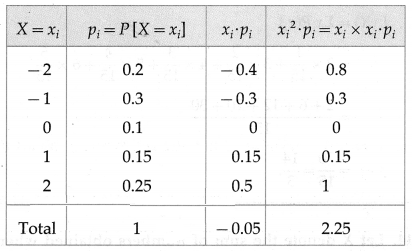
Find expected value and variance of X for the following p.m.f.:Image
Answer
We construct the following table to calculate E(X) and V(X):
Image
From the table,
$ \Sigma x _{ i } p _{ i }=-0.05 \text { and } \Sigma x_i^2 \cdot p_i=2.25$
$\therefore E ( X )=\Sigma x _{ i } p _{ i }=-0.05$
$\text { and } V ( X )=\Sigma x_i^2+p_i-\left(\sum x_i+p_i\right)^2$
$=2.25-(-0.05)^2$
$=2.25-0.0025$
$=2.2475 $
Hence, $E(X)=-0.05$ and $V(X)=2.2475$
View full question & answer
Question 213 Marks
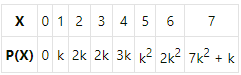
A random variable X has the following probability distribution:
Image
Determine:
(i) k
(ii) P(X < 3) (iii) P(X > 4)
Answer
(i) Since $P(x)$ is a probability distribution of $x$,
$ \sum_{x=0}^7 P(x)=1$
$\Rightarrow P(0)+P(1)+P(2)+P(3)+P(4)+P(5)+P(6)+P(7)=1$
$\Rightarrow 0+\mathrm{k}+2 \mathrm{k}+2 \mathrm{k}+3 \mathrm{k}+\mathrm{k}^2+2 \mathrm{k}^2+7 \mathrm{k}^2+\mathrm{k}=1$
$\Rightarrow 10 \mathrm{k}^2+9 \mathrm{k}-1=0$
$\Rightarrow 10 \mathrm{k}^2+10 \mathrm{k}-\mathrm{k}-1=0$
$\Rightarrow 10 \mathrm{k}(\mathrm{k}+1)-1(\mathrm{k}+1)=0$
$\Rightarrow(\mathrm{k}+1)(10 \mathrm{k}-1)=0$
$\Rightarrow 10 \mathrm{k}-1=0 \ldots \ldots[\because \mathrm{k} \neq-1]$
$\Rightarrow \mathrm{k}=\frac{1}{10} $
$ \text { (ii) } P(X<3)=P(0)+P(1)+P(2)$
$=0+k+2 k$
$=3 k$
$=3\left(\frac{1}{10}\right)$
$=\frac{3}{10} $
$ \text { (iii) } P(0=k+2 k$
$=3 k$
$=3\left(\frac{1}{10}\right)$
$=\frac{3}{10} $
View full question & answer
Question 223 Marks
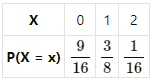
A coin is biased so that the head is $3$ times as likely to occur as the tail. If the coin is tossed twice. Find the probability distribution of a number of tails.
Answer
Given a biased coin such that heads is 3 times as likely as tails.
$\therefore \mathrm{P}(\mathrm{H})=\frac{3}{4} \text { and } \mathrm{P}(\mathrm{T})=\frac{1}{4}$
The coin is tossed twice.
Let $X$ can be the random variable for the number of tails.
Then $X$ can take the value $0,1,2$.
$ \therefore \mathrm{P}(\mathrm{X}=0)=\mathrm{P}(\mathrm{HH})$
$=\frac{3}{4} \times \frac{3}{4}$
$=\frac{9}{16} $
$P(X=1)=P(H T, T H)$
$=\frac{3}{4} \times \frac{1}{4}+\frac{1}{4} \times \frac{3}{4}$
$=\frac{6}{16}$
$=\frac{3}{8}$
$ \mathrm{P}(\mathrm{X}=2)=\mathrm{P}(\mathrm{TT})$
$=\frac{1}{4} \times \frac{1}{4}$
$=\frac{1}{16} $
Therefore, the required probability distribution is as follows.
Image
View full question & answer
Question 233 Marks
From a lot of 30 bulbs which include 6 defectives, a sample of 4 bulbs is drawn at random with replacement. Find the probability distribution of the number of defective bulbs.
Answer
It is given that out of 30 bulbs, 6 are defective.
$\Rightarrow$ Number of non-defective bulbs $=30-6=24$
4 bulbs are drawn from the lot with replacement.
Let $\mathrm{X}$ be the random variable that denotes the number of defective bulbs in the selected bulbs.
$\therefore X$ can take the value $0,1,2,3,4$.
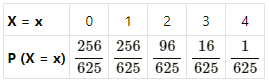
$\therefore \mathrm{P}(\mathrm{X}=0)=\mathrm{P}(4$ non-defective and 0 defective $)={ }^4 C_0 \times \frac{4}{5} \times \frac{4}{5} \times \frac{4}{5} \times \frac{4}{5}=\frac{256}{625}$
$\mathrm{P}(\mathrm{X}=1)=\mathrm{P}(3$ non-defective and 1 defective $)={ }^4 C_1 \times\left(\frac{1}{5}\right) \times\left(\frac{4}{5}\right)^3=\frac{256}{625}$
$\mathrm{P}(\mathrm{X}=2)=\mathrm{P}(2$ non-defective and 2defective $)={ }^4 C_2 \times\left(\frac{1}{5}\right)^2 \times\left(\frac{4}{5}\right)^2=\frac{96}{625}$
$\mathrm{P}(\mathrm{X}=3)=\mathrm{P}(1$ non-defective and 3defective $)={ }^4 C_3 \times\left(\frac{1}{5}\right)^3 \times\left(\frac{4}{5}\right)=\frac{16}{625}$
$\mathrm{P}(\mathrm{X}=4)=\mathrm{P}(0$ non-defective and 4 defective $)={ }^4 C_4 \times\left(\frac{1}{5}\right)^4 \times\left(\frac{4}{5}\right)^0=\frac{1}{625}$
Therefore, the required probability distribution is as follows.

Image

View full question & answer
Question 243 Marks
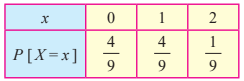
Find the probability distribution of a number of successes in two tosses of a die, where success is defined as a number greater than $4$ appearing on at least one die.
Answer
When a die is tossed twice, the sample space $S$ has $6 \times 6=36$ sample points.
$\therefore \mathrm{n}(\mathrm{S})=36$
Trial will be a success if the number on at least one die is 5 or 6 .
Let $\mathrm{X}$ denote the number of dice on which 5 or 6 appears.
Then $X$ can take values $0,1,2$
When $X=0$ i.e., 5 or 6 do not appear on any of the dice, then
$X=\{(1,1),(1,2),(1,3),(1,4),(2,1),(2,2),(2,3),(2,4),(3,1),(3,2),(3,3),(3,4),(4,1),(4,2),(4,3) \text {, }$
$(4,4)\}$.
$ \therefore \mathrm{n}(\mathrm{X})=16$
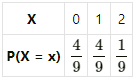
$\therefore \mathrm{P}(\mathrm{X}=0)=\frac{n(X)}{n(S)}=\frac{16}{36}=\frac{4}{9} $
When $X=1$, i.e. 5 or 6 appear on exactly one of the dice, then
$X=\{(1,5),(1,6),(2,5),(2,6),(3,5),(3,6),(4,5),(4,6),(5,1),(5,2),(5,3),(5,4),(6,1),(6,2),(6,3) \text {, }$
$(6,4)\}$
$\therefore \mathrm{n}(\mathrm{X})=16$
$\therefore \mathrm{P}(\mathrm{X}=1)=\frac{n(X)}{n(S)}=\frac{16}{36}=\frac{4}{9}$
When $X=2$, i.e. 5 or 6 appear on both of the dice, then
$ \mathrm{X}=\{(5,5),(5,6),(6,5),(6,6)\}$
$\therefore \mathrm{n}(\mathrm{X})=4$
$\therefore \mathrm{P}(\mathrm{X}=2)=\frac{n(X)}{n(S)}=\frac{4}{36}=\frac{1}{9} $
$\therefore$ The required probability distribution is
Image
View full question & answer