Questions

Solve the Following Question.(5 Marks)

Take a timed test

6 questions · self-marked practice — reveal the answer and mark yourself.

Question 15 Marks
Identify the random variable as either discrete or continuous in each of the following. If the random variable is discrete, list its possible values:
(i) An economist is interested in the number of unemployed graduates in the town of population 1 lakh.
(ii) Amount of syrup prescribed by a physician.
(iii) The person on a high protein diet is interesting to gain weight in a week.
(iv) 20 white rats are available for an experiment. Twelve rats are males. A scientist randomly selects 5 rats, the number of female rats selected on a specific day.
(v) A highway-safety group is interested in studying the speed (in km/hr) of a car at a checkpoint.
Answer
(i) Let X = number of unemployed graduates in a town.
Since the population of the town is 1 lakh, X takes the finite values.
∴ random variable X is discrete.
Range = {0, 1, 2, …, 99999, 100000}.

(ii) Let X = amount of syrup prescribed by a physician.
Then X takes uncountable infinite values.
∴ random variable X is continuous.

(iii) Let X = gain of weight in a week
Then X takes uncountable infinite values
∴ random variable X is continuous.

(iv) Let X = number of female rats selected on a specific day.
Since the total number of rats is 20 which includes 12 males and 8 females, X takes the finite values.
∴ random variable X is discrete.
Range = {0, 1, 2, 3, 4, 5}

(v) Let X = speed of .the car in km/hr.
Then X takes uncountable infinite values
∴ random variable X is continuous.
View full question & answer
Question 25 Marks
Suppose the p.d.f. of a continuous random variable $X$ is defined as:
$f(x)=x+1$, for $-1<x<0$, and $f(x)=1-x, \quad$ for $0 \leq x<1$.
Find the c.d.f. $F(x)$.
View full question & answer
Question 35 Marks
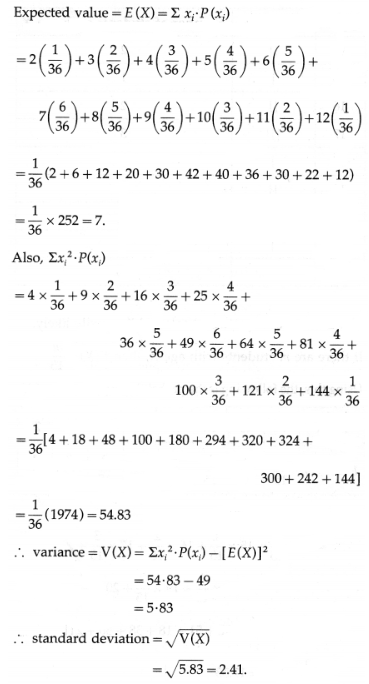
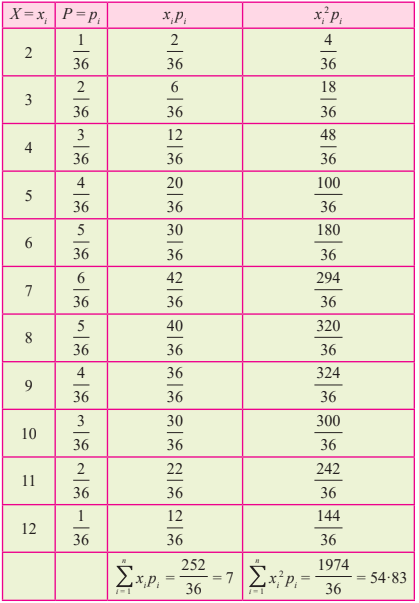
Let a pair of dice be thrown and the random variable $X$ be the sum of the numbers that appear on the two dice. Find the mean or expectation of $X$ and variance of $X$.
Answer
The sample space of the experiment consists of 36 elementary events in the form of ordered pairs $\left(x_i, y_i\right)$, where $x_i=1,2,3,4,5,6$ and $y_i=1,2,3,4,5,6$.
The random variable $\mathrm{X}$ i.e. the sum of the numbers on the two dice takes the values $2,3,4,5,6$, $7,8,9,10,11$ or 12 .

Image

$\begin{aligned} \text { Then } \mathrm{E}(X) & =\sum_{i=1}^n x_i p_i=7 \\ \operatorname{Var}(X) & =\left(\sum_{i=1}^n x_i^2 p_i\right)-\left(\sum_{i=1}^n x_i p_i\right)^2=54 \cdot 83-(7)^2 \\ & =54 \cdot 83-49 \\ & =5 \cdot 83\end{aligned}$

View full question & answer
Question 45 Marks
Suppose the error involved in making a certain measurement is a continuous r.v. X with p.d.f.
f(x) = k(4 – x2), -2 ≤ x ≤ 2 and 0 otherwise.
Compute:
(i) P(X > 0)
(ii) P(-1 < X < 1)
(iii) P(-0.5 < X or X > 0.5).
View full question & answer
Question 55 Marks
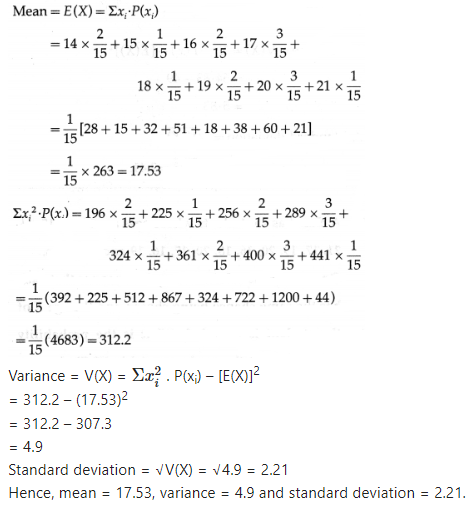
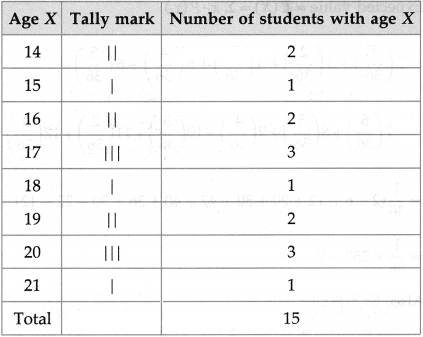
A class has 15 students whose ages are 14, 17, 15, 14, 21, 17, 19, 20, 16, 18, 20, 17, 16, 19 and 20 years. One student is selected in such a manner that each has the same chance of being chosen and the age X of the student is recorded. What is the probability distribution of the random variable X? Find mean, variance, and standard deviation of X.
Answer
Let X denote the age of the chosen student. Then X can take values 14, 15, 16, 17, 18, 19, 20, 21.
We make a frequency table to find the number of students with age X:
Image
The chances of any student selected are equally likely.
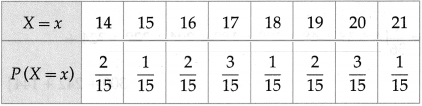
If there are m students with age X, then P(X) = $\frac{m}{15}$
Using this, the following is the probability distribution of X:
ImageImage
View full question & answer
Question 65 Marks
Let X denote the sum of numbers obtained when two fair dice are rolled. Find the standard deviation of X.
Answer
If two fair dice are rolled then the sample space S of this experiment is
S = {(1, 1), (1, 2), (1, 3), (1, 4), (1, 5), (1, 6), (2, 1), (2, 2), (2, 3), (2, 4), (2, 5), (2, 6), (3, 1), (3, 2), (3, 3), (3, 4), (3, 5), (3, 6), (4, 1), (4, 2), (4, 3), (4, 4), (4, 5), (4, 6), (5, 1), (5, 2), (5, 3), (5, 4), (5, 5), (5, 6), (6, 1), (6, 2), (6, 3), (6, 4), (6, 5), (6, 6)}
∴ n(S) = 36
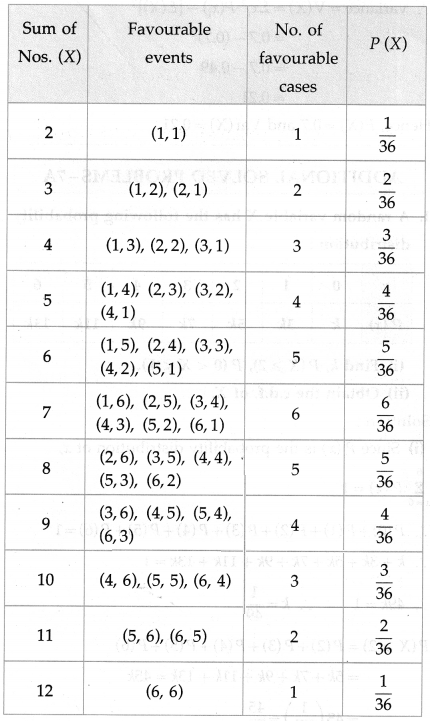
Let X denote the sum of the numbers on uppermost faces.
Then X can take the values 2, 3, 4, 5, 6, 7, 8, 9, 10, 11, 12
Image
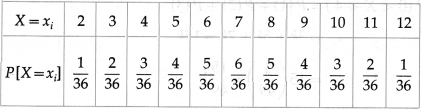
∴ the probability distribution of X is given by
Image
Image
View full question & answer