MCQ 11 Mark
If $A$ and $B$ are two events such that $\text{P(A)}=\frac{3}{8},\text{P(B)}=\frac{5}{4}.$ and $\text{P}(\text{A}|\text{B})\times\text{P}(\overline{\text{A}}\cap\text{B})$ is equals to.
- A
$\frac{2}{5}$
- B
$\frac{3}{8}$
- C
$\frac{3}{20}$
- ✓
$\frac{6}{25}$
AnswerCorrect option: D. $\frac{6}{25}$
$\text{P(A)}=\frac{3}{8},\text{P(B)}=\frac{5}{8},\text{P}\Big({\text{A}}\cup{\text{B}}\Big)=\frac{3}{4}$
$\text{P}(\text{A}\cap\text{B})=\text{P(A)}+\text{P(B)}-\text{P}(\text{A}\cap\text{B})$
$\Rightarrow\ \frac{3}{4}=\frac{3}{8}+\frac{5}{8}-\text{P}(\text{A}\cap\text{B})$
$\Rightarrow\ \text{P}(\text{A}\cap\text{B})=\frac{1}{4}$
$\text{P}\Big(\frac{\text{A}}{\text{B}}\Big)\text{ P}\Big(\frac{\overline{\text{A}}}{\text{B}}\Big)=\frac{\text{P}(\text{A}\cap\text{B})}{\text{P(B)}}\times\frac{\text{P}(\overline{\text{A}}\cap\text{B})}{\text{P(B)}}$
$\text{P}\Big(\frac{\text{A}}{\text{B}}\Big)\text{ P}\Big(\frac{\overline{\text{A}}}{\text{B}}\Big)=\frac{\text{P}(\text{A}\cap\text{B})}{\text{P(B)}}\times\frac{\text{P(B)}-\text{P}(\text{A}\cap\text{B})}{\text{P(B)}}$
$\text{P}\Big(\frac{\text{A}}{\text{B}}\Big)\text{ P}\Big(\frac{\overline{\text{A}}}{\text{B}}\Big)=\frac{\frac{1}{4}}{\frac{5}{8}}\times\frac{\big(\frac{5}{8}-\frac{1}{4}\big)}{\frac{5}{8}}$
$\text{P}\Big(\frac{\text{A}}{\text{B}}\Big)\text{ P}\Big(\frac{\overline{\text{A}}}{\text{B}}\Big)=\frac{6}{25}$
View full question & answer→MCQ 21 Mark
A bag contains $5$ brown and $4$ white socks. A man pulls out two socks. The probability that these are of the sane colour is.
- A
$\frac{5}{108}$
- B
$\frac{18}{108}$
- C
$\frac{30}{108}$
- ✓
$\frac{48}{108}$
AnswerCorrect option: D. $\frac{48}{108}$
Total number of balls $=5$ brown $+ 4$ white $= 9$
Required probability $=\frac{5}{9}\times\frac{4}{8}+\frac{4}{9}\times\frac{3}{8}=\frac{4}{9}$
$\Rightarrow\ \frac{4\times12}{9\times12}=\frac{48}{108}$
View full question & answer→MCQ 31 Mark
An urn contains $9$ balls two of which are red, three blue and four black. Three balls are drawn at random. The probability that they are of the same colour is,
- ✓
$\frac{5}{84}$
- B
$\frac{3}{9}$
- C
$\frac{3}{7}$
- D
$\frac{7}{17}$
AnswerCorrect option: A. $\frac{5}{84}$
Given:
Red balls $= 2$
Blue balls $= 3$
Black balls $= 4$
$P($All three balls are of same colour$) = P($all three are blue$) + P($all three are black$)$
$=\frac{3}{9}\times\frac{2}{8}\times\frac{1}{7}+\frac{4}{9}\times\frac{3}{8}\times\frac{2}{7}$
$=\frac{1}{84}+\frac{4}{84}$
$=\frac{5}{84}$
View full question & answer→MCQ 41 Mark
A die is thrown and a card is selected ar random from a deck pf $52$ playing cards. The probability of getting an even number of the die and a spade card is
- A
$\frac{1}{2}$
- B
$\frac{1}{4}$
- ✓
$\frac{1}{8}$
- D
$\frac{3}{4}$
AnswerCorrect option: C. $\frac{1}{8}$
A Sample space when a die is thrown,
$S_1 = \{1, 2, 3, 4, 5, 6\} \Rightarrow n(S_1) = 6$
Let A be the event that getting even number.
$A = \{2, 4, 6\} \Rightarrow n(A) = 3$
$\Rightarrow\ \text{P(A)}=\frac{3}{6}=\frac{1}{2}$
A card is selected from a deck of $52$ cards.
$\text{n}(\text{S}_2)= {^{52}}\text{C}_2=52$
Let $B$ be the event that getting spade card.
$\text{n(B)}= {^{13}}\text{C}_2=13\Rightarrow\ \text{P(B)}=\frac{13}{52}=\frac{1}{4}$
Required probability $= P(A) \times P(B)$
$=\frac{1}{2}\times\frac{1}{4}=\frac{1}{8}$
View full question & answer→MCQ 51 Mark
Five persone entered the lift cabin on the ground floor of an $8$ floor house. Suppose that each of them independently and with equal probability can leave the cabin at any flor beginning with the first, then the probability of all $5$ persons leaving at different floors is,
- ✓
$\frac{^{7}\text{P}_5}{7_5}$
- B
$\frac{7_5}{^{7}\text{P}_5}$
- C
$\frac{6}{^{6}\text{P}_5}$
- D
$\frac{^{5}\text{P}_5}{5}$
AnswerCorrect option: A. $\frac{^{7}\text{P}_5}{7_5}$
Five persons can leave different floors
By $^{7}\text{P}_5$ ways.
Possible ways of leavinf the lift $= 7^5$
Required probability $=\frac{^{7}\text{P}_5}{7^5}$
View full question & answer→MCQ 61 Mark
Three persons, $A, B$ and $C$ fine a target in turn starting with $A$. Their probability of hitting the target are $0.4, 0.2$ and $0.2,$ respectively. The probability of two hits is
- A
$0.024$
- B
$0.452$
- C
$0.336$
- ✓
$0.188$
AnswerCorrect option: D. $0.188$
Let:
$A$ be the event of hitting the target by the person $A,$
$B$ be the event of hitting the target by the person $B$ and
$C$ be the event of hitting the target by the person $C$
We have,
$P(A) = 0.4, P(B) = 0.3$ and $P(C) = 0.2$
Also,
$\text{P}(\overline{\text{A}})=1-\text{P(A)}=1-0.4=-0.6,$
$\text{P}(\overline{\text{B}})=1-0.3=0.7$ and
$\text{P}(\overline{\text{C}})=1-0.2=0.8$
Now,
$\text{P(Two hits)}=\text{P}(\text{AB}\overline{\text{C}})+\text{P}(\text{A}\overline{\text{B}}\text{C})+\text{P}(\overline{\text{A}}\text{BC})$
$=\text{P(A)}\times\text{P(B)}\times\text{P}(\overline{\text{C}})+\text{P(A)}\times(\overline{\text{B}})\times\text{P(C)}\\+\text{P}(\overline{\text{A}})\times\text{P(B)}\times\text{P(C)}$
$=0.4\times0.3\times0.8+0.4\times0.7\times0.2+0.6\times0.3\times0.2$
$=0.096+0.056+0.036$
$=0.188$
Hence, the correct alternative is option $(d).$
View full question & answer→MCQ 71 Mark
If two events are independent, then.
AnswerCorrect option: D. None of the above is correctIf two. events are independent, then.
Let $A$ and $B$ are two independent events, Then,
$\text{P}(\text{A}\cap\text{B})=\text{P(A)}\times\text{P(B)}$
As, $\text{P}(\text{A}\cap\text{B})\neq0\text{ or }\text{P(A)}+\text{P(B)}\neq1$
So, both are neither mutually exclisive nor their sum of probability is $1.$
Hence, the correct alternative is option $(d).$
View full question & answer→MCQ 81 Mark
A and B are two students. Their chances of solving a problem correctly are $\frac{1}{3}$ and $\frac{1}{4}$ respectively. If the probability of their making common error is $\frac{1}{20}$ and they obtain the same answer, then the probability of their answer to be correct is.
- ✓
$\frac{10}{13}$
- B
$\frac{13}{120}$
- C
$\frac{1}{40}$
- D
$\frac{1}{12}$
AnswerCorrect option: A. $\frac{10}{13}$
$\frac{10}{13}$
Let $E_1$ be the event that Both A and B solve the problem.
A and B are independent,
$\Rightarrow\ \text{P}(\text{E}_1)=\text{P(A)}\times\text{P(B)}$
$\Rightarrow\ \text{P}(\text{E}_1)=\frac{1}{3}\times\frac{1}{4}=\frac{1}{12}$
Let $E _2$ both A and B got wrong solution.g solution.
$\text{P}(\text{E}_2)=\Big(1-\frac{1}{3}\Big)\times\Big(1-\frac{1}{4}\Big)=\frac{1}{2}$
Let E be the event getting same answer.
$\text{P}\Big(\frac{\text{E}}{\text{E}_1}\Big)=1,\text{P}\Big(\frac{\text{E}}{\text{E}_2}\Big)=\frac{1}{20}$
$\Rightarrow\text{P}\Big(\frac{\text{E}_1}{\text{E}}\Big)=\frac{\frac{1}{12}\times1}{\frac{1}{12}\times1+\frac{1}{2}\times\frac{1}{20}}=\frac{10}{13}$
View full question & answer→MCQ 91 Mark
If $A$ and $B$ are two events such that $\text{P(A)}\neq0$ and $\text{P(B)}\neq1,$ then $\text{P}(\overline{\text{A}}|\overline{\text{B}})=$
- A
$1-\text{P}(\text{A}|\text{B})$
- B
$1-\text{P}(\overline{\text{A}}|\text{B})$
- ✓
$\frac{1-\text{P}(\text{A}\cup\text{B})}{\text{P}(\overline{\text{B}})}$
- D
$=\frac{\text{P}(\overline{\text{A}})}{\text{P}(\overline{\text{B}})}$
AnswerCorrect option: C. $\frac{1-\text{P}(\text{A}\cup\text{B})}{\text{P}(\overline{\text{B}})}$
We have,
$\text{P(A)}\neq0$ and $\text{P(B)}\neq1$
Now,
$\text{P}(\overline{\text{A}}|\overline{\text{B}})=\frac{\text{P}(\overline{\text{A}}\cap\overline{\text{B}})}{\text{P}(\overline{\text{B}})}$
$=\frac{\text{P}(\overline{\text{A}\cap\text{B}})}{\text{P}(\overline{\text{B}})}$
$=\frac{1-\text{P}(\text{A}\cup\text{B})}{\text{P}(\overline{\text{B}})}$
Hence, the correct alternative is option $(C).$
View full question & answer→MCQ 101 Mark
If $A$ and $B$ are such that $\text{P}(\text{A}\cup\text{B})=\frac{5}{9}$ and $\text{P}(\overline{\text{A}}\cup\overline{\text{B}})=\frac{2}{3},$ then $\text{P}(\overline{\text{A}})+\text{P}(\overline{\text{B}})=$
- A
$\frac{9}{10}$
- ✓
$\frac{10}{9}$
- C
$\frac{8}{9}$
- D
$\frac{9}{8}$
AnswerCorrect option: B. $\frac{10}{9}$
$\text{P}(\text{A}\cup\text{B})=\frac{5}{9},\text{P}(\overline{\text{A}}\cup\overline{\text{B}})=\frac{2}{3}$
Consider,
$\text{P}(\overline{\text{A}}\cup\overline{\text{B}})=\text{P}(\overline{\text{A}\cup\text{B}})$
$\Rightarrow\text{P}(\overline{\text{A}}\cup\overline{\text{B}})=\frac{2}{3}$
$\Rightarrow 1-\text{P}(\text{A}\cap\text{B})=\frac{2}{3}$
$\Rightarrow\text{P}(\text{A}\cap\text{B})=\frac{1}{3}$
$\Rightarrow\ \text{P(A)}+\text{P(B)}-\text{P}(\text{A}\cup\text{B})=\frac{1}{3}$
$\Rightarrow\ \text{P(A)}+\text{P(B)}-\frac{5}{9}=\frac{1}{3}$
$\Rightarrow\ \text{P(A)}+\text{P(B)}=\frac{8}{9}$
$\text{P}(\overline{\text{A}})+\text{P}(\overline{\text{B}})=1-\text{P(A)}+1-\text{P(B)}$
$\Rightarrow\text{P}(\overline{\text{A}})+\text{P}(\overline{\text{B}})=2-\big[\text{P(A)}+\text{P(B)}\big]$
$\Rightarrow\text{P}(\overline{\text{A}})+\text{P}(\overline{\text{B}})=2-\frac{8}{9}$
$\Rightarrow\text{P}(\overline{\text{A}})+\text{P}(\overline{\text{B}})=\frac{10}{9}$
View full question & answer→MCQ 111 Mark
In a college $30\%$ students fail in Physics, $25\%$ fail in Mathenatics and $10\%$ fail in both. One student is chosen at random. The probability that she fails in Physics if she failed in Mathematics is.
- A
$\frac{1}{10}$
- B
$\frac{1}{3}$
- ✓
$\frac{2}{5}$
- D
$\frac{9}{20}$
AnswerCorrect option: C. $\frac{2}{5}$
Let $A$ be the event that students failed in Physics.
$B$ be the event that students failed in Mathematics.
Given that, $\text{P(A)}=30\%=\frac{30}{100}$
$\text{P(B)}=25\%=\frac{25}{100}$
$\text{P}(\text{A}\cap\text{B})=10\%=\frac{10}{100}$
Required probability is given by $\text{P}\Big(\frac{\text{A}}{\text{B}}\Big)$
$\Rightarrow\ \text{P}\Big(\frac{\text{A}}{\text{B}}\Big)=\frac{\text{P}(\text{A}\cap\text{B})}{\text{P(B)}}=\frac{\frac{10}{100}}{\frac{25}{100}}=\frac{2}{5}$
View full question & answer→MCQ 121 Mark
If $\text{P(B)}=\frac{3}{5},\text{P}(\text{A}|\text{B})=\frac{1}{2}$ and $\text{P}(\text{A}\cup\text{B})=\frac{4}{5},$ then $\text{P}(\overline{\text{A}\cap\text{B}})+\text{P}(\overline{\text{A}}\cap\text{B})=$
- A
$\frac{1}{5}$
- B
$\frac{4}{5}$
- C
$\frac{1}{2}$
- ✓
$1$
Answer$\text{P(B)}=\frac{3}{5},\text{P}\Big(\frac{\text{A}}{\text{B}}\Big)=\frac{1}{2},\text{P}\Big({\text{A}}\cup{\text{B}}\Big)=\frac{4}{5}$
Consider,
$\text{P}\Big(\frac{\text{A}}{\text{B}}\Big)=\frac{1}{2}$
$\Rightarrow\ \frac{\text{P}(\text{A}\cap\text{B})}{\text{P(B)}}=\frac{1}{2}$
$\Rightarrow\ \frac{\text{P}(\text{A}\cap\text{B})}{\frac{3}{5}}=\frac{1}{2}$
$\Rightarrow\ \text{P}(\text{A}\cap\text{B})=\frac{3}{10}$
$\text{P}(\overline{\text{A}\cup\text{B}})+\text{P}(\overline{\text{A}}\cap\text{B})$
$=1-\text{P}(\text{A}\cap\text{B})+\text{P(B)}-\text{P}(\text{A}\cap\text{B})$
$=1-\frac{3}{10}+\frac{3}{5}-\frac{3}{10}$
$=1$
View full question & answer→MCQ 131 Mark
Two persons $A$ and $B$ take turns in throwing a pair of dice.The first person to throw $9$ from both dice will be awarded the prize. If $A$ throws first, then the probability that $B$ wins the game is.
- A
$\frac{9}{17}$
- ✓
$\frac{8}{17}$
- C
$\frac{8}{9}$
- D
$\frac{1}{9}$
AnswerCorrect option: B. $\frac{8}{17}$
$9$ can be obtained from throw of two dice in only $4$ cases as given below:
$\{(3, 6), (4, 5), (5, 4), (6, 3)]$
$\Rightarrow\ \text{P(getting }9)=\frac{4}{36}=\frac{1}{9}$
$\text{P(not getting }9)=\frac{32}{36}=\frac{8}{9}$
Now,
$P(B$ is winning $)=P\left(\right.$ getting 9 in $2^{\text {nd }}$ throw $)+P\left(\right.$ getting $p$ in $4^{\text {th }}$ throw $)+P\left(\right.$ getting 9 in $6^{\text {th }}$ throw $)+\ldots .$.
$=\frac{8}{9}\times\frac{1}{9}+\frac{8}{9}\times\frac{8}{9}\times\frac{8}{9}\times\frac{1}{9}+\ .....$
$=\frac{8}{81}\Big[1+\frac{64}{81}+\Big(\frac{64}{81}\Big)^2+\ ......\Big]$
$=\frac{8}{81}\times\frac{1}{1-\frac{64}{81}}$
$=\frac{8}{81}\times\frac{81}{17}$
$=\frac{8}{17}$
View full question & answer→MCQ 141 Mark
If $\text{P}(\text{A}\cup\text{B})=0.8$ and $\text{P}(\text{A}\cap\text{B})=0.3$ then $\text{P}(\overline{\text{A}})=\text{P}(\overline{\text{B}})=$
AnswerIf $\text{P}(\text{A}\cup\text{B})=0.8\text{ P}(\text{A}\cap\text{B})=0.3,$
$\text{P}(\text{A}\cup\text{B})=\text{P(A)}+\text{P(B)}-\text{P}(\text{A}\cap\text{B})$
$\Rightarrow\ \text{P(A)}+\text{P(B)}=\text{P}(\text{A}\cup\text{B})-\text{P}(\text{A}\cap\text{B})$
$\Rightarrow\ \text{P(A)}+\text{P(B)}=1.1$
$\Rightarrow\ \text{P}(\overline{\text{A}})+\text{P}(\overline{\text{B}})=1-\text{P(A)}+1-\text{P(B)}$
$\Rightarrow\ \text{P}(\overline{\text{A}})+\text{P}(\overline{\text{B}})=\big[\text{P(A)}+\text{P(B)}\big]$
$\Rightarrow\ \text{P}(\overline{\text{A}})+\text{P}(\overline{\text{B}})=2-1.1$
$\Rightarrow\ \text{P}(\overline{\text{A}})+\text{P}(\overline{\text{B}})=0.9$
View full question & answer→MCQ 151 Mark
A bag $X$ contains $2$ white and $3$ black balls and another bag $Y$ contains $4$ white and $2$ black balls. One bag is selected at random and a ball is drawn from it. Then, the probability chosen to be white is,
- A
$\frac{2}{15}$
- B
$\frac{7}{15}$
- ✓
$\frac{8}{15}$
- D
$\frac{14}{15}$
AnswerCorrect option: C. $\frac{8}{15}$
A white ball can be drawn in two mutually exclusive ways:
$i.$ Selecting bag $X$ and then drawing a white ball from it.
$ii.$ Selecting bag $Y$ ane then drawing a white ball from it.
Let $E_1, E_2$ and $A$ be the three evenes as defined below:
$E_1=$ Selecting abg $X$
$E_2=$ Selecting bag $Y$
$A=$ Drawing a white ball
We know that one bag is selected randomly.
View full question & answer→MCQ 161 Mark
Let $A$ and $B$ be two events such that $P(A) = 0.6, P(B) = 0.2, P(A|B) = 0.5.$ Then $\text{P}(\overline{\text{A}}|\overline{\text{B}})$ equals.
- A
$\frac{1}{10}$
- B
$\frac{3}{10}$
- ✓
$\frac{3}{8}$
- D
$\frac{6}{7}$
AnswerCorrect option: C. $\frac{3}{8}$
Given that,
$\text{P(A)}=0.6,\text{P(B)}=0.2,\text{P}\Big(\frac{\text{A}}{\text{B}}\Big)=0.5$
Consider,
$\text{P}\Big(\frac{\text{A}}{\text{B}}\Big)=0.5$
$\Rightarrow\frac{\text{P}(\text{A}\cap\text{B})}{\text{P(B)}}=0.5$
$\Rightarrow\frac{\text{P}(\text{A}\cap\text{B})}{0.2}=0.5$
$\Rightarrow \text{P}(\text{A}\cap\text{B})=0.1$
$\Rightarrow \text{P(A)}+\text{P(B)}-\text{P}(\text{A}\cup\text{B})=0.1$
$\Rightarrow \text{P}(\text{A}\cup\text{B})=\text{P(A)}+\text{P(B)}-0.1$
$\Rightarrow\text{P}(\text{A}\cup\text{B})=0.7$
Now, $\text{P}(\overline{\text{A}}\cap\overline{\text{B}})=\text{P}(\overline{\text{A}\cup\text{B}})$
$\text{P}(\overline{\text{A}}\cap\overline{\text{B}})=1-\text{P}(\text{A}\cup\text{B})$
$\Rightarrow \text{P}(\overline{\text{A}}\cap\overline{\text{B}})=0.3$
To find
$\text{P}\Big(\frac{\overline{\text{A}}}{\overline{\text{B}}}\Big)=\frac{\text{P}(\overline{\text{A}\cap\text{B}})}{\text{P}(\overline{\text{B}})}$
$\text{P}\Big(\frac{\overline{\text{A}}}{\overline{\text{B}}}\Big)=\frac{0.3}{0.8}$
$\text{P}\Big(\frac{\overline{\text{A}}}{\overline{\text{B}}}\Big)=\frac{3}{8}$
View full question & answer→MCQ 171 Mark
If $A$ and $B$ are two events, then $\text{P}(\overline{\text{A}}\cap\text{B})=$
- A
$\text{P}(\overline{\text{A}})\text{ P}(\overline{\text{B}})$
- B
$1-\text{P}(\text{A})-\text{P}(\text{B})$
- C
$\text{P}(\text{A})+\text{P}(\text{B})-\text{P}(\text{A}\cap\text{B})$
- ✓
$\text{P}(\text{B})-\text{P}(\text{A}\cap\text{B})$
AnswerCorrect option: D. $\text{P}(\text{B})-\text{P}(\text{A}\cap\text{B})$
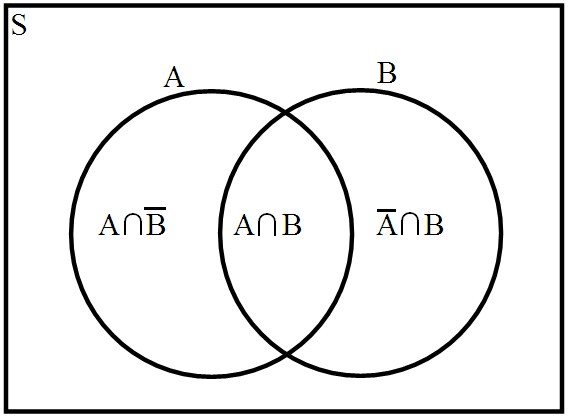
From the diagram, we get $\text{A}\cap\text{B}$ and $\overline{\text{A}}\cap\text{B}$ are mutually exclusive events such that $(\text{A}\cap\text{B})\cup(\overline{\text{A}}\cap\text{B})=\text{B}.$ therefore by
$\text{P}(\text{A}\cap\text{B})+\text{P}(\overline{\text{A}}\cap\text{B})=\text{P(B)}$
$\therefore\ \text{P}(\overline{\text{A}}\cap\text{B})=\text{P(B)}-\text{P}(\text{A}\cap\text{B})$ View full question & answer→MCQ 181 Mark
The probability that in a year of $22^{nd}$ century chosen at random, there will be $53$ Sunday, is
- A
$\frac{3}{28}$
- B
$\frac{2}{28}$
- C
$\frac{7}{28}$
- ✓
$\frac{5}{28}$
AnswerCorrect option: D. $\frac{5}{28}$
We know a leap year is fallen within $4$ years,
So its probability is $\frac{25}{100}=\frac{1}{4}$
53rd Sunday leap year $=\frac{1}{4}\times\frac{2}{7}=\frac{2}{28}$
Similarly probability of 53rd Sunday in a non leap year $=\frac{75}{100}\times\frac{1}{7}=\frac{3}{4}\times\frac{1}{7}=\frac{3}{28}$
Required probability $=\frac{2}{28}+\frac{3}{28}=\frac{5}{28}$.
View full question & answer→MCQ 191 Mark
India play two matches each with West indies and Australia. In any match the probability of india getting $0,1$ and $2$ points are $0.45, 0.05$ and $0.50$ respectively. Assuming that the outcomes are indepecdent, the probability of india getting at least 7 points is.
- ✓
$0.0875$
- B
$\frac{1}{16}$
- C
$0.1125$
- D
AnswerCorrect option: A. $0.0875$
Here, there are total $5$ ways by which India can get at least $7$ points.
$i. \ce{2 points + 2 points + 2 points + 2 points = (0.5 \times 0.5 \times 0.5 \times 0.5)}$
$ii. \ce{1 points + 2 points + 2 points + 2 points = (0.05 \times 0.5 \times 0.5 \times 0.5)}$
$iii. \ce{2 points + 1 points + 2 points + 2 points = (0.5 \times 0.05 \times 0.5 \times 0.5)}$
$iv. \ce{2 points + 2 points + 1 points + 2 points = (0.5 \times 0.5 \times 0.05 \times 0.5)}$
$v. \ce{2 points + 2 points + 2 points + 1 points = (0.5 \times 0.5 \times 0.5 \times 0.05)}$
View full question & answer→MCQ 201 Mark
A box contains $3$ orange balls, $3$ green balls and $2$ blue balls. Three balls are drawn at random from the box without replacement. The probability of drawing $22$ green balls and one blue ball is
- A
$\frac{167}{168}$
- B
$\frac{1}{28}$
- C
$\frac{2}{21}$
- ✓
$\frac{3}{28}$
AnswerCorrect option: D. $\frac{3}{28}$
Total balls in a box $- 3$ orange $+ 3$ green $+ 2$ blue $= 8$
Three balls are drawn at random from the box then samplw space
$\text{n(S)}= {^{8}}\text{C}_3=\frac{8\times7\times6}{3\times2\times1}=56$
Let $A$ be the event that drawing $2$ green and one blue ball.
$\text{n(A)}={^{3}}\text{C}_2\times{^{2}}\text{C}_2=6$
$\text{P(A)}=\frac{6}{56}=\frac{3}{28}$
View full question & answer→MCQ 211 Mark
A box contains $6$ nails and $10$ nuts. Half of the nails and half of the nuts are rusted. If one iten is chosen ar random, the probability that it is rusted or is nail is
- A
$\frac{3}{16}$
- B
$\frac{5}{16}$
- ✓
$\frac{11}{16}$
- D
$\frac{14}{16}$
AnswerCorrect option: C. $\frac{11}{16}$
Rusted items $= 3 + 5 = 8$
Rusted nails $= 3$
Total nails $= 6$
$P($getting a rusted item or a nail$) = P($getting a rusted item$) + P($getting a nail$) - P($getting a rusted item and a nail$)$
$=\frac{8}{16}+\frac{6}{16}-\frac{3}{16}$
$=\frac{8+6-3}{16}$
$=\frac{11}{16}$
View full question & answer→MCQ 221 Mark
If the events $A$ and $B$ are independent, then $\text{P}(\text{A}\cap\text{B})$ is equal to,
AnswerCorrect option: C. $P(A) P(B)$
$\text{P}(\text{A}\cap\text{B})=\text{P(A)} \text{ P(B)}$ for independent events.
View full question & answer→MCQ 231 Mark
If $A$ and $B$ are two events associated to a random experiment such that $\text{P}(\text{A}\cap\text{B})=\frac{7}{10}$ and $\text{P(B)}=\frac{17}{20}$, then $P(A|B) =$
- ✓
$\frac{14}{17}$
- B
$\frac{17}{20}$
- C
$\frac{7}{8}$
- D
$\frac{1}{8}$
AnswerCorrect option: A. $\frac{14}{17}$
$\text{P}(\text{A}\cap\text{B})=-\frac{7}{10},\text{P(B)}=\frac{17}{20}$
$\text{P}\Big(\frac{\text{A}}{\text{B}}\Big)=\frac{\text{P}(\text{A}\cap\text{B})}{\text{P(B)}}$
$\text{P}\Big(\frac{\text{A}}{\text{B}}\Big)=\frac{\frac{7}{10}}{\frac{17}{20}}=\frac{14}{17}$
View full question & answer→MCQ 241 Mark
If $A$ and $B$ are two events such that $\text{P}(\text{A}|\text{B})=\text{p},\text{P(A)}=\text{p},\text{P(B)}=\frac{1}{3}$ and $\text{P}(\text{A}\cup\text{B})=\frac{5}{9},$ then $p =$
- A
$\frac{2}{3}$
- B
$\frac{3}{5}$
- ✓
$\frac{1}{3}$
- D
$\frac{3}{4}$
AnswerCorrect option: C. $\frac{1}{3}$
$\text{P}\Big(\frac{\text{A}}{\text{B}}\Big)=\text{p},\text{P(A)}=\text{p},\text{P(B)}=\frac{1}{3},\text{P}(\text{A}\cup\text{B})=\frac{5}{9}$
Consider,
$\text{P}\Big(\frac{\text{A}}{\text{B}}\Big)=\text{p}$
$\Rightarrow \frac{\text{P}(\text{A}\cap\text{B})}{\text{P(B)}}=\text{P}$
$\Rightarrow \frac{\text{P(A)}+\text{P(B)}-\text{P}(\text{A}\cup\text{B})}{\text{P(B)}}=\text{P}$
$\Rightarrow\frac{\text{p}+\frac{1}{3}-\frac{5}{9}}{\frac{1}{3}}=\text{p}$
$\Rightarrow\text{p}+\frac{1}{3}-\frac{5}{9}=\frac{\text{p}}{3}$
$\Rightarrow\frac{-2}{9}=\frac{\text{p}}{3}-\text{p}$
$=\frac{-2}{3}\text{p}=\frac{-2}{9}$
$\Rightarrow\text{p}=\frac{1}{3}$
View full question & answer→MCQ 251 Mark
A flash light has $8$ batteries out of which $3$ are dead. IF two batteries are selected without replacement and tested, then the probability that both are dead is,
- ✓
$\frac{3}{28}$
- B
$\frac{1}{14}$
- C
$\frac{9}{64}$
- D
$\frac{33}{56}$
AnswerCorrect option: A. $\frac{3}{28}$
We have,
The total number of batteries $= 8$
The number of dead batteries $= 3$
Let $A$ be the event of selecting the first dead battery and $B$ be the event of selecting the second dead battery.
Now,
$P($both dead batteries are selected$) =\text{P}(\text{A}\cap\text{B})$
$=\text{P(A)}\times\text{P}(\text{B}|\text{A})$
$=\frac{3}{8}\times\frac{2}{7}$
$=\frac{3}{28}$
Hence, the correct alternative is option $(a).$
View full question & answer→MCQ 261 Mark
Associated to a random experiment two events $A$ and $B$ are such that $\text{P(B)}=\frac{3}{5},\text{P}(\text{A}|\text{B})=\frac{1}{2}$ and $\text{P}(\text{A}\cup\text{B})=\frac{4}{5}$. The value pf $P(A)$ is
- A
$\frac{3}{10}$
- ✓
$\frac{1}{2}$
- C
$\frac{1}{10}$
- D
$\frac{3}{5}$
AnswerCorrect option: B. $\frac{1}{2}$
$\text{P(B)}=\frac{3}{5},\text{P}\Big(\frac{\text{A}}{\text{B}}\Big)=\frac{1}{2},\text{P}(\text{A}\cup\text{B})=\frac{4}{5}$
$\text{P}\Big(\frac{\text{A}}{\text{B}}\Big)=\frac{1}{2}$
$\frac{\text{P}(\text{A}\cap\text{B})}{\text{P(B)}}=\frac{1}{2}$
$\frac{\text{P}(\text{A}\cap\text{B})}{\frac{3}{5}}=\frac{1}{2}$
$\text{P}(\text{A}\cap\text{B})=\frac{3}{10}$
$\text{P(A)}+\text{P(B)}-\text{P}(\text{A}\cup\text{B})=\frac{3}{10}$
$\text{P(A)}+\frac{3}{5}-\frac{4}{5}=\frac{3}{10}$
$\text{P(A)}=\frac{1}{2}$
View full question & answer→MCQ 271 Mark
A box contains $10$ good articles and $6$ with defects. One item is drawn at random. The probability that it is either good or has a defect is,
- ✓
$\frac{64}{64}$
- B
$\frac{49}{64}$
- C
$\frac{40}{64}$
- D
$\frac{24}{64}$
AnswerCorrect option: A. $\frac{64}{64}$
$P($good item$) =\frac{10}{16}$
$P($defected item$) =\frac{6}{16}$
$P($eitherr good or defected item$) = P($good item$) + P($defected item$)$
$=\frac{10}{16}+\frac{6}{16}$
$=\frac{16}{16}$
$=1$
$=\frac{64}{64}$
View full question & answer→MCQ 281 Mark
If $A$ and $B$ are two events such that $\text{P(A)}=\frac{1}{2},\text{P(B)}=\frac{1}{3},\text{P}(\text{A}|\text{B})=\frac{1}{4},$ then $\text{P}(\overline{\text{A}}\cap\overline{\text{B}})$ equals.
- A
$\frac{1}{12}$
- B
$\frac{3}{4}$
- ✓
$\frac{1}{4}$
- D
$\frac{3}{16}$
AnswerCorrect option: C. $\frac{1}{4}$
$\text{P(A)}=\frac{1}{2},\text{P(B)}=\frac{1}{3},\text{P}\Big(\frac{\text{A}}{\text{B}}\Big)=\frac{1}{4}$
$\text{P}\Big(\frac{\text{A}}{\text{B}}\Big)=\frac{1}{4}$
$\frac{\text{P}(\text{A}\cap\text{B})}{\text{P(B)}}=\frac{1}{4}$
$\frac{\text{P}(\text{A}\cap\text{B})}{\frac{1}{3}}=\frac{1}{4}$
$\text{P}(\text{A}\cap\text{B})=\frac{1}{12}$
$\text{P}\Big(\frac{\text{A}}{\text{B}}\Big)=\frac{\text{P}(\text{A}\cap\text{B})}{\text{P(B)}}$
$\Rightarrow\ \text{P}\Big(\frac{\text{A}}{\text{B}}\Big)=\frac{\frac{1}{12}}{\frac{1}{3}}=\frac{1}{4}$
$\text{P}(\overline{\text{A}}\cap\overline{\text{B}})=\text{P}(\overline{\text{A}\cup\text{B}})$
$\text{P}(\overline{\text{A}}\cap\overline{\text{B}})=1-\text{P}(\text{A}\cup\text{B})$
$\text{P}(\overline{\text{A}}\cap\overline{\text{B}})=-1\big[\text{P(A)}+\text{P(B)}-\text{P}(\text{A}\cap\text{B})\big]$
$\text{P}(\overline{\text{A}}\cap\overline{\text{B}})=1-\Big[\frac{1}{2}+\frac{1}{3}-\frac{1}{12}\Big]$
$\text{P}(\overline{\text{A}}\cap\overline{\text{B}})=\frac{1}{4}$
View full question & answer→MCQ 291 Mark
$A$ and $B$ draw two cards each, one after another, from a pack of well$-$shuffled pack of $52$ cards. The probability that all the four cards drawn are of the same suit is
AnswerCorrect option: A. $\frac{44}{85\times49}$
Total cards $= 52$ There are four suits of cards in a pack,
i.e. diamond, heart, spade and club.
Pall $4$ cards are of same suit $=$ Pall $4$ cards are of diamond $+$ Pall $4$ cards are of heart $+$ Pall $4$ cards are of spade $+$ Pall $4$ cards are of club.
$=4\times\frac{13}{52}\times\frac{12}{51}\times\frac{11}{50}\times\frac{10}{59}$
$=4\times\frac{11}{85\times49}$
$=\frac{44}{85\times49}$
View full question & answer→MCQ 301 Mark
If $A$ and $B$ are two events such that $\text{P(A)}=\frac{4}{5},$ and $\text{P}(\text{A}\cap\text{B})=\frac{7}{10},$ then $P(B|A) =$
- A
$\frac{1}{10}$
- B
$\frac{1}{8}$
- ✓
$\frac{7}{8}$
- D
$\frac{17}{20}$
AnswerCorrect option: C. $\frac{7}{8}$
We have,
$\text{P(A)}=\frac{4}{5}$ and $\text{P}(\text{A}\cap\text{B})=\frac{7}{10}$
Now,
$\text{P}(\text{B}|\text{A})=\frac{\text{P}(\text{A}\cap\text{B})}{\text{P(A)}}$
$=\frac{\Big(\frac{7}{10}\Big)}{\Big(\frac{4}{5}\Big)}$
$=\frac{7\times5}{10\times4}$
$=\frac{7}{8}$
Hence, the correct alternative is option $(c).$
View full question & answer→MCQ 311 Mark
If $A$ and $B$ are two independent events such that $P(A) = 0.3$ and $\text{P}(\text{A}\cup\text{B})=0.5,$ then $P(A|B) - P(B|A) =$
- A
$\frac{2}{7}$
- B
$\frac{3}{35}$
- ✓
$\frac{1}{70}$
- D
$\frac{1}{7}$
AnswerCorrect option: C. $\frac{1}{70}$
We have,
$\text{P(A)}=0.3$ and $\text{P}(\text{A}\cup\text{B})=0.5$
As, $A$ and $B$ are independent events
So, $\text{P}(\text{A}\cap\text{B})=\text{P(A)}\times\text{P(B)}$
$=0.3\times\text{P(B)}$
$=0.3\text{ P(B)}\ .....\text{(i)}$
Also, $\text{P}(\text{A}\cup\text{B})=\text{P(A)}+\text{P(B)}-\text{P}(\text{A}\cap\text{B})$
$\Rightarrow 0.5 = 0.3+\text{P(B)}-0.3\text{ P(B)} [$Using $(i)]$
$\Rightarrow 0.5-0.3 = 0.7\text{ P(B)}$
$\Rightarrow0.7\text{ P(B)}=0.2$
$\Rightarrow\text{ P(B)}=\frac{0.2}{0.7}$
$\Rightarrow\text{ P(B)}=\frac{2}{7}$
Using $(i)$, we get
$\text{P}(\text{A}\cap\text{B})=0.3\times\frac{2}{7}=\frac{6}{70}$
Now,
$\text{P}(\text{A}|\text{B})-\text{P}(\text{B}|\text{A})=\frac{\text{P}(\text{A}\cap\text{B})}{\text{P(B)}}-\frac{\text{P}(\text{A}\cap\text{B})}{\text{P(A)}}$
$=\frac{\Big(\frac{6}{70}\Big)}{\Big(\frac{2}{7}\Big)}-\frac{\Big(\frac{6}{70}\Big)}{0.3}$
$=\frac{6\times7}{70\times2}-\frac{6}{70\times0.3}$
$=\frac{3}{10}-\frac{2}{7}$
$=\frac{21-20}{70}$
$=\frac{1}{70}$
Hence, the correct alternative is option $(c).$
View full question & answer→MCQ 321 Mark
$A$ and $B$ are two events such that $P(A) = 0.25$ and $P(B) = 0.50.$ The probability pf both happening together is $0.14.$ The probability of both $A$ and $B$ hot happening is.
AnswerCorrect option: A. $0.39$
$\text{P}(\text{A}\cup\text{B})=\text{P(A)}+\text{P(B)}-\text{P}(\text{A}\cap\text{B})$
$=0.25+0.5-0.14$
$0.61$
$P($Both $A$ and $B$ not happening$) =\text{P}(\text{A}\cup\text{B})'$
$=1-\text{P}(\text{A}\cup\text{B})$
$=1-0.61$
$=0.39$
View full question & answer→MCQ 331 Mark
If one ball is drawn ar random from each of three boxes containing $3$ white and $1$ black, $2$ white and $2$ black, $1$ white and $3$ black balls, then the probability that $2$ white and $1$ black balls will be drawn is.
- ✓
$\frac{13}{32}$
- B
$\frac{1}{4}$
- C
$\frac{1}{32}$
- D
$\frac{3}{16}$
AnswerCorrect option: A. $\frac{13}{32}$
Total balls in first box $= 3$ white $+ 1$ black $= 4$
Total balls in second box $= 2$ white $+ 2$ black $= 4$
Total balls in third box $= 1$ white $+ 3$ black $= 4$
Probability of $2$ white and $1$ black
$\ce{= P(WWB) + P(WBW) + P(BWW)}$
$=\frac{3}{4}\times\frac{2}{4}\times\frac{3}{4}+\frac{3}{4}\times\frac{2}{4}\times\frac{1}{4}+\frac{1}{4}\times\frac{2}{4}\times\frac{1}{4}$
$=\frac{18+6+2}{64}$
$=\frac{13}{32}$
View full question & answer→MCQ 341 Mark
From a set of $100$ cards numbered $1$ to $100$, one card is drawn at randow. The probability number obtained on the card is divisible by $6$ or $8$ but not by $24$ is
- ✓
$\frac{6}{25}$
- B
$\frac{1}{4}$
- C
$\frac{1}{6}$
- D
$\frac{2}{6}$
AnswerCorrect option: A. $\frac{6}{25}$
Number of cards divisible by $6 = 16$
$\Rightarrow\ \text{P(A)}=\frac{16}{100}$
Number of cards divisible by $8 = 12$
$\Rightarrow\ \text{P(B)}=\frac{12}{100}$
Number of cards divisible by $24 = 4$
$\Rightarrow\ \text{P}(\text{A}\cap\text{B})=\frac{4}{100}$
$\text{P}(\text{A}\cup\text{B})=\frac{16}{100}+\frac{12}{100}-\frac{4}{100}$
$\text{P}(\text{A}\cup\text{B})=\frac{6}{25}$
View full question & answer→MCQ 351 Mark
A bag containe $5$ black, $4$ white balls and $3$ red balls. if a ball is selected randomwise, the probability that it is black or red ball is,
- A
$\frac{1}{3}$
- B
$\frac{1}{4}$
- C
$\frac{5}{12}$
- ✓
$\frac{2}{3}$
AnswerCorrect option: D. $\frac{2}{3}$
We know that the bag contains $5B ($black$), 4W($white$)$ and $3R($red$)$ balls.
Now,
$\text{P(B)}=\frac{5}{12}$
$\text{P(R)}=\frac{3}{12}$
$\text{P}(\text{B or R})=\text{P(B)}+\text{P(R)}$
$=\frac{5}{12}+\frac{3}{12}$
$=\frac{8}{12}$
$=\frac{2}{3}$
View full question & answer→MCQ 361 Mark
A coin is tossed three times. If events $A$ and $B$ are defined as $A =$ Two heads come, $B =$ Last should be head, Then, $A$ and $B$ are
Answer$\ce{S = [(HHH), (HHT), (HTH), (HTT), (THH), (THT), (TTH), (TTT)]}$
$\text{P(A)}=\text{P}(2$ heads $)=\frac{3}{8}$
$\text{P(B)}=\text{P}($ last one is heads $)=\frac{4}{8}$
$\text{P}(\text{A}\cap\text{B})=\frac{2}{8}=\frac{1}{4}\neq\text{P(A) P(B)}$
Thus, $A$ and $B$ are dependent.
View full question & answer→MCQ 371 Mark
If $A$ and $B$ are two independent events with $\text{P(A)}=\frac{3}{5}$ and $\text{P(B)}=\frac{4}{9},$ then $\text{P}(\overline{\text{A}}\cap\overline{\text{B}})$ equals,
- A
$\frac{4}{15}$
- B
$\frac{8}{45}$
- C
$\frac{1}{3}$
- ✓
$\frac{2}{9}$
AnswerCorrect option: D. $\frac{2}{9}$
$\text{P(A)}=\frac{3}{5},\text{P(B)}=\frac{4}{9}$
$\text{P}(\overline{\text{A}}\cap\overline{\text{B}})=\text{P}(\overline{\text{A}\cup\text{B}})$
$\text{P}(\overline{\text{A}}\cap\overline{\text{B}})=1-\text{P}(\text{A}\cup\text{B})$
$\text{P}(\overline{\text{A}}\cap\overline{\text{B}})=1-\big[\text{P(A)}+\text{P(B)}-\text{P}(\text{A}\cap\text{B})\big]$
$\text{P}(\overline{\text{A}}\cap\overline{\text{B}})=1-\Big[\frac{3}{5}+\frac{4}{9}-\frac{3}{5}\times\frac{4}{9}\Big]$
$(\because A$ and $B$ are independent$)$
$\text{P}(\overline{\text{A}}\cap\overline{\text{B}})=1-\frac{7}{9}$
$\text{P}(\overline{\text{A}}\cap\overline{\text{B}})=\frac{2}{9}$
View full question & answer→MCQ 381 Mark
The probability that a leap year will have $53$ fridays or $53$ Saturdays is.
- A
$\frac{2}{7}$
- ✓
$\frac{3}{7}$
- C
$\frac{4}{7}$
- D
$\frac{1}{7}$
AnswerCorrect option: B. $\frac{3}{7}$
Non$-$leap year has $365$ days $= 52$ weeks $+ 1$
$366$ days in leap year.
We want to find probability of $53$ Fridays or $53$ Saturday.
Favourable cases $= \{($Thursday, Friday$), ($Friday, Saturday$), ($Saturday, Sunday$)\}$
Required probability $=\frac{3}{7}$
View full question & answer→MCQ 391 Mark
Two cards are drawn from a well shuffled deck of $52$ playing cards with replacement. The probability that both cards are queen is
- ✓
$\frac{1}{13}\times\frac{1}{13}$
- B
$\frac{1}{13}+\frac{1}{13}$
- C
$\frac{1}{13}\times\frac{1}{17}$
- D
$\frac{1}{13}\times\frac{4}{5}$
AnswerCorrect option: A. $\frac{1}{13}\times\frac{1}{13}$
Two cards are drawn from $52$ cards.
Let,$E_1$ be the event that getting queen in first draw and $E_2$ be the event that getting queen in second draw,
$\text{P}(\text{E}_1\cap\text{E}_2)=\frac{4}{52}\times\frac{4}{52}=\frac{1}{13}\times\frac{1}{13}$
View full question & answer→MCQ 401 Mark
If $\text{P(B)}=\frac{3}{5},\text{P}(\text{A}|\text{B})=\frac{1}{2}$ and $\text{P}(\text{A}\cup\text{B})=\frac{4}{5},$ then $\text{P}(\text{B}|\overline{\text{A}})=$
- A
$\frac{1}{5}$
- B
$\frac{3}{10}$
- C
$\frac{1}{2}$
- ✓
$\frac{3}{5}$
AnswerCorrect option: D. $\frac{3}{5}$
$\text{P(B)}=\frac{3}{5},\text{P}\Big(\frac{\text{A}}{\text{B}}\Big)=\frac{1}{2},\text{P}(\text{A}\cup\text{B})=\frac{4}{5}$
Consider,
$\text{P}\Big(\frac{\text{A}}{\text{B}}\Big)=\frac{1}{2}$
$\frac{\text{P}(\text{A}\cap\text{B})}{\text{P(B)}}=\frac{1}{2}$
$\frac{\text{P}(\text{A}\cap\text{B})}{\frac{3}{5}}=\frac{1}{2}$
$\text{P}(\text{A}\cap\text{B})=\frac{3}{10}$
$\text{P(A)}+\text{P(B)}-\text{P}(\text{A}\cup\text{B})=\frac{3}{10}$
$\text{P(A)}+\frac{3}{5}-\frac{4}{5}=\frac{3}{10}$
$\text{P(A)}=\frac{1}{2}$
$\text{P}\Big(\frac{\text{B}}{\overline{\text{A}}}\Big)=\frac{\text{P}(\text{B}\cap\overline{\text{A}})}{\text{P}(\overline{\text{A}})}$
$\text{P}\Big(\frac{\text{B}}{\overline{\text{A}}}\Big)=\frac{\frac{3}{5}-\frac{3}{10}}{1-\frac{1}{2}}$
$\text{P}\Big(\frac{\text{B}}{\overline{\text{A}}}\Big)=\frac{3}{5}$
View full question & answer→MCQ 411 Mark
If $S$ is the samle space and $\text{P(A)}=\frac{1}{3}, \text{P(B)}$ and $\text{S}=\text{A}\cup\text{B,}$ where $A$ and $B$ are tow mutually exclusive events, then $P(A) =$
- ✓
$\frac{1}{4}$
- B
$\frac{1}{2}$
- C
$\frac{3}{4}$
- D
$\frac{3}{8}$
AnswerCorrect option: A. $\frac{1}{4}$
$\text{P(A)}=\frac{1}{3}\text{P(A)}$
$\Rightarrow\ \text{P(B)}=3\text{P(A)}\ .....(\text{i})$
$A$ and $B$ are mutually exclusive events.
$\Rightarrow\ \text{P}(\text{A}\cap\text{B}) = 0$
Now,
$\text{P}(\text{A}\cup\text{B})=\text{P(A)}+\text{P(B)}=\text{P(S)}$
$\Rightarrow\ \text{P(A)}+\text{P(B)}=1$
$\Rightarrow\ \text{P(A)}+3\text{P(A)}=1 [$From $(i)]$
$\Rightarrow\ 4\text{P(A)}=1$
$\Rightarrow\ \text{P(A)}=\frac{1}{4}$
View full question & answer→MCQ 421 Mark
Out of $30$ consecutive integers, $2$ are chosen at random. The probability that their sum is odd, is
- A
$\frac{14}{29}$
- B
$\frac{16}{29}$
- ✓
$\frac{15}{29}$
- D
$\frac{10}{29}$
AnswerCorrect option: C. $\frac{15}{29}$
For sum of two integers to be odd, one integer should be even and the other should be odd.
In $30$ consecutive integers, $15$ are even and $15$ are odd.
$P($Sum is odd$) = P($first integer is odd and second is even$) + P($first integer is even and second integer is odd$)$
$=\frac{15}{30}\times\frac{15}{29}+\frac{15}{30}\times\frac{15}{29}$
$=\frac{450}{30\times29}$
$=\frac{15}{29}$
View full question & answer→MCQ 431 Mark
Assume that in a family, each chold is equally likely to be a boy or a girl. A family with tree cgildren is chosen at random. Tere probability that the eldest child is a girl given that the family has at least oe girl.
- A
$\frac{1}{2}$
- ✓
$\frac{1}{3}$
- C
$\frac{2}{3}$
- D
$\frac{4}{7}$
AnswerCorrect option: B. $\frac{1}{3}$
$S = \{\text{GBB, GGB, GBG, GGG, BGG, BGB, BBG, BBB}\}$
Let $E_1$ be the event that choosing a family with a girl as eldest child. $E_2$ be the event that choosing a family with at least one girl.
$E_1 = \{\text{GBB, GGB, GBG, GGG}\}$
$E_2 = \{\text{GBB, GGB, GBG, GGG, BGG, BGB, BBG}\}$
$\text{n}(\text{E}_1)=4,\text{n}(\text{E}_2)=7,\text{n}(\text{A}\cap\text{B})=4$
$\Rightarrow\ \text{P}\Big(\frac{\text{A}}{\text{B}}\Big)=\frac{\text{n}(\text{A}\cap\text{B})}{\text{n(B)}}=\frac{4}{7}$
View full question & answer→MCQ 441 Mark
Let $A$ and $B$ be two events. If $\text{P(A)}=0.2,\text{P(B)}=0.4,\text{P}(\text{A}\cup\text{B})=0.6$ then $P(A|B)$ is equal to
Answer$\text{P(A)}=0.2,\text{P(B)}=0.4,\text{P}(\text{A}\cup\text{B})=0.6$
$\text{P}\Big(\frac{\text{A}}{\text{B}}\Big)=\frac{\text{A}(\text{A}\cap\text{B})}{\text{P(B)}}$
$\Rightarrow \text{P}\Big(\frac{\text{A}}{\text{B}}\Big)=\frac{\text{P(A)}+\text{P(B)}-\text{P}(\text{A}\cup\text{B})}{\text{P(B)}}$
$\Rightarrow\text{P}\Big(\frac{\text{A}}{\text{B}}\Big)=\frac{0.2+0.4-0.6}{\text{P(B)}}$
$\Rightarrow\text{P}\Big(\frac{\text{A}}{\text{B}}\Big)=0$
View full question & answer→MCQ 451 Mark
If $A$ and $B$ are two events such that $\text{A}\neq\phi,\text{B}=\phi,$ then,
- ✓
$\text{P}\Big(\frac{\text{A}}{\text{B}}\Big)=\frac{\text{P}(\text{A}\cap\text{B})}{\text{P(B)}}$
- B
$\text{P}\Big(\frac{\text{A}}{\text{B}}\Big)=\text{P(A)}\text{ P(B)}$
- C
$\text{P}\Big(\frac{\text{A}}{\text{B}}\Big)=\text{P}\Big(\frac{\text{B}}{\text{A}}\Big)=1$
- D
$\text{P}\Big(\frac{\text{A}}{\text{B}}\Big)=\frac{\text{P(A)}}{\text{P(B)}}$
AnswerCorrect option: A. $\text{P}\Big(\frac{\text{A}}{\text{B}}\Big)=\frac{\text{P}(\text{A}\cap\text{B})}{\text{P(B)}}$
If $A$ and $B$ are two events such that $\text{A}\neq\phi, \text{B}=\phi$ then,
$\text{P}\Big(\frac{\text{A}}{\text{B}}\Big)=\frac{\text{P}(\text{A}\cap\text{B})}{\text{P(B)}}$
View full question & answer→MCQ 461 Mark
A bag contains $5$ red and $3$ blue balls. If $3$ balls are drawn at random without replacement, then the probability that exactly two of the three balls were red, the first ball being red, is
- A
$\frac{1}{3}$
- ✓
$\frac{4}{7}$
- C
$\frac{15}{28}$
- D
$\frac{5}{28}$
AnswerCorrect option: B. $\frac{4}{7}$
Total number of balls $= 5$ red $+ 3$ Blue $= 8$
Probability of getting exacctly two red balls given that first ball should be red
Required probability $=\text{P}\Big(\frac{\text{R}_2\text{B}_2}{\text{R}_1}\Big)+\text{P}\Big(\frac{\text{R}_1\text{B}_2}{\text{R}_1}\Big)$
Required probability $=\frac{4}{7}\times\frac{3}{6}+\frac{3}{7}\times\frac{4}{6}=\frac{4}{7}$
View full question & answer→MCQ 471 Mark
If $P(A) = 0.4, P(B) = 0.8$ and $P(B|A) = 0.6$ then $\text{P}(\text{A}\cup\text{B})=$
- A
$0.24$
- B
$0.3$
- C
$0.48$
- ✓
$0.96$
AnswerCorrect option: D. $0.96$
We have,
$P(A) = 0.4, P(B) = 0.8$ and $P(B|A) = 0.6$
As, $P(B|A) = 0.6$
$\Rightarrow\ \frac{\text{P}(\text{A}\cap\text{B})}{\text{P(A)}}=0.6$
$\Rightarrow\ \text{P}(\text{A}\cap\text{B})=0.6\times\text{P(A)}$
$\Rightarrow\ \text{P}(\text{A}\cap\text{B})=0.6\times0.4$
$\Rightarrow\ \text{P}(\text{A}\cap\text{B})=0.24$
Now, $\text{P}(\text{A}\cup\text{B})=\text{P(A)}+\text{P(B)}-\text{P}(\text{A}\cap\text{B})$
$=0.4+0.8-0.24$
$=1.2-0.24$
$=0.96$
Hence, the correct alternative is option $(d).$
View full question & answer→MCQ 481 Mark
Three faces of aj ordinary dice are yellow, two faces are red and one face is blue. The dice is rolled $3$ times. The probability that yellow red and blue face appear in the first second and third throws respectively, is
- ✓
$\frac{1}{36}$
- B
$\frac{1}{6}$
- C
$\frac{1}{30}$
- D
AnswerCorrect option: A. $\frac{1}{36}$
$P($yellow face$) =\frac{3}{6}=\frac{1}{2}$
$P($red face$) =\frac{2}{6}=\frac{1}{3}$
$P($one face$) =\frac{1}{6}$
$P($yellow face, red face and blue face appear in the required order$)$
$=\frac{1}{2}\times\frac{1}{3}\times\frac{1}{6}$
$=\frac{1}{36}$
View full question & answer→MCQ 491 Mark
Three integers are chosen at random from the first $20$ integers. The probability that their product is even is,
- A
$\frac{2}{19}$
- B
$\frac{3}{29}$
- ✓
$\frac{17}{19}$
- D
$\frac{4}{19}$
AnswerCorrect option: C. $\frac{17}{19}$
Required probability that product of two integers should be even.
$10$ integers are odd out of first $20$ integers.
Required probability $= 1 -$ Probability of product is odd
Product of three integers is odd if two numbers are odd
Required probability $=1-\frac{10}{20}\times\frac{9}{19}\times\frac{8}{18}=\frac{17}{19}$
View full question & answer→MCQ 501 Mark
A speaks truth in $75\%$ cases and $B$ seaks truth in $80\%$ cases. Probability that they contradict each other in a statement, is
- ✓
$\frac{7}{20}$
- B
$\frac{13}{20}$
- C
$\frac{3}{5}$
- D
$\frac{2}{5}$
AnswerCorrect option: A. $\frac{7}{20}$
$P(A$ speaks truth$) = 0.75$
$P(A$ lies$) = 1 - 0.75 = 0.25$
$P(B$ speaks truth$) = 0.8$
$P(B$ lies$) = 1 - 0.8 = 0.2$
$P($contradicting each other in a statement$) = P(A$ speaks truth and lies$) + P(B$ speaks truth and $A$ lies$)$
$= 0.75 \times 0.2 + 0.8 \times 0.25$
$= 0.15 + 0.2$
$= 0.35$
$=\frac{35}{100}$
$=\frac{7}{20}$
View full question & answer→MCQ 511 Mark
Two dice are thrown simultaneously. The probability of getting a pair of aces is
- ✓
$\frac{1}{36}$
- B
$\frac{1}{3}$
- C
$\frac{1}{6}$
- D
AnswerCorrect option: A. $\frac{1}{36}$
Required probability $=$ Probability of ace in first throw $+$ Probability of ace in second throw
$=\frac{1}{6}\times\frac{1}{6}$
$=\frac{1}{36}$
View full question & answer→MCQ 521 Mark
The probabilities of a student getting $I, II$ and $III$ division in an examination are $\frac{1}{10},\frac{3}{5}$ and $\frac{1}{4}$ respectively. The probability that the student fails in the examination is.
- A
$\frac{197}{200}$
- ✓
$\frac{27}{100}$
- C
$\frac{83}{100}$
- D
AnswerCorrect option: B. $\frac{27}{100}$
$\text{P(A)}=\frac{1}{10},\text{P(B)}=\frac{3}{5},\text{P(C)}=\frac{1}{4}$
Required probability $=\text{P}(\overline{\text{A}}\cap\overline{\text{B}}\cap\overline{\text{C}})$
Required probability $=\text{P}(\overline{\text{A}})\text{ P}(\overline{\text{B}})\text{ P}(\overline{\text{C}})$
Required probability $=(1-\text{P(A)})(1-\text{P(B)})(1-\text{P(C)})$
Required probability $=\Big(1-\frac{1}{10}\Big)\Big(1-\frac{3}{5}\Big)\Big(1-\frac{1}{4}\Big)$
Required probability $=\frac{27}{100}$
View full question & answer→MCQ 531 Mark
If $A$ and $B$ are two events such that $P(A) = 0.4, P(B) = 0.3$ and $\text{P}(\text{A}\cup\text{B})=0.5,$ then $\text{P}(\overline{\text{B}}\cap\text{A})$ equals.
- A
$\frac{2}{3}$
- B
$\frac{1}{2}$
- C
$\frac{3}{10}$
- ✓
$\frac{1}{5}$
AnswerCorrect option: D. $\frac{1}{5}$
$P(A) = 0.4, P(B) = 0.3$ and $\text{P}(\text{A}\cup\text{B})=0.5$
$\text{P}(\overline{\text{B}}\cap\text{A})=\text{P(A)}-\text{P}(\text{A}\cap\text{B})$
$\text{P}(\overline{\text{B}}\cap\text{A})=\text{P(A)}-\big[\text{P(A)}+\text{P(B)}-\text{P}(\text{A}\cup\text{B})\big]$
$\text{P}(\overline{\text{B}}\cap\text{A})=\text{P}(\text{A}\cup\text{B})-\text{P(B)}$
$\text{P}(\overline{\text{B}}\cap\text{A})=0.5-0.3$
$\text{P}(\overline{\text{B}}\cap\text{A})=0.2$
$\text{P}(\overline{\text{B}}\cap\text{A})=\frac{1}{5}$
View full question & answer→MCQ 541 Mark
A person writes $4$ letters and addresses $4$ envelopes. If the letters are placed in the envelopes at random, then the probability that all letters are not placed in the right envelopes, is
- A
$\frac{1}{4}$
- B
$\frac{11}{14}$
- C
$\frac{15}{24}$
- ✓
$\frac{23}{24}$
AnswerCorrect option: D. $\frac{23}{24}$
$4$ letter can be placed in $4$ envelopes in $4!$ ways $= 24$ ways
Now, there is only one method, by which all the letters are placed in the right envelope.
$P($all letters are placed in the envelopes$) =\frac{1}{24}$
$P($all letters are not placed in the right envelopes$) = 1 - P($all letters are placed in the right envelopes$)$
$=1-\frac{1}{24}$
$=\frac{23}{24}$
View full question & answer→MCQ 551 Mark
If $\text{P(A)}=\frac{3}{10},\text{P(B)}=\frac{2}{5}$ and $\text{P}(\text{A}\cap\text{B}=\frac{3}{5,}$ then $P(A|B) + P(B|A)$ equals
- A
$\frac{1}{4}$
- ✓
$\frac{7}{12}$
- C
$\frac{5}{12}$
- D
$\frac{1}{3}$
AnswerCorrect option: B. $\frac{7}{12}$
$\text{P(B)}=\frac{3}{10},\text{P}\Big(\frac{\text{A}}{\text{B}}\Big)=\frac{2}{5},\text{P}(\text{A}\cup\text{B})=\frac{3}{5}$
$\text{P}(\text{A}\cap\text{B})=\text{P(A)}+\text{P(B)}-\text{P}(\text{A}\cup\text{A})$
$\text{P}(\text{A}\cap\text{B})=\frac{3}{10}+\frac{2}{5}-\frac{3}{5}$
$\text{P}\Big(\frac{\text{A}}{\text{B}}\Big)+\text{P}\Big(\frac{\text{B}}{\text{A}}\Big)=\frac{\text{P}(\text{A}\cap\text{B})}{\text{P(B)}}+\frac{\text{P}(\text{A}\cap\text{B})}{\text{P(A)}}$
$\text{P}\Big(\frac{\text{A}}{\text{B}}\Big)+\text{P}\Big(\frac{\text{B}}{\text{A}}\Big)=\frac{\frac{1}{10}}{\frac{2}{5}}+\frac{\frac{1}{10}}{\frac{3}{10}}$
$\text{P}\Big(\frac{\text{A}}{\text{B}}\Big)+\text{P}\Big(\frac{\text{B}}{\text{A}}\Big)=\frac{7}{12}$
Note: Option is modified.
View full question & answer→MCQ 561 Mark
A bag contains $5$ red and $3$ blue balls are drawn at random without replacement, then the probability of getting exactly one red ball is.
- A
$\frac{15}{29}$
- ✓
$\frac{15}{56}$
- C
$\frac{45}{196}$
- D
$\frac{135}{392}$
AnswerCorrect option: B. $\frac{15}{56}$
Total balls $= 5$ red $+ 3$ blue $= 8$
Let $R$ be the event of getting red ball
$B$ be the event of getting a blue ball.
Required probability $= \ce{P(BBR) + R(BRB) + P(RBB)}$
$=\frac{3}{8}\times\frac{2}{7}\times\frac{5}{6}+\frac{3}{8}\times\frac{5}{7}\times\frac{2}{6}+\frac{5}{8}\times\frac{3}{7}\times\frac{2}{6}$
$=\frac{15}{56}$
View full question & answer→MCQ 571 Mark
If $\text{P(A)}=\frac{7}{13},\text{P(B)}=\frac{9}{13}$ and $\text{P}(\text{A}\cap\text{B})=\frac{4}{13}.$ then, $\text{P}(\overline{\text{A}}|\text{B})=$
- ✓
$\frac{5}{9}$
- B
$\frac{4}{9}$
- C
$\frac{4}{13}$
- D
$\frac{6}{13}$
AnswerCorrect option: A. $\frac{5}{9}$
We have,
$\text{P(A)}=\frac{7}{13},\text{P(B)}=\frac{9}{13}$ and $\text{P}(\text{A}\cap\text{B})=\frac{4}{13}$
As, $\text{P}(\overline{\text{A}}\cap\text{B})=\text{P(B)}-\text{P}(\text{A}\cap\text{B})$
$=\frac{9}{13}-\frac{4}{13}$
$=\frac{5}{13}$
Now,
$\text{P}(\overline{\text{A}}|\text{B})=\frac{\text{P}(\overline{\text{A}}\cap\text{B})}{\text{P(B)}}$
$=\frac{\Big(\frac{5}{13}\Big)}{\Big(\frac{9}{13}\Big)}$
$=\frac{5}{9}$
Hence, the correct alternative is option $(a).$
View full question & answer→MCQ 581 Mark
Two dice are thrown. If it is known that the sun of the numbers on the dice was less than $6$, than the probability of gettinga sum $3,$ is
- A
$\frac{1}{18}$
- B
$\frac{5}{18}$
- ✓
$\frac{1}{5}$
- D
$\frac{2}{5}$
AnswerCorrect option: C. $\frac{1}{5}$
$\text{S}=\begin{Bmatrix} (1, 1),(1, 2),(1, 3),(1, 4),(1, 5),(1, 6),\\ (2, 1),(2, 2),(2, 3),(2, 4),(2, 5),(2, 6),\\ (3, 1),(3, 2),(3, 3),(3, 4),(3, 5),(3, 6),\\ (4, 1),(4, 2),(4, 3),(4, 4),(4, 5),(4, 6),\\ (5, 1),(5, 2),(5, 3),(5, 4),(5, 5),(5, 6),\\ (6, 1),(6, 2),(6, 3),(6, 4),(6, 5),(6, 6) \end{Bmatrix}$
$\text{n(S)}=36$
Let $A$ be the event that sum of the numbers on dice was less than $6.$
$\text{A} =\{(1, 1), (1, 2), (1, 3), (1, 4), (2, 1), (2, 2), (2, 3), (3, 1), (3, 2), (4, 1)\}$
$\text{n(A)} = 10$
Let $B$ be the event that getting sum $3.$
$\text{B}=\{(1, 2), (2, 1)\}$
$\Rightarrow\text{n(B)}=2$
$\text{A}\cap\text{B}=\{(1,2),(2,1)\}$
$\Rightarrow\text{n}(\text{A}\cap\text{B})=2$
$\text{P}\Big(\frac{\text{A}}{\text{B}}\Big)=\frac{\text{n}(\text{A}\cap\text{B})}{\text{n}(\text{B})}$
$\Rightarrow\text{P}\Big(\frac{\text{A}}{\text{B}}\Big)=\frac{2}{10}=\frac{1}{5}$
View full question & answer→MCQ 591 Mark
If $\text{P(A)}=\frac{2}{5},\text{P(B)}=\frac{3}{10}$ and $\text{P}(\text{A}\cap\text{B})=\frac{1}{5},$ then, $\text{P}(\overline{\text{A}}|\overline{\text{B}}) \text{ P}(\overline{\text{B}}|\overline{\text{A}})$ is equal to
- A
$\frac{5}{6}$
- B
$\frac{5}{7}$
- ✓
$\frac{25}{42}$
- D
$1$
AnswerCorrect option: C. $\frac{25}{42}$
$\text{P(A)}=\frac{2}{5},\text{P(B)}=\frac{3}{10}$ and $\text{P}(\text{A}\cap\text{B})=\frac{1}{5}$
$\text{P}(\text{A}\cap\text{B})=\frac{1}{5}$
$\text{P(A)}+\text{P(B)}-\text{P}(\text{A}\cup\text{B})=\frac{1}{5}$
$\frac{2}{5}+\frac{3}{10}-\text{P}(\text{A}\cup\text{B})=\frac{1}{5}$
$\text{P}(\text{A}\cup\text{B})=\frac{1}{2}$
$\text{P}\Big(\frac{\overline{\text{A}}}{\overline{\text{B}}}\Big)\text{ P}\Big(\frac{\overline{\text{B}}}{\overline{\text{A}}}\Big)=\frac{\text{P}(\overline{\text{A}}\cap\overline{\text{B}})}{\text{P}(\overline{\text{B}})}\frac{\text{P}(\overline{\text{A}}\cap\overline{\text{B}})}{\text{P}(\overline{\text{A}})}$
$\text{P}\Big(\frac{\overline{\text{A}}}{\overline{\text{B}}}\Big)\text{ P}\Big(\frac{\overline{\text{B}}}{\overline{\text{A}}}\Big)=\frac{\big[\text{P}(\overline{\text{A}\cup\text{B}})\big]^2}{\text{P}(\overline{\text{B}})\text{ P}(\overline{\text{A}})}$
$\text{P}\Big(\frac{\overline{\text{A}}}{\overline{\text{B}}}\Big)\text{ P}\Big(\frac{\overline{\text{B}}}{\overline{\text{A}}}\Big)=\frac{\big[1-\text{P}(\text{A}\cup\text{B})\big]^2}{\text{P}(\overline{\text{B}})\text{ P}(\overline{\text{A}})}$
$\text{P}\Big(\frac{\overline{\text{A}}}{\overline{\text{B}}}\Big)\text{ P}\Big(\frac{\overline{\text{B}}}{\overline{\text{A}}}\Big)=\frac{\Big[1-\frac{1}{2}\Big]^2}{\frac{7}{10}\times\frac{3}{5}}$
$\text{P}\Big(\frac{\overline{\text{A}}}{\overline{\text{B}}}\Big)\text{ P}\Big(\frac{\overline{\text{B}}}{\overline{\text{A}}}\Big)=\frac{25}{42}$
View full question & answer→