Question 13 Marks
Find the area of the ellipse $\frac{x^2}{36}+\frac{y^2}{64}=1$, using integration
AnswerBy the symmetry of the ellipse, required area of the ellipse is $4$ times the area of the region OPQO.
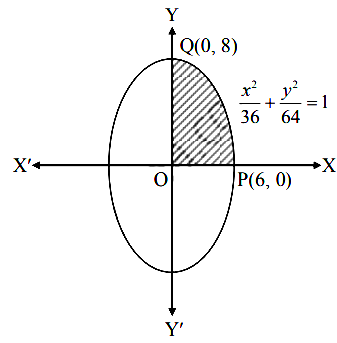
For the region OPQO, the limits of integration are $x=0$ and $x=6$.
Given equation of the ellipse is $\frac{x^2}{36}+\frac{y^2}{64}=1$
$ \therefore \frac{y^2}{64}=1-\frac{x^2}{36}$
$\therefore y ^2=64\left(1-\frac{x^2}{36}\right)$
$\therefore y ^2=\frac{64}{36}\left(36-x^2\right)$
$\therefore y = \pm \frac{8}{6} \sqrt{36-x^2} $
$\therefore y=\frac{4}{3} \sqrt{36-x^2} \ldots \ldots .[\because$ In first quadrant, $y>0]$
$\therefore$ Required area $=4$ (area of the region OPQO)
$=4 \int_0^6 y d x$
$=4 \int_0^6 \frac{4}{3} \sqrt{36-x^2} d x$
$=\frac{16}{3}\left[\frac{x}{2} \sqrt{36-x^2}+\frac{36}{2} \sin ^{-1}\left(\frac{x}{6}\right)\right]_0^6$
$=\frac{16}{3}\left[\frac{6}{2} \sqrt{36-36}+\frac{36}{2} \sin ^{-1}(1)-\left\{0+\frac{36}{2} \sin ^{-1}(0)\right\}\right]$
$=\frac{16}{3}\left(0+\frac{36}{2} \cdot \frac{\pi}{2}-0\right)$
$=48 \pi \text { sq.units }$ View full question & answer→Question 23 Marks
Find the area of the region bounded by the curve $y = \sin x,$ the $X−$ axis and the given lines $x = −\pi, x = \pi$
AnswerGiven equation of the parabola is $x^2=8 y$
$\therefore x= \pm 2 \sqrt{2 y}$
$\therefore x =2 \sqrt{2 y} \quad \ldots . .[\because$ In first quadrant, $x >0]$
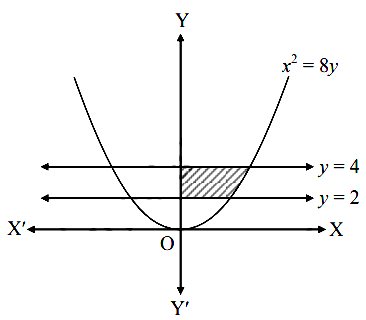
$\therefore \text { Required area }=\int_2^4 x d y$
$=\int_2^4 2 \sqrt{2 y} d y$
$=2 \sqrt{2}\left[\frac{y^{\frac{3}{2}}}{\frac{3}{2}}\right]_2^4$
$=\frac{4 \sqrt{2}}{3}\left[(4)^{\frac{3}{2}}-(2)^{\frac{3}{2}}\right]$
$=\frac{4 \sqrt{2}}{3}(8-2 \sqrt{2})$
$=\frac{8 \sqrt{2}}{3}(4-\sqrt{2}) \text { sq.units }$ View full question & answer→Question 33 Marks
Find the area of the region bounded by the curves $x^2 = 8y, y = 2, y = 4$ and the $Y-$axis, lying in the first quadrant
AnswerGiven equation of the parabola is $x^2=8 y$
$\therefore x= \pm 2 \sqrt{2 y}$
$\therefore x =2 \sqrt{2 y} \quad \ldots . .[\because$ In first quadrant, $x >0]$
$\therefore \text { Required area }=\int_2^4 x d y$
$=\int_2^4 2 \sqrt{2 y} d y$
$=2 \sqrt{2}\left[\frac{y^{\frac{3}{2}}}{\frac{3}{2}}\right]_2^4$
$=\frac{4 \sqrt{2}}{3}\left[(4)^{\frac{3}{2}}-(2)^{\frac{3}{2}}\right]$
$=\frac{4 \sqrt{2}}{3}(8-2 \sqrt{2})$
$=\frac{8 \sqrt{2}}{3}(4-\sqrt{2}) \text { sq.units }$ View full question & answer→Question 43 Marks
Find the area of the region bounded by the parabola $y^2 = 16x$ and the line $x = 4$
AnswerGiven equation of the curve is $y^2=16 x$
$ y ^2=$
$\therefore y = \pm 4 \sqrt{x}$
$\therefore y =4 \sqrt{x} \quad \ldots . .[\because \text { In first quadrant, } y >0] $
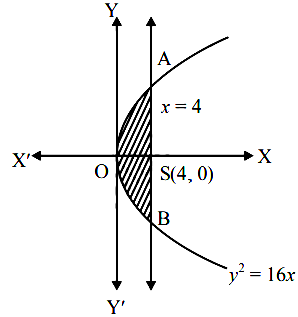
Required area $=$ Area of the region $O B S A O$
$ =2 \ldots . .(\text { Area of the region OSAO) }$
$=2 \int_0^4 y d x$
$=2 \int_0^4 4 \sqrt{x} d x$
$=8\left[\frac{x^{\frac{3}{2}}}{\frac{3}{2}}\right]_0^4$
$=\frac{16}{3}\left[(4)^{\frac{3}{2}}-0\right]$
$=\frac{16}{3}(8)$
$=\frac{128}{3} \text { sq.units } $ View full question & answer→Question 53 Marks
Find the area of the region bounded by the parabola $x^2 = 4y$ and The X-axis and the line $x = 1, x = 4$
AnswerGiven equation of the parabola is $x^2=4 y$.
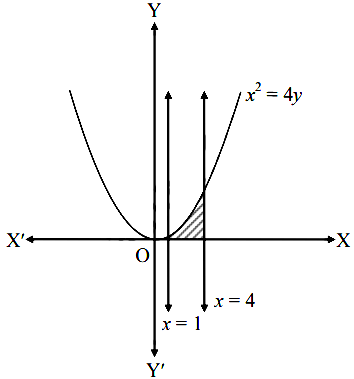
$\text { Required area }=\int_1^4 y d x$
$=\int_1^4 \frac{x^2}{4} d x$
$=\frac{1}{4}\left[\frac{x^3}{3}\right]_1^4$
$=\frac{1}{12}\left(4^3-1^3\right)$
$=\frac{1}{12}(64-1)$
$=\frac{63}{12}$
$=\frac{21}{4} \text { sq.units }$ View full question & answer→Question 63 Marks
Find the area enclosed between the $X-$ axis and the curve $y = \sin x$ for values of $x$ between $0$ to $2\pi$
AnswerLet $A$ be the required area.
Consider the equation $y=\sin x$.
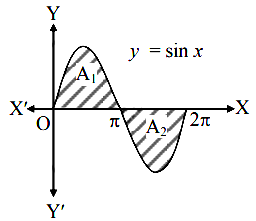
$ A _1=\int_0^{ a } \sin x d x$
$=[-\cos x]_0^\pi$
$=-(\cos \pi-\cos 0)$
$=-(-1-1)$
$=2$
$A _2=\int_\pi^{2 \pi} \sin x d x$
$=[-\cos x]_\pi^{2 \pi}$
$=-[1-(-1)]$
$= A = A _1+\left| A _2\right|$
$=2+|(-2)|$
$=4 \operatorname{sq} \cdot units $ View full question & answer→Question 73 Marks
Evaluate: $\int_0^1 x \cdot \tan ^{-1} x d x$
Answer$\text { Let } I =\int_0^1 x \tan ^{-1} x d x$
$=\left[\tan ^{-1} x \int x d x\right]_0^1-\int_0^1\left[\frac{ d }{ d x}\left(\tan ^{-1} x\right) \int x d x\right] d x$
$=\left[\tan ^{-1} x \cdot \frac{x^2}{2}\right]_0^1-\int_0^1 \frac{1}{1+x^2} \cdot \frac{x^2}{2} d x$
$=\left[\frac{x^2}{2} \tan ^{-1} x\right]_0^1-\frac{1}{2} \int_0^1 \frac{x^2}{1+x^2} d x$
$=\left[\frac{1}{2} \tan ^{-1}-0\right]_{-\frac{1}{2}} \frac{x^2+1-1}{1+x^2} d x$
$=\frac{1}{2} \cdot \frac{\pi}{4}-\frac{1}{2} \int_0^1\left(1-\frac{1}{1+x^2}\right) d x$
$=\frac{\pi}{8}-\frac{1}{2}\left[x-\tan ^{-1} x\right]_0^1$
$=\frac{\pi}{8}-\frac{1}{2}\left[\left(1-\tan ^{-1} 1\right)-\left(0-\tan ^{-1} 0\right)\right]$ $=\frac{\pi}{8}-\frac{1}{2}\left(1-\frac{\pi}{4}-0\right)$
$=\frac{\pi}{8}-\frac{1}{2}+\frac{\pi}{8}$
$\therefore I =\frac{\pi}{4}-\frac{1}{2}$
View full question & answer→Question 83 Marks
$\int \sec ^2 x d x$
Answer$\text { Let } I =\int \sec ^2 x d x$
$=\int \sec x \cdot \sec ^2 x d x$
$=\sec x \int \sec ^2 x d x-\int\left[\frac{ d }{ d x}(\sec x) \int \sec ^2 x d x\right] d x$
$=\sec x \cdot \tan x-\int \sec x \tan x \cdot \tan x d x$
$=\sec x \cdot \tan x-\int \sec x \tan { }^2 x d x$
$=\sec x \cdot \tan x-\int \sec x\left(\sec { }^2 x-1\right) d x$
$=\sec x \cdot \tan x-\int \sec { }^3 x d x+\int \sec x d x$
$\therefore \text { I }=\sec x \cdot \tan x- I +\log |\sec x+\tan x|+ c _1$
$\therefore \log [\sec x \tan x+\log |\sec x+\tan x|]+ c \text { where c }=\frac{ c _1}{2}$
View full question & answer→Question 93 Marks
A wire of length $36$ metres is bent in the form of a rectangle. Find its dimensions if the area of the rectangle is maximum.
AnswerLet $x$ metres and $y$ metre be the length and breadth of the rectangle.
Then its perimeter is $2(x+y)=36$
$\therefore x+y=18$
$\therefore y=18-x$
Area of the rectangle
$ =x y$
$=x(18-x) $
Let $f^{\prime}(x)$
$ =x(18-x)$
$=18 x-x^2 $
$ \therefore f ^{\prime}( x )=\frac{d}{d x}\left(18 x-x^2\right)$
$=18-2 x $
and
$ f^{\prime}( x )=\frac{d}{d x}(18-2 x)$
$=0-2 \times 1$
$=-2 $
Now, $f^{\prime}(x)=0$, if $18-2 x=0$
i.e. if $x=9$
and
$f^{\prime}(9)-2<0$
$\therefore$ By the second derivative test $f$ has maximum value at $x =9$.
When $x=9, y=18-9=9$
$\therefore x=9 cm , y=9 cm$
$\therefore$ Rectangle is a square of side $9\ cm$.
View full question & answer→Question 103 Marks
$x \sin (a+y)+\sin a \cos (a+y)=0$ then show that $\frac{d y}{d x}=\frac{\sin ^2(a+y)}{\sin a}$
Answer$x \sin (a+y)+\sin a \cos (a+y)=0$ $\ldots(i)$
$x \cdot \cos ( a +y) \cdot \frac{ d }{ d x}( a +y)+\sin ( a +y) \cdot \frac{ d }{ d x}(x)+\sin a [-\sin ( a +y)] \cdot \frac{ d }{ d x}( a +y)=0$
$\therefore x \cos ( a +y) \frac{ d y}{ d x}+\sin ( a +y)(1)-\sin ( a +y) \frac{ d y}{ d x}=0$
$\therefore[x \cos ( a +y)-\sin a \sin ( a +y)] \frac{ d y}{ d x}=-\sin ( a + y ) \quad \ldots \ldots . . \text { (ii) }$
From (i), we get
$x=\frac{-\sin a \cos ( a +y)}{\sin ( a +y)}$
Substituting the value of $x$ in (ii), we get
$\left[\frac{-\sin a \cos ( a +y)}{\sin ( a +y)} \cdot \cos ( a +y)-\sin a \sin ( a +y)\right] \frac{ d y}{ d x}=-\sin ( a + y )$
$\therefore-\sin a \left[\frac{\cos ^2( a +y)}{\sin ( a +y)}+\sin ( a +y)\right] \frac{ d y}{ d x}=-\sin ( a + y )$
$\therefore \frac{-\sin a \left[\cos ^2( a +y)+\sin ^2( a +y)\right]}{\sin ( a +y)} \frac{ d y}{ d x}-\sin ( a + y )$
$\therefore-\frac{\sin a (1)}{\sin ( a +y)} \cdot \frac{ d y}{ d x}=-\sin ( a + y )$
$\therefore \frac{ d y}{ d x}=\sin ( a +y)\left[\frac{\sin ( a +y)}{\sin a }\right]$
$\therefore \frac{ d y}{ d x}=\frac{\sin ^2( a +y)}{\sin a }$
View full question & answer→Question 113 Marks
Find the distance between the parallel lines $\frac{x}{2}=\frac{y}{-1}=\frac{z}{2}$ and $\frac{x-1}{2}=\frac{y-1}{-1}=\frac{z-3}{2}$
AnswerLine $\frac{x}{2}=\frac{y}{-1}=\frac{z}{2}$ passes through $(0,0,0)$ and has direction ratios $2,-1,2$
$\therefore$ Vector equation of the line is
$r=(0 \hat{ i }+0 \hat{ j }+0 \widehat{ k })+\lambda(2 \hat{ i }-\hat{ j }+2 \widehat{ k })$
i.e., $r=\lambda(2 \hat{ i }-\hat{ j }+2 \widehat{ k })$
Line $\frac{x-1}{2}=\frac{y-1}{-1}=\frac{z-1}{2}$ passes through $(1,1,1)$ and has direction ratios $2,-1,2$.
$\therefore$ Vector equation of the line is
$
r=(\hat{i}+\hat{j}+\widehat{k})+\lambda(2 \hat{i}-\hat{j}+2 \widehat{k})
$
The distance between parallel lines $\overline{ r }=\overline{ a }_1+\lambda \overline{ b }$ and $\overline{ r }=\overline{ a }_2+\lambda \overline{ b }$ is $\left|\left(\overline{ a }_2-\overline{ a }_1\right) \times \widehat{ b }\right|$
Here, $\overline{ a }_1=0, \overline{ a }_2=\hat{ i }+\hat{ j }+\widehat{ k }, \overline{ b }=2 \hat{ i }-\hat{ j }+2 \widehat{ k }$
$\therefore \overline{ b }=\frac{\overline{ b }}{|\overline{ b }|}$
$=\frac{2 \hat{ i }-\hat{ j }+2 \widehat{ k }}{\sqrt{2^2+(-1)^2+2^2}}$
$=\frac{2}{3} \hat{ i }-\frac{1}{3} \hat{ j }+\frac{2}{3} \widehat{ k }$
$\therefore\left(\bar{a}_2-\bar{a}_1\right) \times \hat{b}=\left|\begin{array}{ccc}\hat{i} & \hat{j} & \hat{k} \\ 1 & 1 & 1 \\ \frac{2}{3} & \frac{-1}{3} & \frac{2}{3}\end{array}\right|$
$=\hat{ i }\left(\frac{2}{3}+\frac{1}{3}\right)-\hat{ j }\left(\frac{2}{3}-\frac{2}{3}\right)+\widehat{ k }\left(\frac{-1}{3}-\frac{2}{3}\right)$
$=\hat{ i }-\hat{ k }$
$\therefore\left|\left(\overline{ a }_2-\overline{ a }_1\right) \times \widehat{ b }\right|=\sqrt{(1)^2+(-1)^2}$
$=\sqrt{2}$
View full question & answer→Question 123 Marks
Prove by vector method, that the angle subtended on semicircle is a right angle.
AnswerLet seg $A B$ be a diameter of a circle with centre $C$ and $P$ be any point on the circle other than $A$ and $B$.
Then $\angle A P B$ is an angle subtended on a semicircle.
Let $\overline{ AC }=\overline{ CB }=\overline{ a }$ and $\overline{ CP }=\overline{ r }$
Then $|\overline{ a }|=|\overline{ r }|$$\ldots(1)$
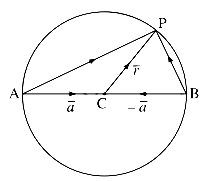
$ \overline{ AP }=\overline{ AC }+\overline{ CP }$
$=\overline{ a }+\overline{ r }$
$=\overline{ r }+\overline{ a }$
$\overline{ BP }=\overline{ BC }+\overline{ CP }$
$=-\overline{ CB }+\overline{ CP }$
$=-\overline{ a }+\overline{ r }$
$\therefore \overline{ AP } \cdot \overline{ BP }=(\overline{ r }+\overline{ a }) \cdot(\overline{ r }-\overline{ a })$
$=\overline{ r } \cdot \overline{ r }-\overline{ r } \cdot \overline{ a }+\overline{ a } \cdot \overline{ r }-\overline{ a } \cdot \overline{ a }$
$=|\overline{ r }|^2-|\overline{ a }|^2$
$=0 \quad \ldots .(\because \overline{ r } \cdot \overline{ a }=\overline{ a } \cdot \overline{ r })$
$\therefore \overline{ AP } \perp \overline{ BP } $
$\therefore \angle APB$ is a right angle.
Hence, the angle subtended on a semicircle is the right angle. View full question & answer→Question 133 Marks
Find the matrix $X$ such that $\left[\begin{array}{lll}1 & 2 & 3 \\ 2 & 3 & 2 \\ 1 & 2 & 2\end{array}\right] \quad X=\left[\begin{array}{ccc}2 & 2 & -5 \\ -2 & -1 & 4 \\ 1 & 0 & -1\end{array}\right]$
AnswerGiven that $\left[\begin{array}{lll}1 & 2 & 3 \\ 2 & 3 & 2 \\ 1 & 2 & 2\end{array}\right] X=\left[\begin{array}{ccc}2 & 2 & -5 \\ -2 & -1 & 4 \\ 1 & 0 & -1\end{array}\right]$
Applying $R_2 \rightarrow R_2-2 R_1$ and $R_3 \rightarrow R_3-R_1$,
we get $\left[\begin{array}{ccc}1 & 2 & 3 \\ 0 & -1 & -4 \\ 0 & 0 & -1\end{array}\right] X=\left[\begin{array}{ccc}2 & 2 & -5 \\ -6 & -5 & 14 \\ -1 & -2 & 4\end{array}\right]$
Applying $R_2 \rightarrow R_2-4 R_3$, we get
$\left[\begin{array}{ccc}1 & 2 & 3 \\0 & -1 & 0 \\0 & 0 & -1\end{array}\right] X=\left[\begin{array}{ccc}2 & 2 & -5 \\-2 & 3 & -2 \\-1 & -2 & 4\end{array}\right]$
Applying $R_1 \rightarrow R_1+2 R_2$, we get
$\left[\begin{array}{ccc}1 & 0 & 3 \\0 & -1 & 0 \\0 & 0 & -1\end{array}\right] X=\left[\begin{array}{ccc}-2 & 8 & -9 \\-2 & 3 & -2 \\-1 & -2 & 4\end{array}\right]$
Applying $R_1 \rightarrow R_1+3 R_3$, we get
$\left[\begin{array}{ccc}1 & 0 & 0 \\0 & -1 & 0 \\0 & 0 & -1\end{array}\right] X=\left[\begin{array}{ccc}-5 & 2 & 3 \\-2 & 3 & -2 \\-1 & -2 & 4\end{array}\right]$
Applying $R_2 \rightarrow(-1) R_2$ and $R_3 \rightarrow(-1) R_3$, we get
$\begin{array}{l}{\left[\begin{array}{lll}1 & 0 & 0 \\0 & 1 & 0 \\0 & 0 & 1\end{array}\right] X=\left[\begin{array}{ccc}-5 & 2 & 3 \\2 & -3 & 2 \\1 & 2 & -4\end{array}\right]} \end{array}$
$\therefore X=\left[\begin{array}{ccc}-5 & 2 & 3 \\2 & -3 & 2 \\1 & 2 & -4\end{array}\right]$
View full question & answer→Question 143 Marks
Evaluate: $\int_0^1 \frac{1}{\sqrt{3+2 x-x^2}} d x$
Answer$\text { Let } I =\int_0^1 \frac{1}{\sqrt{3+2 x-x^2}} d x$
$=\int_0^1 \frac{1}{\sqrt{4-1+2 x-x^2}} d x$
$=\int_0^1 \frac{1}{\sqrt{4-\left(x^2-2 x+1\right)}} d x$
$=\int_0^1 \frac{1}{\sqrt{(2)^2-(x-1)^2}} d x$
$\left.=\sin ^{-1}\left(\frac{x-1}{2}\right)\right]_0^1(0)-\sin ^{-1}\left(\frac{1}{2}\right)$
$=0-\left(-\frac{\pi}{6}\right)$
$\therefore I =\frac{\pi}{6}$
View full question & answer→Question 153 Marks
$\int \frac{1}{2+\cos x-\sin x} d x$
Answer$\text { Let } I =\int \frac{1}{2+\cos x-\sin x} d x$
$\text { Put } \tan \left(\frac{x}{2}\right)= t$
$\therefore x =2 \tan ^{-1} t$
$\therefore dx =\frac{2 dt }{1+ t ^2} \text { and } \sin x =\frac{2 t }{1+ t ^2}, \cos x =\frac{1- t ^2}{1+ t ^2}$
$\therefore I=\int \frac{1}{2+\left(\frac{1- t ^2}{1+ t ^2}\right)-\frac{2 t }{1+ t ^2}} \times \frac{2 dt }{1+ t ^2}$
$=\int \frac{2}{2+2 t ^2+1- t ^{-2} t } dt$
$=2 \int \frac{1}{ t ^2-2 t +3} dt$
$\left(\frac{1}{2} \text { coefficient of } t \right)^2=\left(\frac{1}{2} \times-2\right)^2$
$=(-1)^2$
$=1$
$\therefore I =2 \int \frac{1}{ t ^2-2 t +1-1+3} dt$
$=2 \int \frac{1}{( t -1)^2+2} dt$
$=2 \int \frac{1}{( t -1)^2+(\sqrt{2})^2} dt$
$=2 \cdot \frac{1}{\sqrt{2}} \tan ^{-1}\left(\frac{ t -1}{\sqrt{2}}\right)+ c$
$\therefore I =\sqrt{2} \tan ^{-1}\left[\frac{\tan \left(\frac{x}{2}\right)-1}{\sqrt{2}}\right]+ c $
View full question & answer→Question 163 Marks
Divide the number $30$ into two parts such that their product is maximum.
AnswerLet the first part of $30-x$.
$\therefore$ Their product
$ =x(30- x )$
$=30 x - x ^2$
$= f ^{\prime}( x ) \quad \ldots . . \text { (Say) }$
$\therefore f ^{\prime}( x )=\frac{ d }{ d x}(30-2 x)$
$=0-2 \times 1$
$=-2 $
The root of the equation $f^{\prime}(x)=0$
i.e. $30-2 x=0$ is $x=15$
and $f^{\prime}(15)=-2<0$
$\therefore$ By the second derivative test, $f$ is maximum at $x =15$.
Hence, the required parts of $30$ are $15$ and $15.$
View full question & answer→Question 173 Marks
Find the derivative of $\cos ^{-1} x$ w.r. to $\sqrt{1-x^2}$
AnswerLet $u =\cos ^{-1} x$
Differentiating w. r. t. x, we get
$ \frac{ d u}{ d x}=\frac{ d }{ d x}\left(\cos ^{-1} x\right)$
$=\frac{-1}{\sqrt{1-x^2}} $
Let $v =\sqrt{1-x^2}$
Differentiating w. r. t. x, we get
$ \frac{ dv }{ d x}=\frac{ d }{ d x}\left(\sqrt{1-x^2}\right)$
$=\frac{1}{2 \sqrt{1-x^2}} \cdot \frac{ d }{ d x}\left(1-x^2\right)$
$=\frac{1}{2 \sqrt{1-x^2}} \cdot(-2 x)$
$=\frac{-x}{\sqrt{1-x^2}}$
$\therefore \frac{ d u}{ dv }=\frac{\frac{ d u}{ d x}}{\frac{ dv }{ d x}}$
$=\frac{-1}{\frac{\sqrt{1-x^2}}{\frac{-x}{\sqrt{1-x^2}}}}$
$=\frac{1}{x} $
View full question & answer→Question 183 Marks
Find acute angle between the lines $\frac{x-1}{1}=\frac{y-2}{-1}=\frac{z-3}{2}$ and $\frac{x-1}{2}=\frac{y-1}{1}=\frac{z-3}{1}$
AnswerGiven equations of lines are $\frac{x-1}{1}=\frac{y-2}{-1}=\frac{z-3}{2}$ and $\frac{x-1}{2}=\frac{y-1}{1}=\frac{z-3}{1}$
Direction ratios of above lines are
$a_1=1, b_1=-1, c_1=2 \text { and } a_2=2, b_2=1, c_2=1$
Angle between two lines is
$ \cos \theta=\left|\frac{ a _1 a _2+ b _1 b _2+ c _1 c _2}{\sqrt{ a _1^2+ b _1^2+ c _1^2} \sqrt{ a _2^2+ b _2^2+ c _2^2}}\right|$
$\therefore \cos \theta=\left|\frac{(1)(2)+(-1)(1)+(2)(1)}{\sqrt{1^2+(-1) 2+2^2 \sqrt{2^2+1^2+1^2}}}\right|$
$\therefore \cos \theta=\left|\frac{2-1+2}{\sqrt{6} \sqrt{6}}\right|$
$\therefore \cos \theta=\left|\frac{3}{6}\right|$
$\therefore \theta=\cos ^{-1}\left(\frac{1}{2}\right)$
$\therefore \theta=60^{\circ} $
View full question & answer→Question 193 Marks
If $A(5,1, p), B(1, q, p)$ and $C(1,-2,3)$ are vertices of triangle and $G\left(r,-\frac{4}{3}, \frac{1}{3}\right)$ is its centroid then find the values of $p, q$ and $r$
AnswerLet $\vec{a}, \vec{b}, \vec{c}$ be the position vectors of points $A , B , C$ respectively of $\triangle ABC$ and $\vec{G}$ be the position vector of its centroid $G$.
$ \therefore \vec{a}=5 \hat{i}+\hat{j}+p \widehat{k}_{,}$
$\vec{b}=\hat{i}+q \hat{j}+p \widehat{k},$
$\vec{c}=\hat{i}-2 \hat{j}+3 \widehat{k} $
And $\vec{G}=r \hat{i}-\frac{4}{3} \hat{j}+\frac{1}{3} \widehat{k}$
$\therefore$ By using centroid formula,
$ \vec{G}=\frac{\vec{a}+\vec{b}+\vec{c}}{3}$
$\therefore 3 \vec{G}=\vec{a}+\vec{b}+\vec{c}$
$\therefore 3\left(r \hat{i}-\frac{4}{3} \hat{j}+\frac{1}{3} \widehat{k}\right)=(5 \hat{i}+\hat{j}+p \widehat{k})+(\hat{i}+q \hat{j}+p \widehat{k})+(\hat{i}-2 \hat{j}+3 \widehat{k})$
$\therefore 3 r \hat{i}-4 \hat{j}+\widehat{k}=7 \hat{i}+(q-1) \hat{j}+(2 p+3) \widehat{k} $
$\therefore$ By equality of vectors, we get
$3 r=7,-4=q-1 \text { and } 1=2 p+3$
$\Rightarrow r =\frac{7}{3}, q =-3 \text { and } p =-1$
View full question & answer→Question 203 Marks
Prove that $\cot ^{-1}(7)+2 \cot ^{-1}(3)=\frac{\pi}{4}$
Answer$\text { L.H.S. }=\cot ^{-1}(7)+2 \cot ^{-1}(3)$
$=\cot ^{-1}(7)+\cot ^{-1}(3)+\cot ^{-1}(3)$
$=\frac{\pi}{2}-\tan ^{-1}(7)+\frac{\pi}{2}-\tan ^{-1}(3)+\frac{\pi}{2}-\tan ^{-1}(3) \quad \ldots \ldots . .\left[\because \tan ^{-1} x+\cot ^{-1} x=\frac{\pi}{2}\right]$
$=\frac{3 \pi}{2}-\left[\pi+\tan ^{-1}\left(\frac{7+3}{1-7 \times 3}\right)+\tan ^{-1}(3)\right] \ldots \ldots . .$
${\left[\because \tan ^{-1} x+\tan ^{-1} y=\pi+\tan ^{-1} \frac{x+y}{1-x y}, \text { if } x, y>0 \text { and } x y>1\right]}$
$=\frac{3 \pi}{2}-\pi-\left[\tan ^{-1}\left(\frac{10}{-20}\right)+\tan ^{-1}(3)\right]$
$=\frac{\pi}{2}-\left[\tan ^{-1}\left(\frac{1}{2}\right)+\tan ^{-1}(3)\right]$
$=\frac{\pi}{2}-\left[\tan ^{-1}(3)-\tan ^{-1}\left(\frac{1}{2}\right)\right] \ldots \ldots . .\left[\because \tan ^{-1}(-x)=-\tan ^{-1}(x)\right]$
$=\frac{\pi}{2}-\left[\tan ^{-1}\left(\frac{3-\frac{1}{2}}{1+(3)\left(\frac{1}{2}\right)}\right)\right]$
$=\frac{\pi}{2}-\left[\tan ^{-1}\left(\frac{\frac{5}{2}}{\frac{5}{2}}\right)\right]$
$=\frac{\pi}{2}-\tan ^{-1}(1)$
$=\frac{\pi}{2}-\frac{\pi}{4}$
$=\frac{\pi}{4}$
$=\text { R.H.S. }$
View full question & answer→Question 213 Marks
Find the adjoint of matrix $A=\left[\begin{array}{ccc}2 & 0 & -1 \\ 3 & 1 & 2 \\ -1 & 1 & 2\end{array}\right]$
Answer$A_{11}=(-1)^{1+1} M_{11}=1\left|\begin{array}{ll}1 & 2 \\ 1 & 2\end{array}\right|=1(2-2)=0 $
$ A_{12}=(-1)^{1+2} M_{12}=(-1)\left|\begin{array}{cc}3 & 2 \\ -1 & 2\end{array}\right|=(-1)(6+2)=-8 $
$ A_{13}=(-1)^{1+3} M_{13}=1\left|\begin{array}{cc}3 & 1 \\ -1 & 1\end{array}\right|=1(3+1)=4 $
$ A_{21}=(-1)^{2+1} M_{21}=(-1)\left|\begin{array}{cc}0 & -1 \\ 1 & 2\end{array}\right|=(-1)(0+1)=-1 $
$ A_{22}=(-1)^{2+2} M_{22}=1\left|\begin{array}{cc}2 & -1 \\ -1 & 2\end{array}\right|=1(4-1)=3 $
$ A_{23}=(-1)^{2+3} M_{23}=(-1)\left|\begin{array}{cc}2 & 0 \\ -1 & 1\end{array}\right|=(-1)(2-0)=-2 $
$ A_{31}=(-1)^{3+1} M_{31}=1\left|\begin{array}{cc}0 & -1 \\ 1 & 2\end{array}\right|=1(0+1)=1 $
$ A_{32}=(-1)^{3+2} M_{32}=(-1)\left|\begin{array}{cc}2 & -1 \\ 3 & 2\end{array}\right|=(-1)(4+3)=-7$
$A_{33}=(-1)^{3+3} M_{33}=1\left|\begin{array}{ll}2 & 0 \\ 3 & 1\end{array}\right|=1(2-0)=2 $
$ \therefore \operatorname{adj}(A)=\left[\begin{array}{lll}A_{11} & A_{12} & A_{13} \\ A_{21} & A_{22} & A_{23} \\ A_{31} & A_{32} & A_{33}\end{array}\right]^{ T } $
$ =\left[\begin{array}{ccc}0 & -8 & 4 \\ -1 & 3 & -2 \\ 1 & -7 & 2\end{array}\right]^{ T } $
$ =\left[\begin{array}{ccc}0 & -1 & 1 \\ -8 & 3 & -7 \\ 4 & -2 & 2\end{array}\right]$
View full question & answer→Question 223 Marks
Find the probability distribution of the number of successes in two tosses of a die, where a success is defined as six appears on at least one die
AnswerSuccess is defined as a number six appears on at least one die.Let $X$ denotes the number of successes.
$\therefore$ The possible values of $X$ are $0,1,2$.Let $P ($ getting six $)=p$
$ =\frac{1}{6}$
$\therefore q=1-p$
$=1-\frac{1}{6}$
$=\frac{5}{6}$
$\therefore P(X=0)=P(\text { no success })$
$=q q$
$=q^2$
$=\frac{25}{36} $
$ P(X=1)=P(\text { one success })$
$=p q+q p$
$=2 p q$
$=2 \times \frac{1}{6} \times \frac{5}{6}$
$=\frac{10}{36}$
$P(X=2)=P(\text { two successes })$
$=p p$
$=p^2$
$=\frac{1}{36} $
$\therefore$ Probability distribution of $X$ is as follows:
| X |
0 |
1 |
2 |
| P(X=x) |
$\frac{25}{36}$ |
$\frac{10}{36}$ |
$\frac{1}{36}$ |
View full question & answer→Question 233 Marks
Evaluate: $\int_{-4}^2 \frac{1}{x^2+4 x+13} d x$
Answer$\text { Let } I =\int_{-4}^2 \frac{1}{x^2+4 x+13} d x$
$=\int_{-4}^2 \frac{1}{x^2+4 x+4+9} d x$
$=\int_{-4}^2 \frac{1}{(x+2)^2+(3)^2} d x$
$=\left[\frac{1}{3} \tan ^{-1}\left(\frac{x+2}{3}\right)\right]_{-4}^2$
$=\frac{1}{3}\left[\tan ^{-1}\left(\frac{4}{3}\right)-\tan ^{-1}\left(-\frac{2}{3}\right)\right]$
$\therefore I =\frac{1}{3}\left[\tan ^{-1}\left(\frac{4}{3}\right)+\tan -1\left(\frac{2}{3}\right)\right] \ldots \ldots .\left[\because \tan ^{-1}(-\theta)=-\tan ^{-1} \theta\right]$
View full question & answer→Question 243 Marks
$\int \frac{\sin x}{\sin 3 x} d x$
Answer$ \text { Let } I =\int \frac{\sin x}{\sin 3 x} d x$
$=\int \frac{\sin x}{3 \sin x-4 \sin ^3 x} \cdot d x$
$=\int \frac{\sin x}{\sin x\left(3-4 \sin ^2 x\right)} \cdot d x$
$=\int \frac{1}{3-4 \sin ^2 x} d x $
Dividing numerator and denominator by $\cos ^2 x$, we get
$ I =\int \frac{\sec ^2 x}{3 \sec ^2 x-4 \tan ^2 x} \cdot d x$
$=\int \frac{\sec ^2 x}{3\left(1+\tan ^2 x\right)-4 \tan ^2 x} \cdot d x$
$=\int \frac{\sec ^2 x}{3-\tan ^2 x} d x $
Put $\tan x=t$
$\therefore \sec ^2 x d x=d t$
$\therefore I =\int \frac{ dt }{3- t ^2}$
$=\int \frac{1}{(\sqrt{3})^2- t ^2} dt$
$=\frac{1}{2 \sqrt{3}} \log \left|\frac{\sqrt{3}+ t }{\sqrt{3}- t }\right|+ c$
$\therefore I =\frac{1}{2 \sqrt{3}} \log \left|\frac{\sqrt{3}+\tan x}{\sqrt{3}-\tan x}\right|+c I $
View full question & answer→Question 253 Marks
The profit function $P(x)$ of a firm, selling x items per day is given by $P(x) = (150 – x)x – 1625.$ Find the number of items the firm should manufacture to get maximum profit. Find the maximum profit.
AnswerProfit function $P(x)$ is given by
$ P(x)=(150-x) x-1625$
$=150 x-x^2-1625$
$\therefore P^{\prime}(x)=\frac{d}{d x}\left(150 x-x^2-1625\right)$
$=150 \times 1-2 x-0$
$=150-2 x $
and
$ P ^{\prime \prime}( x )=\frac{ d }{ d x}(150-2 x)$
$=0-2 \times 1$
$=-2 $
Now, $P^{\prime}(x)=0$ gives, $150-2 x=0$
$\therefore x=75$
and
$P^{\prime \prime}(75)=-2<0$
$\therefore$ by the second derivative test, $P ( x )$ is maximum when $x =75$
Maximum profit $= P (75)$
$ =(150-75) 75-1625$
$=75 \times 75-1625$
$=4000 $
Hence, the profit will be maximum, if the manufacturer manufactures $75$ items and maximum profit is $4000.$
View full question & answer→Question 263 Marks
If $y =\sqrt{\cos x+\sqrt{\cos x+\sqrt{\cos x+\ldots \ldots \infty}}}$, show that $\frac{ d y}{ d x}=\frac{\sin x}{1-2 y}$
Answer$ y =\sqrt{\cos x+\sqrt{\cos x+\sqrt{\cos x+\ldots \infty}}}$
$\therefore y ^2=\cos x+\sqrt{\cos x+\sqrt{\cos x+\ldots \infty}}$
$\therefore y ^2=\cos x+y $
Differentiating w. r. t. $x$, we get
$ 2 y \frac{ d y}{ d x}=-\sin x+\frac{ d y}{ d x}$
$\therefore \frac{ d y}{ d x}(1-2 y)=\sin x$
$\therefore \frac{ d y}{ d x}=\frac{\sin x}{1-2 y} $
View full question & answer→Question 273 Marks
Find the Cartesian equation of the plane passing through the points $A(1, 1, 2), B(0, 2, 3) C(4, 5, 6)$
AnswerIf $A \left( x _1, y _1, z _1\right), B \left( x _2, y _2, z _2\right)$ and $C \left( x _3, y _3, z _3\right)$ be three non$-$collinear points and $P ( x , y , z )$ be any point on a plane, then the Cartesian equation of the plane passing through $A, B, C$ is
$\left|\begin{array}{ccc}x-x_1 & y-y_1 & z-z_1 \\x_2-x_1 & y_2-y_1 & z_2-z_1 \\x_3-x_1 & y_3-y_1 & z_3-z_1\end{array}\right|=0$
$\therefore$ The Cartesian equation of the plane passing through $A (1,1,2), B (0,2,3)$ and $C (4,5,6)$ is
$\left|\begin{array}{lrr}x-1 & y-1 & z-2 \\0-1 & 2-1 & 3-2 \\4-1 & 5-1 & 6-2\end{array}\right|=0 $
$\therefore\left|\begin{array}{ccc}x-1 & y-1 & z-2 \\-1 & 1 & 1 \\3 & 4 & 4\end{array}\right|=0 $
$\therefore(x-1)(4-4)-(y-1)(-4-3)+(z-2)(-4-3)=0$
$\therefore 7 y-7-7 z+14=0$
$\therefore y-z+1=0$
View full question & answer→Question 283 Marks
If $G(a, 2, −1)$ is the centroid of the triangle with vertices $P(1, 2, 3), Q(3, b, −4)$ and $R(5, 1, c)$ then find the values of $a, b$ and $c$
AnswerLet $\overline{ p }, \overline{ q }, \overline{ r }$ be the position vectors of points $P , Q , R$ respectively of $\triangle PQR$ and $g$ be the position vector of its centroid $G$.
$\therefore \bar{p}=\hat{i}+2 \hat{j}+3 \widehat{k}, \bar{q}=3 \hat{i}+b \hat{j}-4 \widehat{k}, \bar{r}=5 \hat{i}+\hat{j}+c \widehat{k} \text { and } \bar{g}=a \hat{i}+2 \hat{j}-\widehat{k}$
$\therefore$ By using centroid formula,
$\overline{ g }=\frac{\overline{ p }+\overline{ q }+\overline{ r }}{3}$
$ \therefore 3 \overline{ g }=\overline{ p }+\overline{ q }+ r$
$\therefore 3( a \hat{ i }+2 \hat{ j }-\widehat{ k })=(\hat{ i }+2 \hat{ j }+3 \widehat{ k })+(3 \hat{ i }+ b \hat{ j }-4 \widehat{ k })+(5 \hat{ i }+\hat{ j }+ ck )$
$\therefore 3 a \hat{ i }+6 \hat{ j }-3 \widehat{ k }=(1+3+5) \hat{ i }+(2+ b +1) \hat{ j }+(3-4+ c ) \widehat{ k }$
$\therefore 3 a \hat{ i }+6 \hat{ j }-3 \widehat{ k }=9 \hat{ i }+( b +3) \hat{ j }+( c -1) \widehat{ k } $
$\therefore$ By equality of vectors, we get
$3 a=9,6=b+3 \text { and }-3=c-1$
$\therefore a=3, b=3$ and $c=-2$
View full question & answer→Question 293 Marks
If the angles $A, B, C$ of $\triangle ABC$ are in A.P. and its sides $a, b, c$ are in G.P., then show that $a^2, b^2, c^2$ are in A.P.
Answer$A, B, C$ are in A.P.
$\therefore A+C=2 B$
We know that $A + B + C =180^{\circ}$
$ \therefore 2 B+B=180^{\circ}$
$\therefore 3 B=180^{\circ}$
$\therefore \angle B=60^{\circ} \ldots . . . \text { (i) } $
Also, it is given that sides a, b, c are in G.P.
$\therefore ac = b ^2\ldots(ii)$
Consider, $\cos B =\frac{ a ^2+ c ^2- b ^2}{2 ac }$ [By cosine rule]
$\therefore \cos \left(60^{\circ}\right)=\frac{ a ^2+ c ^2- b ^2}{2 b ^2}$
[From (i) and (ii)]
$\therefore \frac{1}{2}=\frac{ a ^2+ c ^2- b ^2}{2 b ^2}$
$\therefore b^2=a^2+c^2-b^2$
$\therefore a^2+c^2=2 b^2$
$\therefore a^2, b^2, c^2$ are in A.P.
View full question & answer→Question 303 Marks
If $A =\left[\begin{array}{ll}4 & 5 \\ 2 & 1\end{array}\right]$, show that $A ^{-1}=\frac{1}{6}( A -5 I )$.
Answer$ |A|=\left|\begin{array}{ll} 4 & 5 \\ 2 & 1 \end{array}\right|=4-10=-6 \neq 0$
$\therefore A ^{-1}$ exists.
Consider $AA ^{-1}=1$
$\therefore\left[\begin{array}{ll} 4 & 5 \\2 & 1 \end{array}\right] A ^{-1}=\left[\begin{array}{ll} 1 & 0 \\ 0 & 1
\end{array}\right]$
By $\left(\frac{1}{4}\right) R_1$, we get,
$ \left[\begin{array}{ll} 1 & \frac{5}{4} \\ 2 & 1 \end{array}\right] A ^{-1}=\left[\begin{array}{ll} \frac{1}{4} & 0 \\
0 & 1 \end{array}\right] $
By $R_2-2 R_1$ we get,
$ \left[\begin{array}{cc} 1 & \frac{5}{4} \\ 0 & -\frac{3}{2} \end{array}\right] A ^{-1}=\left[\begin{array}{cc} \frac{1}{4} & 0 \\ -\frac{1}{2} & 1 \end{array}\right]$
By $\left(-\frac{2}{3}\right) R _2$, we get,
$ {\left[\begin{array}{ll} 1 & 0 \\ 0 & 1 \end{array}\right] A ^{-1}=\left[\begin{array}{cc} -\frac{1}{6} & \frac{5}{6} \\ \frac{1}{3} & -\frac{2}{3}\ \end{array}\right]} $
$ \therefore A ^{-1}=\frac{1}{6}\left[\begin{array}{cc} -1 & 5 \\ 2 & -4 \end{array}\right] \ldots .(1) $
$ \frac{1}{6}( A -5 I )=\frac{1}{6}\left\{\left[\begin{array}{ll} 4 & 5 \\ 2 & 1 \end{array}\right]-5\left[\begin{array}{ll}
1 & 0 \\ 0 & 1 \end{array}\right]\right\} $
$ =\frac{1}{6}\left\{\left[\begin{array}{ll} 4 & 5 \\ 2 & 1 \end{array}\right]-\left[\begin{array}{ll} 5 & 0 \\ 0 & 5
\end{array}\right]\right\} $
$ =\frac{1}{6}\left[\begin{array}{cc} -1 & 5 \\ 2 & -4 \end{array}\right]$
From $(1)$ and $(2)$, we get $A ^{-1}=\frac{1}{6}( A -5 I )$
View full question & answer→Question 313 Marks
Let the $p.m.f.$ of $r.v. X$ be $P(x)\left\{\begin{array}{l}\frac{3-x}{10}, \text { for } x=-1,0,1,2 \\ 0, \text { otherwise }\end{array}\right.$ Calculate $E(X)$ and Var$(X)$
Answer$ E ( X )=\sum_{ i =1}^4 x_{ i } P \left(x_{ i }\right)$
$=-1 \times\left(\frac{3-(-1)}{10}\right)+0 \times\left(\frac{3-0}{10}\right)+1 \times\left(\frac{3-1}{10}\right)+2 \times\left(\frac{3-2}{10}\right)$
$=\frac{-4+0+2+2}{10}$
$=0$
$E \left( X ^2\right)=\sum_{ i =1}^4 x_{ i }^2 P \left(x_{ i }\right)$
$=(-1)^2 \times \frac{4}{10}+(0)^2 \times \frac{3}{10}+(1)^2 \times \frac{2}{10}+(2)^2 \times \frac{1}{10}$
$=\frac{4+0+2+4}{10}$
$=1$
$\operatorname{Var}( X )= E \left( X ^2\right)-[ E ( X )]^2$
$=1-(0)^2$
$=1$
View full question & answer→Question 323 Marks
Evaluate: $\int_{-1}^1|5 x-3| d x$
Answer$\text { Let } I =\int_{-1}^1|5 x-3| d x$
$|5 x-3|=-(5 x-3) \text { when }(5 x-3)<0 \text { i.e. } x<\frac{3}{5}$
$=5 x-3 \text { when }(5 x-3)>0 \text { i.e., } x>\frac{3}{5}$
$\therefore I =\int_{-1}^{\frac{3}{5}}|5 x-3| d x+\int_{\frac{3}{5}}^1|5 x-3| d x$
$=\int_{-1}^{\frac{3}{5}}-(5 x-3) d x+\int_{\frac{3}{5}}^1(5 x-) d x$
$=-5 \int_{-1}^{\frac{3}{5}} x d x+3 \int_{-1}^{\frac{3}{5}} d x+5 \int_{\frac{3}{5}}^1 x d x-3 \int_{\frac{3}{5}}^1 d x$
$=-\frac{5}{2}\left[\frac{x^2}{2}\right]_{-1}^{\frac{3}{5}}+3[x]_{-1}^{\frac{3}{5}}+5\left[\frac{x^2}{2}\right]_{\frac{3}{5}}^1-3[x]_{\frac{3}{5}}^1$
$=-\frac{5}{2}\left[\left(\frac{3}{5}\right)^2-(-1)^2\right]+3\left[\frac{3}{5}-(-1)\right]+\frac{5}{2}\left[(1)^2-\left(\frac{3}{2}\right)^2\right]-3\left(1-\frac{3}{5}\right)$
$=\frac{5}{2}\left(\frac{9}{25}-1\right)+3\left(\frac{3}{5}+1\right)+\frac{5}{2}\left(1-\frac{9}{25}\right)-3\left(\frac{2}{5}\right)$
$=-\frac{5}{2}\left(\frac{-16}{25}\right)+3\left(\frac{8}{5}\right)+\frac{5}{2}\left(\frac{16}{25}\right)-\frac{6}{5}$
$=\frac{8}{5}+\frac{24}{5}+\frac{8}{5}-\frac{6}{5}$
$=\frac{34}{5}$
View full question & answer→Question 333 Marks
$\int \frac{1}{4 x^2-20 x+17} d x$
Answer$\text { Let } I =\int \frac{1}{4 x^2-20 x+17} d x$
$=\int \frac{1}{4\left(x^2-5 x+\frac{17}{4}\right)} d x$
$\left(\frac{1}{2} \text { coefficient of } x\right)^2=\left(\frac{1}{2} \times(-5)\right)^2$
$=\frac{25}{4}$
$\therefore I=\frac{1}{4} \int \frac{1}{x^2-5 x+\frac{25}{4}-\frac{25}{4}+\frac{17}{4}} d x$
$=\frac{1}{4} \int \frac{1}{\left(x-\frac{5}{2}\right)^2-2} d x$
$=\frac{1}{4} \int \frac{1}{\left(x-\frac{5}{2}\right)^2-(\sqrt{2})^2} d x$
$=\frac{1}{4} \cdot \frac{1}{2 \sqrt{2}} \log \left|\frac{x-\frac{5}{2}-\sqrt{2}}{x-\frac{5}{2}+\sqrt{2}}\right|+ c$
$\therefore I=\frac{1}{8 \sqrt{2}} \log \left|\frac{2 x-5-2 \sqrt{2}}{2 x-5+2 \sqrt{2}}\right|+ c$
View full question & answer→Question 343 Marks
Find the values of x, for which the function $f(x) = x^3 + 12x^2 + 36? + 6$ is monotonically decreasing
Answer$f(x) = x^3 + 12x^2 + 36? + 6$
$\therefore f′(x) = 3x^2 + 24x + 36$
$= 3(x^2 + 8x + 12)$
$= 3(x + 2)(x + 6)$
$f(x)$ is monotonically decreasing, if $f′(x) < 0$
$\therefore 3(x + 2)(x + 6) < 0$
$\therefore (x + 2)(x + 6) < 0$
$ab < 0 ⇔ a > 0$ and $b < 0$ or $a < 0$ and $b > 0$
$\therefore $ Either $x + 2 > 0$ and $x + 6 < 0$
or
$x + 2 < 0$ and $x + 6 > 0$
Case I: $x + 2 > 0$ and $x + 6 < 0$
$\therefore x > – 2$ and $x < – 6,$
which is not possible.
Case II: $x + 2 < 0$ and $x + 6 > 0$
$\therefore x < – 2$ and $x > – 6$
Thus, $f(x)$ is monotonically decreasing for $x \in (– 6, – 2)$.
View full question & answer→Question 353 Marks
If $\log _5\left(\frac{x^4+y^4}{x^4-y^4}\right)=2$, show that $\frac{d y}{d x}=\frac{12 x^3}{13 y^2}$
Answer$ \log _5\left(\frac{x^4+y^4}{x^4-y^4}\right)=2$
$\log _5\left(\frac{x^4+y^4}{x^4-y^4}\right)=2 \log _5^5 \quad\left(\therefore \log _5^5=1\right)$
$\therefore \log _5\left(\frac{x^4+y^4}{x^4-y^4}\right)=\log _5^{5^2}$
$\therefore \frac{x^4+y^4}{x^4-y^4}=5^2 \quad(\therefore \log a=\log b \Rightarrow a=b)$
$\therefore x^4+y^4=25\left(x^4-y^4\right)$
$\therefore x^4+y^4=25 x^4-25 y^4$
$\therefore y^4+25 y^4=25 x^4-x^4$
$\therefore 26 y^4=24 x^4 $
Differentiating w. r. t. x, we get
$ \therefore 26 \times 4 y^3 \frac{ dy }{ d x}=24 \times 4 x^3$
$\therefore \frac{ dy }{ d x}=\frac{24 \times 4 x^3}{26 \times 4 y ^3}$
$\therefore \frac{ dy }{ d x}=\frac{12 x^3}{13 y ^3} $
Hence proved.
View full question & answer→Question 363 Marks
Find the vector equation of a plane at a distance 6 units from the origin and to which vector $2 \hat{ i }-\hat{ j }+2 \widehat{ k }$ is normal
Answer$\text { Let } \overline{ n }=2 \hat{ i }-\hat{ j }+2 \widehat{ k }$
$\therefore \widehat{ n }$ is the unit vector along normal
$ \therefore \widehat{ n }=\frac{\overline{ n }}{|\overline{ n }|}$
$=\frac{2 \hat{ i }-\hat{ j }+2 \widehat{ k }}{\sqrt{2^2+(-1)^2 2^2}}$
$=\frac{2 \hat{ i }-\hat{ j }+2 \widehat{ k }}{\sqrt{4+1+4}}$
$=\frac{2 \hat{ i }-\hat{ j }+2 \widehat{ k }}{3} $
and $p=6$
Vector equation of plane is $\overline{ r } \cdot \widehat{ n }= p$
$ \therefore \overline{ r } \cdot \frac{(2 \hat{ i }-\hat{ j }+2 \widehat{ k })}{3}=6$
$\therefore \overline{ r } \cdot(2 \hat{ i }-\hat{ j }+2 \widehat{ k })=18 $
View full question & answer→Question 373 Marks
The direction ratios of $\overline{ AB }$ are $-2,2,1$. If $A=(4,1,5)$ and $I ( AB )=6$ units, Then find $B$.
AnswerThe direction ratios of $\overline{ AB }$ are $-2,2,1$
Let $I , m , n$ be the direction cosines of $A B$.
$ \therefore I= \pm \frac{(-2)}{\sqrt{(-2)^2+2^2+1^2}}$
$= \pm\left(-\frac{2}{3}\right)$
$m= \pm \frac{2}{\sqrt{(-2)^2+2^2+1^2}}$
$= \pm \frac{2}{3}$
$n= \pm \frac{1}{\sqrt{(-2)^2+2^2+1^2}}$
$= \pm \frac{1}{3} $
Now, $A \equiv(4,1,5)$ and $|\overline{ AB }|=6$ [Given]
If $B \equiv(x, y, z)$, then
$ x -4= \pm\left(-\frac{2}{3}\right)|\overline{ AB }|$
$y-1= \pm \frac{2}{3}|\overline{ AB }| $
$z-5= \pm \frac{1}{3}|\overline{ AB }|$
$\therefore x =4 \pm\left(-\frac{2}{3}\right)(6)$
$\therefore x =0 \text { or } x =8$
$y =1 \pm \frac{2}{3}(6)$
$\therefore y =5 \text { or } y =-3$
$z =5 \pm \frac{1}{3}(6)$
$\therefore z =7 \text { or } z =3$
$\therefore B \equiv(0,5,7) \text { or } B \equiv(8,-3,3)$
View full question & answer→Question 383 Marks
In $\triangle ABC$, prove that $\sin \left(\frac{ A - B }{2}\right)=\left(\frac{ a - b }{ c }\right) \cos \left(\frac{ C }{2}\right)$
AnswerIn $\triangle A B C$ by sine rule, we have
$\frac{a}{\sin A }=\frac{ b }{\sin B }=\frac{ c }{\sin C }= k$
$\therefore a=k \sin A, b=k \sin B, c=k \sin C$
Consider R.H.S. $=\left(\frac{ a - b }{ c }\right) \cos \left(\frac{ C }{2}\right)$
$ =\left(\frac{ k \sin A - k \sin B }{ k \sin C }\right) \cos \left(\frac{ C }{2}\right)$
$=\left(\frac{\sin A -\sin B }{\sin C }\right) \cos \left(\frac{ C }{2}\right)$
$=\frac{2 \cos \left(\frac{ A + B }{2}\right) \sin \left(\frac{ A - B }{2}\right)}{\sin C } \cos \left(\frac{ C }{2}\right) $
But $A+B+C=\pi$
$ \therefore A+B=\pi-C$
$\therefore \frac{A+B}{2}=\frac{\pi}{2}-\frac{C}{2}$
$\therefore \cos \left(\frac{A B}{2}\right)=\cos \left(\frac{\pi}{2}-\frac{C}{2}\right)$
$=\sin \left(\frac{C}{2}\right) $
Substituting (ii) in (i), we get
$\text { R.H.S. }=\frac{\left(2 \sin \frac{ C }{2} \cos \frac{ C }{2}\right) \sin \left(\frac{ A - B }{2}\right)}{\sin C }$
$=\frac{\sin C \sin \left(\frac{ A - B }{2}\right)}{\sin C }$
$=\sin \left(\frac{ A - B }{2}\right)$
$=\text { L.H.S. }$
$\therefore \sin \left(\frac{ A - B }{2}\right)=\left(\frac{ a - b }{ c }\right) \cos \left(\frac{ C }{2}\right)$
View full question & answer→Question 393 Marks
Three chairs and two tables cost $₹ 1850$. Five chairs and three tables cost $₹2850$. Find the cost of four chairs and one table by using matrices
AnswerLet the cost of $1$ chair and $1$ table be $\text{₹}\ x$ and $\text{₹} y$ respectively.
According to the first condition,
$3 x+2 y=1850$
According to the second condition,
$5 x+3 y=2850$
Matrix form of the above system of equations is
$\left[\begin{array}{ll}3 & 2 \\ 5 & 3\end{array}\right]\left[\begin{array}{l}x \\ y\end{array}\right]=\left[\begin{array}{l}1850 \\ 2850\end{array}\right]$
Applying $R_2 \rightarrow 3 R_2-5 R_1$, we get
$\left[\begin{array}{cc}3 & 2 \\ 0 & -1\end{array}\right]\left[\begin{array}{l}x \\ y\end{array}\right]=\left[\begin{array}{c}1850 \\ -700\end{array}\right]$
$\therefore$ By equality of matrices, we get
$3 x+2 y=1850$
$-y=-700$
i.e., $y=700$
Substituting $y=700$ in equation $(i),$ we get
$3 x+2(700)=1850$
$\therefore 3 x=450$
$\therefore x =150$
$\therefore$ The cost of four chairs $=4 \times 150=\text{₹} 600$
$\therefore$ The cost of four chairs and one table is $\text{₹}$
$600+\text{₹} 700=\text{₹} 1300$ .
View full question & answer→Question 403 Marks
Find the mean and variance of the number randomly selected from $1$ to $15$
AnswerThe sample space of the experiment is $S=\{1,2,3, \ldots, 15\}$
Let $X$ denotes the selected number.
Then $X$ is a random variable which can take values $1,2,3, \ldots, 15$.
$ \therefore P (1)= P (2)= P (3)=\ldots= P (15)=\frac{1}{15}$
$E ( X )=\sum_{ i =1}^{ n } x_{ i }^2 P _{ i }$
$=1 \times \frac{1}{15}+2 \times \frac{1}{15}+3 \times \frac{1}{15}+\ldots+15 \times \frac{1}{15}$
$=(1+2+3+\ldots+15) \times \frac{1}{15}$
$=\left(\frac{15 \times 16}{2}\right) \times \frac{1}{15}$
$=8$
$\operatorname{Var}( X )=\left(\sum_{ i =1}^{ n } x_{ i }^2 p _{ i }\right)-\left(\sum_{ i =1}^{ n } x_{ i } p _{ i }\right)^2 $
$=1^2 \times \frac{1}{15}+2^2 \times \frac{1}{15}+3^2 \times \frac{1}{15}+\ldots+15^2 \times \frac{1}{15}-(8)^2$
$=\left(1^2+2^2+3^2+\ldots+15^2\right) \times \frac{1}{15}-(8)^2$
$=\left(\frac{15 \times 16 \times 31}{6}\right) \times \frac{1}{15}-(8)^2$
$=82.67-64$
$=18.67$
View full question & answer→Question 413 Marks
Evaluate: $\int_3^8 \frac{(11-x)^2}{x^2+(11-x)^2} d x$
Answer$ \text { Let } I =\int_3^8 \frac{(11-x)^2}{x^2+(11-x)^2} d x \quad \ldots \ldots . . \text { (i) }$
$=\int_3^8 \frac{[11-(1-x)]^2}{(11-x)^2+[11-(11-x)] 2} d x \quad \ldots \ldots . .\left[\because \int_{ a }^{ b } f (x) d x=\int_{ a }^{ b } f ( a + b -x) d x\right]$
$\therefore I =\int_3^8 \frac{x^2}{(11-x)^2+x^2} d x \ldots \ldots \text { (ii) } $
Adding (i) and (ii), we get
$ 2 I =\int_3^8 \frac{(11-x)^2}{x^2+(11-x)^2} d x+\int_3^8 \frac{x^2}{(11-x)^2+x^2} d x$
$=\int_3^8 \frac{(11-x)^2+x^2}{x^2+(11-x)^2} d x$
$\therefore 2 I =\int_3^8 1 \cdot d x$
$\therefore I =\frac{1}{2}[x]_3^8$
$\therefore I =\frac{1}{2}(8-3)$
$\therefore I =\frac{5}{2} $
View full question & answer→Question 423 Marks
$\int \sqrt{\frac{9+x}{9-x}} d x$
Answer$\text { Let } I =\int \sqrt{\frac{9+x}{9-x}} d x$
$=\int \sqrt{\frac{9+x}{9-x} \times \frac{9+x}{9+x}} d x$
$=\int \frac{9+x}{\sqrt{(9)^2-x^2}} d x$
$=\int\left[\frac{9}{\sqrt{(9)^2-x^2}}+\frac{x}{\sqrt{(9)^2-x^2}}\right] d x$
$=9 \int \frac{1}{\sqrt{(9)^2-x^2}} d x+\int \frac{x}{\sqrt{(9)^2-x^2}} d x$
$=9 \sin ^{-1}\left(\frac{x}{9}\right)+ I _1$
$\ln I_1 \text {, put }(9)^2- x ^2= t$
$\therefore-2 xdx = dt$
$\therefore xdx =-\frac{1}{2} dt$
$\therefore I _1=-\frac{1}{2} \int \frac{ dt }{\sqrt{ t }}$
$\therefore=-\frac{1}{2} \cdot\left(\frac{ t ^{\frac{1}{2}}}{\frac{1}{2}}\right)+ c$
$=-\sqrt{9^2-x^2}+ c$
$\therefore I =9 \sin ^{-1}\left(\frac{x}{9}\right)-\sqrt{81-x^2}+ c$
View full question & answer→Question 433 Marks
Find the values of $x$ for which the function $f(x) = x^3 – 6x^2 – 36x + 7$ is strictly increasing
Answer$f(x) = x^3 – 6x^2 – 36x + 7$
$\therefore f′(x) = 3x^2 – 12x – 36$
$= 3(x^2 – 4x – 12)$
$= 3(x – 6)(x + 2)$
$f(x)$ is strictly increasing, if $f′(x) > 0$
$\therefore 3(x – 6)(x + 2) > 0$
$\therefore (x – 6)(x + 2) > 0$
$ab > 0 ⇔ a > 0$ and $b > 0$ or $a < 0$ and $b < 0$
Either $x – 6 > 0$ and $x + 2 > 0$
or
$x – 6 < 0$ and $x + 2 < 0$
Case I: $x – 6 > 0$ and $x + 2 > 0$
$\therefore x > 6$ and $x > – 2$
$\therefore x > 6$
Case II: $x – 6 < 0$ and $x + 2 < 0$
$\therefore x < 6$ and $x < – 2$
$\therefore x < – 2$
Thus, $f(x)$ is strictly increasing for $x \in (−\infty −2) ∪ (6, \infty ).$
View full question & answer→Question 443 Marks
Differentiate $\tan ^{-1}\left(\frac{8 x}{1-15 x^2}\right)$ w.r. to $x$
Answer$ \text { Let } y =\tan ^{-1}\left(\frac{8 x}{1-15 x^2}\right)$
$=\tan ^{-1}\left(\frac{5 x+3 x}{1-(5 x)(3 x)}\right)$
$=\tan ^{-1} 5 x +\tan ^{-1} 3 x $
Differentiating w. r. t. x, we get
$ \frac{ d y}{ d x}=\frac{ d }{ d x}\left(\tan ^{-1} 5 x+\tan ^{-1} 3 x\right)$
$=\frac{1}{1+(5 x)^2} \cdot \frac{ d }{ d x}(5 x)+\frac{1}{1+(3 x)^2} \cdot \frac{ d }{ d x}(3 x)$
$=\frac{1}{1+25 x^2} \cdot(5)+\frac{1}{1+9 x^2} \cdot 3$
$\therefore \frac{ d y}{ d x}=\frac{5}{1+25 x^2}+\frac{3}{1+9 x^2} $
View full question & answer→Question 453 Marks
Find the coordinates of the foot of perpendicular from the origin to the plane $2x + 6y − 3z = 63$
AnswerGiven equation of plane is $2 x+6 y-3 z=63$
$\therefore$ The direction ratios of the normal to the plane
$2 x+6 y-3 z=63 \text { are } 2,6,-3$
$\therefore$ Direction cosines are,
$ I =\frac{2}{\sqrt{2^2+6^2+(-3)^2}}$
$m =\frac{6}{\sqrt{2^2+6^2+(-3)^2}}$
$n =\frac{-3}{\sqrt{2^2+6^2+(-3)^2}}$
$\therefore I =\frac{2}{7}, m =\frac{6}{7}, n =\frac{-3}{7} $
The normal form of the plane is $\frac{2}{7} x+\frac{6}{7} y-\frac{3}{7} z=\frac{63}{7}$
$\therefore \frac{2}{7} x+\frac{6}{7} y-\frac{3}{7} z=9$
The co-ordinates of the foot of the perpendicular are
$ ( lp , mp , np )=\left[\left(\frac{2}{7}\right) 9,\left(\frac{6}{7}\right) 9,\left(\frac{-3}{7}\right) 9\right]$
$=\left(\frac{18}{7}, \frac{54}{7}, \frac{-27}{7}\right) $
View full question & answer→Question 463 Marks
Using properties of scalar triple product, prove that $\left[\begin{array}{llll}\overline{ a }+\overline{ b } & \overline{ b }+\overline{ c } & \overline{ c }+\overline{ a }\end{array}\right]=2\left[\begin{array}{lll}\overline{ a } & \overline{ b } & \overline{ c }\end{array}\right]$.
Answer$\text { L.H.S }=\left[\begin{array}{lll}\overline{ a }+\overline{ b } & \overline{ b }+\overline{ c } & \overline{ c }+\overline{ a }\right]$
$=(\overline{ a }+\overline{ b }) \cdot[(\overline{ b }+\overline{ c }) \times(\overline{ c }+\overline{ a })]$
$=(\overline{ a }+\overline{ b }) \cdot[\overline{ b } \times \overline{ c }+\overline{ b } \times \overline{ a }+\overline{ c } \times \overline{ c }+\overline{ c } \times \overline{ a }]$
$=(\overline{ a }+\overline{ b }) \cdot[\overline{ b } \times \overline{ c }+\overline{ b } \times \overline{ a }+\overline{ c } \times \overline{ a }] \quad \ldots[\because \overline{ c } \times \overline{ c }=\overline{0}]$
$=\overline{ a } \cdot[(\overline{ b } \times \overline{ c })+(\overline{ b } \times \overline{ a })+(\overline{ c } \times \overline{ a })]+\overline{ b } \cdot[(\overline{ b } \times \overline{ c })+(\overline{ b } \times \overline{ a })+(\overline{ c } \times \overline{ a })]$
$=\overline{ a } \cdot(\overline{ b } \times \overline{ c })+\overline{ a } \cdot(\overline{ b } \times \overline{ a })+\overline{ a } \cdot(\overline{ c } \times \overline{ a })+\overline{ b } \cdot(\overline{ b } \times \overline{ c })+\overline{ b }(\overline{ b } \times \overline{ a })+\overline{ b }(\overline{ c } \times \overline{ a })$
$=[\overline{ a } \overline{ b } \overline{ c }]+[\overline{ a } \overline{ b } \overline{ a }]+[\overline{ a } \overline{ c } \overline{ a }]+[\overline{ b } \overline{ b } \overline{ c }]+[\overline{ b } \overline{ b } \overline{ a }]+[\overline{ b } \overline{ c } \overline{ a }]$
$=[\overline{ a } \overline{ b } \overline{ c }]+0+0+0+0+[\overline{ a } \overline{ b } \overline{ c }]$
$=2[\overline{ a } \overline{ b } \overline{ c }]$
$=R \cdot H \cdot S$
View full question & answer→Question 473 Marks
In $\triangle A B C$, if $\frac{2 \cos A}{a}+\frac{\cos B}{b}+\frac{2 \cos C}{c}=\frac{a}{b c}+\frac{b}{c a}$, then show that the triangle is a right angled
AnswerIn $\triangle A B C$ by cosine rule, we get
$ \cos A=\frac{b^2+c^2-a^2}{2 b c}, \cos B=\frac{a^2+c^2-b^2}{2 a c}, \cos C=\frac{a^2+b^2-c^2}{2 a b}$
$\frac{2 \cos A}{a}+\frac{\cos B}{b}+\frac{2 \cos C}{c}=\frac{a}{b c}+\frac{b}{c a} \ldots \ldots . .[\text { Given }]$
$\therefore \frac{2\left(b^2+c-a^2\right)}{2 a b c}+\frac{a^2+c^2-b^2}{2 a b c}+\frac{2\left(a^2+b^2-c^2\right)}{2 a b c}=\frac{2 a^2+2 b^2}{2 a b c}$
$\therefore 2 b^2+2 c^2-2 a^2+a^2+c^2-b^2+2 a^2+2 b^2-2 c^2=2 a^2+2 b^2$
$\therefore b^2-a^2+c^2=0$
$\therefore a^2=b^2+c^2 $
Hence, $\triangle A B C$ is a right angled triangle.
View full question & answer→Question 483 Marks
If $A=\left[\begin{array}{ccc}1 & 2 & -1 \\ 3 & -2 & 5\end{array}\right]$, apply $R_1 \leftrightarrow R_2$ and then $C_1 \rightarrow C_1+2 C_3$ on $A$
Answer$
A=\left[\begin{array}{ccc}
1 & 2 & -1 \\
3 & -2 & 5
\end{array}\right]
$
Applying $R_1 \leftrightarrow R_2$, we get
$
\left[\begin{array}{ccc}
3 & -2 & 5 \\
1 & 2 & -1
\end{array}\right]
$
Applying $C_1 \rightarrow C_1+2 C_3$, we get
$
\left[\begin{array}{ccc}
13 & -2 & 5 \\
-1 & 2 & -1
\end{array}\right]
$
View full question & answer→Question 493 Marks
The probability that a person who undergoes a kidney operation will be recovered is $0.5.$ Find the probability that out of $6$ patients who undergo similar operation half of them recover.
AnswerLet $X$ denote the number of patients recovered.
$ P(\text { patient recovers })=p=0.5$
$\therefore q=1-p=1-0.5=0.5 $
Given, $n =6$
$\therefore X \sim B (6,0.5)$
The p.m.f. of $X$ is given by
$ P(X=x)={ }^6 C_x(0.5)^x(0.5)^{6-x}, x=0,1, \ldots, 6$
$P(\text { half of them recover })=P(X=3)$
$={ }^6 C_3(0.5)^3(0.5)^3$
$=\frac{6 !}{3 ! \times 3 !} \times \frac{1}{2^6}$
$=\frac{6 \times 5 \times 4}{3 \times 2} \times \frac{1}{64}$
$=\frac{20}{64}$
$=\frac{5}{16} $
View full question & answer→Question 503 Marks
The probability that a person who undergoes a kidney operation will be recovered is $0.5.$ Find the probability that out of $6$ patients who undergo similar operation none will recover
AnswerLet $X$ denote the number of patients recovered.
$ P(\text { patient recovers })=p=0.5$
$\therefore q=1-p=1-0.5=0.5 $
Given, $n=6$
$\therefore X \sim B (6,0.5)$
The p.m.f. of $X$ is given by
$ P(X=x)={ }^6 C_x(0.5)^x(0.5)^{6-x}, x=0,1, \ldots, 6$
$P(\text { none will recover })=P(X=0)$
$={ }^6 C_0(0.5)^0(0.5)^6$
$={ }^{\wedge} 1 / 2^{\wedge} 6$
$=\frac{1}{64} $
View full question & answer→Question 513 Marks
A fair coin is tossed 8 times. Find the probability that it shows heads at least once
AnswerLet $X$ denote the number of heads
$P($ getting head $)=\frac{1}{2}, q=1-p=1-\frac{1}{2}=\frac{1}{2}$
Given, $n =8$
$\therefore X \sim B \left(8, \frac{1}{2}\right)$
The p.m.f. of $X$ is given by
$ P ( X = x )={ }^8 C _x\left(\frac{1}{2}\right)^x\left(\frac{1}{2}\right)^{8-x}, x=0,1,2, \ldots, 8$
$P (\text { at least one head })= P ( X \geq 1)$
$=1- P (\text { no head })$
$=1- P ( X <1)$
$=1- P ( X =0)$
$=1-{ }^8 C _0\left(\frac{1}{2}\right)^0\left(\frac{1}{2}\right)^8$
$=1-(1)(1) \times \frac{1}{256}$
$=\frac{255}{256} $
View full question & answer→Question 523 Marks
A fair coin is tossed $8$ times. Find the probability that it shows heads exactly $5$ times
AnswerLet $X$ denote the number of heads
$P($ getting head $)=p=\frac{1}{2}, q=1-p=1-\frac{1}{2}=\frac{1}{2}$
Given, $n =8$
$\therefore X \sim B \left(8, \frac{1}{2}\right)$
The p.m.f. of $X$ is given by
$ P(X=x)={ }^8 C_x\left(\frac{1}{2}\right)^x\left(\frac{1}{2}\right)^{8-x}, x=0,1,2, \ldots, 8$
$P(\text { exactly } 5 \text { heads })=P(X=5)$
$={ }^8 C _5\left(\frac{1}{2}\right)^5 \cdot\left(\frac{1}{2}\right)^3$
$=\frac{8 !}{5 ! 3 !} \times \frac{1}{2^8}$
$=\frac{8 \times 7 \times 6 \times 5 !}{3 \times 2 \times 1 \times 5 !} \times \frac{1}{256}$
$=\frac{8 \times 7}{256}$
$=\frac{7}{32} $
View full question & answer→Question 533 Marks
Find the probability distribution of the number of doublets in three throws of a pair of dice
AnswerLet $X$ denotes the number of doublets in three throws of a pair of dice.
$\therefore$ Possible values of $X$ are $0,1,2$ and 3 .In a toss of pair of dice, possible doublets are $(1,1),(2,2),(3,3)$, $(4,4),(5,5)$ and $(6,6)$.
$\therefore$ Probability of getting a doublet $= p$
$\therefore$ Probability of not getting a doublet $= q$
$ =1-\frac{1}{6}$
$=\frac{5}{6} $
$\therefore P ( X =0)= P (\text { no doublet })$
$=q \times q \times q$
$=\frac{5}{6} \times \frac{5}{6} \times \frac{5}{6}$
$=\frac{125}{216}$
$P(X=1)=P(\text { one doublet })$
$=p q q+q p q+q q p$
$=\frac{1}{6} \times \frac{5}{6} \times \frac{5}{6}+\frac{5}{6} \times \frac{1}{6} \times \frac{5}{6}+\frac{5}{6} \times \frac{5}{6} \times \frac{1}{6}$
$=\frac{75}{216}$
$P(X=2)=P(\text { two doublets })$
$=p p q+p q p+q p p$
$=\frac{1}{6} \times \frac{1}{6} \times \frac{5}{6}+\frac{1}{6} \times \frac{5}{6} \times \frac{1}{6}+\frac{5}{6} \times \frac{1}{6} \times \frac{1}{6}$
$=\frac{15}{216}$
$ P(X=3)=P(\text { three doublets })$
$=p \times p \times p$
$=\frac{1}{6} \times \frac{1}{6} \times \frac{1}{6}$
$=\frac{1}{216} $
$\therefore$ Probability distribution of $X$ is as follows:
| X |
$0$ |
$1$ |
$2$ |
$3$ |
| P(X=x) |
$\frac{125}{216}$ |
$\frac{75}{216}$ |
$\frac{15}{216}$ |
$\frac{1}{216}$ |
View full question & answer→Question 543 Marks
Evaluate: $\int_0^{\frac{\pi}{2}} \frac{\sin ^4 x}{\sin ^4 x+\cos ^4 x} d x$
Answer$ \text { Let } I =\int_0^{\frac{\pi}{2}} \frac{\sin ^4 x}{\sin ^4 x+\cos ^4 x} d x \quad \ldots \ldots . . \text { (i) }$
$\left.=\int_0^{\frac{\pi}{2}} \frac{\sin ^4\left(\frac{\pi}{2}-x\right)}{\sin ^4\left(\frac{\pi}{2}-x\right)+\cos ^4\left(\frac{\pi}{2}-x\right)} \ldots \ldots . . \int_0^{ a } f (x) d x=\int_0^{ a } f ( a -x) d x\right]$
$\therefore I =\int_0^{\frac{\pi}{2}} \frac{\cos ^4 x}{\cos ^4 x+\sin ^4 x} d x \ldots \ldots . . \text { (ii) } $
Adding (i) and (ii), we get
$ 2 I =\int_0^{\frac{\pi}{2}} \frac{\sin ^4 x}{\sin ^4 x+\cos ^4 x} d x+\int_0^{\frac{\pi}{2}} \frac{\cos ^4 x}{\cos ^4 x+\sin ^4 x} d x$
$=\int_0^{\frac{\pi}{2}} \frac{\sin ^4 x+\cos ^4 x}{\sin ^4 x+\cos ^4 x} d x$
$\therefore 2 I =\int_0^{\frac{\pi}{2}} 1 \cdot d x$
$\therefore I =\frac{1}{2}[x]_0^{\frac{\pi}{2}}$
$=\frac{1}{2}\left(\frac{\pi}{2}-0\right)$
$\therefore I =\frac{\pi}{4} $
View full question & answer→Question 553 Marks
$\int \frac{7+4 x+5 x^2}{(2 x+3)^{\frac{3}{2}}} d x$
Answer$Lt I =\int \frac{x^2+4 x+7}{(2 x+3)^{\frac{3}{2}}} d x$
Put $2 x+3=t^2$$\ldots(i)$
Differentiating w.r.t. $x$, we get
$ 2 dx =2 t d t$
$\therefore dx = t d t $
From (i), we get
$ x =\frac{ t ^2-3}{2}$
$\therefore I =\int \frac{5\left(\frac{ t ^2-3}{2}\right)^2+4\left(\frac{ t ^2-3}{2}\right)+7}{\left( t ^2\right)^{\frac{3}{2}}} \cdot t d t$
$=\int \frac{5\left(\frac{ t ^4-6 t ^2+9}{4}\right)+2 t ^2-6+7}{ t ^3} \cdot t d t$
$=\int \frac{5 t ^4-30 t ^2+45+8 t ^2+4}{4 t ^3} \cdot t d t$
$=\int \frac{5 t ^4-22 t ^2+49}{4 t ^2} dt$
$=\frac{5}{4} \int t ^2 dt -\frac{22}{4} \int dt +494 \int t ^{-2} dt$
$=\frac{5}{4} \cdot \frac{ t ^3}{3}-\frac{22}{4} t +\frac{49}{4} \cdot \frac{ t ^{-1}}{-1}+ c$
$=\frac{5}{12} t ^3-\frac{11}{2} t -\frac{49}{4 t }+ c$
$\therefore I =\frac{5}{12}(2+3)^{\frac{3}{2}}-\frac{11}{2} \sqrt{2 x+3}-\frac{49}{4} \cdot \frac{1}{\sqrt{2 x+3}}+ c$
View full question & answer→Question 563 Marks
A ladder 10 meter long is leaning against a vertical wall. If the bottom of the ladder is pulled horizontally away from the wall at the rate of 1.2 meters per seconds, find how fast the top of the ladder is sliding down the wall when the bottom is 6 meters away from the wall
AnswerLet $AC$ be the ladder. $BC = x$ be the distance of the bottom of the ladder from the wall and $A B=y$ be the distance of the top of the ladder from the floor.
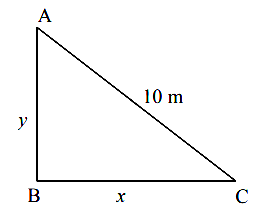
Then, $\frac{ d x}{ dt }=1.2 m / sec , AC =10 m , BC =6 m$ $\ldots$[Given]
By Pythagoras theorem, we get
$x ^2+ y ^2=A C^2$
$\therefore y ^2=A C^2- x ^2$
$\therefore y ^2=(10)^2- x ^2\ldots(i)$
Differentiating w.r.t. t, we get
$2 y \frac{ d y}{ dt }=-2 x \frac{ d x}{ dt }$
$\therefore \frac{ d y}{ dt }=\frac{-x}{y} \cdot \frac{ d x}{ dt }$
$=\frac{-6(1.2)}{y} \ldots \ldots . . \text { (ii) }$
Substituting $x=6$ in (i), we get
$y^2=(10)^2-(6)^2$
$=100-36$
$=64$
$\therefore y=8$
Substituting $y=8$ in (ii), we get
$\frac{ d y}{ dt }=\frac{(-6)(1.2)}{8}$
$=-0.9\ metre / sec$
Thus, the top of the ladder is sliding down at the rate of 0.9 meters/sec. View full question & answer→Question 573 Marks
Differentiate $\sin ^{-1}\left(\frac{2 \cos x+3 \sin x}{\sqrt{13}}\right)$ w.r. to $x$
Answer$ \text { Let } y =\sin ^{-1}\left(\frac{2 \cos x+3 \sin x}{\sqrt{13}}\right)$
$=\sin ^{-1}\left(\frac{2 \cos x}{\sqrt{13}}+\frac{3 \sin x}{\sqrt{13}}\right) $
Put $\frac{2}{\sqrt{13}}=\sin t$ and $\frac{3}{\sqrt{13}}=\cos t$
Also, $\sin ^2 t +\cos ^2 t =\frac{4}{13}+\frac{9}{13}=1$
and $\tan t =\frac{2}{3}$
$\therefore t =\tan ^{-1}\left(\frac{2}{3}\right)$
$\therefore y=\sin ^{-1}(\sin t \cdot \cos x+\cos t \cdot \sin x)$
$=\sin ^{-1}[\sin (t+x)]$
$= t + x$
$=\tan ^{-1}\left(\frac{2}{3}\right)+x$
Differentiating w. r. t. x, we get
$ \frac{ d y}{ d x}=\frac{ d }{ d x}\left[\tan ^{-1}\left(\frac{2}{3}\right)+x\right]$
$=0+1$
$=1 $
View full question & answer→Question 583 Marks
Find the Cartesian equation of the plane passing through $A(7, 8, 6)$ and parallel to $XY$ plane
AnswerThe plane passes through the point $A(7, 8, 6).$
$\therefore x_1 = 7, y_1 = 8, z_1 = 6.$
Since the required plane is parallel to the $XY$ plane,
direction ratios of normal vector will be $a = 0, b = 0, c = 1(Z-$axis$).$
Equation of a plane in Cartesian form is
$a(x − x_1) + b(y − y_1) + c(z − z_1) = 0$
$\therefore 0(x − 7) + 0(y − 8) + 1(z − 6) = 0$
$\therefore z − 6 = 0$
$\therefore z = 6$
View full question & answer→Question 593 Marks
Show that the points $A(2, –1, 0) B(–3, 0, 4), C(–1, –1, 4)$ and $D(0, – 5, 2)$ are non coplanar
AnswerLet $\overline{ a }, \overline{ b }, \overline{ c }, \overline{ c }, \overline{ d }$ be the position vectors of points $A , B , C , D$ respectively.
$\therefore \overline{ a }=2 \hat{ i }-\hat{ j }, \overline{ b }=-3 \hat{ i }+4 \widehat{ k }, \overline{ c }=-\hat{ i }-\hat{ j }+4 \widehat{ k }, \overline{ d }=-5 \hat{ j }+2 \widehat{ k }$
$\therefore \overline{ AB }=\overline{ b }-\overline{ a }$
$=(-3 \hat{ i }+4 \widehat{ k })-(2 \hat{ i }-\hat{ j })$
$=-5 \hat{ i }+\hat{ j }+4 \widehat{ k }$
$\overline{ AC }=\overline{ c }-\overline{ a }$
$=(-\hat{ i }-\hat{ j }+4 \widehat{ k })-(2 \hat{ i }-\hat{ j })$
$=-3 \hat{ i }+4 \widehat{ k }$
$\overline{ AD }=\overline{ d }-\overline{ a }$
$=\overline{ AD }=\overline{ d }-\overline{ a }$
$=(-5 \hat{ j }+2 \widehat{ k })-(2 \hat{ i }-\hat{ j })$
$=-2 \hat{ i }-4 \hat{ j }+2 \widehat{ k }$
Points $A , B , C , D$ are non$-$coplanar if $\overline{ AB }, \overline{ AC }$ and $\overline{ AD }$ are non$-$coplanar.
$\overline{A B A C A D}=\left|\begin{array}{ccc}-5 & 1 & 4 \\ -3 & 0 & 4 \\ -2 & -4 & 2\end{array}\right|$
$=-5(0+16)-1(-6+8)+4(12-0)$
$=-5(16)-1(2)+4(12)$
$=-80-2+48$
$=-34 \neq 0$
$\therefore$ The points $\text{A, B, C, D}$ are non$-$coplanar.
View full question & answer→Question 603 Marks
If the angle between the lines represented by $ax^2 + 2hxy + by^2 = 0$ is equal to the angle between the lines $2x^2 − 5xy + 3y^2 = 0$, then show that $100(h^2 − ab) = (a + b)^2$
AnswerLet $\theta$ be the acute angle between the lines $a x^2+2 h x y+b y^2=0$.
$\tan \theta=\left|\frac{2 \sqrt{ h ^2- ab }}{ a + b }\right|$ $\ldots(i)$
Comparing the equation $2 x^2-5 x y+3 y^2=0$ with $a x^2+2 h x y+b y^2=0$,
We get $a =2, h =-\frac{5}{2}, b =3$
Let $\alpha$ be the acute angle between the lines given by $2 x^2-5 x y+3 y^2=0$
$\therefore \tan \alpha=\left|\frac{2 \sqrt{\left(-\frac{5}{2}\right)^2-(2)(3)}}{2+3}\right|$
$\tan \alpha=\left|\frac{2 \sqrt{\frac{25}{4}-6}}{5}\right|$
$=\left|\frac{2 \sqrt{\frac{25-24}{4}}}{5}\right|$
$=\left|\frac{2 \cdot \frac{1}{2}}{5}\right|$
$\therefore \tan \alpha=\frac{1}{5}$$\ldots(ii)$
But $\theta=\alpha$ [Given]
$ \therefore \tan \theta=\tan \alpha$
$\therefore\left|\frac{2 \sqrt{ h ^2- ab }}{ a + b }\right|=\frac{1}{5} \quad \ldots . . .[\text { From (i) and (ii)] } $
By taking square of both sides, we get
$ \frac{4\left(h^2-a b\right)}{(a+b)^2}=\frac{1}{25}$
$\therefore 100\left(h^2-a b\right)=(a+b)^2 $
View full question & answer→Question 613 Marks
Prove that $\sin \left[\tan ^{-1}\left(\frac{1-x^2}{2 x}\right)+\cos ^{-1}\left(\frac{1-x^2}{1+x^2}\right)\right]=1$
Answer$\text { L.H.S. }=\sin \left[\tan ^{-1}\left(\frac{1-x^2}{2 x}\right)+\cos ^{-1}\left(\frac{1-x^2}{1+x^2}\right)\right]$
Substituting $x=\tan \theta$, we get
$ \text { L.H.S. }=\sin \left[\tan ^{-1}\left(\frac{1-\tan ^2 \theta}{2 \tan \theta}\right)+\cos ^{-1}\left(\frac{1-\tan ^2 \theta}{1+\tan ^2 \theta}\right)\right]$
$=\sin \left[\tan ^{-1}\left(\frac{1}{\tan 2} \theta\right)+\cos ^{-1}(\cos 2 \theta)\right]$
$=\sin \left[\tan ^{-1}(\cot 2 \theta)+\cos ^{-1}(\cos 2 \theta)\right]$
$=\sin \left[\tan ^{-1}\left\{\tan \left(\frac{\pi}{2}-2 \theta\right)\right\}+2 \theta\right]$
$=\sin \left(\frac{\pi}{2}-2 \theta+2 \theta\right)$
$=\sin \left(\frac{\pi}{2}\right)$
$=1$
$=\text { R.H.S. } $
View full question & answer→Question 623 Marks
Solve the following by inversion method $2x + y = 5, 3x + 5y = −3$
AnswerMatrix form of the given system of equations is
$\left[\begin{array}{ll}2 & 1 \\3 & 5\end{array}\right]\left[\begin{array}{l}x \\y\end{array}\right]=\left[\begin{array}{c}5 \\-3\end{array}\right]$
This is of the form $A X=B$,
where $A =\left[\begin{array}{ll}2 & 1 \\ 3 & 5\end{array}\right], X =\left[\begin{array}{l}x \\ y\end{array}\right]$ and
$B =\left[\begin{array}{c}5 \\ -3\end{array}\right]$
To determine $X$, we have to find $A^{-1}$
$\begin{array}{l}|A|=\left[\begin{array}{ll}2 & 1 \\3 & 5\end{array}\right] \\=10-3 \\=7 \neq 0\end{array}$
$\therefore A ^{-1}$ exists.
Consider $AA ^{-1}= I$
$\therefore\left[\begin{array}{ll}2 & 1 \\3 & 5\end{array}\right] A^{-1}=\left[\begin{array}{ll}1 & 0 \\0 & 1\end{array}\right]$
Applying $R_2 \rightarrow 2 R_2-3 R_1$, we get
$\left[\begin{array}{ll}2 & 1 \\0 & 7\end{array}\right] A^{-1}=\left[\begin{array}{cc}1 & 0 \\-3 & 2\end{array}\right]$
Applying $R_1 \rightarrow 7 R_1-R_2$, we get
$\left[\begin{array}{cc}14 & 0 \\0 & 7\end{array}\right] A^{-1}=\left[\begin{array}{cc}10 & -2 \\-3 & 2\end{array}\right]$
Applying $R _1 \rightarrow\left(\frac{1}{14}\right) R _1$
and $R _2 \rightarrow\left(\frac{1}{7}\right) R _2$, we get
${\left[\begin{array}{ll}1 & 0 \\0 & 1 \end{array}\right] A^{-1}=\left[\begin{array}{cc}\frac{10}{14} & \frac{-2}{14} \\\frac{-3}{7} & \frac{2}{7}\end{array}\right]} $
$\therefore A^{-1}=\frac{1}{7}\left[\begin{array}{cc}5 & -1 \\-3 & 2\end{array}\right]$
Pre$-$multiplying $A X=B$ by $A^{-1}$, we get
$A^{-1}(A X)=A^{-1} B$
$\therefore\left( A ^{-1} A \right) X = A ^{-1} B$
$\therefore IX = A ^{-1} B$
$\therefore X = A ^{-1} B$
$\therefore X =\frac{1}{7}\left[\begin{array}{cc}5 & -1 \\-3 & 2\end{array}\right]\left[\begin{array}{c}5 \\-3\end{array}\right] $
$\therefore\left[\begin{array}{c}x \\y\end{array}\right]=\frac{1}{7}\left[\begin{array}{c}25+3 \\-15-6\end{array}\right] $
$=\frac{1}{7}\left[\begin{array}{c}28 \\-21\end{array}\right] $
$=\left[\begin{array}{c}4 \\-3\end{array}\right]$
$\therefore$ By equality of matrices, we get
$x=4, y=-3$
View full question & answer→Question 633 Marks
Find the probability of guessing correctly at least nine out of ten answers in a "true" or "false" objective test
AnswerLet $X$ denote the number of correct answers.
$ P(\text { answer is correct })=p=\frac{1}{2}$
$\therefore q=1-p$
$=1-\frac{1}{2}$
$=\frac{1}{2} $
Given, $n =10$
$\therefore X \sim\left(10, \frac{1}{2}\right)$
The p.m.f. of $X$ is given by
$P ( X = x )={ }^{10} C _x\left(\frac{1}{2}\right)^x\left(\frac{1}{2}\right)^{10-x}, x=0,1, \ldots, 10$
$P$ (at least nine answers are correct)
$=P(X \geq 9)$
$=P(X=9)+P(X=10)$
$={ }^{10} C_9\left(\frac{1}{2}\right)^9\left(\frac{1}{2}\right)+{ }^{10} C_{10}\left(\frac{1}{2}\right)^{10}$
$=\frac{10}{2^{10}}+\frac{1}{2^{10}}$
$=\frac{11}{2^{10}}$
$=\frac{11}{1024}$
View full question & answer→Question 643 Marks
A random variable X has the following probability distribution:
| X |
0 |
1 |
2 |
3 |
4 |
5 |
6 |
7 |
| P(X) |
$0$ |
$k$ |
$2k$ |
$2k$ |
$3k$ |
$k^2$ |
$2k^2$ |
$7k^2 + k$ |
Determine:
- k
- P(X < 3)
- P( X > 4)
Answeri. Since $P(x)$ is a probability distribution of $X$,
$ \Sigma_{x=0}^7 P(x)=1$
$\therefore P(0)+P(1)+P(2)+P(3)+P(4)+P(5)+P(6)+P(7)=1$
$\therefore 0+ k +2 k +2 k +3 k + k ^2+2 k ^2+7 k ^2+ k =1$
$\therefore 10 k ^2+9 k -1=0$
$\therefore 10 k ^2+10 k - k -1=0$
$\therefore 10 k ( k +1)-1( k +1)=0$
$\therefore( k +1)(10 k -1)=0$
$\therefore 10 k -1=0$
$\therefore 10 k -1=0 \quad \ldots \ldots . .( k \neq-1)$
$\therefore k =\frac{1}{10} $
$ \text { ii. } P(X<3)=P(0)+P(1)+P(2)$
$=0+k+2 k$
$=3 k$
$=3\left(\frac{1}{10}\right)$
$=\frac{3}{10} $
iii. $P (0< X <3)=+ P (1)+ P (2)$
$ = k +2 k$
$=3 k$
$=3\left(\frac{1}{10}\right)$
$=\frac{3}{10} . $
View full question & answer→Question 653 Marks
Prove that: $\int_0^{ a } f (x) d x=\int_0^{ a } f ( a -x) d x$. Hence find $\int_0^{\frac{\pi}{2}} \sin ^2 x d x$
AnswerConsider R.H.S : $\int_0^{ a } f ( a -x) d x$
Let $I =\int_0^{ a } f ( a -x) d x$
Put $a-x=t$
$\therefore- dx = dt$
$\therefore- d x= dt$
When $x =0, t = a -0= a$
and when $x = a , t = a - a =0$
$\therefore \int_0^{ a } f (x) d x=\int_0^{ a } f ( a -x) d x$
Let $I =\int_0^{\frac{\pi}{2}} \sin ^2 x d x$\ldots(i)
Adding (i) and (ii), we get
$ 2 I =\int_0^{\frac{\pi}{2}} \sin ^2 x d x+\int_0^{\frac{\pi}{2}} \cos ^2 x d x$
$=\int_0^{\frac{\pi}{2}}\left(\sin ^2 x+\cos ^2 x\right) d x$
$\therefore 2 I =\int_0^{\frac{\pi}{2}} 1 \cdot d x$
$\therefore I =\frac{1}{2}[x]_0^{\frac{\pi}{2}}$
$\therefore I =\frac{1}{2}\left(\frac{\pi}{2}-0\right)$
$\therefore I =\frac{\pi}{4} $
View full question & answer→Question 663 Marks
$\int \frac{\left(x^2+2\right)}{x^2+1} a ^{x+\tan ^{-1 x}} d x$
AnswerLet $I =\int\left(\frac{x^2+2}{x^2+1}\right) a ^{x+\tan ^{-1 x}} d x$
Put $x+\tan ^{-1} x=t$
Differentiating w.r.t. $x$, we get
$ \left(1+\frac{1}{1+x^2}\right) d x= dt$
$\therefore\left(\frac{x^2+2}{x^2+1}\right) d x= dt$
$\therefore I =\int a ^1 dt$
$=\frac{ a ^1}{\log a }+ c$
$\therefore I =\frac{ a ^{x+\tan ^{-1 x}}}{\log a }+ c $
View full question & answer→Question 673 Marks
The surface area of a spherical balloon is increasing at the rate of $2 cm^2/sec$. At what rate the volume of the balloon is increasing when radius of the balloon is $6$ cm?
AnswerLet $r$ be the radius, $s$ be the surface area and $V$ be the volume of the spherical balloon.
Then, $\frac{ ds }{ dt }=2 cm ^2 / sec , r =6 cm$.......[Given]
$s=4 \pi r^2$
Differentiating w.r.t. t, we get
$ \frac{ ds }{ dt }=4 \pi(2 r ) \cdot \frac{ dr }{ dt }$
$\therefore 2=8 \pi r \cdot \frac{ dr }{ dt }$
$\therefore \frac{ dr }{ dt }=\frac{1}{4 \pi r }\ldots(i) $
Now, $V=\frac{4}{3} \pi r^3$
Differentiating w.r.t. t, we get
$ \frac{ dV }{ dt }=\frac{4}{3} \pi\left(3 \pi^2\right) \cdot \frac{ dr }{ dt }$
$=4 \pi r ^2\left(\frac{ dr }{ dt }\right)$
$=4 \pi r ^2 \cdot \frac{1}{4 \pi r } \quad \ldots \ldots . .[\text { From (i) }] $
$ =r$
$\therefore \frac{ dV }{ dt }=6 cm ^3 / sec $
Thus, the volume of the spherical balloon is increasing at the rate of $6 cm ^3 / sec$.
View full question & answer→Question 683 Marks
Differentiate $\cot ^{-1}\left(\frac{\cos x}{1+\sin x}\right)$ w.r. to $x$
Answer$ \text { Let } y =\cot ^{-1}\left(\frac{\cos x}{1+\sin x}\right)$
$=\tan ^{-1}\left(\frac{1+\sin x}{\cos x}\right)$
$=\tan ^{-1}\left[\frac{\cos ^2\left(\frac{x}{2}\right)+\sin ^2\left(\frac{x}{2}\right)+2 \sin \left(\frac{x}{2}\right) \cos \left(\frac{x}{2}\right)}{\cos ^2\left(\frac{x}{2}\right)-\sin ^2\left(\frac{x}{2}\right)}\right]$
$=\tan ^{-1}\left[\frac{\left\{\cos \left(\frac{x}{2}\right)+\sin \left(\frac{x}{2}\right)\right\}^2}{\left[\cos \left(\frac{x}{2}\right)+\sin \left(\frac{x}{2}\right)\right]\left[\cos \left(\frac{x}{2}\right)-\sin \left(\frac{x}{2}\right)\right]}\right]$
$=\tan ^{-1}\left[\frac{\cos \left(\frac{x}{2}\right)+\sin \left(\frac{x}{2}\right)}{\cos \left(\frac{x}{2}\right)-\sin \left(\frac{x}{2}\right)}\right]$
$=\tan ^{-1}\left[\frac{1+\tan \left(\frac{x}{2}\right)}{1-\tan \left(\frac{x}{2}\right)}\right]$
$=\tan ^{-1}\left[\frac{\tan \left(\frac{\pi}{4}\right)+\tan \left(\frac{\pi}{2}\right)}{1-\tan \left(\frac{\pi}{4}\right) \tan \left(\frac{x}{2}\right)}\right]$
$=\tan ^{-1}\left[\tan \left(\frac{\pi}{4}+\frac{x}{2}\right)\right]$
$\therefore y=\frac{\pi}{4}+\frac{x}{2} $
Differentiating w. r. t. x, we get
$\frac{ d y}{ d x}=\frac{ d }{ d x}\left(\frac{\pi}{4}+\frac{x}{2}\right)=0+\frac{1}{2}=\frac{1}{2}$
View full question & answer→Question 693 Marks
Find the Cartesian equation of the line passing through $(−1, −1, 2)$ and parallel to the line $2x − 2 = 3y + 1 = 6z – 2$
Answer$ 2 x-2=3 y+1=6 z-2 \quad \ldots \ldots . .[\text { Given }]$
$\therefore 2(x-1)=3\left(y+\frac{1}{3}\right)$
$=6\left(z-\frac{2}{3}\right)$
$\therefore \frac{x-1}{\frac{1}{2}}=\frac{y-\left(-\frac{1}{3}\right)}{\frac{1}{3}}$
$=\frac{z-\frac{1}{3}}{\frac{1}{6}} $
Direction ratios of given line are $\frac{1}{2}, \frac{1}{3}, \frac{1}{6}$.
Since the required line is parallel to the given line, direction ratios of the required line will be $\frac{1}{2}, \frac{1}{3}, \frac{1}{6}$.
Equation of a line passing through the point $\left(x_1, y_1, z_1\right)$ and having direction ratios $(a, b, c)$ is
$ \frac{x-x_1}{ a }=\frac{y-y_1}{ b }=\frac{z-z_1}{ c }$
$\therefore \frac{x-(-1)}{\frac{1}{2}}=\frac{y-(-1)}{\frac{1}{3}}=\frac{z-2}{\frac{1}{6}}$
$\therefore \frac{x+1}{\frac{1}{2} \times 6}=\frac{y+1}{\frac{1}{3} \times 6}=\frac{z-2}{\frac{1}{6} \times 6}$
$\therefore \frac{x+1}{3}=\frac{y+1}{2}=\frac{z-2}{1}, $
which is the required cartesian equation of the line.
View full question & answer→Question 703 Marks
If $a$ line has the direction ratios $4, −12, 18,$ then find its direction cosines
AnswerDirection ratios of the line are $a=4, b=-12, c=18$.
Let $I , m , n$ be the direction cosines of the line.
Then $\mid=\frac{a}{\sqrt{a^2+b^2+c^2}}$
$=\frac{4}{\sqrt{4^2+(-12)^2+(18)^2}}$
$=\frac{4}{\sqrt{16+144+324}}$
$=\frac{4}{22}$
$=\frac{2}{11}$
$m=\frac{b}{\sqrt{a^2+b^2+c^2}}$
$=\frac{-12}{\sqrt{4^2+(-12)^2+(18)^2}}$
$=\frac{-12}{\sqrt{16+144+324}}$
$=\frac{-12}{22}$
$=\frac{-6}{11}$
and
$ n=\frac{c}{\sqrt{a^2+b^2+c^2}}$
$=\frac{18}{\sqrt{4^2+(-12)^2+(18)^2}}$
$=\frac{18}{\sqrt{16+144+324}}$
$=\frac{18}{22}$
$=\frac{9}{11} $
Hence, the direction cosines of the line are $\frac{2}{11}, \frac{-6}{11}, \frac{9}{11}$.
View full question & answer→Question 713 Marks
If $\theta$ is the acute angle between the lines given by $a x^2+2 h x y+b y^2=0$ then prove that $\tan \theta$ $=\left|\frac{2 \sqrt{ h ^2}- ab }{ a + b }\right|$. Hence find acute angle between the lines $2 x ^2+7 xy +3 y ^2=0$
AnswerLet $m 1$ and $m 2$ be the slopes of the lines represented by the equation $a x^2+2 h x y+b y^2=0$.
$ \therefore m _1+ m _2=\frac{-2 h }{ b } \text { and } m _1 m _2=\frac{ a }{ b }$
$\therefore\left( m _1- m _2\right)^2=\left( m _1+ m _2\right)^2-4 m _1 m _2$
$=\left(\frac{-2 h }{ b }\right)^2-4\left(\frac{ a }{ b }\right)$
$=\frac{4 h ^2}{ b ^2}-\frac{4 ab }{ b ^2}$
$=\frac{4 h ^2-4 ab }{ b ^2}$
$=\frac{4\left( h ^2- ab \right)}{ b ^2}$
$\therefore m _1- m _2= \pm \frac{2 \sqrt{ h ^2-a b}}{ b } $
As $\theta$ is the acute angle between the lines,
$ \tan \theta=\left|\frac{ m _1- m _2}{1+ m _1 m _2}\right|$
$=\left|\frac{ \pm \frac{2 \sqrt{ h ^2- ab }}{ b }}{1+\frac{ a }{ b }}\right|$
$=\left|\frac{2 \sqrt{ h ^2- ab }}{ a + b }\right| \ldots \ldots . . \text { (i) } $
View full question & answer→Question 723 Marks
If $\tan ^{-1} x +\tan ^{-1} y +\tan ^{-1} z =\pi$, then show that $\frac{1}{x y}+\frac{1}{y z}+\frac{1}{z x}=1$
Answer$\tan ^{-1} x +\tan ^{-1} y +\tan ^{-1} z =\pi$
$\therefore \tan ^{-1} x +\tan ^{-1} y =\pi-\tan ^{-1} z$
$\therefore \tan ^{-1}\left(\frac{x+y}{1-x y}\right)=\pi-\tan ^{-1} z$
$\therefore \frac{x+y}{1-x y}=\tan \left(\pi-\tan ^{-1} z \right)$
$\therefore \frac{x+y}{1-x y}=-\tan \left(\tan ^{-1} z \right)$
$\therefore \frac{x+y}{1-x y}=- z$
$\therefore x + y =- z + xyz$
$\therefore x + y + z = xyz$
$\therefore \frac{1}{y z}+\frac{1}{x z}+\frac{1}{x y}=1, \text { i.e., } \frac{1}{x y}+\frac{1}{y z}+\frac{1}{z x}=1$
View full question & answer→Question 733 Marks
If $A=\left[\begin{array}{ccc}-4 & -3 & -3 \\ 1 & 0 & 1 \\ 4 & 4 & 3\end{array}\right]$, find $\operatorname{adj}(A)$
Answer$\begin{aligned} & A_{11}=(-1)^{1+1} M_{11}=1\left|\begin{array}{ll}0 & 1 \\ 4 & 3\end{array}\right|=1(0-4)=-4 \end{aligned} $
$ A_{12}=(-1)^{1+2} M_{12}=(-1)\left|\begin{array}{ll}1 & 1 \\ 4 & 3\end{array}\right|=(-1)(3-4)=(-1)(-1)=1 $
$ A_{13}=(-1)^{1+3} M_{13}=1\left|\begin{array}{ll}1 & 0 \\ 4 & 4\end{array}\right|=1(4-0)=(1)(4)=4 $
$ A_{21}=(-1)^{2+1} M_{21}=(-1)\left|\begin{array}{cc}-3 & -3 \\ 4 & 3\end{array}\right|=(-1)(-9+12)=(-1)$
$ (3)=-3 $
$\begin{aligned} & A_{22}=(-1)^{2+2} M_{22}=1\left|\begin{array}{cc}-4 & -3 \\ 4 & 3\end{array}\right|=1(-12+12)=1(0)=0 \end{aligned} $
$ A_{23}=(-1)^{2+3} M_{23}=(-1)\left|\begin{array}{cc}-4 & -3 \\ 4 & 4\end{array}\right|=(-1)(-16+12)=(-1) $
$ (-4)=4$
$\begin{aligned} & A_{31}=(-1)^{3+1} M_{31}=1\left|\begin{array}{cc} -3 & -3 \\ 0 & 1 \end{array}\right|=1(-3-0)=-3 \end{aligned} $
$ A_{32}=(-1)^{3+2} M_{32}=(-1)\left|\begin{array}{cc} -4 & -3 \\ 1 & 1 \end{array}\right|=(-1)(-4+3)=(-1)(-1) =1 $
$A_{33}=(-1)^{3+3} M_{33}=1\left|\begin{array}{cc}-4 & -3 \\ 1 & 0\end{array}\right|=1(0+3)=(1)(3)=3$
$\begin{aligned} & \operatorname{adj}(A)=\left[\begin{array}{lll}A_{11} & A_{12} & A_{13} \\ A_{21} & A_{22} & A_{23} \\ A_{21} & A_{32} & A_{33}\end{array}\right] \end{aligned} $
$ =\left[\begin{array}{ccc}-4 & 1 & 4 \\ -3 & 0 & 4 \\ -3 & 1 & -3\end{array}\right] $
$ =\left[\begin{array}{ccc}-4 & -3 & -3 \\ 1 & 0 & 1 \\ 4 & 4 & 3\end{array}\right]$
View full question & answer→Question 743 Marks
The probability that certain kind of component will survive a check test is $0.6.$ Find the probability that exactly $2$ of the next $4$ tested components survive
AnswerLet $X$ denote the number of tested components survive.
$P($ component survive the check test $)=p=0.6$[Given]
$ \therefore q=1-p$
$=1-0.6$
$=0.4 $
Given, $n =4$
$\therefore X \sim B (4,0.6)$
The p.m.f. of $X$ is given by
$P ( X = x )={ }^4 C _x(0.6)^x(0.4)^{4-x}, x=0,1, \ldots, 4$
$\therefore P$ (exactly 2 components tested survive)
$ =P(X=2)$
$={ }^4 C_2(0.6)^2(0.4)^2$
$=6(0.36)(0.16)$
$=0.3456 $
View full question & answer→Question 753 Marks
A coin is biased so that the head is $3$ times as likely to occur as tail. If the coin is tossed twice, find the probability distribution of number of tails.
AnswerGiven a biased coin such that heads is 3 times as likely as tails.
$\therefore P ( H )=\frac{3}{4} \text { and } P ( T )=\frac{1}{4}$
The coin is tossed twice.
Let $X$ can be the random variable for the number of tails.
Then $X$ can take the value $0,1,2$.
$ \therefore P ( X =0)= P ( HH )$
$=\frac{3}{4} \times \frac{3}{4}$
$=\frac{9}{16}$
$P ( X =1)= P ( HT , TH )$
$=\frac{3}{4} \times \frac{1}{4}+\frac{1}{4} \times \frac{3}{4}$
$=\frac{6}{16} $
$ =\frac{3}{8}$
$P(X=2)=P(T T)$
$=\frac{1}{4} \times \frac{1}{4}$
$=\frac{1}{16} $
Therefore, the required probability distribution is as follows.
| X |
$0$ |
$1$ |
$2$ |
| P(X=x) |
$\frac{9}{16}$ |
$\frac{3}{8}$ |
$\frac{1}{16}$ |
View full question & answer→Question 763 Marks
Prove that: $\int_{ a }^{ b } f (x) d x=\int_{ a }^{ b } f ( a + b -x) d x$
AnswerConsider R.H.S. : $\int_{ a }^{ b } f ( a + b -x) d x$
Let $I =\int_{ a }^{ b } f ( a + b -x) d x$
Put $a+b-x=t$
$\therefore- dx = dt$
$\therefore dx =- dt$
When $x = a , t = a + b - a = b$
and when $x = b , t = a + b - b = a$
$ \therefore I =\int_{ b }^{ a } f ( t )(- dt )$
$=-\int_{ b }^{ a } f ( t ) dt$
$=\int_{ a }^{ b } f ( t ) dt \quad \ldots . .\left[\because \int_{ a }^{ b } f (x) d x=-\int_{ b }^{ a } f (x) d x\right]$
$=\int_{ b }^{ a } f ( t ) d x \quad \ldots . \cdot\left[\because \int_{ a }^{ b } f (x) d x=\int_{ a }^{ b } f ( t ) dt \right]$
$= L \cdot H \cdot S .$
$\therefore \int_{ a }^{ b } f (x) d x=\int_{ a }^{ b } f ( a + b -x) d x $
View full question & answer→Question 773 Marks
If $f ^{\prime}( x )=x-\frac{3}{x^3}, f (1)=\frac{11}{2}$ find $f ( x )$
Answer$ f ^{\prime}( x )=x-\frac{3}{x^3}, f (1)=\frac{11}{2} ...[Given]$
$f ( x )=\int f ^{\prime}(x) d x$
$=\int\left(x-\frac{3}{x^3}\right) d x$
$=\int x d x-3 \int x^{-3} d x$
$=\frac{x^2}{2}-3\left(\frac{x^{-2}}{2}\right)+ c$
$\therefore f ( x )=\frac{x^2}{2}+\frac{3}{2 x^2}+ c$
$\therefore f (1)=\frac{(1)^2}{2}+\frac{3}{2(1)^2+ c }$
$\therefore \frac{11}{2}=\frac{1}{2}+\frac{3}{2}+ c$
$\therefore \frac{11}{2}=2+ c$
$\therefore c =\frac{7}{2} $
Substituting $c=\frac{7}{2}$ in (i),, w get
$f ( x )=\frac{x^2}{2}+\frac{3}{2 x^2}+\frac{7}{2}$
View full question & answer→Question 783 Marks
A spherical soap bubble is expanding so that its radius is increasing at the rate of $0.02\ cm/sec.$ At what rate is the surface area is increasing, when its radius is $5\ cm?$
AnswerLet $r$ be the radius and $s$ be the surface area of the spherical soap bubble.
Then, $\frac{ dr }{ dt }=0.02 cm / sec , r =5 cm$$\ldots[Given]$
$s=4 \pi r^2$
Differentiating w.r.t. t, we get
$ \frac{ ds }{ dt }=4 \pi(2 r ) \cdot \frac{ dr }{ dt }$
$=8 \pi r \frac{ dr }{ dt }$
$=8 \pi \times 5 \times 0.02$
$\therefore \frac{ ds }{ dt }=0.8 \pi cm ^2 / sec $
Thus, the surface area is increasing at the rate of $0.8 \pi cm ^2 / sec$.
View full question & answer→Question 793 Marks
If $y =\log \left[4^{2 x}\left(\frac{x^2+5}{\sqrt{2 x^3-4}}\right)^{\frac{3}{2}}\right]$, find $\frac{ d y}{ d x}$
Answer$ y=\log \left[\sqrt{\frac{1-\cos \left(\frac{3 x}{2}\right)}{1+\cos \left(\frac{3 x}{2}\right)}}\right], \text { find } \frac{ d y}{ d x}$
$=\log \left[\sqrt{\left.\frac{2 \sin ^2\left(\frac{3 x}{4}\right)}{2 \cos ^2\left(\frac{3 x}{4}\right)}\right]}\right.$
$=\log \left[\sqrt{\tan ^2\left(\frac{3 x}{4}\right)}\right]$
$=\log \left[\tan \left(\frac{3 x}{4}\right)\right] $
Differentiating w. r. t. x, we get
$ \frac{ d y}{ d x}=\frac{ d }{ d x}\left[\log \left(\tan \left(\frac{3 x}{4}\right)\right)\right]$
$=\frac{1}{\tan \left(\frac{3 x}{4}\right)} \cdot \frac{ d }{ d } x\left[\tan \left(\frac{3 x}{4}\right)\right]$
$=\cot \left(\frac{3 x}{4}\right) \cdot \sec ^2\left(\frac{3 x}{4}\right) \cdot \frac{ d }{ d x}\left(\frac{3 x}{4}\right)$
$=\frac{\cos \left(\frac{3 x}{4}\right)}{\sin \left(\frac{3 x}{4}\right)} \cdot \frac{1}{\cos ^2\left(\frac{3 x}{4}\right)} \cdot \frac{3}{4}$
$=\frac{3}{2\left[2 \sin \left(\frac{3 x}{4}\right) \cos ^2\left(\frac{3 x}{4}\right)\right]}$
$=\frac{3}{2 \sin \left(\frac{3 x}{2}\right)}$
$=\frac{3}{2} \operatorname{cosec}\left(\frac{3 x}{2}\right) $
View full question & answer→Question 803 Marks
Find the vector equation of the line passing through the point having position vector $-\hat{ i }-\hat{ j }+2 \widehat{ k }$ and parallel to the line $\overline{ r }=(\hat{ i }+2 \hat{ j }+3 \widehat{ k })+\mu(3 \hat{ i }+2 \hat{ j }+\widehat{ k }), \mu$ is a parameter
AnswerLet $\overline{ a }$ be the position vector of the point
$
\therefore \overline{ a }=-\hat{ i }-\hat{ j }+2 \widehat{ k }
$
Equation of given line is $\overline{ r }=(\hat{ i }+2 \hat{ j }+3 \widehat{ k })+\mu(3 \hat{ i }+2 \hat{ j }+\widehat{ k })$
$\therefore$ Direction ratios of the line are $3,2,1$.
Let $\overline{ b }$ be the vector parallel to this line.
$
\therefore \overline{ b }=3 \hat{ i }+2 \hat{ j }+\widehat{ k }
$
The vector equation of a line passing through a point with position vector $\overline{ a }$ and parallel to $\overline{ b }$ is $\overline{ r }=\overline{ a }+\lambda \overline{ b }$.
$\therefore$ Vector equation of the line is $\overline{ r }=(-\hat{ i }-\hat{ j }+2 \widehat{ k })+\lambda(3 \hat{ i }+2 \hat{ j }+\widehat{ k })$
View full question & answer→Question 813 Marks
Find the centroid of tetrahedron with vertices $K(5, −7, 0), L(1, 5, 3), M(4, −6, 3), N(6, −4, 2)$
AnswerLet $G$ be the centroid of the tetrahedron $K , L , M , N$.
Let $\vec{p}, \vec{l}, \vec{m}, \vec{n}$ be the position vectors of the points $K , L , M , N$ respectively w.r.t. the origin $O$.
Then, $\vec{p}=5 \hat{i}-7 \hat{j}+0 \widehat{k}$
$ \vec{l}=\hat{i}+5 \hat{j}+3 \widehat{k}$
$\vec{m}=4 \hat{i}-6 \hat{j}+3 \widehat{k}$
$\vec{n}=6 \hat{i}-4 \hat{j}+2 \widehat{k} $
Let $G( g )$ be the centroid of the tetrahedron.
Then by centroid formula
$ \vec{g}=\frac{\vec{p}+\vec{l}+\vec{m}+\vec{n}}{4}$
$=\frac{1}{4}[(5 \hat{i}-7 \hat{j}+0 . \widehat{k})+(\hat{i}+5 \hat{j}+3 \widehat{k})+(4 \hat{i}-6 \hat{j}+3 \widehat{k})+(6 \hat{i}-4 \hat{j}+2 \widehat{k})]$
$=\frac{1}{4}(16 \hat{ i }-12 \hat{ j }+8 \widehat{ k })$
$=4 \hat{i}-3 \hat{j}+2 \widehat{k} $ Hence, the centroid of the tetrahedron is $G=(4,-3,2)$.
View full question & answer→Question 823 Marks
Show that the homogeneous equation of degree $2$ in $x$ and $y$ represents a pair of lines passing through the origin if $h^2− ab \geq 0.$
Answer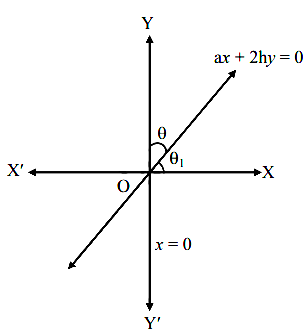
Consider the homogeneous equation of degree two in $x$ and $y$
$a x^2+2 h x y+b y^2=0\ldots(i)$
Consider two cases $b=0$ and $b \neq 0$.
These two cases are exhaustive.
Case I:
If $b=0$ then the equation $a x^2+2 h x y=0$
$\therefore x(a x+2 h y)=0$, which is the combined equation of lines $x=0$ and $a x+2 h y=0$.
We observe that these lines pass through the origin.
Case II:
If $b \neq 0$, then we multiply equation (i) by $b$
$ a b x^2+2 h b x y+b^2 y^2=0$
$\therefore b^2 y^2+2 h b x y=-a b x^2 $
To make L.H.S. complete square we add $h^2 x^2$ to both sides.
$b^2 y^2+2 h b x y+h^2 x^2=h^2 x^2-a b x^2$
$\therefore\left(b y+h x^2=\left(h^2-a b\right) x^2\right.$
$\therefore( b y+ h x)^2=\left(\sqrt{ h ^2- ab }\right)^2 x^2, as h ^2- ab \geq 0$
$ \therefore( b y+ h x)^2-\left(\sqrt{ h ^2- ab }\right)^2 x^2=0$
$\therefore\left( b y+ h x+\sqrt{ h ^2- ab x}\right)\left( b y+ h x-\sqrt{ h ^2- ab x}\right)=0$
$\therefore\left[\left( h +\sqrt{ h ^2- ab }\right) x+ b y\right] \cdot\left[\left( h -\sqrt{ h ^2- ab }\right) x+ b y\right]=0, $
which is the combined equation of lines
$\left( h +\sqrt{ h ^2- ab }\right) x+ b y=0 \text { and }(" h "-\operatorname{sqrt}(" h " \wedge 2-" a b ")) x +\text { "b" } y \text { " }=0$
As $b \neq 0$, we can write these equations in the form
$=m_1 x \text { and } y=m_2 x$
Where $m_1=\frac{-h-\sqrt{h^2-a b}}{b}$ and $m_2=\frac{-h+\sqrt{h^2-a b}}{b}$
We observe that these lines pass through the origin.
$\therefore$ From the above two cases, we conclude that the equation $a x^2+2 h x y+b y^2=0$ represents a pair of lines passing through the origin, if $h^2-a b \geq 0$. View full question & answer→Question 833 Marks
In $\triangle ABC$, prove that $\frac{\cos 2 A }{ a ^2}-\frac{\cos 2 c }{ c ^2}=\frac{1}{ a ^2}-\frac{1}{ c ^2}$
Answer$\text { Consider L.H.S. }=\frac{\cos 2 A }{ a ^2}-\frac{\cos 2 c }{ c ^2}$
$=\frac{1-2 \sin ^2 A }{ a ^2}-\frac{1-2 \sin ^2 C }{ c ^2}$
$=\frac{1}{ a ^2}-2 \frac{\sin ^2 A }{ a ^2}-\frac{1}{ c ^2}+2 \frac{\sin ^2 C }{ c ^2}$
$=\frac{1}{ a ^2}-2 k ^2-\frac{1}{ c ^2}+2 k ^2 \ldots \ldots . . \text { [By since rule] }$
$=\frac{1}{ a ^2}-\frac{1}{ c ^2}$
$=\text { R.H.S. }$
View full question & answer→Question 843 Marks
If $A=\left[\begin{array}{cc}0 & 1 \\ 2 & 3 \\ 1 & -1\end{array}\right]$ and $B=\left[\begin{array}{lll}1 & 2 & 1 \\ 2 & 1 & 0\end{array}\right]$, then find $(A B)^{-1}$
Answer$A B=\left[\begin{array}{cc}0 & 1 \\ 2 & 3 \\ 1 & -1\end{array}\right]\left[\begin{array}{lll}1 & 2 & 1 \\ 2 & 1 & 0\end{array}\right]$
$=\left[\begin{array}{lll}0+2 & 0+1 & 0+0 \\ 2+6 & 4+3 & 2+0 \\ 1-2 & 2-1 & 1+0\end{array}\right]$
$=\left[\begin{array}{ccc}2 & 1 & 0 \\ 8 & 7 & 2 \\ -1 & 1 & 1\end{array}\right]$
$\therefore|A B|=2\left|\begin{array}{ll}7 & 2 \\ 1 & 1\end{array}\right|-1|8 \quad 2|+0$
$=2(7-2)-(8+2)$
$=10-10$
$=0$
$\therefore(A B)^{-1}$ does not exist.
View full question & answer→Question 853 Marks
Find the probability distribution of the number of successes in two tosses of a die, where a success is defined as number greater than $4$ appears on at least one die.
AnswerWhen a die is tossed twice, the sample space $S$ has $6 \times 6=36$ sample points.
$\therefore n ( S )=36$
Trial will be a success if the number on at least one die is $5$ or $6.$
Let $X$ denote the number of dice on which 5 or 6 appears.
Then $X$ can take values $0,1,2$
When $X=0$ i.e., 5 or 6 do not appear on any of the dice, then
$ X =\{(1,1),(1,2),(1,3),(1,4),(2,1),(2,2),(2,3),(2,4),(3,1),(3,2),$
$(3,3),(3,4),(4,1),(4,2),(4,3),(4,4)\} .$
$\therefore n ( X )=16$
$\therefore P ( X =0)=\frac{n(X)}{n(S)}=\frac{16}{36}=\frac{4}{9} $
When $X=1$, i.e. 5 or 6 appear on exactly one of the dice, then
$ X=\{(1,5),(1,6),(2,5),(2,6),(3,5),(3,6),(4,5),(4,6),(5,1),(5,2),$
$(5,3),(5,4),(6,1),(6,2),(6,3),(6,4)\} $
$ \therefore n ( X )=16$
$\therefore P ( X =1)=\frac{n(X)}{n(S)}=\frac{16}{36}=\frac{4}{9} $
When $X=2$, i.e. 5 or 6 appear on both of the dice, then
$ X =\{(5,5),(5,6),(6,5),(6,6)\}$
$\therefore n ( X )=4$
$\therefore P ( X =2)=\frac{n(X)}{n(S)}=\frac{4}{36}=\frac{1}{9} $
$\therefore$ The required probability distribution is
| X |
$0$ |
$1$ |
$2$ |
| P(X=x) |
$\frac{4}{9}$ |
$\frac{4}{9}$ |
$\frac{1}{9}$ |
View full question & answer→Question 863 Marks
Prove that: $\int_{ a }^{ b } f (x) d x=\int_{ a }^{ c } f (x) d x+\int_{ c }^{ b } f (x) d x$, where $a < c <$ b
Answer$ \text { Let } \int f (x) d x= g (x)+c$
$\int_{ a }^{ b } f (x) d x=[ g (x)+ c ]_{ a }^{ b }$
$=[\{ g ( b )+ c \}-\{ g ( a )+ c \}]$
$= g ( b )- g ( a ) \quad \ldots \ldots . . \text { (i) }$
$\int_{ a }^{ c } f (x) d x+\int_{ c }^{ b } f (x) d x=[ g (x)+ c ]_{ a }^{ c }+[ g (x)+ c ]_{ c }^{ b }$
$=[\{ g ( c )+ c \}-\{ g ( a )+ c \}]+[ g ( b )+ c \}- g ( c )+ c ]_{ c }^{ b }$
$= g ( c )+ c - g ( a )- c + g ( b )+ c - g ( c )- c$
$= g ( b )- g ( a ) \quad \ldots \ldots . .( ii ) $
From (i) and (ii), we get
$\int_{ a }^{ b } f (x) d x=\int_{ a }^{ c } f (x) d x+\int_{ c }^{ b } f (x) d x \text {, where } a < c < b$
View full question & answer→Question 873 Marks
$\int \frac{1}{x\left(x^3-1\right)} d x$
Answer$ \text { Let } I =\int \frac{1}{x\left(x^3-1\right)} d x$
$=\int \frac{1}{x \cdot x^3\left(1-\frac{1}{x^3}\right)} d x$
$=\int \frac{1}{x^4\left(1-\frac{1}{x^3}\right)} d x $
Put $1-\frac{1}{x^3}= t$
Differentiating w.r.t.x, we get
$ \frac{3}{x^4} d x= dt$
$\therefore \frac{1}{x^4} d x=\frac{1}{3} dt$
$\therefore \mid=\frac{1}{3} \int \frac{ dt }{ t }$
$=\frac{1}{3} \log | t |+ c$
$=\frac{1}{3} \log \left|1-\frac{1}{x^3}\right|+ c$
$\therefore\left|=\frac{1}{3} \log \right| \frac{x^3-1}{x^3} \mid+ c $
View full question & answer→Question 883 Marks
Find the point on the curve $y=\sqrt{x-3}$ where the tangent is perpendicular to the line $6 x+$ $3 y-5=0$.
AnswerLetthe required point on the curve $y =\sqrt{x-3}$ be $P \left( x _1, y _1\right)$.
Differentiating $y =\sqrt{x-3}$ w.r.t.x., we get
$ \frac{d y}{d x}=\frac{d}{d x}(\sqrt{x-3})$
$=\frac{1}{2 \sqrt{x-3}} \cdot \frac{d}{d x}(x-3)$
$=\frac{1 \times(1-0)}{2 \sqrt{x-3}}$
$=\frac{1}{2 \sqrt{x-3}} $
$\therefore$ Slope of the tangent at $\left( x _1, y _1\right)$
$ =\left(\frac{d y}{d x}\right)_{a t\left(x_1, y_1\right)}$
$=\frac{1}{2 \sqrt{x_1-3}} $
Since, this tangent is perpendicular to $6 x+3 y-5=0$ whose slope is $\frac{-6}{3}=$ $-2$.
Slope of the tangent $=\frac{-1}{-2}=\frac{1}{2}$
$\therefore \frac{1}{2 \sqrt{x_1-3}}=\frac{1}{2}$
$\therefore \sqrt{x_1-3}=1$
$\therefore x _1-3=1$
$\therefore x _1=4$
Since, $\left( x _1, y _1\right)$ lies on $y =\sqrt{x-3}, y _1=\sqrt{x_1-3}$
When $x _1=4, y _1=\sqrt{4-3}= \pm 1$
Hence, the required points are $(4,1)$ and $(4,-1)$.
View full question & answer→Question 893 Marks
If $x =\sin \theta, y =\tan \theta$, then find $\frac{ d y}{ d x}$
Answer$ y=\log \left[\sqrt{\frac{1-\cos \left(\frac{3 x}{2}\right)}{1+\cos \left(\frac{3 x}{2}\right)}}\right], \text { find } \frac{ d y}{ d x}$
$=\log \left[\sqrt{\left.\frac{2 \sin ^2\left(\frac{3 x}{4}\right)}{2 \cos ^2\left(\frac{3 x}{4}\right)}\right]}\right.$
$=\log \left[\sqrt{\tan ^2\left(\frac{3 x}{4}\right)}\right]$
$=\log \left[\tan \left(\frac{3 x}{4}\right)\right] $
Differentiating w. r. t. x, we get
$ \frac{ d y}{ d x}=\frac{ d }{ d x}\left[\log \left(\tan \left(\frac{3 x}{4}\right)\right)\right]$
$=\frac{1}{\tan \left(\frac{3 x}{4}\right)} \cdot \frac{ d }{ d } x\left[\tan \left(\frac{3 x}{4}\right)\right]$
$=\cot \left(\frac{3 x}{4}\right) \cdot \sec ^2\left(\frac{3 x}{4}\right) \cdot \frac{ d }{ d x}\left(\frac{3 x}{4}\right)$
$=\frac{\cos \left(\frac{3 x}{4}\right)}{\sin \left(\frac{3 x}{4}\right)} \cdot \frac{1}{\cos ^2\left(\frac{3 x}{4}\right)} \cdot \frac{3}{4}$
$=\frac{3}{2\left[2 \sin \left(\frac{3 x}{4}\right) \cos ^2\left(\frac{3 x}{4}\right)\right]}$
$=\frac{3}{2 \sin \left(\frac{3 x}{2}\right)}$
$=\frac{3}{2} \operatorname{cosec}\left(\frac{3 x}{2}\right) $
View full question & answer→Question 903 Marks
Find Cartesian equation of the line passing through the point $A(2,1,-3)$ and perpendicular to vectors $\hat{ i }+\hat{ j }+\widehat{ k }$ and $\hat{ i }+2 \hat{ j }-\widehat{ k }$
AnswerLet $\overline{ b }=\hat{ i }+\hat{ j }+\widehat{ k }$ and $\overline{ c }=\hat{ i }+2 \hat{ j }-\widehat{ k }$
We know that $\overline{ b } \times \overline{ c }$ is perpendicular to both $\overline{ b }$ and $\overline{ c }$.
$\therefore \overline{ b } \times \overline{ c }=\left|\begin{array}{ccc}\hat{ i } & \hat{ j } & \widehat{ k } \\1 & 1 & 1 \\1 & 2 & -1\end{array}\right| $
$=\hat{ i }(-1,-2)-\hat{ j }(-1,-1)+\widehat{ k }(2-1)$
$=-3 \hat{ i }+2 \hat{ j }+\widehat{ k }$
$\therefore$ The direction ratios of the required line are $-3,2,1$ and it passes through $A (2,1,-3)$.
$\therefore$ The Cartesian equation of a line passing through the point $\left( x _1, y _1, z _1\right)$ and having direction ratios $(a, b, c)$ is
$\frac{x-x_1}{ a }=\frac{y-y_1}{ b }=\frac{z-z_1}{ c }$
i.e., $\frac{x-2}{-3}=\frac{y-1}{2}=\frac{z+3}{1}$
View full question & answer→Question 913 Marks
If two of the vertices of a triangle are $A (3, 1, 4)$ and $B(− 4, 5, −3)$ and the centroid of the triangle is at $G (−1, 2, 1),$ then find the coordinates of the third vertex $C$ of the triangle.
AnswerLet $\overline{ a }, \overline{ b }, \overline{ c }$ and $\overline{ g }$ be the position vectors of $A , B , C$ and $G$ respectively.
Then, $\overline{ a }=3 \hat{ i }+\hat{ j }+4 \widehat{ k }, \overline{ b }=-4 \hat{ i }+5 \hat{ j }-3 \widehat{ k }$ and $\overline{ g }=-\hat{ i }+2 \hat{ j }+\widehat{ k }$.
Since $G$ is the centroid of the $\triangle ABC$,
By the centroid formula,
$ \overline{ g }=\frac{\overline{ a }+\overline{ b }+\overline{ c }}{3}$
$\therefore 3 \overline{ g }=\overline{ a }+\overline{ b }+\overline{ c }$
$\therefore 3(-\hat{ i }+2 \hat{ j }+\widehat{ k })=(3 \hat{ i }+\hat{ j }+4 \widehat{ k })+(-4 \hat{ i }+5 \hat{ j }-3 \widehat{ k })+\overline{ c }$
$\therefore-3 \hat{ i }+6 \hat{ j }+3 \widehat{ k }=3 \hat{ i }+\hat{ j }+4 \widehat{ k }-4 \hat{ i }+5 \hat{ j }-3 \widehat{ k }+\overline{ c }$
$\therefore-3 \hat{ i }+6 \hat{ j }+3 \widehat{ k }=(-\hat{ i }+6 \hat{ j }+\widehat{ k })+\overline{ c }$
$\therefore \overline{ c }=-3 \hat{ i }+6 \hat{ j }+3 \widehat{ k }-(-\hat{ i }+6 \hat{ j }+\widehat{ k })$
$\therefore \overline{ c }=-3 \hat{ i }+6 \hat{ j }+3 \widehat{ k }+\hat{ i }-6 \hat{ j }-\widehat{ k }$
$\therefore \overline{ c }=-2 \hat{ i }+0 . \hat{ j }+2 \widehat{ k } $
$\therefore$ The coordinates of third vertex $C$ are $(-2,0,2)$.
View full question & answer→Question 923 Marks
Show that the combined equation of pair of lines passing through the origin is a homogeneous equation of degree $2$ in $x$ and $y.$ Hence find the combined equation of the lines $2x + 3y = 0$ and $x − 2y = 0$
Answer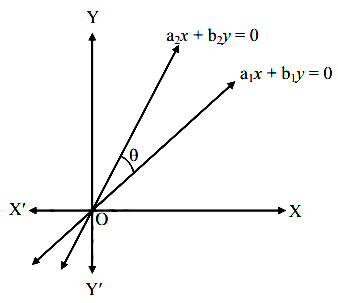
Let $a_1x + b_1y = 0$ and $a_2x + b_2y = 0$ be a pair of lines passing through the origin.
$\therefore $ Their combined equation is $(a_1x + b_1y)(a_2x + b_2y) = 0$
$\therefore a_1a_2x_2 + a_1b_2xy + b_1a_2xy + b_1b_2y^2 = 0$
$\therefore (a_1a_2)x^2 + (a_1b_2 + a_2b_1)xy + (b_1b_2)y^2 = 0$
In this if we put $a_1a_2 = a, a_1b_2 + a_2b_1 = 2h, b_1b_2 = b,$
We get $ax^2 + 2hxy + by^2 = 0$ which is a homogeneous equation of degree $2$ in $x$ and $y.$
Now, on comparing $2x + 3y = 0$ and $x − 2y = 0$ with $a_1x + b_1y = 0$ and $a_2x + b_2y = 0,$
we get $a_1 = 2, b_1 = 3, a_2 = 1$ and $b_2 = −2$
Substituting in equation $(i)$, we get
$2(1)x^2 + [2(−2) + 1(3)]xy + 3(−2)y^2 = 0$
$i.e., 2x^2 − xy − 6y^2 = 0,$
Which is the required combined equation. View full question & answer→Question 933 Marks
In ΔABC, if a cos A = b cos B, then prove that ΔABC is either a right angled or an isosceles triangle
AnswerIn $\triangle ABC$ by sine rule, we have
$
\frac{a}{\sin A }=\frac{ b }{\sin B }= k
$
$\therefore a=k \sin A$ and $b=k \sin B$
Now, $a \cos A=b \cos B$ [Given]
$\therefore k \sin A \cos A=k \sin B \cos B$
$\therefore \sin A \cos A=\sin B \cos B$
$\therefore 2 \sin A \cos A=2 \sin B \cos B$
$\therefore \sin 2 A=\sin 2 B \therefore \sin 2 A-\sin 2 B=0$
$\therefore 2 \cos (A+B) \sin (A-B)=0$
$\therefore 2 \cos (\pi-C) \sin (A-B)=0$ $[\because A+B+C=\pi]$
$\therefore-2 \cos C \sin (A-B)=0$
$\therefore \cos C=0$ or $\sin (A-B)=0$
$\therefore C =\frac{\pi}{2}$ or $A - B =0$
$\therefore C =\frac{\pi}{2}$ or $A = B$
$\therefore C=\frac{\pi}{2}$ implies that $\triangle A B C$ is a right-angled triangle and $A=B$ implies that $\triangle A B C$ is an isosceles triangle.
$\therefore$ The triangle is either a right-angled triangle or an isosceles triangle.
View full question & answer→Question 943 Marks
If $A=\left[\begin{array}{ccc}0 & 4 & 3 \\ 1 & -3 & -3 \\ -1 & 4 & 4\end{array}\right]$, then find $A^2$ and hence find $A^{-1}$
Answer$\begin{aligned} & |A|=0-4\left|\begin{array}{cc}1 & -3 \\ -1 & 4\end{array}\right|+3\left|\begin{array}{cc}1 & -3 \\ -1 & 4\end{array}\right|\end{aligned} $
$=-4(4-3)+3(4-3) $
$=-1 \neq 0 $
$\therefore A^{-1}$ exist
$\begin{aligned} & A^2=\left[\begin{array}{ccc}0 & 4 & 3 \\ 1 & -3 & -3 \\ -1 & 4 & 4\end{array}\right]\left[\begin{array}{ccc}0 & 4 & 3 \\ 1 & -3 & -3 \\ -1 & 4 & 4\end{array}\right]\end{aligned} $
$ =\left[\begin{array}{ccc}0+4-3 & 0-12+12 & 0-12+12 \\ 0-3+3 & 4+9-12 & 3+9-12 \\ 0+4-4 & -4-12+16 & -3-12+16\end{array}\right] $
$ =\left[\begin{array}{lll}1 & 0 & 0 \\ 0 & 1 & 0 \\ 0 & 0 & 1\end{array}\right]$
$ \text { i.e., } A \times A=\mathrm{I}$
$ \therefore A^{-1} \times A \times A=A^{-1} \times I$
$ \therefore A=A^{-1} $
$ \therefore A^{-1}=\left[\begin{array}{ccc}0 & 4 & 3 \\ 1 & -3 & -3 \\ -1 & 4 & 4\end{array}\right]$
View full question & answer→Question 953 Marks
A fair coin is tossed $5$ times, find the probability that no head
AnswerLet $X$ denote the number of heads.
$P(\text { getting head })=p=\frac{1}{2}$
$\therefore q=1-p $
$=1-\frac{1}{2} $
$=\frac{1}{2}$
Given, $n=5$
$\therefore X \sim B \left(5, \frac{1}{2}\right)$
The p.m.f. of $X$ is given by
$ P ( X = x )={ }^5 C _x\left(\frac{1}{2}\right)^x\left(\frac{1}{2}\right)^{5-x}$
$x =0,1,2, \ldots, 5$
$P (\text { no head })= P ( X =0)$
$={ }^5 C _0\left(\frac{1}{2}\right)^0\left(\frac{1}{2}\right)^5$
$=\frac{1}{32} $
View full question & answer→Question 963 Marks
A Fair coin is tossed 5 times, find the probability that coin shows exactly three times head
AnswerLet $X$ denote the number of heads.
$P(\text { getting head })=p=\frac{1}{2}$
$\therefore q=1-p$
$=1-\frac{1}{2}$
$=\frac{1}{2}$
Given, $n =5$
$\therefore X \sim B \left(5, \frac{1}{2}\right)$
The p.m.f. of $X$ is given by
$P ( X = x )={ }^5 C _x\left(\frac{1}{2}\right)^x\left(\frac{1}{2}\right)^{5-x}$
$x =0,1,2, \ldots, 5$
$P($ exactly three heads $)=P(X=3)$
$={ }^5 C _3\left(\frac{1}{2}\right)^3\left(\frac{1}{2}\right)^2$
$=\frac{10}{2^5}$
$=\frac{5}{16}$
View full question & answer→Question 973 Marks
Evaluate: $\int_0^1 t ^2 \sqrt{1- t } dt$
Answer$\text { Let } I =\int_0^1 t ^2 \sqrt{1- t } dt$
$=\int_0^1(1- t )^2 \sqrt{1-(1- t )} dt \quad \ldots . . .\left[\because \int_0^{ a } f (x) d x=\int_0^{ a } f ( a -x) d x\right]$
$=\int_0^1\left(1-2 t+t^2\right) \sqrt{t} d t$
$=\int_0^1\left(t^{\frac{1}{2}}-2 t^{\frac{3}{2}}+t^{\frac{5}{2}}\right) d t$
$=\int_0^1 t^{\frac{1}{2}} d t-2 \int_0^1 t^{\frac{3}{2}} d t+\int_0^1 t^{\frac{5}{2}} d t$
$=\left[\frac{ t ^{\frac{3}{2}}}{\frac{3}{2}}\right]_0^1-2\left[\frac{ t ^{\frac{5}{2}}}{\frac{5}{2}}\right]_0^1+\left[\frac{ t ^{\frac{7}{2}}}{\frac{7}{2}}\right]_0^1$
$=\frac{2}{3}\left(1^{\frac{3}{2}}-0\right)-\frac{4}{5}\left(1^{\frac{5}{2}}-0\right)+\frac{2}{7}\left(1^{\frac{7}{2}}-0\right)$
$=\frac{2}{3}-\frac{4}{5}+\frac{2}{7}$
$=\frac{70-84+30}{105}$
$\therefore I =\frac{16}{105}$
View full question & answer→Question 983 Marks
Evaluate: $\int_0^3 x^2(3-x)^{\frac{5}{2}} d x$
Answer$\text { Let } I =\int_0^3 x^2(3-x)^{\frac{5}{2}} d x$
$=\int_0^3(3-x)^2[3-(3-x)]^{\frac{5}{2}} d x \quad \ldots\left[\because \int_0^{ a } f (x) d x=\int_0^{ a } f ( a -x) d x\right]$
$=\int_0^3\left(9-6 x+x^2\right) x^{\frac{5}{2}} d x$
$=\int_0^3\left(9 x^{\frac{5}{2}}-6 x^{\frac{7}{2}}+x^{\frac{9}{2}}\right) d x$
$=9 \int_0^2 x^{\frac{5}{2}} d x-6 \int_0^3 x^{\frac{7}{2}} d x+\int_0^3 x^{\frac{9}{2}} d x$
$=9\left[\frac{x^{\frac{7}{2}}}{\frac{7}{2}}\right]_0^3-6\left[\frac{x^{\frac{9}{2}}}{\frac{9}{2}}\right]_0^3+\left[\frac{x^{\frac{11}{2}}}{\frac{11}{2}}\right]_0^3$
$=\frac{18}{7}\left[(3)^{\frac{7}{2}}-0\right]-\frac{12}{9}\left[(3)^{\frac{9}{2}}-0\right]+\frac{2}{1}\left[(3)^{\frac{11}{2}}-0\right]$
$=\left[\frac{18}{7}-\left(\frac{12}{9} \times 3\right)+\left(\frac{2}{11} \times 9\right)\right](3)^{\frac{7}{2}}$
$=\left(\frac{198-308+126}{77}\right)(3)^{\frac{7}{2}}$
$\therefore I =\frac{16}{77}(3)^{\frac{7}{2}}$
View full question & answer→Question 993 Marks
Evaluate: $\int_0^{ a } \frac{1}{x+\sqrt{ a ^2-x^2}} d x$
AnswerLet $I =\int_0^{ a } \frac{1}{x+\sqrt{ a ^2-x^2}} d x$
Put $x=a \sin \theta$
$\therefore dx = a \cos \theta d \theta$
When $x =0, \theta=0$ and when $x = a , \theta=\frac{\pi}{2}$
$ \therefore I =\int_0^{\frac{\pi}{2}} \frac{ a \cos \theta d \theta}{ a \sin \theta+\sqrt{ a ^2- a ^2 \sin ^2 \theta}}$
$=\int_0^{\frac{\pi}{2}} \frac{ a \cos \theta d \theta}{ a \sin \theta+ a \sqrt{1-\sin ^2 \theta}}$
$\int_0^{\frac{\pi}{2}} \frac{\cos \theta}{\sin \theta+\sqrt{\cos ^2 \theta}} d \theta$
$\therefore I =\int_0^{\frac{\pi}{2}} \frac{\cos \theta}{\sin \theta+\cos \theta} d \theta\ldots(i)$
$\therefore I =\int_0^{\frac{\pi}{2}} \frac{\cos \left(\frac{\pi}{2}-\theta\right)}{\sin \left(\frac{\pi}{2}-\theta\right)+\cos \left(\frac{\pi}{2}-\theta\right)}$
${\left[\because \int_0^{ a } f (x) d x=\int_0^{ a } f ( a -x) d x\right]} $
$\therefore I =\int_0^{\frac{\pi}{2}} \frac{\sin \theta}{\cos \theta+\sin \theta} d \theta\ldots(ii)$
Adding (i) and (ii), we get
$ 2 I =\int_0^{\frac{\pi}{2}} \frac{\cos \theta}{\sin \theta+\cos \theta} d \theta+\int_0^{\frac{\pi}{2}} \frac{\sin \theta}{\cos \theta+\sin \theta} d \theta$
$=\int_0^{\frac{\pi}{2}} \frac{\cos \theta+\sin \theta}{\sin \theta+\cos \theta} d \theta$
$=\int_0^{\frac{\pi}{2}} d \theta-[\theta]_0^{\frac{\pi}{2}}$
$=\frac{\pi}{2}-0$
$\therefore I =\frac{1}{2} \times \frac{\pi}{2}$
$\therefore I =\frac{\pi}{4} $
View full question & answer→Question 1003 Marks
$\int \frac{6 x^3+5 x^2-7}{3 x^2-2 x-1} d x$
AnswerLet $I =\int \frac{6 x^2+5 x^2-7}{3 x^2-2 x-1} d x$
$\left.3 x^2-2 x-1\right) \frac{2 x +3}{6 x^3+5 x^2+0 x-7}$
$6 x ^3-4 x ^2-2 x$
$\underline{( - )( +) ( +)}$
$9 x ^2+2 x -7$
$9 x ^2-6 x -3$
$\underline{(-)( +)(+)}$
$8 x -4$
$\therefore I =\int\left(2 x+3+\frac{8 x-4}{3 x^2-2 x-1}\right) d x$
$3 x^2-2 x-1=3 x^2-3 x+x-1$
$=3 x(x-1)+1(x-1)$
$=(x-1)(3 x+1)$
$\therefore I =\int\left[2 x+3+\frac{8 x-4}{(x-1)(3 x+1)}\right] d x$
Let $\frac{8 x-4}{(x-1)(3 x+1)}=\frac{ A }{x-1}+\frac{ B }{3 x+1}$
$\therefore 8 x-4=A(3 x+1)+B(x-1)\ldots(i)$
Putting $x=1$ in (i), we get
$4=4 A$
$\therefore A=1$
Putting $x=\frac{-1}{3}$ in (i), we get
$8\left(-\frac{1}{3}\right)-4= B \left(-\frac{1}{3}-1\right)$
$\therefore \frac{-20}{3}=-\frac{4}{3} B$
$\therefore B =5$
$\therefore \frac{8 x-4}{(x-1)(3 x+1)}=\frac{1}{x-1}+\frac{5}{3 x+1}$
$\therefore I =\int\left(2 x+3+\frac{1}{x-1}+\frac{5}{3 x+1}\right) d x$
$=2 \int x d x+3 \int d x+\int \frac{1}{x-1} d x+\frac{5}{3} \int \frac{3}{3 x+1} d x$
$=2\left(\frac{x^2}{2}\right)+3 x+\log |x+1|+\frac{5 \log |3 x+1|}{3}+ c$
$\therefore I =x^2+3 x+\log |x-1|+\frac{5}{3} \log |3 x+1|+ c$
View full question & answer→Question 1013 Marks
Evaluate: $\int_{-1}^1 \frac{1}{ a ^2 e ^x+ b ^2 e ^{-x}} d x$
Answer$\text { Let } I =\int_{-1}^1 \frac{1}{ a ^2 e ^x+ b ^2 e ^{-x}} d x$
$=\int_{-1}^1 \frac{1}{ a ^2 e ^x+\frac{ b ^2}{ e ^x}} d x$
$=\int_{-1}^1 \frac{ e ^x}{ a ^2\left( e ^x\right)^2+ b ^2} d x$
Put $e ^{ x }= t$
$\therefore e ^{ x } dx = dt$
When $x =-1, t = e ^{-1}$ and when $x =1, t = e$
$\therefore I =\int_{ e ^{-1}}^{ e } \frac{ dt }{ a ^2 t ^2+ b ^2}$
$=\frac{1}{ a ^2} \int_{ e ^{-1}}^{ e } \frac{ dt }{ t ^2+\left(\frac{ b }{ a }\right)^2}$
$=\frac{1}{ a ^2}\left[\frac{1}{\frac{ b }{ a }} \tan ^{-1}\left(\frac{ t }{\frac{ b }{ a }}\right)\right]_{ e ^{-1}}^{ e }$
$=\frac{1}{ ab }\left[\tan ^{-1}\left(\frac{ at }{ b }\right)\right]_{ e ^{-1}}^{ e }$
$\therefore I =\frac{1}{ ab }\left[\tan ^{-1}\left(\frac{ ae }{ b }\right)-\tan ^{-1}\left(\frac{ a }{ be }\right)\right]$
View full question & answer→Question 1023 Marks
$\int \frac{x^2+x-1}{x^2+x-6} d x$
Answer$\text { Let } I =\int \frac{x^2+x-1}{x^2+x-6} d x$
$=\int \frac{x^2+x-6+5}{x^2+x-6} d x$
$=\int\left[1+\left(\frac{5}{x^2+x-6}\right)\right] d x$
Let $\frac{5}{x^2+x-6}=\frac{5}{(x+3)(x-2)}$
$=\frac{A}{x+3}+\frac{B}{x-2}$
$\therefore 5= A (x-2)+ B ( x +3)\ldots(i)$
Putting $x=2$ in (i), we get
$5= B (5)$
$\therefore B =1$
Putting $x=-3$ in (i), we get
$5= A (-5)$
$\therefore A =-1$
$\therefore \frac{5}{(x+3)(x-2)}=\frac{-1}{x+3}+\frac{1}{x-2}$
$\therefore I =\int\left[1+\frac{-1}{x+3}+\frac{1}{x-2}\right] d x$
$=\int d x-\int \frac{1}{x+3} d x+\int \frac{1}{x-2} d x$
$= x -\log | x +3|+\log | x -2|+ c$
$\therefore I =x+\log \left|\frac{x-2}{x+3}\right|+ c $
View full question & answer→Question 1033 Marks
Evaluate: $\int_0^{\frac{\pi}{2}} \frac{\cos x}{(1+\sin x)(2+\sin x)} d x$
AnswerLet $I =\int_0^{\frac{\pi}{2}} \frac{\cos x}{(1+\sin x)(2+\sin x)} d x$
Put $\sin x=t$
$\therefore \cos xdx = dt$
When $x =0, t =0$ and when $x =\frac{\pi}{2}, t =1$
$\therefore I=\int_0^1 \frac{ dt }{(1+ t )(2+ t )}$
Let $\frac{1}{(1+t)(2+t)}=\frac{A}{1+t}+\frac{B}{2+t} \ldots \ldots \ldots$ (i)
$\therefore 1= A (2+ t )+ B (1+ t )\ldots(ii)$
Putting $t=-1$ in (ii), we get
$A=1$
Putting $t=-2$ in (ii), we get
$1=- B$
$\therefore B =-1$
From (i), we get
$ \frac{1}{(1+ t )(2+ t )}=\frac{1}{1+ t }-\frac{1}{2+ t }$
$\therefore I =\int_0^1\left(\frac{1}{1+ t }-\frac{1}{2+ t }\right) dt$
$=\int_0^1 \frac{1}{1+ t } dt -\int_0^1 \frac{1}{2+1} dt$
$=[\log |1+ t |]_0^1-[\log |2+ t |]_0^1$
$=(\log 2-\log 1)-(\log 3-\log 2)$
$=\log 2-0-\log \left(\frac{3}{2}\right)$
$=\log \left(2 \times \frac{2}{3}\right)$
$\therefore I=\log \left(\frac{4}{3}\right) $
View full question & answer→Question 1043 Marks
$\int e ^x \frac{\left(1+x^2\right)}{(1+x)^2} d x$
Answer$\text { Let } I =\int e ^x \frac{\left(1+x^2\right)}{(1+x)^2} d x$
$=\int e ^x\left[\frac{x^2-1+2}{(1+x)^2}\right] d x$
$=\int e ^x\left[\frac{x^2-1}{(x+1)^2}+\frac{2}{(x+1)^2}\right] d x$
$=\int e ^x\left[\frac{x-}{x+1}+\frac{2}{(x+1)^2}\right] d x$
Put $f ( x )=\frac{x-1}{x+1}$
$\therefore f ^{\prime}( x )=\frac{(x+1)(1-0)-(x-1)(1+0)}{(x+1)^2}$
$=\frac{2}{(x+1)^2}$
$\therefore I =\int e ^x\left[ f (x)+ f ^{\prime}(x)\right] d x$
$= e ^{ x } \cdot f ( x )+ c$
$= e ^x\left(\frac{x-1}{x+1}\right)+ c$
View full question & answer→Question 1053 Marks
Evaluate: $\int_0^{\frac{\pi}{2}} \frac{1}{5+4 \cos x} d x$
AnswerLet $I =\int_0^{\frac{\pi}{2}} \frac{1}{5+4 \cos x} d x$
Put $\tan \left(\frac{x}{2}\right)= t$
$\therefore x =2 \tan ^{-1} t$
$\therefore dx =\frac{2}{1+ t ^2} dt$ and $\cos x =\frac{1- t ^2}{1+ t ^2}$
When $x =0, t =0$ and when $x =\frac{\pi}{2}, t =1$
$\therefore I =\int_0^1 \frac{1}{5+4\left(\frac{1- t ^2}{1+ t ^2}\right)} \times \frac{2}{1+ t ^2} dt$
$=2 \int_0^1 \frac{1}{5+5 t +4-4 t ^2} dt$
$=2 \int_0^1 \frac{1}{9+ t ^2} dt$
$=2 \int_0^1 \frac{1}{ t ^2+3^2} dt$
$=2\left[\frac{1}{3} \tan ^{-1}\left(\frac{ t }{3}\right)\right]_0^1$
$=\frac{2}{3}\left[\tan ^{-1}\left(\frac{1}{3}\right)-\tan ^{-1}(0)\right]$
$=\frac{2}{3} \tan ^{-1}\left(\frac{1}{3}\right)$
View full question & answer→Question 1063 Marks
$\int e ^{\sin ^{-1 x}}\left[\frac{x+\sqrt{1-x^2}}{\sqrt{1-x^2}}\right] d x$
AnswerLet $I =\int e ^{\sin ^{-1 x}}\left[\frac{x+\sqrt{1-x^2}}{\sqrt{1-x^2}}\right] d x$
Put $\sin ^{-1} x=t\ldots(i)$
$\therefore x =\sin t$
Differentiating (i) w.r.t. $x$, we get
$\frac{1}{\sqrt{1-x^2}} d x= dt$
$\therefore I =\int e ^{ t }\left[\sin t +\sqrt{1-\sin ^2 t }\right] dt$
$=\int e ^{ t }[\sin t +\cos t ] dt$
Put $f(t)=\sin t$
$\therefore f ^{\prime}( t )=\cos t$
$\therefore I =\int e ^{ t }\left[ f ( t )+ f ^{\prime}( t )\right] dt$
$= e ^{ t } f ( t )+ c$
$= e ^{ t } \sin t + c$
$\therefore I = e ^{\sin ^{-1 x}}(x)+ c$
View full question & answer→Question 1073 Marks
If $A=\left[\begin{array}{lll}1 & 0 & 1 \\ 0 & 2 & 3 \\ 1 & 2 & 1\end{array}\right]$ and $B=\left[\begin{array}{lll}1 & 2 & 3 \\ 1 & 1 & 5 \\ 2 & 4 & 7\end{array}\right]$, then find the matrix $X$ such that $X A=B$
Answer$A=\left[\begin{array}{lll}1 & 0 & 1 \\ 0 & 2 & 3 \\ 1 & 2 & 1\end{array}\right]$ and $B=\left[\begin{array}{lll}1 & 2 & 3 \\ 1 & 1 & 5 \\ 2 & 4 & 7\end{array}\right]$
$X A=B$
Post multiplying by $A^{-1},$ we get
$X \ A A^{-1}=B A^{-1}$
$ \therefore X=B A^{-1}$
$\begin{aligned} & |A|=\left|\begin{array}{lll}1 & 0 & 1 \\ 0 & 2 & 3 \\ 1 & 2 & 1\end{array}\right|\end{aligned} $
$ =1(2-6)-0+1(0-2) $
$ =-4-2 $
$ =-6 \neq 0 $
$ \therefore A^{-1}$ exists.
$\begin{aligned} & A_{11}=(-1)^{1+1} M_{11}=1\left|\begin{array}{ll}2 & 3 \\ 2 & 1\end{array}\right|=1(2-6)=-4 \end{aligned} $
$ A_{12}=(-1)^{1+2} M_{12}=-1\left|\begin{array}{ll}0 & 3 \\ 1 & 1\end{array}\right|=-1(0-3)=3 $
$ A_{13}=(-1)^{1+3} M_{13}=1\left|\begin{array}{ll}0 & 2 \\ 1 & 2\end{array}\right|=1(0-2)=-2 $
$ A_{21}=(-1)^{2+1} M_{21}=-1\left|\begin{array}{ll}0 & 1 \\ 2 & 1\end{array}\right|=-1(0-2)=2 $
$ A_{22}=(-1)^{2+2} M_{22}=1\left|\begin{array}{ll}1 & 1 \\ 1 & 1\end{array}\right|=1(1-1)=0 $
$ A_{23}=(-1)^{2+3} M_{23}=-1\left|\begin{array}{ll}1 & 0 \\ 1 & 2\end{array}\right|=-1(2-0)=-2 $
$ A_{31}=(-1)^{3+1} M_{31}=1\left|\begin{array}{ll}0 & 1 \\ 2 & 3\end{array}\right|=1(0-2)=-2 $
$ A_{32}=(-1)^{3+2} M_{32}=-1\left|\begin{array}{ll}1 & 1 \\ 0 & 3\end{array}\right|=-1(3-0)=-3 $
$ A_{33}=(-1)^{3+3} M_{33}=1\left|\begin{array}{ll}1 & 0 \\ 0 & 2\end{array}\right|=1(2-0)=2$
$\therefore$ The matrix of the co$-$factors is
$\begin{aligned} & {\left[A_{i j}\right]_{3 \times 3}=\left[\begin{array}{lll} A_{11} & A_{12} & A_{13} \\ A_{21} & A_{22} & A_{23} \\
A_{31} & A_{32} & A_{33} \end{array}\right]} \end{aligned}$
$ =\left[\begin{array}{ccc} -4 & 3 & -2 \\ 2 & 0 & -2 \\ -2 & -3 & 2 \end{array}\right] $
Now, $\operatorname{adj} A=\left[A_{i j}\right]_{3 \times 3}^T$
$\begin{aligned} & =\left[\begin{array}{ccc} -4 & 2 & -2 \\ 3 & 0 & -3 \\ -2 & -2 & 2 \end{array}\right] \\ & \therefore A^{-1}=\frac{1}{|A|}(\operatorname{adj} A) \end{aligned} $
$ =-\frac{1}{6}\left[\begin{array}{ccc} -4 & 2 & -2 \\ 3 & 0 & -3 \\ -2 & -2 & 2 \end{array}\right] $
$X=B A^{-1} \quad \ldots \ldots \ldots[\text { From (i) }]$
$\begin{aligned} & \therefore X=\left[\begin{array}{lll}1 & 2 & 3 \\ 1 & 1 & 5 \\ 2 & 4 & 7\end{array}\right]\left\{\left(-\frac{1}{6}\right)\left[\begin{array}{ccc}-4 & 2 & -2 \\ 3 & 0 & -3 \\ -2 & -2 & 2\end{array}\right]\right\} \end{aligned} $
$ \therefore X=\frac{1}{6}\left[\begin{array}{ccc}4 & 4 & 2 \\ 11 & 8 & -5 \\ 10 & 10 & 2\end{array}\right]$
View full question & answer→Question 1083 Marks
Evaluate: $\int_0^{\frac{\pi}{4}} \sec ^4 x d x$
Answer$\text { Let } I =\int_0^{\frac{\pi}{4}} \sec ^4 x d x$
$=\int_0^{\frac{\pi}{4}} \sec ^2 x \cdot \sec ^2 x d x$
$=\int_0^{\frac{\pi}{4}}\left(1+\tan ^2 x\right) \sec ^2 x d x$
Put $\tan x=t$
$\therefore \sec ^2 x d dx = dt$
When $x =0, t =0$ and when $x =\frac{\pi}{4}, t =1$
$\therefore I =\int_0^1\left(1+ t ^2\right) dt$
$=\int_0^1 dt +\int_0^1 t ^2 dt$
$=[ t ]_0^1+\left[\frac{ t ^3}{3}\right]_0^1$
$=(1-0)+\frac{1}{3}\left(1^3-0\right)$
$=\frac{4}{3}$
View full question & answer→Question 1093 Marks
$\int \sec ^2 x \sqrt{\tan ^2 x+\tan x-7} d x$
AnswerLet $I =\int \sec ^2 x \sqrt{\tan ^2 x+\tan x-7} d x$
Put $\tan x=t$
$ \therefore \sec ^2 x d x = dt$
$\therefore I =\int \sqrt{ t ^2+ t -7} dt$
$=\int \sqrt{ t ^2+ t +\frac{1}{4}-\frac{1}{4}-7} dt$
$=\int \sqrt{\left( t +\frac{1}{2}\right)^2-\frac{29}{4}} dt$
$=\int \sqrt{\left( t +\frac{1}{2}\right)^2-\left(\frac{\sqrt{29}}{2}\right)^2} dt$
$=\frac{ t +\frac{1}{2}}{2} \sqrt{\left( t +\frac{1}{2}\right)^2-\left(\frac{\sqrt{29}}{2}\right)^2}$
$=-\frac{\left(\frac{\sqrt{29}}{2}\right)^2}{2} \log \left| t +\frac{1}{2}+\sqrt{ t ^2+ t -7}\right|+ c$
$=\frac{2 t +1}{4} \sqrt{ t ^2+ t -7}-\frac{29}{8} \log \left| t +\frac{1}{2}+\sqrt{ t ^2+ t -7}\right|+ c$
$\therefore I =$
$\frac{(2 tan x+1)}{4} \sqrt{\tan ^2 x+\tan x-7}-\frac{29}{8} \log \left|\tan x+\frac{1}{2}+\sqrt{\tan ^2 x+\tan x-7}\right|+ c $
View full question & answer→Question 1103 Marks
Find $m$, if the lines $\frac{1-x}{3}=\frac{7 y-14}{2 m }=\frac{z-3}{2}$ and $\frac{7-7 x}{3 m }=\frac{y-5}{1}=\frac{6-z}{5}$ are at right angles
AnswerThe equation of the lines are
$\frac{1-x}{3}=\frac{7 y-14}{2 m }=\frac{z-3}{2}$
i.e., $\frac{x-1}{3}=\frac{y-2}{\frac{2}{7} m }=\frac{z-3}{2}$
and $\frac{7-7 x}{3 m }=\frac{y-5}{1}=\frac{6-z}{5}$
i.e. $\frac{x-1}{\frac{-3}{7} m }=\frac{y-5}{1}=\frac{z-6}{-5}$
$\therefore$ Direction ratios of two lines are
$-3, \frac{2}{7} m , 2 \text { annd } \frac{-3}{7} m , 1,-5$
Since the lines are at right angles (perpendicular)
$ \therefore(-3)\left(\frac{-3}{7} m \right)+\left(\frac{2}{7} m \right)(1)+(2)(-5)=0$
$\therefore \frac{9}{7} m +\frac{2}{7} m -10=0$
$\therefore 11 m -70=0$
$\therefore m =\frac{70}{11} $
View full question & answer→Question 1113 Marks
Prove that altitudes of a triangle are concurrent
AnswerConsider $\triangle ABC$.
Let $AP \perp BC$ and $BQ \perp AC$.
Let $AP$ and $BQ$ intersect at $O$.
Join $O C$ and extend $O C$ to meet $A B$ at $R$.
To prove that $C R$ is also the altitude of $\triangle A B C$.
i.e., to prove that $C R \perp A B$
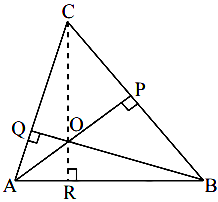
Let $\overline{ a }, \overline{ b }, \overline{ c }$ be the position vectors of the points $A , B , C$ respectively.
Consider $\overline{ AP } \perp \overline{ BC }$
$\therefore \overline{ AO } \perp \overline{ BC }$
$\therefore \overline{ AO } \cdot \overline{ BC }=0$
$\therefore-\overline{ a } \cdot(\overline{ c }-\overline{ b })=0 \quad \ldots \ldots .[\because \overline{ AO }=-\overline{ OA }]$
$\therefore \overline{ a } \cdot \overline{ c }-\overline{ a } \cdot \overline{ b }=0 \quad \ldots \ldots . .( i )$
Now, $\overline{ BQ } \perp \overline{ AC }$
$\therefore \overline{ BO } \perp \overline{ AC }$
$\therefore \overline{ BO } \cdot \overline{ AC }=0$
$\therefore-\overline{ b } \cdot(\overline{ c }-\overline{ a })=0 \ldots \ldots[\because \overline{ BO }=-\overline{ OB }]$
$\therefore \overline{ b } \cdot \overline{ c }-\overline{ b } \cdot \overline{ a }=0 \ldots \ldots . .( ii )$
Comparing equations (i) and (ii), we get
$\therefore \overline{ a } \cdot \overline{ c }-\overline{ a } \cdot \overline{ b }=\overline{ b } \cdot c -\overline{ b } \cdot \overline{ a }$
$\therefore \overline{ a } \cdot \overline{ c }=\overline{ b } \cdot \overline{ c }$
$\therefore \overline{ a } \cdot \overline{ c }-\overline{ b } \cdot \overline{ c }=0$
$\therefore \overline{ c } \cdot(\overline{ a }-\overline{ b })=0$
$\therefore-\overline{ c } \cdot(\overline{ a }-\overline{ b })=0$
$\therefore \overline{ CO } \perp \overline{ BA }$
$\therefore \overline{ CR } \perp \overline{ BA }$
$\therefore CR \perp BA$
$\therefore C R$ is also the altitude of $\triangle A B C$.
$\therefore AP , BQ , CR$ intersect at $O$.
$\therefore$ All three altitudes of $\triangle ABC$ intersect at a common point.
Thus, the altitudes of a triangle are concurrent. View full question & answer→Question 1123 Marks
Transform $\left[\begin{array}{ccc}1 & 2 & 4 \\ 3 & -1 & 5 \\ 2 & 4 & 6\end{array}\right]$ into an upper triangular matrix by using suitable row transformations
AnswerLet $A=\left[\begin{array}{ccc}1 & 2 & 4 \\ 3 & -1 & 5 \\ 2 & 4 & 6\end{array}\right]$
Applying $R_2 \rightarrow R_2-3 R_1$ and $R_3 \rightarrow R_3-2 R_1$, we get
$
\left[\begin{array}{ccc}
1 & 2 & 4 \\
0 & -7 & -7 \\
0 & 0 & -2
\end{array}\right]
$
This is required upper triangular matrix.
View full question & answer→Question 1133 Marks
Evaluate: $\int_0^{\frac{1}{\sqrt{2}}} \frac{\sin ^{-1} x}{\left(1-x^2\right)^{\frac{3}{2}}} d x$
AnswerLet $I =\int_0^{\frac{1}{\sqrt{2}}} \frac{\sin ^{-1} x}{\left(1-x^2\right)^{\frac{3}{2}}} d x$
Put $\sin ^{-1} x=t$
$\therefore x =\sin t$
$\therefore d x=\cos t d t$
When $x =0, t =0$ and when $x =\frac{1}{\sqrt{2}}, t =\frac{\pi}{4}$
$\therefore I =\int_0^{\frac{\pi}{4}} \frac{ t }{\left(1-\sin ^2 t \right)^{\frac{3}{2}}} \times \cos t d t$
$=\int_0^{\frac{\pi}{4}} \frac{ t }{\left(\cot ^2 t \right)^{\frac{3}{2}}} \times \cos t d t$
$=\int_0^{\frac{\pi}{4}} t \sec ^2 t dt$
$=\left[ t \int \sec ^2 t d t \right]_0^{\frac{\pi}{4}}-\int_0^{\frac{\pi}{4}}\left[\frac{ d }{ dt }( t ) \int \sec ^2 t dt \right] dt$
$=[ t \cdot \tan t ]_0^{\frac{\pi}{4}}-\int_0^{\frac{\pi}{4}} 1 \cdot \tan t d t$
$=\left(\frac{\pi}{4} \cdot \tan \frac{\pi}{4}-0\right)-[\log |\sec t|]_0^{\frac{\pi}{4}}$
$=\frac{\pi}{4}(1)-\left[\log \left|\sec \frac{\pi}{4}\right|-\log |\sec 0|\right]$
$=\frac{p}{4}-(\log \sqrt{2}-\log 1)$
$=\frac{\pi}{4}-\left(\log 2^{\frac{1}{2}}-0\right)$
$\therefore I =\frac{\pi}{4}-\frac{1}{2} \log 2$
View full question & answer→Question 1143 Marks
$\int \sin (\log x) d x$
AnswerLet $I =\int \sin (\log x) d x$
Put $\log x=t$
$\therefore x = e ^{ t }$
$\therefore d x = e ^{ t } dt$
$\therefore I =\int \sin t \cdot e ^{ t } dt$
$=\sin t \int e ^{ t } dt -\int\left[\frac{ d }{ dt }(\sin t ) \int e ^{ t } dt \right] dt$
$=\sin t \cdot e ^{ t }-\int \cos t \cdot e ^{ t } dt$
$= e ^{ t } \sin t -\left[\cos t \int e ^{ t } dt -\int\left(\frac{ d }{ dt }(\cos t ) \int e ^{ t } dt \right) dt \right]$
$= e ^{ t } \sin t -\left[ e ^{ t } \cos t -\int(-\sin t ) e ^{ t } dt \right]$
$= e ^{ t } \sin t - e ^{ t } \cos t -\int \sin t \cdot e ^{ t } dt$
$\therefore I = e ^{ t }(\sin t -\cos t )- I + c _1$
$\therefore 2 I = e ^{ t }(\sin t -\cos t )+ c _1$
$\therefore I =\frac{ e ^{ t }}{2}(\sin t -\cos t )+\frac{ c _1}{2}$
$\therefore I =\frac{x}{2}[\sin (\log x)-\cos (\log x)]+ c _r$
$\text { where } c =\frac{ c _1}{2}$
View full question & answer→Question 1153 Marks
If $y=5^x \cdot x^5 \cdot x^x \cdot 5^5$, find $\frac{d y}{d x}$
Answer$y=5^x \cdot x^5 \cdot x^x \cdot 5^5$
Taking log on both sides, we get
$\log y=\log \left(5^x \cdot x^5 \cdot x^x \cdot 5^5\right)$
$=\log 5^x+\log x^5+\log x^x+\log 5^5$
$\therefore \log y=x \log 5+5 \log x+x \log x+5 \log 5$
Differentiating w.r.t. $x$, we get
$\frac{ d }{ d x}(\log y)=\frac{ d }{ d x}(x \log 5+5 \log x+x \log x+5 \log 5)$
$\therefore$
$\frac{1}{y} \cdot \frac{ d y}{ d x}=\log 5 \cdot \frac{ d }{ d x}(x)+5 \cdot \frac{ d }{ d x}(\log x)+x \cdot \frac{ d }{ d x}(\log x)+\log x \cdot \frac{ d }{ d x}(x)+\frac{ d }{ d x}(5 \log 5)$
$=\log 5 \cdot 1+5 \cdot \frac{1}{x}+x \cdot \frac{1}{x}+\log x \cdot 1+0$
$\therefore \frac{ d y}{ d x}=y\left(\log 5+\frac{5}{x}+1+\log x\right)$
$\therefore \frac{ d y}{ d x}=5^x \cdot x^5 \cdot x^x \cdot 5^5\left(\log 5+\frac{5}{x}+1+\log x\right)$
View full question & answer→Question 1163 Marks
Find the equation of the plane passing through the point $(7,8,6)$ and parallel to the plane $\overline{ r } \cdot(6 \hat{ i }+8 \hat{ j }+7 \widehat{ k })=0$
AnswerThe plane passes through the point $A(7,8,6)$.
$\therefore x _1=7, y _1=8, z _1=6$
Since the required plane is parallel to the plane $\overline{ r } \cdot(6 \hat{ i }+8 \hat{ j }+7 \widehat{ k })=0$
Direction ratios of normal vector will be $a=6, b=8, c=7$.
Equation of a plane in Cartesian form is
$ a\left(x-x_1\right)+b\left(y-y_1\right)+c\left(z-z_1\right)=0$
$\therefore 6(x-7)+8(y-8)+7(z-6)=0$
$\therefore 6 x-42+8 y-64+7 z-42=0$
$\therefore 6 x+8 y+7 z=42+42+64$
$\therefore 6 x+8 y+7 z=148 $
View full question & answer→Question 1173 Marks
Prove that medians of a triangle are concurrent
AnswerConsider $\triangle ABC$.
Let $P, Q, R$ be the midpoints of the sides $B C, C A, A B$ respectively.
Let the medians $B Q$ and $C R$ intersect at $G$.
To prove that the third median AP also passes through $G$.
Let $\overline{ a }, \overline{ b }, \overline{ c }, \overline{ p }, \overline{ q }, \overline{ r }, \overline{ g }$ be the position vectors of the points $A, B, C, P, Q , R , G$ respectively.
Since $P, Q, R$ are the mid-points of the sides $B C, C A, A B$ respectively
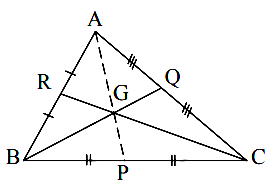
$\therefore$ By midpoint formula, we get
$\overline{ p }=\frac{\overline{ b }+\overline{ c }}{2}\ldots(i)$
$\overline{ q }=\frac{\overline{ c }+\overline{ a }}{2}\ldots(ii)$
$\overline{ r }=\frac{\overline{ a }+\overline{ b }}{2}\ldots(iii)$
From (i), (ii) and (iii), we get
$2 \overline{ p }=\overline{ b }+\overline{ c } \Rightarrow 2 \overline{ p }+\overline{ a }=\overline{ a }+\overline{ b }+\overline{ c }$
$2 \overline{ q }=\overline{ c }+\overline{ a } \Rightarrow 2 \overline{ q }+\overline{ b }=\overline{ a }+\overline{ b }+\overline{ c }$
$2 \overline{ r }=\overline{ a }+\overline{ b } \Rightarrow 2 \overline{ r }+\overline{ c }=\overline{ a }+\overline{ b }+\overline{ c }$
$\therefore \frac{2 p +\overline{ a }}{3}=\frac{2 \overline{ q }+\overline{ b }}{3}=\frac{2 \overline{ r }+\overline{ c }}{3}=\frac{\overline{ a }+\overline{ b }+\overline{ c }}{3}$
$\therefore \frac{2 p +\overline{ a }}{2+1}=\frac{2 \overline{ q }+\overline{ b }}{2+1}=\frac{2 \overline{ r }+\overline{ c }}{2+1}=\frac{\overline{ a }+\overline{ b }+\overline{ c }}{3}$
$=\overline{ g } \quad \ldots \ldots . \text { (say) }$
This shows that the point $G$ whose position vector is $\bar{g}$ lies on the three medians $A P, B Q, C R$ dividing them internally in the ratio $2: 1$.
Hence, the three medians are concurrent. View full question & answer→Question 1183 Marks
Find the inverse of $A=\left[\begin{array}{ccc}\sec \theta & \tan \theta & 0 \\ \tan \theta & \sec \theta & 0 \\ 0 & 0 & 1\end{array}\right]$
Answer$\begin{aligned} & |A|=\left[\begin{array}{ccc}\sec \theta & \tan \theta & 0 \\ \tan \theta & \sec \theta & 0 \\ 0 & 0 & 1\end{array}\right] \ \end{aligned}$
$ =\sec \theta(\sec \theta-0)-\tan \theta(\tan \theta-0)+0 $
$ =\sec ^2 \theta-\tan ^2 \theta =1 \neq 0$
$\therefore A^{-1}$ exists.
Consider $A A^{-1}=1$
$\therefore\left[\begin{array}{ccc}\sec \theta & \tan \theta & 0 \\ \tan \theta & \sec \theta & 0 \\ 0 & 0 & 1\end{array}\right] A^{-1}=\left[\begin{array}{lll}1 & 0 & 0 \\ 0 & 1 & 0 \\ 0 & 0 & 1\end{array}\right]$
Applying $R_1 \rightarrow(\sec \theta) R_1-(\tan \theta) R_2$, we get
$\left[\begin{array}{ccc}\sec ^2 \theta-\tan ^2 \theta & \sec \theta \tan \theta-\sec \theta \tan \theta & 0 \\ \tan \theta & \sec \theta & 0 \\ 0 & 0 & 1\end{array}\right] A^{-1}=$
$\begin{aligned} & {\left[\begin{array}{ccc} \sec \theta & -\tan \theta & 0 \\ 0 & 1 & 0 \\ 0 & 0 & 1 \end{array}\right]} \end{aligned} $
$ \therefore\left[\begin{array}{ccc} 1 & 0 & 0 \\ \tan \theta & \sec \theta & 0 \\ 0 & 0 & 1 \end{array}\right] A^{-1}=\left[\begin{array}{ccc}\ \sec \theta & -\tan \theta & 0 \\ 0 & 1 & 0 \\ 0 & 0 & 1 \end{array}\right] $
Applying $R_2 \rightarrow R_2-\tan \theta R_1$, we get
$\begin{aligned} & {\left[\begin{array}{ccc}1 & 0 & 0 \\ 0 & \sec \theta & 0 \\ 0 & 0 & 1\end{array}\right] A^{-1}=\left[\begin{array}{ccc}\sec \theta & -\tan \theta & 0 \\ -\sec \tan \theta & 1+\tan ^2 \theta & 0 \\ 0 & 0 & 1\end{array}\right]} \end{aligned} $
$ \therefore\left[\begin{array}{ccc}1 & 0 & 0 \\ 0 & \sec \theta & 0 \\ 0 & 0 & 1\end{array}\right] A^{-1}=\left[\begin{array}{ccc}\sec \theta & -\tan \theta & 0 \\ -\sec \tan \theta & \sec ^2 \theta & 0 \\ 0 & 0 & 1\end{array}\right]$
Applying $R_2 \rightarrow\left(\frac{1}{\sec \theta}\right) R_2$, we get
$\left[\begin{array}{lll}1 & 0 & 0 \\ 0 & 1 & 0 \\ 0 & 0 & 1\end{array}\right] A^{-1}=\left[\begin{array}{ccc}\sec \theta & -\tan \theta & 0 \\ -\tan \theta & \sec \theta & 0 \\ 0 & 0 & 1\end{array}\right]$
$\therefore A^{-1}=\left[\begin{array}{ccc}\sec \theta & -\tan \theta & 0 \\ -\tan \theta & \sec \theta & 0 \\ 0 & 0 & 1\end{array}\right]$
View full question & answer→Question 1193 Marks
Verify $y=\log x+c$ is the solution of differential equation $x \frac{ d ^2 y}{ d x^2}+\frac{ d y}{ d x}=0$
Answer$y=\log x+c$
Differentiating w.r.t. $x$, we get
$ \frac{ d y}{ d x}=\frac{1}{x}$
$\therefore x \frac{ d y}{ d x}=1 $
Again, differentiating w.r.t. x, we get
$ x \frac{ d ^2 y}{ d x^2}+\frac{ d y}{ d x} \times 1=0$
$\therefore x \frac{ d ^2 y}{ d x^2}+\frac{ d y}{ d x}=0 $
$\therefore y =\log x + c$ is the solution of $x \frac{ d ^2 y}{ d x^2}+\frac{ d y}{ d x}=0$
View full question & answer→Question 1203 Marks
Find the differential equation by eliminating arbitrary constants from the relation $y = (c_1 + c_2x)e^x$
Answer$y=\left(c_1+c_2 x\right) e^x\ldots(i)$
Here, $c_1$ and $c_2$ are arbitrary constants.
Differentiating w.r.t. $x$, we get
$ \frac{ d y}{ d x}=\left( c _1+ c _2 x \right) e ^{ x }+ c _2 e ^{ x }$
$\therefore \frac{ d y}{ d x}= y + c _2 e ^{ x }\ldots(ii)\ldots[From(i)] $
Again, differentiating w.r.t. $x$, we get
$ \frac{ d ^2 y}{ d x^2}=\frac{ d y}{ d x}+ c _2 e ^x$
$\therefore c _2 e ^{ x }=\frac{ d ^2 y}{ d x^2}-\frac{ d y}{ d x}\ldots(iii) $
Substituting (iii) in (ii), we get
$ \frac{ d y}{ d x}=y+\frac{ d ^2 y}{ d x^2}-\frac{ d y}{ d x}$
$\therefore \frac{ d ^2 y}{ d x^2}-2 \frac{ d y}{ d x}+y=0 $
View full question & answer→Question 1213 Marks
Find the differential equation by eliminating arbitrary constants from the relation $x^2 + y^2 = 2ax$
Answer$x^2+y^2=2 a x\ldots(i)$
Here, a is an arbitrary constant.
Differentiating (i) w.r.t. $x$, we get
$ 2 x+2 y \frac{ d y}{ d x}=2 a$
$\therefore 2 x+2 y \frac{ d y}{ d x}=\frac{x^2+y^2}{x} \ldots . . .[\text { From (i)] }$
$\therefore 2 x^2+2 x y \frac{ d y}{ d x}= x ^2+ y ^2$
$\therefore 2 x y \frac{ d y}{ d x}= y ^2- x ^2 $
View full question & answer→Question 1223 Marks
Solve the following differential equation $\frac{ d y}{ d x}= x ^2 y + y$
Answer$ \frac{ d y}{ d x}= x ^2 y + y$
$\therefore \frac{ d y}{ d x}= y \left( x ^2+1\right)$
$\therefore \frac{ d y}{y}=\left( x ^2+1\right) dx $
Integrating on both sides, we get
$ \int \frac{ d y}{y}=\int\left(x^2+1\right) d x$
$\therefore \log | y |=\frac{x^3}{3}+x+ c $
View full question & answer→Question 1233 Marks
Solve the differential equation $(x^2 – yx^2)dy + (y^2 + xy^2)dx = 0$
Answer$ \left(x^2-y x^2\right) d y+\left(y^2+x y^2\right) d x=0$
$\therefore x^2(1-y) d y+y^2(1+x) d x=0$
$\therefore x^2(1-y) d y=-y^2(1+x) d x$
$\therefore\left(\frac{1-y}{y^2}\right) d y=-\left(\frac{1+x}{x^2}\right) d x $
Integrating on both sides, we get
$ \int\left(\frac{1-y}{y^2}\right) d y=-\int\left(\frac{1+x}{x^2}\right) d x$
$\therefore \int \frac{1}{y^2} d y-\int \frac{1}{y} d y=-\int \frac{1}{x^2} d x-\int \frac{1}{x} d x$
$\therefore \frac{y^{-1}}{-1}-\log |y|=\left(\frac{x^{-1}}{-1}\right)-\log |x|+ c$
$\therefore-\frac{1}{y}-\log |y|=\frac{1}{x}-\log |x|+ c $
$\therefore \log |x|-\log |y|=\frac{1}{x}+\frac{1}{y}+c$
View full question & answer→Question 1243 Marks
Solve the differential equation $xdx + 2ydy = 0$
Answer$x d x+2 y d y=0$
Integrating on both sides, we get
$\int x d x+2 \int y d y=0$
$\therefore \frac{x^2}{2}+2\left(\frac{y^2}{2}\right)^2= c _1 $
$\therefore x ^2+2 y ^2= c , \text { where } c =2 c _1$
View full question & answer→Question 1253 Marks
Solve $\frac{ d y}{ d x}=\frac{x+y+1}{x+y-1}$ when $x =\frac{2}{3}, y =\frac{1}{3}$
Answer$\frac{ d y}{ d x}=\frac{x+y+1}{x+y-1}\ldots(i)$
Put $x+y=u$
$\therefore y = u - x\ldots(ii)$
Differentiating w.r.t. $x$, we get
$\frac{ d y}{ d x}=\frac{ du }{ d x}-1\ldots(iii)$
Substituting (ii) and (iii) in (i), we get
$ \frac{ du }{ d x}-1=\frac{ u +1}{ u -1}$
$\therefore \frac{ du }{ d x}=\frac{ u +1}{ u -1}+1$
$=\frac{ u +1+ u -1}{ u -1}$
$\therefore \frac{ du }{ d x}=\frac{2 u }{ u -1}$
$\therefore\left(\frac{ u -1}{ u }\right) du =2 dx$
$\therefore\left(1-\frac{1}{ u }\right) du 2 dx $
Integrating on both sides, we get
$ \int\left(1-\frac{1}{u}\right) d u=2 \int d x$
$\therefore u-\log |u|=2 x+c$
$\therefore x+y-\log |x+y|=2 x+c$
$\therefore-\log |x+y|=x-y+c $
Putting $x=\frac{2}{3}$ and $y=\frac{1}{3}$, we get
$ -\log (1)=\frac{1}{3}+ c$
$\therefore c =-\frac{1}{3}$
$\therefore-\log | x + y |=x-y-\frac{1}{3}$
$\therefore \log | x + y |=y-x+\frac{1}{3} $
View full question & answer→Question 1263 Marks
Solve the differential equation $x \frac{ d y}{ d x}+2 y= x ^2 \log x$
Answer$x \frac{ d y}{ d x}+2 y= x ^2 \log x$
Dividing both sides by $x$, we get
$\frac{ d y}{ d x}+\frac{2}{x} y= x \log x$
The given equation is of the form
$\frac{ d y}{ d x}+ P y= Q .$
where $P =\frac{2}{x}$ and $Q = x \log x$
$ \therefore \text { I.F. }= e ^{\int^{ Pd x}}$
$= e ^{2 \int \frac{1}{x} d x}$
$= e ^{2 \log |x|}$
$= e ^{\log \left|x^2\right|}$
$= x ^2 $
$\therefore$ Solution of the given equation is
$ y(\text { I.F. })=\int Q (\text { I.F. }) d x+ c$
$\therefore yx ^2=\int(x \log x) x^2 d x+ c$
$=\int x^3 \log x d x+ c$
$=\log x \int x^3 d x-\int\left(\frac{ d }{ d x} \log x \int x^3 d x\right) d x+ c$
$=\log x \cdot \frac{x^4}{4}-\int \frac{1}{x}\left(\frac{x^4}{4}\right) d x+ c$
$=\frac{x^4}{4} \log x-\frac{1}{4} \int x^3 d x+ c$
$=\frac{x^4}{4} \log x-\frac{1}{4} \cdot \frac{x^4}{4}+ c$
$\therefore x ^2 y =\frac{x^4}{16}(4 \log x-1)+ c $
View full question & answer→Question 1273 Marks
Solve the differential equation $\frac{ d y}{ d x}+y= e ^{- x }$
Answer$\frac{ d y}{ d x}+y= e ^{- x }$
The given equation is of the form
$\frac{ d y}{ d x}+ P y= Q .$
where $P =1$ and $Q = e ^{- x }$
$ \therefore \text { I.F. }= e ^{\iint^{ Pd x}}$
$= e ^{\int d x}$
$= e ^{ X } $
$\therefore$ Solution of the given equation is
$y(\text { I.F. })=\int Q (\text { I.F. }) d x+ c$
$\therefore y \cdot e ^x=\int e ^{-x} \times e ^x d x+ c$
$\therefore y \cdot e ^x=\int e ^{-x+x} d x+ c$
$\therefore y \cdot e ^x=\int e ^0 d x+ c$
$\therefore y \cdot e ^x=\int 1 d x+ c$
$\therefore ye ^{ x }= x + c $
View full question & answer→Question 1283 Marks
Solve: $\frac{ d y}{ d x}+\frac{2}{x} y= x ^2$
Answer$\frac{ d y}{ d x}+\frac{2}{x} y= x ^2$
The given equation is of the form
$\frac{ d y}{ d x}+ P y= Q$
where $P =\frac{2}{x}$ and $Q = x ^2$
$ \therefore \text { I.F. }= e ^{\int^{ Pd x}}$
$= e ^{\int \frac{2}{x}} d x$
$= e ^{2 \log x}$
$= e ^{\log x^2}$
$= x ^2 $
$\therefore$ Solution of the given equation is
$ y(\text { I. F. })=\int Q (\text { I.F. }) d x+ c _1$
$\therefore y \cdot x^2=\int x^2 \cdot x^2 d x+ c _1$
$\therefore y x^2=\int x^4 d x+ c _1$
$\therefore yx ^2=\frac{x^5}{5}+ c _1$
$\therefore 5 x ^2 y = x ^5+ c _1 \text { where } c =5 c _1 $
View full question & answer→