Question 15 Marks
Find a unit vector perpendicular to the plane A B C, where the coordinates of A, B and C are A (3, -1, 2), B (1, -1, -3) and C (4, -3, 1).
AnswerHere, position vector of $\text{A}=\big(3\hat{\text{i}}-\hat{\text{j}}+2\hat{\text{k}}\big)$
position vector of $\text{B}=\big(\hat{\text{i}}-\hat{\text{j}}-3\hat{\text{k}}\big)$
position vector of $\text{C}=\big(4\hat{\text{i}}-3\hat{\text{j}}+\hat{\text{k}}\big)$
$\overrightarrow{\text{AB}}=\vec{\text{B}}-\vec{\text{A}}$
$=\big(\hat{\text{i}}-\hat{\text{j}}-3\hat{\text{k}}\big)-\big(3\hat{\text{i}}-\hat{\text{j}}+2\hat{\text{k}}\big)$
$=\hat{\text{i}}-\hat{\text{j}}-3\hat{\text{k}}-3\hat{\text{i}}+\hat{\text{j}}-2\hat{\text{k}}$
$=-2\hat{\text{i}}-5\hat{\text{k}}$
$\overrightarrow{\text{AC}}=\vec{\text{C}}-\vec{\text{A}}$
$=\big(4\hat{\text{i}}-3\hat{\text{j}}+\hat{\text{k}}\big)-\big(3\hat{\text{i}}-\hat{\text{j}}+2\hat{\text{k}}\big)$
$=4\hat{\text{i}}-3\hat{\text{j}}+\hat{\text{k}}-3\hat{\text{i}}+\hat{\text{j}}-2\hat{\text{k}}$
$=\hat{\text{i}}-2\hat{\text{j}}-\hat{\text{k}}$
vector perpendicular to the plane ABC
$=\overrightarrow{\text{AC}}\times\overrightarrow{\text{AB}}=\begin{vmatrix}\hat{\text{i}}&\hat{\text{j}}&\hat{\text{k}}\\1&-2&-1\\-2&0&-5 \end{vmatrix}$
$\overrightarrow{\text{AC}}\times\overrightarrow{\text{AB}}=\hat{\text{i}}(10-0)-\hat{\text{j}}(-5-2)+\hat{\text{k}}(0-4)$
$=10\hat{\text{i}}+7\hat{\text{j}}-4\hat{\text{k}}$
$\overrightarrow{\text{AC}}\times\overrightarrow{\text{AB}}=\sqrt{(10)^2+(7)^2+(-4)^2}$
$=\sqrt{100+49+16}$
$=\sqrt{165}$
Therefore, unit vector perpendicular to the plane ABC $=\frac{\overrightarrow{\text{AC}}\times\overrightarrow{\text{AB}}}{\big|\overrightarrow{\text{AC}}\times\overrightarrow{\text{AB}}\big|}$
$=\frac{1}{\sqrt{165}}\big(10\hat{\text{i}}+7\hat{\text{j}}-4\hat{\text{k}}\big)$
unit vectore perpendicular to the plane ABC $=\frac{1}{\sqrt{165}}\big(10\hat{\text{i}}+7\hat{\text{j}}-4\hat{\text{k}}\big)$
View full question & answer→Question 25 Marks
Find a unit vector perpendicular to the plane containing the vectors $\vec{\text{a}}=2\hat{\text{i}}+\hat{\text{j}}+\hat{\text{k}}$ and $\vec{\text{b}}=\hat{\text{i}}+2\hat{\text{j}}+\hat{\text{k}.}$
AnswerA vector perpendicular to the plane containing the vector $\vec{\text{a}}$ and $\vec{\text{b}}$ is given by $\vec{\text{a}}\times\vec{\text{b}}=\pm\vec{\text{c}}$ (say)
$\vec{\text{a}}\times\vec{\text{b}}=\begin{vmatrix}\hat{\text{i}}&\hat{\text{j}}&\hat{\text{k}}\\\text{a}_1&\text{b}_1&\text{c}_1\\\text{a}_2&\text{b}_2&\text{c}_2 \end{vmatrix}$
$\vec{\text{c}}=\begin{vmatrix}\hat{\text{i}}&\hat{\text{j}}&\hat{\text{k}}\\2&1&1\\1&2&1 \end{vmatrix}$
$\vec{\text{c}}=\hat{\text{i}}(1-2)-\hat{\text{j}}(2-1)+\hat{\text{k}}(4-1)$
$\vec{\text{c}}=-\hat{\text{i}}-\hat{\text{j}}+3\hat{\text{k}}$
$\hat{\text{c}}=\frac{\vec{\text{c}}}{|\vec{\text{c}}|}$
$=\frac{-\hat{\text{i}}-\hat{\text{j}}+3\hat{\text{k}}}{\sqrt{(-1)^2+(-1)^2+(3)^2}}$
$=\frac{-\hat{\text{i}}-\hat{\text{j}}+3\hat{\text{k}}}{\sqrt{1+1+9}}$
$=\frac{1}{\sqrt{11}}\big(-\hat{\text{i}}-\hat{\text{j}}+3\hat{\text{k}}\big)$
Unit vector perpendicular to the plane of $\vec{\text{a}}$ and $\vec{\text{b}}=\pm\frac{1}{\sqrt{11}}\big(-\hat{\text{i}}-\hat{\text{j}}+3\hat{\text{k}}\big).$
View full question & answer→Question 35 Marks
Find all vectors of magnitude $10\sqrt{3}$ that are perpendicular to the plane of $\hat{\text{i}}+2\hat{\text{j}}+\hat{\text{k}}$ and $-\hat{\text{i}}+3\hat{\text{i}}+4\hat{\text{k}}.$
AnswerLet $\vec{\text{a}}=\hat{\text{i}}+2\hat{\text{j}}+\hat{\text{k}}$ and $\vec{\text{b}}=-\hat{\text{i}}+3\hat{\text{j}}+4\hat{\text{k}}$
Unit vectors perpendicular to both $\vec{\text{a}}$ and $\vec{\text{b}}=\pm\frac{\vec{\text{a}}\times\vec{\text{b}}}{\big|\vec{\text{a}}\times\vec{\text{b}}\big|}$
$\vec{\text{a}}\times\vec{\text{b}}=\begin{vmatrix}\hat{\text{i}}&\hat{\text{j}}&\hat{\text{k}}\\1&2&1\\-1&3&4\end{vmatrix}$
$=5\hat{\text{i}}-5\hat{\text{j}}+5\hat{\text{k}}$
$\therefore\big|\vec{\text{a}}\times\vec{\text{b}}\big|=\big|5\hat{\text{i}}-5\hat{\text{j}}+5\hat{\text{k}}\big|$
$=\sqrt{5^2+(-5)^2+5^2}$
$\sqrt{75}$
$=5\sqrt{3}$
Unit vectors perpendicular to both $\vec{\text{a}}$ and $\vec{\text{b}}=\pm\frac{5\hat{\text{i}}-5\hat{\text{j}}+5\hat{\text{k}}}{5\sqrt{3}}=\pm\frac{\hat{\text{i}}-\hat{\text{j}}+\hat{\text{k}}}{\sqrt{3}}$
Required vectors $=10\sqrt{3}\Big(\pm\frac{\hat{\text{i}}-\hat{\text{j}}+\hat{\text{k}}}{\sqrt{3}}\Big)=\pm10\big(\hat{\text{i}}-\hat{\text{j}}+\hat{\text{k}}\big)$
Thus, the vectors of magnitude $10\sqrt{3}$ that are perpendicular to the plane of $\hat{\text{i}}+2\hat{\text{j}}+\hat{\text{k}}$ and $-\hat{\text{i}}+3\hat{\text{j}}+4\hat{\text{k}}$ are $\pm10\big(\hat{\text{i}}-\hat{\text{j}}+\hat{\text{k}}\big)$
View full question & answer→Question 45 Marks
If $\vec{\text{a}}=2\hat{\text{i}}+5\hat{\text{j}}-7\hat{\text{k}},\vec{\text{b}}=-3\hat{\text{i}}+4\hat{\text{j}}+\hat{\text{k}}$ and $\vec{\text{c}}=\hat{\text{i}}-2\hat{\text{j}}-3\hat{\text{k}},$ compute $\big(\vec{\text{a}}\times\vec{\text{b}}\big)\times\vec{\text{c}}$ and $\vec{\text{a}}\times\big(\vec{\text{b}}\times\vec{\text{c}}\big)$ and verify that these are not equal.
AnswerGiven:
$\vec{\text{a}}=2\hat{\text{i}}+5\hat{\text{j}}-7\hat{\text{k}}$
$\vec{\text{b}}=-3\hat{\text{i}}+4\hat{\text{j}}+\hat{\text{k}}$
$\vec{\text{c}}=\hat{\text{i}}-2\hat{\text{j}}-3\hat{\text{k}}$
$\therefore\vec{\text{a}}\times\vec{\text{b}}=\begin{vmatrix}\hat{\text{i}}&\hat{\text{j}}&\hat{\text{k}}\\2&5&-7\\-3&4&1 \end{vmatrix}$
$=(5+28)\hat{\text{i}}-(2-21)\hat{\text{j}}+(8+15)\hat{\text{k}}$
$=33\hat{\text{i}}+19\hat{\text{j}}+23\hat{\text{k}}$
$\Rightarrow\big(\vec{\text{a}}\times\vec{\text{b}}\big)\times\vec{\text{c}}=\begin{vmatrix}\hat{\text{i}}&\hat{\text{j}}&\hat{\text{k}}\\33&19&23\\1&-2&-3 \end{vmatrix}$
$=(-57+46)\hat{\text{i}}-(-99-23)\hat{\text{j}}+(-66-19)\hat{\text{k}}$
$\Rightarrow\big(\vec{\text{a}}\times\vec{\text{b}}\big)\times\vec{\text{c}}=-11\hat{\text{i}}+122\hat{\text{j}}-85\hat{\text{k}}\dots(1)$
$\therefore\vec{\text{b}}\times\vec{\text{c}}=\begin{vmatrix}\hat{\text{i}}&\hat{\text{j}}&\hat{\text{k}}\\-3&4&1\\1&-2&-3 \end{vmatrix}$
$=(-12+2)\hat{\text{i}}-(9-1)\hat{\text{j}}+(6-4)\hat{\text{k}}$
$=-10\hat{\text{i}}-8\hat{\text{j}}+2\hat{\text{k}}$
$\Rightarrow\vec{\text{a}}\times\big(\vec{\text{b}}\times\vec{\text{c}}\big)=\begin{vmatrix}\hat{\text{i}}&\hat{\text{j}}&\hat{\text{k}}\\2&5&-7\\-10&-8&2 \end{vmatrix}$
$=(10-56)\hat{\text{i}}-(4-70)\hat{\text{j}}+(-16+50)\hat{\text{k}}$
$\Rightarrow\vec{\text{a}}\times\big(\vec{\text{b}}\times\vec{\text{c}}\big)=-46\hat{\text{i}}+66\hat{\text{j}}+34\hat{\text{k}}\dots(2)$
From (1) and (2), we get
$\big(\vec{\text{a}}\times\vec{\text{b}}\big)\times\vec{\text{c}}\neq\vec{\text{a}}\times\big(\vec{\text{b}}\times\vec{\text{c}}\big)$
View full question & answer→Question 55 Marks
If $\vec{\text{p}}$ and $\vec{\text{q}}$ are unit vectors forming an angle of 30°; find the area of the parallelogram having $\vec{\text{a}}=\vec{\text{p}}+2\vec{\text{q}}$ and $\vec{\text{b}}=2\vec{\text{p}}+\vec{\text{q}}$ as its diagonals.
AnswerGiven $\vec{\text{p}}$ and $\vec{\text{q}}$ be unit vector with angle 30° between then
$|\vec{\text{p}}|=|\vec{\text{q}}|=1$
$\vec{\text{p}}\times\vec{\text{q}}=|\vec{\text{p}}|\vec{\text{q}}|\sin30^{\circ}\hat{\text{n}}$
$=1.1\big(\frac{1}{2}\big)\hat{\text{n}}$
$|\vec{\text{p}}\times\vec{\text{q}}|=\big|\frac{\hat{\text{n}}}{2}\big|$
$\big|\vec{\text{p}}\times\vec{\text{q}}\big|=\frac{1}{2}\dots(1)$ [since, $\hat{\text{n}}$ is a unit vector]
Area of parallelogram $=\frac{1}{2}\big|\vec{\text{a}}\times\vec{\text{b}}\big|$
$=\frac{1}{2}\big|\big(\vec{\text{p}}+2\vec{\text{q}}\big)\times\big(2\vec{\text{p}}+\vec{\text{q}}\big)\big|$
$=\frac{1}{2}|\vec{\text{p}}\times2\vec{\text{p}}+\vec{\text{p}}\times\vec{\text{q}}+2\vec{\text{q}}\times2\vec{\text{p}}+2\vec{\text{q}}\times\vec{\text{q}}|$
$=\frac{1}{2}|\vec{0}+\vec{\text{p}}\times\vec{\text{q}}+2\vec{\text{q}}\times2\vec{\text{p}}+\vec{0}|$ $\big[\text{Since, }\vec{\text{p}}\times2\vec{\text{q}}=\vec{0}\text{ and }2\vec{\text{q}}\times\vec{\text{q}}=\vec{0}\big]$
$=\frac{1}{2}|\vec{\text{p}}\times\vec{\text{q}}+4\big(\vec{\text{q}}\times\vec{\text{p}}\big)|$
$=\frac{1}{2}|\big(\vec{\text{p}}\times\vec{\text{q}}\big)-4\big(\vec{\text{p}}\times\vec{\text{q}}\big)|$ $\big[\text{Since, }\vec{\text{q}}\times\vec{\text{p}}=-\vec{\text{p}}\times\vec{\text{q}}\big]$
$=\frac{1}{2}|-3\big(\vec{\text{p}}\times\vec{\text{q}}\big)|$
$=\frac{3}{2}|\vec{\text{p}}\times\vec{\text{q}}|$
$=\frac{3}{2}\times\frac{1}{2}$ [using (1)]
$=\frac{3}{4}$
Area of parallelogram $=\frac{3}{4}\text{ sq. unit}$
View full question & answer→Question 65 Marks
If $|\vec{\text{a}}|=13,\big|\vec{\text{b}}\big|=5$ and $\vec{\text{a}}.\vec{\text{b}}=60,$ then find $\big|\vec{\text{a}}\times\vec{\text{b}}\big|.$
AnswerWe know that, if $\theta$ is angle between $\vec{\text{a}}$ and $\vec{\text{b}},$
$\vec{\text{a}}.\vec{\text{b}}=|\vec{\text{a}}||\vec{\text{b}}|\cos\theta$
$60=13.5.\cos\theta$
$\cos\theta=\frac{60}{65}$
$\cos\theta=\frac{12}{13}$
$\sin^2\theta=1-\cos^2\theta$
$=1-\Big(\frac{12}{13}\Big)^2$
$=1-\frac{144}{169}$
$=\frac{169-144}{169}$
$=\frac{25}{169}$
$\sin\theta=\pm\sqrt{\frac{25}{169}}$
$=\pm\frac{5}{13}$
$|\sin\theta|=\frac{5}{13}$
We know that,
$\vec{\text{a}}\times\vec{\text{b}}=|\vec{\text{a}}|.\big|\vec{\text{b}}\big|.\sin\theta.\hat{\text{n}}$
$\big|\vec{\text{a}}\times\vec{\text{b}}\big|=|\vec{\text{a}}|.\big|\vec{\text{b}}\big|.|\sin\theta|.|\hat{\text{n}}|$
$=13.5.\frac{5}{13}.1$ [Since, $\hat{\text{n}}$ is aunit vector]
$\big|\vec{\text{a}}\times\vec{\text{b}}\big|=25$
View full question & answer→Question 75 Marks
If $\vec{\text{a}}=\text{a}_1\hat{\text{i}}+\text{a}_2\hat{\text{j}}+\text{a}_3\hat{\text{k}},\vec{\text{b}}=\text{b}_1\hat{\text{i}}+\text{b}_2\hat{\text{j}}+\text{b}_3\hat{\text{k}}$ and $\vec{\text{c}}=\text{c}_1\hat{\text{i}}+\text{c}_2\hat{\text{j}}+\text{c}_3\hat{\text{k}},$ then verify that $\vec{\text{a}}\times\big(\vec{\text{b}}+\vec{\text{c}}\big)=\vec{\text{a}}\times\vec{\text{b}}+\vec{\text{a}}\times\vec{\text{c}}.$
AnswerWe have,
$\vec{\text{a}}=\text{a}_1\hat{\text{i}}+\text{a}_2\hat{\text{j}}+\text{a}_3\hat{\text{k}}$
$\vec{\text{b}}=\text{b}_1\hat{\text{i}}+\text{b}_2\hat{\text{j}}+\text{b}_3\hat{\text{k}}$
$\vec{\text{c}}=\text{c}_1\hat{\text{i}}+\text{c}_2\hat{\text{j}}+\text{c}_3\hat{\text{k}},$
$\big(\vec{\text{b}}+\vec{\text{c}}\big)=(\text{b}_1+\text{c}_1)\hat{\text{i}}+(\text{b}_2+\text{c}_2)\hat{\text{j}}+(\text{b}_3+\text{c}_3)\hat{\text{k}}$
Now, $\vec{\text{a}}\times\big(\vec{\text{b}}+\vec{\text{c}}\big)=\begin{vmatrix}\hat{\text{i}}&\hat{\text{j}}&\hat{\text{k}}\\\text{a}_1&\text{a}_2&\text{a}_3\\\text{b}_1+\text{c}_{1}&\text{b}_2+\text{c}_2&\text{b}_3+\text{c}_3 \end{vmatrix}$
$=\hat{\text{i}}\big[\text{a}_2(\text{b}_3+\text{c}_3)-\text{a}_3(\text{b}_2+\text{c}_2)\big]-\hat{\text{j}}\big[\text{a}_1(\text{b}_3+\text{c}_3)-\text{a}_3(\text{b}_1+\text{c}_1)\big]\\+\hat{\text{k}\big[\text{a}}_1(\text{b}_2+\text{c}_2)-\text{a}_2(\text{b}_1+\text{c}_1)\big]$
$=\hat{\text{i}}\big[\text{a}_2\text{b}_3+\text{a}_2\text{c}_3-\text{a}_3\text{b}_2-\text{a}_3\text{c}_2\big]+\hat{\text{j}}\big[-\text{a}_1\text{b}_3-\text{a}_1\text{c}_3+\text{a}_3\text{b}_1+\text{a}_3\text{c}_1\big]\\+\hat{\text{k}}\big[\text{a}_1\text{b}_2+\text{a}_1\text{c}_2-\text{a}_2\text{b}_1-\text{a}_2\text{c}_1\big]\dots(1)$
$$$\vec{\text{a}}\times\vec{\text{b}}=\begin{vmatrix}\hat{\text{i}}&\hat{\text{j}}&\hat{\text{k}}\\\text{a}_1&\text{a}_2&\text{a}_3\\\text{b}_1&\text{b}_2&\text{b}_3 \end{vmatrix}$
$=\hat{\text{i}}\big[\text{a}_2\text{b}_3-\text{a}_3\text{b}_2\big]+\hat{\text{j}}\big[\text{b}_1\text{a}_3-\text{a}_1\text{b}_3\big]+\hat{\text{k}}\big[\text{a}_1\text{b}_2-\text{a}_2\text{b}_1\big]\ \dots(2)$
$\vec{\text{a}}\times\vec{\text{c}}=\begin{vmatrix}\hat{\text{i}}&\hat{\text{j}}&\hat{\text{k}}\\\text{a}_1&\text{a}_2&\text{a}_3\\\text{c}_1&\text{c}_2&\text{c}_3 \end{vmatrix}$
$=\hat{\text{i}}\big[\text{a}_2\text{c}_3-\text{a}_3\text{c}_2\big]+\hat{\text{j}}\big[\text{a}_3\text{c}_1-\text{a}_1\text{c}_3\big]+\hat{\text{k}}\big[\text{a}_1\text{c}_2-\text{a}_3\text{c}_1\big]\ \dots(3)$
View full question & answer→Question 85 Marks
Using vectors find the area of the triangle with vertices, A(2, 3, 5), B(3, 5, 8) and C(2, 7, 8).
AnswerLet $\vec{\text{a}},\vec{\text{b}},$ and $\vec{\text{c}}$ be the position vectors of A, B and C, respectively. then,
$\vec{\text{a}}=2\hat{\text{i}}+3\hat{\text{j}}+5\hat{\text{k}}$
$\vec{\text{b}}=3\hat{\text{i}}+5\hat{\text{j}}+8\hat{\text{k}}$
$\vec{\text{c}}=2\hat{\text{i}}+7\hat{\text{j}}+8\hat{\text{k}}$
Now,
$\overrightarrow{\text{AB}}=\vec{\text{b}}-\vec{\text{a}}$
$=\hat{\text{i}}+2\hat{\text{j}}+3\hat{\text{k}}$
$\overrightarrow{\text{AC}}=\vec{\text{c}}=\vec{\text{a}}$
$=0\hat{\text{i}}+4\hat{\text{j}}+3\hat{\text{k}}$
$\therefore\overrightarrow{\text{AB}}\times\overrightarrow{\text{AC}}=\begin{vmatrix}\hat{\text{i}}&\hat{\text{j}}&\hat{\text{k}}\\1&2&3\\0&4&3 \end{vmatrix}$
$=-6\hat{\text{i}}-3\hat{\text{j}}+4\hat{\text{k}}$
$\Rightarrow\big|\overrightarrow{\text{AB}}\times\overrightarrow{\text{AC}}\big|=\sqrt{36+9+16}$
$=\sqrt{61}$
Area of triangle ABC $=\frac{1}{2}\big|\overrightarrow{\text{AB}}\times\overrightarrow{\text{AC}}\big|$
$=\frac{\sqrt{61}}{2}\text{ sq. units}$
View full question & answer→Question 95 Marks
The two adjacent sides of a parallelogram are $2\hat{\text{i}}-4\hat{\text{j}}-5\hat{\text{k}}$ and $2\hat{\text{i}}+2\hat{\text{j}}+3\hat{\text{k}}.$ Find the two unit vectors parallel to its diagonals. Using the diagonal vectors, find the area of the parallelogram.
AnswerThe two adjacent sides of a parallelogram are $2\hat{\text{i}}-4\hat{\text{j}}-5\hat{\text{k}}$ and $2\hat{\text{i}}+2\hat{\text{j}}+3\hat{\text{k}}.$ suppose $\vec{\text{a}}=2\hat{\text{i}}-4\hat{\text{j}}-5\hat{\text{k}}$ and $\vec{\text{b}}=2\hat{\text{i}}+2\hat{\text{j}}+3\hat{\text{k}}$
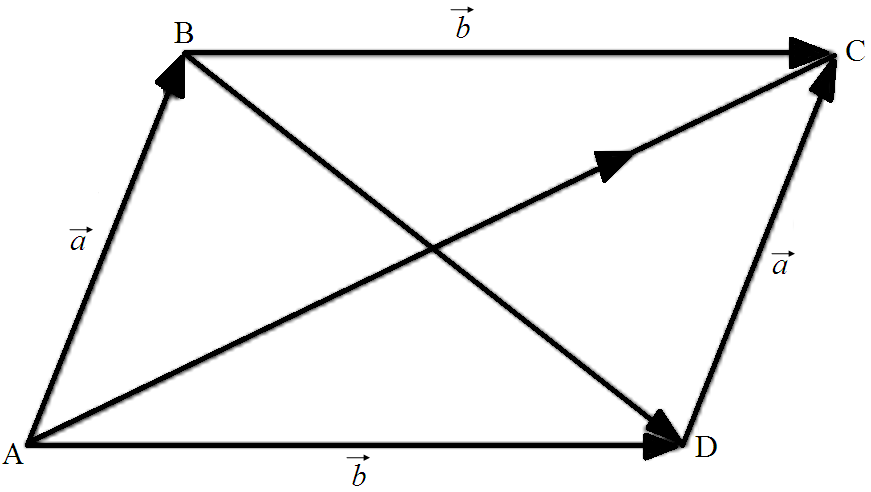
Then any one diagonal of a parallelogram is $\vec{\text{P}}=\vec{\text{a}}+\vec{\text{b}}.$
$\vec{\text{P}}=\vec{\text{a}}+\vec{\text{b}}$
$=2\hat{\text{i}}-4\hat{\text{j}}-5\hat{\text{k}}+2\hat{\text{i}}+2\hat{\text{j}}+3\hat{\text{k}}$
$=4\hat{\text{i}}-2\hat{\text{j}}-2\hat{\text{k}}$
Therefore, unit vector along the diagonal is $\frac{\vec{\text{P}}}{\big|\vec{\text{P}}\big|}=\frac{4\hat{\text{i}}-2\hat{\text{j}}-2\hat{\text{k}}}{\sqrt{16+4+4}}=\frac{2\hat{\text{i}}-\hat{\text{j}}-\hat{\text{k}}}{\sqrt{6}}.$
Another diagonal of a parallelogram is $\vec{\text{P}}'=\vec{\text{b}}-\vec{\text{a}}.$
$\vec{\text{P}}'=\vec{\text{b}}-\vec{\text{a}}$
$=2\hat{\text{i}}+2\hat{\text{j}}+3\hat{\text{k}}-2\hat{\text{i}}+4\hat{\text{j}}+5\hat{\text{k}}$
$=6\hat{\text{j}}+8\hat{\text{k}}$
Therefore, unit vector along the diagonal is $\frac{\vec{\text{P}}}{\big|\vec{\text{P}}\big|}=\frac{6\hat{\text{j}}+8\hat{\text{k}}}{\sqrt{36+64}}=\frac{6\hat{\text{j}}+8\hat{\text{k}}}{10}=\frac{3\hat{\text{j}}+4\hat{\text{k}}}{5}.$
Now,
$\vec{\text{P}}\times\vec{\text{P}}'=\begin{vmatrix}\hat{\text{i}}&\hat{\text{j}}&\hat{\text{k}}\\4&-2&-2\\0&6&8\end{vmatrix}$
$=\hat{\text{i}}(-16+12)-\hat{\text{j}}(32-0)+\hat{\text{k}}(24-0)$
$=-4\hat{\text{i}}-32\hat{\text{j}}+24\hat{\text{k}}$
Area of parallelogram $\frac{\big|\vec{\text{p}}\times\vec{\text{p}'}\big|}{2}=\frac{\sqrt{16+1024+576}}{2}=\frac{\sqrt{1616}}{2}$
$=\frac{4\sqrt{101}}{2}=2\sqrt{101}\text{ square units}$ View full question & answer→Question 105 Marks
Given $\vec{\text{a}}=\frac{1}{7}\big(2\hat{\text{i}}+3\hat{\text{j}}+6\hat{\text{k}}\big),\vec{\text{b}}=\frac{1}{7}\big(3\hat{\text{i}}-6\hat{\text{j}}+2\hat{\text{k}}\big),$$\vec{\text{c}}=\frac{1}{7}\big(6\hat{\text{i}}+2\hat{\text{j}}-3\hat{\text{k}}\big),\hat{\text{i}},\hat{\text{j}},\hat{\text{k}}$
being a right handed orthogonal system of unit vector in spece, show that $\vec{\text{a}},\vec{\text{b}},\vec{\text{c}}$ is also another system.
AnswerGiven:
$\vec{\text{a}}=\frac{1}{7}\big(2\hat{\text{i}}+3\hat{\text{j}}+6\hat{\text{k}}\big)$
$\vec{\text{b}}=\frac{1}{7}\big(3\hat{\text{i}}-6\hat{\text{j}}+2\hat{\text{k}}\big)$
$\vec{\text{c}}=\frac{1}{7}\big(6\hat{\text{i}}+2\hat{\text{j}}-3\hat{\text{k}}\big)$
$\vec{\text{a}}\times\vec{\text{b}}=\Big(\frac{1}{7}\Big)\Big(\frac{1}{7}\Big)\begin{vmatrix}\hat{\text{i}}&\hat{\text{j}}&\hat{\text{k}}\\2&3&6\\3&-6&2 \end{vmatrix}$
$=\frac{1}{49}\big(42\hat{\text{i}}+14\hat{\text{j}}-21\hat{\text{k}}\big)$
$=\frac{1}{49}\big[7\big(6\hat{\text{i}}+2\hat{\text{j}}-3\hat{\text{k}}\big)\big]$
$=\frac{1}{7}\big(6\hat{\text{i}}+2\hat{\text{j}}-3\hat{\text{k}}\big)$
$=\vec{\text{c}}$
$\vec{\text{b}}\times\vec{\text{c}}=\Big(\frac{1}{7}\Big)\Big(\frac{1}{7}\Big)\begin{vmatrix}\hat{\text{i}}&\hat{\text{j}}&\hat{\text{k}}\\3&-6&2\\6&2&-3 \end{vmatrix}$
$=\frac{1}{49}\big(14\hat{\text{i}}+21\hat{\text{j}}+42\hat{\text{k}}\big)$
$=\frac{1}{49}\big[7\big(2\hat{\text{i}}+3\hat{\text{j}}+6\hat{\text{k}}\big)\big]$
$=\frac{1}{7}\big(2\hat{\text{i}}+3\hat{\text{j}}+6\hat{\text{k}}\big)$
$=\vec{\text{a}}$
$\vec{\text{c}}\times\vec{\text{a}}=\Big(\frac{1}{7}\Big)\Big(\frac{1}{7}\Big)\begin{vmatrix}\hat{\text{i}}&\hat{\text{j}}&\hat{\text{k}}\\6&2&-3\\2&3&6 \end{vmatrix}$
$=\frac{1}{49}\big(21\hat{\text{i}}-42\hat{\text{j}}+14\hat{\text{k}}\big)$
$=\frac{1}{49}\big[7\big(3\hat{\text{i}}-6\hat{\text{j}}+2\hat{\text{k}}\big)\big]$
$=\frac{1}{7}\big(3\hat{\text{i}}-6\hat{\text{j}}+2\hat{\text{k}}\big)$
$=\vec{\text{b}}$
$|\vec{\text{a}}|=\frac{1}{7}\sqrt{4+9+36}$
$=\frac{7}{7}$
$=1$
$\big|\vec{\text{b}}\big|=\frac{1}{7}\sqrt{9+36+4}$
$=\frac{7}{7}$
$=1$
$|\vec{\text{c}}|=\frac{1}{7}\sqrt{36+4+9}$
$=\frac{7}{7}$
$=1$
Thus, $\vec{\text{a}},\vec{\text{b}}$ and $\vec{\text{c}}$ from a right handed orthogonal system of unit vectors.
View full question & answer→Question 115 Marks
Using vectors, find the area of the triangle with vertices:
- A(1, 1, 2), B(2, 3, 5) and C(1, 5, 5)
- A(1, 2, 3), B(2, -1, 4) and C(4,5, -1)
AnswerGiven that
A = (1, 1, 2)
B = (2, 3, 5)
C = (1, 5, 5)
Position vector of $\text{A}=\hat{\text{i}}+\hat{\text{j}}+2\hat{\text{k}}$
Position vector of $\text{B}=2\hat{\text{i}}+3\hat{\text{j}}+5\hat{\text{k}}$
Position vector of $\text{C}=\hat{\text{i}}+5\hat{\text{j}}+5\hat{\text{k}}$
$\overrightarrow{\text{AB}}=$ Position vector of B-position vector of A
$=2\hat{\text{i}}+3\hat{\text{j}}+5\hat{\text{k}}-\big(\hat{\text{i}}+\hat{\text{j}}+2\hat{\text{k}}\big)$
$=\hat{\text{i}}+2\hat{\text{j}}+3\hat{\text{k}}$
$\overrightarrow{\text{AC}}-$ Position vector of C-position vector of A
$=\hat{\text{i}}+5\hat{\text{j}}+5\hat{\text{k}}-\big(\hat{\text{i}}+\hat{\text{j}}+2\hat{\text{k}}\big)$
$=4\hat{\text{j}}+3\hat{\text{k}}$
Area of triangle $=\frac{1}{2}\big|\overrightarrow{\text{AB}}\times\overrightarrow{\text{AC}}\big|$
$\overrightarrow{\text{AB}}\times\overrightarrow{\text{AC}}\begin{bmatrix}\hat{\text{i}}&\hat{\text{j}}&\hat{\text{k}}\\1&2&3\\0&4&3 \end{bmatrix}$
$=\hat{\text{i}}(6-12)-\hat{\text{j}}(3-0)+\hat{\text{k}}(4-0)$
$=-6\hat{\text{i}}-3\hat{\text{j}}+4\hat{\text{k}}$
$\overrightarrow{\text{AB}}\times\overrightarrow{\text{AC}}=\sqrt{(-6)^2+(-3)^2+4^2}$
$-\sqrt{36+9+16}$
$=\sqrt{61}$
Area of the teiangle $=\frac{1}{2}\sqrt{61}$ Sq. unit
View full question & answer→Question 125 Marks
The two adjecent sides of a parallelogram are $2\hat{\text{i}}-4\hat{\text{j}}+5\hat{\text{k}}$ and $\hat{\text{i}}-2\hat{\text{j}}-3\hat{\text{k}}.$ Find the unit vector parallel to one of its diagonals. Also, find its area.
AnswerSuppose $\Box\text{ ABCD}$ is the given parallelogram and AC is its diagonal.
Let:
$\overrightarrow{\text{AB}}=2\hat{\text{i}}-4\hat{\text{j}}+5\hat{\text{k}}$
$\overrightarrow{\text{BC}}=\hat{\text{i}}-2\hat{\text{j}}-3\hat{\text{k}}$
$\therefore$ Diagonal $\overrightarrow{\text{AC}}=\overrightarrow{\text{AB}}+\overrightarrow{\text{BC}}$
$=3\hat{\text{i}}-6\hat{\text{j}}+2\hat{\text{k}}$
$\Rightarrow\big|\overrightarrow{\text{AC}}\big|=\sqrt{9+36+4}$
$=7$
Unit vector parallel to $\overrightarrow{\text{AC}}=\frac{\overrightarrow{\text{AC}}}{\big|\overrightarrow{\text{AC}}\big|}$
$=\frac{3\hat{\text{i}}-6\hat{\text{j}}+2\hat{\text{k}}}{7}$
Now,
$\Rightarrow\overrightarrow{\text{AB}}\times\overrightarrow{\text{BC}}=\begin{vmatrix}\hat{\text{i}}&\hat{\text{j}}&\hat{\text{k}}\\2&-4&5\\1&-2&-3 \end{vmatrix}$
$=22\hat{\text{i}}+11\hat{\text{j}}+0\hat{\text{k}}$
$\Rightarrow\big|\overrightarrow{\text{AB}}\times\overrightarrow{\text{AC}}\big|=\sqrt{484+121}$
$=\sqrt{605}$
$=11\sqrt{5}$
Area of triangle ABC $=\frac{1}{2}\big|\overrightarrow{\text{AB}}\times\overrightarrow{\text{AC}}\big|$
$=\frac{11\sqrt{5}}{2}\text{ sq. units}$
View full question & answer→Question 135 Marks
If a, b, c are the langths of sides, BC, CA and AB of a triangle ABC, prove that $\overrightarrow{\text{BC}}+\overrightarrow{\text{CA}}+\overrightarrow{\text{AB}}=\vec{\text{0}}$ and deduce that $\frac{\text{a}}{\sin\text{A}}=\frac{\text{b}}{\sin\text{B}}=\frac{\text{c}}{\sin\text{C}}.$
AnswerWe have
$\overrightarrow{\text{BC}}=\vec{\text{a}}$
$\overrightarrow{\text{CA}}=\vec{\text{b}}$
$\overrightarrow{\text{AB}}=\vec{\text{c}}$
$|\vec{\text{a}}|=\text{a}$
$\big|\vec{\text{b}}\big|=\text{b}$ ($\because$ Length is alwys positive)
$\vec{\text{c}}=\text{c}$
Now,
$\overrightarrow{\text{BC}}+\overrightarrow{\text{CA}}+\overrightarrow{\text{AB}}=\vec{0}$ (Given)
$\Rightarrow\vec{\text{a}}+\vec{\text{b}}+\vec{\text{c}}=\vec{0}$
$\Rightarrow\vec{\text{a}}\times\big(\vec{\text{a}}+\vec{\text{b}}+\vec{\text{c}}\big)=\vec{\text{a}}\times\vec{0}$
$\Rightarrow\vec{\text{a}}\times\vec{\text{a}}+\vec{\text{a}}\times\vec{\text{b}}+\vec{\text{a}}\times\vec{\text{c}}=\vec{\text{0}}$
$\Rightarrow\vec{0}+\vec{\text{a}}\times\vec{\text{b}}-\vec{\text{c}}\times\vec{\text{a}}=\vec{\text{0}}$
$\Rightarrow\vec{\text{a}}\times\vec{\text{b}}=\vec{\text{c}}\times\vec{\text{a}}$
$\Rightarrow|\vec{\text{a}}|\big|\vec{\text{b}}\big|\sin\text{C}=|\vec{\text{c}}||\vec{\text{a}}|\sin\text{B}$
$\Rightarrow\text{ab}\sin\text{C}=\text{ca}\sin\text{B}$
Dividing both sides by abc, we get
$\Rightarrow\frac{\sin\text{C}}{\text{c}}=\frac{\sin\text{B}}{\text{b}}\dots(1)$
Again,
$\overrightarrow{\text{BC}}+\overrightarrow{\text{CA}}+\overrightarrow{\text{AB}}=\vec{0}$
$\Rightarrow\vec{\text{a}}+\vec{\text{b}}+\vec{\text{c}}=\vec{0}$
$\Rightarrow\vec{\text{b}}\times\big(\vec{\text{a}}+\vec{\text{b}}+\vec{\text{c}}\big)=\vec{\text{b}}\times\vec{0}$
$\Rightarrow\vec{\text{b}}\times\vec{\text{a}}+\vec{\text{b}}\times\vec{\text{b}}+\vec{\text{b}}\times\vec{\text{c}}=\vec{0}$
$\Rightarrow-\vec{\text{a}}\times\vec{\text{b}}+\vec{0}+\vec{\text{b}}\times\vec{\text{c}}=\vec{0}$
$\Rightarrow\vec{\text{a}}\times\vec{\text{b}}=\vec{\text{b}}\times\vec{\text{c}}$
$\Rightarrow|\vec{\text{a}}|\big|\vec{\text{b}}\big|\sin\text{C}=\big|\vec{\text{b}}\big||\vec{\text{c}}|\sin\text{A}$
$\Rightarrow\text{ab}\sin\text{C}=\text{bc}\sin\text{A}$
Dividing both sides by abc, we get
$\Rightarrow\frac{\sin\text{C}}{\text{c}}=\frac{\sin\text{A}}{\text{a}}\dots(2)$
From (1) and (2), we get
$\frac{\sin\text{A}}{\text{a}}=\frac{\sin\text{B}}{\text{b}}=\frac{\sin\text{C}}{\text{c}}$
$\Rightarrow\frac{\text{a}}{\sin\text{A}}=\frac{\text{b}}{\sin\text{B}}=\frac{\text{c}}{\sin\text{C}}$
View full question & answer→Question 145 Marks
Let $\vec{\text{a}}=\hat{\text{i}}+4\hat{\text{j}}+2\hat{\text{k}},\vec{\text{b}}=3\hat{\text{i}}-2\hat{\text{j}}+7\hat{\text{k}}$ and $\vec{\text{c}}=2\hat{\text{i}}-\hat{\text{j}}+4\hat{\text{k}}.$Find a vector $\vec{\text{d}}$ which is perpendicular to both $\vec{\text{a}}$ and $\vec{\text{d}}$ and $\vec{\text{c}}.\vec{\text{d}}=15.$
AnswerGiven
$\vec{\text{a}}=\hat{\text{i}}+4\hat{\text{j}}+2\hat{\text{k}}$
$\vec{\text{b}}=3\hat{\text{i}}-2\hat{\text{j}}+7\hat{\text{k}}$
$\vec{\text{c}}=2\hat{\text{i}}-\hat{\text{j}}+4\hat{\text{k}}$
Since d is perpendicular to both a and b, it is parallel to $\vec{\text{a}}\times\vec{\text{b}}.$
Suppose $\text{d}=\lambda\big(\vec{\text{a}}\times\vec{\text{b}}\big)$ for some scalar $\lambda.$
$\text{d}=\lambda\begin{vmatrix}\hat{\text{i}}&\hat{\text{j}}&\hat{\text{k}}\\1&4&2\\3&-2&7 \end{vmatrix}$
$=\lambda\big[(28+4)\hat{\text{i}}-(7-6)\hat{\text{j}}+(-2-12)\hat{\text{k}}\big]$
$\vec{\text{c}}.\vec{\text{d}}=15$ (Given)
$\Rightarrow\big(2\hat{\text{i}}-\hat{\text{j}}+4\hat{\text{k}}\big).\lambda\big(32\hat{\text{i}}-\hat{\text{j}}-14\hat{\text{k}}\big)=15$
$\Rightarrow\lambda(64+1-56)=15$
$\Rightarrow\lambda=\frac{5}{3}$
$\therefore\vec{\text{d}}=\frac{5}{3}\big(32\hat{\text{i}}-\hat{\text{j}}-14\hat{\text{k}}\big)$
$\Rightarrow\vec{\text{d}}=\frac{1}{3}\big(160\hat{\text{i}}-5\hat{\text{j}}-70\hat{\text{k}}\big)$
Disclaimer: The question should contain "Which is perpendicular to both $\vec{\text{a}}$ and $\vec{\text{b}}$ " instead of "Which is perpendicular to both $\vec{\text{a}}$ and $\vec{\text{d}}$ "
View full question & answer→Question 155 Marks
If $\vec{\text{a}}=2\hat{\text{i}}-3\hat{\text{j}}+\hat{\text{k}},\vec{\text{b}}=-\hat{\text{i}}+\hat{\text{k}},\vec{\text{c}}=2\hat{\text{j}}-\hat{\text{k}}$are three vectors, find the aera of the parallelogram having diagonals $\big(\vec{\text{a}}+\vec{\text{b}}\big)$ and $\big(\vec{\text{b}}+\vec{\text{c}}\big).$
AnswerIt is given that $\vec{\text{a}}=2\hat{\text{i}}-3\hat{\text{j}}+\hat{\text{k}},\vec{\text{b}}=-\hat{\text{i}}+\hat{\text{k}},\vec{\text{c}}=2\hat{\text{j}}-\hat{\text{k}}$
$\vec{\text{a}}+\vec{\text{b}}=\big(2\hat{\text{i}}-3\hat{\text{j}}+\hat{\text{k}}\big)+\big(-\hat{\text{i}}+\hat{\text{k}}\big)=\hat{\text{i}}-3\hat{\text{j}}+2\hat{\text{k}}$
$\vec{\text{b}}+\vec{\text{c}}=\big(-\hat{\text{i}}+\hat{\text{k}}\big)+\big(2\hat{\text{j}}-\hat{\text{k}}\big)=-\hat{\text{i}}+2\hat{\text{j}}$
WE know that the area of parallelogram $\frac{1}{2}\big|\vec{\text{d}}_1\times\vec{\text{d}}_2\big|$ where $\vec{\text{d}}_1$ and $\vec{\text{d}}_2$ are the diagonal vectors.
Now,
$\big(\vec{\text{a}}+\vec{\text{b}}\big)\times\big(\vec{\text{b}}+\vec{\text{c}}\big)=\begin{vmatrix}\hat{\text{i}}&\hat{\text{j}}&\hat{\text{k}}\\1&-3&2\\-1&2&0 \end{vmatrix}=-4\hat{\text{i}}-2\hat{\text{j}}-\hat {\text{k}}$
$\therefore$ Area of the parallelogram having diagonals $\big(\vec{\text{a}}+\vec{\text{b}}\big)$ and $\big(\vec{\text{b}}+\vec{\text{c}}\big)$
$=\frac{1}{2}\big|\big(\vec{\text{a}}+\vec{\text{b}}\big)\times\big(\vec{\text{b}}+\vec{\text{c}}\big)\big|=\frac{1}{2}\big|-4\hat{\text{i}}-2\hat{\text{j}}-\hat{\text{k}}\big|$
$=\frac{1}{2}\sqrt{(-4)^2+(-2)^2+(-1)^2}$
$=\frac{\sqrt{21}}{2}\text{square units}$
View full question & answer→Question 165 Marks
Find a unit vector perpendicular to each of the vectors $\vec{\text{a}}+\vec{\text{b}}$ and $\vec{\text{a}}-\vec{\text{b}},$ where $\vec{\text{a}}=3\hat{\text{i}}+2\hat{\text{j}}+2\hat{\text{k}}$ and $\vec{\text{b}}=\hat{\text{i}}+2\hat{\text{j}}-2\hat{\text{k}}.$
AnswerGiven, $\vec{\text{a}}=3\hat{\text{i}}+2\hat{\text{j}}+2\hat{\text{k}}$
$\vec{\text{b}}=\hat{\text{i}}+2\hat{\text{j}}-2\hat{\text{k}}$
Let, $\vec{\text{d}}=\vec{\text{a}}+\vec{\text{b}}$
$=\big(3\hat{\text{i}}+2\hat{\text{j}}+2\hat{\text{k}}\big)+\big(\hat{\text{i}}+2\hat{\text{j}}-2\hat{\text{k}}\big)$
$\vec{\text{d}}=4\hat{\text{i}}+4\hat{\text{j}}-0\hat{\text{k}}$
And, $\vec{\text{e}}=\vec{\text{a}}-\vec{\text{b}}$
$=\big(3\hat{\text{i}}+2\hat{\text{j}}+2\hat{\text{k}}\big)-\big(\hat{\text{i}}+2\hat{\text{j}}-2\hat{\text{k}}\big)$
$\vec{\text{e}}=2\hat{\text{i}}+4\hat{\text{k}}$
Let, $\vec{\text{f}}$ be any vector perpendicular to both $\vec{\text{d}}$ and $\vec{\text{e}}$
$\vec{\text{f}}=\begin{vmatrix}\hat{\text{i}}&\hat{\text{j}}&\hat{\text{k}}\\4&4&0\\2&0&4 \end{vmatrix}$
$=\hat{\text{i}}(16-0)-\hat{\text{j}}(16-0)+\hat{\text{k}}(0-8)$
$\vec{\text{f}}=16\hat{\text{i}}-16\hat{\text{j}}-8\hat{\text{k}}$
$=8(2\hat{\text{i}}-2\hat{\text{j}}-\hat{\text{k}})$
Let $\vec{\text{g}}$ be the required vector, then
$\vec{\text{g}}=\lambda\vec{\text{f}}$ and $|\vec{\text{g}}|=1$
$\vec{\text{g}}=8\lambda\big(2\hat{\text{i}}-2\hat{\text{j}}-\hat{\text{k}}\big)\dots(1)$
$|\vec{\text{g}}|=1$
$8\lambda\sqrt{(2)^2+(-2)^2+(-1)^2}=1$
$8\lambda\sqrt{4+4+1}=1$
$8\lambda\sqrt{9}=1$
$24\lambda=1$
$\lambda=\frac{1}{24}$
put $\lambda$ in (1)
$\vec{\text{g}}=8\Big(\frac{1}{24}\Big)\big(2\hat{\text{i}}-2\hat{\text{j}}-\hat{\text{k}}\big)$
$\vec{\text{g}}=\frac{1}{2}\big(2\hat{\text{i}}-2\hat{\text{j}}-\hat{\text{k}}\big)$
Thus,
Unit vector perpendicular to $\big(\vec{\text{a}}+\vec{\text{b}}\big)$ and $\big(\vec{\text{a}}-\vec{\text{b}}\big)=\frac{1}{3}\big(2\hat{\text{i}}-2\hat{\text{j}}-\hat{\text{k}}\big)$
View full question & answer→