Question 13 Marks
A long solenoid has 1500 turns $/ m$. A coil C having cross sectional area 25 cm 2 and 150 turns $\left( N _{ C }\right)$ is wound tightly around the centre of the solenoid. If a current of 3.0A flows through the solenoid, calculate :
(a) the magnetic flux density at the centre of the solenoid,
(b) the flux linkage in the coil C ,
(c) the average emf induced in coil C if the direction of the current in the solenoid is reversed in a time of 0.5 s . ( $\mu_0=$ $\left.4 \pi \times 10^{-7} H / m \right)$
AnswerData: $n=1.5 \times 10^3 m , A =25 \times 10^{-4} m ^2$,
$N _{ c }=150, I =3 A , \Delta t =0.5 s$,
$\mu_0=4 \pi \times 10^{-7} H / m$
(a) Magnetic flux density inside the solenoid,
$ B=u_0 nl =\left(4 \pi \times 10^{-7}\right)(1500)(3)$
$=5.656 \times 10^{-3} T =5.656 mT $
(b) Flux per unit turn through the coils of the solenoid, $\Phi_m=B A$
Since the coil $C$ is wound tightly over the solenoid, the flux linkage of $C$ is
$ N _C \Phi_{ m }= N _C BA =(150)\left(5.656 \times 10^{-3}\right)\left(25 \times 10^{-4}\right)$
$=2.121 \times 10^{-3} Wb =2.121 mWb $
(c) Initial flux through coil $C$,
$\Phi_{ i }= N _{ C } \Phi_{ m }=2.121 \times 10^{-3} Wb$
Reversing the current in the solenoid reverses the flux through coil $C$, the magnitude remaining the same. But since the flux enters through the other face of the coil, the final flux through $C$ is $\Phi_f=-2.121 \times 10^{-3} Wb$
Therefore, the average emf induced in coil $C_{\text {r }}$
$ e =-\frac{\Phi_{ f }-\Phi_1}{\Delta t}=-\frac{(-2.121-2.121) \times 10^{-3}}{0.5}$
$=2 \times 4.242 \times 10^{-3}=8.484 \times 10^{-3} V =8.484 mV $
View full question & answer→Question 23 Marks
A metal disc is made to spin at 20 revolutions per second about an axis passing through its centre and normal to its plane. The disc has a radius of 30 cm and spins in a uniform magnetic field of 0.20 T, which is parallel to the axis of rotation. Calculate
(a) The area swept out per second by the radius of the disc,
(b) The flux cut per second by a radius of the disc,
(c) The induced emf in the disc.
AnswerData: $R=0.3 m , f =20 rps , B =0.2 T$
(a) The area swept out per unit time by a given radius = (the frequency of rotations) $\times$ (the area swept out per rotation $)=f\left(\pi r^2\right)$
$=(20)(3.142 \times 0.09)=5.656 m ^2$
(b) The time rate at which a given radius cuts magnetic flux
$ =\frac{d \Phi_{ m }}{d t}=B f\left(\pi r^2\right)$
$=(0.2)(5.656)=1.131 Wb / s $
(c) The magnitude of the induced emf,
$| e |=\frac{d \Phi_{ m }}{d t}=1.131 V$
View full question & answer→Question 33 Marks
A long solenoid of length l, cross-sectional area A and having N1 turns (primary coil) has a small coil of N2 turns (secondary coil) wound about its centre. Determine the Mutual inductance (M) of the two coils.
AnswerWe assume the solenoid to be ideal and that all the flux from the solenoid passes through the outer coil C. For a steady current Is through the solenoid, the uniform magnetic field inside the solenoid is$B=\mu_0 n I_s$
Then, the magnetic flux through each turn of the coil due to the current in the solenoid is
$\Phi_{C S}=B A=\left(\mu_0 n l_s\right)\left(\pi R^2\right)$
Thus, their mutual inductance is
$\mathrm{M}=\frac{N \Phi_{\mathrm{CS}}}{I_{\mathrm{S}}}=\mu_0 \pi \mathrm{R}^2 \mathrm{nN}$
Equation (2) is true as long as the magnetic field of the solenoid is entirely contained within the cross section of the coil C. Hence, M does not depend on the shape, size, or possible lack of close packing of the coil.
replacing $n$ with $\mathrm{N}_1 / l$ and $\mathrm{N}$ with $\mathrm{N}_2 \cdot \mathrm{M}=\mu_0 \mathrm{~A}=\frac{N_1 N_2}{l}$
[Note: The answer given in the textbook misses out the factor of 1.] .
View full question & answer→Question 43 Marks
A toroidal ring, having $100$ turns per cm of a thin wire is wound on a nonmagnetic metal rod of length $1\ m$ and diameter $1\ cm.$ If the permeability of bar is equal to that of free space $(\mu_0),$ calculate the magnetic field inside the bar $(B)$ when the current (i) circulating through the turns is $1\ A.$ Also determine the self-inductance $(L)$ of the coil.
AnswerData $: \mid=1 m , d=1 cm , n=100 cm ^{-1}=10^4 m ^{-1}$, $I=100 A , \mu_0=4 \pi \times 10^{-7} H / m$
The radius of cross section, $r=\frac{d}{2}=0.5 cm$ $=5 \times 10^{-3} m$
(a) Magnetic field inside the toroid,
$ B=\mu_0 nl =\left(4 \pi \times 10^{-7}\right)\left(10^4\right)(100)$
$=0.4 \times 3.142=1.257 T $
(b) Self inductance of the toroid,
$ L=\mu_0 2 \pi R n^2 A=\mu_0 n^2\left|A=\mu_0 n^2\right|\left(\pi r^2\right)$
$=\left(4 \pi \times 10^{-7}\right)\left(10^4\right)^2(1)\left[\pi\left(5 \times 10^{-3}\right)^2\right]$
$=\pi^2 \times 10^{-3}=9.87 \times 10^{-3} H =9.87 mH $
View full question & answer→Question 53 Marks
Prove that the inductance of parallel wires of length I in the same circuit is given by $L=$ $\left(\frac{\mu_0 l}{\pi}\right) \ln ( d / a )$, where $a$ is the radius of wire and $d$ is separation between wire axes.
AnswerIf $I$ is the current in each wire, from Ampe're's law the magnitude of the magnetic field outside each wire is
$
B =\frac{\mu_0 I}{2 \pi r}
$
By right hand grip rule, the direction of the magnetic field due to both the wires are in the same direction at the point shown. Hence, by the symmetry of the setup, the total magnetic flux through an area $dA =1 dr$ shown is two times that due to one wire.
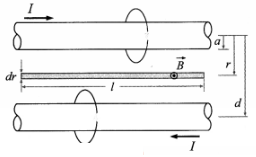
$\begin{aligned} \Phi & =2 \int B d A=2 \int_a^{d-a}\left(\frac{\mu_0 I}{2 \pi r}\right) l d r=\frac{\mu_0 l I}{\pi} \int_a^{d-a} \frac{d r}{r} \\ & =\frac{\mu_0 l I}{\pi} \log _e \frac{d-a}{a} \\ \therefore L & =\frac{\Phi}{I}=\frac{\mu_0 l}{\pi} \log _e \frac{d-a}{a} \approx \frac{\mu_0 l}{\pi} \log _e \frac{d}{a}, \text { for } a \ll d\end{aligned}$
View full question & answer→Question 63 Marks
Explain why the inductance of two coils connected in parallel is less than the inductance of either coil.
AnswerAssuming that their mutual inductance can be ignored, the equivalent inductance of a parallel combination of two coils is given by
$
\frac{1}{L_{\text {parallel }}}=\frac{1}{L_1}+\frac{1}{L_2} \text { or } L_{\text {parallel }}=\frac{L_1 L_2}{L_1+L_2}
$
Hence, the equivalent inductance is less than the inductance of either coil.
View full question & answer→Question 73 Marks
If the copper disc of a pendulum swings between the poles of a magnet, the pendulum comes to rest very quickly. Explain the reason. What happens to the mechanical energy of the pendulum?
AnswerAs the copper disc enters and leaves the magnetic field, the changing magnetic flux through it induces eddy current in the disc. In both cases, Fleming’s right hand rule shows that opposing magnetic force damps the motion. After a few swings, the mechanical energy becomes zero and the motion comes to a stop.
Joule heating due to the eddy current warms up the disc. Thus, the mechanical energy of the pendulum is transformed into thermal energy.
View full question & answer→Question 83 Marks
What do you mean by electromagnetic induction? State Faraday’s law of induction.
AnswerThe phenomenon of production of emf in a conductor or circuit by a changing magnetic flux through the circuit is called electromagnetic induction.
Faraday’s laws of electromagnetic induction :
(1) First law ; Whenever there is a change in the magnetic flux associated with a circuit, an emf is induced in the circuit.
(2) Second law : The magnitude of the induced emf is directly proportional to the time rate of change of magnetic flux through the circuit.
[Note : The phenomenon was discovered in 1830 by Joseph Henry (1797-1878), US physicist, and independently in 1832 by Michael Faraday (1791 -1867), British chemchemist and physicist.]
View full question & answer→Question 93 Marks
A step down transtormer works on $220 V$ a mains. What is the efficiency of the transtormer when a bulb of $100 Wf 20 V$ is connected to the a mains and the current in the primary is 0.5 A ?
AnswerData: $V_p=220 V_{,} V_S=20 V , P_S=100 W _t l _{ p }=0.5 A$
The Input power. $\left.P_p=l_p V_p=(0.5) 220\right)=110 W$
The output power, $P _{ S }=100 W$
$\therefore$ The efficiency of the transformer
$
=\frac{\text { output power }}{\text { input power }}=\frac{100}{110}=0.9091 \text { or } 90.91 \%
$
View full question & answer→Question 103 Marks
A transformer converts 400 volt ac to 100 volt ac The secondary of the transformer has 50 turns and the load across it draws a current of $600 mA$. What is the current in the primary, the power consumed and the number of turns in the primary?
AnswerData : $V_p=400 V \cdot V_S=100 V , N _S=50, I _S=0.6 A$
Assuming no power loss. $P _{ p } V _{ p }= I _5 V _{ S }$
$\therefore$ The current in the primary,
The power consumed,
$
I_{ S } V_{ S }=(0.6)(100)=60 W
$
The turns ratio, $\frac{N_{ S }}{N_{ P }}=\frac{V_{ S }}{V_{ P }}$
$\therefore$ The number of turns in the primary,
$
N_{ P }=\frac{N_{ S } V_{ P }}{V_{ S }}=\frac{(50)(400)}{100}= 2 0 0
$
View full question & answer→Question 113 Marks
A resistance of $3 \Omega$ is connected to the secondary coil of $60$ turns of an ideal transformer. Calculate the current $($peak value$)$ in the resistor if the primary has $1200$ turns and is connected to $240 V \ ($peak$)$ ac supply. Assume that all the magnetic flux in the primary coil passes through the secondary coil and that there are no other losses.
AnswerData : $R=3 \Omega, N_S=60,$
$ N_p=1200, V_p=240 V$
$V_S=\frac{N_{ S }}{N_{ p }} \times V_{ p }$
$=\frac{60}{1200} \times 240=12 V \ ($peak$)$
$\therefore$ The peak value of the current in the resistor in the transformer secondary coil is
$I_5=\frac{V_s}{R}=\frac{12}{3}=4 A$
View full question & answer→Question 123 Marks
A transformer converts $200 V$ ac to $50 V ac$. The secondary has $50$ turns and the load across it draws $300 \ m\ A$ current. Calculate $(i) $ the number of turns in the primary $(ii)$ the power consumed.
AnswerData: $V_p=200 V , V_S=50 V ,$
$ N _S=50, I _S=300 mA =0.3 A$
$(i)\ \frac{N_{ P }}{N_{ g }}=\frac{V_{ P }}{V_{ s }}$
$\therefore$ The number of turns in the primary,
$N_p=N_S \frac{V_p}{V_g}$
$=50 \times \frac{200}{50}=200$
$(ii)$ Power consumed $=V_5 l_5=50 \times 0.3=15 W$
View full question & answer→Question 133 Marks
The primary and secondary coils of a transformer, assumed to be ideal, have $20$ and $300$ turns of wire, respectively. If the primary voltage is $VP =10$ sincot $($in volt$),$ what is the maximum voltage in the secondary coil?
AnswerData: $N_p=20, N_S=300, $
$V_p=10 \sin \omega t V$
$V_S=\frac{N_{ B }}{N_{ P }} V_{ P }$
$=\frac{300}{20} \times 10 \sin \omega t$
$=150 \sin \omega t V$
This is of the form $V_0 \sin \omega t,$ where $V_0$ is the peak $($or maximum$)$ voltage.
$\therefore$ The maximum voltage in the secondary coil is $150 V$.
View full question & answer→Question 143 Marks
A current of $10 A$ in the primary of a transformer is reduced to zero at the uniform rate in 0.1 second. If the mutual inductance be $3 H$, what is the emf induced in the secondary and change in the magnetic flux per turn in the secondary if it has 50 turns?
Answer$
\text { Data : } \frac{d I_{ p }}{d t}=-\frac{10 A }{0.1 s }=-100 A / s , M=3 H , N_{ S }=50
$
(i) The emf induced in the secondary
$
=-M \frac{d I_{ p }}{d t}=-3 \times(-100)=300 V
$
(ii) $e_{ S }=-N_{ S } \frac{d \phi_{ S }}{d t}$
$
\begin{aligned}
\therefore d \Phi_S=-\frac{e_S d t}{N_S} & =-\frac{300 \times 0.1}{50} \\
& =-0.6 W b \text { per turn }
\end{aligned}
$
This gives the change in the magnetic flux per turn in the secondary.
View full question & answer→Question 153 Marks
A plane coil of lo turns is tightly wound around a solenoid of diameter $2 \ cm$ having $400$ turns per centimeter. The relative permeability of the core is $800$ . Calculate the mutual inductance.
AnswerData: $N =10, R =1 \ cm =10^{-2} m$,
$n =400 \ cm ^{-1}=4 \times 10^4 m ^{-1}, k =800 \text {, }$
$\mu_0=4 \pi \times 10^4 H / m$
Mutual inductance,
$M=k \mu_0 \pi R^2 n N$
$=(800)\left(4 \pi \times 10^{-7}\right)\left[\pi \times\left(10^2\right)^2\right]\left(4 \times 10^4\right)(10)$
$=0.1264 H$
View full question & answer→Question 163 Marks
Distinguish between a step-up and a step-down transformers. (Any two points)
Question 173 Marks
What are step-up and step-down transformers?
AnswerStep-up transformer : It increases the amplitude of the alternating emf, i.e., it changes a low voltage alternating emf into a high voltage alternating emf with a lower current.Step-down transformer : It decreases the amplitude of the alternating emf, i.e., it changes a high voltage alternating emf into a low voltage alternating emf with a higher current. View full question & answer→Question 183 Marks
What is a transformer?
State the principle of working of a transformer.
AnswerA transformer is an electrical device which uses mutual induction to transform electrical power at one alternating voltage into electrical power at another alternating voltage (usually different), without change of frequency of the voltage.
Principle : A transformer works on the principle that a changing current through one coil creates a changing magnetic flux through an adjacent coil which in turn induces an emf and a current in the second coil.
View full question & answer→Question 193 Marks
What is meant by coefficient of magnetic coupling?
AnswerFor two inductively coupled coils, the fraction of the magnetic flux produced by the current in one coil (primary) that is linked with the other coil (secondary) is called the coefficient of magnetic coupling between the two coils.The coupling coefficient $K$ shows how good the coupling between the two coils is; $0 \leq K \leq 1$. In the ideal case when all the flux of the primary passes through the secondary, $K=I$. For coils which are not coupled, $K=0$. Two coils are tightly coupled if $K>0.5$ and loosely coupled if $K$ $<0.5$.
[ Note ; For iron-core coupled circuits, the value of $K$ may be as high as 0.99 , for air-core coupled circuits, $K$ varies between 0.4 to 0.8 . ]
View full question & answer→Question 203 Marks
State and define the SI unit of mutual inductance. Give its dimensions.
AnswerThe SI unit of mutual inductance is called the henry $( H )$.
The mutual inductance of a coil (secondary) with respect to a magnetically linked neighbouring coil (primary) is one henry if an emf of 1 volt is induced in the secondary coil when the current in the primary coil changes at the rate of 1 ampere per second.The dimensions of mutual inductance are $\left[ ML ^2 T ^{-2} I ^{-2}\right]$ (the same as those of self inductance).
View full question & answer→Question 213 Marks
A coaxial cable, whose outer radius is five times its inner radius, is carrying a current of $1.5 A$. What is the magnetic field energy stored in a $2 m$ length of the cable?
AnswerData $: b / a=5, I=1.5 A , $
$l =2 m , \frac{\mu_0}{4 \pi}=10^{-7} H / m$
The total magnetic energy in a given length of a current $-$ carrying coaxial cable,
$U _{ m }=\left(\frac{\mu_0}{4 \pi}\right) I^2 l \log _e \frac{b}{a}$
Therefore, the required magnetic energy is
$U_m=\left(10^{-7}\right)(1.5)^2(2) \log _e 5$
$=4.5 \times 10^7 \times 2.303 \times \log _{10} 5$
$=4.5 \times 10^{-7} \times 2.303 \times 0.6990$
$=7.24 \times 10^{-7} J$
View full question & answer→Question 223 Marks
A toroid of circular cross section of radius $0.05 m$ has $2000$ windings and a self inductance of $0.04 H$. What is $(a)$ the current through the windings when the energy in its magnetic field is $2 \times 10^{-6} J ( b )$ the central radius of the toroid?
AnswerData : $ r =0.05 m , N =2000, $
$L =0.04 H _{\text {, }}$
$U _{ m }=2 \times 10^{-6} J , $
$\mu_0=4 \pi \times 10^{-7} H / m$
$(a)\ U_m=\frac{1}{2} LI ^2$
Therefore, the current in the windings,
$I=\sqrt{\frac{2 U_{ m }}{L}}=\sqrt{\frac{2\left(2 \times 10^{-6}\right)}{4 \times 10^{-2}}}=10^{-2} A$
$(b)\ L=\frac{\mu_0 N^2 r^2}{2 R} \quad$
Therefore, the central radius of the toroid,
$R =\frac{\mu_0 N^2 r^2}{2 L}=\frac{\left(4 \pi \times 10^{-7}\right)\left(2 \times 10^3\right)^2\left(5 \times 10^{-2}\right)^2}{2\left(4 \times 10^{-2}\right)}$
$ =\frac{\pi}{2} \times 10^{-1}=0.157 m$
View full question & answer→Question 233 Marks
A solenoid $40 \ cm$ long has a cross-sectional area of $0.9 \ cm^ 2$ and is tightly wound with wire of diameter $1 \ mm$. Calculate the self inductance of the solenoid.
AnswerData : $ D=1 \ mm , I =40 \ cm =0.4 m , $
$A =0.9 \ cm ^2=9 \times 10^{-5} m ^2,$
$ l _{ i }=10 A , l _{ f }=0, \Delta t =0.1 s ,$
$\mu_0=4 \pi \times 10^{-7} H / m$
The number of turns per unit length,
$n =\frac{1}{1 mm }=1 \ mm ^{-1}=10^3 m ^{-1}$
Self inductance of the solenoid,
$L=\mu_0 n^2 IA $
$=\left(4 \pi \times 10^{-7}\right)\left(10^3\right)^2(0.4)\left(9 \times 10^{-5}\right)$
$=16 \times 9 \times 3.142 \times 10^{-7}$
$=4.524 \times 10^{-5} H$
View full question & answer→Question 243 Marks
A $10 H$ inductor carries a current of $25 A$. Flow much ice at $0{ }^{\circ} C$ could be melted by the energy stored in the magnetic field of the inductor? [Latent heat of fusion of ice, $L_f=335$ $J / g ]$
AnswerData : $L =10 H , Z =25 A , L f=335 J / g$
Magnetic energy stored,
$
U_m=\frac{1}{2} L L^2=\frac{1}{2}(10)(25)^2=3125 J
$
Heat energy required to melt ice at $0{ }^{\circ} C$ of mass $m$,
$
H = m L _f
$
Equating $H$ with $U _{ m }$
$
m =\frac{U_{ m }}{L_{ r }}=\frac{3125}{335}=9.328 g
$
Therefore, $9.328 g$ of ice could be melted by the energy stored.
View full question & answer→Question 253 Marks
A coil of self inductance $3 H$ and resistance $100 \Omega$ carries a steady current of $2 A$. (a) What is the energy stored in the magnetic field of the coil? (b) What is the energy per second dissipated in the resistance of the coil ?
AnswerData : $L=3 H , R =100 \Omega, I =2 A$
(a) Magnetic energy stored,
$
U_m=\frac{1}{2} L I^2=\frac{1}{2}(3)(2)^2=6 J
$
(b) Power dissipated in the resistance of the coil,
$
P=1^2 R=(2)^2(100)=400 W
$
View full question & answer→Question 263 Marks
An emf of $2 V$ is induced in a closely $-$ wound coil of $50$ turns when the current through it increases uniformly from $O$ to $5 A$ in $0.1 s. \ (a)$ What is the self inductance of the coil? $(b)$ What is the flux through each turn of the coil for a steady current at $5A$?
AnswerData : $e =2 V , N =50, l _{ i }=0, $
$l _{ f }=5 A , \Delta t =0.1 s$
$(a)$ The rate of change of current
$\frac{d I}{d t}=\frac{I_{ f }-I_{ j }}{\Delta t}=\frac{5-0}{0.1}=50 A / s$
Self inductance, $L=\frac{|e|}{d I / d t}$
$\therefore L=\frac{2}{50}=0.04 H =40 mH$
$N \Phi_{ m }=L I$
$\therefore \Phi_{ m }=\frac{L I}{N}$
$=\frac{0.04 \times 5}{50}=0.004 Wb =4 mWb$
This is the flux through each turn.
View full question & answer→Question 273 Marks
A toroidal coil has an inductance of $47 mH$. Find the maximum self-induced emf in the coil when the current in it is reversed from $15 A$ to $-15 A$ in $0.01 s$.
AnswerData : $L=4.7 \times 10^{-2} H _{ r } I _{ i }=15 A , I _{ i }=-15 A$,
$\Delta f =0.01 s$
The rate of change of current,
$
\frac{d I}{d t}=\frac{I_f-I_i}{\Delta t}=\frac{(-15)-15}{0.01}=-3000 A / s
$
$\therefore$ The maximum self-induced emf;
$
e=-L \frac{d I}{d t}\left(4.7 \times 10^{-2}\right)(-3000)=141 V
$
View full question & answer→Question 283 Marks
A coil of self inductance $5 H$ is connected in series with a switch and a battery. After the switch is closed, the steady state value of the current is $5 A$. The switch is then suddenly opened, causing the current to drop to zero in $0.2 s$. Find the emf developed across the inductor (coil) as the switch is opened.
AnswerData : $L =5 H _1 I _{ i }=5 A , I _{ f }=0, \Delta t =0.2 s$
The rate of change of current,
$\frac{d I}{d t}=\frac{I_t-I_1}{\Delta t}=\frac{0-5}{0.2}=-25 A / s$
$\therefore$ The induced emf,
$e =- L \frac{d I}{d t}=-5(-25)=125 V$
View full question & answer→Question 293 Marks
State the expression for the self inductance of a solenoid. Hence show that the SI unit of magnetic permeability is the henry per metre.
AnswerThe self inductance of an air-cored long solenoid of volume $V$ and number of turns per unit length $n$ is $L=\mu_0 n^2 V$. Since $\left[n^2\right]=\left[L^{-2}\right], n^2 V$ has the dimension of length. The SI unit of the $L$ being the henry, the SI unit of magnetic permeability $\left(\mu_0\right)$ is the henry per metre $( H / m )$. .
$
\mu_0=4 \pi \times 10^{-7} H / m =4 \pi \times 10^{-7} T \cdot m / A
$
View full question & answer→Question 303 Marks
State the expressions for the effective or equivalent inductance of a combination of a number of inductors connected (a) in series (b) in parallel. Assume that their mutual inductance can be ignored.
AnswerWe assume that the inductors are so far apart that their mutual inductance is negligible.
(a) For a series combination of a number of inductors, $L_1, L_2, L_3, \ldots$, the equivalent inductance is
$
L_{\text {series }}=L_1+L_2+L_3+\ldots \ldots . .
$
(b) For a parallel combination of a number of inductors, $L_1, L_2, L_3, \ldots$, the equivalent inductance is
$
\frac{1}{L_{\text {parallel }}}=\frac{1}{L_1}+\frac{1}{L_2}+\frac{1}{L_3}+\ldots
$
View full question & answer→Question 313 Marks
What is the role of an inductor in an ac circuit?
AnswerAs a circuit element, an inductor slows down changes in the current in the circuit. Thus, it provides an electrical inertia and is said to act as a ballast. In a non-inductive coil $(L \simeq 0)$, electrical energy is converted into heat due to ohmic resistance of the coil (Joule heating). On the other hand, an inductive coil or an inductor stores part of the energy in the magnetic field of its coils when the current through it is increasing; this energy is released when the current is decreasing. Thus, an inductor limits an alternating current more efficiently than a non-inductive coil or a pure resistor.
View full question & answer→Question 323 Marks
State the expression for the energy stored in'the magnetic field of an inductor. Hence, define its self inductance.
AnswerWhen a steady current is passed through an inductor of self inductance $L$ the energy stored in the
magnetic field of the inductor is $\left.U_m=\frac{1}{2} L i^2\right]$. Therefore, for unit current, $L=2 U_m$
Hence, we may define the self inductance of a coil as numerically equal to twice the energy stored in its magnetic field for unit current through the inductor.
View full question & answer→Question 333 Marks
Current passes through a coil shown from left to right. In which direction is th induced emf. if the current is (a) increasing with time (b) decreasing in time?

AnswerFrom Lent’s law, the induced emf must oppose the diange in the magnetic flux. (a) When the current mcreases to the right, so is the magnetic flux. To oppose the increasing flux to the tight. the induced emi Is to the left. i.e.. the point A is at a positive potential relative to point B.
(b) When the current to the right is decreasing the induced emf acts to boost up the flux to the right and points to the tight, so that the point A is at a negative potential relative to point B.
View full question & answer→Question 343 Marks
View full question & answer→Question 353 Marks
State and define the SI unit of self inductance. Give its dimensions.###Write the SI unit and dimensions of the coefficient of self induction.
AnswerThe SI unit of self inductance or coefficient of self induction or inductance as it is commonly called is called the henry (H).
The self-inductance of a coil is 1 henry, if an emf of 1 volt is induced in the coil when the current through the same coil changes at the rate of 1 ampere per second.
The dimensions of self inductance or coefficient of self induction are [ML2T-2I-2].
1 henry = 1 H = 1 V/A.s = 1 T.m2/A
[ Note : The unit henry is named in honour of Joseph Henry (1797-1878) US physicist.]
View full question & answer→Question 363 Marks
A metal rod of resistance of $15 \Omega$ is moved to the right at a constant $60 cm / s$ along two parallel conducting rails $-25 cm$ apart and shorted at one end. A magnetic field of magnitude 0.35 T points into the page, (a) What are the induced emf and current in the rod? (b) At what rate is thermal energy generated?
AnswerData: $R=15 \Omega, v=0.6 m / s , \mid=0.25 m , B=0.35 T$
(a) Induced emf, e $= Blv =(0.35)(0.25)(0.6)$
$
=0.0525 V =52.5 mV
$
The current in the rod, $I =\frac{e}{ R }=\frac{52.5}{15}=35 mA$
(b) Power dissipated, $P = el =0.0525 \times 3.5 \times 10^{-4}$
$
=0.184 mW
$
View full question & answer→Question 373 Marks
If a magnet is dropped through a long thick- walled vertical copper tube, it attains a constant velocity after some time. Explain.
AnswerEvery thin transverse section of a thick-walled vertical copper tube is an annular disc. The downward motion of the magnet causes increased magnetic flux through such conducting discs. By Lenz’s . law, the induced or eddy current around the discs produces a magnetic field of its own to oppose the change in flux due to the magnet’s motion.Initially, as the magnet falls under gravity, its speed increases. But, quickly the vertically upward force on the magnet due to the induced current becomes equal in magnitude to the gravitational force on the magnet and the net force on the magnet becomes zero. The subsequent motion of the magnet is at this constant terminal speed.
View full question & answer→Question 383 Marks
The armature windings of a $dc$ motor have a resistance of $10 \Omega$. The motor is connected to a $220 V$ line, and when the motor reaches full speed at normal load, the back $\text{emf}$ is $160 V$.
Calculate
$(a)$ the current when the motor is just starting up
$(b)$ the current at full speed,
$(c)$ What will be the current if the load causes it to run at half speed?
Answer$R=10 \Omega \text {, eapplied }=220 V _{ r }, \text { e }_{\text {back }}=160 V \text {, }$
$f_2=f_1 / 2 \text {. }$
$\text { eapplied }-e_{\text {back }}-I R=0$
$(a)$ At start up, back emf is zero.
$\therefore I_{\text {start }}=\frac{e_{\text {applasl }}}{R}=\frac{220}{10}=22 A$
$(b)$ At full speed,
$I _{\text {normal }}=\frac{e_{\text {enplod }}-e_{\text {tock }}}{R}$
$=\frac{220-160}{10}$
$=\frac{60}{10}$
$=6 A$
$(c)$ Back $\text{emf}$ is proprtional to rotational speed.
Thus, if the motion is running at half the speed, back $\text{emf}$ is half the original value,
i.e, $80 V$.
Therefore, at half speed,
$l _2=\frac{e_{\text {npplad }}-e_2}{R}$
$=\frac{220-80}{10}$
$=\frac{140}{10}$
$=14 A$
View full question & answer→Question 393 Marks
The back emf in a motor is $100 V$ when operating . at $2500 rpm$. What would be the back emf at $1800 rpm$ ? Assume the magnetic field remains unchanged.
AnswerData $: e_1=100 V _{ r } f _1=2500 rpm , f _2=1800 rpm$
The back emf is proportional to the angular speed.
$\therefore \frac{e_2}{e_1}=\frac{f_2}{f_1}$
$\therefore e_2=\frac{f_2}{f_1} \times e_1=\frac{1800}{2500} \times 100=72 V$
This is the back emf at lower speed.
View full question & answer→Question 403 Marks
A dynamo attached to a bicycle has a 200 turn coil, each of area $0.10 m ^2$. The coil rotates half a revolution per second and is placed in a uniform magnetic field of $0.02 T$. Find the maximum voltage generated in the coil.
AnswerData : $N =200, A =0.1 m ^2, f =0.5 Hz , B =0.02 T$
$e _0= NAB \omega= NAB (2 \pi f )$
Therefore, the maximum voltage generated,
$e_0=(200)(0.1)(0.02)(2 \times 3.142 \times 0.5)=1.26 V$
View full question & answer→Question 413 Marks
An ac generator has a coil of 250 turns rotating at $60 Hz$ in a magnetic field of $\frac{0.6}{\pi} T$. What must be the area of each turn of the coil to produce a maximum emf of $180 V$ ?
AnswerData : $N =250, f =60 Hz , B =\frac{0.6}{\pi} T$
$e_0=N A B \omega=N A B(2 \pi f)$
$\therefore A =\frac{e_0}{N B 2 \pi f}=\frac{180}{(250)(0.6 / \pi)(2 \pi \times 60)}=\frac{18}{25 \times 72}$
$=10^{-2} m ^2$
This must be the area of each turn of the coil.
View full question & answer→Question 423 Marks
An ac generator spinning at a rate of $750 rev / min$ produces a maximum emf of $45 V$. At what angular speed does this generator produce a maximum emf of $102 V$ ?
AnswerData : $e_1=45 V _1 f _1=750 rpm , e _2=102 V$
$e=N A B w=N A B(2 \pi f) \therefore e \propto f$
$\therefore \frac{e_2}{e_1}=\frac{f_2}{f_1}$
$\therefore f _2=\frac{e_2}{e_1} \times f _1=\frac{102}{45} \times 750=1700 rpm$
This is the required frequency of the generator coil.
View full question & answer→Question 433 Marks
What is back torque in a generator?
AnswerIn an electric generator, the mechanical rotation of the armature induces an emf in its coil. This is the output emf of the generator. Under no-load condition, there is no current although the output emf exists, and it takes little effort to rotate the armature.
However, when a load current is drawn, the situation is similar to a current-carrying coil in an external magnetic field. Then, a torque is exerted, and this torque opposes the rotation. This is called back torque or counter torque.
Because of the back torque, the external agent has to apply a greater torque to keep the generator running. The greater the load current, the greater is the back torque.
View full question & answer→Question 443 Marks
Explain back emf in a motor.
AnswerA generator converts mechanical energy into electrical energy, whereas a motor converts electrical energy into mechanical energy. Also, motors and generators have the same construction. When the coil of a motor is rotated by the input emf, the changing magnetic flux through the coil induces an emf, consistent with Faraday’s law of induction. A motor thus acts as a generator whenever its coil rotates. According to Lenz’s law, this induced emf opposes any change, so that the input emf that powers the motor is opposed by the motor’s self-generated emf. This self-generated emf is called a back emf because it opposes the change producing it.
View full question & answer→Question 453 Marks
What is an ac generator? State the principle of an ac generator.
AnswerAn electric generator or dynamo converts mechanical energy into electric energy, just the opposite of what an electric motor does.
Principle : An AC generator works on electro-magnetic induction : When a coil of wire rotates between two poles of a permanent magnet such that the magnetic flux through the coil changes periodically with time due to a change in the angle between the area vector and the magnetic field, an alternating emf is induced in the coil causing a current to pass when the circuit is closed.
View full question & answer→Question 463 Marks
A straight conductor (rod) of length $0.3 m$ is rotated about one end at a constant $6280 rad / s$ in a plane normal to a uniform magnetic field of induction $5 \times 10^{-5} T$. Calculate the emf induced between its ends.
AnswerData $: I=0.3 m , \omega=6280 rad / s , B=5 \times 10^{-5} T$ In one rotation, the rod traces out a circle of radius $I$, i.e., an area, $A=\left.\pi\right|^2$. Therefore, the time rate at which the rod traces out the area is
$
\frac{d A}{d t}=\text { frequency of rotation } \times A=\frac{\omega}{2 \pi} \times \pi l^2=\frac{1}{2} \omega l^2
$
The time rate of change of magnetic flux linked with the rod is
$
\frac{d \Phi}{d t}=B \frac{d A}{d t}=\frac{1}{2} B \omega l^2
$
Hence, the magnitude of the emf induced between the ends of the rod is
$
\begin{aligned}
|e| & =\frac{d \Phi_{ m }}{d t}=\frac{1}{2} B \omega l^2 \\
& =\frac{1}{2}\left(5 \times 10^{-5}\right)(6280)(0.3)^2=1.413 \times 10^{-2} V
\end{aligned}
$
View full question & answer→Question 473 Marks
A straight metal wire slides to the right at a constant $5 m / s$ along a pair of parallel metallic rails $25 cm$ apart. A $10 \Omega$ resistor connects the rails on the left end. The entire setup lies wholly inside a uniform magnetic field of strength $0.5 T$, directed into the page. Find the magnitude and direction of the induced current in the circuit.
AnswerData : $v=5 m / s , I =0.25 m , R =10 \Omega, B =0.5 T$
The induced current.
$
i =\frac{e}{R}=\frac{B l v}{R}=\frac{(0.5)(0.25)(5)}{10}=0.0625 A
$
Since the magnetic flux into the page through the | closed conducting loop increases, the induced current in the loop must be anticlockwise. Alternatively, Fleming's right hand rule gives the direction of induced current in the moving wire from bottom to top.
View full question & answer→Question 483 Marks
A television loop antenna has diameter of $11 cm$. The magnetic field of the TV signal is uniform, normal to the plane of the loop and changing at the rate of $0.16 T / s$. What is the magnitude of the emf induced in the antenna?
AnswerData : $d=0.11 m , \theta=0(\vec{B} \perp \vec{A}), d B / d t=0.16 T / s$
$
e=-\frac{d \Phi_{ m }}{d t}=-\frac{d}{d t}(B A \cos \theta)=-A \frac{d B}{d t}, A=\frac{\pi d^2}{4}
$
Therefore, induced emf,
$
\begin{aligned}
|e| & =\frac{\pi d^2}{4} \frac{d B}{d t}=\frac{3.142\left(1.21 \times 10^{-2}\right)}{4}(0.16) \\
& =3.142 \times 1.21 \times 4 \times 10^{-4} \\
& = 1 5 . 2 1 \times 10^{-4} V = 1 . 5 2 1 m V
\end{aligned}
$
View full question & answer→Question 493 Marks
A 1000 turn, $20 cm$ diameter coil is rotated in the Earth's magnetic field of strength $5 \times 10^{-5}$
T. The plane of the coil was initially perpendicular to the Earth's field and is rotated to be parallel to the field in $10 ms$ ? Find the average emf induced.
AnswerData: $N =1000, d =0.2 m , B =5 \times 10^{-5} T _{ r }$
$\Delta t =10 ms =10^{-2} s$
Radius of coil $r=d / 2=10^{-1} m$
Induced emf, $e =- N \frac{\Delta \Phi_{ m }}{\Delta t}=-N \frac{\Phi_t-\Phi_1}{\Delta t}$
Initial area, $A _{ j }=\pi r ^2$ and initial flux,
$N \Phi_i=N B A_i N B\left(\pi r^2\right)$
Final flux $\Phi_f=O_t$ since the plane of the coil is parallel to the field lines.
$
\begin{aligned}
\therefore e & =-N\left(\frac{0-B A_{ i }}{\Delta t}\right)=N B \frac{\pi r^2}{\Delta t} \\
& =\left(10^3\right)\left(5 \times 10^{-5}\right) \frac{\left(3.142 \times 10^{-2}\right)}{10^{-2}}=0.1571 V
\end{aligned}
$
View full question & answer→Question 503 Marks
The magnetic flux through a loop of resistance $0.1 \Omega$ is varying according to the relation $\Phi=$
$6 t ^2+7 t +1$, where $\Phi$ is in mihiweber and $t$ is in second. What is the emf induced in the loop at $t=1 s$ and the magnitude of the current?
Answer$R =0.1 \Omega,$
$\Phi_{ m }=6 t ^2+7 t +1 mW ,$
$t =1 s$
$(i)$ The induced emf,$| e |=\frac{d \Phi_{ m }}{d t}=\frac{d}{d t}\left(6 t ^2+7 t +1\right)$
$=(12 t +7) mV$
$=12(1)+7=19 mV$
$(ii)$ The magnitude of the current $=\frac{|e|}{R}$
$=\frac{19 mV }{0.1 \Omega}$
$=190 mA$
View full question & answer→Question 513 Marks
A square wire loop with sides $0.5 m$ is placed with its plane perpendicular to a magnetic field. The resistance of the loop is $5 \Omega$. Find at what rate the magnetic induction should be changed so that a current of $0.1 A$ is induced in the loop.
AnswerData : $|=0.5 m , R =5 \Omega|=,0.1 A$
$A=l^2=0.5 \times 0.5=0.25 m ^2$
The magnitude of the induced emf,
$| e |=\frac{d F }{d t}=\frac{d}{d t}( BA )= A \frac{d B}{d t}$
since the area (A) of the coil is constant. The induced current, $\mid=\frac{|e|}{R}=\frac{A}{R} \frac{d B}{d t}$
$\therefore$ The time rate of change of magnetic induction,
$\frac{d B}{d t}=\frac{I R}{A}=\frac{0.1 \times 5}{0.25}=2 T / s$
View full question & answer→Question 523 Marks
A coil of effective area $25 m ^2$ is placed in a field-free region. Subsequently, a uniform magnetic field that rises uniformly from zero to $1.25 T$ in $0.15 s$ is applied perpendicular to the plane of the coil. What is the magnitude of the emf induced in the coil?
AnswerData : $N A=25 m ^2, B_f=1.25 T _{ r } B _{ i }=0, At =0.15 s$
Initial magnetic flux $\Phi_i=0\left(\because B_i=0\right)$
Final magnetic flux, $\Phi_f=N_f B_f$
$
\begin{aligned}
e = & -\frac{d \Phi}{d t}=-\frac{\left(\Phi_{ t }-\Phi_1\right)}{d t} \\
& =-\frac{N A B_{ f }-0}{d t}=\frac{-N A B_{ f }}{d t} \\
& =-\frac{25 \times 1.25}{0.15}=-208.3 V
\end{aligned}
$
$\therefore$ The magnitude of the induced emf,
$
|e|=\left|\frac{d \Phi}{d t}\right|=208.3 V
$
View full question & answer→Question 533 Marks
State the SI units and dimensions of
(i) magnetic induction
(ii) magnetic flux.
Answer(i) Magnetic induction, B :
Sl unit : the tesla $(T): 1 T =1 Wb / m ^2$
Dimensions: $[ B ]=\left[ MT ^{-2} T ^{-1}\right]$.
(ii) Magnetic flux, $\Phi_m$ :
Sl unit : the weber $( Wb )$
Dimensions : $\left[\Phi_{ m }\right]=[ B ][ A ]$
$
=\left[ MT ^{-2} I ^{-1}\right]\left[ L ^2\right]=\left[ ML ^2 T ^{-2} Y ^{-1}\right]
$
View full question & answer→Question 543 Marks
When is the magnetic flux through an area element (i) maximum (ii) zero? Explain.
AnswerWhen an area element $d A$ is placed in a magnetic field $\vec{B}$, the magnetic flux through the element is
$
d \Phi_m=B(d A) \cos \theta
$
where 8 is the angle between $\vec{B}$ and the area vector $\overrightarrow{d A}$.
(i) The maximum value of $\cos \theta=1$ when $\theta=0$. Thus, from Eq. (1), the magnetic flux is maximum, $d \Phi_m=B(d A)_{\text {, }}$ when the magnetic induction is in the direction of the area vector.
(ii) The minimum value of $\cos \theta=0$ when $\theta=90^{\circ}$. Then, the magnetic flux is minimum, $d \Phi_m$ $=0$, when the magnetic induction is perpendicular to the area vector.
View full question & answer→Question 553 Marks
A bar magnet is dropped vertically through a thick copper ring as shown. What is the direction of the force exerted by the coil on the magnet? Explain.
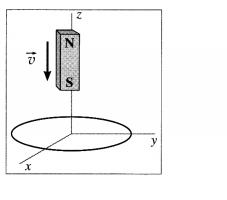
AnswerThe magnetic flux through the loop increases when the magnet approaches the loop, and decreases after the magnet has passed through. The induced current in the loop opposes the cause producing the change in flux which, in this case, is the falling magnet. Therefore, the motion of the magnet’ is opposed, first with a repulsion and then with an attraction. The force, in both cases, is upward in the + z-direction.
The magnetic dipole moment of the falling magnet is directed up. Therefore, looking down the z-axis, the induced current is clockwise when the magnet is approaching the loop, so that the magnetic moment of the loop points down; subsequently, as the magnet recedes, the induced current is anticlockwise.
View full question & answer→Question 563 Marks
In one version of Faraday’s coil-coil experiment, the two coils are wound on the same iron ring as shown, where closing and opening the switch induces a current in the other coil. How do the multiple-loop coils and iron ring enhance the observation of induced emf?
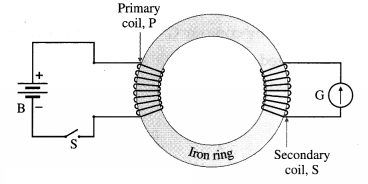
AnswerThe magnetic flux through a coil is directly proportional to the number of turns a coil has. Hence, with multiloop coils in Faraday’s coil-coil experiment, the induced emf is directly proportional to N. Also, the permeability of iron being many orders of magnitude greater than air, the magnetic field lines of the primary coil P are confined to the iron ring and almost all the flux is linked with the secondary coil S. Thus, increased flux and better flux linkage enhances the magnitude of the induced emf.
View full question & answer→