MCQ 11 Mark
A magnetising field of $360 Am -1$ produces a magnetic flux density $( B )=0.6 T$ in a ferromagnetic material. What is its permeability in $\operatorname{Tm} A^{-1}$ ?
- A
$\frac{1}{300}$
- B
$300$
- ✓
$\frac{1}{600}$
- D
$600$
AnswerCorrect option: C. $\frac{1}{600}$
$\frac{1}{600}$
View full question & answer→MCQ 21 Mark
A rectangular magnet suspended freely has a period of oscillation equal to T. Now it is broken into two equal halves ( each having half of the original length) and one piece is made to oscillate freely. Its period of oscillation is T′, the ratio of T′ / T is.
- A
$\frac{1}{2} \sqrt{2}$
- ✓
$\frac{1}{2}$
- C
$2$
- D
$\frac{1}{4}$
AnswerCorrect option: B. $\frac{1}{2}$
$\frac{1}{2}$
View full question & answer→MCQ 31 Mark
Which of the following statements is correct for diamagnetic materials?
- A
- B
- C
χ does not depend on temperature
- ✓
View full question & answer→MCQ 41 Mark
Soft iron is used to make the core of transformer because of its
- ✓
low coercivity and low retentivity
- B
low coercivity and high retentivity
- C
high coercivity and high retentivity
- D
high coercivity and low retentivity
AnswerCorrect option: A. low coercivity and low retentivity
low coercivity and low retentivity
View full question & answer→MCQ 51 Mark
Intensity of magnetic field of the earth at the point inside a hollow iron box is.
MCQ 61 Mark
The materials suitable for making electromagnets
- A
high retentivity and high coercivity
- ✓
low retentivity and low coercivity
- C
high retentivity and low coercivity
- D
low retentivity and high coercivity
AnswerCorrect option: B. low retentivity and low coercivity
(b) : low retentivity and low coercivity
View full question & answer→MCQ 71 Mark
A thin rod of length $L$ has magnetic moment $M$ when magnetised. If rod is bent in a semicircular arc what is magnetic moment in new shape?
- A
$\frac{M}{L}$
- B
$\frac{M}{\pi}$
- C
$\frac{M}{2 \pi}$
- ✓
$\frac{2 M}{\pi}$
AnswerCorrect option: D. $\frac{2 M}{\pi}$
As, $L=\pi r $
$\Rightarrow r=\frac{L}{\pi}$
$M=m \times L .....(i)$
$M^{\prime}=m \times 2 r=m \times \frac{2 L}{\pi}......(ii)$
$\frac{M^{\prime}}{M}=\frac{m \times 2 L}{\pi \times m L}$
$=\frac{2}{\pi} ; M^{\prime}$
$=\frac{2 M}{\pi}$
View full question & answer→MCQ 81 Mark
In the hysteresis curve the value of magnetization $(B)$ which will be present in a substance when value of magnetizing force $(H)$ is made zero $(H=0)$ is called as
Answer(b) : The value of magnetization which remain in substance when magnetic force is made zero, is called retentivity.
View full question & answer→MCQ 91 Mark
If $M_0$ and $L_0$ denote the magnetic moment and angular momentum of the electron due to its orbital motion respectively, then the gyromagnetic ratio is given by
- A
$\frac{L_0}{M_0}$
- B
$L_0 M_0$
- ✓
$\frac{M_0}{L_0}$
- D
$\sqrt{\frac{M_0}{L_0}}$
AnswerCorrect option: C. $\frac{M_0}{L_0}$
(c) : If $M_0$ and $L_0$ denote the orbital angular moment and the angular momentum of the electron due to its orbital motion, then the gyromagnetic ratio is given by $\frac{M_0}{L_0}$.
View full question & answer→MCQ 101 Mark
A metal wire is of length $l$ and magnetic moment $M$. What is the new magnetic moment if is bent in $L$-shape?
- A
$2 M$
- B
$\frac{M}{2}$
- C
$M$
- ✓
$\frac{M}{\sqrt{2}}$
AnswerCorrect option: D. $\frac{M}{\sqrt{2}}$
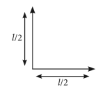
(d) : Magnetic moment, $M=m l$ $\frac{M}{l}=m$, Here ' $m$ ' is pole strength Distance between poles,
$
\sqrt{\left(\frac{l}{2}\right)^2+\left(\frac{l}{2}\right)^2}=\frac{l}{\sqrt{2}}
$
So, $M^{\prime}=\frac{m l}{\sqrt{2}}=\frac{M}{\sqrt{2}}$
View full question & answer→MCQ 111 Mark
Magnetic susceptibility $(\chi)$ for a paramagnetic and diamagnetic materials is respectively
- A
small, positive and small, positive
- B
large, positive and small, negative
- ✓
small, positive and small, negative
- D
large, negative and large, positive.
AnswerCorrect option: C. small, positive and small, negative
(c) : $\chi$ is positive and small for paramagnetic. $\chi$ is negative and small for diamagnetic.
View full question & answer→MCQ 121 Mark
If $M_z=$ magnetization of a paramagnetic sample, $B=$ external magnetic field, $T=$ absolute temperature, $C=$ curie constant. Then according to Curie's law in magnetism, the correct relation is
- A
$M_z=\frac{T}{C B}$
- ✓
$M_x=\frac{C B}{T}$
- C
$C=\frac{M_x B}{T}$
- D
$C =\frac{T^2}{M_x B}$
AnswerCorrect option: B. $M_x=\frac{C B}{T}$
(b) : According to Curie's law of magnetisation for para-magnet i.e. material, $M_z \propto \frac{1}{T}$ or $\quad M_z=\frac{C B}{T}$, where $C=$ Curie constant
View full question & answer→MCQ 131 Mark
The ratio of magnetic fields due to a bar magnet at the two axial points $P_1$ and $P_2$, which are separated from each other by $10 cm$ is $25: 2$. Point $P_1$ is situated at $10 cm$ from the centre of the magnet. Magnetic length of the bar magnet is (Points $P_1$ and $P_2$ are on the same side of magnet and distance of $P_2$ from the centre is greater than distance of $P_1$ from the centre of magnet)
- ✓
$5 cm$
- B
$10 cm$
- C
$15 cm$
- D
$20 cm$
AnswerCorrect option: A. $5 cm$
(a) : Given, that $\frac{B_1}{B_1}=\frac{25}{2}$
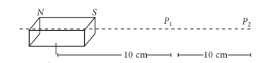
$\frac{\frac{\mu_0}{4 \pi} \frac{M d_1}{\left(d_1^2-l^2\right)^2}}{\frac{\mu_0}{4 \pi} \frac{M d_2}{\left(d_2^2-l^2\right)^2}}=\frac{25}{2} \Rightarrow \frac{d_1}{d_2} \times \frac{\left(d_2^2-l^2\right)^2}{\left(d_1^2-l^2\right)^2}=\frac{25}{2}$
$\begin{aligned} & d_1=10 cm , d_2=20 cm \\ & \frac{10}{20} \times\left(\frac{20^2-l^2}{10^2-l^2}\right)^2=\frac{25}{2} \Rightarrow 400-l^2=5\left(100-l^2\right) \\ & 4 l^2=100 \Rightarrow l^2=25 \Rightarrow l=5 cm \end{aligned}$ View full question & answer→MCQ 141 Mark
A bar magnet has length $3 cm$, cross-sectional area $2 cm ^2$ and magnetic moment $3 Am ^2$. The intensity of magnetisation of bar magnet is
- A
$2 \times 10^5 A / m$
- B
$3 \times 10^5 A / m$
- C
$4 \times 10^3 A / m$
- ✓
$5 \times 10^5 A / m$
AnswerCorrect option: D. $5 \times 10^5 A / m$
(d) : Given, $l=3 cm , A=2 cm ^2, M=3 Am ^2$
Intensity of magnetisation $=\frac{M}{L A}$
$
\begin{aligned}
& =\frac{3}{3 \times 10^{-2} \times 2 \times 10^{-4}}=\frac{1}{2 \times 10^{-6}} \\
& =0.5 \times 10^6=5 \times 10^5 A / m
\end{aligned}
$
View full question & answer→MCQ 151 Mark
The magnetic moment of electron due to orbital motion is proportional to ( $n=$ principle quantum number)
- A
$\frac{1}{n^2}$
- B
$\frac{1}{n}$
- C
$n^2$
- ✓
$n$
Answer(d) : The magnetic moment of electron is
$
M=\frac{e}{2 m_0} \times l
$
where $l=$ angular momentum $=\frac{n h}{2 \pi}$
$
\therefore \quad M \propto n
$
View full question & answer→MCQ 161 Mark
An iron rod is placed parallel to magnetic field of intensity $2000 A / m$. The magnetic flux through the rod is $6 \times 10^{-4} Wb$ and its cross-sectional area is $3 cm ^2$. The magnetic permeability of the rod in Wb/A-m is
- A
$10^{-1}$
- B
$10^{-2}$
- ✓
$10^{-3}$
- D
$10^{-4}$
AnswerCorrect option: C. $10^{-3}$
(c) : Given, $H=2000 A / m , \phi=6 \times 10^{-4} Wb$,
$
A=3 cm ^2=3 \times 10^{-4} m ^2
$
$
\because \quad \phi=B A \quad \therefore \quad B=\frac{\phi}{A}=\frac{6 \times 10^{-4}}{3 \times 10^{-4}}=2 Wb / m ^2
$
Also, $B=\mu H$
$
\therefore \mu=\frac{B}{H}=\frac{2}{2000}=10^{-3} Wb / A - m
$
View full question & answer→MCQ 171 Mark
The magnetic field $(B)$ inside a long solenoid having $n$ turns per unit length and carrying current I when iron core is kept in it is $\left(\mu_0=\right.$ permeability of vacuum, $\chi=$ magnetic susceptibility)
- A
$\mu_0 n I(1-\chi)$
- B
$\mu_0 n I$
- C
$\mu_0 n I^2(1+\chi)$
- ✓
$\mu_0 n I(1+\chi)$
AnswerCorrect option: D. $\mu_0 n I(1+\chi)$
(d) : Magnetic field inside a long solenoid with an iron core inside it is $B=\mu n I$
But $\mu=\mu_0(1+\chi)$
$\therefore B=\mu_0(1+\chi) n I$
View full question & answer→MCQ 181 Mark
For diamagnetic materials, magnetic susceptibility is
Answer(a) : Diamagnetic material has small and negative value of magnetic susceptibility.
View full question & answer→MCQ 191 Mark
Electromagnets are made of soft iron because soft iron has
- ✓
high susceptibility and low retentivity
- B
low susceptibility and high retentivity
- C
low susceptibility and low retentivity
- D
high susceptibility and high retentivity
AnswerCorrect option: A. high susceptibility and low retentivity
(a) : Electromagnets are made of soft iron because soft iron has high susceptibility and low retentivity.
View full question & answer→MCQ 201 Mark
The length of a bar magnet is large compared to its width and breadth. The time period of its angular oscillation in a vibration magnetometer is $2 s$. The magnet is cut along its length into two equal parts and the two parts are then mounted together in the magnetometer with their like poles together. The time period of this combination will be
- A
$2 s$
- ✓
$1 s$
- C
$\frac{1}{2} s$
- D
$\frac{1}{\sqrt{2}} s$
View full question & answer→MCQ 211 Mark
Magnetizing and demagnetizing a material that has hysteresis involves
- ✓
increase in the temperature of the material
- B
a terro-to-para phase change
- C
decrease in the temperature of the material
- D
AnswerCorrect option: A. increase in the temperature of the material
increase in the temperature of the material
View full question & answer→MCQ 221 Mark
View full question & answer→MCQ 231 Mark
An iron rod of volume $10^4 m ^3$ acquires a magnetic moment of $25 A ^2$ when placed inside a solenoid whose windings carry a current of $0.5 A$. The magnetization of the $\operatorname{rod}( in A / m )$ ), assumed to be uniform, is
- A
$5 \times 10^{-5}$
- B
$2.5 \times 10^{-3}$
- C
- ✓
$2.5 \times 10^5$
AnswerCorrect option: D. $2.5 \times 10^5$
$2.5 \times 10^5$
View full question & answer→MCQ 241 Mark
A bar magnet $10 cm$ long has cross-sectional area $2 cm ^2$ and magnetic dipole moment of 10 A.-m². The magnetization of its material, assumed to be uniform, is
- ✓
$5 \times 10^5 A / m$
- B
$2 \times 10^5 A / m$
- C
$0.5 A / m$
- D
$0.2 A / m$.
AnswerCorrect option: A. $5 \times 10^5 A / m$
$5 \times 10^5 A / m$
View full question & answer→MCQ 251 Mark
Bohr magneton is the magnetic dipole moment of
MCQ 261 Mark
If $\vec{M}_0, \vec{L}_0$ and $\psi_0$ are respectively the magnetic dipole moment, orbital angular momentum and gyrornagnetic ratio of an orbital electron. Then.
- A
$\vec{M}_0=-\gamma_0 \vec{L}_0$
- B
$\vec{L}_0=-\gamma_0 \vec{M}_0$
- C
$\vec{L}_0=\gamma_0 \vec{M}_0$
- D
$\vec{M}_0=y_0 \vec{L}_0$
Answer$\vec{M}_0=-\gamma_0 \overrightarrow{L_0}$
View full question & answer→MCQ 271 Mark
The gyromagnetic ratio of an orbital electron is the ratio of its
- A
- B
magnetic moment to volume
- C
orbital magnetic moment to linear momentum
- ✓
orbital magnetic moment to orbital angular momentum.
AnswerCorrect option: D. orbital magnetic moment to orbital angular momentum.
orbital magnetic moment to orbital angular momentum.
View full question & answer→MCQ 281 Mark
The dimensions of magnetic dipole moment are
- ✓
$[L^2I]$
- B
$[LI]$
- C
$[L^{-1}I]$
- D
$[L^{-2}I]$
AnswerCorrect option: A. $[L^2I]$
$[L^2I]$
View full question & answer→MCQ 291 Mark
The magnetic dipole moment has the dimensions of current
AnswerCorrect option: B. current $\times$ area
current $\times$ area
View full question & answer→