Questions

2 Mark Question

Take a timed test

6 questions · self-marked practice — reveal the answer and mark yourself.

Question 12 Marks
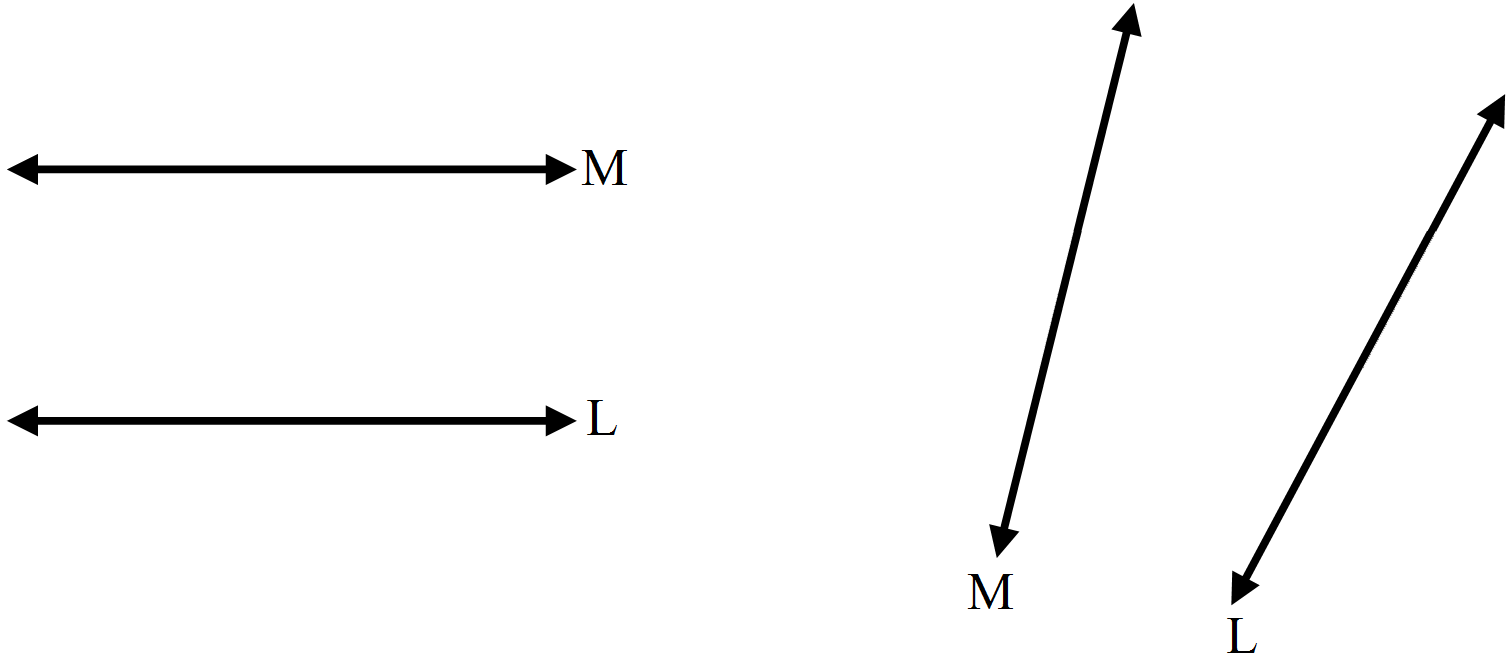
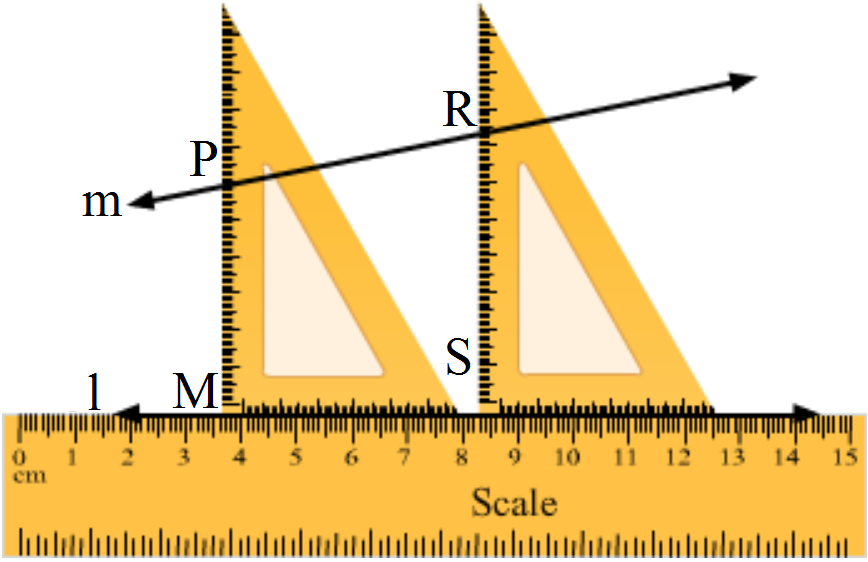
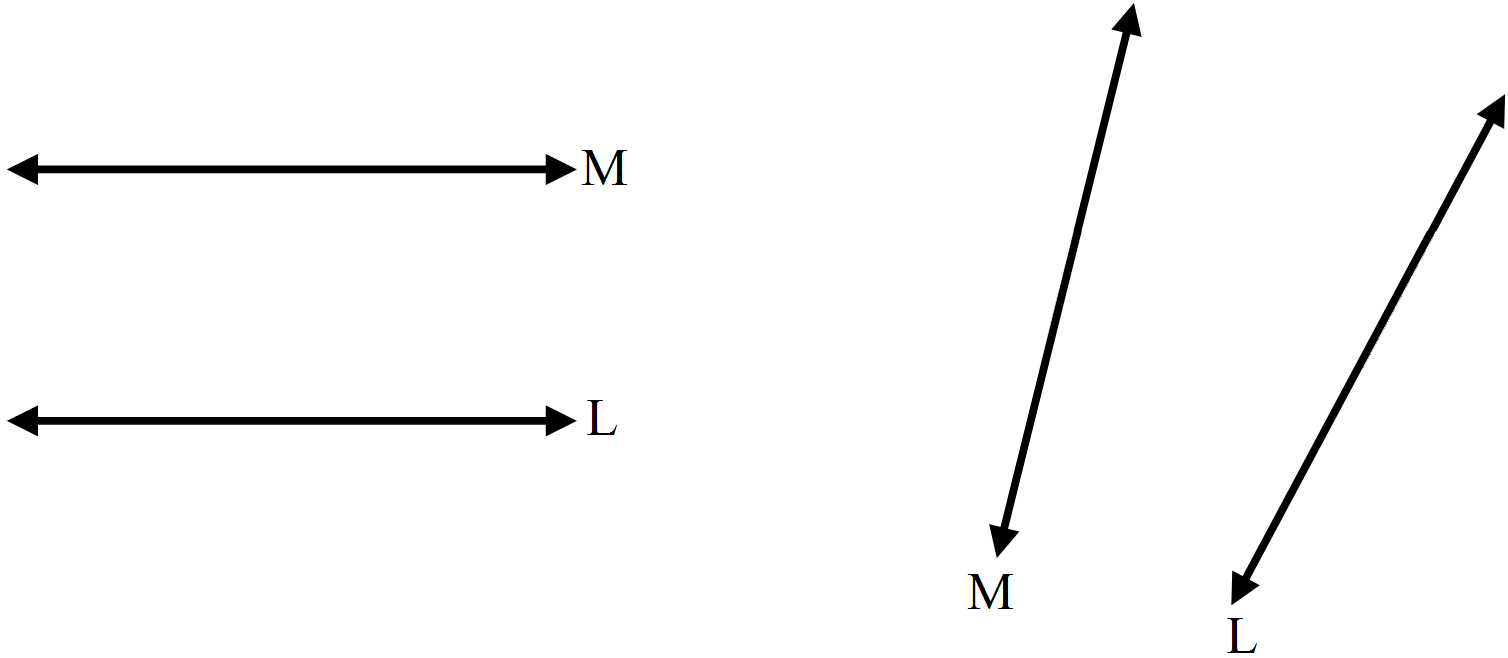
Using a set square and a ruler, test whether l || m in the following cases:
Answer
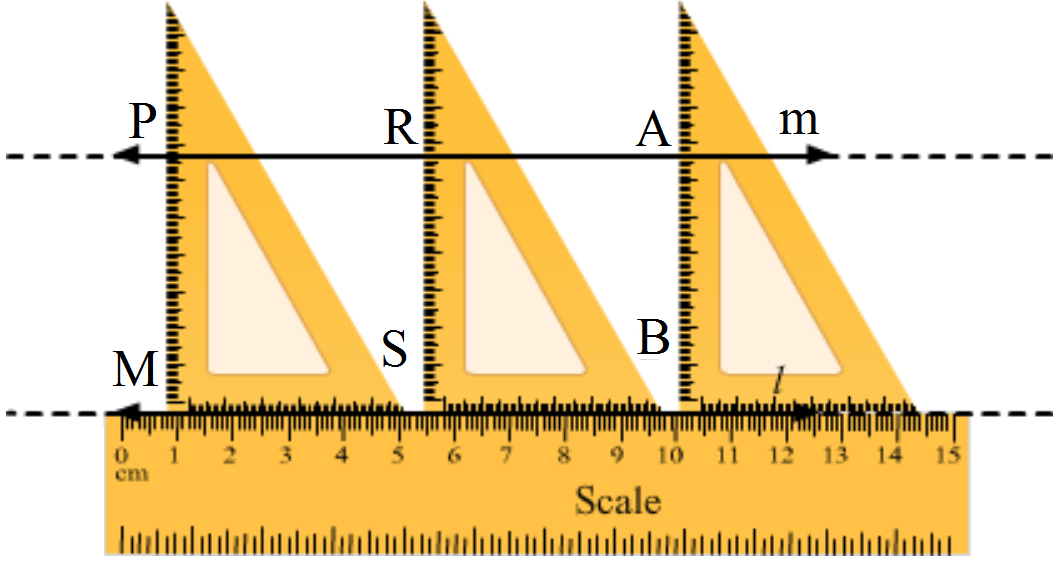
Place the ruler so that one of its measuring edges lies along the line l. Hold it firmly with one hand. Now place a set square with one arm of the right angle coinciding with the edge of the ruler. Draw line segments between l and m (say PM, RS, AB) with the set square. Now, we see that PM = AB = RS. Thus, we can say that l || m.
View full question & answer
Question 22 Marks
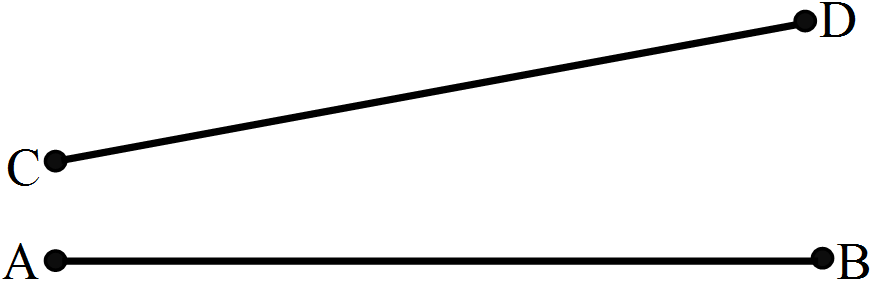
In the figure, do the segments AB and CD intersect? Are they parallel? Give reasons for your answer.
Answer
Line segments AB and CD will intersect if they are produced endlessly towards the ends A and C, respectively.
Therefore, they are not parallel to each other.
View full question & answer
Question 32 Marks
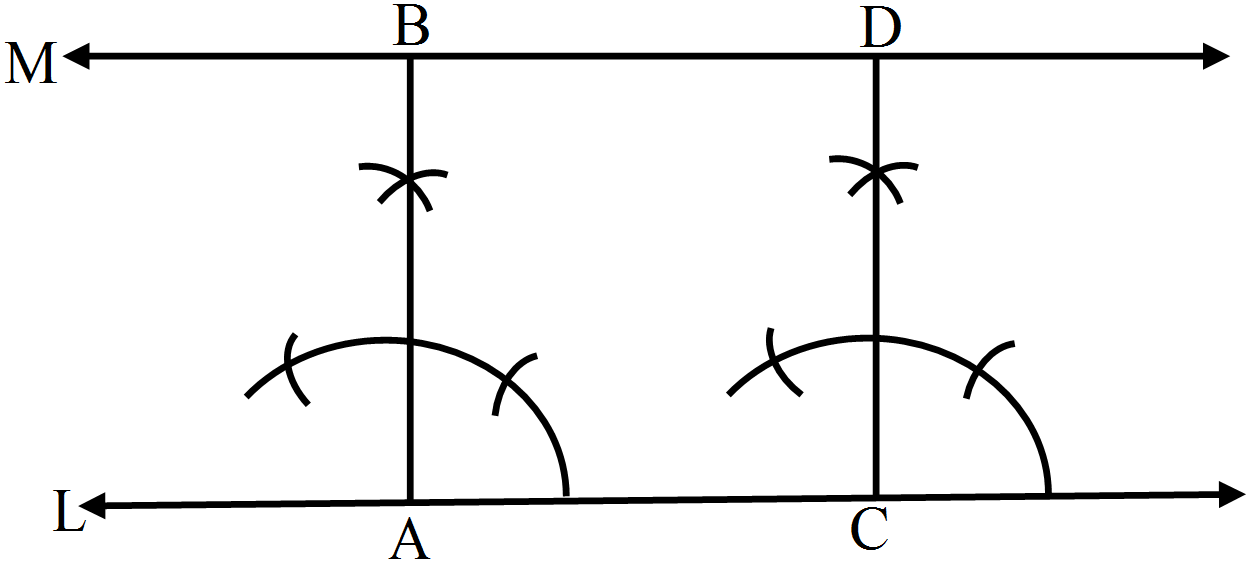
In the figure, l || m. If $\text{AB}\perp\text{l}$ and AB = 2.3cm, find CD.
Answer
At point A, AB is the perpendicular distance between l and m.
At point C, CD is the perpendicular distance between l and m.
The perpendicular distance between two parallel lines is same at all points.
Therefore, CD = AB = 2.3cm
View full question & answer
Question 42 Marks
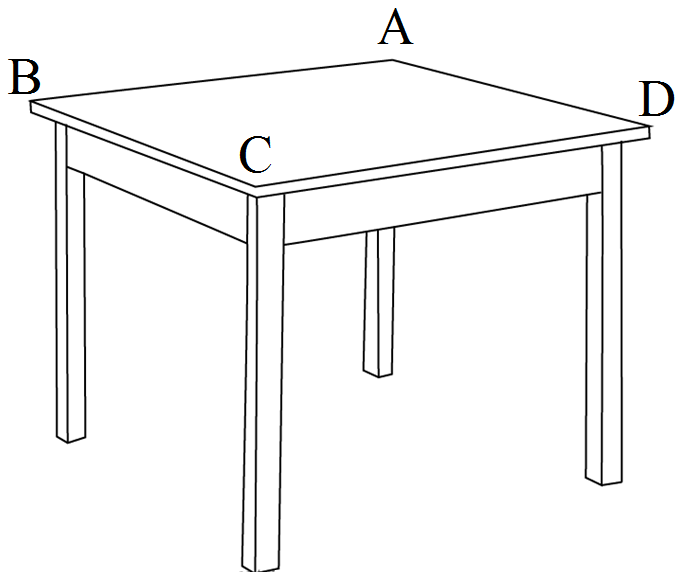
In the figure of a table given below, name the pairs of parallel edges of the top.
Answer
Following are the parallel edges of the top:
AD || BC
This is because AD and BC will not intersect even of both these line segments are produced to infinity in both the directions.
AB || DC
This is because AB and DC will not intersect even if both these line segments are produced to infinity in both the directions.
View full question & answer
Question 52 Marks
Using a set square and a ruler, test whether l || m in the following cases:
Answer
In this case, we see that when we draw line segments between l and m, they are unequal, i.e., PM neq RS. Therefore, l is not parallel to m.
View full question & answer
Question 62 Marks
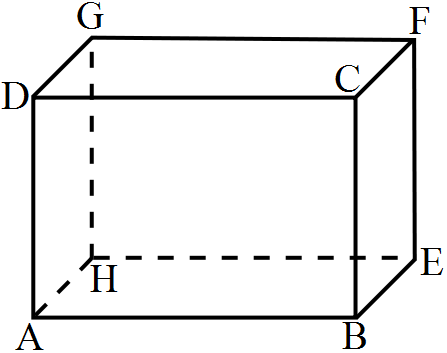
Name the group of all possible parallel edges of the box whose figure is shown below.
Answer
The groups of parallel edges are (AD || GH || BC || FE), (AB || DC || GF || HE) and (AH || BE || CF || DG).
The above mentioned groups of edges are parallel because they will not meet each other if produced to infinity to both sides.
View full question & answer