Questions · Page 2 of 2

2 Mark Question

Question 512 Marks
The HCF of two numbers is 23 and their product is 55545. Find their LCM.
Answer
Product of two numbers = HCF of two numbers × LCM of two numbers
⇒ 55545 = 23 × LCM of two numbers
⇒ LCM of two numbers = 5554523 = 2415
View full question & answer
Question 522 Marks
Write first five multiples of the following numbers:
45
Answer
45
The first five multiples of 45 are as follows:
45 × 1 = 45
45 × 2 = 90
45 × 3 = 135
45 × 4 = 180
45 × 5 = 225
View full question & answer
Question 532 Marks
Sort out even and odd numbers:
  1. 42
  2. 89
  3. 144
  4. 321
Answer
A number which is exactly divisible by 2 is called an even number. Therefore, 42 and 144 are even numbers.
A number which is not exactly divisible by 2 is called an odd number. Therefore, 89 and 321 are odd numbers.
View full question & answer
Question 542 Marks
Write all factors of the following numbers:
729
Answer
729
729 = 1 × 729
729 = 3 × 243
729 = 9 × 81
729 = 27 × 27
Therefore, the factors of 729 are 1, 3, 9, 27, 81, 243 and 729.
View full question & answer
Question 552 Marks
Can two numbers have 16 as their H.C.F and 380 as their L.C.M.? Give reason.
Answer
No. We know that HCF of the given two numbers must exactly divide their LCM.
But 16 does not divide 380 exactly.
Hence, there can be no two numbers with 16 as their HCF and 380 as their LCM.
View full question & answer
Question 562 Marks
Determine prime factorization of the following numbers:
7325
Answer
7325
We have:
5
7325
5
1465
293
293
 
1
Therefore, Prime factorization of 732 5= 5 × 5 × 293
View full question & answer
Question 572 Marks
Write first five multiples of the following numbers:
35
Answer
35
The first five multiples of 35 are as follows:
35 × 1 = 35
35 × 2 = 70
35 × 3 = 105
35 × 4 = 140
35 × 5 = 175
View full question & answer
Question 582 Marks
Which of the following pairs are always co-primes?
two prime numbers.
Answer
Two prime numbers.
Two prime numbers are always co-primes to each other.
Example: 7 and 11 are co-primes to each other.
View full question & answer
Question 592 Marks
Determine the L.C.M of the numbers given below:
42, 63
Answer
42, 63
Prime factorization of 42 = 2 × 3 × 7
Prime factorization of 63 = 3 × 3 × 7
Therefore, Required LCM = 2 × 3 × 3 × 7 = 126
View full question & answer
Question 602 Marks
Write the largest 4-digit number and give its prime factorization.
Answer
The largest 4-digit number is 9999.
We have:
3
9999
3
3333
11
1111
101
101
 
1
Hence, the largest 4-digit number 9999 can be expressed in the form of its prime factors as:
3 × 3 × 11 × 101.
View full question & answer
Question 612 Marks
Find the H.C.F of the following numbers using prime factorization method:
84,98
Answer
84 and 98
Prime factorization of 84 = 2 × 2 × 3 × 7
Prime factorization of 98 = 2 × 7 × 7
Therefore, HCF = 2 × 7 = 14
View full question & answer
Question 622 Marks
What are co-primes? Give examples of five of co-primes. Are co-primes always prime? If no, illustrate your answer by an examples.
Answer
Two numbers are said to be co-primes if they do not have any common factors other than 1.
For example, (2, 3), (3, 4), (4, 5), (5, 7) and (13, 17) are co-primes.
Two co-primes numbers need not be both prime numbers.
e.g., (3, 4), (6, 7) and (4, 13).
View full question & answer
Question 632 Marks
Find numbers between 1 and 100 having exactly three factors.
Answer
The numbers between 1 and 100 having exactly three factors are 4, 9, 25, and 49.
The factors of 4 are 1, 2 and 4.
The factors of 9 are 1, 3 and 9.
The factors of 25 are 1, 5 and 25.
The factors of 49 are 1, 7 and 49.
View full question & answer
Question 642 Marks
Determine the L.C.M of the numbers given below:
108, 135, 162
Answer
108, 135, 162
Prime factorization of 108 = 2 × 2 × 3 × 3 × 3
Prime factorization of 135 = 3 × 3 × 3 × 5
Prime factorization of 162 = 2 × 3 × 3 × 3 × 3
Therefore, Required LCM = 2 × 2 × 3 × 3 × 3 × 3 × 5 = 1,620
View full question & answer
Question 652 Marks
For a number, greater than 10, to be prime what may be the possible digit in the unit's place?
Answer
For a number (greater than 10) to be a prime number, the possible digit in the unit’s place may be 1, 3, 7 or 9.
Example: 11, 13, 17 and 19 are prime numbers greater than 10.
View full question & answer
Question 662 Marks
Write first five multiples of the following numbers:
40
Answer
40
The first five multiples of 40 are as follows:
40 × 1 = 40
40 × 2 = 80
40 × 3 = 120
40 × 4 = 160
40 × 5 = 200
View full question & answer
Question 672 Marks
A list consists of the following pairs of numbers:
51, 53; 55, 57; 59, 61; 63, 65; 67, 69; 71, 73
Categorize them as pairs of:
Co-primes
Answer
Co-primes: Two natural numbers are said to be co-primes numbers if they have 1 as their only common factor.
Hence, all the given pairs of numbers are co-primes.
View full question & answer
Question 682 Marks
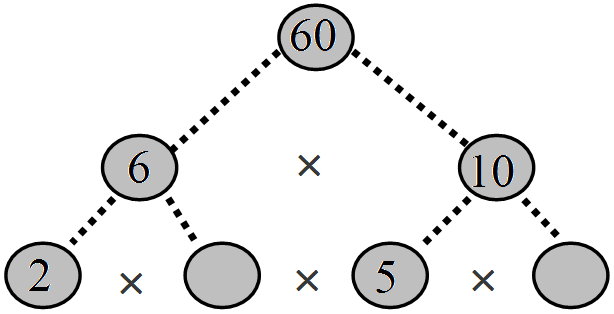
Here are two different factor trees for 60. Write the missing numbers:
Answer
We have: Since 6 = 2 × 3 and 10 = 5 × 2.
View full question & answer
Question 692 Marks
Determine prime factorization of the following numbers:
945
Answer
945
We have:
3
945
3
315
3
105
5
35
7
7
 
1
Therefore, Prime factorization of 945 = 3 × 3 × 3 × 5 × 7
View full question & answer
Question 702 Marks
A list consists of the following pairs of numbers:
51, 53; 55, 57; 59, 61; 63, 65; 67, 69; 71, 73
Categorize them as pairs of:
Composites
Answer
Composite numbers: Natural numbers which have more than two factors are called composite numbers.
Hence, (55, 57) and (63, 65) are pairs of composite numbers.
View full question & answer
Question 712 Marks
Which of the following numbers are divisible by 21?
20163
Answer
20163
Sum of the digits of the given number = 2 + 0 + 1 + 6 + 3 = 12 which is divisible by 3. Hence, 20,163 is divisible by 3.
Again, a number is divisible by 7 if the difference between twice the one’s digit and the number formed by the other digits is either 0 or multiple of 7. 2016 - (2 × 3) = 2010 which is not a multiple of 7. Thus, 20,163 is not divisible by 21.
View full question & answer
Question 722 Marks
Determine the L.C.M of the numbers given below:
15, 30, 90
Answer
15, 30, 90
Prime factorization of 15 = 3 × 5
Prime factorization of 30 = 2 × 3 × 5
Prime factorization of 90 = 2 × 3 × 3 × 5
Therefore, Required LCM = 2 × 3 × 3 × 5 = 90
View full question & answer
Question 732 Marks
Which of the following pairs are always co-primes?
Two composite numbers.
Answer
Two composite numbers
Two composite numbers are not always co-primes to each other.
Example: 4 and 6 are not co-primes to each other.
View full question & answer
Question 742 Marks
Find the common factors of:
2, 6 and 8
Answer
2, 6 and 8
Factors of 2 are 1 and 2
Factors of 6 are 1, 2, 3 and 6
Factors of 8 are 1, 2, 4 and 8
Therefore, the common factors of 2, 6 and 8 are 1 and 2.
View full question & answer
Question 752 Marks
Write all factors of the following numbers:
76
Answer
76
76 = 1 × 76
76 = 2 × 38
76 = 4 × 19
Therefore, The factors of 76 are 1, 2, 4, 19, 38 and 76.
View full question & answer
Question 762 Marks
Find first two common multiples of 12 and 18.
Answer
Multiples of 12: 12, 24, 36, 48, 60, 72, 84, 96, 108, 120, 132…
Multiples of 18: 18, 36, 54, 72, 90, 108, 126, 144, 162, 180, 198…
Therefore, the first two common multiples of 12 and 18 are 36 and 72.
View full question & answer
Question 772 Marks
Find first three common multiples of 6 and 8
Answer
Multiples of 6: 6, 12, 18, 24, 30, 36, 42, 48, 54, 60, 66, 72, 78, 84…
Multiples of 8: 8, 16, 24, 32, 40, 48, 56, 64, 72, 80, 88, 96…
Therefore, the first three common multiples of 6 and 8 are 24, 48 and 72.
View full question & answer
Question 782 Marks
Without actual division show that 11 is a factor of the following numbers:
1111
Answer
1,111
The sum of the digits at the odd places = 1 + 1 = 2
The sum of the digits at the even places = 1 + 1 = 2
The difference of the two sums = 2 - 2 = 0
Therefore, 1,111 is divisible by 11 because the difference of the sums is zero.
View full question & answer
Question 792 Marks
Find the HCF of all natural numbers from 200 to 478.
Answer
The HCF of all natural numbers from 200 to 478 is 1 because there are some prime numbers like 211, 233 and so on which can't have common factor other than 1.
View full question & answer
Question 802 Marks
The LCM of two numbers is 1024 and one of them is a prime number. Find their HCF.
Answer
LCM of two numbers is $1024=2^{10}$ Since, the other is prime number. Hence, the other must be 2 . HCF of 2 and 1024 is 2 .
View full question & answer
Question 812 Marks
Find the H.C.F and L.C.F of the following pairs of numbers:
861,1353
Answer
861 and 1353
Prime factorization of 861 = 3 × 7 × 41
Prime factorization of 1353 = 3 × 11 × 41
Therefore, Required HCF of 861 and 1353 = 123
Therefore, Required LCM of 861 and 1353 = 3 × 7 × 11 × 41 = 9471
View full question & answer
Question 822 Marks
Determine the H.C.F of the following numbers by using Euclid's algorithm (i-x):
1045,1520
Answer
1045 and 1520
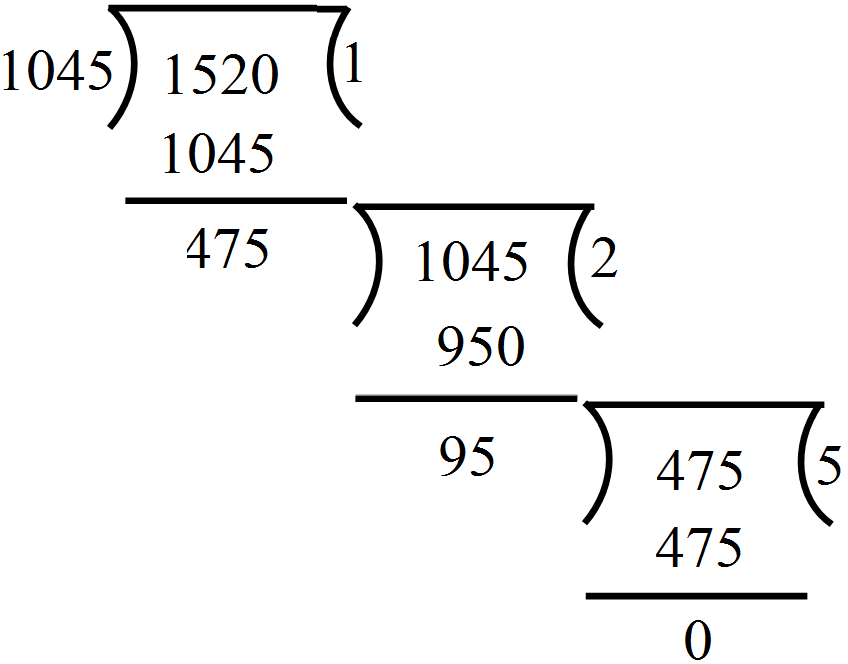
We have dividend = 1045 and divisor = 1520

Clearly, the last divisor is 95.
Hence, HCF of given numbers is 95.
View full question & answer
Question 832 Marks
Determine the L.C.M of the numbers given below:
56, 65, 85
Answer
56, 65, 85
Prime factorization of 56 = 2 × 2 × 2 × 7
Prime factorization of 65 = 5 × 13
Prime factorization of 85 = 5 × 17
Therefore, Required LCM = 2 × 2 × 2 × 5 × 7 × 13 × 17 = 61,880
View full question & answer
Question 842 Marks
Find the H.C.F and L.C.F of the following pairs of numbers:
117,221
Answer
174 and 221
Prime factorization of 117 = 3 × 3 × 13
Prime factorization of 221 = 13 × 17
Therefore, Required HCF of 117 and 221 = 13
Therefore, Required LCM of 117 and 221 = 3 × 3 × 13 × 17 = 1989
View full question & answer
Question 852 Marks
Without actual division show that 11 is a factor of the following numbers:
11011
Answer
11011
The sum of the digits at the odd places = 1 + 0 + 1 = 2
The sum of the digits at the even places = 1 + 1 = 2
The difference of the two sums = 2 – 2 = 0
Therefore, 11,011 is divisible by 11 because the difference of the sums is zero.
View full question & answer
2 Mark Question - Page 2 - Maths STD 6 Questions - Vidyadip