Questions

5 Mark Question

Take a timed test

2 questions · self-marked practice — reveal the answer and mark yourself.

Question 15 Marks
For the cuboid shown:
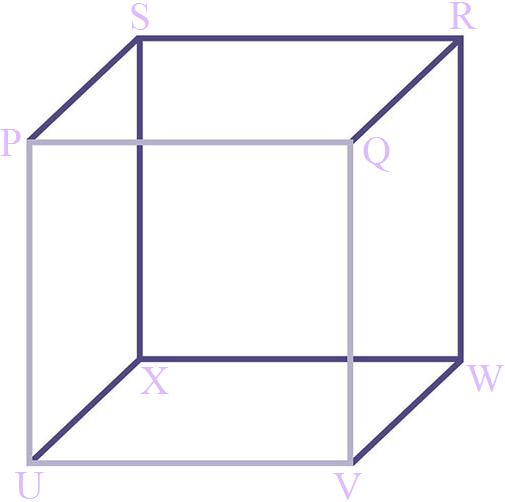
  1. What is the base of this cuboid?
  2. What are the lateral faces of this cuboid?
  3. Name one pair of opposite faces. How many pairs of opposite faces are there. Name them.
  4. Name all the faces of this cuboid which have X as a vertex. Also, name those which have VW as a side.
  5. Name the edges of this cuboid which meet at the vertex P. Also name those faces which meet at this vertex.
Answer
  1. UVWX is the base of a cuboid.
  2. The lateral faces for the base UVWX are UXSP, QVWR, PQVU and SXWR.
  3. Any one pair of opposite faces among the lateral faces of the base are PQVU and SXWR or UXSP and QVWR.
There are two pairs of opposite faces among the lateral faces of the base of the cuboid.
  1. The faces, which have one of the vertex as X, are UVWX, UXSP and SXWR. The faces, which have VW as side, are QVWR and UVWX.
  2. Edges which meet at P are UP, SP, and PQ. Faces which meet at vertex P are PQRS, UPSX, and PQVU.
View full question & answer
Question 25 Marks
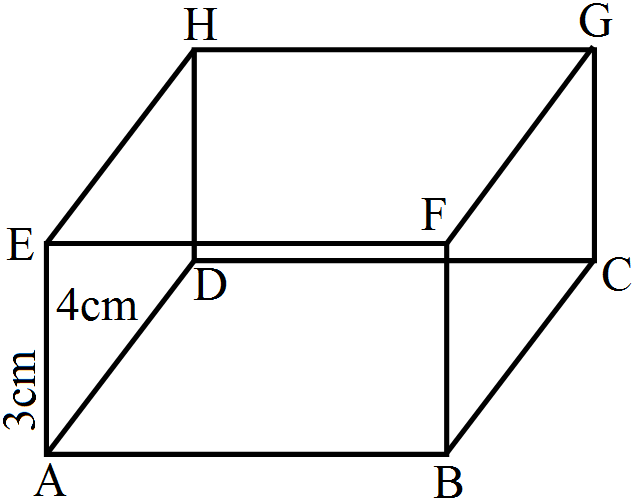
The dimensions of a cuboid with vertices A, B, C, D, E, F, G and H are as shown:


i. Which edges are of length 4 cm ? Which edges are of length 5 cm ?
ii. Which faces have area equal to $20 cm^2$ ?
iii. Which faces have the largest area? What is this largest area?
iv. Which faces have a diagonal equal to 5 cm ?
v . What is the area of the base of this cuboid?
vi. Do all the lateral faces have the same area?
Answer
i. The edges of 4 cm length are $AD , EH , BC$, and FG . The edges of 5 cm length are $AB , EF , CD$ and GH .
ii. The faces having dimensions of $5 cm \times 4 cm$ would have an area of $20 cm^2$. and such faces are $A B C D$ and EFGH.
iii. $A B C D$ and $E F G H$ have the largest area of $20 cm^2$. There are three pairs of opposite faces of equal area. The area of opposite faces are: $3 \times 4 cm^2, 4 \times 5 cm^2$, and $3 \times 5 cm^2$. and among these, $4 \times 5 cm^2$ is the largest.
iv. The faces having sides of 3 cm and 4 cm respectively would have the diagonal of 5 cm . (As hypotenuse of a right- angles triangle is: $3^2+4^2=5^2$ ). Therefore, the faces ADHE and BCGF have the diagonal of 5 cm .
v. base has $q$ dimension of $4 cm \times 5 cm$, so area of abase is: $4 \times 5=20 cm^2$.
vi. No, all lateral faces do not have the same area. The two lateral faces have an area of $3 \times 5=15 cm^2$ and rest of the two lateral faces have an area of $3 \times 4=12 cm^2$.
View full question & answer