Questions

1 Mark Question

Take a timed test

32 questions · self-marked practice — reveal the answer and mark yourself.

Question 11 Mark
State the kind of angle, in each case, formed between the following directions:
North and North-East
Answer
North and north-east directions form an angle of 45°, which is an acute angle.

View full question & answer
Question 21 Mark
Classify the following angles as acute, obtuse, straight, right, zero and complete angle:
145º
Answer
An acute angle measures between 0° and 90°. An obtuse angle measures between 90° and 180°. A straight angle measures 180°. A right angle measures 90°. A zero angle measures 0° and a complete angle measures 360°.
145° is an obtuse angle.
View full question & answer
Question 41 Mark
Classify the following angles as acute, obtuse, straight, right, zero and complete angle:
30º
Answer
An acute angle measures between 0° and 90°. An obtuse angle measures between 90° and 180°. A straight angle measures 180°. A right angle measures 90°. A zero angle measures 0° and a complete angle measures 360°.30° is an acute angle.
View full question & answer
Question 71 Mark
Classify the following angles as acute, obtuse, straight, right, zero and complete angle:
179º
Answer
An acute angle measures between 0° and 90°. An obtuse angle measures between 90° and 180°. A straight angle measures 180°. A right angle measures 90°. A zero angle measures 0° and a complete angle measures 360°.
179° is an obtuse angle.
View full question & answer
Question 81 Mark
Which of the following statements are true:
  1. The vertex of an angle lies in its interior.
  2. The vertex of an angle lies in its exterior.
  3. The vertex of an angle lies on it.
Answer
  1. The vertex of an angle lies on it.
Solution:

This is the only correct statement.
View full question & answer
Question 91 Mark
An angle is formed by two adjacent fingers. What kind of angle will it appear?
Answer
Angle formed by two adjacent fingers will appear as an acute angle.
View full question & answer
Question 101 Mark
Classify the following angles as acute, obtuse, straight, right, zero and complete angle:
75º
Answer
An acute angle measures between 0° and 90°. An obtuse angle measures between 90° and 180°. A straight angle measures 180°. A right angle measures 90°. A zero angle measures 0° and a complete angle measures 360°.75° is an acute angle.
View full question & answer
Question 111 Mark
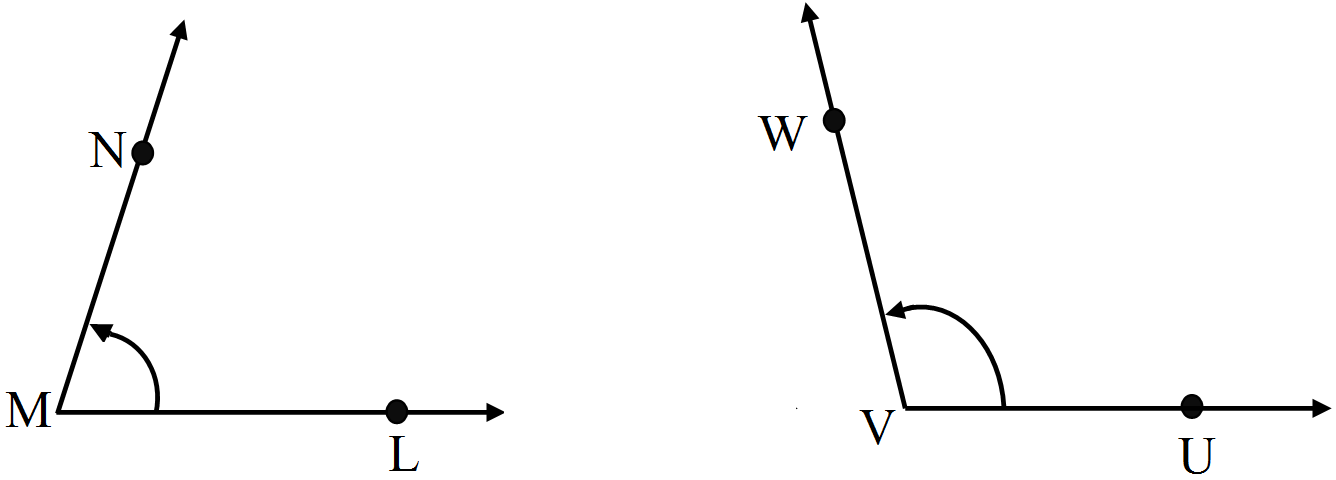
By using tracing paper compare the angles in the pairs given in Fig.
Answer
Using tracing paper, we get that:
$\angle\text{UVW}$ is greater than $\angle\text{LMN}.$
View full question & answer
Question 121 Mark
Classify the following angles as acute, obtuse, straight, right, zero and complete angle:
90.5º
Answer
An acute angle measures between 0° and 90°. An obtuse angle measures between 90° and 180°. A straight angle measures 180°. A right angle measures 90°. A zero angle measures 0° and a complete angle measures 360°.90.5° is an obtuse angle.
View full question & answer
Question 131 Mark
Classify the following angles as acute, obtuse, straight, right, zero and complete angle:
89.5º
Answer
An acute angle measures between 0° and 90°. An obtuse angle measures between 90° and 180°. A straight angle measures 180°. A right angle measures 90°. A zero angle measures 0° and a complete angle measures 360°.
89.5° is an acute angle.
View full question & answer
Question 141 Mark
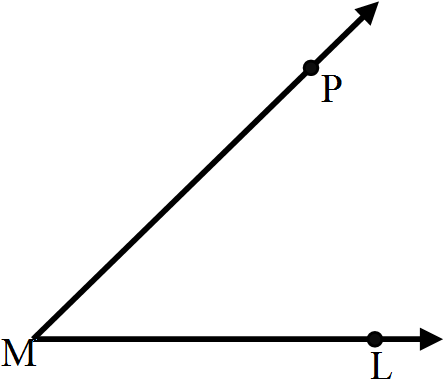
Write the arms and the vertex of $\angle\text{LMP}$ given in Figure:
Answer
Arms of $\angle\text{LMP}$ are MP and ML. Further, vertex is M.
View full question & answer
Question 151 Mark
Classify the following angles as acute, obtuse, straight, right, zero and complete angle:
360º
Answer
An acute angle measures between 0° and 90°. An obtuse angle measures between 90° and 180°. A straight angle measures 180°. A right angle measures 90°. A zero angle measures 0° and a complete angle measures 360°.
360° is a complete angle.
View full question & answer
Question 161 Mark
Classify the following angles as acute, obtuse, straight, right, zero and complete angle:
165º
Answer
An acute angle measures between 0° and 90°. An obtuse angle measures between 90° and 180°. A straight angle measures 180°. A right angle measures 90°. A zero angle measures 0° and a complete angle measures 360°.
165° is an obtuse angle.
View full question & answer
Question 171 Mark
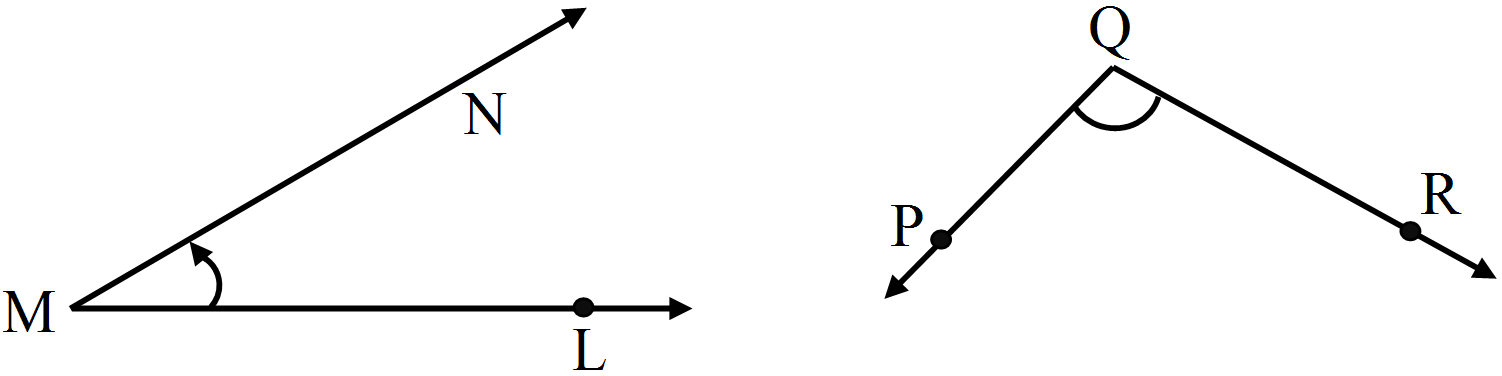
By simply looking at the pair of angles given in Figure, state which of the angles in the pairs is greater:
Answer
$\angle\text{PQR}$ is greater than $\angle\text{LMN}.$
View full question & answer
Question 181 Mark
State the kind of angle, in each case, formed between the following directions:
East and North
Answer
East and North directions form an angle of 90°, which is a right angle.
View full question & answer
Question 191 Mark
Classify the following angles as acute, obtuse, straight, right, zero and complete angle:
Answer
An acute angle measures between 0° and 90°. An obtuse angle measures between 90° and 180°. A straight angle measures 180°. A right angle measures 90°. A zero angle measures 0° and a complete angle measures 360°.
0° is a zero angle.
View full question & answer
Question 201 Mark
Classify the following angles as acute, obtuse, straight, right, zero and complete angle:
118º
Answer
An acute angle measures between 0° and 90°. An obtuse angle measures between 90° and 180°. A straight angle measures 180°. A right angle measures 90°. A zero angle measures 0° and a complete angle measures 360°.
118° is an obtuse angle.
View full question & answer
Question 221 Mark
State the kind of angle, in each case, formed between the following directions:
East and West
Answer
East and west directions form an angle of 180°, which is a straight angle.
View full question & answer
Question 231 Mark
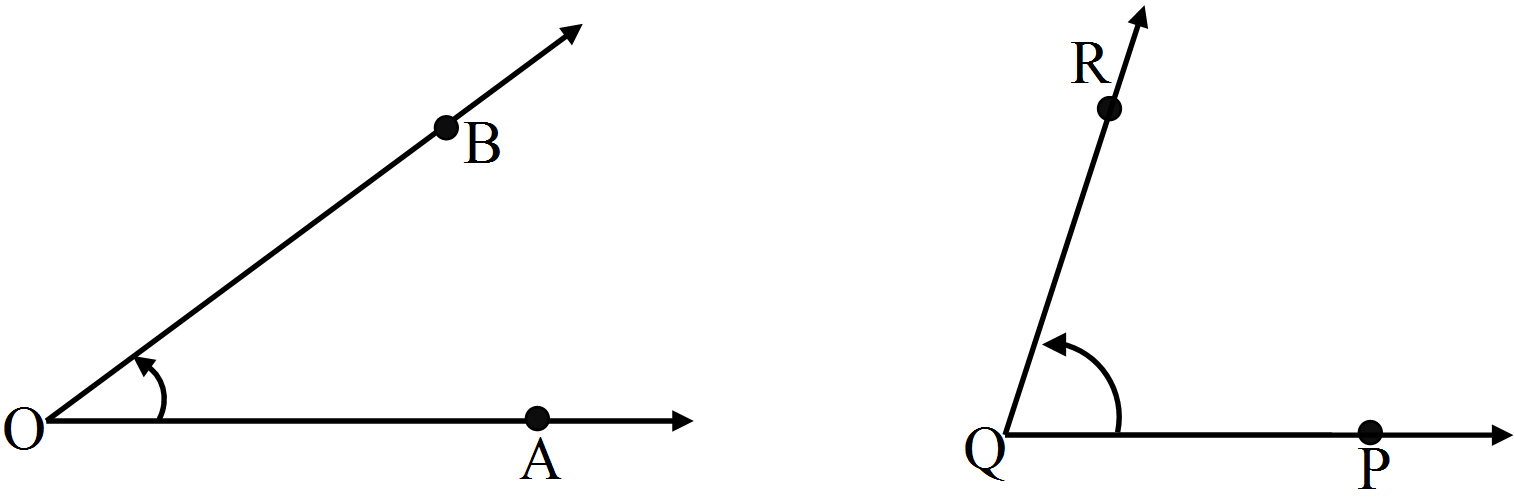
By using tracing paper compare the angles in the pairs given in Fig.
Answer
Using tracing paper, we get that:
$\angle\text{PQR}$ is greater than $\angle\text{AOB}.$
View full question & answer
Question 241 Mark
Classify the following angles as acute, obtuse, straight, right, zero and complete angle:
90º
Answer
An acute angle measures between 0° and 90°. An obtuse angle measures between 90° and 180°. A straight angle measures 180°. A right angle measures 90°. A zero angle measures 0° and a complete angle measures 360°.
90° is a right angle.
View full question & answer
Question 251 Mark
Classify the following angles as acute, obtuse, straight, right, zero and complete angle:
180º
Answer
An acute angle measures between 0° and 90°. An obtuse angle measures between 90° and 180°. A straight angle measures 180°. A right angle measures 90°. A zero angle measures 0° and a complete angle measures 360°.
180° is a straight angle.
View full question & answer
Question 261 Mark
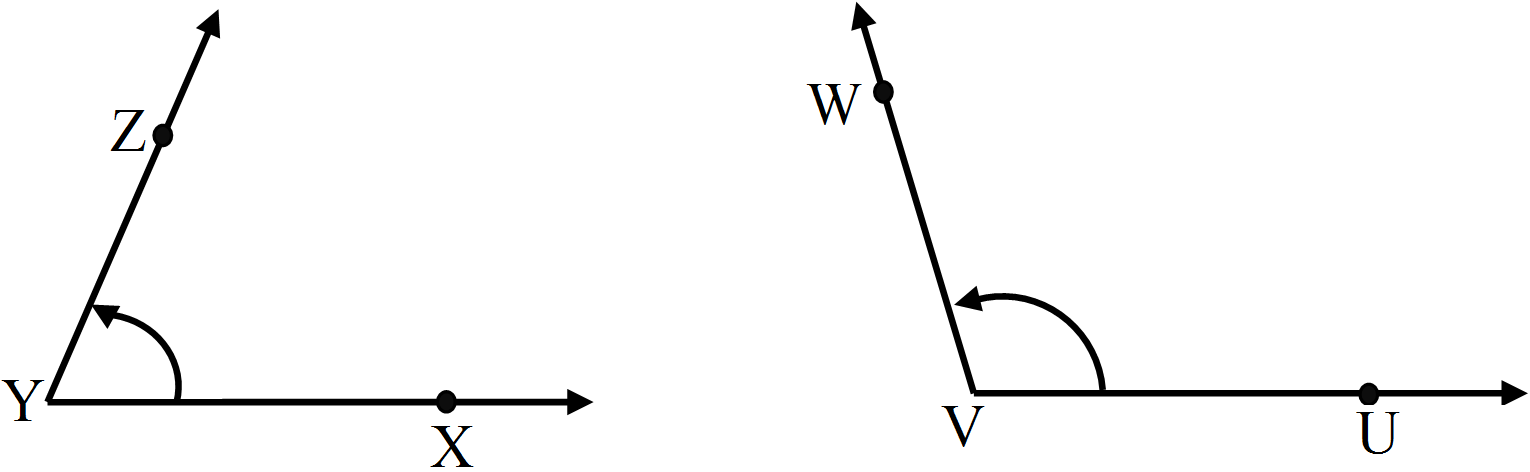
By simply looking at the pair of angles given in Figure, state which of the angles in the pairs is greater:
Answer
$\angle\text{UVW}$ is greater than $\angle\text{XYZ}.$
View full question & answer
Question 271 Mark
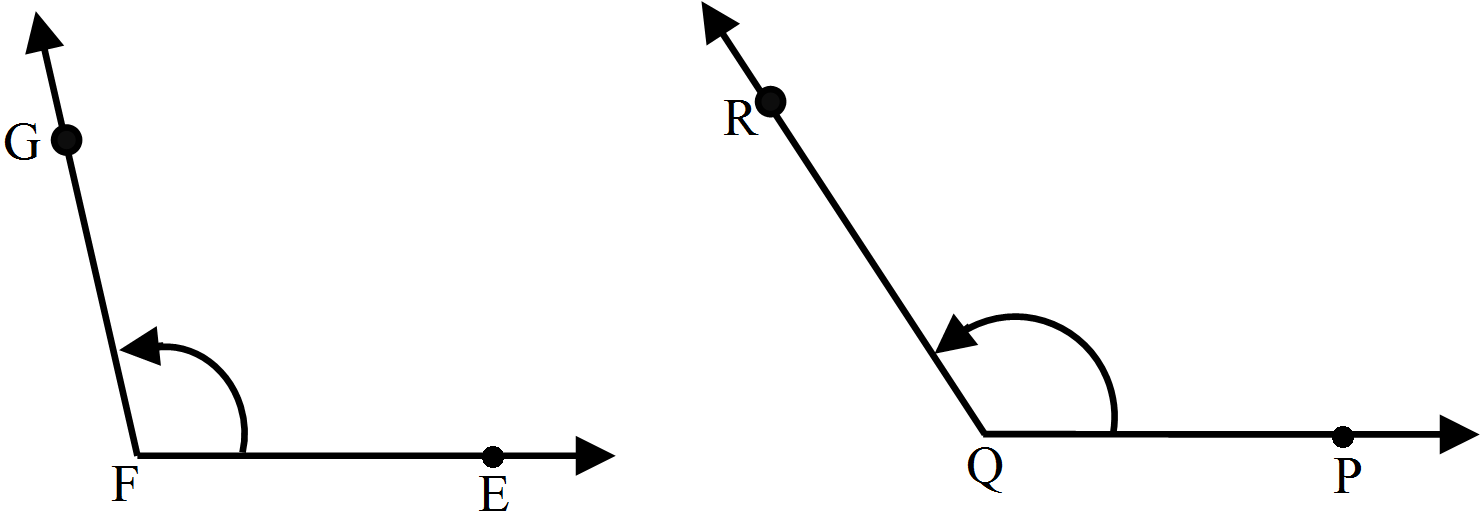
By using tracing paper compare the angles in the pairs given in Fig.
Answer
Using tracing paper, we get that:
$\angle\text{PQR}$ is greater than $\angle\text{EFG}.$
View full question & answer
Question 281 Mark
State the kind of angle, in each case, formed between the following directions:
North and South-East
Answer
North and south-east directions form an angle of 135°, which is an obtuse angle.
View full question & answer
Question 291 Mark
Classify the following angles as acute, obtuse, straight, right, zero and complete angle:
29º
Answer
An acute angle measures between 0° and 90°. An obtuse angle measures between 90° and 180°. A straight angle measures 180°. A right angle measures 90°. A zero angle measures 0° and a complete angle measures 360°.
29° is an acute angle.
View full question & answer
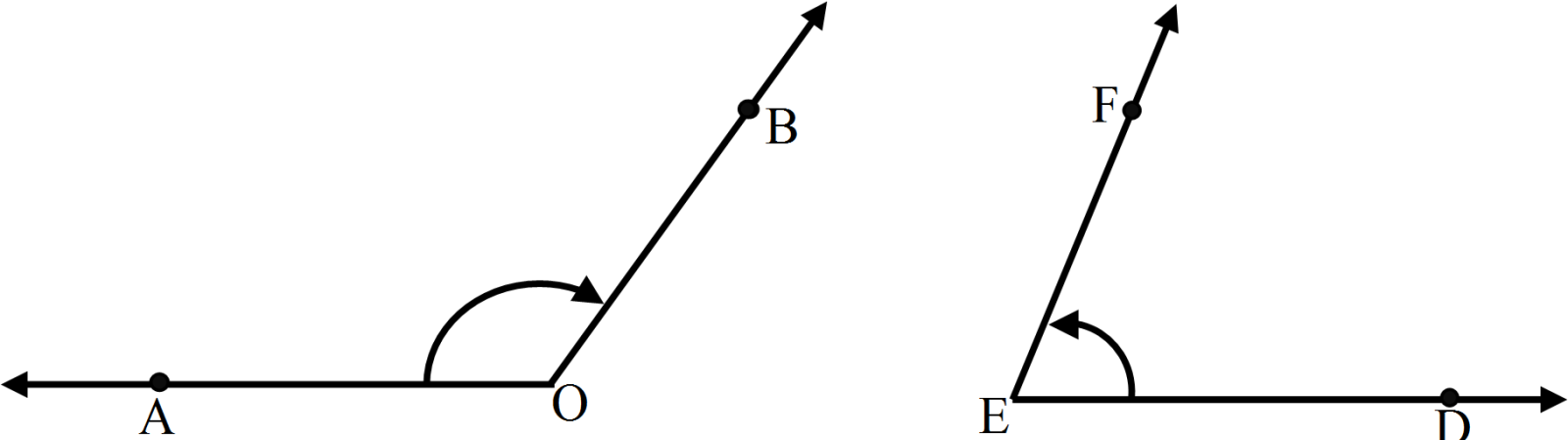
Question 311 Mark
By simply looking at the pair of angles given in Figure, state which of the angles in the pairs is greater:
Answer
$\angle\text{AOB}$ is greater than $\angle\text{DEF}.$
View full question & answer
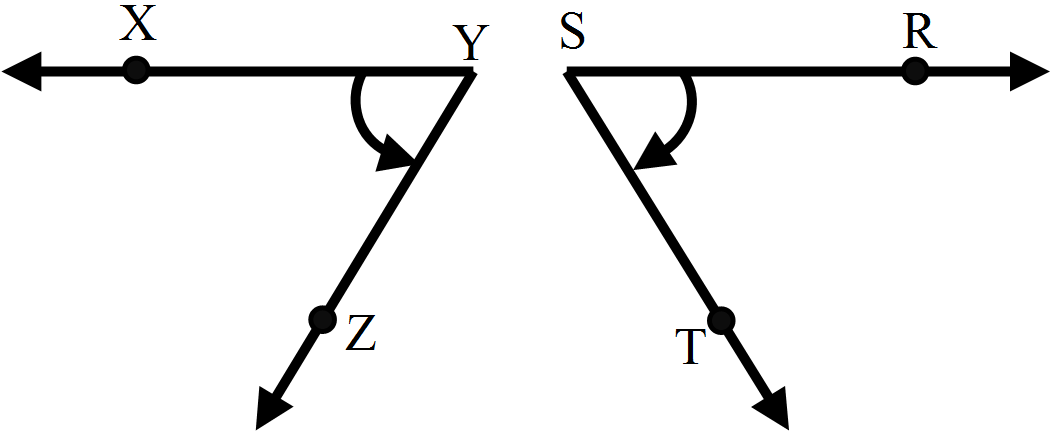
Question 321 Mark
By using tracing paper compare the angles in the pairs given in Fig.
Answer
Using tracing paper, we get that:
$\angle\text{RST}$ is greater than $\angle\text{XYZ}.$
View full question & answer