Questions

3 Mark Question

Take a timed test

9 questions · self-marked practice — reveal the answer and mark yourself.

Question 13 Marks
In name:
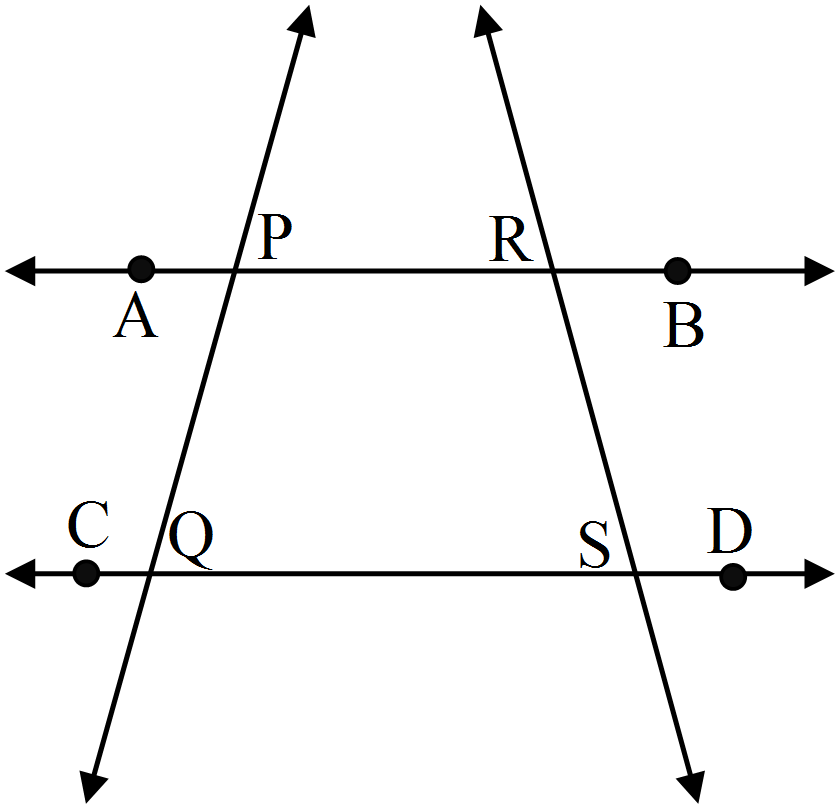
  1. Five line segments.
  2. Five rays.
  3. Non-intersecting line segments.
Answer
  1. Five line segments: PQ, RS, PR, QS, AP.
  2. Five rays: QC, SD, PA, RB, AND RA.
  3. Non intersecting line segments: PR, QS.
View full question & answer
Question 23 Marks
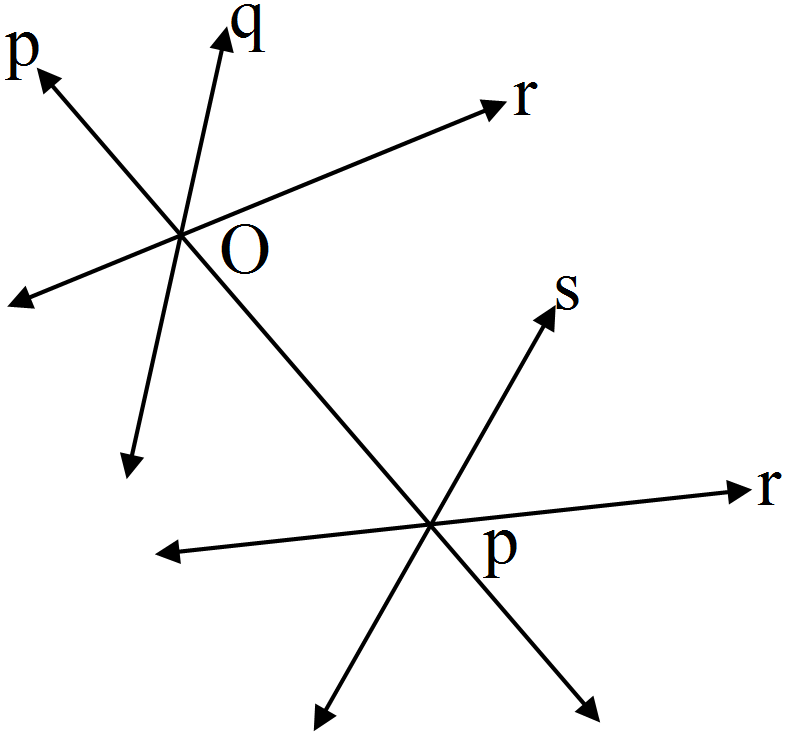
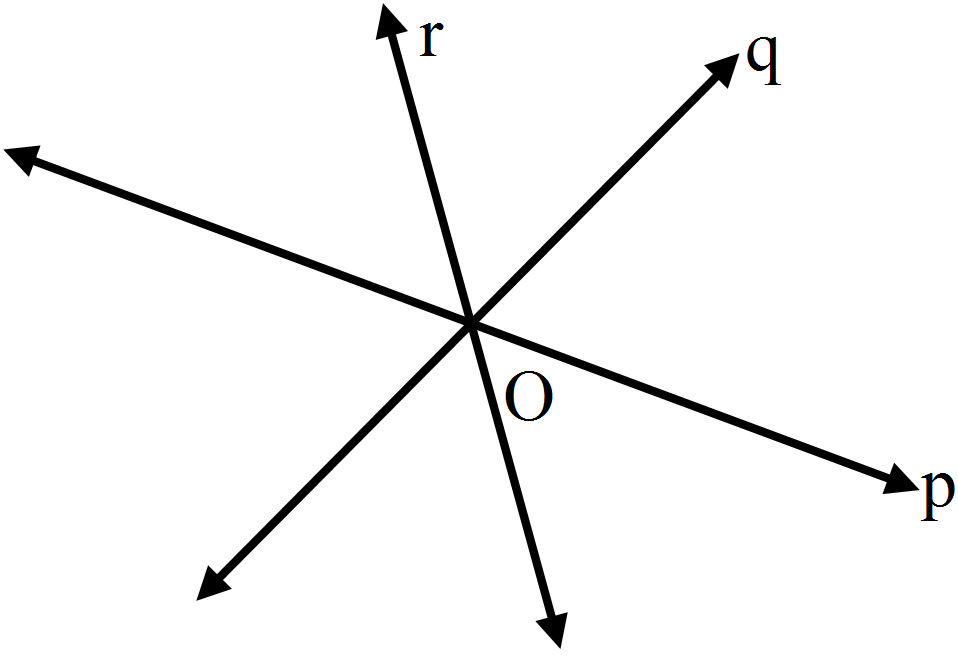
Lines p, q and r are concurrent. Also lines p, s and t are concurrent. Is it always true that the lines q, r and s will be concurrent? Is it always true for lines q, r and t?
Answer
Lines p, q, and r are concurrent. So, lines p, q and r intersect at a common point O.
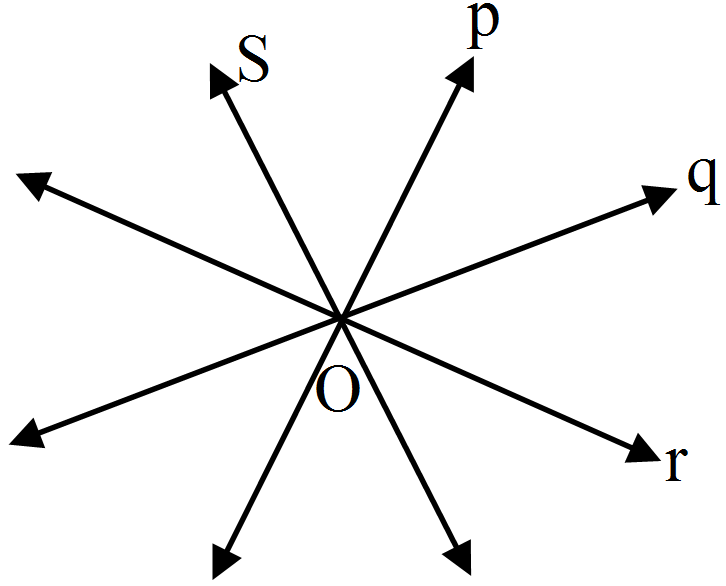
Given lines p, s, and t are concurrent. So, lines p, s and t also intersect at a common point. However, it is not always true that q, r and s or q, r and t are concurrent.
View full question & answer
Question 33 Marks
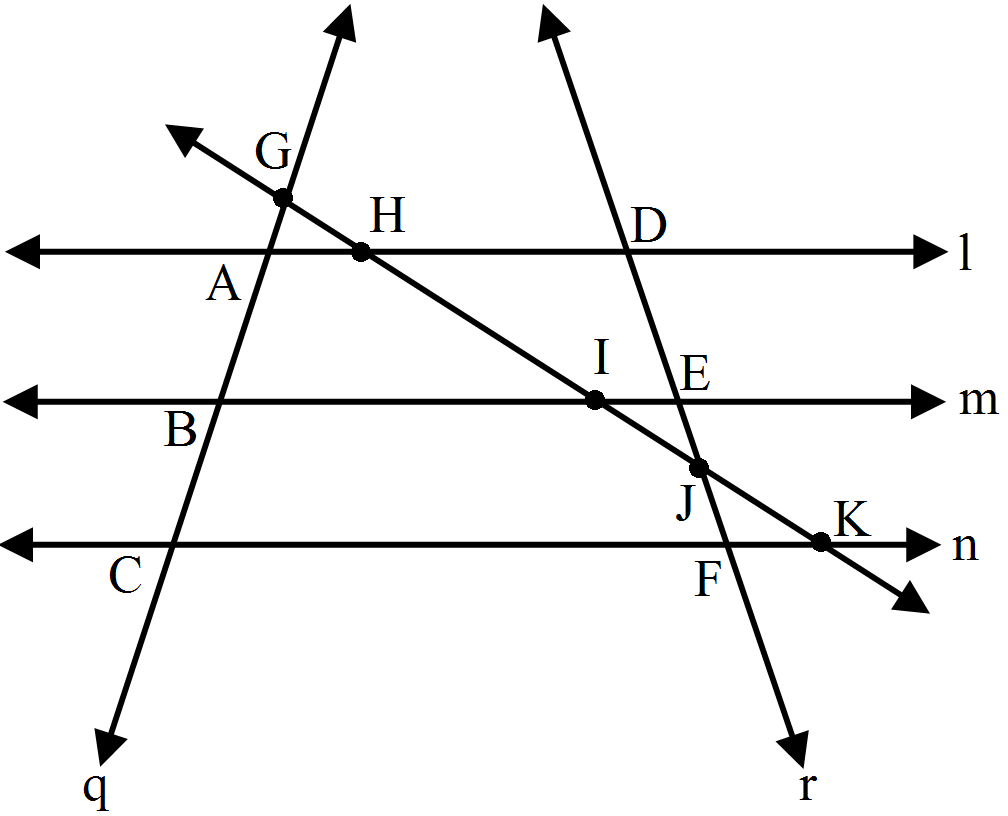
From write:
  1. All paris of parallel lines.
  2. All pairs of intersecting lines.
  3. Lines whose point of intersection is I.
  4. Lines whose point of intersection is D.
  5. Lines whose point of intersection is E.
  6. Lines whose point of intersection is A.
  7. Collinear points.
Answer
  1. All pairs of intersecting lines:
(l, m), (m, n) and (l, n)
  1. All pairs of intersecting lines:
(l, p), (m, p), (n, p), (l, r), (m, r), (n, r), (I, q), (m, q), (n, q), (q, p), (q, r)
  1. Lines whose point of intersection is l:
(m, p)
  1. Lines whose point of intersection is D:
(l, r)
  1. Lines whose point of intersection E:
(m, r)
  1. Lines whose point of intersection is A:
(l, q)
  1. Collinear points:
(G, A, B and C) ,(D, E, J and F), ( G, H, I and J, K), (A, H and D), (B, I and E) and (C, F and K).
View full question & answer
Question 43 Marks
There are a number of ways by which we can visualise a portion of a line. State whether the following represent a portion of a line of not:
  1. A piece of elastic stretched to the breaking point.
  2. Wire between two electric poles.
  3. The line thread by which a spider lowers itself.
Answer
There are a number of ways by which we can visualize a portion of a line. State whether the following represent a portion of line or not:
  1. A piece of elastic stretched to the breaking point - Yes.
  2. Wire between two electric poles - No.
  3. The line thread by which a spider lowers itself - Yes.
View full question & answer
Question 53 Marks
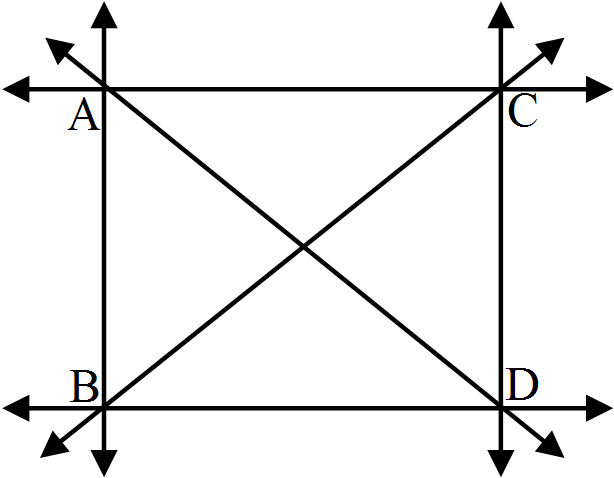
Mark four points A, B, C and D in your notebook such that no three of them are collinear. Draw all the lines which join them in pairs as shown.
  1. How many such lines can be drawn?
  2. Write the names of these lines.
  3. Name the lines which are concurrent at A.
Answer
  1. How many such lines can be drawn.
  2. Six lines can be drawn through these four points as given in the figure.
  3. Write the names of these lines.
  4. These lines are AB, BC, CD, BD and AD.
  5. Name the lines which are concurrent to A.
  6. Lines which are concurrent at A are AC, AB and AD.
View full question & answer
Question 63 Marks
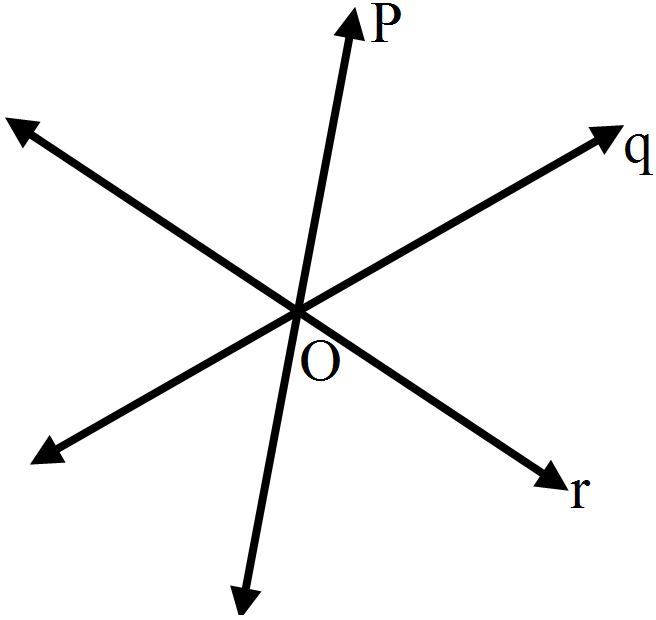
Lines p, q and r are concurrent. Also lines p, r and s are concurrent. Draw a figure and state whether lines p, q, r and s are concurrent or not.
Answer

Thus, lines p, q and r intersect at a common point O.
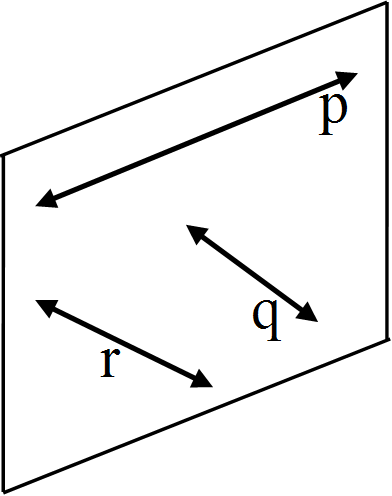
Also, lines p, r and s are concurrent,
Therefore, lines p, r, and s intersect at a common point. But q and r intersect each other at O.
So, p, q and r intersect at O,
Hence, p, q, r and s are concurrent. Lines p, q, r and s intersect at O.
View full question & answer
Question 73 Marks
What is the maximum number of points of intersection of three lines in a plane? What is the minimum number?
Answer
Maximum number of points of intersection of three lines in a plane will be three.
Minimum number of points of intersection of three lines in a plane will be zero.
View full question & answer
Question 83 Marks
With the help of a figure, find the maximum and minimum number of points of intersection of four lines in a plane.
Answer
Maximum number of points of intersection of four lines in a plane will be six,

Minimum number of points of intersection of four lines in a plane will be zero.
View full question & answer
Question 93 Marks
In name all rays with initial points as A, B and C respectively.
  1. Is ray $\overrightarrow{\text{AB}}$ different from ray $\overrightarrow{\text{AC}}$?
  2. Is ray $\overrightarrow{\text{BA}}$ different from ray $\overrightarrow{\text{CA}}$?
  3. Is ray $\overrightarrow{\text{CP}}$ different from ray $\overrightarrow{\text{CQ}}$?
Answer
Name of all rays with initial point as A: $\overrightarrow{\text{AP}}\ \text{and}\ \overrightarrow{\text{AB}}\ \text{or}\ \overrightarrow{\text{AC}}\ \text{or}\ \overrightarrow{\text{AQ}}$
Name of all rays with initial point as B: $\overrightarrow{\text{BP}}\text{or}\ \overrightarrow{\text{BA}}\ \text{and}\ \overrightarrow{\text{BC}}\ \text{or}\ \overrightarrow{\text{BQ}}$
Name of all rays with initial point as C: $\overrightarrow{\text{CP}}\ \text{or}\ \overrightarrow{\text{CA}}\ \text{or}\ \overrightarrow{\text{CB}}\ \text{and}\ \overrightarrow{\text{CQ}}$
  1. No, because the origin point of both the rays $\overrightarrow{\text{AB}}$ and $\overrightarrow{\text{AC}}$ is same.
  2. Yes, because the origin point of both the rays $\overrightarrow{\text{BA}}$ and $\overrightarrow{\text{CA}}$ is different.
  3. Yes, because both the rays $\overrightarrow{\text{CP}}$ and $\overrightarrow{\text{CQ}}$ are in opposite directions.
View full question & answer