Questions

3 Mark Question

Take a timed test

11 questions · self-marked practice — reveal the answer and mark yourself.

Question 13 Marks
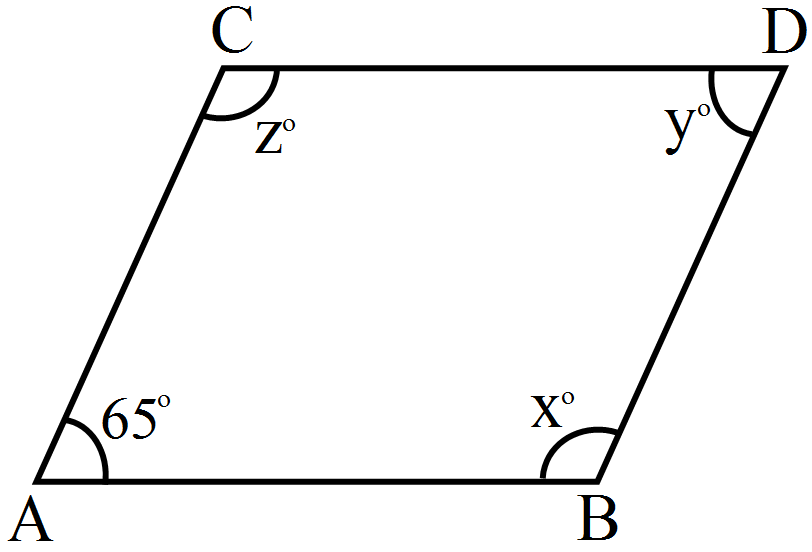
In Figure, AB || CD and AC || BD. Find the values of x, y, z.
Answer
Since, AC || BD and CD || AB, ABCD is a parallelogram
Adjacent angles of parallelogram,
$\angle \text{CAD}+\angle \text{ACD}=180^\circ$
$=\angle \text{ACD}=180^\circ-65^\circ$
$=115^\circ$
Opposite angles of parallelogram,
$=\angle \text{CAD}=\angle \text{CDB}=65^\circ$
$=\angle \text{ACD}=\angle \text{DBA}=115^\circ$
View full question & answer
Question 23 Marks
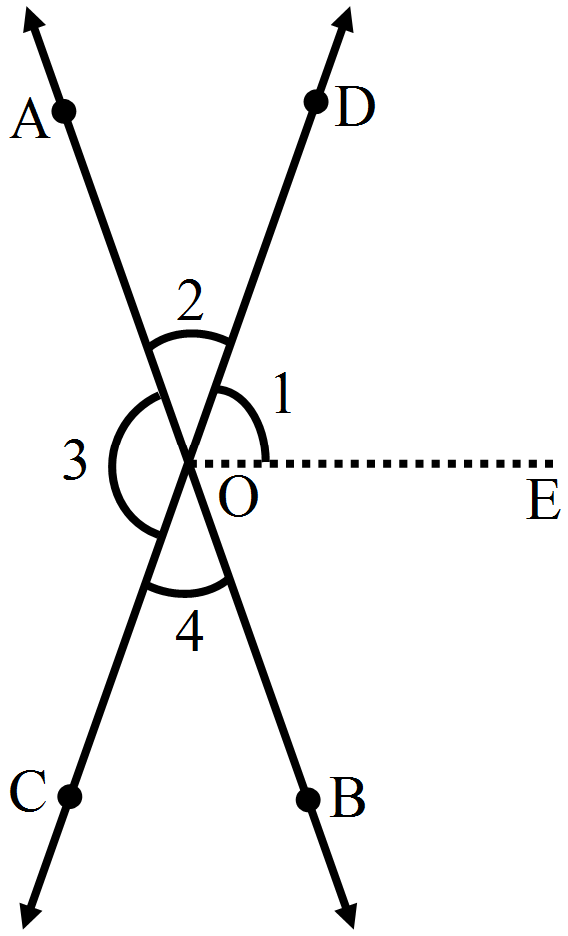
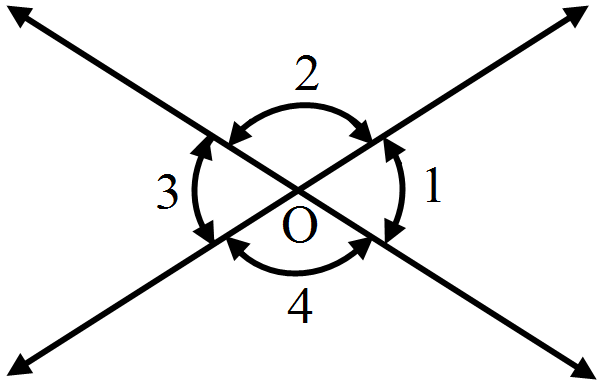
In Fig., it being given that $\angle1 = 65^\circ,$ find all the other angles.
Answer
Given,
$\angle1=\angle3 $ are the vertically opposite angles
Therefore, $\angle3 = 65^\circ$
Here, $\angle1 + \angle2 = 180^\circ$ are the linear pair
Therefore, $\angle2 = 180^\circ-65^\circ$
$= 115^\circ$
$\angle2 = \angle4$ are the vertically opposite angles
Therefore, $\angle2 = \angle4 = 115^\circ$
And $\angle3 = 65^\circ$
View full question & answer
Question 33 Marks
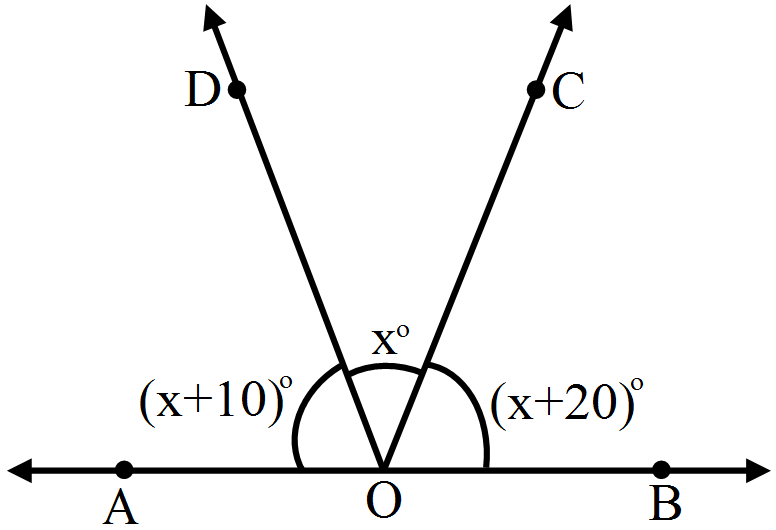
In Figure, find $\angle \text{x}.$ Further find $\angle \text{BOC}, \angle \text{COD}, \text{ and }\angle \text{AOD}$
Answer
$\angle \text{AOD}+\angle \text{DOC}+\angle \text{COB}=180^\circ$ (Linear pair)
$(\text{x}+10)^\circ+\text{x}^\circ+(\text{x}+20)^\circ=180^\circ$
$3\text{x}+30^\circ=180^\circ$
$3\text{x}=180^\circ-30^\circ$
$3\text{x}=150^\circ$
$\text{x}=\frac{150^\circ}{3}=50^\circ$
$\angle \text{BOC}=\text{x}+20^\circ$
$=50^\circ+20^\circ=70^\circ$
$\angle \text{COD}=\text{x}=50^\circ$
$\angle \text{AOD}=\text{x}+10^\circ$
$=50^\circ+10^\circ=60^\circ$
View full question & answer
Question 43 Marks
In Figure, OE is the bisector of $\angle \text{BOD}.$ If $\angle1 =70^\circ,$ Find the magnitude of $\angle2, \angle3, \angle4$
Answer
Since OE is the bisector of $\angle\text{BOD},$
$\therefore\angle\text{DOE}=\angle\text{EOB}$
$\angle2+\angle1+\angle\text{EOB}=180^\circ$ (Linear pair)
$\angle2+\angle1=180^\circ$ $(\angle1=\angle\text{EOB})$
$\Rightarrow\angle2=180^\circ-2\angle1=180^\circ-2\times 70^\circ$
$\Rightarrow 180^\circ-140^\circ=40^\circ$
$\angle4=\angle2=40^\circ$ (Vertically opposite angles)
$\angle3=\angle\text{DOB}=\angle1+\angle\text{EOB}$ $[\angle3=\angle\text{DOB}$ (Vertically opposite)$]$
$=70^\circ+70^\circ$
$=140^\circ$
View full question & answer
Question 53 Marks
If two supplementary angles have equal measure, what is the measure of each angle?
Answer
Let p and q be the two supplementary angles that are equal
$\angle \text{p}=\angle \text{q}$
So,
$\angle \text{p}+\angle \text{q}=180^\circ$
$\Rightarrow\angle \text{p}+\angle \text{p}=180^\circ$
$\Rightarrow2\angle \text{p}=180^\circ$
$\Rightarrow \angle \text{p}=\frac{180^\circ}{2}$
$\Rightarrow \angle \text{p}=90^\circ$
Therefore, $\angle \text{p}=\angle \text{q}=90^\circ$
View full question & answer
Question 63 Marks
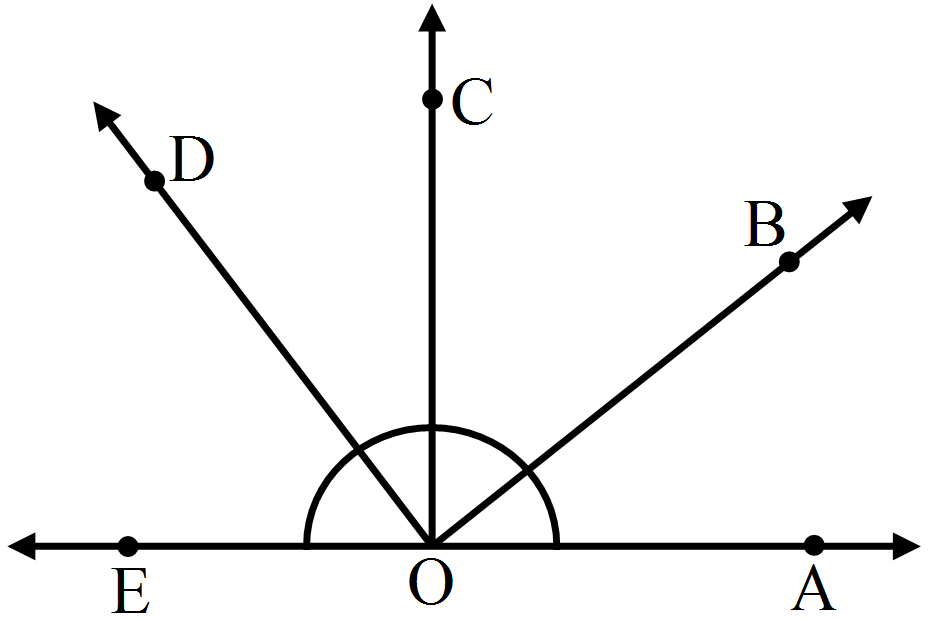
How many pairs of adjacent angles, in all, can you name in Figure?
Answer
There are 10 adjacent pairs,
$\angle \text{EOD}\text{ and }\angle \text{DOC}$
$\angle \text{COD}\text{ and }\angle \text{BOC}$
$\angle \text{COB}\text{ and }\angle \text{BOA}$
$\angle \text{AOB}\text{ and }\angle \text{BOD}$
$\angle \text{BOC}\text{ and }\angle \text{COE}$
$\angle \text{COD}\text{ and }\angle \text{COA}$
$\angle \text{DOE}\text{ and }\angle \text{DOB}$
$\angle \text{EOD}\text{ and }\angle \text{DOA}$
$\angle \text{EOC}\text{ and }\angle \text{AOC}$
$\angle \text{AOB}\text{ and }\angle \text{BOE}$
View full question & answer
Question 73 Marks
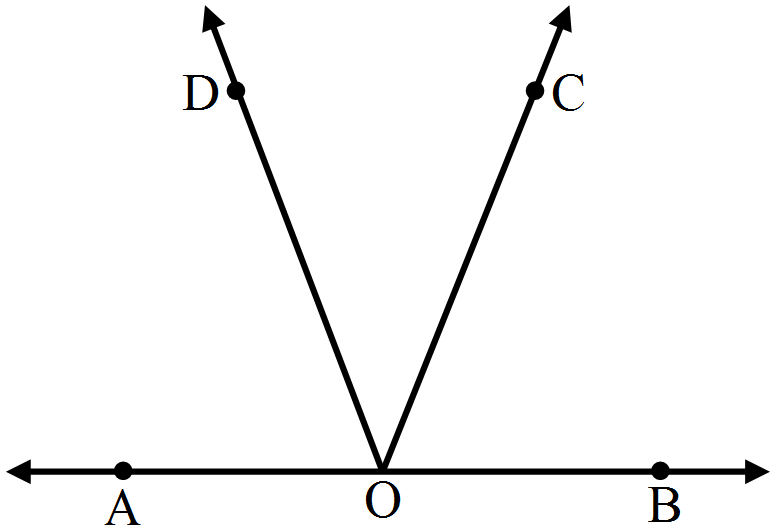
In Figure, write all pairs of adjacent angles and all the linear pairs.
Answer
Pairs of adjacent angles are:
$\angle\text{DOA and }\angle\text{DOC}$
$\angle \text{BOC}\text{ and }\angle \text{COD}$
$\angle \text{AOD}\text{ and } \angle \text{BOD}$
$\angle \text{AOC}\text{ and }\angle \text{BOC}$
Linear pairs:
$\angle \text{AOD}\text{ and }\angle \text{BOD}$
$\angle \text{AOC}\text{ and }\angle \text{BOC}$
View full question & answer
Question 83 Marks
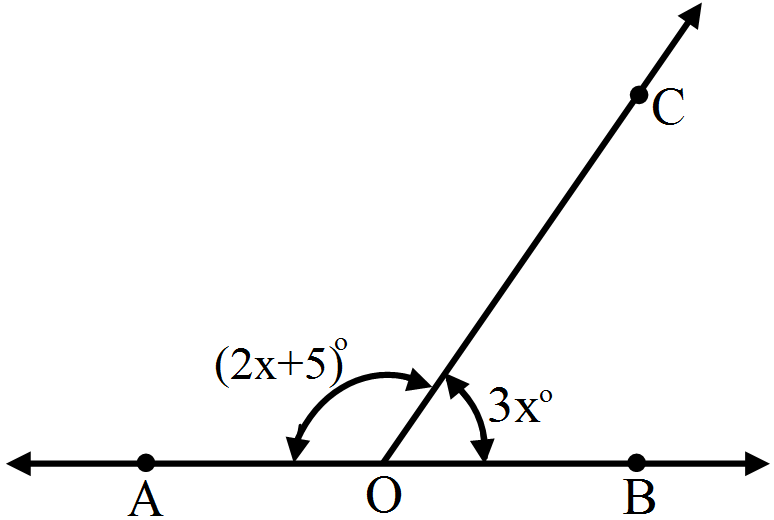
In Fig. OA and OB are the opposite rays:
If x = 25°, what is the value of y?
Answer
$\angle \text{AOC}+\angle \text{BOC}=180^\circ-\text{Linear pair}$
$\Rightarrow 2\text{y}+5+3\text{x}=180^\circ$
$\Rightarrow 3\text{x}+2\text{y}=175^\circ$
If $\text{x}=25^\circ,$ then
$\Rightarrow 3(25^\circ)+2\text{y}=175^\circ$
$\Rightarrow 75^\circ+2\text{y}=175^\circ$
$\Rightarrow 2\text{y}=175^\circ-75^\circ$
$\Rightarrow2\text{y}=100^\circ$
$\Rightarrow \text{y}=\frac{100^\circ}{2}$
$\Rightarrow \text{y}=50^\circ$
View full question & answer
Question 93 Marks
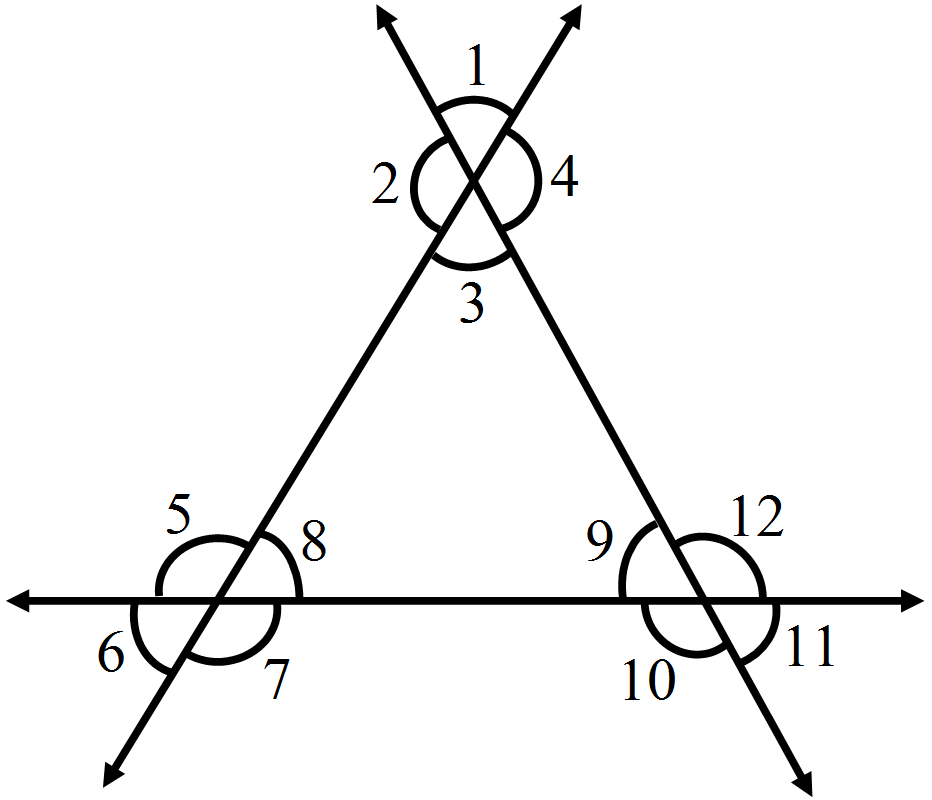
In Figure, name each linear pair and each pair of vertically opposite angles.
Answer
Two adjacent angles are said to be linear pair of angles, if their non-common arms are two opposite rays.
$\angle1 \text{ and } \angle2$
$\angle2 \text{ and } \angle3$
$\angle3 \text{ and } \angle4$
$\angle1 \text{ and } \angle4$
$\angle5 \text{ and } \angle6$
$\angle6 \text{ and } \angle7$
$\angle7 \text{ and } \angle8$
$\angle8 \text{ and } \angle5$
$\angle9 \text{ and } \angle10$
$\angle10 \text{ and } \angle11$
$\angle11 \text{ and } \angle12$
$\angle12 \text{ and } \angle9$
The two angles are said to be vertically opposite angles if the two intersecting lines have no common arms.
$\angle1 \text{ and } \angle3$
$\angle4 \text{ and } \angle2$
$\angle5 \text{ and } \angle7$
$\angle6 \text{ and } \angle8$
$\angle9 \text{ and } \angle11$
$\angle10 \text{ and } \angle12$
View full question & answer
Question 103 Marks
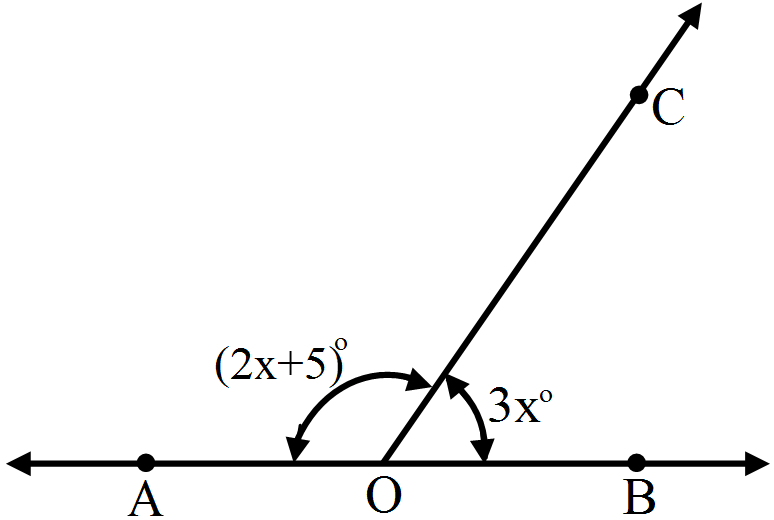
In Fig. OA and OB are the opposite rays:
If y = 35°, what is the value of x?
Answer
$\angle \text{AOC}+\angle \text{BOC}=180^\circ-\text{Linear pair}$
$\Rightarrow 2\text{y}+5+3\text{x}=180^\circ$
$\Rightarrow 3\text{x}+2\text{y}=175^\circ$
If $\text{y}=35^\circ,$ then
$3\text{x}+2(35^\circ)=175^\circ$
$\Rightarrow 3\text{x}+70^\circ=175^\circ$
$\Rightarrow 3\text{x}=175^\circ-70^\circ$
$\Rightarrow 3\text{x}=105^\circ$
$\Rightarrow \text{x}=\frac{105^\circ}{3}$
$\Rightarrow \text{x}=35^\circ$
View full question & answer
Question 113 Marks
If the complement of an angle is 28°, then find the supplement of the angle.
Answer
Here, let p be the complement of the given angle 28°
Therefore, $\angle \text{p}+28^\circ=90^\circ$
$\Rightarrow \angle \text{p}=90^\circ-28^\circ$
$=62^\circ$
So, the supplement of the angle = 180° - 62°
= 118°
View full question & answer