MCQ 11 Mark
The area of a square and that of a square drawn on its diagonal are in the ratio:
- A
$1:\sqrt{2}$
- ✓
$1 : 2$
- C
$1 : 3$
- D
$1 : 4$
AnswerCorrect option: B. $1 : 2$
Let side of square $=\text{a}$
Then its diagonal $=\sqrt{2}\text{a}$
Now, area of square $=\text{a}^2$
and area of square on diagonal $=(\sqrt{2}\text{a}^2)=2\text{a}^2$
Ratio $=\text{a}^2:2\text{a}^2=1:2$
View full question & answer→MCQ 21 Mark
The perimeters of a square and a rectangle are equal. If their areas be $A m ^2$ and $B m ^2$, then which of the following is a true statement?
- A
$\text{A}<\text{B}$
- B
$\text{A}\leq\text{B}$
- ✓
$\text{A}>\text{B}$
- D
$\text{A}\geq\text{B}$
AnswerCorrect option: C. $\text{A}>\text{B}$
$\text{A}>\text{B}$
If perimeters of a square and a rectangle are equal Then the area of the square will be greater than that of a rectangle $A > B$
View full question & answer→MCQ 31 Mark
The base and height of a triangle are $12m$ and $8m$ respectively. Its area is:
- A
$96\text{m}^2$
- ✓
$48\text{m}^2$
- C
$16\sqrt{3}\text{m}^2$
- D
$16\sqrt{2}\text{m}^2$
AnswerCorrect option: B. $48\text{m}^2$
Base of triangle $=12\text{m}$
and height $=8\text{m}$
Area $=\frac{1}{2}\times\text{base}\times\text{height}$
$=\frac{1}{2}\times12\times8=48\text{m}^2$
View full question & answer→MCQ 41 Mark
The area of a rhombus is $144 cm^2$ and one of its diagonals is double the other. The length of the longer diagonal is:
Answer24 cm
Area of a rhombus $=144 cm^2$
Let one diagonal $\left( d _1\right)= a$
then Second diagonal $\left( d _2\right)=2 a$
$\therefore \frac{1}{2} d_1 \times d_2=144$
$\Rightarrow \frac{1}{2} a \times 2 a=144$
$\Rightarrow a^2=144=(12)^2$
$\Rightarrow a=12$
Largar diagonal $=2 a =2 \times 12=24 cm$
View full question & answer→MCQ 51 Mark
On increasing each side of a square by $25 \%$, the increase in area will be:
- A
$25 \%$
- B
$55 \%$
- C
$40.5 \%$
- ✓
$56.25 \%$
AnswerCorrect option: D. $56.25 \%$
$56.25 \%$
Let original side of square $=x$
area $=x^2$
Increased side $=\text{x}\times\Big(\frac{100+25}{100}\Big)$
$=\text{x}\times\frac{125}{100}=\frac{5}{4}\text{x}$
$\therefore\text{Area}=\Big(\frac{5}{4}\text{x}\Big)^2=\frac{25}{16}\text{x}^2$
$\therefore$ Increase in area $=\frac{25}{16}\text{x}^2-\text{x}^2$
$=\Big(\frac{25-16}{16}\Big)\text{x}^2$
$=\frac{9}{16}\text{x}^2$
% increase $=\frac{9}{16}\text{x}^2\times\frac{100}{\text{x}^2}$
$=\frac{9\times25}{4}\%=\frac{225}{4}\%$
$=56.25\%$
View full question & answer→MCQ 61 Mark
The length and breadth of a rectangular field are in the ratio $5: 3$ and its perimeter is 480 m . The area of the field is:
- A
$7200 m^2$
- ✓
$13500 m^2$
- C
$15000 m^2$
- D
$54000 m^2$
AnswerCorrect option: B. $13500 m^2$
$13500 m^2$
Perimeter of rectangle $=480\text{m}$
$\therefore\text{l + b}=\frac{480}{2}=240\text{m}$
$\text{l : b}=5:3$
$\therefore\text{length}=\frac{240\times5}{5+3}=\frac{240\times5}{8}=150$
and breadth $=\frac{240\times3}{5+3}=\frac{240\times3}{8}=90\text{m}$
and area $=\text{l}\times\text{b}=150\times90=13500\text{m}^2$
View full question & answer→MCQ 71 Mark
The area of an equilateral triangle is $4\sqrt{3}\text{cm}^2.$ The length of each of its sides is:
AnswerCorrect option: B. $4\text{cm}$
Let side $=\text{a}$
Then area $=\frac{\sqrt{3}}{4}\text{a}^2$
$\therefore\frac{\sqrt{3}}{4}\text{a}^2=4\sqrt{3}$
$\text{a}^2=4\sqrt{3}\times\frac{4}{\sqrt{3}}=16=(4)^2$
$\therefore\text{a}=4$
$\Rightarrow\text{side}=4\text{cm}$
View full question & answer→MCQ 81 Mark
Mark ( $\checkmark$ ) against the correct answer.
The circumference of a circle is 44 cm . Its area is:
- A
$308 cm^2$
- ✓
$154 cm^2$
- C
$77 cm^2$
- D
$616 cm^2$
AnswerCorrect option: B. $154 cm^2$
$154 cm^2$
Let the radius of the circle be r cm.
Circumference $=(2\pi\text{r})\text{cm}$
$(2\pi\text{r})=44$
$\Rightarrow\Big(2\times\frac{22}{7}\times\text{r}\Big)=44$
$\Rightarrow\text{r}=\Big(\frac{44\times7}{2\times22}\Big)=7\text{cm}$
$\therefore$ Area of the circle $=\pi\text{r}^2$
$=\Big(\frac{22}{7}\times7\times7\Big)\text{cm}^2=154\text{cm}^2$
View full question & answer→MCQ 91 Mark
The length of a rectangular field is thrice its breadth and its perimeter is $240m$. The length of the field is:
AnswerPerimeter of rectangle $= 240m$
$l + b =\frac{240}{2}=120\text{m}$
Let breadth $= x$, then length $= 3x.$
$3x + x = 120$
$\Rightarrow 4x = 120$
$\Rightarrow x = 30$
Length $= 3x = 3 \times 30 = 90m$
View full question & answer→MCQ 101 Mark
The perimeter of the floor of a room is 18m and its height is 3m. What is the area of 4 walls of the room?
- A
$21 m^2$
- B
$42 m^2$
- ✓
$54 m^2$
- D
$108 m^2$
AnswerCorrect option: C. $54 m^2$
$54 m^2$
Perimeter of room $=18 m$
and height $=3 m$
Area of 4 walls $=$ Perimeter $\times$ height
$=18 \times 3=54 m^2$
View full question & answer→MCQ 111 Mark
How many metres of carpet 63cm wide will be required to cover the floor of a room 14m by 9m?
Answer200m
Area of floor $=1 \times b=14 \times 9=126 m^2$
Area of carpet $=126 m^2$
Width of carpet $=63\text{cm}=\frac{63}{100}\text{m}$
$\therefore$ Length of carpet $=\frac{\text{Area}}{\text{Width}}$
$=\frac{126\times100}{63}=200\text{m}$
View full question & answer→MCQ 121 Mark
Mark ( $\checkmark$ ) against the correct answer.
The area of a square is $50 cm^2$. The length of its diagonal is:
- A
$5\sqrt{2}\text{cm}$
- ✓
$10\text{cm}$
- C
$10\sqrt{2}\text{cm}$
- D
$8\text{cm}$
AnswerCorrect option: B. $10\text{cm}$
$10\text{cm}$
Given that the area of the square is $50 cm^2$
We know:
Area of a square
$=\Big\{\frac{1}{2}\times(\text{Diagonal})^2\Big\}\text{ sq. units}$
$\therefore$ Diagonal of the square $=\sqrt{2\times\text{Area of the square}}$
$=(\sqrt{2\times50})\text{cm}=(\sqrt{100})\text{cm}=10\text{cm}$
Hence, the diagonal of the square is 10cm.
View full question & answer→MCQ 131 Mark
The length of a rectangle is 16cm and the length of its diagonal is 20cm. The area of the rectangle is:
- A
$320 cm^2$
- B
$160 cm^2$
- ✓
$192 cm^2$
- D
$156 cm^2$
AnswerCorrect option: C. $192 cm^2$
$192 cm^2$
Length of rectangle $A B=16 cm$
and diagonal $BD =20 cm$
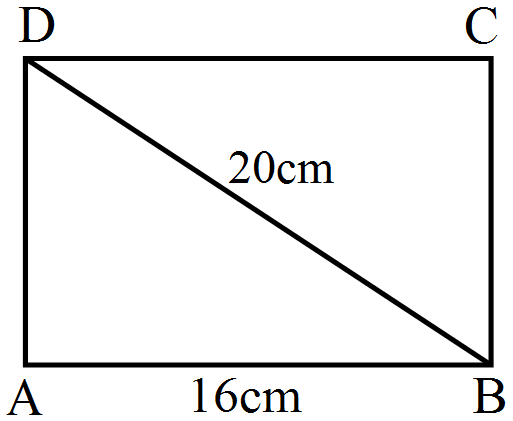
But, in right $\triangle ABD$
$B D^2=A B^2+A D^2$
$\Rightarrow(20)^2=(16)^2+A D^2$
$\Rightarrow 400=256+A D^2$
$\Rightarrow A D^2=400-256=144=(12)^2$
$\Rightarrow A D=12 cm$
Area $=1 \times b =16 \times 12=192 cm^2$ View full question & answer→MCQ 141 Mark
Mark ( $\checkmark$ ) against the correct answer.
The lengths of the diagonals of a rhombus are 18 cm and 15 cm . The area of the rhombus is:
- A
$270 cm^2$
- ✓
$135 cm^2$
- C
$90 cm^2$
- D
$180 cm^2$
AnswerCorrect option: B. $135 cm^2$
$135 cm^2$
Solution:
Area of the rhombus $=\frac{1}{2} \times$ (Product of the diagonals)
$=\frac{1}{2} \times 18 \times 15=135 cm^2$
Hence, the area of the rhombus is $135 cm^2$.
View full question & answer→MCQ 151 Mark
Mark $( \sqrt{ } )$ against the correct answer.
Each diagonal of a square is $14 \ cm$ long. Its area is:
- A
$196 \ cm^2$
- B
$88 \ cm^2$
- ✓
$98 \ cm^2$
- D
$147 \ cm^2$
AnswerCorrect option: C. $98 \ cm^2$
Given that the diagonal of a square is $14\ cm$
Area of a square
$=\Big\{\frac{1}{2}\times(\text{Diagonal})^2\Big\}\text{ sq. units}$
$=\Big\{\frac{1}{2}\times(14)^2\Big\}\text{cm}^2$
$=\Big\{\frac{1}{2}\times196\Big\}\text{cm}^2=98\text{cm}^2$
Hence, area of the square is $98 \ cm^2$.
View full question & answer→MCQ 161 Mark
Mark ( $\checkmark$ ) against the correct answer.
The sides of triangle are $13 cm, 14 cm$ and 15 cm . The area of the triangle is:
- ✓
$84 cm^2$
- B
$91 cm^2$
- C
$105 cm^2$
- D
$97.5 cm^2$
AnswerCorrect option: A. $84 cm^2$
$84 cm^2$
Let a = 13cm, b = 14cm and c = 15cm
$\text{s}=\frac{\text{a + b + c}}{2}$
$=\Big(\frac{13+14+15}{2}\Big)\text{cm}$
$=21\text{cm}$
$\therefore$ Area of the triangle
$=\sqrt{\text{s(s}-\text{a})\text{(s}-\text{b})\text{(s}-\text{c})}\text{ sq. units}$
$=\sqrt{21(21-13)(21-14)(21-15)}\text{cm}^2$
$=\sqrt{21\times8\times7\times6}\text{cm}^2$
$=\sqrt{3\times7\times2\times2\times2\times7\times2\times3}\text{cm}^2$
$=(2\times2\times3\times7)\text{cm}^2=84\text{cm}^2$
View full question & answer→MCQ 171 Mark
The difference between the circumference and radius of a circle is 37cm. The area of the circle is:
- A
$111 cm^2$
- B
$148 cm^2$
- ✓
$154 cm^2$
- D
$259 cm^2$
AnswerCorrect option: C. $154 cm^2$
$154 cm^2$
Let r be the radius of the circle Then
$\text{c}=2\pi\text{r}$
$2\pi\text{r}-\text{r}=37$
$\Rightarrow\text{r}\Big(2\times\frac{22}{7}-1\Big)=37$
$\Rightarrow\text{r}\Big(\frac{44}{7}-1\Big)=37$
$\Rightarrow\text{r}\Big(\frac{37}{7}\Big)=37$
$\therefore\text{r}=\frac{37\times7}{37}=7\text{cm}$
and area $=\pi\text{r}^2=\frac{22}{7}\times7\times7=154\text{cm}^2$
View full question & answer→MCQ 181 Mark
The length of a room is $15m$. The cost of carpeting it with a carpet $75\ cm$ wide at $Rs .50$ per metre is $Rs .6000$. The width of the room is:
AnswerTotal cost of carpet $=\text{Rs. }6000$
Rate per metre $=\text{Rs. }50$
$\therefore$ Length of carpet $=\frac{6000}{50}=120\text{m}$
Width $=75\text{cm}=\frac{3}{4}\text{m}$
$\therefore$ Area of room $=120\times\frac{3}{4}$
$=90\text{m}^2$
But length of room $=15\text{m}$
$\therefore\text{breadth} =\frac{\text{Area}}{\text{Length}}=\frac{90}{15}=6\text{m}$
View full question & answer→MCQ 191 Mark
The ratio of the area of a square of side a and that of an equilateral triangle of side a, is:
- A
$2:1$
- B
$2:\sqrt{3}$
- C
$4:3$
- ✓
$4:\sqrt{3}$
AnswerCorrect option: D. $4:\sqrt{3}$
$4:\sqrt{3}$
Side of a square = a
Area = $a^2$
Side of equilateral triangle = a
$\therefore\text{Area}=\frac{\sqrt{3}}{4}\text{a}^2$
$\therefore$ Ratio in their areas $=\frac{\text{a}^2}{\frac{\sqrt{3}}{4}\text{a}^2}$
$=\frac{4\text{a}^2}{\sqrt{3}\text{a}^2}=\frac{4}{\sqrt{3}}$
$=4:\sqrt{3}$
View full question & answer→MCQ 201 Mark
One side of a parallelogram is $16\ cm$ and the distance of this side from the opposite side is $4.5\ cm.$ The area of the parallelogram is:
- A
$36 \ cm^2$
- ✓
$72 \ cm^2$
- C
$18 \ cm^2$
- D
$54 \ cm^2$
AnswerCorrect option: B. $72 \ cm^2$
One side $($Base$)$ of parallelogram $=16 \ cm$
and altitude $=4.5 \ cm$
Area $=$ base $\times$ altitude $=16 \times 4.5=72 \ cm^2$
View full question & answer→MCQ 211 Mark
Mark $(✓)$ against the correct answer.
One side of a parallelogram is $14\ cm$ and the distance of this side from the opposite side is $6.5\ cm.$ The area of the parallelogram is:
- A
$45.5 \ cm^2$
- ✓
$91 \ cm^2$
- C
$182 \ cm^2$
- D
$190 \ cm^2$
AnswerCorrect option: B. $91 \ cm^2$
Base $=14 \ cm$
Height $=6.5 \ cm$
Area of the parallelogram $=$ Base $\times$ Height
$=(14 \times 6.5) \ cm ^2$
$=91 \ cm^2$
View full question & answer→MCQ 221 Mark
The lengths of the diagonals of a rhombus are $24\ cm$ and $18\ cm$ respectively. Its area is:
- A
$432 \ cm^2$
- ✓
$216 \ cm^2$
- C
$108 \ cm^2$
- D
$144 \ cm^2$
AnswerCorrect option: B. $216 \ cm^2$
Length of diagonals of a rhombus are $24\ cm$ and $18\ cm$
$\therefore\text{Area}=\frac{\text{Product of diagonals}}{2}$
$=\frac{24\times18}{2}=216\text{cm}^2$
View full question & answer→MCQ 231 Mark
Mark $(\checkmark)$ against the correct answer.
The area of a circle is $154 \ cm^2$. Its diameter is:
- ✓
$14 \ cm$
- B
$11 \ cm$
- C
$7 \ cm$
- D
$22 \ cm$
AnswerCorrect option: A. $14 \ cm$
Let the radius of the circle be $r \ cm$
Then, its area will be $(\pi\text{r}^2)\text{cm}^2$
$\pi\text{r}^2=154$
$\Rightarrow\Big(\frac{22}{7}\times\text{r}\times\text{r}\Big)=154$
$\Rightarrow\text{r}^2=\Big(\frac{154\times7}{22}\Big)=49$
$\Rightarrow\text{r}=\sqrt{49}=7\text{cm}$
$\therefore$ Diameter of the circle $=2 r =(2 \times 7) \ cm =14 \ cm$
View full question & answer→MCQ 241 Mark
If the ratio of the areas of two squares is $9: 1$, then the ratio of their perimeters is:
- A
$2: 1$
- ✓
$3: 1$
- C
$3: 2$
- D
$4: 1$
AnswerCorrect option: B. $3: 1$
Ratio in area of two squares $=9: 1$
Let area of bigger square $=9 x^2$
and of smaller square $=x^2$
Side of bigger square $=\sqrt{9} x^2=3 x$
and perimeter $=4 \times$ side $=4 \times 3 x=12 x$
Side of smaller square $=\sqrt{x}^2= x$
Perimeter $=4 x$
Now ratio in their perimeter $=12 x: 4 x=3: 1$
View full question & answer→MCQ 251 Mark
The sides of a triangle measure $13\ cm, 14\ cm$ and $15\ cm.$ Its area is:
- ✓
$84 \ cm^2$
- B
$91 \ cm^2$
- C
$168 \ cm^2$
- D
$182 \ cm^2$
AnswerCorrect option: A. $84 \ cm^2$
Sides are $13\ cm, 14\ cm, 15\ cm$
$\therefore\text{s}=\frac{\text{a + b + c}}{2}$
$=\frac{13+14+15}{2}=\frac{42}{2}=21$
and area $=\sqrt{\text{s(s}-\text{a})\text{(s}-\text{b})\text{(s}-\text{c})}$
$=\sqrt{21(21-13)(21-14)(21-15)}$
$=\sqrt{21\times8\times7\times6}$
$=\sqrt{3\times7\times2\times2\times2\times7\times2\times3}$
$=2\times2\times3\times7$
$=84\text{cm}^2$
View full question & answer→MCQ 261 Mark
The area of a rhombus is $36 \ cm^2$ and the length of one of its diagonals is $6 \ cm .$ The length of the second diagonal is:
- A
$6\ cm$
- B
$6\sqrt{2}\text{cm}$
- ✓
$12\ cm$
- D
AnswerCorrect option: C. $12\ cm$
Area of rhombus $=36 \ cm^2$
Length of one diagonal $=6 \ cm$
Length of second diagonal
$=\frac{\text { Area } \times 2}{\text { One diagonal }}$
$=\frac{36 \times 2}{6}$
$=12 \ cm$
View full question & answer→MCQ 271 Mark
The area of a circle is increased by $22 \ cm^2$ when its radius is increased by $1 \ cm .$ The original radius of the circle is:
- A
$6 \ cm$
- B
$3.2 \ cm$
- ✓
$3 \ cm$
- D
$3.5 \ cm$
AnswerCorrect option: C. $3 \ cm$
Let original radius $=\text{r}$
Then its area $=\pi\text{r}^2$
Radius of increased circle $=\text{r}+1$
$\therefore\text{Area}=\pi(\text{r + 1})^2$
Now $\pi(\text{r}+1)^2-\pi\text{r}^2=22$
$\Rightarrow\pi(\text{r}^2+2\text{r}+1)-\pi\text{r}^2=22$
$\Rightarrow\pi\text{r}^2+2\pi\text{r}+\pi-\pi\text{r}^2=22$
$\Rightarrow\pi(2\text{r}+1)=22$
$\Rightarrow\frac{22}{7}(2\text{r}+1)=22$
$\Rightarrow2\text{r + 1}=\frac{22\times7}{22}$
$\Rightarrow2\text{r}=7-1=6$
$\Rightarrow\text{r}=\frac{6}{2}=3$
Radius of original circle $=3\text{cm}$
View full question & answer→MCQ 281 Mark
The area of a square is equal to the area of a circle. What is the ratio between the side of the square and the radius of the circle?
- ✓
$\sqrt{\pi}:1$
- B
$1:\sqrt{\pi}$
- C
$1:\pi$
- D
$\pi:1$
AnswerCorrect option: A. $\sqrt{\pi}:1$
Let a be the side of a square
Area =$a^2$
Then area of circle =$a^2$
Let r be the radius
$\therefore\text{r}=\sqrt{\frac{\text{Area}}{\pi}}=\sqrt{\frac{\text{a}^2}{\pi}}=\frac{\text{a}}{\sqrt{\pi}}$
$\therefore$ Ratio in side of square and radius of circle
$=\text{a}:\frac{\text{a}}{\sqrt{\pi}}=1:\frac{1}{\sqrt{\pi}}$
$=\sqrt{\pi}:1$
View full question & answer→MCQ 291 Mark
Each side of an equilateral triangle is equal to the radius of a circle whose area is $154\ cm^2$. The area of the triangle is:
AnswerCorrect option: B. $\frac{49\sqrt{3}}{4}\text{cm}^2$
Let each side of an equilateral triangle $=\text{a}$
Then area $=\frac{\sqrt{3}}{4}\text{a}^2$
Now radius of the circle $=\text{a}$
Then area $=\pi\text{r}^2=\pi\text{a}^2$
$\therefore\pi\text{a}^2=154\Rightarrow\frac{22}{7}\text{a}^2=154$
$\text{a}^2=\frac{154\times7}{22}=49=(7)^2$
$\therefore\text{a}=7$
$\therefore\text{Area of }\triangle=\frac{\sqrt{3}}4{}(7)^2=\frac{49\sqrt{3}}{4}\text{cm}^2$
View full question & answer→MCQ 301 Mark
The height of an equilateral triangle is $\sqrt{6}\text{cm}.$ Its area is:
- A
$3\sqrt{3}\text{cm}^2$
- ✓
$2\sqrt{3}\text{cm}^2$
- C
$2\sqrt{2}\text{cm}^2$
- D
$6\sqrt{2}\text{cm}^2$
AnswerCorrect option: B. $2\sqrt{3}\text{cm}^2$
Let a be the side of an equilateral triangle
$\therefore\text{Altitude}=\frac{\sqrt{3}}{2}\text{a}$
$\therefore\frac{\sqrt{3}}2{}\text{a}=\sqrt{6}$
$\Rightarrow\text{a}=\frac{\sqrt{6}\times2}{\sqrt{3}}=2\sqrt{2}$
and area $=\frac{\sqrt{3}}{4}\text{a}^2=\frac{\sqrt{3}}{4}(2\sqrt{2})^2$
$=\frac{\sqrt{3}}4{}\times4\times2$
$=2\sqrt{3}\text{cm}^2$
View full question & answer→MCQ 311 Mark
Each diagonal of a square is $12\ cm$ long. Its area is:
- A
$144 \ cm^2$
- ✓
$72 \ cm^2$
- C
$36 \ cm^2$
- D
$36 \ cm^2$
AnswerCorrect option: B. $72 \ cm^2$
Diagonal of square $= 12\ cm$
Let side $= 9$
diagonal $=\sqrt{2}\text{a}$
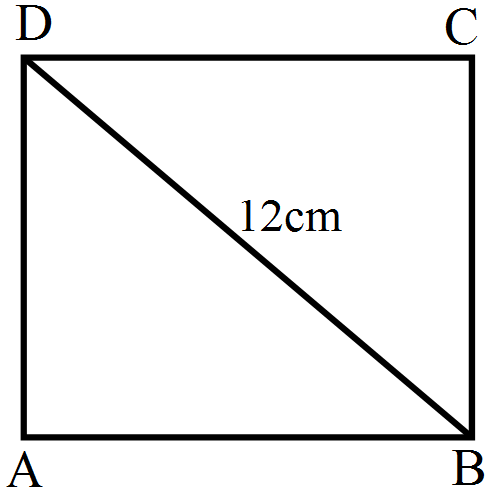
$\therefore\sqrt{2}\text{a}=12\Rightarrow\text{a}=\frac{12}{\sqrt{2}}$
$\therefore\text{Area = a}^2=\Big(\frac{12}{\sqrt{2}}\Big)^2=\frac{12}{\sqrt{2}}\times\frac{12}{\sqrt{2}}=\frac{144}{2}$
$=72\text{cm}^2$ View full question & answer→MCQ 321 Mark
Each side of an equilateral triangle is $8\ cm$ long. Its area is:
- A
$32\text{cm}^2$
- B
$64\text{cm}^2$
- ✓
$16\sqrt{3}\text{cm}^2$
- D
$16\sqrt{2}\text{cm}^2$
AnswerCorrect option: C. $16\sqrt{3}\text{cm}^2$
Side of an equilateral triangle $=8\text{cm}$
$\therefore\text{Area}=\frac{\sqrt{3}}{4}\text{a}^2=\frac{\sqrt{3}}{4}\times8\times8\text{cm}^2$
$=16\sqrt{3}\text{cm}^2$
View full question & answer→MCQ 331 Mark
If the diagonal of a rectangle is $17\ cm$ long and its perimeter is $46\ cm,$ the area of the rectangle is:
- A
$100 \ cm^2$
- B
$110 \ cm^2$
- ✓
$120 \ cm^2$
- D
$150 \ cm^2$
AnswerCorrect option: C. $120 \ cm^2$
Perimeter $=46 \ cm$
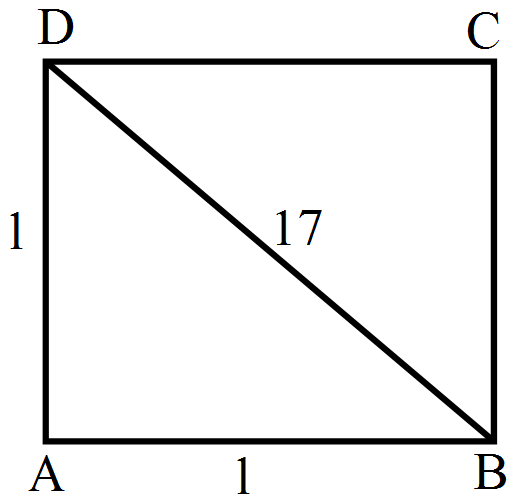
$=l+b=\frac{46}{2}=23 \ cm$
$\text { and } I^2+b^2=17^2=289$
Now $(I+b)^2=(23)^2$
$\Rightarrow l^2+b^2+2 lb=529$
$\Rightarrow 289+2 lb=529$
$\Rightarrow 2 lb=529-289$
$\Rightarrow 21 b=240 \Rightarrow lb$
$=\frac{240}{2}=120$
Now area of rectangle $= lb =120 \ cm^2$ View full question & answer→MCQ 341 Mark
The radius of a circular wheel is $1.75m$. How many revolutions will it make in travelling $11\ km?$
- A
$10$
- B
$100$
- ✓
$1000$
- D
$10000$
AnswerCorrect option: C. $1000$
Radius of a circular wheel $(r) =1.75\text{m}$
Circumference $=2\pi\text{r}=2\times\frac{22}{7}\times1.75\text{m}$
$=44\times0.25\text{m}=11\text{m}$
Total distance covered $=11\text{km}$
$\therefore$ No. of revolutions $=\frac{11\text{km}}{11\text{m}}$
$=\frac{11\times1000}{11}=1000$
View full question & answer→MCQ 351 Mark
The area of a square is $200 \ cm^2$. The length of its diagonal is:
- A
$10\ cm$
- ✓
$20\ cm$
- C
$10\sqrt{2}\text{cm}$
- D
$14.1\ cm$
AnswerCorrect option: B. $20\ cm$
Area $=200\text{cm}^2$
side $=\sqrt{200}=\sqrt{2}\times10$
and diagonal $=\sqrt{2}\text{a}=\sqrt{2}\times\sqrt{2}\times10=20$
View full question & answer→MCQ 361 Mark
The area of a square field is $0.5$ hectare. The length of its diagonal is:
- ✓
$100m$
- B
$50m$
- C
$250m$
- D
$50\sqrt{2}\text{m}$
AnswerCorrect option: A. $100m$
Area of square $= 0.5$ hectare $=0.5\times10000=5000\text{m}^2$
$=\sqrt{10000}=100\text{m}$
View full question & answer→MCQ 371 Mark
The area of a circle is $24.64 m^2$. The circumference of the circle is:
- A
$14.64m$
- B
$16.36m$
- ✓
$17.60m$
- D
$18.40m$
AnswerCorrect option: C. $17.60m$
Area of a circle $=24.64\text{m}^2$
$\therefore\text{Radius}=\sqrt{\frac{\text{Area}}{\pi}}$
$=\sqrt{\frac{24.64\times7}{22}}=\sqrt{1.12\times7}$
$=\sqrt{7.84}=2.8\text{m}$
$\therefore$ Circumference $=2\pi\text{r}$
$=2\times\frac{22}{7}\times2.8\text{m}$
$=17.60\text{m}$
View full question & answer→MCQ 381 Mark
The area of a rectangle $144m$ long is the same as that of a square of side $84m.$ The width of the rectangle is:
AnswerCorrect option: C. $49 m$
Side of square $=84 m$
Area of square $=(84)^2=7056 m^2$
Area of rectangle $=7056 m^2$
Length of rectangle $=144 m$
$\text { Width }=\frac{\text { Area }}{\text { Length }}$
$=\frac{7056}{144}=49 m$
View full question & answer→MCQ 391 Mark
Mark $(✓)$ against the correct answer.
The length and breadth of a rectangular park are in the ratio $4 : 3$ and its perimeter is $56m.$ The area of the field is:
- ✓
$192 m^2$
- B
$300 m^2$
- C
$432 m^2$
- D
$228 m^2$
AnswerCorrect option: A. $192 m^2$
Let the length of the rectangular park be $4 x$.
Breadth $=3 x$
Perimeter of the park $=2(1+b)=56 m ($given$)$
$\Rightarrow 56=2(4 x+3 x)$
$\Rightarrow 56=14 x$
$\Rightarrow x=4$
Length $=4 x=(4 \times 4)=16 m$
Breadth $=3 x =(3 \times 4)=12 m$
Area of the rectangular park $=16 m \times 12 m=192 m^2$
View full question & answer→MCQ 401 Mark
The ratio of the areas of two squares, one having its diagonal double that of the other, is:
- A
$2: 1$
- B
$3: 1$
- C
$3: 2$
- ✓
$4: 1$
AnswerCorrect option: D. $4: 1$
Let the diagonals of two square be $2 d$ and
Area of bigger square $2(2 d)^2=8 d^2$
and of smaller $=2(d)^2=2 d^2$
Ratio in their area $=\frac{8 d^2}{2 d^2}=\frac{4}{1}$
$=4: 1$
View full question & answer→MCQ 411 Mark
Mark $(✓)$ against the correct answer. Each side of an equilateral triangle is $8\ cm$. Its area is:
- ✓
$16\sqrt{3}\text{cm}^2$
- B
$32\sqrt{3}\text{cm}^2$
- C
$24\sqrt{3}\text{cm}^2$
- D
$8\sqrt{3}\text{cm}^2$
AnswerCorrect option: A. $16\sqrt{3}\text{cm}^2$
Given that each side of an equilateral triangle is $8\ cm$
Area of the equilateral triangle
$=\frac{\sqrt{3}}{4}(\text{side)}^2\text{sq. units}$
$=\frac{\sqrt{3}}{4}(8)^2\text{cm}^2$
$=\Big(\frac{\sqrt{3}}4{}\times64\Big)\text{cm}^2=16\sqrt{3}\text{cm}^2$
View full question & answer→