Questions

MCQ

Take a timed test

34 questions · auto-graded multiple-choice test.

MCQ 11 Mark
Which of the following is the set of measures of the sides of a triangle?
  • A
    $8\ cm, 4\ cm, 20\ cm$
  • $9\ cm, 17\ cm, 25\ cm$
  • C
    $11\ cm, 16\ cm, 28\ cm$
  • D
    None of these.
Answer
Correct option: B.
$9\ cm, 17\ cm, 25\ cm$
We knwno that Triangle Inequality Theorem states that the sum of two side lengths of a triangle is always greater than the third side.
Using this in $(a)$, we get
$8 + 4 \geq20$
$\Rightarrow 12 \geq20$
So, triangle is not possible
Using this in $(b)$, we get
$9 + 17 > 25$
$\Rightarrow 26 > 25$
and,
$9 + 25 > 7$
$\Rightarrow 34 > 7$
and,
$17 + 25 > 9$
$\Rightarrow 42 > 9$
So, triangle is possible.
Using this in $(c)$, we get
$11 + 16\geq 28$
$\Rightarrow 27 \geq 28$
So, triangle is not possible.
Hence, the correct answer is option $(b).$
View full question & answer
MCQ 21 Mark
Which of the following is/ are not Pythagorean triplet $(s)?$
  • A
    $3,4,5$
  • B
    $8,15,17$
  • C
    $7,24,25$
  • $13,26,29$
Answer
Correct option: D.
$13,26,29$
In $(a)$
$3^2+4^2=5^2$
$\Rightarrow 9+16=25$
$\Rightarrow 25=25$
Since, the sum of the square of two smallest number is equal to the square of largest number.
Hence, it is a Pythagorean triplet.
In $(b)$
$8^2+15^2=17^2$
$\Rightarrow 64+225=289$
$\Rightarrow 289=289$
Since, the sum of the square of two smallest number is equal to the square of largest number.
Hence, it is a Pythagorean triplet.
In $(c)$
$7^2+24^2=25^2$
$\Rightarrow 49+576=625$
$\Rightarrow 625=625$
Since, the sum of the square of two smallest number is equal to the square of largest number.
Hence, it is a Pythagorean triplet.
In $(d)$
$13^2+26^2 \neq 29^2$
$\Rightarrow 169+676 \neq 841$
$\Rightarrow 845 \neq 841$
Since, the sum of the square of two smallest number is not equal to the square of largest number.
Hence, it is not a Pythagorean triplet.
Hence, the correct answer is option $(d).$
View full question & answer
MCQ 31 Mark
In a $\triangle \text{ABC},$ if $2\angle \text{A}=3\angle \text{B}=6\angle \text{C},$ then th s measure of the smallest angle is:
  • A
    $90^\circ$
  • B
    $60^\circ$
  • C
    $40^\circ$
  • $30^\circ$
Answer
Correct option: D.
$30^\circ$

We have,
$2\angle \text{A}=3\angle \text{B}=6\angle \text{C}$
$\therefore 3\angle \text{B}=2\angle \text{A}$ and $6\angle \text{C}=2\angle \text{A}$
$\Rightarrow \angle \text{B}=\frac{2}{3}\angle \text{A}$ and $\angle \text{C}=\frac{2}{6}\angle \text{A}=\frac{1}{3}\angle \text{A}$
Now, $\angle \text{A}+\angle \text{B}+\angle \text{C}=180^\circ$ [Angle sum property of triangle$]$
$\Rightarrow \angle \text{A}+\frac{2}{3}\angle \text{A}+\frac{1}{3}\angle \text{A}=180^\circ$
$\Rightarrow 3\angle \text{A}+2\angle \text{A}+\angle \text{A}=180^\circ\times3$
$\Rightarrow 6\angle \text{A}=540^\circ$
$\Rightarrow \angle \text{A}=90^\circ$
$\therefore$ Smallest angle $=\angle \text{C}=\frac{1}{3}\angle \text{A}=\frac{1}{3}\times90^\circ$
$=30^\circ$
Hence, the correct answer is option $(d).$

View full question & answer
MCQ 41 Mark
If the exterior angles of a triangle are $(2x + 10)^\circ , (3x - 5)^\circ $ and $(2x + 40)^\circ ,$ then $x =$
  • A
    $25$
  • B
    $35$
  • $45$
  • D
    $55$
Answer
Correct option: C.
$45$
Sum of the exterior angles of a triangle is $360^\circ $
$\therefore \ (2x + 10)^\circ + (3x - 5)^\circ + (2x + 40)^\circ = 360^\circ $
$\Rightarrow 2x + 10 + 3x - 5 + 2x + 40 = 360$
$\Rightarrow 7x + 45 = 360$
$\Rightarrow 7x = 315$
$\Rightarrow x = 45$
Hence, the correct answer is option $(c)$
View full question & answer
MCQ 51 Mark
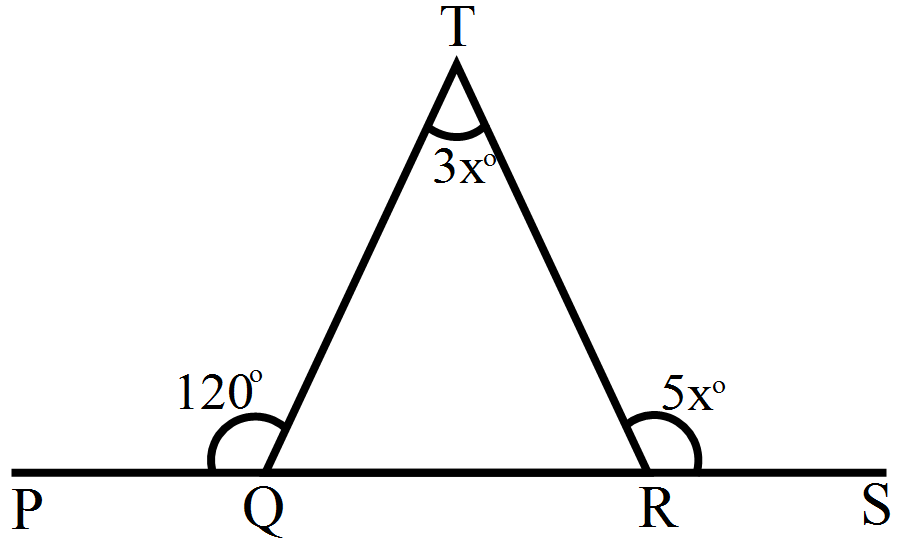
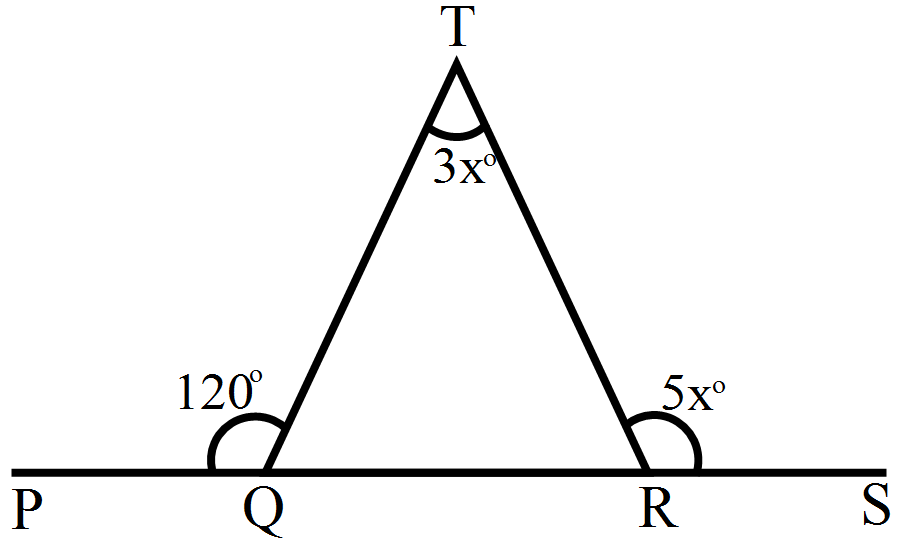
In Fig. the value of $x$ is:
  • A
    $20$
  • $30$
  • C
    $40$
  • D
    $25$
Answer
Correct option: B.
$30$
$\angle \text{TRS}+\angle \text{TRQ}=180^\circ [$Linear angles$]$
$\Rightarrow 5\text{x}^\circ+\angle \text{TRQ}=180^\circ$
$\Rightarrow \angle \text{TEQ}=180^\circ-5\text{x}^\circ$
Now, $\angle \text{QTR}+\angle \text{TRQ}=\angle \text{PQT} [$Exterior angle property of triangle$]$
$\Rightarrow 3\text{x}^\circ+180^\circ-5\text{x}^\circ=120^\circ$
$\Rightarrow 2\text{x}^\circ=60^\circ$
$\Rightarrow \text{x}=30$
Hence, the correct answer is option $(b).$
View full question & answer
MCQ 61 Mark
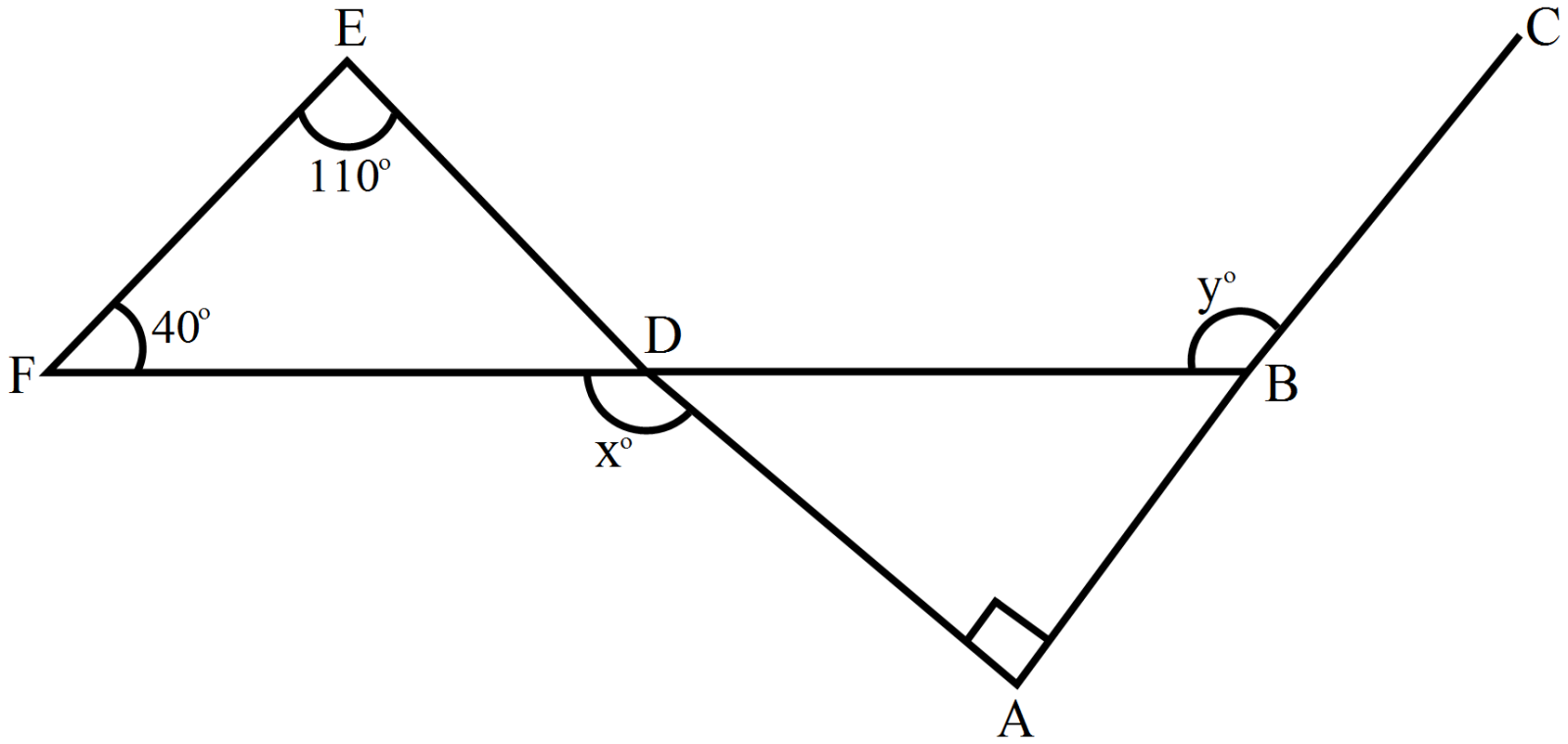
In Fig. the values of $x$ and $y$ are:
  • A
    $x = 120, y = 150$
  • B
    $x = 110, y = 160$
  • $x = 150, y = 120$
  • D
    $x = 110, y = 160$
Answer
Correct option: C.
$x = 150, y = 120$

In $\triangle \text{DEF}$
$\angle \text{DEF}+\angle \text{DFE}+\angle \text{EDF}=180^\circ [$Angle sum property of triangle$]$
$\Rightarrow 110^\circ+40^\circ+\angle \text{EDF}=180^\circ$
$\Rightarrow \angle \text{EDF}=30^\circ$
Now, $\angle \text{EDF}+\angle \text{FDA}=180^\circ [$Linear pair angles$]$
$\Rightarrow 30^\circ+\text{x}^\circ=180^\circ$
$\Rightarrow \text{x}=150$
Now, $\angle \text{EDF}=\angle \text{ADB}=30^\circ [$Vertically opposite angles$]$
Now, In $\triangle \text{ABD},$
$\angle \text{ADB}+\angle \text{DAB}+\angle \text{ABD}=180^\circ [$Angle sum property of triangle$]$
$\Rightarrow 30^\circ+90^\circ+\angle \text{ABD}=180^\circ$
$\Rightarrow \angle \text{ABD}=60^\circ$
Now, $\angle \text{ABD}+\angle \text{DBC}=180^\circ [$Linear pair angles$]$
$\Rightarrow 60^\circ+\text{y}^\circ=180^\circ$
$\Rightarrow \text{y}=120$
Hence, the correct answer is option $(c).$

View full question & answer
MCQ 71 Mark
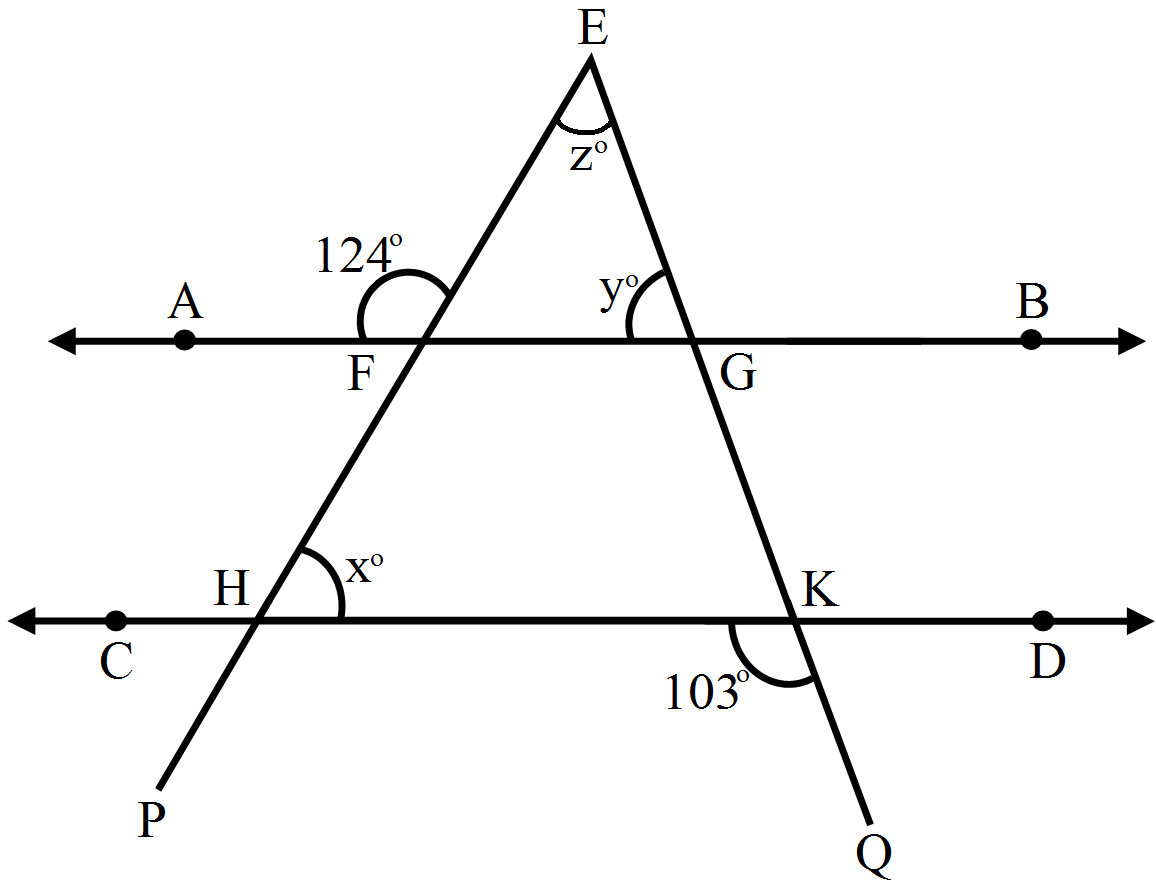
Fig. if $AB \| CD$, then the values of $x, y$ and $z$ are:
  • A
    $x = 56, y = 47, z = 77$
  • B
    $x = 47, y = 56, z = 77$
  • C
    $x = 77, y = 56, z = 47$
  • $x = 56, y = 77, z = 47$
Answer
Correct option: D.
$x = 56, y = 77, z = 47$

$\angle \text{AFE}+\angle \text{EFG}=180^\circ [$Linear pair angles$]$
$\Rightarrow 124^\circ+\angle\text{EFG}=180^\circ$
$\Rightarrow \angle\text{EFG}=56^\circ$
Since, $AB \| CD$
$\therefore \angle \text{EFG}=\angle \text{FHK}=56^\circ [$Corresponding angles$]$
$\Rightarrow \text{x}=56$
Now, $\angle \text{QKH}+\angle \text{GKH}=180^\circ [$Linear pair angles$]$
$\Rightarrow 103^\circ+\angle \text{GKH}=180^\circ$
$\Rightarrow \angle \text{GKH}=77^\circ$
Since, $AB \| CD$
$\therefore \angle \text{EGF}=\angle \text{GKH}=77^\circ [$Corresponding angles$]$
$\Rightarrow \text{y}=77$
In $\triangle \text{EHK},$
$\angle \text{EHK}+\angle \text{EKH}+\angle \text{HEK}=180^\circ [$Angle sum property of triangle$]$
$\Rightarrow 56^\circ+77^\circ+\text{z}^\circ=180^\circ$
$\Rightarrow \text{z}=47$
Hence, the correct answer is option $(d).$

View full question & answer
MCQ 81 Mark
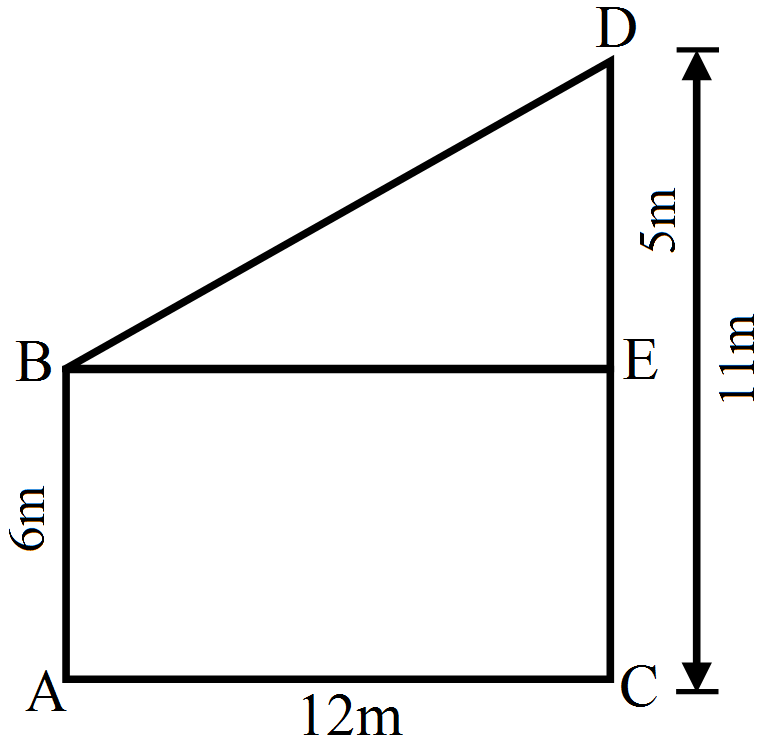
Two poles of heights $6m$ and $11m$ stand vertically on a plane ground. If the distance between their feet is $12m,$ the distance between their tops is:
  • $13 m$
  • B
    $14 m$
  • C
    $15 m$
  • D
    $12.8 m$
Answer
Correct option: A.
$13 m$
Suppose $AB$ and $CD$ are two poles. The is distance between $A B$ and $C D$ is $12 m .$

In right traingle $\text{BDE} _{\text {, }}$
$BD^2=DE^2+BE^2$
$\Rightarrow BD^2=(5)^2+(12)^2$
$\Rightarrow BD^2=25+144$
$\Rightarrow BD^2=169$
$\Rightarrow BD^2=(13)^2$
$\Rightarrow BD=13 m$
Hence, the correct answer is option $(a).$
View full question & answer
MCQ 91 Mark
$\triangle \text{ABC}$ is a right triangle right angled at $A.$ If $AB = 24\ cm$ and $AC = 7\ cm,$ then $BC =$
  • A
    $31 \ cm$
  • B
    $17 \ cm$
  • $25 \ cm$
  • D
    $28 \ cm$
Answer
Correct option: C.
$25 \ cm$
In right traingle $\text{ABC}$,
$B C^2=A C^2+A B^2$
$\Rightarrow B C^2=(7)^2+(24)^2$
$\Rightarrow BC ^2=49+576$
$\Rightarrow BC ^2=625$
$\Rightarrow B C^2=(25)^2$
$\Rightarrow BC =25 cm$
Hence, the correct answer is option $(c).$
View full question & answer
MCQ 101 Mark
If the measures of the angles of a triangle are $(2x)^\circ , (3x - 5)^\circ $ and $(4x -13)^\circ .$ Then the value of $x$ is:
  • $22$
  • B
    $18$
  • C
    $20$
  • D
    $30$
Answer
Correct option: A.
$22$
$(2x)^\circ + (3x - 5)^\circ + (4x - 13)^\circ = 180^\circ [$Angle sum property of triangle$]$
$\Rightarrow 2x + 3x - 5 + 4x - 13 = 180^\circ $
$\Rightarrow 9x - 18 = 180$
$\Rightarrow 9x = 198$
$\Rightarrow x = 22$
Hence, the correct answer is option $(a).$
View full question & answer
MCQ 111 Mark
The angles of a triangle are in the ratio $2 : 3 : 7$. The measure of the largest angle is:
  • A
    $84^\circ$
  • B
    $91^\circ$
  • $105^\circ$
  • D
    $98^\circ$
Answer
Correct option: C.
$105^\circ$
Let the angles of the triangle be $2x, 3x$ and $7x.$
Now, $2x + 3x + 7x = 180^\circ [$Angle sum property of triangle$]$
$\Rightarrow 12x = 180^\circ$
$\Rightarrow x = 15^\circ$
$\therefore$ Largest angle $= 7x = 7 \times 15^\circ$
$= 105^\circ$
Hence, the correct answer is option $(c).$
View full question & answer
MCQ 121 Mark
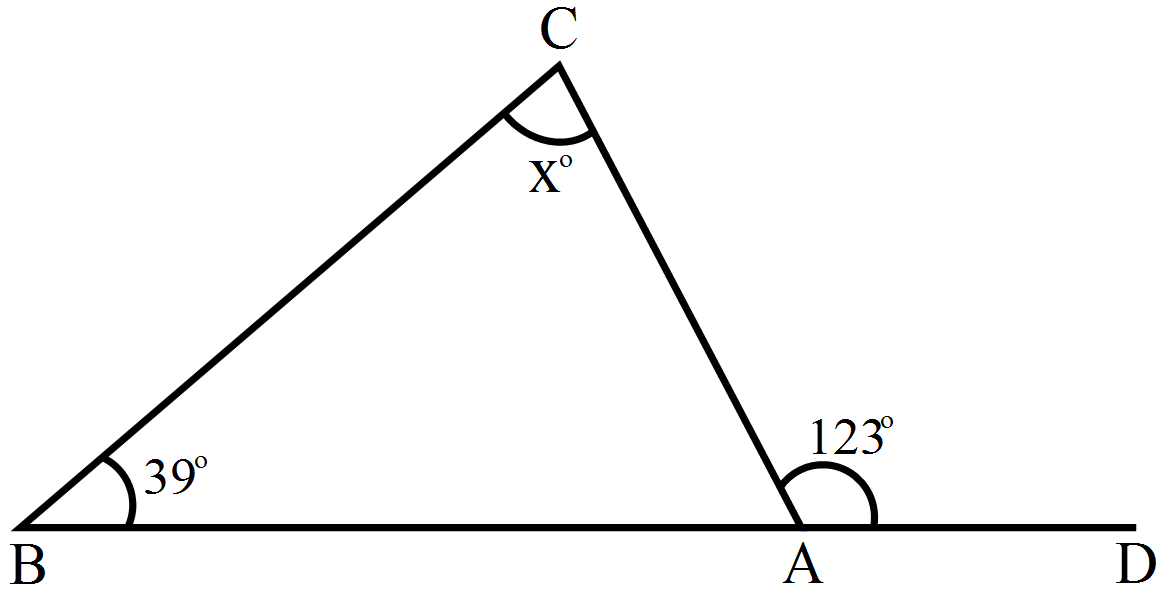
In Fig. the value of $x$ is:
  • $84$
  • B
    $74$
  • C
    $94$
  • D
    $57$
Answer
Correct option: A.
$84$
$\angle \text{CAD}=\angle \text{ABC}+\angle \text{ACB} [$Exterior angle property$]$
$\Rightarrow 123^\circ = 39^\circ + \text{x}^\circ$
$\Rightarrow 84^\circ = \text{x}^\circ$
$\Rightarrow \text{x} = 84$
Hence, the correct answer is option $(a).$
View full question & answer
MCQ 131 Mark
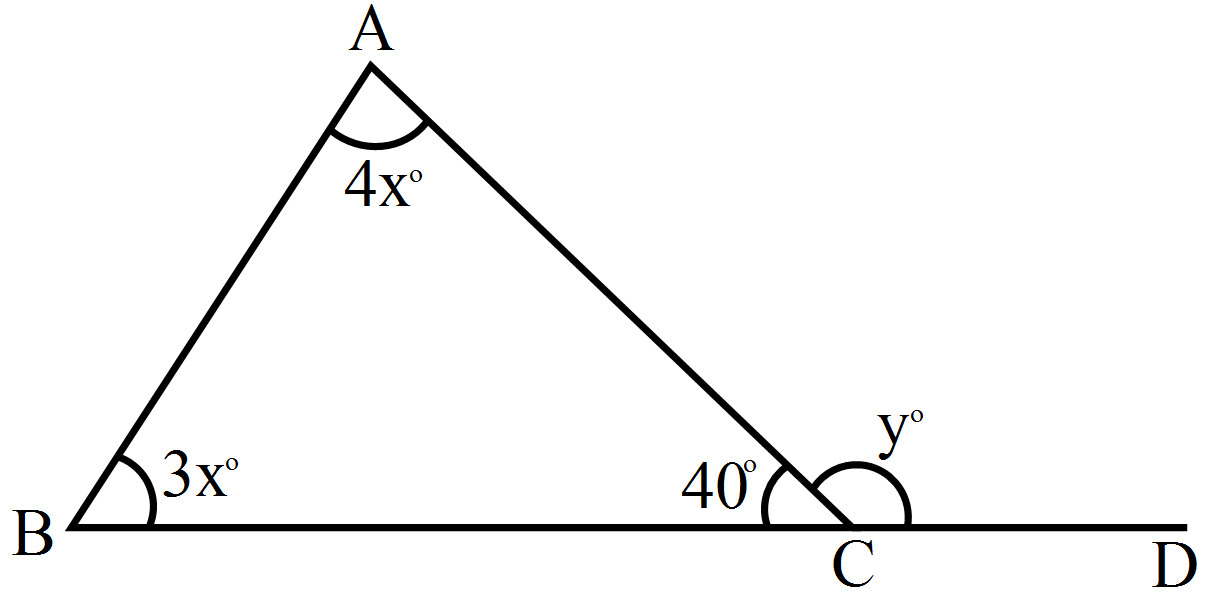
In Fig. the values of $x$ and $y$ are:
  • A
    $x = 20, y = 130$
  • B
    $x = 20, y = 140$
  • $x = 40, y = 140$
  • D
    $x = 15, y = 140$
Answer
Correct option: C.
$x = 40, y = 140$

$\angle \text{ACB}+\angle \text{ACD}=180^\circ$
$\Rightarrow 40^\circ + \text{y}^\circ = 180^\circ$
$\Rightarrow \text{y}^\circ = 140^\circ$
$\Rightarrow \text{y} = 140$
Now, $\angle \text{ACD}=\angle \text{ABC}+\angle \text{BAC} [$Exterior angle property$]$
$\Rightarrow 3\text{x}^\circ + 4\text{x}^\circ = \text{y}^\circ$
$⇒ 7\text{x}^\circ = 140^\circ$
$\Rightarrow \text{x} = 20$
Hence, the correct answer is option $(c).$

View full question & answer
MCQ 141 Mark
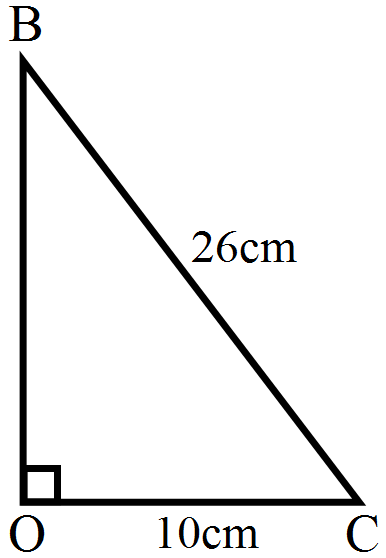
The hypotenuse of a right triangle is $26\ cm$ long. If one of the remaining two sides is $10\ cm$ long, the length of the other side is:
  • A
    $25 \ cm$
  • B
    $23 \ cm$
  • $24 \ cm$
  • D
    $22 \ cm$
Answer
Correct option: C.
$24 \ cm$

In right traingle $\text{BOC}$
$BC^2=OC^2+O OB^2$
$\Rightarrow(26)^2=(10)^2+OB^2$
$\Rightarrow 676=100+OB^2$
$\Rightarrow O B^2=576$
$\Rightarrow O B^2=(24)^2$
$\Rightarrow O B=24 \ cm$
Hence, the correct answer is option $(c).$
View full question & answer
MCQ 151 Mark
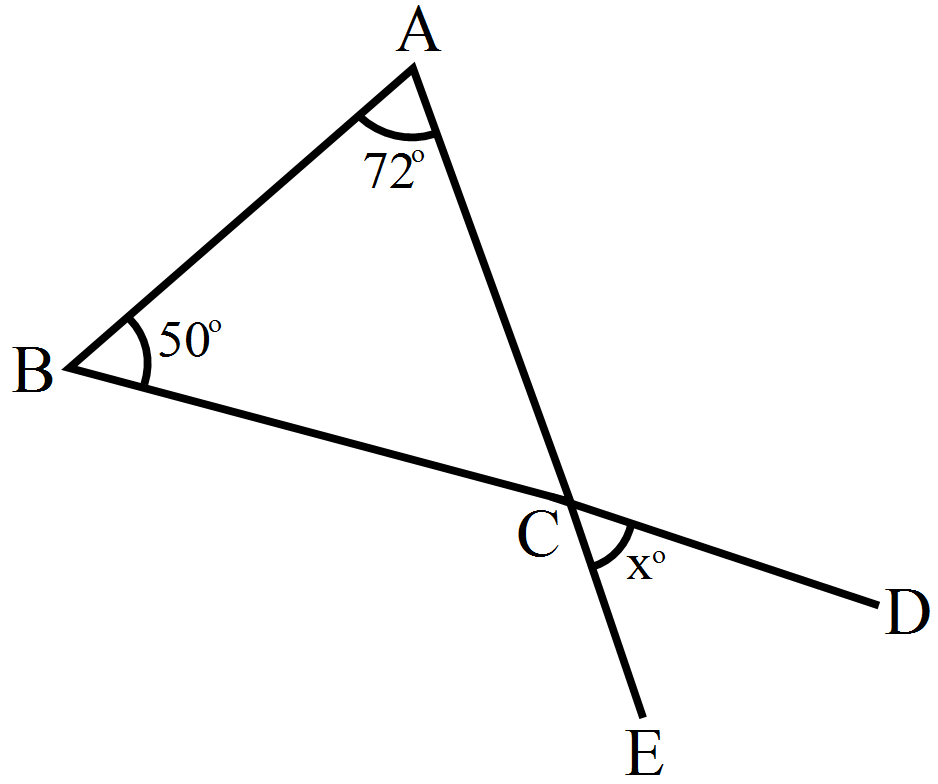
In Fig. the value of $x$ is:
  • A
    $72$
  • B
    $50$
  • $58$
  • D
    $48$
Answer
Correct option: C.
$58$

$\angle \text{A}+\angle \text{B}+\angle \text{C}=180^\circ [$Angle sum property of triangle$]$
$ \Rightarrow 50^\circ+72^\circ+\angle \text{C}=180^\circ$
$\Rightarrow \angle \text{C}+122^\circ=180^\circ$
$\Rightarrow \angle \text{C}=58^\circ$
Now, $\text{x}^\circ=\angle\text{C} [$Vertically opposite angles$]$
$\Rightarrow \text{x}^\circ= 58^\circ$
$\Rightarrow \text{x}=58$
Hence, the correct answer is option $(c).$

View full question & answer
MCQ 161 Mark
In a $\triangle \text{ABC},$ if $\angle \text{A}-\angle \text{B}=33^\circ$ and $\angle \text{B}-\angle \text{C}=10^\circ,$ then $\angle \text{B} =$
  • A
    $35^\circ$
  • B
    $45^\circ$
  • C
    $55^\circ$
  • $25^\circ$
Answer
Correct option: D.
$25^\circ$

$\angle \text{A}-\angle \text{B}=33^\circ$ and $\angle \text{B}-\angle \text{C}=18^\circ$
$\Rightarrow \angle \text{A}=\angle \text{B}+33^\circ$ and $\angle \text{C}=\angle \text{B}-18^\circ$
Now, $\angle \text{A}+\angle \text{B}+\angle \text{C}=180^\circ [$Angle sum property of triangle$]$
$\Rightarrow \angle \text{B}+33^\circ+\angle \text{B}+\angle \text{B}-18^\circ=180^\circ$
$\Rightarrow 3\angle \text{B}+15^\circ=180^\circ$
$\Rightarrow 3\angle \text{B}=165^\circ$
$\Rightarrow \angle \text{B}=55^\circ$
Hence, the correct answer is option $(d).$

View full question & answer
MCQ 171 Mark
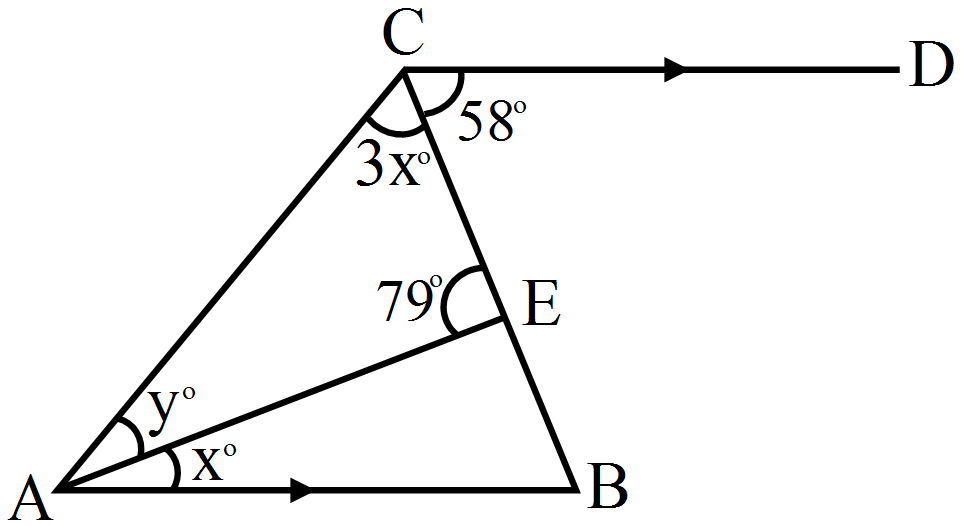
In Fig. if $AB \| CD$, the values of $x$ and $y$ are:
  • A
    $x = 21, y = 28$
  • $x = 21, y = 38$
  • C
    $x = 38, y = 21$
  • D
    $x = 22, y = 38$
Answer
Correct option: B.
$x = 21, y = 38$

$\angle \text{AEC}+\angle \text{AEB}=180^\circ [$Linear angles$]$
$\Rightarrow 79^\circ+\angle \text{AEB}=180^\circ$
$\Rightarrow \angle \text{AEB}=101^\circ$
Since, $AB \| CD$
$\angle \text{ABE}=\angle \text{ECD}=58^\circ [$Alternate angles$]$
Now, In $\triangle \text{AEB}$
$\angle \text{AEB}+\angle \text{EAB}+\angle \text{ABE}=180^\circ $[Angle sum property of triangle$]$
$\Rightarrow 101^\circ+58^\circ+\text{x}^\circ=180^\circ$
$\Rightarrow \text{x}^\circ=21^\circ$
$\Rightarrow \text{x}=21$
Now, In $\triangle \text{AEB}$
$\angle \text{AEC}+\angle \text{CAE}+\angle \text{CEA}=180^\circ [$Angle sum property of triangle$]$
$\Rightarrow 79^\circ+\text{y}^\circ+3\text{x}^\circ=180^\circ$
$\Rightarrow 79^\circ+\text{y}^\circ+3(21)^\circ=180^\circ$
$\Rightarrow 79^\circ+\text{y}^\circ+63^\circ=180^\circ$
$\Rightarrow \text{y}^\circ=38^\circ$
$\Rightarrow \text{y}=38$
Hence, the correct answer is option $(b).$
View full question & answer
MCQ 181 Mark
In Fig. if $AB \| CD$ and $AE \| BD$, then the value of $x$ is:
  • A
    $38$
  • $48$
  • C
    $58$
  • D
    $68$
Answer
Correct option: B.
$48$
$48$
View full question & answer
MCQ 191 Mark
If the measures of the angles of a triangle are $(2\text{x}-5)^\circ,\Big(3\text{x}-\frac{1}{2}\Big)$ and $\Big(30-\frac{\text{x}}{2}\Big)^\circ,$ then $x =$
  • $\frac{311}{9}$
  • B
    $\frac{309}{11}$
  • C
    $\frac{310}{9}$
  • D
    $\frac{301}{9}$
Answer
Correct option: A.
$\frac{311}{9}$

$(2\text{x}-5)^\circ,\Big(3\text{x}-\frac{1}{2}\Big)+\Big(30-\frac{\text{x}}{2}\Big)^\circ=180^\circ [$Angle sum property of triangle$]$
$\Rightarrow 2\text{x}-5+3\text{x}-\frac{1}{2}+30-\frac{\text{x}}{2}=180$
$\Rightarrow 2\text{x}+3\text{x}-\frac{\text{x}}{2}-5-\frac{1}{2}+30=180$
$\Rightarrow 4\text{x}+6\text{x}-\text{x}-10-1+60=180\times2$
$\Rightarrow 9\text{x}+49=360$
$\Rightarrow \text{x}=\frac{311}{9}$
Hence, the correct answer is option $(a).$

View full question & answer
MCQ 201 Mark
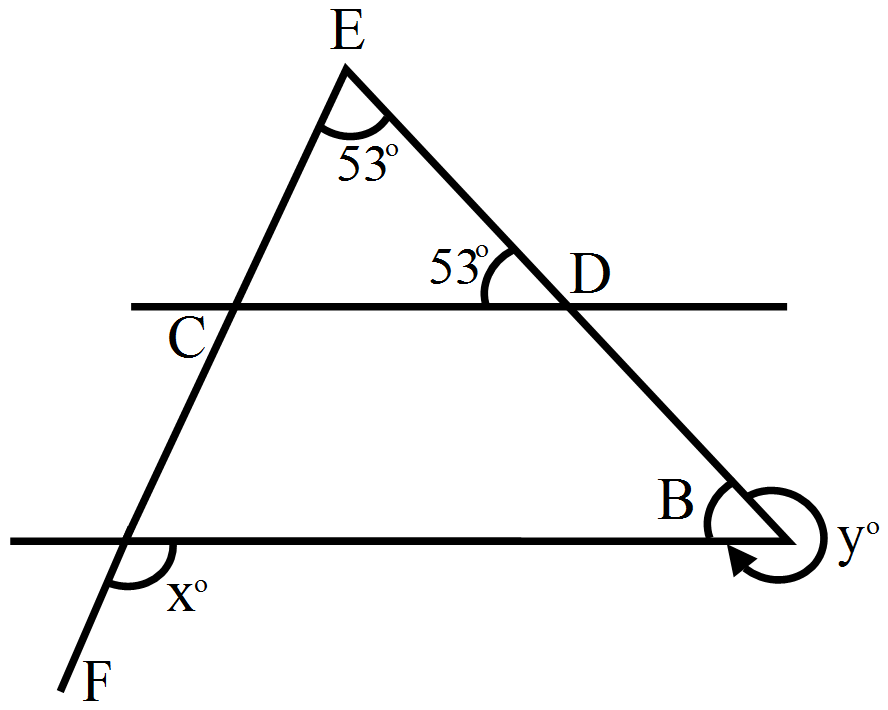
In Fig. if $AB \| CD$, then the values of $x$ and $y$ are:
  • $x = 106, y = 307$
  • B
    $x = 307, y = 106$
  • C
    $x =107, y = 306$
  • D
    $x = 105, y = 308$
Answer
Correct option: A.
$x = 106, y = 307$
In $\triangle \text{CDE}$
$\angle \text{CDE}+\angle \text{CED}+\angle \text{ECD}=180^\circ [$Angle sum property of triangle$]$
$\Rightarrow 53^\circ+53^\circ+\angle \text{ECD}=180^\circ$
$\Rightarrow \angle \text{ECD}=74^\circ$
Since, $AB \| CD$
$\therefore \angle \text{ECD}=\angle \text{CGB}=74^\circ [$Corresponding angles$]$
Now, $\angle \text{CGB}+\angle \text{BGF}=180^\circ [$Linear pair angles$]$
$\Rightarrow 74^\circ+\text{x}^\circ=180^\circ$
$\Rightarrow \text{x}=106$
Now, In $\triangle \text{EGB},$
$\angle \text{EGB}+\angle \text{BEG}+\angle \text{EBG}=180^\circ [$Angle sum property of triangle$]$
$\Rightarrow 74^\circ+53^\circ+\angle \text{EBG}=180^\circ$
$\Rightarrow \angle \text{EBG}=53^\circ$
Now, $\angle \text{EBG}+\text{Reflex }\angle \text{EBG}=360^\circ [$Complete angle$]$
$\Rightarrow 53^\circ+\text{y}^\circ=360^\circ$
$\Rightarrow \text{y}=307$
Hence, the correct answer is option $(a).$
View full question & answer
MCQ 211 Mark
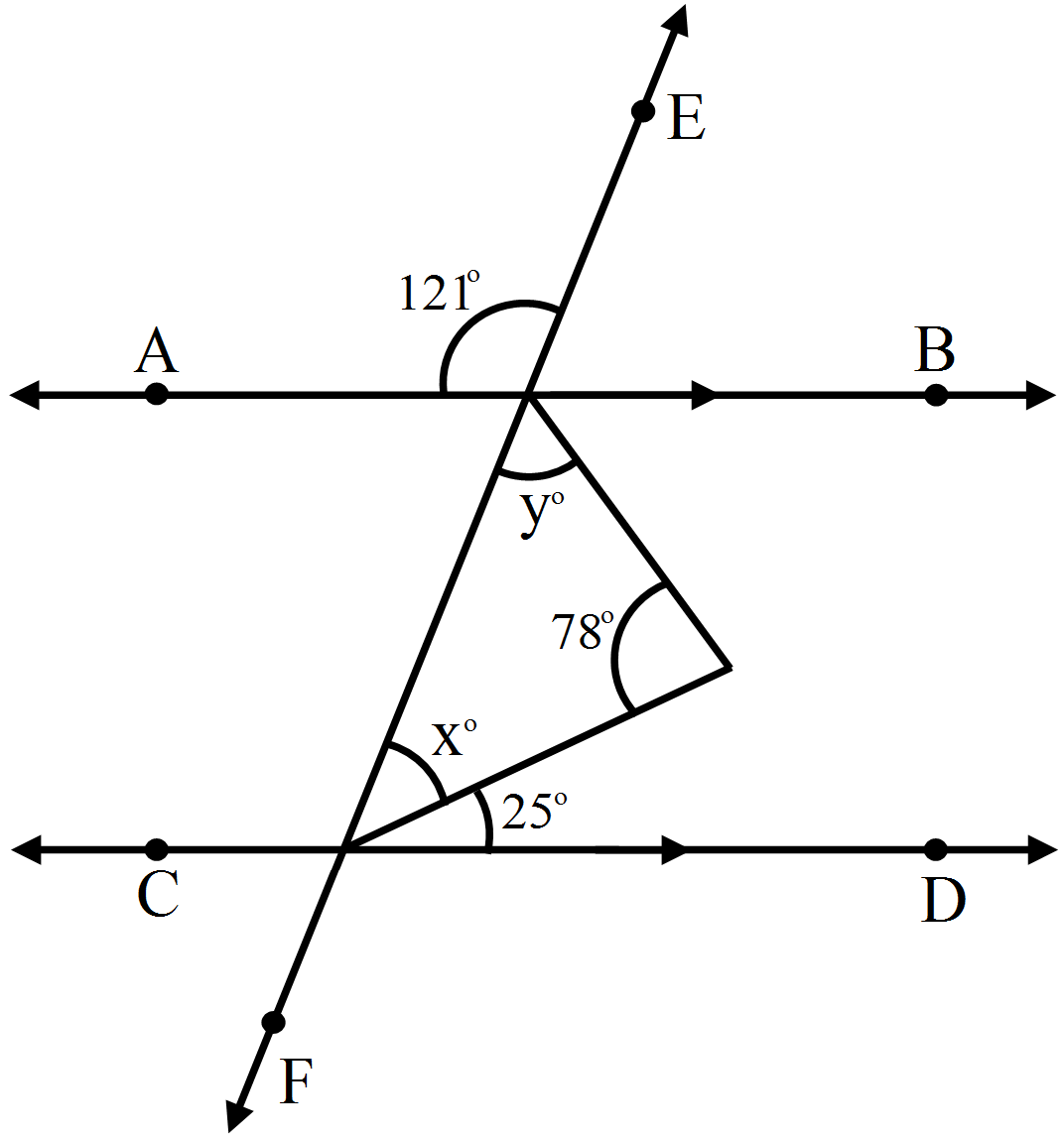
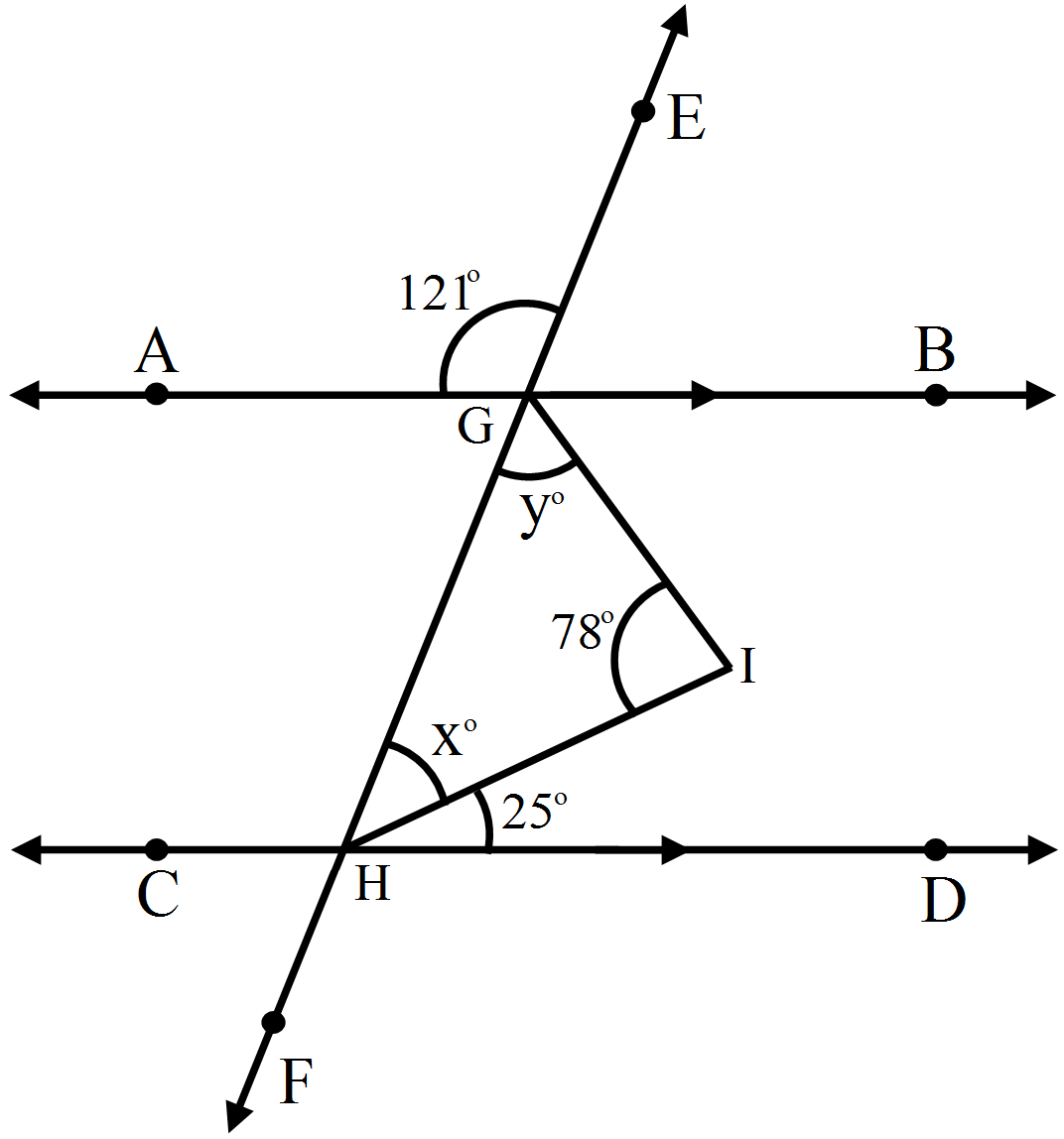
In Fig. if $AB \| CD$, then the values of $x$ and $y$ are:
  • A
    $x = 24, y = 48$
  • $x = 34, y = 68$
  • C
    $x = 24, y = 68$
  • D
    $x = 34, y = 48$
Answer
Correct option: B.
$x = 34, y = 68$

$\angle \text{AGE}+\angle \text{BGE}=180^\circ [$Linear pair angles$]$
$\Rightarrow 121^\circ+\angle \text{BGE}=180^\circ$
$\Rightarrow \angle \text{BGE}=59^\circ$
Since, AB || CD
$\therefore \angle \text{BGE}= \angle \text{GHD}=59^\circ [$Corresponding angles$]$
$\Rightarrow \text{x}^\circ+25^\circ=59^\circ$
$\Rightarrow \text{x}=34$
In $\triangle \text{GHI},$
$\angle \text{GHI}+\angle \text{GIH}+\angle \text{HGI}=180^\circ [$Angle sum property of triangle$]$
$\Rightarrow 34^\circ+78^\circ+\text{y}^\circ=180^\circ$
$\Rightarrow \text{y}=68$
Hence, the correct answer is option $(b).$
View full question & answer
MCQ 221 Mark
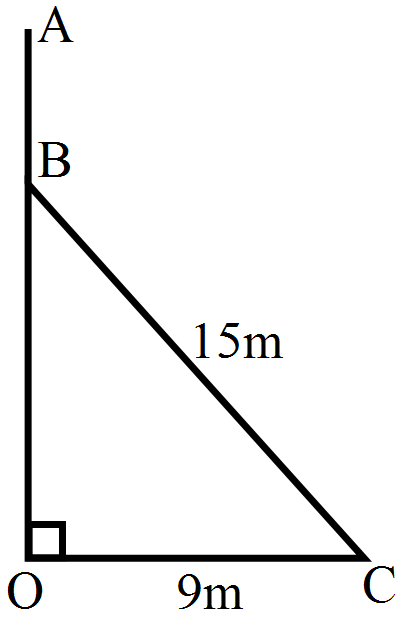
A $15m$ long ladder is placed against a wall in such away that the foot of the ladder is $9m$ away from the wall. Up to what height does the ladder reach the wall?
  • A
    $13 m$
  • B
    $10 m$
  • C
    $8 m$
  • $12 m$
Answer
Correct option: D.
$12 m$

In right traingle $\text{BOC} ,$
$BC^2=OC^2+OB^2$
$\Rightarrow(15)^2=(9)^2+OB^2$
$\Rightarrow 225=81+OB^2$
$\Rightarrow OB^2=144$
$\Rightarrow OB^2=(12)^2$
$\Rightarrow OB=12 m$
Hence, the correct answer is option $(d).$
View full question & answer
MCQ 231 Mark
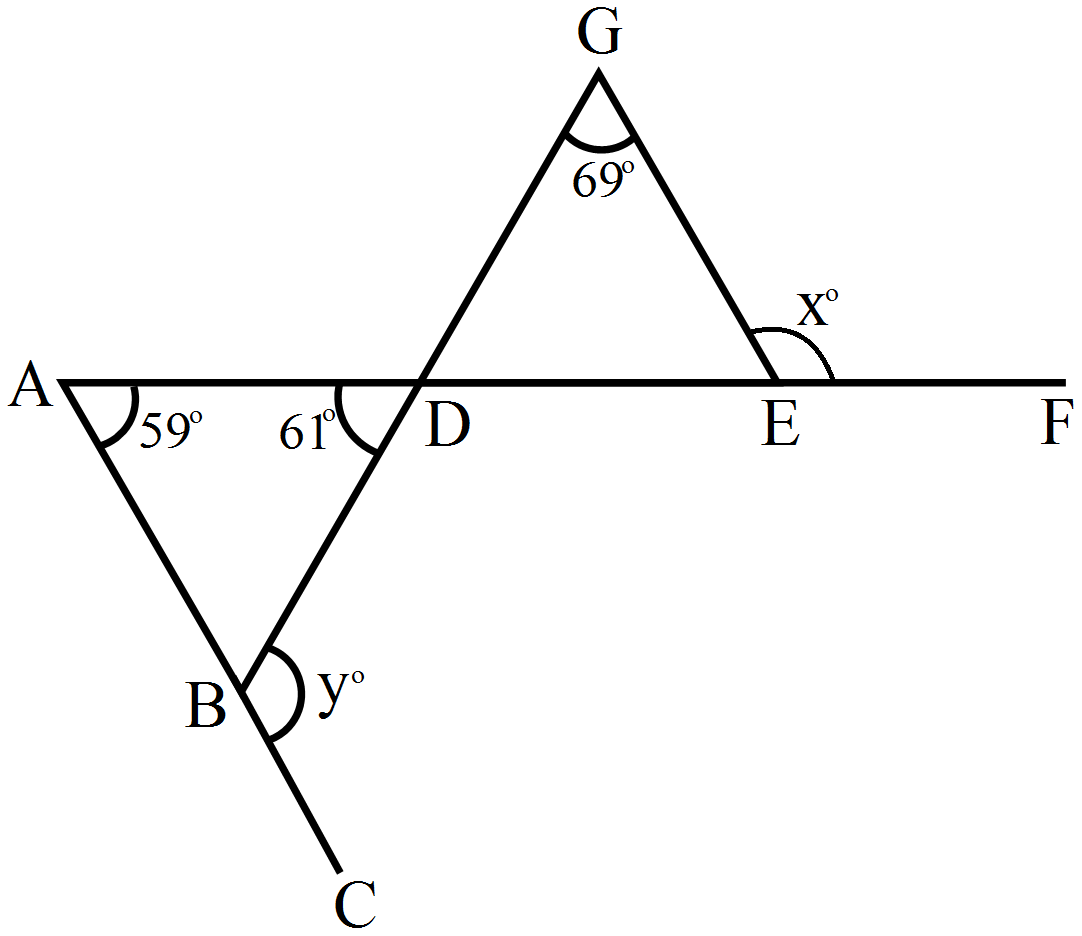
In Fig. the values of $x$ and $y$ are:
  • $x = 130, y = 120$
  • B
    $x = 120, y = 130$
  • C
    $x = 120, y = 120$
  • D
    $x = 130, y = 130$
Answer
Correct option: A.
$x = 130, y = 120$

In $\triangle \text{ABD}$
$\angle \text{ADB}+\angle \text{BAD}+\angle \text{ABD}=180^\circ [$Angle sum property of triangle$]$
$\Rightarrow 61^\circ+59^\circ+\angle \text{ABD}=180^\circ$
$\Rightarrow \angle \text{ABD}=60^\circ$
$\angle \text{ABD}+\angle \text{DBC}=180^\circ [$Linear pair angles$]$
$\Rightarrow 60^\circ+\text{y}^\circ=180^\circ$
$\Rightarrow \text{y}=120$
Now, $\angle \text{ADB}=\angle \text{GDE}=61^\circ [$Vertically opposite angles$]$
Now, In $\triangle \text{GDE},$
$\angle \text{GDE}+\angle \text{DGE}+\angle \text{GED}=180^\circ [$Angle sum property of triangle$]$
$\Rightarrow 61^\circ+69^\circ+\angle \text{GED}=180^\circ$
$\Rightarrow \angle \text{GED}=50^\circ$
Now, $\angle \text{GED}+\angle \text{GEF}=180^\circ [$Linear pair angles$]$
$\Rightarrow 50^\circ+\text{x}^\circ=180^\circ$
$\Rightarrow \text{x}=130$
Hence, the correct answer is option $(a).$

View full question & answer
MCQ 241 Mark
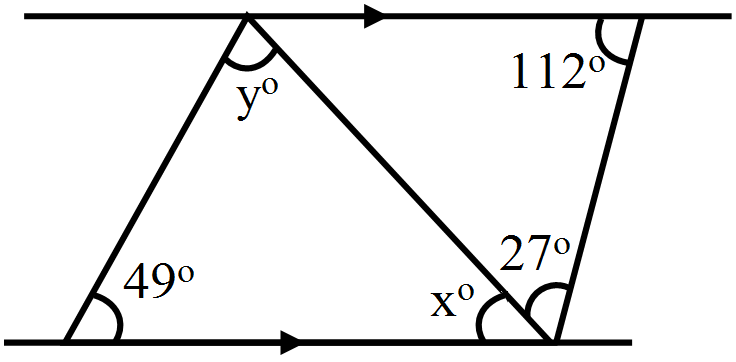
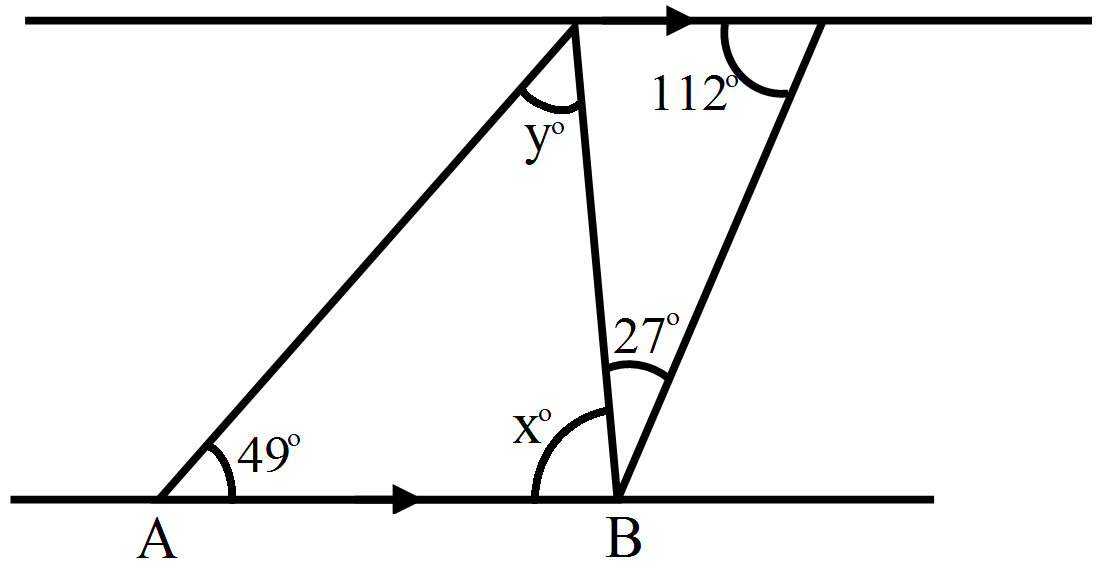
In Fig. if $AB \| CO, \angle \text{CAB}=49^\circ, \angle \text{CBD}=27^\circ$ and $\angle \text{BDC}=112^\circ,$ then the values of $x$ and $y$ are:
  • $x = 41, y = 90$
  • B
    $x = 41, y = 63$
  • C
    $x = 63, y = 41$
  • D
    $x = 90, y = 41$
Answer
Correct option: A.
$x = 41, y = 90$

Since, $AB \| CD$
$\angle \text{ABD}+\angle \text{CDB}=180^\circ [$Angles on the same side of a transversal line are supplementary$]$
$\Rightarrow \text{x}^\circ+27^\circ+112^\circ=180^\circ$
$\Rightarrow \text{x}^\circ=41^\circ$
$\Rightarrow \text{x}=41$
Now, In $\triangle \text{ABC},$
$\angle \text{A}+\angle \text{B}+\angle \text{C}=180^\circ [$Angle sum property of triangle$]$
$\Rightarrow 49^\circ+41^\circ+\text{y}^\circ=180^\circ$
$\Rightarrow \text{y}^\circ=90^\circ$
$\Rightarrow \text{y}=90$
Hence, the correct answer is option $(a).$
View full question & answer
MCQ 251 Mark
In Fig. the value of $x$ is:
  • A
    $20$
  • $30$
  • C
    $40$
  • D
    $25$
Answer
Correct option: B.
$30$

$\angle \text{TRS}+\angle \text{TRQ}=180^\circ [$Linear angles$]$
$\Rightarrow 5\text{x}^\circ+\angle \text{TRQ}=180^\circ$
$\Rightarrow \angle \text{TEQ}=180^\circ-5\text{x}^\circ$
Now, $\angle \text{QTR}+\angle \text{TRQ}=\angle \text{PQT} [$Exterior angle property of triangle$]$
$\Rightarrow 3\text{x}^\circ+180^\circ-5\text{x}^\circ=120^\circ$
$\Rightarrow 2\text{x}^\circ=60^\circ$
$\Rightarrow \text{x}=30$
Hence, the correct answer is option $(b).$
View full question & answer
MCQ 261 Mark
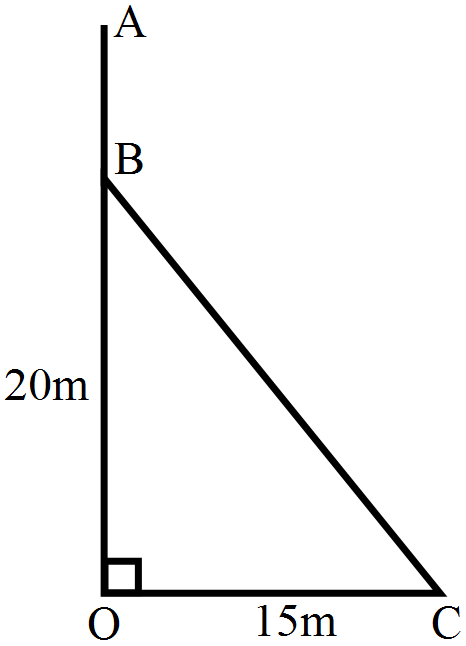
A ladder is placed in such a way that its foot is $15m$ away from the wall and its top reaches a window $20m$ above the ground. The length of the ladder is:
  • A
    $35 m$
  • $25 m$
  • C
    $18 m$
  • D
    $17.5 m$
Answer
Correct option: B.
$25 m$
Suppose $BC$ is the ladder which is placed againts the wall $OA.$ The foot of the ladder $C$ is $15m$ away from the foot $O$ of the wall and its top reaches the window which is $20m$ above the ground.

In right traingle $\text{BOC ,}$
$BC^2=OC^2+OB^2$
$\Rightarrow BC^2=(15)^2+(20)^2$
$\Rightarrow BC^2=225+400$
$\Rightarrow BC^2=625$
$\Rightarrow BC^2=(25)^2$
$\Rightarrow BC=25 m$
Hence, the correct answer is option $(b).$
View full question & answer
MCQ 271 Mark
In which of the following cases can a right triangle $\text{ABC}$ be constructed?
  • A
    $AB =5 \ cm, BC =7 \ cm, AC =10 \ cm$
  • B
    $AB =7 \ cm, BC =8 \ cm, AC =12 \ cm$
  • $AB =8 \ cm, BC =17 \ cm, AC =15 \ cm$
  • D
    None of these.
Answer
Correct option: C.
$AB =8 \ cm, BC =17 \ cm, AC =15 \ cm$
$B C^2=A C^2+A B^2$
$\Rightarrow(17)^2=(15)^2+(8)^2$
$\Rightarrow 289=225+64$
$\Rightarrow 289=289$
Since, the sum of the square of two smallest side is equal to the square of largest side.
Hence, $\text{ABC}$ is a right angle triangle at $A$.
Hence, the correct answer is option $(c).$
View full question & answer
MCQ 281 Mark
In which of the following cases, a right triangle cannot be constructed?
  • $12 cm, 5 cm, 13 cm$
  • B
    $8 cm, 6 cm, 10 cm$
  • C
    $5 cm, 9 cm, 11 cm$
  • D
    None of these.
     
Answer
Correct option: A.
$12 cm, 5 cm, 13 cm$

$\text { In (a) }$

$12^2+5^2=13^2$

$\Rightarrow 144+25=169$

$\Rightarrow 169$

Since, the sum of the square of two smallest side is equal to the square of largest side.

Hence, a right triangle can be constructed.

In (b)

$8^2+6^2=10^2$

$\Rightarrow 44+36=100$

$\Rightarrow 100=100$

Since, the sum of the square of two smallest side is equal to the square of largest side.

Hence, a right triangle can be constructed.

$\text { In (c) }$

$5^2+9^2 \neq 11^2$

$\Rightarrow 25+81 \neq 121$

$\Rightarrow 106 \neq 121$

Since, the sum of the square of two smallest side is not equal to the square of largest side.

Hence, a right triangle can not be constructed.

Hence, the correct answer is option (c).
View full question & answer
MCQ 291 Mark
In a $\triangle \text{ABC},$ if $\angle \text{A}+\angle \text{B}=150^\circ$ and $\angle \text{B}+\angle \text{C}=75^\circ,$ then $\angle \text{B} =$
  • A
    $35^\circ$
  • $45^\circ$
  • C
    $55^\circ$
  • D
    $25^\circ$
Answer
Correct option: B.
$45^\circ$

$\angle \text{A}+\angle \text{B}+\angle \text{C}=180^\circ [$Angle sum property of triangle$]$
$\Rightarrow 150^\circ+\angle \text{C}=180^\circ$
$\Rightarrow \angle \text{C}=30^\circ$
Now, $\angle \text{B}+\angle \text{C}=75^\circ$
$\Rightarrow \angle \text{B}+30^\circ=75^\circ$
$\Rightarrow \angle \text{B}=45^\circ$
Hence, the correct answer is option $(b).$
View full question & answer
MCQ 301 Mark
In a right triangle, one of the acute angles is four times the other. Its measure is:
  • A
    $68^\circ$
  • B
    $84^\circ$
  • C
    $80^\circ$
  • $72^\circ$
Answer
Correct option: D.
$72^\circ$

Let the smallest angle be $x$, then the other angle be $4x.$
Now,
$x + 4x + 90^\circ = 180^\circ $
$\Rightarrow 5x = 90^\circ $
$\Rightarrow x = 18^\circ $
Thus, the measure of the angles are $18^\circ ,$ and $4(18)^\circ = 72^\circ $
Hence, the correct answer is option $(d).$

View full question & answer
MCQ 311 Mark
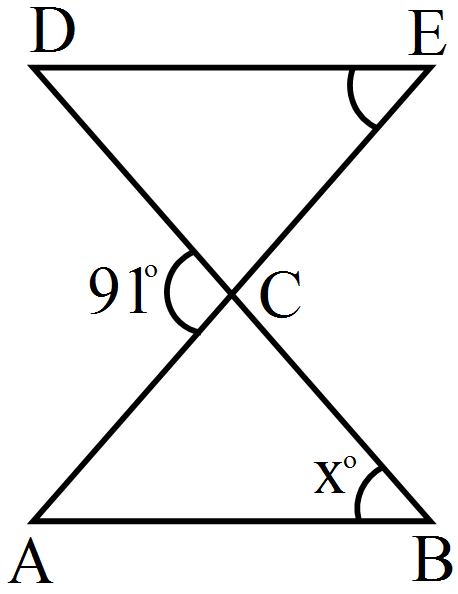
In Fig. if $AB \| DE$, then the value of $x$ is:
  • A
    $25$
  • B
    $35$
  • C
    $40$
  • $45$
Answer
Correct option: D.
$45$

$\angle \text{ACD}+\angle \text{ACB}=180^\circ [$Linear angles$]$
$\Rightarrow 91^\circ+\angle \text{ACB}=180^\circ$
$\Rightarrow \angle \text{ACB}=89^\circ$
Since, $AB \| DE$
$\angle \text{DEC}=\angle \text{CAB}=46^\circ [$Alternate angles$]$
Now,
$\angle \text{ACB}+\angle \text{CAB}+\angle \text{ABC}=180^\circ [$Angle sum property of triangle$]$
$\Rightarrow 89^\circ + 46^\circ + \text{x}^\circ = 180^\circ$
$⇒ \text{x}^\circ = 45^\circ$
$\Rightarrow \text{x} = 45$
Hence, the correct answer is option $(d).$

View full question & answer
MCQ 321 Mark
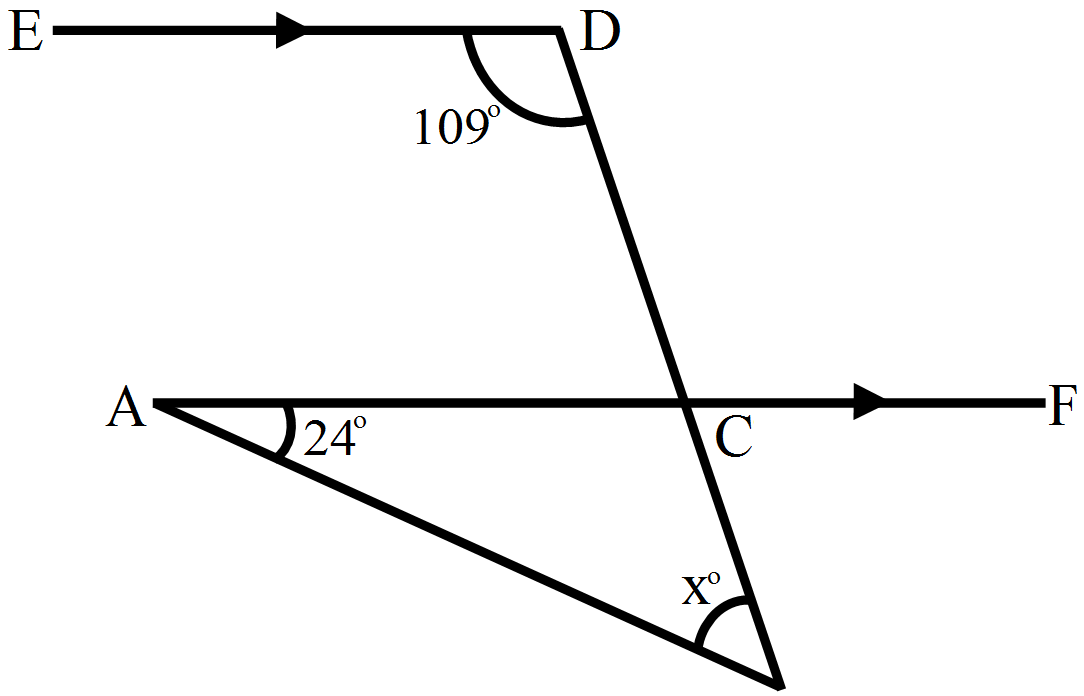
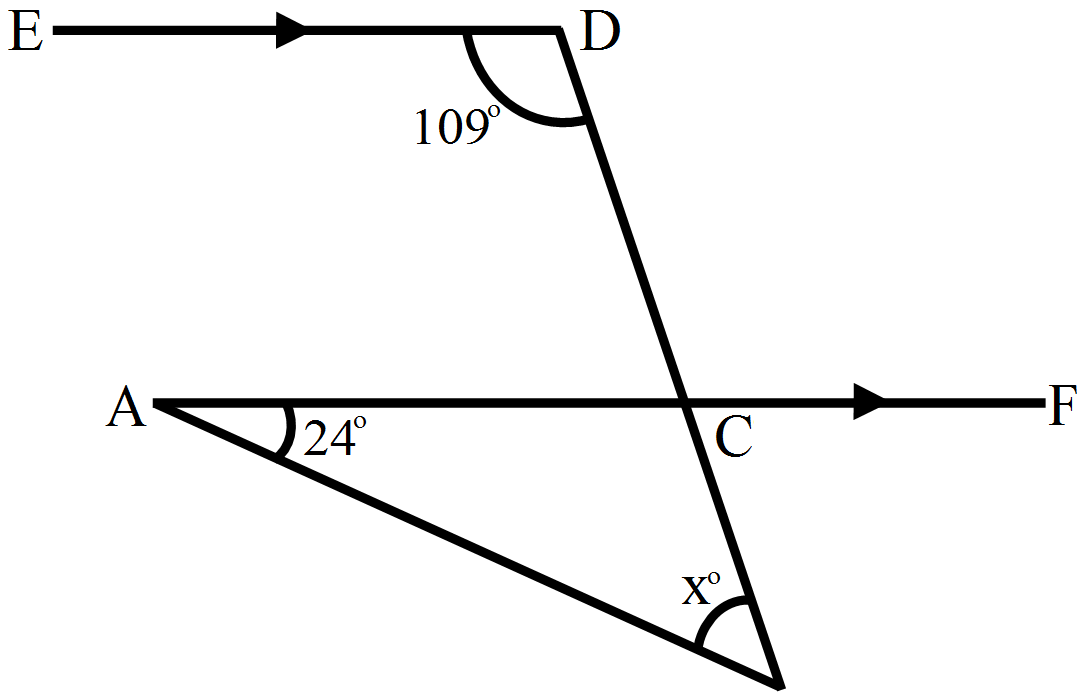
In Fig. if $AF \| DE$, then $x =$
  • A
    $37$
  • B
    $57$
  • $47$
  • D
    $67$
Answer
Correct option: C.
$47$

$\angle \text{EDC}=\angle \text{ACB}=109^\circ [$Corresponding angles$]$
Now, In $\triangle \text{ABC}$
$\angle \text{ACB}+\angle \text{CAB}+\angle \text{CBA}=180^\circ [$Angle sum property of triangle$]$
$\Rightarrow 109^\circ+24^\circ+\text{x}^\circ=180^\circ$
$\Rightarrow \text{x}^\circ=47^\circ$
$\Rightarrow \text{x}=47$
Hence, the correct answer is option $(c).$
View full question & answer
MCQ 331 Mark
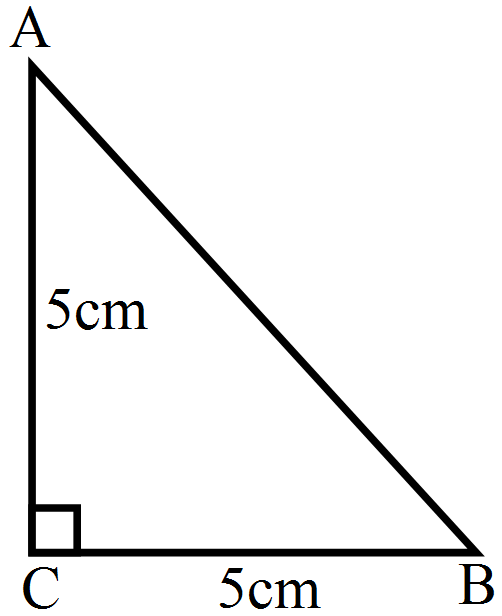
If $\triangle ABC$ is an isosceles right$-$triangle right angled at $C$ such that $AC =5 \ cm$. Then, $AB =$
  • A
    $2.5 \ cm$
  • $5 \sqrt{2} \ cm$
  • C
    $10 \ cm$
  • D
    $5 \ cm$
Answer
Correct option: B.
$5 \sqrt{2} \ cm$

Suppose $BC$ is the ladder which is placed againts the wall $OA$. The foot of the ladder $C$ is $15 m$ away from the foot $O$ of the wall and its top reaches the window which is $20$ m above the ground.
In right traingle $\text{ABC}$
$AB^2=BC^2+AC C^2$
$\Rightarrow AB^2=(5)^2+(5)^2$
$\Rightarrow AB^2=25+25$
$\Rightarrow AB^2=50$
$\Rightarrow AB=(5 \sqrt{2})^2$
$\Rightarrow AB=5 \sqrt{2} cm$
Hence, the correct answer is option $(b).$
View full question & answer
MCQ 341 Mark
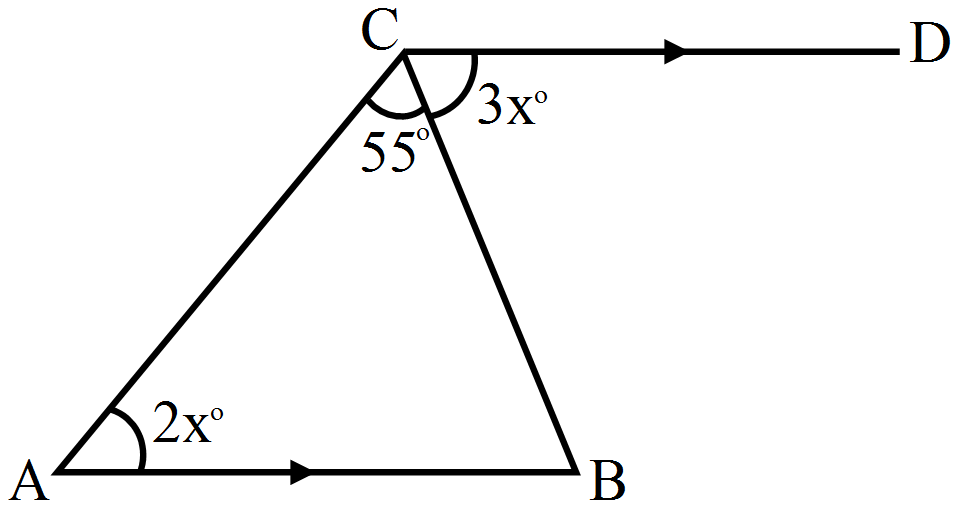
In Fig. if $AB \| CD$, the value of $x$ is:
  • $25$
  • B
    $35$
  • C
    $15$
  • D
    $20$
Answer
Correct option: A.
$25$
Since, $AB \| DE$
$\angle \text{DCB}=\angle \text{CBA}=3\text{x}^\circ [$Alternate angles$]$
Now,
$\angle \text{ACB}+\angle \text{CAB}+\angle \text{CBA}=180^\circ [$Angle sum property of triangle$]$
$\Rightarrow 55^\circ + 2\text{x}^\circ + 3\text{x}^\circ= 180$
$\Rightarrow 5\text{x}^\circ= 125^\circ$
$\Rightarrow \text{x} = 25$
Hence, the correct answer is option $(a).$
View full question & answer