Questions

2 Mark Question

Take a timed test

11 questions · self-marked practice — reveal the answer and mark yourself.

Question 12 Marks
Is it possible to draw a triangle, the lengths of whose sides are given below?
2cm, 3cm, 4cm
Answer
Clearly, 2 + 3 > 4
3 + 4 > 2
2 + 4 > 3
Thus, the sum of any two sides is greater than the third side.
Hence, it is possible to draw a triangle having sides 2cm, 3cm and 4cm.
View full question & answer
Question 22 Marks
Is it possible to draw a triangle, the lengths of whose sides are given below?
1cm, 1cm, 1cm
Answer
Consider numbers 1, 1 and 1.
Clearly, 1 + 1 > 1
1 + 1 > 1
1 + 1 > 1
Thus, the sum of any two sides is greater than the third side.
Hence, it is possible to draw a triangle having sides 1m, 1cm and 1cm.
View full question & answer
Question 32 Marks
Is it possible to draw a triangle, the lengths of whose sides are given below?3.4cm, 2.1cm, 5.3cm
Answer
Consider the numbers 3.4, 2.1 and 5.3
Clearly: 3.4 + 2.1 > 5.3
5.3 + 2.1 > 3.4
5.3 + 3.4 > 2.1
Thus, the sum of any two sides is greater than the third side.
Hence, it is possible to draw a triangle having sides 3.4cm, 2.1cm and 5.3cm.
View full question & answer
Question 42 Marks
Is it possible to draw a triangle, the lengths of whose sides are given below?7cm, 8cm, 15cm
Answer
Clearly, 7 + 8 = 15Thus, the sum of these two numbers is not greater than the third number.
Hence, it is not possible to draw a triangle having sides 7cm, 8cm and 15cm.
View full question & answer
Question 52 Marks
In a $\triangle\text{ABC}$, if $\angle\text{A} = 72^\circ$ and $\angle\text{B} = 63^\circ$, find $\angle\text{C}$.
Answer
In $\triangle\text{ABC}$,
$\angle\text{A} = 72^\circ,\angle\text{B} = 63^\circ$
But $\angle\text{A}+\angle\text{B}+\angle\text{C}=360^\circ$ (Sum of angles of a triangle)
$\Rightarrow72^\circ + 63^\circ +\angle\text{C} = 180^\circ$
$\Rightarrow 135^\circ +\angle\text{C} = 180^\circ$
$\Rightarrow\angle\text{C}=180^\circ-135^\circ=45^\circ$
View full question & answer
Question 62 Marks
In a $\triangle\text{XYZ}$, if $\angle\text{X} = 90^\circ$and $\angle\text{Z} = 48^\circ$, find $\angle\text{Y}$.
Answer
In $\triangle\text{XYZ}$,
$\angle\text{X} = 90^\circ$, and $\angle\text{Z} = 48^\circ$
But $\angle\text{X}+\angle\text{Y}+\angle\text{Z}=180^\circ$ (sum of angles of a triangle)
$\Rightarrow90^\circ+\angle\text{Y}+48^\circ=180^\circ$
$\Rightarrow\angle\text{Y}+138^\circ=180^\circ$
$\Rightarrow\angle\text{Y}=180^\circ-138^\circ$
$\Rightarrow\angle\text{D}=42^\circ$
View full question & answer
Question 72 Marks
In a $\triangle\text{DEF}$, if $\angle\text{E} = 105^\circ$and $\angle\text{F} = 40^\circ$, find $\angle\text{D}$.
Answer
In $\triangle\text{DEF}$,
$\angle\text{E} = 105^\circ$, and $\angle\text{F} = 40^\circ$
But $\angle\text{D}+\angle\text{E}+\angle\text{F}=180^\circ$ (sum of angles of a triangle)
$\Rightarrow\angle\text{D}+105^\circ+40^\circ=180^\circ$
$\Rightarrow\angle\text{D}+145^\circ=180^\circ$
$\Rightarrow\angle\text{D}=180^\circ-145^\circ$
$\Rightarrow\angle\text{D}=35^\circ$
View full question & answer
Question 82 Marks
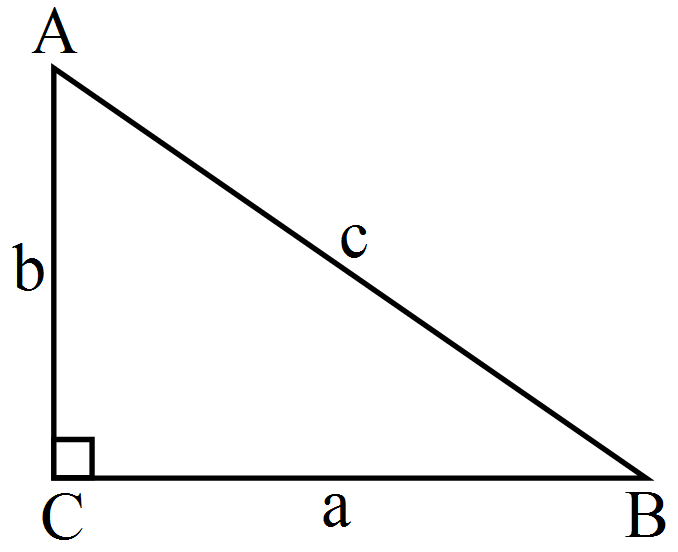
In right $\triangle\text{ABC},$ the lengths of its legs are given as a = 6cm and b = 4.5cm. Find the length of its hypotenuse.
Answer


In right $\triangle ABC , \angle C =90^{\circ}$
$a=6 cm, b=4.5 cm$
By Pythagoras Theorem,
$c^2=a^2+b^2$
$=(6)^2+(4.5)^2$
$=36.00+20.25$
$=56.25$
$=(7.5)^2$
$c=7.5 cm$
View full question & answer
Question 92 Marks
What is the measure of each angle of an equilateral triangle?
Answer
In an equilateral triangle,
All sides are equal.
All angles are also equal.
Each angle $=\frac{180^\circ}{3}=60^\circ$ (Sum of angles of a triangle = 180°)
View full question & answer
Question 102 Marks
Is it possible to draw a triangle, the lengths of whose sides are given below?6cm, 7cm, 14cm
Answer
Consider the numbers 6, 7 and 14.
Clearly, 6 + 7 < 14
Thus, the sum of these two numbers is not greater than the third number.
Hence, it is not possible to draw a triangle having sides 6cm, 7cm and 14cm.
View full question & answer
Question 112 Marks
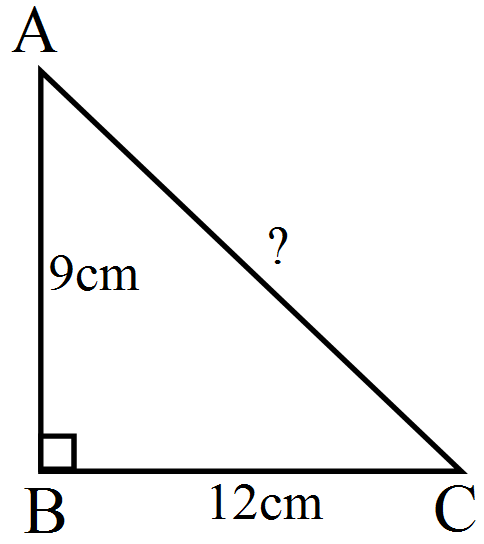
Find the length of the hypotenuse of a right triangle, the other two sides of which measure 9cm and 12cm.
Answer

In right triangle $A B C$,
$\angle B=90^{\circ} AB=9 cm, BC=12 cm$
By Pythagoras Theorem,
$AC^2=AB^2+BC^2=(9)^2+(12)^2$
$AC^2=81+144$
$AC^2=225$
$AC=\sqrt{225}=15 cm$
View full question & answer