Diverse types of bushes and grasses are found in the grasslands.
Question types
The Living World: Adaptations and Classification question types
97 questions across 12 question groups — pick any mix to generate a Science paper with step-by-step answer keys.
97
Questions
12
Question groups
5
Question types
01
Write True or False, correct and rewrite the false statements.
10 Q→02Do as instructed
4 Q→03Answer the following questions:[1 M]
7 Q→04Fill in the blanks
19 Q→05Who am I.
10 Q→06Give scientific reasons:
20 Q→07Answer the following questions: [2 M]
9 Q→08Do as instructed:[2 M]
7 Q→09Answer the following questions:[3 M]
4 Q→10Do as instructed[4M]
1 Q→11Distinguish between
3 Q→12Do as instructed[5 M]
3 Q→Sample Questions
The Living World: Adaptations and Classification questions
One sample from each question group in this chapter. Select any group above to see the full set with answer keys.
View full solution →
A frog is an amphibian.
The eyes of predatory carnivores are located on either side of the head.
Crocodiles use their muscles for creeping.
House lizard and monitor lizards have webbed toes.
Who is lying ?
Camel has thin skin and short eyelashes.
Camel has thin skin and short eyelashes.
Who is lying ?
Cactus – My fleshy, green part is a leaf.
Cactus – My fleshy, green part is a leaf.
Who is lying ?
Hen – My toes are webbed.
Hen – My toes are webbed.
Who is lying ?
Cockroach – I have five legs.
Cockroach – I have five legs.
2 parts of bionomial nomenclature.
World Frog Protection Day.
Plants that eat insects.
Plants of snowy regions.
Animals which have webbed feet.
…………. proposed the theory of the survival of the fittest.
…………. is not a sudden process, it is gradual and continuous.
Spring like …………. on the stems of some climbers are examples of their adaptation.
Desert plants are either leafless or their leaves are like …………. or modified into …………. .
Bats can fly with the help of …………. .
I am mango, my genus is?
I have special thin folds in between my forelegs and hind legs called patagium.
I discovered Binomial nomenclature.
My Scientific name is Bos taurus.
I have waxy broad leaves and air spaces in my stem.
Birds can fly in the air.
White fox has white body colour.
Camel can live in desert.
The eyes of predatory carnivores are located in the front of their head.
Tigers have padded paws.
The lotus stalk has holes or air spaces?
Why are roots of lotus plants short and fibrous?
Why does water trickle off lotus leaves?
What is the main difference between vehicles on the road and aeroplanes?
In what way are sloping branches useful to plants in a snowy region?
Read each of the following statements. Write a paragraph about it.
We have long ears.
We have long ears.
Read each of the following statements. Write a paragraph about it.
We hide.
We hide.
Read each of the following statements. Write a paragraph about it.
Grasslands are lush green.
Grasslands are lush green.
Read each of the following statements. Write a paragraph about it.
There is extreme heat in deserts.
There is extreme heat in deserts.
Match the columns.
| Column ‘A’ | Column B’ |
| 1. Dog | a. Hibiscus roso sinensis |
| 2. Cow | b. Sorghum bicolor |
| 3. Hibiscus | c. Bos taurus |
| 4. Jowar | d. Canis lupus familiarise |
How are organisms classified?
What is the inter-relationship between adaptations of organisms and their surroundings?
How can the plants like cactus and acacia live in deserts with scarce water?
Why is the camel called the ‘ship of the desert’?
Arc the plants and animals from Kashmir and Rajasthan of the same type? Can you elaborate on any differences between the two?
Give one special adaptation or features of the following plant or animal to suit its habitat surrounding.
| Plant/animal | Special adaptation/features |
| 1. Fish | |
| 2. Bird | |
| 3. Camel | |
| 4. Deer | |
| 5. Tiger | |
| 6. Duck | |
| 7. Fungi | |
| 8. Cuscuta | |
| 9. Venus fly trap | |
| 10. Deodar tree | |
| 11. Grape vine | |
| 12. Acacia |
What is the difference between the plants given in the pictures. Give 2 points of difference taking into consideration their adaptations with their surroundings.
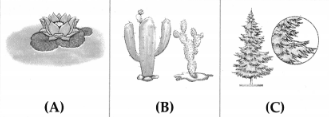
Compare the lotus plant to the Acacia plant and Hibiscus plant.
Read the paragraph and answer the following questions:
I am a penguin. I live in polar region covered by snow. My abdomen is white. My skin is thick with a layer of fat underneath. My body is spindle-shaped. My wings are small. My toes are webbed. We live in flocks.
1.Why is my skin white and thick and why is there a thick layer of fat underneath?
2.Why do we live in flocks sticking close to each other?
3.Which geographical region do I inhabit? Why?
4.Which adaptations should you have to enable you to live permanently in the polar region? Why?
I am a penguin. I live in polar region covered by snow. My abdomen is white. My skin is thick with a layer of fat underneath. My body is spindle-shaped. My wings are small. My toes are webbed. We live in flocks.
1.Why is my skin white and thick and why is there a thick layer of fat underneath?
2.Why do we live in flocks sticking close to each other?
3.Which geographical region do I inhabit? Why?
4.Which adaptations should you have to enable you to live permanently in the polar region? Why?
Observe the diagram and answer the questions.
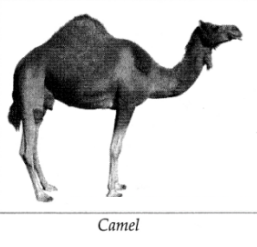
1.What habitat does this camel live in?
2.State any 2 of its body adaptations to survive in desert?
3.How does a camel protect itself from sand storms or winds carrying sand?
Draw a neat labelled diagram of fish and answer the following questions.
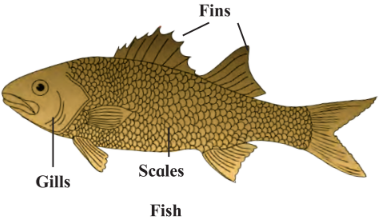
1.Why do fish have a body tapering towards both its ends?
2.Why do Fish have transparent eyelids.
3.How are they able to float?
Generate a The Living World: Adaptations and Classification paper free
Pick question groups from the list above, set marks and difficulty, and export a branded PDF with step-by-step answer keys. First 3 chapters free — no signup.