Questions

5 Mark Question

Take a timed test

11 questions · self-marked practice — reveal the answer and mark yourself.

Question 15 Marks
Students should take examples of their own and practice construction of triangles.
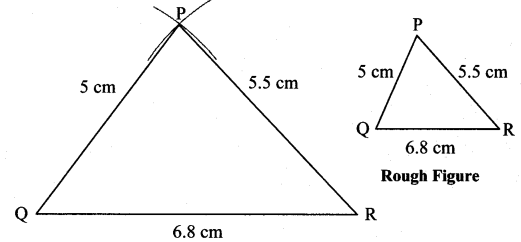
i. In ∆PQR, l(PQ) = 5 cm, l(QR) = 6.8 cm, l(PR) = 5.5 cm.
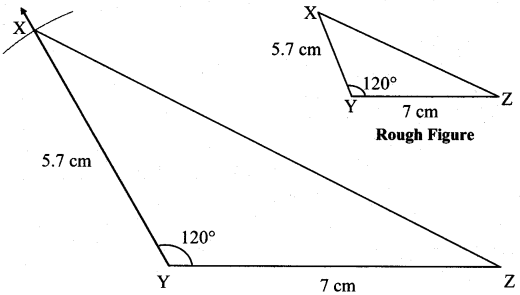
ii. In ∆XYZ, l(XY) = 5.7 cm, m∠Y = 120°, l(YZ) = 7 cm.
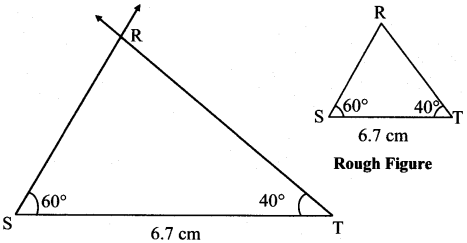
iii. In ∆RST, l(ST) = 6.7 cm, m∠S = 60°, m∠T = 40°.
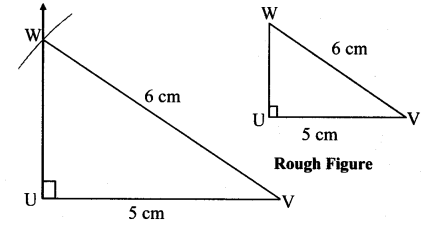
iv. In ∆UVW, m∠U = 90°, l(UV) = 5 cm, l(VW) = 6 cm.
Answer
i. In ∆PQR, l(PQ) = 5 cm, l(QR) = 6.8 cm, l(PR) = 5.5 cm.
Image

ii. In ∆XYZ, l(XY) = 5.7 cm, m∠Y = 120°, l(YZ) = 7 cm.
Image

iii. In ∆RST, l(ST) = 6.7 cm, m∠S = 60°, m∠T = 40°.
Image

iv. In ∆UVW, m∠U = 90°, l(UV) = 5 cm, l(VW) = 6 cm.
Image

View full question & answer
Question 45 Marks
Draw triangle with the measures given. In the right-angled ∆STU, hypotenuse SU = 5cm and l(ST) = 4cm.
View full question & answer
Question 65 Marks
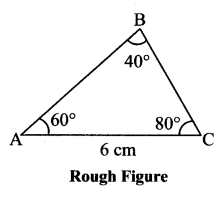
In $\triangle ABC, m\angle A = 60^\circ, m\angle B = 40^\circ, l(AC) = 6\ cm.$ (Textbook pg. no. $5$)
1. Can you draw $\triangle ABC?$
2. What further information is required before it can be drawn?
3. Which property can be used to get it?
4. Draw the rough figure to find out.
Answer
1. $\triangle \mathrm{ABC}$ cannot be drawn using the given information.
Seg $A C$ is included inside the angles $\angle A$ and $\angle C$. Since measure of $\angle C$ is not known, the triangle cannot be drawn.
2. To draw the triangle, measure of $\angle C$ is required.
3. The property of sum of the measures of the angles of a triangle can be used to find out $\mathrm{m} \angle \mathrm{C}$.
4. In $\triangle \mathrm{ABC}$
$ \mathrm{m} \angle \mathrm{A}+\mathrm{m} \angle \mathrm{B}+\mathrm{m} \angle \mathrm{C}=180^{\circ}$
$\therefore 60^{\circ}+40^{\circ}+\mathrm{m} \angle \mathrm{C}=180^{\circ}$
$\therefore 100^{\circ}+\mathrm{m} \angle \mathrm{C}=180^{\circ}$
$\mathrm{m} \angle \mathrm{C}=180^{\circ}-100^{\circ}$
$\therefore \mathrm{m} \angle \mathrm{C}=80^{\circ} $
Image
View full question & answer
Question 115 Marks
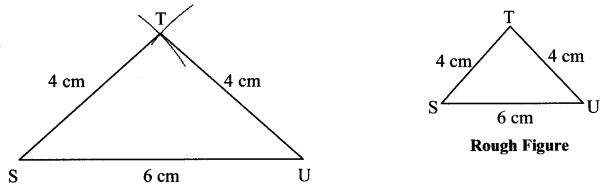
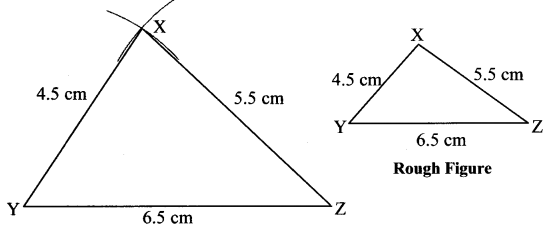
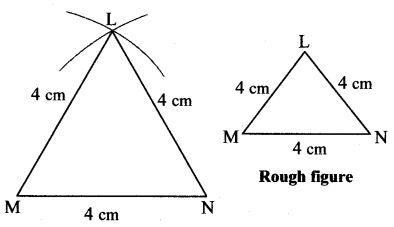
Choose the lengths of the sides yourself and draw one equilateral, one isosceles and one scalene triangle.
Answer
i. Equilateral triangle LMN, l(LM) = l(MN) = l(LN) = 4 cm.
Image

ii. Isosceles triangle STU, l(ST) = l(TU) = 4cm, l(SU) = 6 cm.

Image

iii. Scalene triangle XYZ, l(XY) = 4.5 cm, l(XY) = 6.5 cm, l(XZ) = 5.5 cm.

Image

View full question & answer