Questions

3 Mark Question

Take a timed test

39 questions · self-marked practice — reveal the answer and mark yourself.

Question 13 Marks
The angles of a triangle are in the ratio 3 : 4 : 5. Find the smallest angle.
Answer
Given that
Angles of a triangle are in the ratio: 3 : 4 : 5
Measure of the angles be 3x, 4x, 5x
Sum of the angles of a triangle = 180°
$3\text{x}+4\text{x}+5\text{x}=180^\circ$
$12\text{x}=180^\circ$
$\text{x}=\frac{180}{12}$
$\text{x}=15^\circ$
Smallest angle = 3x
= 3 × 15°
= 45°
View full question & answer
Question 23 Marks
One angle of a triangle is greater than the sum of the other two. What can you say about the measure of this angle? What type of a triangle is this?
Answer
Let the three angles of the given triangle be $\angle \text{a},\angle \text{b}$ and $\angle \text{c}$
We know: $\angle \text{a}>\angle \text{b}+\angle \text{c}...(\text{i})$ (Given)
We also know that the sum of all the angles of a triangle is equal to 180º
$\therefore\angle \text{a}+\angle \text{b}+\angle \text{c}=180^\circ$
$\Rightarrow \angle \text{b}+\angle \text{c}=180^\circ-\angle \text{a}$
Putting the value of $\angle \text{b}+\angle \text{c}$ from equation (i):
$\angle \text{a}>180^\circ-\angle \text{a}$
$\Rightarrow 2\angle \text{a}>180^\circ$
$\Rightarrow \angle \text{a}>90^\circ$
Thus, the angle is more than 90º
Hence, we can conclude by saying that the given triangle is an abtuse triangle.
View full question & answer
Question 33 Marks
Is it possible to have a triangle, in which.
Each angle is less than 60°?
Answer
Give reasons in support of your answer in. No, because if each angle is less than 60°, then the sum of all three angles will be less than 180°, which is not possible in case of a triangle.Proof:
Let the three angles of the triangle be $\angle \text{A},\angle \text{B}$ and $\angle \text{C}$ As per the given information, $\angle \text{A}<60^\circ...(\text{i})$ $\angle \text{B}<60^\circ...(\text{ii})$ $\angle \text{C}<60^\circ...(\text{iii})$ On adding (i), (ii) and (iii), we get: $\angle \text{A}+\angle \text{B}+\angle \text{C}<60^\circ+60^\circ+60^\circ$ $\angle \text{A}+\angle \text{B}+\angle \text{C}<180^\circ$ We can see that the sum of all three angles is less than 180°, which is not possible for a triangle. Hence, we can say that it is not possible for each angle of a triangle to be less than 60°
View full question & answer
Question 43 Marks
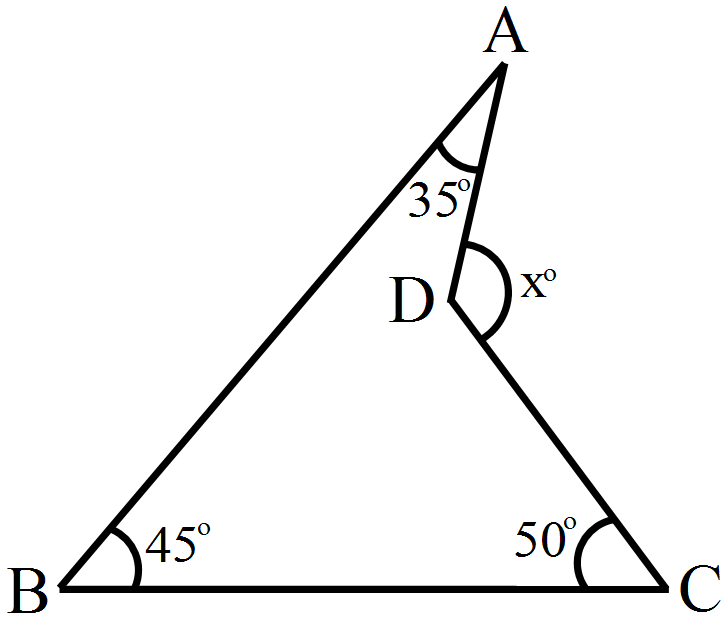
Compute the value of x in the following figure.
Answer
In the given figure, we have a quadrilateral whose sum of all angles is 360º
Thus,
$35^\circ+45^\circ+50^\circ+\text{reflex}\ \angle \text{ADC}=360^\circ$
Or,
Reflex $\angle \text{ADC}=230^\circ$
$230^\circ+\text{x}=360^\circ$ (A complete angle)
$\text{x}=130^\circ$
View full question & answer
Question 53 Marks
If one angle of a triangle is equal to the sum of the other two, show that the triangle is a right triangle.
Answer
One angle of a triangle is equal to the sum of the other two
x = y + z
Let the measure of angles be x, y, z
x + y + z = 180°
x + x = 180°
2x = 180°
$\text{x}=\frac{180}{2}$
$\text{x}=90^\circ$
If one angle is 90° then the given triangle is a right angled triangle.
View full question & answer
Question 63 Marks
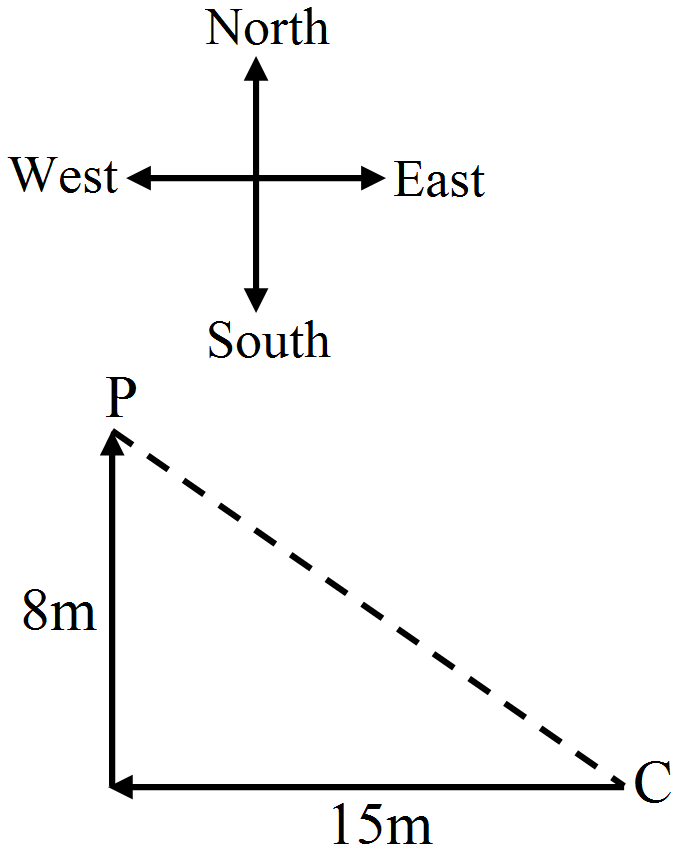
A man goes 15m due west and then 8m due north. How far is he from the starting point?
Answer

Let O be the starting point and P be the final point.
By using the Pythagoras theorem, we can find the distance OP.
$O P^2=15^2+8^2$
$O P^2=225+64$
$O P^2=289$
$O P=17$
Hence, the required distance is 17m.
View full question & answer
Question 73 Marks
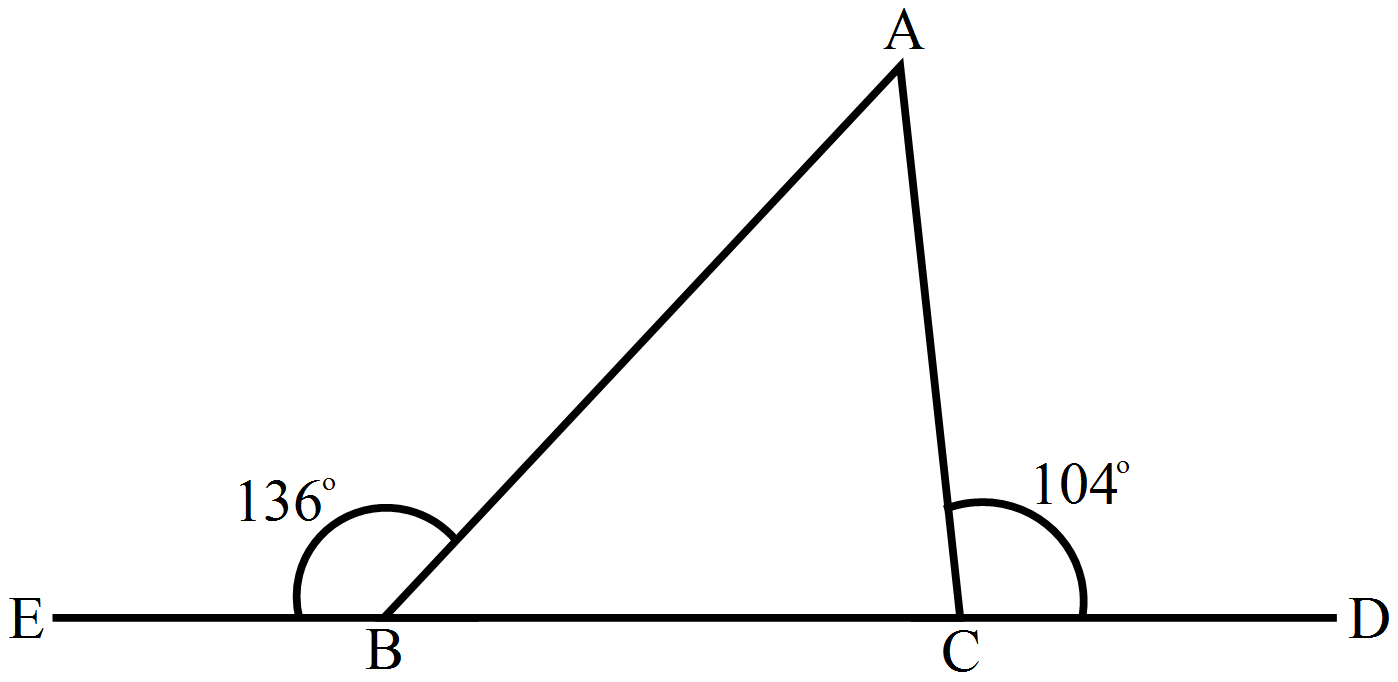
The exterior angles, obtained on producing the base of a triangle both ways are 104° and 136°. Find all the angles of the triangle.
Answer

In the given figure, $\angle \text{ABE}$ and $\angle \text{ABC}$ form a linear pair.
$\angle \text{ABE}+\angle \text{ABC}=180^\circ$
$\angle \text{ABC}=180^\circ-136^\circ$
$\angle \text{ABC}=44^\circ$
We can also see that $\angle \text{ACD}$ and $\angle \text{ACB}$ form a linear pair.
$\angle \text{ACD}+\angle \text{ACB}=180^\circ$
$\angle \text{AUB}=180^\circ-104^\circ$
$\angle \text{ACB}=76^\circ$
We know that the sum of interior opposite angles is equal to the exterior angle.
Therefore, we can say that:
$\angle \text{BAC}+\angle \text{ABC}=104^\circ$
$\angle \text{BAC}=104^\circ-44^\circ$
$=60^\circ$
Thus,
$\angle \text{ACE}=76^\circ$ and $\angle \text{BAC}=60^\circ$
View full question & answer
Question 83 Marks
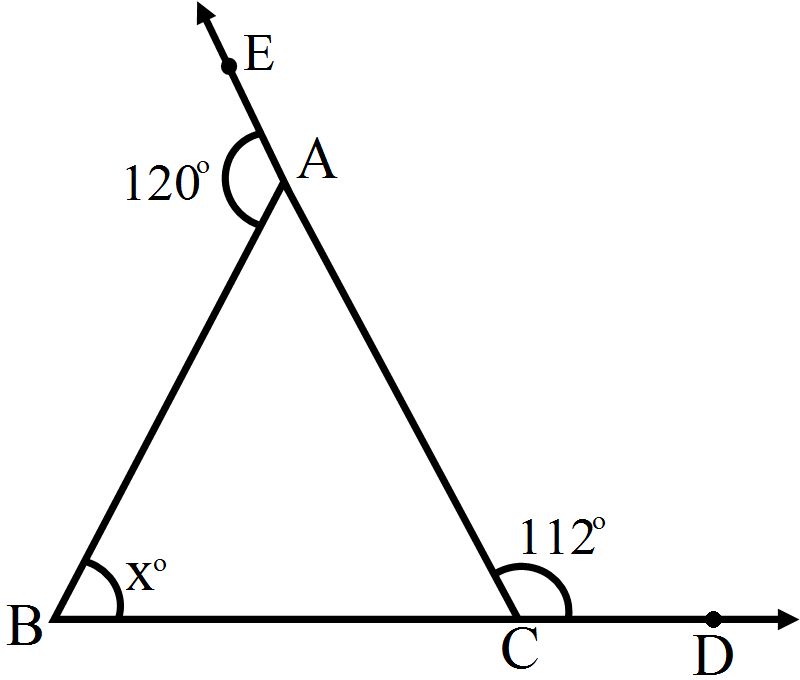
Compute the value of x in the following figure.
Answer
From the given figure, we can say that:
$\angle \text{ACD}+\angle \text{ACB}=180^\circ$ (Linear pair)
Or,
$\angle \text{ACB}=180^\circ-112^\circ=68^\circ$
We can also say that:
$\angle \text{BAE}+\angle \text{BAC}=180^\circ$ (Linear pair)
Or,
$\angle \text{BAC}=180^\circ-120^\circ=60^\circ$
We know that the sum of all angles of a triangle is 180°
Therefore, for $\triangle \text{ABC}:$
$\text{x}+\angle \text{BAC}+\angle \text{ACB}=180^\circ$
$\text{x}=180^\circ-60^\circ-68^\circ=52^\circ$
$\text{x}=52^\circ$
View full question & answer
Question 93 Marks
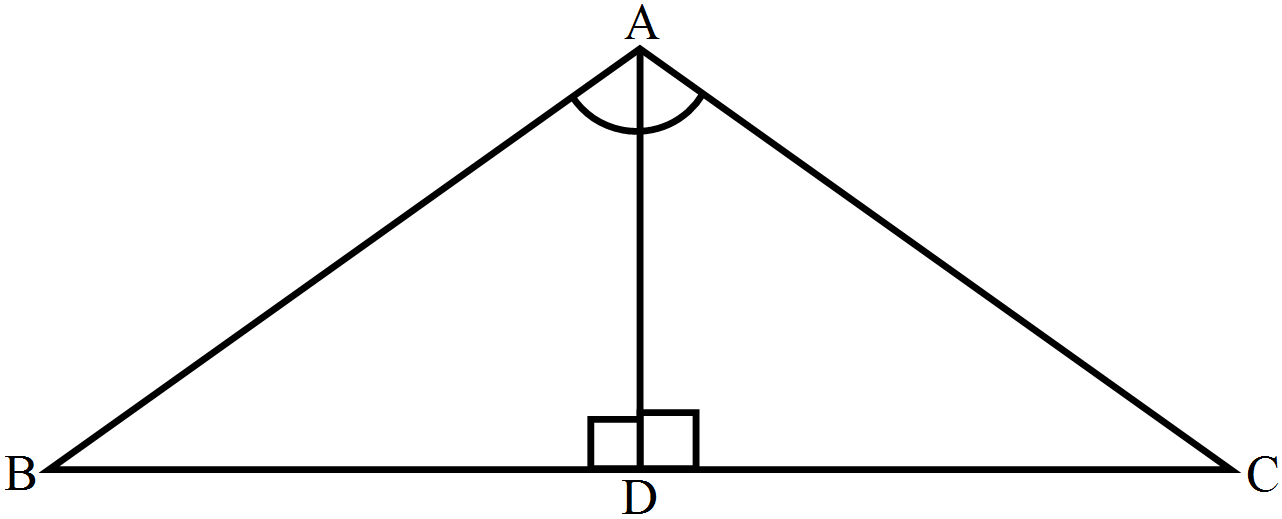
In $\triangle \text{ABC},\angle \text{A}=100^\circ,$ AD bisects $\angle \text{A}$ and $\text{AD}\bot\text{BC}.$ Find $\angle \text{B}$
Answer

Consider $\triangle \text{ABD}$
$\angle \text{BAD}=\frac{100}{2}$ $($AD bisects $\angle \text{A})$
$\angle \text{BAD}=50^\circ$
$\angle \text{ADB}=90^\circ$ (AD perpendicular to BC)
We know that the sum of all three angles of a triangle is 180°
Thus,
$\angle \text{ABD}+\angle \text{BAD}+\angle \text{ADB}=180^\circ$ $($Sum of angles of $\triangle \text{ABD})$
Or,
$\angle \text{ABD}+50^\circ+90^\circ=180^\circ$
$\angle \text{ABD}=180^\circ-140^\circ$
$\angle \text{ABD}=40^\circ$
View full question & answer
Question 103 Marks
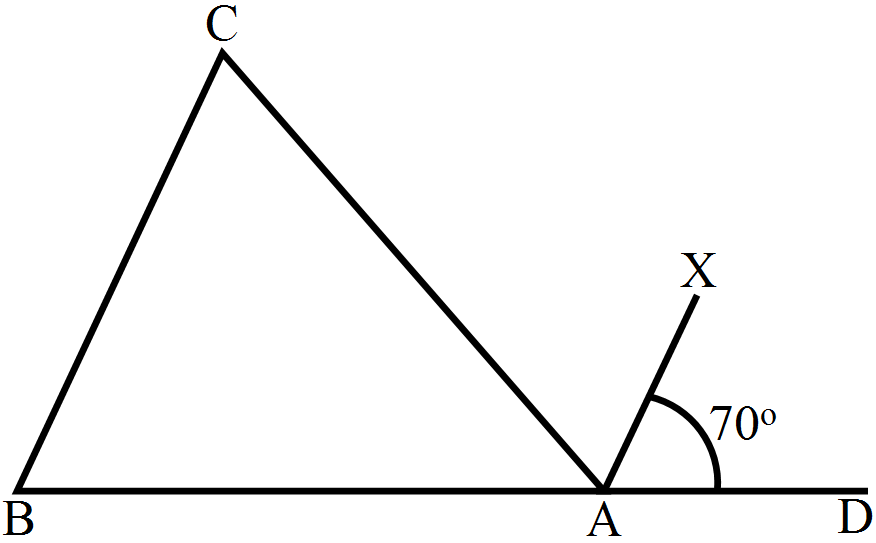
ABC is a triangle in which $\angle \text{B} = \angle \text{C}$ and ray AX bisects the exterior angle DAC. If $\angle \text{DAX}=70^\circ.$ Find $\angle \text{ACB}$
Answer
Here,
$\angle \text{CAX}=\angle \text{DAX}$ $($AX bisects $\angle \text{CAD})$
$\angle \text{CAX}=70^\circ$
$\angle \text{CAX}+\angle \text{DAX}+\angle \text{CAB}=180^\circ$
$70^\circ+70^\circ+\angle \text{CAB}=180^\circ$
$\angle \text{CAB}=180^\circ-140^\circ$
$\angle \text{CAB}=40^\circ$
$\angle \text{ACB}+\angle \text{CBA}+\angle \text{CAB}=180^\circ$ $($Sum of the angles of $\triangle \text{ABC})$
$\angle \text{ACB}+\angle \text{ACB}+40^\circ=180^\circ$ $(\angle \text{C}=\angle \text{B})$
$2\angle \text{AVB}=180^\circ-40^\circ$
$\angle \text{ACB}=\frac{140}{2}$
$\angle \text{ACB}=70^\circ$
View full question & answer
Question 113 Marks
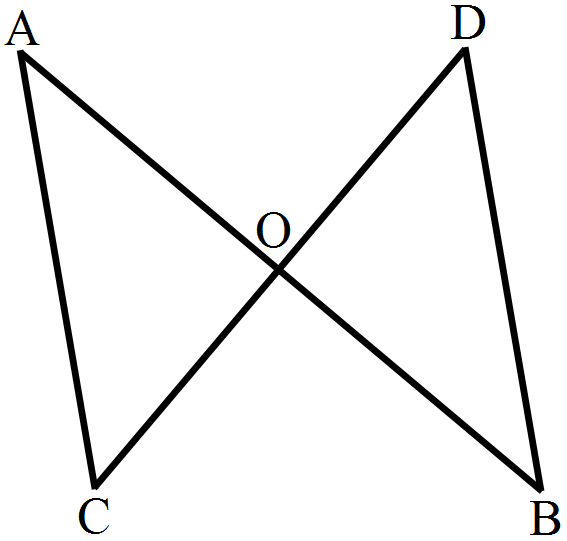
Line segments AB and CD intersect at O such that AC perpendicular DB. It $\angle \text{CAB}=35^\circ$ and$ \angle \text{CDB}=55^\circ$. Find $\angle \text{BOD}$
Answer

We know that AC parallel to BD and AB cuts AC and BD at A and B, respectively.
$\angle \text{CAB}=\angle \text{DBA}$ (Alternate interior angles)
$\angle \text{DBA}=35^\circ$
We also know that the sum of all three angles of a triangle is 180°
Hence, for $\triangle \text{OBD},$ we can say that:
$\angle \text{DBO}+\angle \text{ODB}+\angle \text{BOD}=180^\circ$
$35^\circ+55^\circ+\angle \text{BOD}=180^\circ$ $(\angle \text{DBO}=\angle \text{DBA}$ and $\angle \text{ODB}=\angle \text{CDM})$
$\angle \text{BOD}=180^\circ-90^\circ$
$\angle \text{BOD}=90^\circ$
View full question & answer
Question 123 Marks
Two angles of a triangle are of measures 150º and 30º. Find the measure of the third angle.
Answer
Let the third angle be x
Sum of all the angles of a triangle = 180º
105º + 30º + x = 180º
135º + x = 180º
x = 180º - 135º
x = 45º
Therefore the third angle is 45º
View full question & answer
Question 133 Marks
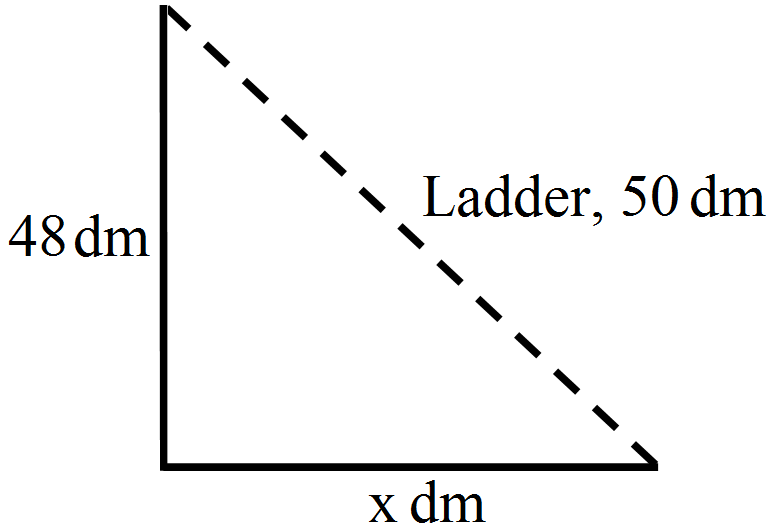
A ladder 50dm long when set against the wall of a house just reaches a window at a height of 48dm. How far is the lower end of the ladder from the base of the wall?
Answer

Let the distance of the lower end of the ladder from the wall be x m.
On using the Pythagoras theorem, we get:
$x^2+48^2=50^2$
$x^2=50^2-48^2$
$=2500-2304$
$=196$
$H = 14dm$
Hence, the distance of the lower end of the ladder from the wall is 14dm.
View full question & answer
Question 143 Marks
If the angles of a triangle are in the ratio 1 : 2 : 3, determine three angles.
Answer
If angles of the triangle are in the ratio 1 : 2 : 3 then take first angle as ‘x’, second angle as ‘2x’ and third angle as ‘3x’
Sum of all the angles of a triangle = 180º
$\text{x}+2\text{x}+3\text{x}=180^\circ$
$6\text{x}=180^\circ$
$\text{x}=\frac{180}{6}$
$\text{x}=30^\circ$
$2\text{x}=30^\circ\times 2=60^\circ$
$3\text{x}=30^\circ\times 3=90^\circ$
Therefore the first angle is 30º, second angle is 60º and third angle is 90º
View full question & answer
Question 153 Marks
A student when asked to measure two exterior angles of $\triangle \text{ABC}$ observed that the exterior angles at A and B are of 103° and 74° respectively. Is this possible? Why or why not?
Answer
Internal angle at A + External angle at A = 180º
Internal angle at A + 103º =180º
Internal angle at A = 77°
Internal angle at B + External angle at B = 180º
Internal angle at B + 74º = 180º
Internal angle at B = 106º
Sum of internal angles at A and B = 77° + 106º
= 183°
It means that the sum of internal angles at A and B is greater than 180°, which cannot be possible.
View full question & answer
Question 163 Marks
O is a point in the exterior of △ABC. What symbol ‘>’, ’<’ or ‘=’ will you see to complete the statement OA + OB…. AB? Write two other similar statements and show that.
$\text{OA}+\text{OB}+\text{OC}>\frac{1}{2}(\text{AB}+\text{BC}+\text{CA})$
Answer
Because the sum of any two sides of a triangle is always greater than the third side, in triangle OAB, we have:
OA + OB > AB... (i)
OB + OC > BC... (ii)
OA + OC > CA... (iii)
On adding equations (i), (ii) and (iii) we get:
OA + OB + OB + OC + OA + OC > AB + BC + CA
2(OA + OB + OC) > AB + BC + CA
$\text{OA}+\text{OB}+\text{OC}>\frac{(\text{AB}+\text{BC}+\text{CA})}{2}$
View full question & answer
Question 173 Marks
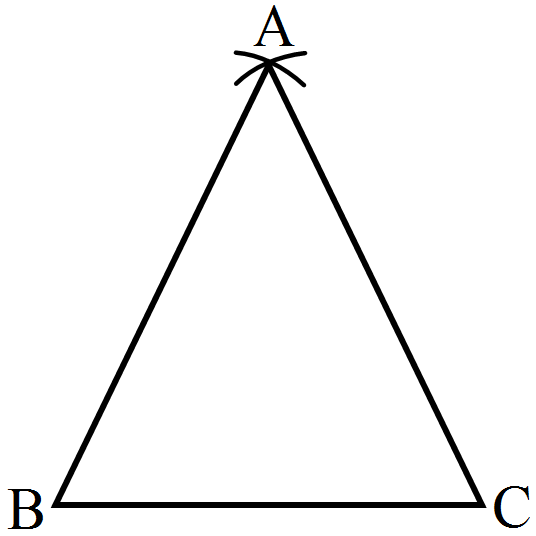
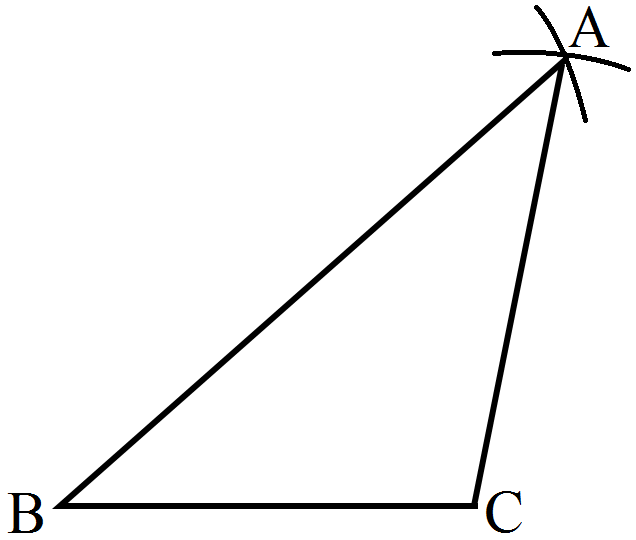
Draw a triangle $A B C$, with $A C=4 cm, BC =3 cm$ and $\angle C=80^{\circ}$. Measure AB . Is $(A B)^2=(A C)^2+(B C)^2$ ? If not which one of the following is true:
$(A B)^2>(A C)^2+(B C)^2 \text { or }(A B)^2<(A C)^2+(B C)^2$
Answer

Draw $\triangle ABC$,
Draw a line $B C=3 cm$.
At point C , draw a line at $80^{\circ}$ angle with BC .
Take an arc of 4 cm from point $C$, which will cut the line at point $A$.
Now, join $A B$; it will be approximately 4.5 cm .
$AC^2+BC^2$
$=4^2+3^2$
$=9+16$
$=25$
$AB^2=4.5^2=20.25$
$A B^2$ not equal to $A C^2+B C^2$
Here,
$A B^2<A C^2+B C^2$
View full question & answer
Question 183 Marks
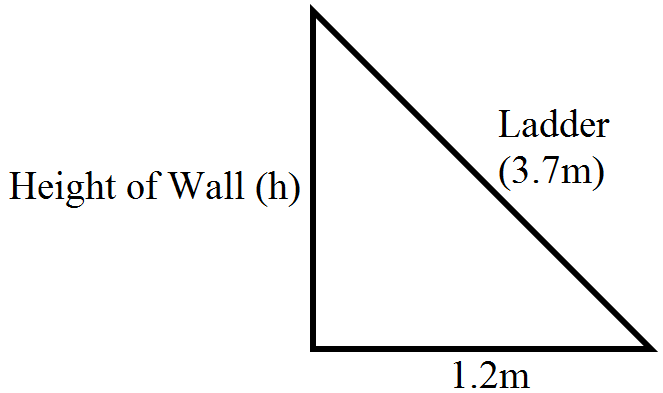
A ladder 3.7m long is placed against a wall in such a way that the foot of the ladder is 1.2m away from the wall. Find the height of the wall to which the ladder reaches.
Answer

Let the hypotenuse be h.
Using the Pythagoras theorem, we get:
$3.72=1.22+h^2$
$h^2=13.69-1.44=12.25$
$h=3.5 m$
Hence, the height of the wall is 3.5 m .
View full question & answer
Question 193 Marks
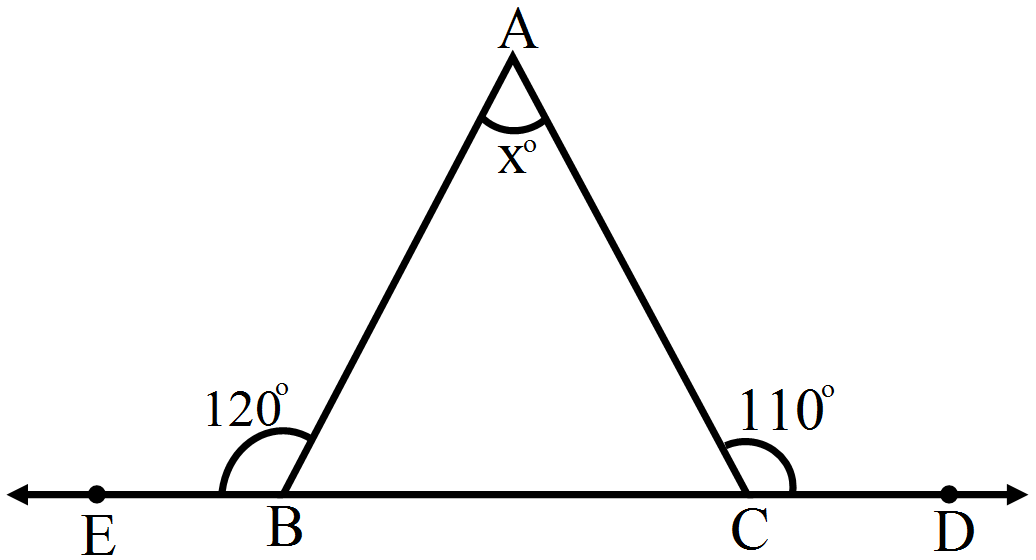
Compute the value of x in the following figure.
Answer
From the given figure, we can say that:
$\angle \text{ABC}+120^\circ=180^\circ$ (Linear pair)
$\angle \text{ABC}=60^\circ$
We can also say that:
$\angle \text{ACB}+110^\circ=180^\circ$ (Linear pair)
$\angle \text{ACB}=70^\circ$
We know that the sum of all angles of a triangle is 180°
Therefore, for $\triangle \text{ABC}:$
$\text{x}+\angle \text{ABC}+\angle \text{ACB}=180^\circ$
$\text{x}=50^\circ$
View full question & answer
Question 203 Marks
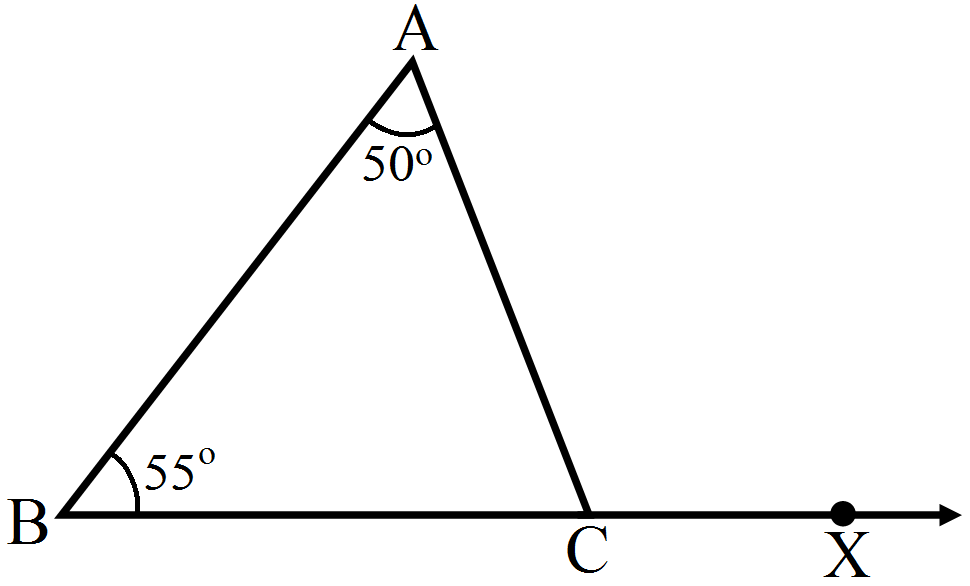
In the fig., two of the angles are indicated. What are the measures of $\angle \text{ACX}$ and $\angle \text{ACB}$?
Answer
In $\triangle \text{ABC}, \angle \text{A}=50^\circ$ and $\angle \text{B}=55^\circ$
Because of the angle sum property of the triangle, we can say that
$\angle \text{A}+\angle \text{B}+\angle \text{C}=180^\circ$
$55^\circ+55^\circ+\angle \text{C}=180^\circ$
Or,
$\angle \text{C}=75^\circ$
$\angle \text{ACB}=75^\circ$
$\angle \text{ACX}=180^\circ-\angle \text{ACB}=180^\circ-75^\circ$
$=105^\circ$
View full question & answer
Question 213 Marks
If one angle of a triangle is 60° and the other two angles are in the ratio 1 : 2, find the angles.
Answer
We know that one of the angles of the given triangle is 60° (Given)
We also know that the other two angles of the triangle are in the ratio 1 : 2.
Let one of the other two angles be x.
Therefore, the second one will be 2x.
We know that the sum of all the three angles of a triangle is equal to 180°.
60° + x + 2x = 180°
3x = 180° - 60°
3x = 120°
$\text{x}=\frac{120}{3}$
x = 40°
2x = 2 × 40
2x = 80°
Hence, we can conclude that the required angles are 40° and 80°
View full question & answer
Question 223 Marks
Two acute angles of a right triangle are equal. Find the two angles.
Answer

Given acute angles of a right angled triangle are equal.
Right triangle: whose one of the angle is a right angle.
Measured angle be x, x, 90°
$\text{x}+\text{x}+180^\circ=180^\circ$
$2\text{x}=90^\circ$
$\text{x}=\frac{90}{2}$
$\text{x}=45^\circ$
The two angles are 45° and 45°
View full question & answer
Question 233 Marks
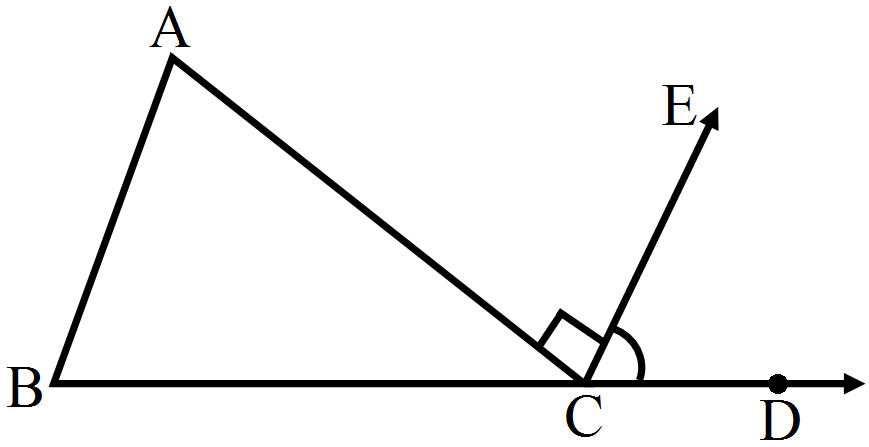
In Figure, $\text{AC}\bot\text{CE}$ and C $\angle \text{A}:\angle \text{B}:\angle \text{C}=3:2:1.$ Find the value of $\angle \text{ECD}$
Answer
In the given triangle, the angles are in the ratio 3 : 2 : 1.
Let the angles of the triangle be 3x, 2x and x.
Because of the angle sum property of the triangle, we can say that:
3x + 2x + x = 180°
6x = 180º
Or,
x = 30° …(i)
Also, $\angle \text{ACB}+\angle \text{ACE}+\angle \text{ECD}=180^\circ$
$\text{x}+90^\circ+\angle \text{ECD}=180^\circ$ $(\angle \text{ACE}=90^\circ)$
$\angle \text{ECD}=60^\circ$ [From (i)]
View full question & answer
Question 243 Marks
The angles of a triangle are arranged in ascending order of magnitude. If the difference between two consecutive angles is 10°. Find the three angles.
Answer
Let the first angle be x
Second angle be x + 10°
Third angle be x + 10° + 10°
Sum of all the angles of a triangle = 180°
x + x + 10° + x + 10° + 10° = 180°
3x + 30 = 180
3x = 180 - 30
3x = 150
$\text{x}=\frac{150}{3}$
$\text{x}=50^\circ$
First angle is 50°
Second angle x + 10° = 50 + 10 = 60°
Third angle x + 10° + 10°
= 50 + 10 + 10
= 70°
View full question & answer
Question 253 Marks
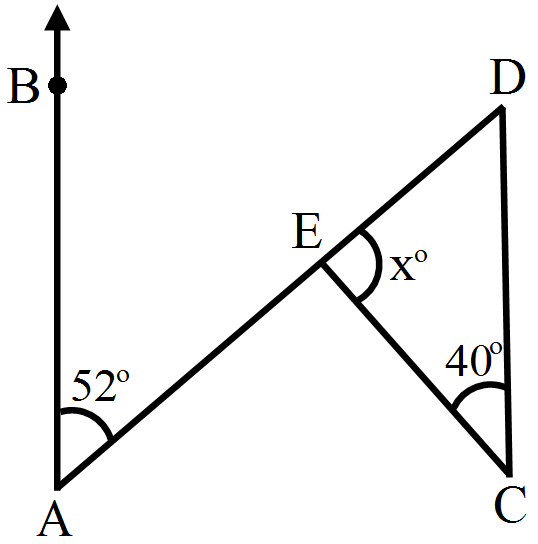
Compute the value of x in the following figure.
Answer
From the given figure, we can see that:
$\angle \text{BAD}=\angle \text{ADC}=52^\circ$ (Alternate angles)
We know that the sum of all the angles of a triangle is 180°
Therefore, for $\triangle \text{DEC}:$
$\text{x}+40^\circ+52^\circ=180^\circ$
$\text{x}=88^\circ$
View full question & answer
Question 263 Marks
Two angles of a triangle are equal and the third angle is greater than each of those angles by 30°. Determine all the angles of the triangle.
Answer
Let the first and second angle be x
The third angle is greater than the first and second by 30° = x + 30°
The first and the second angles are equal
Sum of all the angles of a triangle = 180°
x + x + x + 30° = 180°
3x + 30 = 180
3x = 180 - 30
3x = 150
$\text{x}=\frac{150}{3}$
$\text{x}=50^\circ$
Third angle = x + 30° = 50° + 30° = 80°
The first and the second angle is 50° and the third angle is 80°
View full question & answer
Question 273 Marks
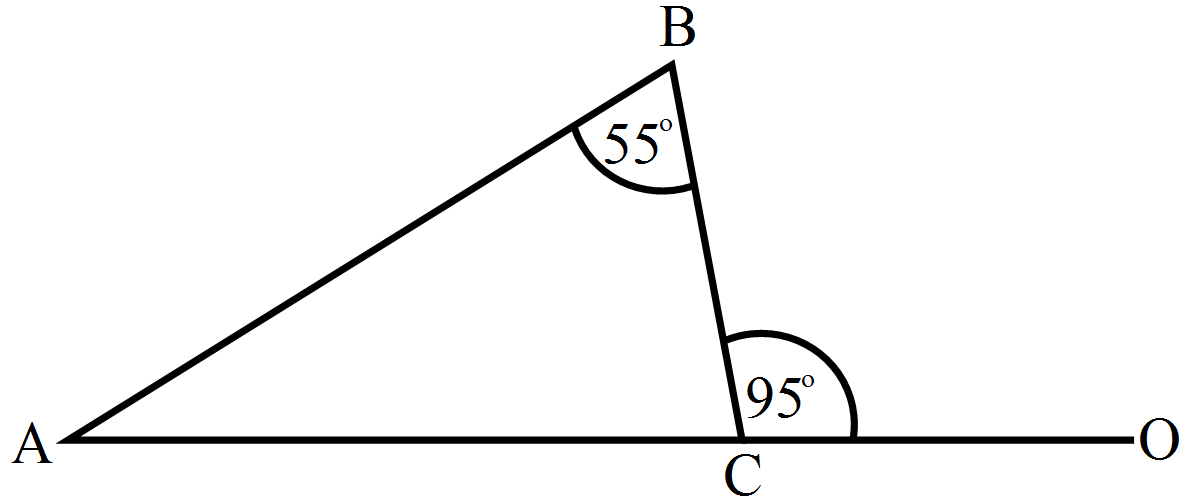
In a triangle, an exterior angle at a vertex is 95º and its one of the interior opposite angles is 55°. Find all the angles of the triangle.
Answer

We know that the sum of interior opposite angles is equal to the exterior angle.
Hence, for the given triangle, we can say that:
$\angle \text{ABC}+\angle \text{BAC}=\angle \text{BCO}$
$55^\circ+\angle \text{BAC}=95^\circ$
Or,
$\angle \text{BAC}=95^\circ-95^\circ$
$=\angle \text{BAC}=40^\circ$
We also know that the sum of all angles of a triangle is 180°
Hence, for the given $\triangle \text{ABC},$ we can say that:
$\angle \text{ABC}+\angle \text{BAC}+\angle \text{BCA}=180^\circ$
$55^\circ+40^\circ+\angle \text{BCA}=180^\circ$
Or,
$\angle \text{BCA}=180^\circ-95^\circ$
$=\angle \text{BCA}=85^\circ$
View full question & answer
Question 283 Marks
One of the exterior angles of a triangle is 80°, and the interior opposite angles are equal to each other. What is the measure of each of these two angles?
Answer
Let us assume that A and B are the two interior opposite angles.
We know that $\angle \text{A}$ is equal to $\angle \text{B}$
We also know that the sum of interior opposite angles is equal to the exterior angle.
Hence, we can say that:
$\angle \text{A}+\angle \text{B}=80^\circ$
Or,
$\angle \text{A}+\angle \text{A}=80^\circ$ $(\angle \text{A}=\angle \text{B})$
$2\angle \text{A}=80^\circ$
$\angle \text{A}=\frac{40}{2}=40^\circ$
$\angle \text{A}=\angle \text{B}=40^\circ$
Thus, each of the required angles is of 40°
View full question & answer
Question 293 Marks
One of the angles of a triangle is 130°, and the other two angles are equal. What is the measure of each of these equal angles?
Answer
Let the second and third angle be x
Sum of all the angles of a triangle = 180°
130º + x + x = 180º
130º + 2x = 180º
2x = 180º - 130º
2x = 50º
$\text{x}=\frac{50}{2}$
$\text{x}=25^\circ$
Therefore the two other angles are 25º each.
View full question & answer
Question 303 Marks
The three angles of a triangle are equal to one another. What is the measure of each of the angles?
Answer
Let the each angle be x
Sum of all the angles of a triangle = 180º
$\text{x}+\text{x}+\text{x}=180^\circ$
$3\text{x}=180^\circ$
$\text{x}= \frac{180}{3}$
$\text{x}=60^\circ$
Therefore angle is 60º each.
View full question & answer
Question 313 Marks
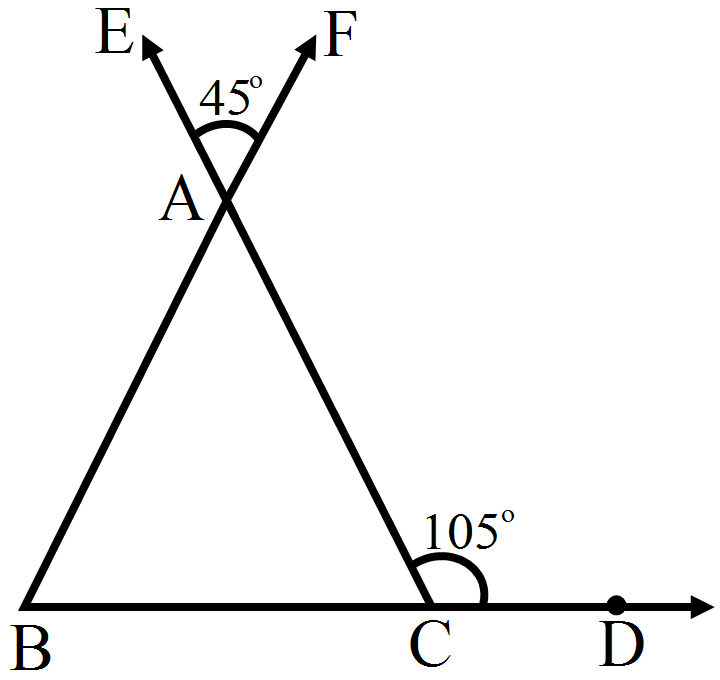
In Fig, the sides BC, CA and BA of a $\triangle \text{ABC}$ have been produced to D, E and F respectively. If $\angle \text{ACD}=105^\circ$ and $\angle \text{EAF}=45^\circ,$ find all the angles of the $\triangle \text{ABC}$
Answer
$\angle \text{EAF}$In a $\triangle \text{ABC}, \angle \text{BAC}$ and are vertically opposite angles.
Hence, we can say that:
$\angle \text{BAC}=\angle \text{EAF}=45^\circ$
Considering the exterior angle property, we can say that:
$\angle \text{BAC}+\angle \text{ABC}=\angle \text{ACD}=105^\circ$
$\angle \text{ABC}=105^\circ - 45^\circ =60^\circ$
Because of the angle sum property of the triangle, we can say that:
$\angle \text{ABC}+\angle \text{ACS}+\angle \text{BAC}=180^\circ$
$\angle \text{ACB}=75^\circ$
Therefore, the angles are 45°, 65° and 75°
View full question & answer
Question 323 Marks
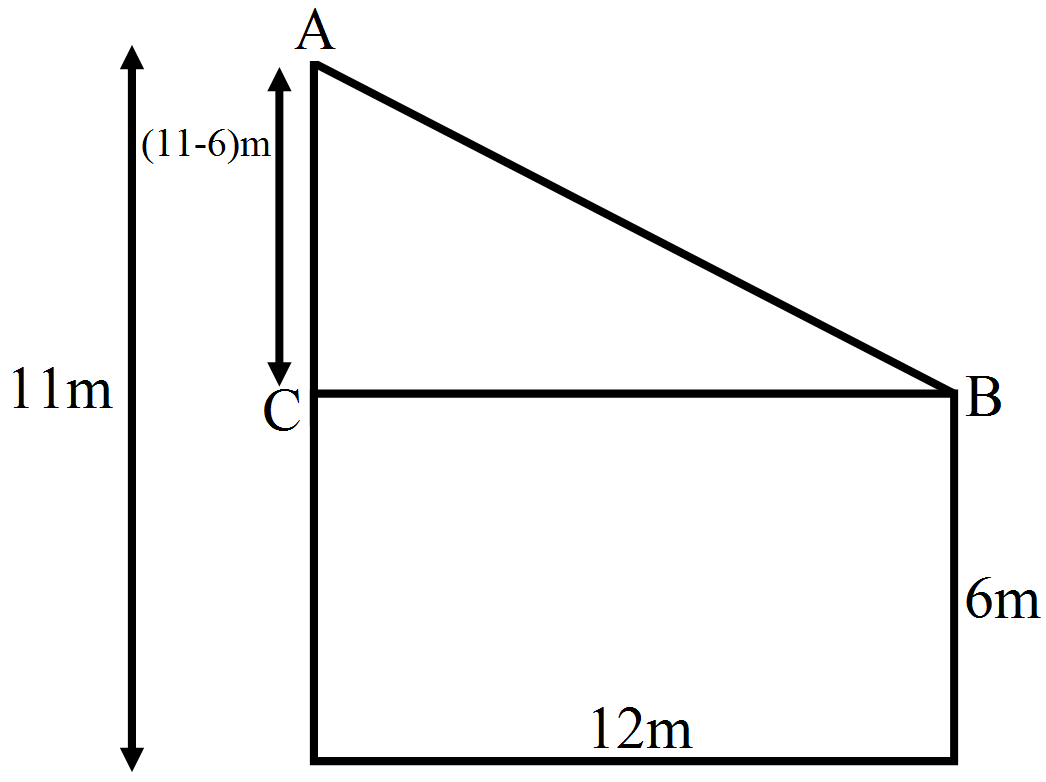
Two poles of heights 6 m and 11 m stand on a plane ground. If the distance between their feet is 12 m . Find the distance between their tops.
(Hint: Find the hypotenuse of a right triangle having the sides $(11-6) m =5 m$ and 12 m )
Answer

The distance between the tops of the poles is the distance between points A and B .
We can see from the given figure that points $A , B$ and C form a right triangle, with AB as the hypotenuse.
On using the Pythagoras Theorem in $\triangle ABC$, we get:
$(11-6)^2+12^2=A B^2$
$A B^2=25+144$
$A B^2=169$
$A B=13$
Hence, the distance between the tops of the poles is 13 m .
View full question & answer
Question 333 Marks
The angles of a triangle are (x − 40)º, (x − 20)º and $\Big(\frac{1}{2}\text{x}-10\Big)^\circ.$ Find the value of x.
Answer
Sum of all the angles of a triangle = 180º
$(\text{x}-40)^\circ+(\text{x}-20)^\circ+\Big(\frac{\text{x}}{2}-10\Big)^\circ=$
$\text{x}+\text{x}+\frac{\text{x}}{2}-40^\circ-20^\circ-10^\circ=180^\circ$
$\text{x}+\text{x}+\frac{\text{x}}{2}-70^\circ=180^\circ$
$\text{x}+\text{x}+\frac{\text{x}}{2}=180^\circ+70^\circ$
$\frac{5\text{x}}{2}=250^\circ$
$\text{x}=\frac{2}{5}\times 250^\circ$
$\text{x}=100^\circ$
Hence, we can conclude that x is equal to 100º
View full question & answer
Question 343 Marks
It one angle of a triangle is 100° and the other two angles are in the ratio 2 : 3. find the angles.
Answer
We know that one of the angles of the given triangle is 100°
We also know that the other two angles are in the ratio 2 : 3.
Let one of the other two angles be 2x
Therefore, the second angle will be 3x
We know that the sum of all three angles of a triangle is 180°
100° + 2x + 3x = 180°
5x = 180° - 100°
5x = 80°
$\text{x}=\frac{80}{5}$
2x = 2 ×16
2x = 32°
3x = 3 × 16
3x = 48°
Thus, the required angles are 32° and 48°
View full question & answer
Question 353 Marks
Draw a triangle $A B C$, with $A C=4 cm, BC =3 cm$ and $\angle C=105^{\circ}$. Measure AB . Is. $(A B)^2=(A C)^2+(B C)^2$ ? If not which one of the following is true:
$(A B)^2>(A C)^2+(B C)^2 \text { or }(A B)^2<(A C)^2+(B C)^2$
Answer

Draw $\triangle ABC$,
Draw a line $B C=3 cm$.
At point C, draw a line at $105^{\circ}$ angle with BC .
Take an arc of 4 cm from point $C$, which will cut the line at point $A$.
Now, join $A B$, which will be approximately 5.5 cm .
$AC^2+BC^2$
$=4^2+3^2$
$=9+16$
$=25$
$AB^2=5.52=30.25$
$A B^2$ not equal to $A C^2+B C^2$
Here,
$A B^2>A C^2+B C^2$
View full question & answer
Question 363 Marks
State Pythagoras theorem and its converse.
Answer
The Pythagoras Theorem: In a right triangle, the square of the hypotenuse is always equal to the sum of the squares of the other two sides.
Converse of the Pythagoras Theorem: If the square of one side of a triangle is equal to the sum of the squares of the other two sides, then the triangle is a right triangle, with the angle opposite to the first side as right angle.
View full question & answer
Question 373 Marks
Is it possible to have a triangle, in which.
Each angle is greater than 60°?
Answer
Give reasons in support of your answer in. No, because if each angle is greater than 60°, then the sum of all three angles will be greater than 180°, which is not possible.Proof:
Let the three angles of the triangle be $\angle \text{A},\angle \text{B}$ and $\angle \text{C}.$ As per the given information, $\angle \text{A}>60^\circ...(\text{i})$ $\angle \text{B}>60^\circ...(\text{ii})$ $\angle \text{C}>60^\circ...(\text{iii})$ On adding (i), (ii) and (iii), we get: $\angle \text{A}+\angle \text{B}+\angle \text{C}>60^\circ+60^\circ+60^\circ$ $\angle \text{A}+\angle \text{B}+\angle \text{C}>180^\circ$ We can see that the sum of all three angles of the given triangle are greater than 180°, which is not possible for a triangle. Hence, we can say that it is not possible for each angle of a triangle to be greater than 60°
View full question & answer
Question 383 Marks
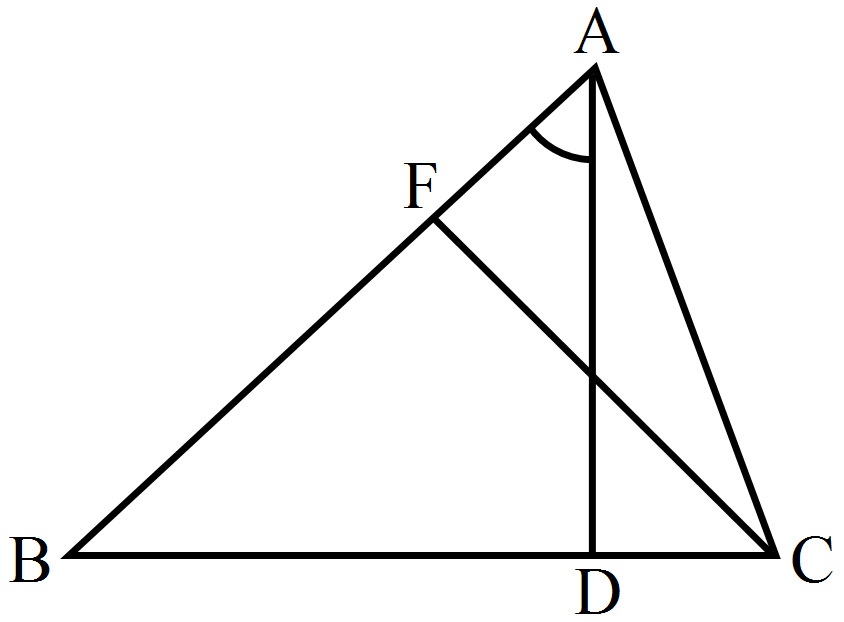
In Figure, AD and CF are respectively perpendiculars to sides BC and AB of$ \triangle \text{ABC}.$ If $\angle \text{FCD}=50^\circ,$ find $\angle \text{BAD}$
Answer
We know that the sum of all angles of a triangle is 180°
Therefore, for the given $\triangle \text{FCB},$ we can say that:
$\angle \text{FCB}+\angle \text{CBF}+\angle \text{BFC}=180^\circ$
$50^\circ+\angle \text{CBF}+90^\circ=180^\circ$
Or,
$\angle \text{CBF}=180^\circ-50^\circ-90^\circ=40^\circ...(\text{i})$
Using the above rule for $\triangle \text{ABD},$ we can say that:
$\angle \text{ABD}+\angle \text{BDA}+\angle \text{BAD}=180^\circ$
$\angle \text{BAD}=180^\circ-90^\circ-40^\circ=50^\circ$ [from (i)]
View full question & answer
Question 393 Marks
Is it possible to have a triangle, in which.
Each angle is equal to 60°
Answer
Give reasons in support of your answer in. Yes, if each angle of the triangle is equal to 60°, then the sum of all three angles will be 180° , which is possible in case of a triangle.Proof:
Let the three angles of the triangle be $\angle \text{A},\angle \text{B}$ and $\angle \text{C}.$ As per the given information, $\angle \text{A}=60^\circ...(\text{i})$ $\angle \text{B}=60^\circ...(\text{ii})$ $\angle \text{C}=60^\circ...(\text{iii})$ On adding (i), (ii) and (iii), we get: $\angle \text{A}+\angle \text{B}+\angle \text{C}=60^\circ+60^\circ+60^\circ$ $\angle \text{A}+\angle \text{B}+\angle \text{C}=180^\circ$ We can see that the sum of all three angles of the given triangle is equal to 180°, which is possible in case of a triangle. Hence, we can say that it is possible for each angle of a triangle to be equal to 60°
View full question & answer