Question 14 Marks
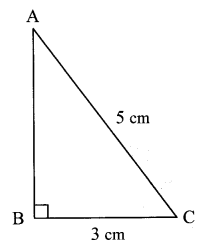
On a sheet of card paper, draw a right-angled triangle of sides 3 cm, 4 cm and 5 cm. Construct a square on each of the sides. Find the area of each of the squares and verify Pythagoras’ theorem.
Answer
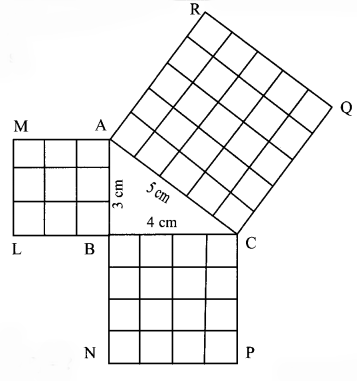
Area of square ABLM = l(AB)² = 32 = 9 sq.cm
Area of square BCPN = l(BC)²= 42 = 16 sq.cm
Area of square ACQR = l(AC)² = 52 = 25 sq.cm
Now, 25 = 16 + 9
i.e. 5² = 4² + 3²
∴ l(AC)² = l(BC)² + l(AB)²
∴ (hypotenuse)² = (base)² + (height)²
View full question & answer→Area of square ABLM = l(AB)² = 32 = 9 sq.cm
Area of square BCPN = l(BC)²= 42 = 16 sq.cm
Area of square ACQR = l(AC)² = 52 = 25 sq.cm
Now, 25 = 16 + 9
i.e. 5² = 4² + 3²
∴ l(AC)² = l(BC)² + l(AB)²
∴ (hypotenuse)² = (base)² + (height)²