Questions

Distinguish between

Take a timed test

3 questions · self-marked practice — reveal the answer and mark yourself.

Question 14 Marks
Solar eclipse and Lunar eclipse.
Answer
Solar eclipseLunar eclipse
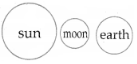
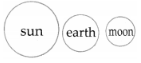
1. When the moon comes between the sun and the earth, a shadow of the moon is cast on the earth and sun cannot be seen from the part in shadow. This is called a solar eclipse.1. When the earth comes between the sun and the moon a shadow of the earth is cast on the moon and a part of the moon in covered this is called the lunar eclipse.
2. A solar eclipse is seen only on a new moon day.2. A lunar eclipse is seen only on a full moon night.
3. A solar eclipse should never be watched with the naked eye. because ultra violate rays which are harmful to us reach the earth
Image
3. A lunar eclipse can be seen with the naked eye.
Image
4. It can be seen for a few minutes only.4. It can be seen over a period of a few hours.

View full question & answer
Question 24 Marks
Umbra and Penumbra.
Answer
UmbraPenumbra
1. The umbra is a central core of darkness which tapers away.1. The penumbra is an outer cone of partial shadow which diverges, instead of tapering.
2. Umbra is shadow formed from a point source of light.2. It is the shadow formed from the extended source of light.
3. It is dark3. It is faint
4. Umbra is the area of total shadow4. Penumbra is the area of partial shadow.
View full question & answer
Question 34 Marks
Point sources and Extended sources.
Answer
Point sourcesExtended sources
1. A source of radiation light that is concentrated at a point and considered as having no spatial extension.1. An extended source is a source consisting of many point sources separated internally.
2. Shadow we get from a point source is dark called umbra.2. Shadow we get from extended source of light is faint called penumbra and dark called umbra
View full question & answer