Questions

Do as instructed[4M]

Take a timed test

9 questions · self-marked practice — reveal the answer and mark yourself.

Question 14 Marks
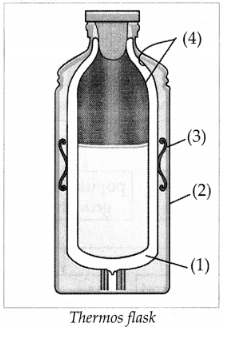
Observe the diagram and answer the given questions below it.

Image
1.Label parts 1 – 4
2.What is the principle of this object?
3.State the uses of the given object.
4.What is an infrared camera?
5.What is thermoware?

Answer
1.

  1. Vacuum
  2. metal/plastic jar
  3. Spring
  4. silvered surface of the glass.


2.As there is no medium in the vacuum between the two bottles, no transfer of heat takes place due to conduction and convection and radiated heat is reflected back by the shiny surface.
3.The temperature of substances inside it are maintained for some time. Hot things remain hot and cold things cold for 2 – 3 hours..
4.It is a camera which uses radiations to make our surroundings visible at night. Using this camera, it is possible to keep a watch on the movements of the enemy during the night.
5.Thermoware are object which do not allow heat to escape from them. So things stay warm in them. eg. hot pot, thermos flask.
View full question & answer
Question 24 Marks
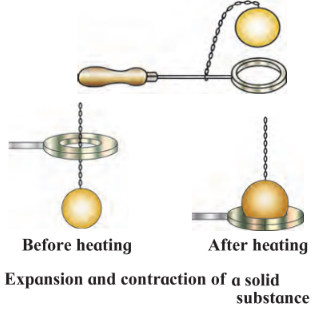
Observe the diagram and answer the given questions below it.

Image
1.What is the diagram about?
2.Does the same thing happen in liquids and gases?
3.Give one example of this property in everyday life.

Answer
1.Expansion and contraction of a solid substance.
2.Yes. Generally substances solids, liquids and gases expand on heating and contract on cooling.
3.Gaps are present in between two railway line track joints so that they do not bend due to expansion.
View full question & answer
Question 34 Marks
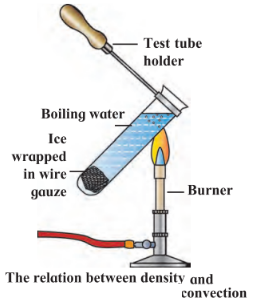
Observe the diagram and answer the given questions below it.

Image
1.What is the diagram about?
2.Why is the ice wrapped in wire gauze?
3.What does this experiment prove?

Answer
1.The diagram is showing us the relation between density and convection.
2.Ice floats on water, to make it sink, it is wrapped in wire gauze.
3.When a liquid is heated, its density decreases and it rises upwards. This leads to the convection currents which makes the heated liquid rise upwards and cooler liquid takes it place.
View full question & answer
Question 94 Marks
Define the following:
  1. Conduction
  2. convection
  3. radiation
  4. Transfer of heat.
Answer
  1. Conduction: The transfer of heat from one end of a solid substance to the other, without the particles leaving their original place is called conduction.
  2. Convection: Transfer of heat in fluids due to formation of currents is called convection.
  3. Radiation: Transfer of heat in all directions in the absence of a medium is called radiation.
  4. Transfer of heat: The flow of heat from one place to another is called transfer of heat.
View full question & answer